“No signal” might become one of those things we eventually forget used to happen.
SpaceX is moving to acquire nationwide low-band spectrum licenses in the U.S. Low-band is the useful stuff for phones: it travels farther and gets through walls, trees and difficult terrain much better.
Cities. Highways. Farms. Mountains. Remote areas. Pair that with Starlink Gen 2 satellites and ordinary phones can stay connected across far more of the map.
Do that globally and Starlink becomes a communications layer reaching people almost wherever they go.
Germany’s Solar Sleeping Pods Are Turning Freezing Nights Into a Chance for Survival.
Imagine spending a freezing winter night on the street, with nowhere warm to go. Now imagine a small shelter that uses the power of the sun to help protect you from the cold. In Germany, solar-powered sleeping capsules are offering homeless people a safer place to rest during harsh winter nights.
Designed to provide protection from the elements, these compact shelters show how renewable energy can serve a deeply human purpose. But there is more to these unusual shelters than meets the eye. The Ulmer Nest capsules have insulated walls, fresh-air systems, and sensors that alert support workers when someone uses a shelter. The next morning, workers can check on the person and connect them with additional help.
These capsules are an emergency safety measure, not a replacement for permanent housing or proper shelters. But on a bitterly cold night, a small, secure space can make a meaningful difference. Sometimes, the most powerful use of technology is not changing the world. It is helping someone survive another night. Source: Stadt Ulm. Ulmer Nester stehen ab dem 10. November wieder bereit.
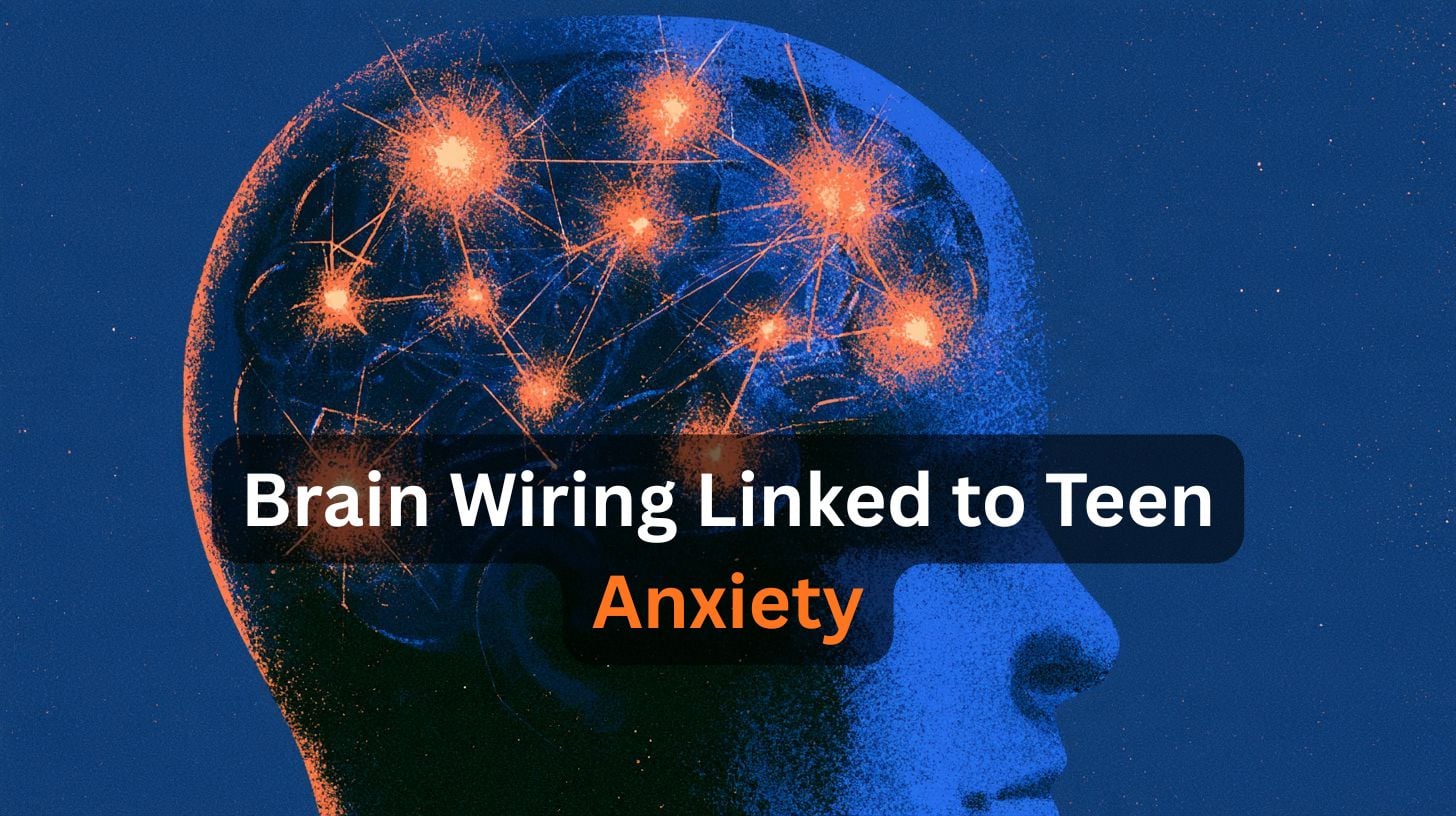
Neuroimaging reveals that disruption within a circuit connecting the amygdala, thalamus, and cerebellum is tied to adolescent anxiety as early as age 11. Credit: Neuroscience News
Key Brain Circuit Linked to Teen Anxiety Identified
Brain imaging in nearly 3,500 adolescents reveals that disrupted connectivity across a key subcortical-cerebellar circuit—connecting the amygdala, thalamus, and cerebellum, is directly associated with heightened anxiety. The alterations, already detectable by ages 11 to 12, also correlate with reduced visuospatial processing abilities, offering specific neurobiological targets for precision psychiatry.
Key Facts:
Specific Tri-Node Circuit Implicated: Youth exhibiting high anxiety displayed altered structural organization and diminished connection strength across a specific network linking the cerebellum, amygdala, and thalamus.
Early Emergence (Ages 11–12): Neural alterations were already measurable in early adolescence, highlighting an urgent window for early detection before structural patterns consolidate.
Visuospatial Processing Link:The structural and circuit abnormalities in anxious youth were significantly associated with deficits in spatial integration, skills necessary for navigation, spatial reasoning, and fine motor coordination.
Source: Boston Children’s Hospital
Adolescence represents a critical, vulnerable window for neurodevelopment during which emotional and cognitive systems undergo massive structural rewiring. It is also the developmental stage where clinical mental health conditions most frequently surface, with anxiety disorders affecting more than 30% of teenagers in the United States.
Despite its prevalence, the precise neurobiological changes underlying adolescent anxiety have remained difficult to pinpoint.
Now, in a study published in Imaging Neuroscience, researchers from Boston Children’s Hospital have mapped specific brain circuit alterations that distinguish youth suffering from generalized and social anxiety disorders. By analyzing neuroimaging data from nearly 3,500 adolescents, the team isolated a compromised subcortical-cerebellar network that correlates not only with emotional distress, but also with subtle everyday cognitive deficits.
A Crucial Circuit: Cerebellum, Amygdala, and Thalamus
Led by Caterina Stamoulis, PhD, Principal Investigator of the Computational Neuroscience Laboratory at Boston Children’s, the research team analyzed brain scans from the Adolescent Brain Cognitive Development (ABCD) study, the largest long-term investigation of brain development and child health in the United States.
The researchers discovered that adolescents experiencing elevated anxiety showed distinct structural alterations and weakened functional connections across a specific triad:
The Amygdala: The brain’s central emotional salience and threat-detection hub.
The Thalamus: The primary sensory relay and attentional gating station.
The Cerebellum: Traditionally viewed strictly as a motor coordinator, but now recognized as a critical regulator of cognition, emotional balance, and network timing.
In youth with high anxiety, the organization of this circuit was disorganized, showing weaker connection strength. Conversely, adolescents who exhibited high topological efficiency and structural resilience in other parallel brain networks demonstrated a protective buffering effect against both generalized and social anxiety disorders.
Beyond Emotion: The Hidden Visuospatial Toll
Crucially, the team identified that these neural alterations did not exist in an emotional vacuum. The structural and network disruptions in the amygdala-thalamus-cerebellum circuit were closely tied to measurable reductions in visuospatial processing, the cognitive ability to perceive, evaluate, and integrate the spatial relationships between shapes and objects.
Visuospatial integration is essential for core daily life activities, ranging from navigating physical environments and operating vehicles to fine motor tasks like assembling objects or tying shoes. The finding illustrates how developmental anxiety can ripple into broader cognitive and functional domains during formative school years.
The Promise of Early Precision Psychiatry
Importantly, these circuit-level anomalies were already prominent in children aged 11 and 12 years old. This early appearance emphasizes that neurodevelopmental pathways diverging toward anxiety are already detectable at the very threshold of adolescence.
According to the authors, isolating these precise neural signatures offers a crucial roadmap for moving beyond trial-and-error behavioral therapies and toward targeted neuromodulation or cognitive training.
“Precision psychiatry is likely to play an important role in future mental health care,” said Stamoulis. “In this study, we have identified specific circuits that are implicated in anxiety, which could become the targets of precision interventions to improve short- and longer-term mental health outcomes in youth.”
By intervening early to reinforce circuit resilience, clinicians hope to mitigate both psychiatric suffering and downstream cognitive challenges before they crystallize in adulthood.
Editorial Notes:
This article was edited by a Neuroscience News editor.
If you’ve delved into the worlds of Star Trek, The Terminator or William Gibson’s cyberpunk novel Neuromancer, you’ll know that enhanced, electronic vision is a staple of science fiction. Now, what was once futuristic fiction is becoming a reality.
Researchers have developed bionic eyes that can restore some lost vision. These devices’ capabilities are currently basic, but they have been steadily improving in recent years.
One day, they might even offer features that transcend the limits of natural human eyesight – for instance by manipulating images in a way the human eye cannot or by seeing beyond the spectrum of visible light.
Technology that boosts people’s physical and mental abilities is no longer the preserve of science fiction. In this series, we explore cutting-edge ways that human capabilities could be augmented both now and in the near future – and the ethics of these innovations.
To date, implants have focused on combatting problems with the retina, the light-sensing layer of cells inside the back of the eye. Akin to the film in the back of a camera, the retina allows us to see the outside world. When things go badly wrong with it, the result can be a total loss of vision.
Work to fix retinal blindness with implants began more than two decades ago. One of the first devices, developed by the German manufacturer Retina Implant AG, featured a light-sensing chip placed under a person’s damaged retina. This connected with their remaining healthy retinal cells, which then transmitted the chip’s vision signal from the eye to the occipital cortex, the brain region where vision is perceived.
Surgery to implant the chip took about eight hours. This included creating a recess in the skull behind the ear to implant a power receiver and then connecting this with a wire beneath the skin to the chip.
The device offered only rudimentary vision, with patients seeing flashes of light that corresponded roughly to the shape of the object they were looking at. Many implants also broke over time, possibly because of the frequent rapid movements of the eye or corrosion caused by its salty liquid interior. Retina Implant AG ceased operations in 2019, citing its lack of medical progress as one of the main reasons.
The other leading early device, Argus II, combined a glasses-mounted camera with a chip surgically inserted on top of the retina. The camera’s picture was converted into a signal and transmitted wirelessly to the chip (along with power), which then stimulated healthy cells in the damaged retina using an array of 60 electrodes.
Despite positive early results and FDA authorisation in 2013, ARGUS II also ultimately failed to deliver sufficiently convincing results. It was discontinued in 2019.
Newer approaches
Despite these setbacks, investigators have persisted in trying to create artificial vision.
A newer approach is to use an external camera that wirelessly transfers power and image data to a chip implanted in the occipital cortex. This built research that placed electrical probes directly into the occipital cortex to stimulate visual perception.
This approach can help both patients with diseases of the retina and those with conditions affecting the optic nerve, which connects the retina to the brain. But exactly how much resolution can be achieved with this technique isn’t clear, as the retina’s high resolution and complex signal processing is lost.
One company trying this technique, Belgium-based ReVision Implant, is launching its first human clinical test in October 2026.
Another option is to use spectacles that transmit both images and power to a surgically inserted subretinal chip via an infrared signal. A device using this technique, Prima, has been tested in a specific disease of the retina called dry age-related macular degeneration (AMD), a leading cause of blindness.
Left: Simulation of a patient’s vision with macular degeneration. Right: Simulation of the patient’s vision enhanced with Prima. Palanker Lab/Stanford Medicine
In a small clinical trial, the device restored functional central vision to 81% of patients, allowing them to read letters, numbers and words. The device is now authorised in 30 European countries.
As AMD is far more common than the inherited retinal diseases treated by most earlier devices, this device is much more appealing to investors. However, there are ethical questions here. Unlike patients with inherited retinal diseases, most with AMD still have good peripheral vision, so have much to lose if things go wrong. The complex surgery to implant a subretinal chip is far from zero risk.
Super-human vision?
Because these technologies relay visual information electronically, extra functionality could potentially be built into them. With Prima, patients can already use optical zoom, while algorithms that could allow for image sharpening have been proposed.
In the future, it is possible that devices may emerge that use cameras capable of seeing beyond the visible light spectrum. This could potentially offer thermal imaging and night vision. One device offering near-infrared vision has already been tested in primates.
But while exciting, these will probably not offer enhanced vision until the currently rudimentary artificial vision is advanced to the point that these “optional extras” become more relevant.
For now, there are still many biomaterial and electrical challenges preventing retinal implants from offering full, long-term vision restoration. However, a potentially greater challenge comes from competing biological solutions, such as stem cells, which are in the early stages of human trials.
These have also had a few false dawns and there are big obstacles to overcome in terms of cell survival and integration. But if new human retinal cells can replace those lost to disease, they could one day overtake bionic eyes entirely as the solution for vision restoration.
The failed lethal injection of convicted Tennessee murderer Christa Pike, and the proposed livestreamed execution by firing squad of US Army major Nidal Hasan, sentenced to death for 13 murders, drew the world’s attention to America’s exceptional use of the death penalty.
In Australia, Queensland’s abolition of the death penalty in 1922, made it the first jurisdiction in the British Empire to do so. Western Australia, the final state to do away with capital punishment, abolished it in 1984.
By retaining the death penalty and inflicting capital punishment, the United States keeps company with countries such as Iran, North Korea and Somalia. If the military carries out Defense Secretary Pete Hegseth’s plan to livestream Hasan’s execution, American-style justice will resemble Afghanistan’s, not the majority of the world’s democracies.
A state matter
Most executions in the US are conducted under state authority in the 27 (out of 50) states that currently retain the death penalty. For capital crimes deemed federal offences, including ones prosecuted by courts martial, presidential approval is required for executions to be carried out.
One of President Donald Trump’s first executive orders in his second term reversed President Joe Biden’s moratorium on federal executions.
Since the mid-19th century, US politicians, judges, and religious and secular lobbyists have opposed the death penalty. The abolition movement peaked in the 1960s, when approval of capital punishment dipped to 42%. Today, that rate sits at 52%. Yet, just 23 states have abolished the death penalty.
The death penalty and American exceptionalism
Historically, the concept of American exceptionalism has referred to the republic’s founding in democracy, liberty and rights.
Paradoxically, Americans invoke those values to support the death penalty, not just its abolition.
In the 1950s and ‘60s, civil rights activists used evidence of racial bias in the use of capital punishment to argue it was unconstitutional. In 1972, the US Supreme Court agreed. Since state death penalty statutes failed to prevent their “arbitrary and capricious” administration, they were unconstitutional under the Eighth Amendment’s prohibition of cruel and unusual punishment.
That decision overturned every retentionist state’s death penalty laws and it spared close to 600 prisoners on death row. For five years, no executions occurred in the US.
Yet, the Supreme Court did not represent the will of the people. Was its ruling undemocratic?
Thirty-five states thought so, and they updated their death penalty statutes in response. In 1976, the Supreme Court ruled the revised statutes were constitutional on procedural grounds. Besides, the majority argued, “in a democratic society, legislatures, not courts, are constituted to respond to the will and consequently the moral values of the people”.
Executions resumed in the US in 1977, the first one in Utah, conducted by firing squad. Although the American Civil Liberties Union tried to intervene, the condemned man, Gary Gilmore, who twice attempted suicide, asserted his right to choose to die for committing two robbery murders.
After 1977, there were few executions by firing squad but the number of deaths by other means mounted.One reason for the escalation was the introduction of lethal injection in 1982. This method made capital punishment more palatable to Americans. Compared with the gas chamber, the electric chair and death by firing squad, lethal injection, its advocates claimed, made execution clean, clinical and painless.
Yet, that promise turned out to be false. Compared with the methods it replaced, lethal injection is the method most likely to be botched, as Pike’s case has revealed.
Four months before Tennessee failed to execute Pike, corrections officials called off another inmate’s execution after death chamber technicians could not insert the intravenous line for pentobarbital.
In South Carolina, where condemned prisoners can choose death by electrocution, firing squad or lethal injection, a convicted murderer, Brad Sigmon, opted for firing squad in March 2025 because he knew the previous three men the state executed by lethal injection had experienced prolonged suffering.
As legal and political battles brew over Pike’s and Hasan’s cases, bipartisan objections to her re-execution and his public execution have emerged. But the possibility of both outcomes remains.
In Tennessee, state Republicans are leaning in favour of returning to the electric chair, the method US Senator and state gubernatorial candidate, Marsha Blackburn, advocates.
Far from reckoning with the justifiability of capital punishment, the state majority leader pledged to “speed up” the appeals process and use a method “that’s far more reliable and predictable”.
Execution as deterrent?
Politicians typically frame such claims in terms of victims’ rights. The mother of Colleen Slemmer, the 19-year-old Pike confessed to torturing and murdering, watched as the state botched the execution of her daughter’s killer.
Similarly, Hegseth has justified the livestreamed execution of a man who brutally gunned down troops at Fort Hood before he was shot and paralysed. The execution must be public, Hegseth said, “because people need to understand there’s serious consequences for these types of things”.
The belief that the death sentence’s deterrent value is most potent when the public can witness executions is remarkably resilient. Yet, there is no compelling evidence to support its purportedly unique capacity to deter murderous violence.
Americans are not exceptionally brutal. But the prevailing politics of capital punishment in the US certainly are.
Carolyn StrangeProfessor of History, School of History, ANU, Australian National University
Disclosure statement
Carolyn Strange does not work for, consult, own shares in or receive funding from any company or organisation that would benefit from this article, and has disclosed no relevant affiliations beyond their academic appointment.
Executive Editorial Director of Europe and the Middle East
Follow
October 12, 2026, 1:00 AM ET
Yuriy Ryzhenkov, CEO of Metinvest, the largest steelmaker in Ukraine.Courtesy of Metinvest
Yuriy Ryzhenkov is that rare individual—a chief executive who has led his firm of 33,700 people during a never-ending war. He is the CEO of the largest steelmaker in Ukraine, Metinvest. More than 8,000 of his employees are fighting Russian forces. Factories are under constant bombardment. Hundreds of Metinvest colleagues have been killed.
Recommended Video
Discover the Fortune 500 Europe 2026 – Insights by Grethe Schepers, Lists Director, Europe.
Amid the flames and destruction, Ryzhenkov says that this period of the war is as tough as anything the company has seen since Russia’s full-scale invasion of Ukraine more than four years ago.
“The blockade of the seaports is more severe now than it was in 2022,” Ryzhenkov, who became CEO in 2013, tells me. “We’ve been hit numerous times. Our facilities have been hit over the last four and a half years, and even though we were restoring them after every hit, you lose. You get weaker with every such attack.
“In wartime you cannot afford to restore to the original state. You do the best you can to continue operating, and that best is never the ideal. Unfortunately, it was one of the most severe campaigns for bombing in August and September this year. We had to stop both of our steel mills.
“We lost 14 people at our steel mills, which was probably the largest loss since 2023 in a single bombing. That’s where we are.”
Now there is another threat to the future of steelmaking in Ukraine, and it doesn’t come from the East, but from the European Union. In July, new tariffs were applied to all EU steel imports in an effort to protect the continent’s industry from cheaper foreign competition. The key steel tariff-rate quota for Ukraine from July 2026 was cut by 60%, and is expected to reduce steel imports from Ukraine to the EU by 1.3 million metric tons per year, according to the GMK Center, a Ukrainian think tank.
“If you compare the quotas that were allocated to Ukraine this year to what was supplied last year, it’s minus 60%, and that’s at the time when the ports were already closed, and we literally have no other alternative,” Ryzhenkov says.
Damage to Metinvest factories caused by Russian attacks. Hundreds of Metinvest colleagues have been killed.
“When the invasion happened, the EU pretty much realized that for Ukraine the only available market is actually the EU with the blockade of ports. They abolished any restrictions for the steel to be supplied there, which was, in my view, the correct answer.
“In wartime you cannot afford to restore to the original state. You do the best you can to continue operating, and that best is never the ideal.”Yuriy Ryzhenkov, CEO of Fortune 500 europe company, Metinvest
“And then suddenly, in the first half of this year, we got these quotas where we were pretty much dumped with all the other countries [outside the EU], and the fact that we had exceptional circumstances in terms of logistics, in terms of energy supply, in terms of personnel availability, they were not taken into account, in my view, at all.
Negotiations continue, and the EU has said it is aware that Ukraine is a unique case. But the pincer movement—the armed invasion from the East, and tariffs from the West—is leaving steelmaking in Ukraine in a perilous position. Between 2021 and 2025, steel production in Ukraine fell from 21 million to 7.4 million metric tons; the value of exports fell from $22 billion to $6 billion; and tax revenues dropped from $3.5 billion to $870 million. Russia’s constant attacks on factories, energy supply systems, and the railways means that steel supply to the Ukrainian armed forces is also being degraded.
I ask whether we could be witnessing the end of steelmaking in Ukraine?
“Well, if nothing is done, it’s almost inevitable,” he says. “If Ukraine is not allowed to participate in the European market fully, and at the same time the circumstances preclude any significant investments, then, I mean, everything comes to an end eventually.”
Ryzhenkov comes from a long line of steelmakers. His grandmother was a coal plant chemical engineer closely aligned to steelmaking, and his mother, father, and uncle all work in the sector. That family history does bring with it a high level of determination to continue despite the losses and the constant threats of more attacks.
“To be honest, that’s the only choice we have, right?” he tells me. “Well, not the only choice. I mean, obviously, you can slam the door and walk out, but we have more than 35,000 people working for us with their families. We have 8,500 of our employees in the Ukrainian armed forces, which also rely on us. So, I mean, why would you slam the door if you can still try to do something to carry on? I just don’t find a reason for myself to do that.”
Quick note: As the CFO mandate keeps expanding, Fortune is convening C-Suite Conversations: In Conversation with Finance Leaders on 28 October. CFOs from Loewe, Standard Chartered Bank, and MUFG Americas join Fortune’s Sam Birchall to discuss building the next generation of finance leadership. Register here.
About the Author
By Kamal AhmedExecutive Editorial Director of Europe and the Middle East
Follow
Kamal Ahmed is the executive editorial director of Europe and the Middle East. Kamal is the author of Letter from London, Fortune Europe’s weekly take on global business as seen from London. Previously, he was director of audio at The Telegraph and p
A 28-year-old researcher dies under mysterious circumstances at a Russian anti-plague laboratory in Siberia. Authorities quarantine potentially exposed individuals but insist there is no dangerous pathogen outbreak. So why are questions mounting about what really happened? Michael Smerconish speaks with investigative journalist and bestselling author Annie Jacobsen, whose recent book, *Biological War: A Scenario*, explores a terrifying hypothetical: a genetically modified form of pneumonic plague escaping from a high-security laboratory in Russia and triggering a global catastrophe. Now, just months after the book’s publication, reports of a death at a Russian research institute have raised unsettling questions about biological safety, transparency, and international oversight. Jacobsen explains the similarities between her extensively researched scenario and the reported incident, while acknowledging that there is no confirmed evidence of a biological weapons accident or plague outbreak. The conversation explores: • What Russian authorities have disclosed about the researcher’s death. • Why the reported quarantines have attracted international attention. • The possibility of dual-use laboratories conducting both legitimate medical research and potentially dangerous biological work. • The limitations of international biological weapons agreements. • Whether the United States has sufficient safeguards against an emerging biological threat. Jacobsen also explains why independent verification matters when governments control the information coming out of sensitive research facilities. Could a dangerous biological incident go undetected until it’s too late? Watch Michael Smerconish’s conversation with Annie Jacobsen and share your thoughts in the comments. Subscribe for more conversations exploring national security, politics, and the stories shaping our world. #MichaelSmerconish#AnnieJacobsen#Russia#BiologicalWeapons#Plague#NationalSecurity
Kevin Roose’s new book, “The AGI Chronicles,” provides a Rosetta Stone to understanding the three most important architects of modern AI: Dario Amodei, Sam Altman and Demis Hassabis.
Why it matters: Knowing what motivates each man helps explain their business strategies, public posturing and conflicts.
Here’s my distillation of Roose’s take based on his book, interviews and podcast appearances — especially Derek Thompson’s Plain English, which explores the three men and their motivations. Read the book.…Listen to the pod
The survivalist: Dario Amodei(Anthropic)
You can trace Dario’s warnings (and obsessive worry) about AI catastrophe to … the atomic bomb. He used to hand every new Anthropic employee his favorite book, “The Making of the Atomic Bomb.
“His hero isLeo Szilard. Szilard conceived the nuclear chain reaction and then urged fellow physicists to keep it secret. He drafted the 1939 Einstein letter to FDR that launched the Manhattan Project, then fought to restrain the bomb’s use.
Dario has likened himself to Szilard, who decided once the blueprint of nuclear weapons was known, America had no choice but to build or control it — or lose to Nazi Germany.
Read him as: a man who believes he’s building the bomb and must get there before the reckless do. It’s unclear if “the reckless” is China or Sam, whom he deeply distrusts
The seller: Sam Altman(OpenAI)Sam has two distinct gifts, in Roose’s telling: an ability to sell anyone on anything and an unshakable belief in limitless scaling.
Altman can figure out what someone wants and give it to them, or appear to. The rap from countless former colleagues: He tells different people different things, leaving people wondering what sits at his core.
This has allowed him to raise insane amounts of money, turn a nonprofit into an IPO-bound behemoth and scale faster than almost anyone. It has also left Dario, Elon Musk and many former colleagues loathing him.
Read him as: the biggest, fastest, at almost any cost. Great for speed. But the purpose is the mystery.
The scientist: Demis Hassabis(Google DeepMind)
Demis got the science right — early. His AlphaFold cracked protein folding and won him a share of the 2024 Nobel Prize in Chemistry. (“The Thinking Game” documentary is a must-watch on this.)
But he got LLMs wrong. He thought that modern AI would be developed in a lab governed by scientists and global leaders and shown to the public only when big problems were solved.
He was deeply skeptical of the scaling laws Sam and Dario rode to power — and to substantial early leads. Selling DeepMind to Google suffocated him, so Demis is scrambling to recapture his magic and glory.
Read him as: a scientist and purist forced to sprint in a race he didn’t want, on a path he doubted, against two men with a big head start.










 The AI gods
 The survivalist: Dario Amodei (Anthropic)
 The seller: Sam Altman (OpenAI)Sam has two distinct gifts, in Roose’s telling: an ability to sell anyone on anything and an unshakable belief in limitless scaling.
 The scientist: Demis Hassabis (Google DeepMind)
 If you’re a CEO or on a CEO’s team:
