
- Home
- Posts
- The billionaires’ eugenics project: how Epstein infiltrated Harvard, muzzled the humanities and preached master-race science
The billionaires’ eugenics project: how Epstein infiltrated Harvard, muzzled the humanities and preached master-race science
Edge – Jeffrey Epstein’s favourite intellectual salon – was sold to me as a gathering of the world’s finest minds, writes Virginia Heffernan. The files reveal it was something far darker: a decades-long project that cloaked eugenics, race science and sexual misconduct in Ivy League respectability

Feb 13, 2026
Graphic: John Brockman, Jeffrey Epstein and Harvard University, Massachusetts. Photos: Getty Images.
It’s alarming to see your name in the Epstein files, but I was braced to see mine. Years ago, I was part of a salon for intellectuals and pseudointellectuals called Edge founded by John Brockman. His mass emails evidently copied in Epstein and a dozen such email blasts made their way to the latest dump of hazmat.
Brockman, my former agent for tech writing, told me Edge was an intellectual salon. Edge.org is indeed intriguingly sprawling, jammed with scholarly idols whose bios have “Booker” and “Nobel” in them. Members of Edge participated in conferences and symposia, and promoted each other’s work. Who was I to say no? Among Edge’s prodigious ranks were Ian McEwan, Yuval Noah Harari, Steve Wozniak, Richard Dawkins, Nassim Nicholas Taleb and Daniel Kahneman.
But if I’d read the member list more closely, I might have hesitated. Edge was overwhelmingly male, for one. It was said to be an intellectual salon, but in the club photos were tech bro billionaires, including Edge members Elon Musk, Bill Gates and Larry Page. And too many members were men now largely renowned for misconduct, professional or personal: Marc D Hauser, Jonah Lehrer, Lawrence Krauss, and Marvin Minsky.
Turns out I didn’t have to worry about meeting these people. Brockman kept me at a distance. As the latest Epstein files reveal, the token female members of Edge were actively excluded from schmoozing and conferences, especially the glittering events known as the Billionaires’ Dinners.
Good policy. Otherwise, we might have struck up conversations with the anxious-looking teenage girls kept out of the photos. We might have overheard the Edge men praising race science, rape culture and genetic engineering. We might even have asked where the money came from. Then we would have come face to face with the illiterate child rapist and passionate eugenicist who bankrolled the whole thing. Jeffrey Epstein.
Whatever Edge was supposed to be, it became something sinister. The salon played yenta to billionaire money and alpha-male minds, and together, over decades, they all converged on a master philosophy: they were apex predators ordained by nature to exploit and subjugate others. This creed allowed the Edge set to steer intellectual history into its current fascist dead-end. 
Jeffrey Epstein (2nd from left) at a dinner he hosted at Harvard, September 2004 with (l-r) professors Alan Dershowitz, Robert Trivers, Lawrence Summers (formerly Secretary of the Treasury and Harvard President) and Stephen Pinker. Photo: Rick Friedman / Alamy
Edge began in 1996, an online iteration of a club Brockman founded to promote technological ideas and oppose what he called the “sleepy wisdom” of the humanities. The 1990s and 2000s were a perfect time for Edge. The club gained momentum along with an avalanche of books that savaged political correctness, multiculturalism, and the “Obamacrats”. Several of these books were by men in the Edge circle and the Epstein files, including Palantir mastermind Peter Thiel, Trump’s crypto czar David O Sacks, and computer scientist David Gelernter. (Gelernter stopped teaching at Yale this month after his own lecherous emails with Epstein surfaced).
Billionaires really like thinkers who see their exploitation of the weak as a good and natural thing
With its contempt for the humanities, Edge offered intellectually insecure reactionaries a pass. Without even opening a book, they could dismiss all of feminism, postcolonial theory and queer studies. They could continue to ignore giants like Edward Said, Judith Butler, and David Graeber, and devote their brains instead to the race science and rape apologetics that now pass for scholarship on edgelord podcasts.
It’s not clear when Epstein met Brockman, but by the late 90s he’d burrowed into Edge. With his cash infusions, Edge came to be known as home to far-right academics and the tech billionaires who love them. By 2000, Epstein was flying the Edge sausage party around on his planes, which served meals from Le Cirque and was appointed with mink throws.
Billionaires really like thinkers who see their exploitation of the weak as a good and natural thing. Epstein funnelled as much as $20m a year to academic men who shared his ideology. In exchange, Epstein himself, who could barely read and write, was empowered to hold forth in formal sessions at Harvard, condemning feeding and caring for the poor as if he were making a scholarly argument.
The academics, in turn, liked the billionaire glitz. Middle-class rightwingers at Edge functions, including former New York Times columnist David Brooks and neuroscientist Sam Harris, now consorted with the likes of tech monopolists Jeff Bezos and Sergey Brin.
In this atmosphere of warm brotherhood, how could they not have felt chosen to rule over the rest of us? One Edge member and Epstein consort, the anarchist Noam Chomsky, described this ethos: “The cool observers – meaning us smart guys – it’s our task to impose necessary illusions and emotionally potent oversimplifications to keep these poor simpletons on course.” 
Jeffrey Epstein and the late professor Marvin Minsky, September 2004. Photo: Rick Friedman / Corbis via Getty Images.
The men of prestige and ambition that Epstein especially liked to sugar-daddy at Edge were figures with a hand in the grim sophistry of evolutionary psychology. Among these were Edge darlings Martin Nowak, a “mathematical biologist”, and evolutionary biologist Robert Trivers.
In an email in the recently released Epstein files, Nowak, whose Program for Evolutionary Dynamics (PED) at Harvard was founded with $6.5m from the child rapist, is asked “Did you torture her?” by Epstein. It’s not clear what Epstein is referring to.
As for Trivers, his name appears in the Epstein files as part of an FBI report alleging that he sexually abused a 15-year-old girl in late 2019. (On the Edge site, Steven Pinker, a zealous Edge member, called Trivers “one of the great thinkers in the history of Western thought”.)
Others in the Edge circle, including Charles Murray and Robert Kurzban, have long hammered away at what they consider universal constants: the inferiority of Black minds and the predisposition of men to violence and rape. (While Edge man Murray, a proud white supremacist, is still the right’s darling of free speech, Edge man Kurzban resigned his post at the University of Pennsylvania in 2018 after several alleged sexual relationships with undergraduates.)
Sign up for membership to help fund our journalism
In a classic of the just-asking-questions form perfected by rightwing trolls, Pinker pummelled the Edge audience in 2006 with these pressing inquiries: “Do most victims of sexual abuse suffer no lifelong damage? Did Native Americans engage in genocide and despoil the landscape? Do men have an innate tendency to rape?” And then, for good measure: “Is homosexuality the symptom of an infectious disease?”
And thus while he was peddling his vision for Edge as “a salon for the world’s finest minds”, its male members were preaching master-race ideology. Citing their work, Brockman predicted in 2005 that the “dangerous idea of the next decade” would be that “groups of people differ genetically in their average talents”.
Surprise: white men, notably those of Ashkenazi descent like Epstein, have been “biologically selected for high intelligence”, according to the Edge site.
The intellectual groundwork was laid for Epstein to spring his world-domination plan on his kept Edge scholars. The big reveal: he hoped to seed the human race with his superior DNA by impregnating women at his ranch in New Mexico.
Throughout the decades, according to The New York Times, Epstein talked up this ambition. He told at least one fellow eugenicist that he hoped to freeze his peerless brain and penis at his death, so his organs could be revived for future use in “transhumanism”. He also generously funded the work of George Church, the Harvard geneticist and Edge superstar who developed a dating app to match people based on the fitness of their genes. Epstein’s friends enthusiastically discussed eugenics with him up till shortly before he died in prison. 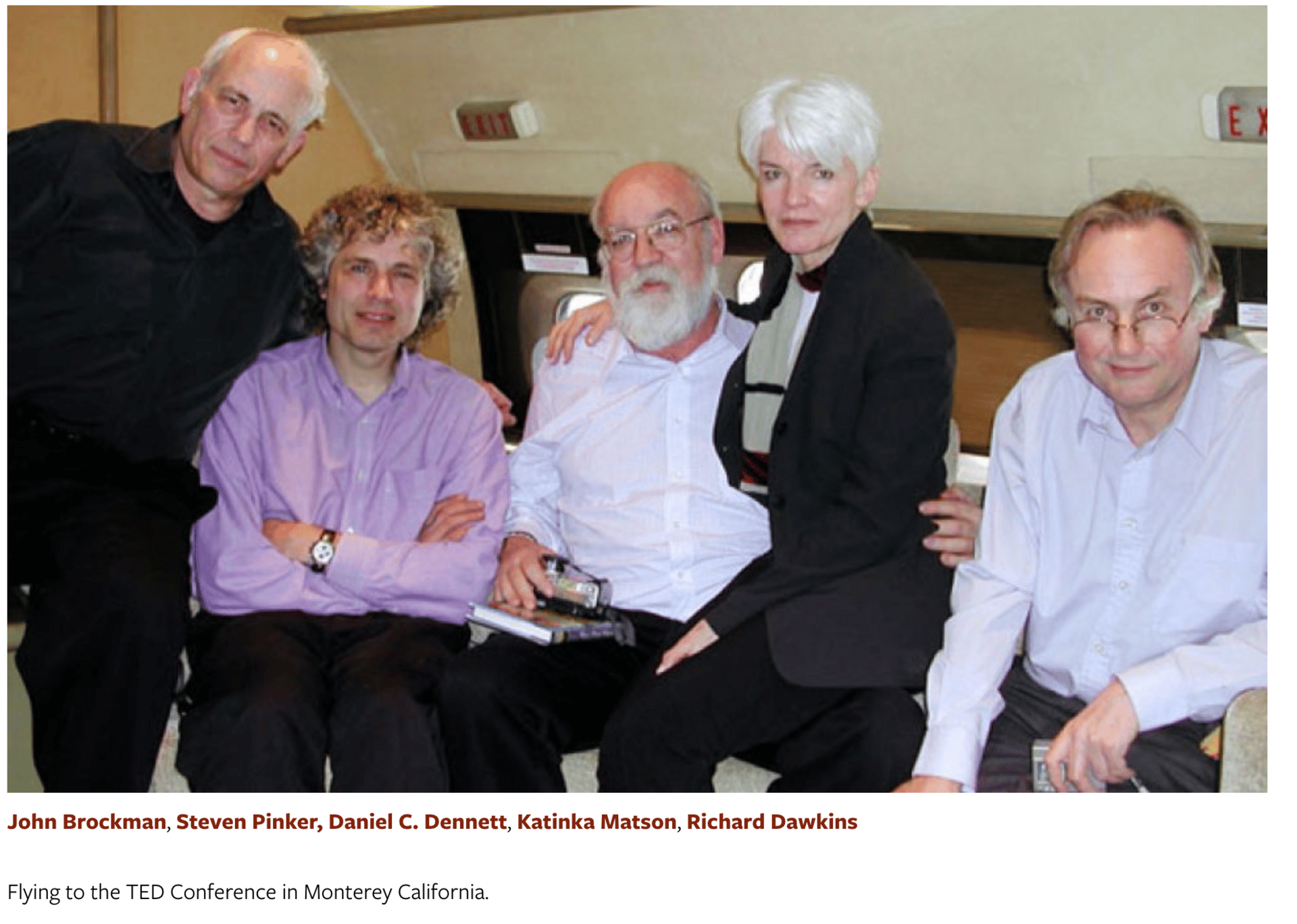
Screenshot from Edge.org website showing John Brockman, Steven Pinker, Daniel C Dennett, Katinka Matson and Richard Dawkins en route to TED in 2002. According to Yahoo Finance, an earlier picture caption, since altered, stated that they were travelling with Epstein.
What’s more, even as the NYT concludes that “there is no evidence that [Epstein’s plan] ever came to fruition”, this period in Epstein’s life is described contemporaneously by his teenage rape victims. One traumatised 16-year-old, whose diary surfaced in the most recent tranche of files, calls herself an “incubator” for Epstein’s offspring. She chronicles Epstein’s “Nazi”-like effort to create a “superior gene pool”. The fact that Sarah Ferguson, in a recently released email, congratulates Epstein on a “baby boy” has raised questions about where the DNA-seeding project stands now.
Other Epstein survivors, in the files and in court, have recounted hellish experiences of enslavement on the ranch, forced pregnancies, and bloody deliveries. In emails released by the justice department, Epstein is consulted dozens of times about pregnancies, sonograms, egg-freezing, and other obstetrical matters.
Finally, there’s the long video interview that Epstein gave to Steve Bannon, the far-right Christian nationalist, which provides more context for Epstein’s obsession with eugenics. To start, Epstein blithely explains his racist worldview. “If I was in the forest and I had to run from the lion or figure out a way not to be eaten, and my competition is a local African, I’m the one who’s getting eaten … They have the intelligence to deal with their local environment.”
Epstein also tells Bannon that he helped fund the Santa Fe Institute, a New Mexico research operation, in part to advance his interest in “genetic algorithms”, which he can hardly describe. “Complex systems are complex, by definition,” he says. Epstein justifies his own manifest illiteracy by saying that people who know how to write can’t think broadly, unlike Socrates, Jesus, and himself.
“Genetic algorithms” are evidently systems theory crossed with race science. They “work” by “improving” chromosomes or their digital analogues using selection and mutation over several generations. Genetic algorithms are also described as “a metaheuristic inspired by the process of natural selection”.
I flashed back to the Edge crew’s relentless criticism of the humanities in the 1990s. In The Diversity Myth, Thiel and Sacks bitterly complained about “diversity” as jargon that concealed a nefarious political agenda. Well, now we have metaheuristical eugenics, and the jargon’s on the other foot.
With the Epstein files, we’re confronted with exactly what all the Edge men – from Pinker to Dawkins to Musk to Gates – did with the intellectual territory they seized. With their Ivy League posts, their billions, and their blue-ribbon DNA, the would-be intellectuals in Epstein’s circle converged on nothing less than the ideology of Mein Kampf. The Edge dinners have ceased and the site is now dormant, but generations of young men trained at Harvard, LSE and Oxford absorbed the lesson — and generations of young women learned that their place in intellectual history is sidelined, exploited, or prone.
Virginia Heffernan in an American journalist and cultural critic who writes regularly for The New Republic. Her podcast and newsletter, Magic + Loss, can be found on Substack


 X·carolecadwalla

 Instagram·carole_cadwalladr
 The Guardian
 In late-stage clinical trial
  What we’re watching: AI is fueling hopes for a transformational era of medicine, where diseases are detected earlier and cured altogether.
 Axios Finish Line: Your bionic brain



 Illustration: Aïda Amer/Axios
  I’m here not to scare or shame you. I’m here to tell you this war will determine the future of your mind and your intelligence. It is winnable on your terms — if you understand the nature of it.
 Make no mistake: We’ve entered the age of extreme information inequality. It’s the defining divide of the next decade. Bigger than wealth. Bigger than education. Bigger than geography.You land on the right side of the divide by controlling what information you consume and by using AI to augment — not replace — your learning and thinking.You will choose. Choose bionic. Reject blah.
 Start by understanding the Great Information Paradox of the 21st century.There is more misinformation, manipulative content and pure mind garbage available to us for free than at any point in human history. At the same time, there is more high-quality, mind-expanding, life-enhancing content available to us for free than at any point in human history. We all have access to the smartest minds alive via podcasts, YouTube and newsletters.Greatness and garbage. At the same time. On the same device. In the same five seconds of interaction.
 Path One: Outsource your thinking to AI. Let ChatGPT write your emails. Let Claude make your decisions. Let an algorithm or LLM tell you what to believe about Iran, about the economy, about your own job and skills. Stop reading. Stop wrestling. Stop forming your own views. Just ask the machine and ship the answer.The temptation is enormous. It is easier. It is faster. It feels productive. And it will quietly hollow you out. In two years, you won’t have opinions — you’ll have prompts. You won’t have judgment — you’ll have outputs.
 I want to give you something concrete. Five moves. You can start every one of them tonight.
 If you’re a CEO or on a CEO’s team:


 canisgallicus