Eurasia Review: The Migrant Tunnels Burrowing From Belarus Into The EU

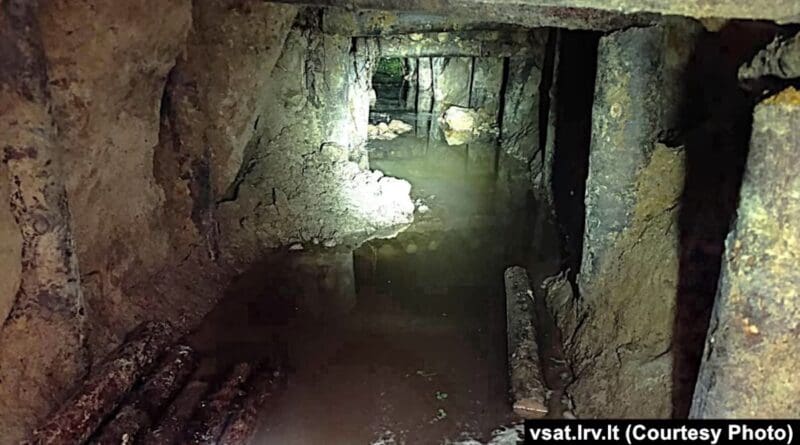
  • A tunnel dug from Belarus toward Lithuania that was discovered in July. Photo: vsat.lrv.lt (Courtesy Photo)

A tunnel dug from Belarus toward Lithuania that was discovered in July. Photo: vsat.lrv.lt (Courtesy Photo via RFE/RL)

The Migrant Tunnels Burrowing From Belarus Into The EU


By RFE RL

FacebookTwitterEmailFlipboardMastodonLinkedInSharenextstay

Playlist advancing in 5 seconds

Ad ends in 10

Video Muted

By Amos Chapple

Key Takeaways

  • Latvian border guards discovered the country’s first migrant tunnel from Belarus on August 10 after intercepting a group of migrants; similar tunnels have been found in Poland (starting 2025) and Lithuania (multiple attempts in 2026). 
  • EU border authorities say Belarus routinely denies construction is underway even when given precise locations and real-time evidence, while restricted access zones on the Belarusian side and statements from officials raise suspicions of at least passive, and possibly active, support. 
  • The tunnels are viewed as a continuation of hybrid pressure tactics that intensified after the 2021 migrant surge; affected states are increasing cross-border cooperation and seeking specialized equipment to detect underground activity.

When a group of 15 migrants in “sand-stained clothing” were spotted moving through a forest in southeastern Latvia on August 10, border guards could not initially determine where the group had emerged from.

After questioning the migrants, a border patrol spotted a brush-filled tunnel exit just 10 meters from Latvia’s border fence with Belarus.

The underground passage was the first migrant tunnel discovered in Latvia, but only the latest of several dug into EU territory in recent months. Border authorities say Belarus has not moved to stop the tunnels, even when presented with real-time intelligence about their construction.

Lina Laurinaityte, a spokesperson for the Lithuanian State Border Guard Service, told RFE/RL that “in a number of cases, after [Lithuanian border guards] informed Belarusian authorities about tunnel construction and provided information about the location, the Belarusian side has denied that any such activity was taking place.”

She says the Belarusian response has been to claim that the indicated location has been checked and they have found nothing “despite [Lithuanian border guards] having clear evidence of the tunnel construction.”

Laurinaityte added that Lithuanian authorities have no proof that Belarus is directly involved in building the tunnels.

After a surge of mostly Middle Eastern migrants trying to cross from Belarus into the EU peaked in late 2021, Belarus’s western neighbors — Poland, Latvia, and Lithuania — erected border fences that initially eased the crisis.

The first migrant tunnel from Belarus was uncovered in Poland in September 2025 and several more tunnels were uncovered by Polish patrols later that year, including one through which around 180 migrants entered the country.

Lithuania has recorded 12 attempts to dig tunnels into its territory since early 2026. Lithuanian media reported that a border guard was injured during an incident in the south of the country on July 27 when a group of migrants who had emerged from a tunnel attempted to “drag him toward Belarusian territory.”

Images released by Lithuanian border authorities show unfinished underground passages originating in Belarus and reinforced with wooden supports resembling those used in mines.

Poland’s deputy interior minister, Czeslaw Mroczek, alleged in a December 2025 interview that Minsk had brought in “specialists” from the Middle East with experience in underground tunneling to dig into his country’s territory.

Poland’s border authorities declined to comment to RFE/RL on this claim.

Jolanta Babisko, a spokesperson for the Latvian State Border Guard told RFE/RL that there are “reasonable grounds to suspect that support is being provided from within Belarus” for the digging of tunnels into EU territory.

“Access to the area on the Belarusian side within several hundred meters of the border is restricted, and only border guards performing their official duties are permitted to be there,” she said.

Belarusian leader Aleksandr Lukashenko has blamed Brussels for the wider issue of mass migration, while hinting that he would respond to sanctions from the bloc by not stopping migrants seeking to enter the EU.

“Guys, we won’t protect you. We won’t catch [migrants] on the border as we did before,” he said at a conference in October 2024.

Laurinaityte says Lithuanian border authorities have cooperated with their Polish counterparts to detect tunneling and are aiming to buy additional technical equipment capable of sensing underground activity.

“For operational security reasons, we cannot provide details about the specific technologies used,” she added.

  • Amos Chapple is a New Zealand-born writer and visual journalist with a particular interest in the former U.S.S.R.

About RFE RL

RFE/RL journalists report the news in 21 countries where a free press is banned by the government or not fully established.

View all posts by RFE RL →

Get the Eurasia Review newsletter

Selected analysis, news, and opinion delivered by email.First name or full name

Posted in Uncategorized | Leave a comment

On X: After fleeing Nazi persecution in Austria, Holocaust survivor Hedi Argent MBE arrived at Victoria Station with her parents, exhausted and uncertain of what awaited them in Britain. She remembers how one stranger’s small act of kindness made her feel welcomed – a moment she has carried with her for more than 80 years.

@HolocaustUK

After fleeing Nazi persecution in Austria, Holocaust survivor Hedi Argent MBE arrived at Victoria Station with her parents, exhausted and uncertain of what awaited them in Britain. She remembers how one stranger’s small act of kindness made her feel welcomed – a moment she has carried with her for more than 80 years.

https://twitter.com/HolocaustUK/status/2088536205231088005/video/1

Posted in Uncategorized | Leave a comment

Steve Hanke on X: Tanker trackers show crude oil tanker traffic through the Bab el-Mandeb Strait has fallen from OVER SIX crossings per day in mid-July to ONLY ~2 per day so far in August. WHEN IT COMES TO THE BAB EL-MANDEB STRAIT, THE HOUTHIS RUN THE SHOW.

Steve Hanke

@steve_hanke

·

Tanker trackers show crude oil tanker traffic through the Bab el-Mandeb Strait has fallen from OVER SIX crossings per day in mid-July to ONLY ~2 per day so far in August. WHEN IT COMES TO THE BAB EL-MANDEB STRAIT, THE HOUTHIS RUN THE SHOW.

Posted in Uncategorized | Leave a comment

Mo Gawdat: “We’re living through a period of change unlike anything before. Economics, geopolitics, work, and society itself are all shifting at the same time. What makes this moment different isn’t just the pace of change, it’s the force accelerating all of it.”

Mo Gawdat

@MGawdat

·

We’re living through a period of change unlike anything before. Economics, geopolitics, work, and society itself are all shifting at the same time. What makes this moment different isn’t just the pace of change, it’s the force accelerating all of it.

https://twitter.com/MGawdat/status/2088555094371451152/video/1

Posted in Uncategorized | Leave a comment

Axios: Exclusive: New Bibi, Trump rift

Exclusive: New Bibi, Trump rift
 
Photo illustration of Benjamin Netanyahu and Donald Trump over abstract lines in the shape of the Middle East.
Photo illustration: Aïda Amer/Axios. Photos: Alessandra Benedetti/Corbis and Win McNamee/Getty Images
 
Axios’ Barak Ravid, who has closely covered President Trump’s relationship with Bibi Netanyahu and Israel going back to the 2016 election, writes:

When Benjamin Netanyahu and Donald Trump met in the Oval Office two weeks ago, the president asked the Israeli prime minister how he was doing in the polls ahead of the Oct. 27 election.

Netanyahu paused. Then one of his advisers piped up: “Mr. President, he is winning,” the aide said, according to a U.S. official familiarwith the exchange.

Why it matters: Netanyahu isn’t winning. And Bibi wants an endorsement from Trump, who so far hasn’t given it, despite being asked about it repeatedly by reporters. That White House scene, first reported here, captures the tension.

The president could still change his mind. But with just 74 days left until Israel’s election, time is running short for Netanyahu.

🖼️ The big picture: In the first few weeks of the war in Iran, some of Trump’s close advisers were confident he would endorse Netanyahu.

But as time passed and the war bogged down, the two men’s foreign policy goals — and their domestic political interests — started to diverge.

More and more daylight has opened between them over the last three months — not just on Iran, but on Lebanon and Gaza as well.

Two senior U.S. officials said that while Trump likes Netanyahu on a personal level, he’s been frustrated by his decisions and policies.

“Bibi is his own worst enemy,” Trump said, according to two people who spoke to the president about Netanyahurecently.President Trump and Israeli Prime Minister Benjamin Netanyahu meet in the Oval Office last month. Photo: Ma’ayan Toaf/Israeli Government Press Office via Getty Images

Behind the scenes: Several Netanyahu political adversaries have expressed concern that Trump will endorse the incumbent leader, two of their aides told Axios.

According to two sources with knowledge of the outreach, those opposition figures back-channeled messages to Trump and his aides through mutual friends, donors and other political allies, urging the president to remain neutral.

A former U.S. official briefed on the situation claimedthat Netanyahu’s weakness in polls has deterred Trump from getting involved.

The intrigue: Trump was asked by reporters four times in recent weeks whether he endorses Netanyahu. Each time, he has stopped short of doing so.

In several recent interviews, Trump praised Netanyahu for being a “great wartime prime minister,” but each time referred to him in the past tense.

👀 What to watch: The Israeli election is crucial for Trump’s Middle East agenda for his final two years in office, especially with the Iran crisis in a “no deal, no war” limbo.

Trump also wants to push forward his Gaza peace plan, make progress in negotiations between Israel and Lebanon, cinch a security agreement between Israel and Syria and, most importantly, broker a historic peace deal between Israel and Saudi Arabia.

Share this story.
Share on Facebook Tweet this Story Post to LinkedIn Email this Story Text this Story
 

Posted in Uncategorized | Leave a comment

Buchanan: Dublin Time Machine: Today in 1903, was a mini revolution against the evil reign of Landlords in Ireland. The Wyndham Land Act swept into Irish law.

BUCHANAN: Dublin Time Machine

@RobLooseCannon

Today in 1903, was a mini revolution against the evil reign of Landlords in Ireland. The Wyndham Land Act swept into Irish law. John Redmond, leader of the Irish Parliamentary Party, called it “the most substantial victory gained for centuries by the Irish race for the reconquest of the soil of Ireland by the people.” It bore the name of George Wyndham, the patrician Conservative who had become Chief Secretary for Ireland in 1900.

Wyndham had an eye for political theatre. In a bold gesture, he appointed Sir Antony MacDonnell, an Irish Catholic, as his Under-Secretary. The great breakthrough came in December 1902, when the Land Conference convened in the Mansion House. Across the table sat Redmond, William O’Brien, and Timothy Harrington for the cause of Tenants. Opposite them, Lord Dunraven and other grandees of the Landlord interest. It was an unlikely gathering of nationalist parliamentarians and aristocratic landlords, engaged in the delicate business of dismantling the system that had defined Irish rural life for centuries.

By January, they had agreed on 18 recommendations. Chief among them was the abolition of dual ownership. This was a hybrid halfway house of feudalism introduced by the 1881 Land Act in which the tenant tilled the soil but the landlord still held the title. Wyndham understood what the tenants wanted “to secure absolutely the fruits of their industry and enterprise” and he planned to give it to them.

The Land Purchase (Ireland) Act that emerged in August 1903 offered terms almost unthinkable a generation earlier. The Treasury would advance £100 million to tenants so they could purchase outright the land they worked. Repayments would be spread over 68.5 years at the low rate of 3.25 % making the yearly instalments cheaper than rent. Landlords who sold would receive a 12% bonus on the agreed price, a sweetener few could refuse.

The effect was immediate and incredible. By 1908, seven million acres had changed hands. The old landlord order, already weakened by decades of agitation, began to crumble in earnest. Wyndham himself, in a letter to Lord Dunraven that year, allowed himself a moment of optimism “I feel fairly confident that 1903 will mark an epoch in Irish history.”

And then for the sake of greed and ignorance the Irish managed to sell themselves once more in to chattel slavery and landlessness on their own ancestral land. Will we ever learn? Will there be a recognisable Ireland left to buy back? Buy the Dublin Time Machine a pint and support the DTM Book https://ko-fi.com/buchanandublintimemachine

Posted in Uncategorized | Leave a comment

Chris Hedges – Will Iran or Trump Bring Down the American Empire? EMPIRE ON THE BRINK

Chris Hedges – Will Iran or Trump Bring Down the American Empire?

Dr Myriam FrançoisDr Myriam François

Posted in Uncategorized | Leave a comment

The Deep View: Jason Hiner: How AI agents are becoming Android’s new interface. Android’s big leap is from apps to agents


The Deep View and Jason Hiner

Subscribe

13

Share

Aug 14, 2026 The Deep View: ConversationsThe smartphone has been built around apps and taps for nearly two decades. Google thinks AI will fundamentally change that. In this episode of The Deep View Conversations, we talked with Sameer Samat, president of Android ecosystem at Google, about what the company means when it says it’s transforming Android from an operating system into an intelligence system. Samat explains why the next generation of computing could shift us from micromanaging our devices to simply telling them what we want to accomplish. We dig into how AI agents could navigate apps and complete multistep tasks and why those agents need to follow us across phones, computers, cars, watches and glasses. And what happens to the app-centric model that has defined smartphones for the past 15 years? We also get into some of the practical ways this is already taking shape. Samat discusses Google’s app automations and Rambler, the new Google Keyboard experience that can turn your voice brain-dumps into polished text. He also explains how Google is thinking about permissions, sandboxing and human oversight as AI agents gain the ability to take action on our behalf. The conversation goes well beyond the phone. We talk about why smart glasses and cars could be especially powerful interfaces for AI agents, what Google learned from the original Google Glass, and why the best AI features may be the ones consumers barely think of as AI. Other topics covered include: • How AI is already changing work inside Google • Why product managers can now build functional prototypes themselves • Samat’s favorite overlooked AI tool • His “calendar cleanse” strategy for getting time back If you’re trying to understand where mobile computing goes next, what AI agents will actually look like on phones, and how Google plans to weave intelligence across devices, this conversation offers insights into what the company is building and why. Subscribe to Deep View Conversations for interviews with the leaders shaping the future of AI, business, and technology: tdv.transitor.fm And don’t forget to sign up for The Deep View daily newsletter. We don’t just cover AI, we decode it. In a world flooded with hype, we deliver sharp, no-nonsense insights to keep you ahead of the curve and help you put AI to work every day: subscribe.thedeepview.com

TIMELINE 0:00 Introduction 3:13 Will AI agents replace mobile apps? 7:51 Gemini agents and app automation 12:16 Rambler: Google’s intelligent Gboard microphone 19:10 How AI agents could change the way we work 23:48 How Google teams are using AI internally 28:21 The best task an AI agent has completed for Sameer 30:03 Building trust, permissions, and safeguards for AI agents 35:58 Gemini on smart glasses, watches and cars 42:07 Simplifying Google’s products and branding 45:08 Is Pixel 11 the first truly agentic phone? 45:59 The future AI feature Sameer wants most 47:45 Sameer’s pick for most underrated AI tool 52:56 Leadership tip: a quarterly “calendar cleanse”

Posted in Uncategorized | Leave a comment

The Rest is Politics: What A New Alliance Means For The Future of War. A New Major Military Power

Posted in Uncategorized | Leave a comment

Outpost: The Hidden Story of Britain’s Worst Terrorists : Documentary

Aug 11, 2026

In an exclusive documentary for Outpost Studios, Katie Lam MP travels through Northern Ireland to understand how the conflict still haunts those who lived through it. Speaking to key figures on all sides, each with their own account of what happened, she asks: amid so many competing narratives, what is the truth about one of the darkest periods in recent British history?

Posted in Uncategorized | Leave a comment