
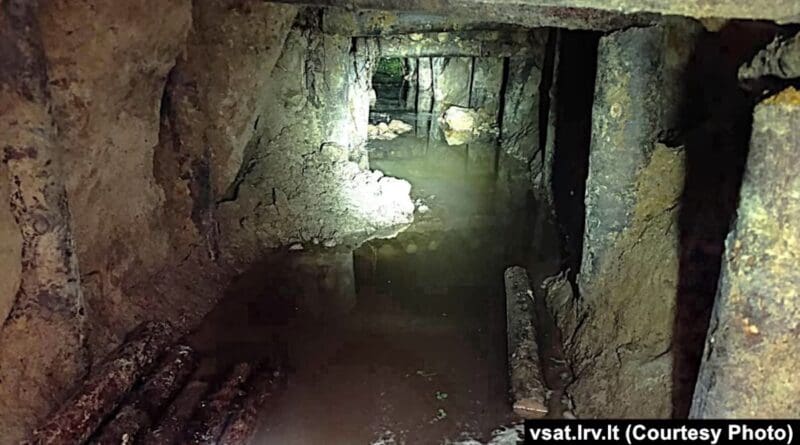
A tunnel dug from Belarus toward Lithuania that was discovered in July. Photo: vsat.lrv.lt (Courtesy Photo via RFE/RL)
The Migrant Tunnels Burrowing From Belarus Into The EU
By RFE RL
FacebookTwitterEmailFlipboardMastodonLinkedInSharenextstay
Playlist advancing in 5 seconds
Ad ends in 10
Video Muted
By Amos Chapple
Key Takeaways
- Latvian border guards discovered the country’s first migrant tunnel from Belarus on August 10 after intercepting a group of migrants; similar tunnels have been found in Poland (starting 2025) and Lithuania (multiple attempts in 2026).
- EU border authorities say Belarus routinely denies construction is underway even when given precise locations and real-time evidence, while restricted access zones on the Belarusian side and statements from officials raise suspicions of at least passive, and possibly active, support.
- The tunnels are viewed as a continuation of hybrid pressure tactics that intensified after the 2021 migrant surge; affected states are increasing cross-border cooperation and seeking specialized equipment to detect underground activity.
When a group of 15 migrants in “sand-stained clothing” were spotted moving through a forest in southeastern Latvia on August 10, border guards could not initially determine where the group had emerged from.
After questioning the migrants, a border patrol spotted a brush-filled tunnel exit just 10 meters from Latvia’s border fence with Belarus.
The underground passage was the first migrant tunnel discovered in Latvia, but only the latest of several dug into EU territory in recent months. Border authorities say Belarus has not moved to stop the tunnels, even when presented with real-time intelligence about their construction.
Lina Laurinaityte, a spokesperson for the Lithuanian State Border Guard Service, told RFE/RL that “in a number of cases, after [Lithuanian border guards] informed Belarusian authorities about tunnel construction and provided information about the location, the Belarusian side has denied that any such activity was taking place.”
She says the Belarusian response has been to claim that the indicated location has been checked and they have found nothing “despite [Lithuanian border guards] having clear evidence of the tunnel construction.”
Laurinaityte added that Lithuanian authorities have no proof that Belarus is directly involved in building the tunnels.
After a surge of mostly Middle Eastern migrants trying to cross from Belarus into the EU peaked in late 2021, Belarus’s western neighbors — Poland, Latvia, and Lithuania — erected border fences that initially eased the crisis.
The first migrant tunnel from Belarus was uncovered in Poland in September 2025 and several more tunnels were uncovered by Polish patrols later that year, including one through which around 180 migrants entered the country.
Lithuania has recorded 12 attempts to dig tunnels into its territory since early 2026. Lithuanian media reported that a border guard was injured during an incident in the south of the country on July 27 when a group of migrants who had emerged from a tunnel attempted to “drag him toward Belarusian territory.”
Images released by Lithuanian border authorities show unfinished underground passages originating in Belarus and reinforced with wooden supports resembling those used in mines.
Poland’s deputy interior minister, Czeslaw Mroczek, alleged in a December 2025 interview that Minsk had brought in “specialists” from the Middle East with experience in underground tunneling to dig into his country’s territory.
Poland’s border authorities declined to comment to RFE/RL on this claim.
Jolanta Babisko, a spokesperson for the Latvian State Border Guard told RFE/RL that there are “reasonable grounds to suspect that support is being provided from within Belarus” for the digging of tunnels into EU territory.
“Access to the area on the Belarusian side within several hundred meters of the border is restricted, and only border guards performing their official duties are permitted to be there,” she said.
Belarusian leader Aleksandr Lukashenko has blamed Brussels for the wider issue of mass migration, while hinting that he would respond to sanctions from the bloc by not stopping migrants seeking to enter the EU.
“Guys, we won’t protect you. We won’t catch [migrants] on the border as we did before,” he said at a conference in October 2024.
Laurinaityte says Lithuanian border authorities have cooperated with their Polish counterparts to detect tunneling and are aiming to buy additional technical equipment capable of sensing underground activity.
“For operational security reasons, we cannot provide details about the specific technologies used,” she added.
- Amos Chapple is a New Zealand-born writer and visual journalist with a particular interest in the former U.S.S.R.

About RFE RL
RFE/RL journalists report the news in 21 countries where a free press is banned by the government or not fully established.
Get the Eurasia Review newsletter
Selected analysis, news, and opinion delivered by email.First name or full name


