A blood test that draws on artificial intelligence can predict who will develop Parkinson’s disease up to seven years before symptoms arise, researchers say.
The test is designed to work on equipment already found in many NHS laboratories and, if validated in a broad population of people, could be made available to the health service within two years.
There are no drugs to protect the brain from Parkinson’s at present, but an accurate predictive test would enable clinics to identify people who stand to benefit most from clinical trials of treatments that aim to slow or halt the disease.
“At the moment, we’re shutting the stable door after the horse has bolted,” said Prof Kevin Mills, a senior author on the study at UCL Great Ormond Street Institute of Child Health. “We need to get to people before they develop symptoms. It’s always better to do prevention rather than cure.”
Parkinson’s disease is the world’s fastest growing neurodegenerative condition, a trend driven primarily by the ageing population. The disorder affects more than 150,000 people in the UK and 10 million worldwide. It is caused by the buildup of a protein called alpha-synuclein that damages or destroys nerve cells which produce an important substance called dopamine in part of the brain called the substantia nigra.
People who develop Parkinson’s can experience tremors, difficulties with movement and muscle stiffness, but also problems with balance, memory, dizziness and nerve pain. Many receive dopamine replacement therapy, but efforts are under way to find treatments that slow or stop the disease.
To develop the test, scientists at UCL and the University of Göttingen used a machine learning algorithm to spot a signature pattern of eight blood proteins in patients with Parkinson’s. The algorithm was then able to predict future Parkinson’s in other patients who provided blood samples. In one patient, the disorder was correctly predicted more than seven years before symptoms arose. “It is possible that it could go back even further,” said Dr Jenny Hällqvist, at the UCL Institute of Neurology, and first author on the study published in Nature Communications.
Prof Roger Barker, a consultant neurologist who specialises in Parkinson’s at the University of Cambridge and Addenbrooke’s hospital, said if validated by other groups, the test raised the possibility of diagnosing Parkinson’s at the very earliest stages, enabling patients to be enrolled in clinical trials when the disease process had just begun. “As such, we could treat people with Parkinson’s with disease-modifying therapies before they have lost many cells in their brain,” he said. “Obviously, we still need to find such therapies, but this study is a step in the right direction.”
Prof Ray Chaudhuri, the medical director of the Parkinson Foundation International Centre of Excellence, said there was a “massive unmet need” for blood tests that predict and diagnose Parkinson’s, but cautioned that such tests come with “major challenges”.
“Parkinson’s is not a single disease but a syndrome and can present in various different ways,” he said. “As such, management differs and one size does not fit all. The prediction is unlikely to signpost these subgroups at this stage.” Without effective treatments an early diagnosis raises considerable ethical issues, he added, as well as potentially affecting patients’ insurance policies.
“The process does help us have a group of people with Parkinson’s who may be ready or suitable for future trials of neuroprotective molecules,” Chaudhuri said. “Furthermore, there is some preliminary evidence that in such “at risk” people with Parkinson’s, physical activity and programmed exercise may be beneficial in terms of potentially slowing the course of the illness.”
20,649 views Premiered 19 hours ago Economic Update with Richard D. Wolff [Full Episodes] [EU S14 E22] The Political Economy Of Tariffs In this week’s Economic Update, Professor Richard Wolff devotes the entire program to an analysis of tariffs. We discuss why tariffs are not a worker’s issue, why capitalism’s continuous swings between free trade and protectionist periods and phases make little impact on workers, and why competing capitalists seek to get workers to support their positions on tariffs. If you haven’t already, please subscribe to our channel, follow us on social media and of course be sure to sign up on our website: http://www.democracyatwork.info As always, we thank you for your attention, support, and solidarity. The d@w Team Economic Update with Richard D. Wolff is a DemocracyatWork.info Inc. production. We make it a point to provide the show free of ads and rely on viewer support to continue doing so. You can support our work by joining our Patreon community: / democracyatwork Or you can go to our website: https://www.democracyatwork.info/donate Every donation counts and helps us provide a larger audience with the information they need to better understand the events around the world they can’t get anywhere else. We want to thank our devoted community of supporters who help make this show and the others we produce possible each week. We kindly ask you to also support the work we do by encouraging others to subscribe to our YouTube channel and website: http://www.democracyatwork.info
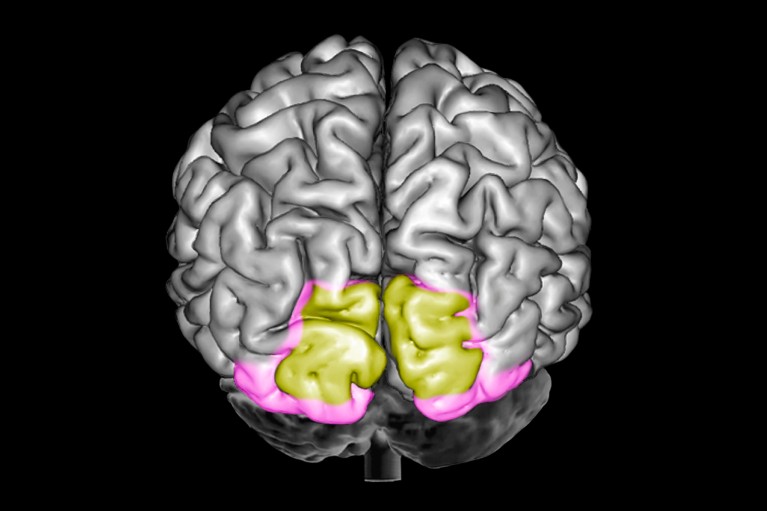
The primary visual cortex (yellow, artificially coloured) is involved in creating vivid visual memories, experiments show.Credit: Sovereign/ISM/SPL
Picture a strawberry. Most people can easily distinguish between that image in their mind’s eye and an actual strawberry.Now researchers say that they’ve worked out how the brain draws this distinction and where in the brain the process happens.
According to a study1 in monkeys, the key part of the brain is the primary visual cortex, which is also involved in vision. The authors found that neurons in this region displayed a different activity pattern for images conjured up from memory compared with that for real-time visual input. They conclude that the primary visual cortex is crucial for recalling images stored in memory.
“It’s an intriguing study that goes beyond what we know in several ways,” says cognitive neuroscientist Floris de Lange at Radboud University in Nijmegen, the Netherlands, who was not involved in the work. But others in the field, such as Julio Martinez-Trujillo, a cognitive neurophysiologist at Western University in London, Canada, says that another area of the brain, the prefrontal cortex, is more likely than the visual cortex to be key for recalling images.
The study was published today in Science Advances.
Total recall
Vivid memories of objects or scenes that flash into the mind’s eye as if onto a screen are called visual memories. Scientists have long wondered where in the brain those memories are made. One candidate area is the primary visual cortex, which transforms raw sensory input from the eyes into perceptions that it passes on to other areas of the brain.A myopia epidemic is sweeping the globe. Here’s how to stop it
Images of people’s brains “have suggested that the primary visual cortex is the primary location of visual memory”, says cognitive neuroscientist Dajun Xing at Beijing Normal University, who led the latest study. But those images don’t measure neuronal activity directly. As a result, there was little direct neuronal evidence for the role of the primary visual cortex, Xing says.
For the current study, the authors trained two macaque monkeys (one Macaca fascicularis and one Macaca rhesus) to perform various memory tasks, and recorded data from an array of microelectrodes implanted into each monkey’s primary visual cortex.
The array measured the activity of 60–70 neurons, many more than the single neurons measured during most previous studies, says Xing. Moreover, the team kept the measurements running for months, whereas previous studies generally recorded for just a few hours.
When the monkeys were remembering images, the spatial pattern of their neuronal activity differed from that recorded when they were actually looking at something.The researchers were able to determine whether the monkeys were remembering colours, faces or the orientations of shapes just from the neuronal firing pattern.
Monkey see
The cleverest part of the work was the association task, says de Lange. Over dozens of training sessions, the monkeys learnt to associate a colour — either red or blue — with an image of black and white stripes that were either vertical or sloping.The monkeys were shown one of the striped images and tasked with remembering the associated colour. Neuronal activity showed that each monkey’s primary visual cortex represented a colour during the task. They weren’t looking at any colour, which rules out the “more boring interpretations” of the results, says de Lange, “that [they were] seeing an echo of the sensory stimulus”. The monkeys must have been seeing the colour in their mind’s eye.
Xing interprets the results to mean that the primary visual cortex is essential for visual memory. Although that’s possible, it’s not convincingly supported by these results, say both de Lange and Martinez-Trujillo.
“There’s a possibility that the actual memory encoding is happening elsewhere, and that what you’re seeing in the primary visual cortex is the downstream consequences,” says de Lange. To test this, he says, researchers would need to interfere with the primary visual cortex and see whether the animals could still recall visual memories.
Martinez-Trujillo maintains that a different brain area, the prefrontal cortex, is essential for visual memory. Observational studies2 dating back almost a century found that when people had lesions in their prefrontal cortex, their memory was disrupted, he says.
Ian Bremmer’s Quick Take: Hi, everybody. Ian Bremmer here and a Quick Take to kick off your week. I want to talk about US elections and democracy.
This has been the year 2024 of elections all over the world. And most of them are going just fine. I mean, pretty much almost all of them. Okay, Russia is not a democracy. So you shouldn’t really talk about elections because it’s not like the people actually have a choice. It’s Putin or it’s Putin. But everywhere else, we’ve had elections that are free and fair and peaceful, and they’ve led to stable transitions, whether they’re voting people out, or whether they’re clipping their power or whether they’re doubling down on them. And that’s been true in Indonesia and Mexico and South Africa, India, the European Parliament. And soon it will be true in the coming weeks, first in France and in the United Kingdom. So it’s not like democracy all over the world is in crisis or is about to fall apart. It’s not like most countries can’t have normal elections.
The Summit on Peace in Ukraine held last week in Switzerland was a step towards a just peace. Here is my intervention. Comments welcome.
The Summit on Peace in Ukraine held last week in Switzerland was a step towards a just peace. Here is my intervention. Comments welcome. pic.twitter.com/JIAqAfP5wV
257,194 views 10 Jun 2024 Huberman Lab In this episode, my guest is Dr. Jonathan Haidt, Ph.D., professor of social psychology at New York University and bestselling author on how technology and culture impact the psychology and health of kids, teens, and adults. We discuss the dramatic rise of suicide, depression, and anxiety as a result of replacing a play-based childhood with smartphones, social media, and video games. He explains how a screen-filled childhood leads to challenges in psychological development that negatively impact learning, resilience, identity, cooperation, and conflict resolution — all of which are crucial skills for future adult relationships and career success. We also discuss how phones and social media impact boys and girls differently and the underlying neurobiological mechanisms of how smartphones alter basic brain plasticity and function. Dr. Haidt explains his four recommendations for healthier smartphone use in kids, and we discuss how to restore childhood independence and play in the current generation. This is an important topic for everyone, young or old, parents and teachers, students and families, to be aware of in order to understand the potential mental health toll of smartphone use and to apply tools to foster skill-building and reestablish healthy norms for our kids. Access the full show notes, including referenced articles, books, people mentioned, and additional resources: https://www.hubermanlab.com/episode/d… Thank you to our sponsors AG1: https://drinkag1.com/huberman Helix Sleep: https://helixsleep.com/huberman AeroPress: https://aeropress.com/huberman Joovv: https://joovv.com/huberman LMNT: https://drinklmnt.com/huberman Huberman Lab Social & Website Instagram: / hubermanlab Threads: https://www.threads.net/@hubermanlab Twitter: / hubermanlab Facebook: / hubermanlab TikTok: / hubermanlab LinkedIn: / andrew-huberman Website: https://www.hubermanlab.com Newsletter: https://www.hubermanlab.com/newsletter
46,945 views 17 Jun 2024 For the full discussion, please join us on Patreon at – / professor-john-106039860 00:00 Intro 00:19 The shift in perspective around Israel 02:10 The history of Israels world stage presence 5:00 How the first Intifada changed Israel 7:42 Israel on the world stage today Katie and John Mearsheimer discuss whether people’s increased criticism of Israel is because Israel has gotten worse or Israel’s crimes were previously hidden. John Mearsheimer is the R. Wendell Harrison Distinguished Service Professor in the Political Science Department at the University of Chicago and the author of “Why Leaders Lie: The Truth About Lying in International Politics,” “The Great Delusion: Liberal Dreams and International Realities,” and co-author of the controversial and ground-breaking “The Israel Lobby and U.S. Foreign Policy.” **Please support The Katie Halper Show **For bonus content, exclusive interviews, to support independent media & to help make this program possible, please join us on Patreon / thekatiehalpershow Get your Katie Halper Show Merch here! https://katiehalper.myspreadshop.com/… Katie on Twitter: @kthalps
1,644,891 views 10 Jul 2023 #DrJordanPeterson#DailyWirePlus#JordanBPeterson Dr. Peterson and Tim Ballard delve into the depths of human psychology. They shed light on how individuals, initially harboring bitterness and resentment, progressively immerse themselves in solitary brooding, and twisted fantasies. As time passes, these fantasies become increasingly darker, encompassing violent and sexual elements. Watch the full episode here: Ep. 372 – • The Fight Against Worldwide Child Sla… Dr. Peterson’s extensive catalog is available now on DailyWire+: https://utm.io/ueSFn
Why breaking things or going for a run doesn’t make you less angry
Although letting off steam by releasing energy is what we feel like doing when we’re mad, the most effective way to calm down is doing an activity that decreases arousal
A Rage Room in Bangkok, Thailand, in 2020.NurPhoto (NurPhoto via Getty Images)
In recent years, there has been a boom in businesses that let clients pay money to enter a space where they can throw axes or break things, releasing stress and anger. They are called rage rooms, and they have sprung up across the world. The idea may be tempting, but according to experts, it’s not an effective way to deal with anger. Sophie L. Kjaervik, a psychologist specializing in aggression and anger and a postdoctoral researcher at Virginia Commonwealth University, for example, has been concerned by the rising popularity of rage rooms for some time. But how could she prove that the concept is actually harmful? With research.
“By expressing anger, you are practicing aggressive behavior. I wanted to break the myth that it is effective when it comes to controlling anger and to show healthier alternatives,” she explains. To do this, she reviewed 154 studies that explored the effectiveness of different activities in decreasing arousal. The study was published in the journal Clinical Psychological Reviewlast April. The conclusion is clear: venting anger by releasing anger (hitting objects, going for a run, etc.) does not work. What does work, however, are activities that decrease arousal, such as deep breathing, meditation and yoga.
For the meta-analysis, which she conducted as part of her dissertation at Ohio State University, Kjaervik divided the activities that claim to reduce anger into two groups: those that reduce arousal and those that increase it. Seeking to control anger by controlling arousal makes sense, since in moments of rage the body is activated in a very specific way.
“During an episode of anger, there is an increase in general muscle tone, often accompanied by tension in specific muscle groups, such as those of the forearm and hand to form a fist, the masseter muscles to clench the jaws or the superciliary muscles to frown. In addition, breathing tends to become more agitated and frequent,” explains Raquel Gómez Leal, PhD in psychology and professor in the Master’s program in emotional intelligence at the University of Málaga (UMA). Anger also produces changes in heart rate and the force of contraction of the heart, in addition to the secretion of hormones such as adrenaline, related to the mobilization of energy. There are even changes in the skin, with skin conductivity increasing with arousal.
Another effect of anger is that our thinking becomes clouded, adds clinical psychologist Xacobe Abel Fernández García, president of the psychology and health department of the Official College of Psychologists of Galicia (COPG) in Spain. That’s why when we are angry, what we most want to do is vent out that energy. Boxing, breaking objects in an environment like a rage room, or going for a run often seem more appealing. However, the scientific evidence compiled by Kjaervik in her meta-analysis shows that none of these actions reduces anger.What’s more, going for a run not only does not make us less angry, it makes us more so. In the study, Kjaervik and Brad J. Bushman, the co-author, speculate that the repetitive effect of running may be behind the rise in anger.
Why, then, is there the widespread belief that venting our anger or exhausting ourselves will make us less angry? Kjaervik explains, referring specifically to rage rooms, that breaking and hitting objects can make us feel good. However, the effect lasts only a few minutes. Gómez Leal agrees that “these situations can provide temporary relief, giving a feeling of relief and release of tension.” Furthermore, as it is “an accepted model of anger management” that is seen a lot in movies and television, we think it is effective, even if it is only momentarily so.
On the other hand, it is always better to “punch a closet than a person,” says Fernández García. It is, of course, not the healthiest or most advisable move, but we must also keep in mind that not everyone will find arousal-reducing activities effective on the first try.
What does work
According to the study, all activities that lower arousal reduce anger, aggressiveness and hostility, regardless of a person’s sex, age, occupation or culture. These activities include meditation, mindfulness, breathing exercises and progressive muscle relaxation. Activities that have a cognitive component (examples include meditation and mindfulness), where, as Kjaervik explains, “you’re not just trying to relax your body, but also your mind,” are even more effective. “In some way, you observe your anger and let it float away on a cloud,” says the researcher, using a classic meditation exercise as an example.
UMA psychologist Gómez Leal offers another idea. “A good example would be combining deep breathing with cognitive reappraisal. That is, while you breathe deeply (you should practice these techniques a little) you can reevaluate the situation; this technique consists of modifying the way you think in different intense situations,” she explains.
Practice is important, because a person with anger management problems may not be able to simply breathe and control it. “It takes practice and a bit of strategy,” says Fernández García, from the COPG. “It is important to know yourself and practice. If I find myself in arguments and angry, and then I regret it and feel bad because I have said things that I shouldn’t have, or I have broken cabinets, or I have thrown things, it is important to first analyze why I have become so angry,” he explains. If this is done along with exercises that help keep us calm, and we learn to reduce arousal, “perhaps it will be a skill that we can also use when we get caught up in anger, which starts trying to stop us from thinking clearly.”
Another interesting finding from the meta-analysis is that not all activities that increase arousal are ineffective in managing anger: ball sports and activities such as aerobics do improve mood.Kjaervik believes this is because they introduce an element of play, which triggers positive emotions and counteracts anger. “You can’t be happy and angry at the same time; it’s impossible,” she says.
Why it’s important to control anger
Anger is a natural emotion that we have all experienced and will experience throughout our lives.It can even be useful “in specific situations to mobilize resources and face obstacles,” says Gómez Leal. However, it is important to learn to control it. “Anger can lead to impulsive and aggressive actions that can cause harm to oneself or others, either physically or emotionally,” explains the psychologist.
Gómez Leal adds that chronic anger is also bad for our health. “Chronic or uncontrolled anger can have negative effects on physical and mental health, such as increased risk of cardiovascular disease, digestive problems, sleep disorders, depression and anxiety,” she explains. Kjaervik highlights the damage to cardiovascular health: “Anger is bad for the heart.” There is a lot of research on this relationship; the most recent, published in early May, indicates that even brief episodes of anger reduce blood vessels’ ability to dilate, which is related to an increased risk of heart attack.
On the other hand, since it is a natural emotion, it is also important to know when we should start worrying and seek help. “Getting angry is normal, getting angry is legitimate. The barrier is to respect the rights of other people, their physical and moral integrity. That is, no blows, no insults, no displays of force,” says Fernández García. “When it is repeated, when the people around us start telling us about it, it is a sign that there is a problem. One reason for going to a professional is also the fear of losing control. Some people have been in situations where they have been afraid of themselves.”
Instead of hitting something or paying a company to destroy objects in a rage room, learning to breathe deeply is not only more effective, but also better for your health and your wallet.
Sign up for our weekly newsletter to get more English-language news coverage from EL PAÍS USA Edition
142,459 views 13 Jun 2024 Author Douglas Murray has blasted Hamas for refusing to bring an end to its war with Israel as it rejects ceasefire proposals. It follows a rescue operation conducted by the IDF where four hostages abducted from the Tribe of Nova music festival in the Negev desert on October 7 were saved. “If the war is going to go on, everybody can say now with 100 per cent certainty as you could for the last eight months, the reason there is no ceasefire is because of Hamas,” Mr Murray told Sky News host Rita Panahi.
Transcript
=============
22,273 views 14 Jun 2024 Angry Muslim Woman INSULTS Douglas Murray While Debating Israel-Hamas Conflict