
·
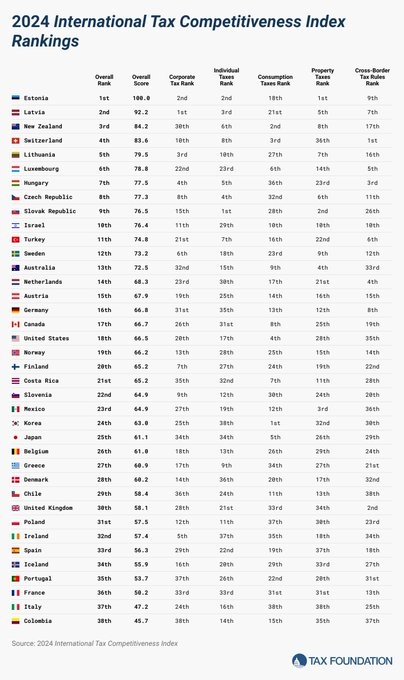
Ireland’s personal taxes rated second worst among 38 countries. This has been the case for almost two decades.
·
Ireland’s personal taxes rated second worst among 38 countries. This has been the case for almost two decades.
BREAKING: Peskov drags Britain into the war
The Kremlin spokesman claimed that Britain is taking part in the war on the side of the “Kyiv regime” and is “systematically and regularly adding fuel to the fire” by providing Ukraine with information needed to produce missiles.
Dmitry Peskov also accused the British government of standing in the way of a peaceful resolution to the war.
https://twitter.com/nexta_tv/status/2091831632630354346/video/1
·
Germany may lose its AAA credit rating from S&P due to record levels of debt. The federal government’s debt currently stands at 65.2% of GDP, and Berlin plans to spend almost a third of its 2027 budget on servicing its debts. And of course Ukraine. Slava self harm.

By
Senior Reporter, Economics and Markets
August 23, 2026, 4:00 AM ET
A Nobel-winning economic historian has got a theory on why birthrates are decliningMalte Mueller – Getty Images
The world’s most powerful economies are increasingly alarmed by their declining birthrates, and there’s no shortage of theories on why. SpaceX founder Elon Musk suggests society is “teaching a fear of pregnancy,” while policymakers in France seem to believe young people are simply forgetting to procreate, and sent reminder letters to 29-year-olds as a result.
Other suggestions are more banal: the cost of raising a child is too high, or would-be parents worry that the world is already running out of resources needed to support population levels.
A working paper by Claudia Goldin, a Nobel prize-winning economic historian at Harvard University, proposes an alternative: Perhaps hardworking, highly educated women are concerned about the autonomy they would sacrifice if their partners don’t share the workload of raising children.
“Women who undertake greater investments in themselves will be more likely to have children if they can reap the financial and personal rewards from their education while raising their children,” Goldin writes. “In the absence of that assurance, they will be more likely either not to have children or not to undertake the initial investment in themselves.”
Recommended Video
Zohran Mamdani and Kathy Hochul announce a $1.7 billion investment in child care
Next Stay
She adds: “The more that men can credibly signal they will be dependable ‘dads’ and not disappointing ‘duds,’ the more investment in women’s education and careers, and the higher will be the birthrate in the face of greater female agency.”
The theory is neat, and subject to criticism as a result. Some point out that birthrates have continued to fall despite household work being carried out more equitably. In the decade between 2026 and 2016, data from the Bureau of Labor Statistics shows that the hours men spend on household activities have fractionally increased, while the hours carried out by women have slightly decreased. Birthrates have still continued to decline. Other critics suggest the data used in the research is inconsistent, with skeptics also questioning what “dependability” in dads entails.
But Goldin doesn’t claim to have all the solutions to the questions her work raises. “When women did not have any choice, [having children] is what they did,” she tells Fortune. “But now they are given a choice.” So do men, she adds: How to demonstrate whether they are a dud or a dad. But “we don’t really know the answer [to] what sort of commitment mechanisms [men] have,” Goldin says.
Goldin, perhaps attuned to this dynamic because of her research, says she can spot anecdotal indicators among her students: “I can pretty much tell who the good dads are. There’s no question—they are the individuals who are clearly going to share and [are] going to engage in what I would call couple equity.”
“Couple equity doesn’t mean equality—it doesn’t mean you’re doing exactly the same things … but it does mean that each of them has decided that they’re willing to give up a certain amount of income and prestige to raise a child or two, or three together.”
While Goldin’s methodology can be debated (and indeed, the historian is open to feedback), the research is nevertheless making waves. On a superficial level, Google searches for Goldin’s name have increased 400% over the past year compared to a year prior. More broadly, the topic of birthrates is ascending the political agenda—President Trump even suggested he’d be known as the “fertilization president” courtesy of policies aimed at supporting birthrates, such as increasing access to IVF.
So why the sudden focus? The trends driving Goldin’s formula are nothing new: Women have been investing in their education in increasing numbers over the past 50 years. The Bureau of Labor Statistics’ (BLS) latest reporting, for the year 2024, found that among recent high school graduates ages 16 to 24, 69.5% of women were enrolled in college, and 55.4% of men had done the same. Meanwhile, Census data from 50 years prior shows that in 1974, 45.87% of 14 to 24-year-olds enrolled in college were women.
In addition to women wanting to build careers for their enjoyment and fulfillment, there’s also been an increasing economic need for them to do so. Brookings found in a 2020 study that without women’s earnings, middle-income households would have seen virtually no income growth between 1979 and 2018.
Myra Strober, a labor economist and Professor Emerita at the School of Education at Stanford University, sees an answer both simpler and broader than the data from the past half-century suggests: The need for children has shifted from the household level to the societal.

Paid Content
From Wesco
“Historically, people had children because they needed them,” Strober tells Fortune. “In an agricultural economy, you needed children to do the work … as agriculture has become a less and less important part of our economy, people don’t need children the way they did before.
“And people had lots of children because the infant mortality rate was high. You couldn’t be assured that the children you had would live to adulthood, and so you better ensure you have plenty of children to help around the farm. Once agriculture declines and the infant mortality rate goes way down … people don’t need children in the way that they did.”
Strober founded the famous Stanford course “Women and Work” (later renamed “Work and Family”), where she met student Abby Davisson, now an entrepreneur and consultant. The pair co-authored their book ‘Money and Love’ in 2023, which is now required course reading at Stanford’s Graduate School of Business.
At the end of the duo’s book, they examine the extent to which public policy trickles down into household decision-making, “yet we have not changed our policies around … work expectation or cultural norms. It’s much easier to change policy than it is to change culture,” Davisson tells Fortune.
“There is a cultural conversation piece that’s tricky here, even if we have the best geopolitical policies and …. everyone holds hands and agrees on that, if the culture—the expectations for parents do not change, if the expense for raising children does not change—I don’t see how we’re going to see different behaviour at the individual level, because it’s not just this one piece of policy.”
“We should be thinking about the economy as a whole and public policy rather than bedroom policy,” Strober echoed.
Whether or not equity in partnerships is the cause of declining birth rates, Goldin, Strober, and Davisson are united in advocating for it—the latter duo even includes checklists to prompt conversations between couples in their book. But that doesn’t mean equity is no longer a significant economic concern.
“If you begin with the thought that you have a distribution among women and men of talent and creativity, why would you not want to use both distributions and take the top of each to run your economy and your society?” Strober poses. “In terms of economic well-being, social well-being, use of resources, you want to look equally among men and women.”
Davisson, mom to two boys, chimes: “I really value the fact that my children see their father in food preparation mode all the time—he’s the family chef—like they’re going to grow up thinking that that is totally normal. The value is both for the workplace and for the citizens in that workplace.”
Fortune Daily breaks the traditional barrier between audience and newsroom. The show transforms Fortune’s trusted reporting into actionable, conversational, and entertaining insights for an emerging class of business leaders. Watch here.
About the Author
By Eleanor PringleSenior Reporter, Economics and Markets
Eleanor Pringle is an award-winning senior reporter at Fortune covering news, the economy, and personal finance. Eleanor previously worked as a business correspondent and news editor in regional news in the U.K. She completed her journalism training with the Press Association after earning a degree from the University of
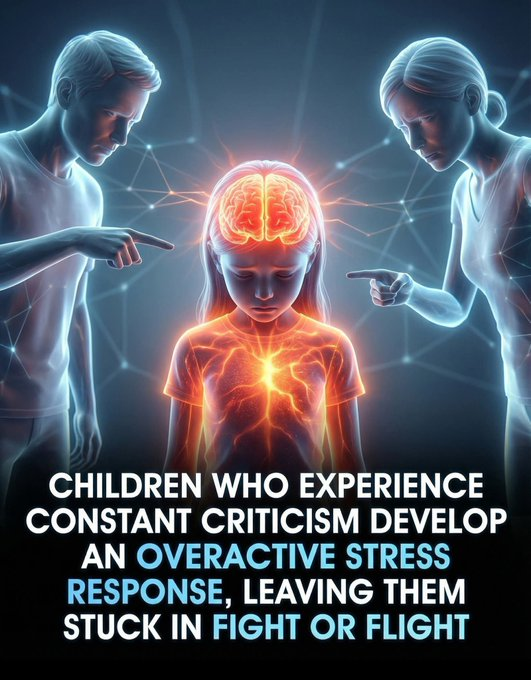
 Research shows constant criticism rewires a child’s brain. And the emotional stress shapes lifelong mental health. Children raised in environments filled with constant criticism often develop a stress-response system that remains on high alert, even in the absence of actual threats.
This chronic activation of the fight-or-flight state interferes with a child’s ability to feel safe, calm, or emotionally grounded.
According to research from the Center on the Developing Child at Harvard University, persistent emotional stress in early life can alter brain architecture, leading to long-term issues with emotional regulation, anxiety, and attention. When everyday interactions are perceived as threatening, children may respond with hypervigilance, withdrawal, or emotional shutdown—defense mechanisms rooted in survival.
As these children grow, the expectation of judgment or harm becomes deeply ingrained in their nervous system, affecting their self-esteem and relationships. They may struggle to trust others or feel secure in social settings, constantly anticipating criticism or rejection. This state of chronic stress is known as “toxic stress,” and it’s been linked to a range of lifelong impacts—from depression and learning difficulties to physical health problems. The findings underscore how emotionally unsafe environments can have a lasting effect on a child’s development, both psychologically and biologically. Source: The Center on the Developing Child at Harvard University. InBrief: The Impact of Early Adversity on Children’s Development.
Ralph Martin08/22/2026August 22, 2026
Russia’s war against Ukraine and the US-Iran conflict are becoming increasingly intertwined. From Iranian drones in Ukraine and Ukrainian support for Gulf states, the lines between the conflicts are beginning to blur.
Current historical work: https://share.google/d2bWHA6RuBiRSC0lu
Charles Ffrench (or French) Blake-Forster (c. 1850/1851–9 September 1874) was a short-lived but prolific Irish writer, genealogist, and local public figure from a landed Galway-Clare family. He was born at Forster House (Forster Street House) on Forster Street/College Road in Galway, the eldest son of Captain Francis Blake-Forster (c. 1817–1881), an officer in the Connaught Rangers, JP, and landowner, and Mary Josephine Comerford (1827–1862).
en.wikipedia.orgThe Forster family originated in Hertfordshire and acquired Galway property from the mid-17th century (a royal grant of Clooneene/Ashfield in 1677). They became Blake-Forster through marriage into the Blake family of Menlo. Charles’s paternal grandmother was the Hon. Rose ffrench, linking him to the ffrench family (he was a grand-nephew of Edmund Ffrench, the last Warden of Galway). His mother was the daughter (and a co-heiress) of Henry Comerford, so the children were grandchildren of that prominent Galway merchant.
patrickcomerford.comSiblings and the 1874 deathsCharles had at least two younger siblings:
Rose Emily died on 6 August 1874 (aged about 19–20) and was buried in the family vault at Bushypark Cemetery. Charles died of a brain haemorrhage roughly one month later, on 9 September 1874, at his father’s house on Forster Street, aged 23 or 24. Contemporary accounts attribute his death to overwork on literary and public duties compounded by the “fatigue and mental anxiety” from his sister’s illness and death. Local or family tradition (as you note) links her death to a horse fall; this is not detailed in the main published obituaries or genealogical summaries but fits the timing and the obituary’s reference to a beloved sister’s illness/death. Both were interred in the Blake-Forster family tomb at Bushypark.
findagrave.comCharles had been active young: town councillor, Board of Guardians member, and High Sheriff of Galway Town in 1874 (presiding over the first parliamentary elections under the Ballot Act). He was posthumously elected for the East Ward as a mark of respect. He contributed historical articles to the Galway Vindicator and Galway Express (1869–1871), including material on Kilfenora, and published The Irish Chieftains; or, A Struggle for the Crown (McGlashan & Gill, 1872). This mixes novelistic narrative of the Williamite-Jacobite War (from a Galway/Clare perspective, featuring figures such as Sir Roger O’Shaughnessy and family ancestors) with extensive notes, appendices, pedigrees, and documents. Its nationalist/Jacobite tone and uncrowned-harp binding reportedly led to his expulsion from the County Clubs of Galway and Ennis. He left several unpublished or lost manuscripts (including The Annals of Galway and others listed in the book).
galwaysown.ieHenry Comerford and the family’s enrichment (and the St John)Henry Comerford (c. 1795/1796–1861), Charles’s maternal grandfather, was a Clare-born Galway merchant (Merchant’s Road), magistrate, and landowner who also held Ballykeale (Ballykeel) House near Kilfenora. He married Margaret McDonagh in 1824 and had a large family; Mary Josephine was among the daughters. He acquired extensive post-Famine lands: more than £35,000 for roughly 4,440 acres in Co. Galway (including substantial holdings around Kinvara purchased from Sir William Gregory in 1857, Doorus, Rineen, and other townlands), plus property in Co. Clare (Drumcreehy, Kilfenora/Burren). He owned the tolls and customs of Kinvara, Delamaine Lodge, the Fair Green, gatehouse, animal pound, and much of the town parks (hundreds of acres), along with other urban Galway property. These passed in part to sons-in-law after his death (6 September or December 1861), notably through Mary Josephine’s 1846 marriage to Captain Francis Blake-Forster, which brought Ballykeale and related estates into the Blake-Forster family and “enriched” them.
patrickcomerford.comHenry is also remembered as owner of the brig St John (sometimes called a “coffin ship”), a Galway vessel of about 200 tons. It sailed from Galway on 7 September 1849 under Captain Martin Oliver, carrying roughly 100–143 passengers (many from Ennistymon, Lahinch, Kilfenora, and Connemara/Clare-Galway areas fleeing the aftermath of the Famine) plus crew, bound for Boston. On 7 October 1849 it was wrecked in a storm on Grampus Ledge (near Minot’s Ledge) off Cohasset, Massachusetts. Approximately 99–100 people died; only about 20–21 survived (including the captain and first mate Henry Comerford—believed a nephew of the owner—plus a few passengers). About 45 bodies washed ashore and were buried in a mass grave in Cohasset Central Cemetery (later marked by a Celtic Cross erected by the Ancient Order of Hibernians in 1914). Henry David Thoreau visited the scene shortly afterward and described it in Cape Cod. The disaster was one of the most notorious among the famine-era emigrant shipwrecks.
cohassetanchor.comMarcella Blake-Forster and the presentation copyMarcella Blake-Forster (née Johnstone) was Charles’s sister-in-law (wife of his brother Francis O’Donnellan). She and her husband retained links to the former Comerford properties (Ballykeale House remained in the family into the early 20th century). In 1906 she is recorded as owning over 250 acres of untenanted land and a mansion house at Corr (barony of Longford). Their children included a daughter also named Marcella Margaret (who later married Senator Michael Comyn KC). This makes Marcella a natural relative to present a copy of Charles’s Irish Chieftains to G.A. Comerford (almost certainly a kinsman on the Comerford side) in June 1904 or 1907.
comerfordfamily.blogspot.comThe Blake-Forster/Comerford connection thus united older Galway tribal and Forster/Blake landed interests with the commercial/landed rise of Henry Comerford. Charles’s early death cut short a promising career that mixed local administration, romantic nationalist historiography, and family pride in Galway and Clare roots. Forster Street, Forster Court, and the former family house still recall the name, while the Bushypark tomb and the lost manuscripts underscore how much more he might have contributed. Local histories (including the Galway Stories piece you shared and the detailed Comerford family research by Patrick Comerford) remain the best starting points for further primary-source digging in newspapers, land records, and parish registers.
7 web pages
Explore the St John shipwreck details
Investigate Henry Comerford’s land holdings
Clarify the Marcella Blake-Forster connection
Clarify the Marcella Blake-Forster connection
Thought for 18s
Marcella Blake-Forster (née Johnston/Johnstone, c. 1852–26 June 1917) was the sister-in-law of Charles Ffrench Blake-Forster. She was the wife of his younger brother, Captain Francis O’Donnellan Blake-Forster (1853–27 June 1912).
comerfordfamily.blogspot.comKey details of the connection
Link to the presentation copy of The Irish ChieftainsThe Marcella who presented a copy of Charles’s 1872 book The Irish Chieftains; or, A Struggle for the Crown to G.A. Comerford in June 1904 (or 1907) is this Marcella (née Johnston), Charles’s sister-in-law. As the wife (and later widow) of his brother and a member of the extended family that inherited Comerford-linked estates, she had natural access to family copies of the work and a clear reason to gift one to a Comerford relative. G.A. Comerford was almost certainly a kinsman on the maternal (Comerford) side of the family, descending from or connected to Henry Comerford (Charles’s maternal grandfather).
galwaysown.ieNote that one of her daughters was also named Marcella (Marcella Margaret, later Mrs Comyn). A later family comment refers to “my grandmother Marcella ffrench Blake-Forster” born at Arran View and living at Ballykeale before marrying Michael Comyn—this describes the daughter, not the 1904/1907 presenter.
patrickcomerford.comIn short, the connection runs: Charles → brother Francis O’Donnellan → wife Marcella (née Johnston) Blake-Forster → presentation of the book to a Comerford relative. This ties the Blake-Forster and Comerford lines together through both blood (via Charles’s mother) and marriage.

4 web pages
Explore the Comerford family lineage
Investigate the Irish Chieftains book
Clarify the distinction between the two Marcellas
Investigate the Irish Chieftains book
Thought for 24s
The Irish Chieftains; or, A Struggle for the Crown: with numerous notes and a copious appendix (1872) is the only full-length published work of Charles Ffrench Blake-Forster (c. 1850/1851–1874). It is a hybrid of historical novel and scholarly local history focused on the Williamite–Jacobite War (1689–1691) in Ireland, especially from a Galway and North Clare perspective.
deburcararebooks.comPublication details
Content and structureThe book divides roughly into two parts:
The half-title lists several other projected works by Blake-Forster (The Annals of Galway, legends of Clare and Galway, etc.) that were never published (or have been lost).Reception and controversyThe book was well-received in some nationalist and local-history circles for its patriotism and research, but it provoked strong reaction among the Protestant and Unionist gentry. Blake-Forster was reportedly expelled or blackballed from the County Clubs of Galway and Ennis (and principal Dublin clubs) because of the Jacobite/nationalist opinions expressed and the uncrowned harp on the binding. A relative later confirmed this. A contemporary review appeared in the Dublin University Magazine (February 1873).
sources.nli.ieSignificance today
In summary, the book is both a product of its youthful, gifted author and a substantial (if partisan) contribution to the history of the Williamite War in the west of Ireland, distinguished above all by its dense supporting apparatus of notes and family documentation.
4 web pages
Explore the Williamite War in Ireland
Investigate the Irish Brigade in France
Investigate the Irish Brigade in France
Thought for 28s
The Irish Brigade in France (French: Brigade irlandaise; Irish: Briogáid Éireannach) was a formation of Irish expatriate soldiers in the French Royal Army that served from 1690 until its formal dissolution in 1791. It is the most famous of the “Wild Geese” units—Irish Catholic soldiers who left Ireland after the Williamite War to serve continental Catholic monarchs.
wikipedia.orgOriginsIn May 1690, during the Williamite War in Ireland, five Jacobite (pro-James II) Irish regiments were sent to France in exchange for a larger French force under the Comte de Lauzun that reinforced James II in Ireland. These roughly 5,000 men formed the original Irish Brigade under Justin MacCarthy, Viscount Mountcashel. The initial regiments were Mountcashel’s, Butler’s, Feilding’s, O’Brien’s, and Dillon’s; Butler’s and Feilding’s were soon absorbed, leaving three core units (Mountcashel’s, O’Brien’s/Clare’s, and Dillon’s).
en.wikipedia.orgAfter the Treaty of Limerick (3 October 1691) ended the war, an estimated 12,000–19,000 additional Jacobite soldiers (plus women and children) sailed to France under Patrick Sarsfield in the event romanticised as the Flight of the Wild Geese. These troops initially formed a separate Jacobite army in exile under James II at Saint-Germain-en-Laye. After the Treaty of Ryswick (1697) and further reorganisations, the remnants were amalgamated into the French Irish Brigade. Recruiting continued for decades, drawing young Catholic men (especially from the west of Ireland) who faced limited prospects under the Penal Laws.
en.wikipedia.orgComposition and organisationThe Brigade typically consisted of three to six infantry regiments (each of one or more battalions) plus, at times, cavalry (notably Fitzjames’s Horse). Core long-lasting units included:
Regiments were named after their colonels (often hereditary within Irish exile families) and retained distinct Irish identity, red uniforms (evoking Stuart allegiance), and privileges as foreign troops. Strength fluctuated; at peak periods it numbered several thousand. Officers were predominantly Irish or of Irish descent; rank-and-file recruitment gradually included more French-born men of Irish ancestry.
regiments.orgMajor campaignsThe Brigade fought in nearly every major French land campaign between 1690 and 1789:
Decline and endAfter Fontenoy the Brigade gradually lost purely Irish character as native recruitment declined and French-born men filled the ranks. In 1775 several units were amalgamated, leaving three main regiments (Dillon, Berwick, Walsh). On 21 July 1791 the French National Assembly “nationalised” all foreign regiments except the Swiss; the Irish units became ordinary French line infantry (87e, 88e, and 92e Régiments de Ligne) and lost their distinctive titles, uniforms, and status. Some royalist officers later joined the émigré Army of the Princes; a short-lived “Loyal Irish Brigade” was raised in British service (1794–1798) from former officers and Irish recruits, but it saw limited action and was disbanded. Napoleon later created a separate Irish Legion (1803–1815), which was not a direct continuation.
en.wikipedia.orgIn 1792 the Comte de Provence (future Louis XVIII) presented the remaining units with a farewell standard bearing a harp, shamrocks, fleurs-de-lys, and the motto “1692–1792 Semper et Ubique Fidelis” (“Always and Everywhere Faithful”).Legacy and connection to Blake-ForsterThe Brigade became a powerful symbol in Irish nationalist memory of exile, loyalty, and martial prowess. Nineteenth-century writers (including John Cornelius O’Callaghan’s History of the Irish Brigades in the Service of France, 1870) romanticised it extensively. In Charles Ffrench Blake-Forster’s The Irish Chieftains (1872) the Brigade features in the narrative and especially the extensive notes/appendices, which cover Irish Brigade service, family connections among Galway/Clare exiles, and post-Limerick Jacobite history up to the mid-18th century.
deburcararebooks.comOverall, more than 50,000 Irishmen are estimated to have served in French, Spanish, and other continental armies during this era. The French Irish Brigade stands as the longest-lived and most celebrated of these formations, bridging the Jacobite cause with broader European warfare for a full century.
6 web pages
Explore the Battle of Fontenoy
Investigate the Spanish Irish Brigade
Explore the Battle of Fontenoy
Thought for 1m 4s
The Battle of Fontenoy (11 May 1745) was a major engagement of the War of the Austrian Succession, fought near the village of Fontenoy (close to Tournai, in present-day Belgium). It is best known as the masterpiece of French Marshal Maurice, Comte de Saxe, and as the highest battle honour of the Irish Brigade in French service.
en.wikipedia.orgBackgroundBy early 1745 France sought a decisive victory in the Low Countries to force an end to the war. Saxe, despite severe illness (dropsy), laid siege to the strategic fortress of Tournai on the Scheldt. The Allied “Pragmatic Army” (British, Hanoverian, Dutch, and a small Austrian contingent), commanded by the 24-year-old William Augustus, Duke of Cumberland (son of George II), marched to relieve it. Saxe left about 22,000 men to continue the siege and positioned his main army of roughly 50,000 on a strong natural defensive feature around the villages of Fontenoy, Antoing, and Vezon, about 8 km southeast of Tournai. He strengthened the position with redoubts and artillery. King Louis XV and the Dauphin were present on the battlefield.Forces
The Irish Brigade (about 3,870 infantry bayonets in the regiments of Dillon, Clare, Berwick, Bulkeley, Lally, and Roth, plus ~270 sabres of Fitzjames’s Horse) was held in reserve on the French left near the Bois de Barry.
historyireland.comCourse of the battleCumberland planned a coordinated attack but abandoned a more ambitious flanking move after Dutch reconnaissance was driven off. At dawn on 11 May the Allies formed up: British and Hanoverians on the right/centre, Dutch on the left.Early Allied assaults on the flanks failed under heavy French artillery and musketry. Cumberland then launched a massive frontal assault with a dense column of about 15,000 British and Hanoverian infantry against the French centre-left. This column advanced with great discipline, absorbing severe flanking fire, and temporarily broke into the French lines, reaching the French camp itself. A famous (possibly apocryphal) anecdote, popularised by Voltaire, describes Lord Charles Hay of the Allied ranks toasting the French and inviting them to fire first.The French line nearly collapsed. Saxe, directing from a litter because of his illness, committed successive counter-attacks with infantry, cavalry, and massed artillery. The decisive moment came when he ordered the fresh Irish Brigade (together with supporting French regiments such as Normandie and des Vaisseaux) to charge the right flank of the Allied column. Advancing to the cry “Cuimnidh ar Luimneach agus ar feall na Sasanach” (“Remember Limerick and Saxon treachery”), the Irish drove into the British ranks with the bayonet. Combined with French artillery and further assaults, this forced the Allied column to withdraw in good order but with heavy losses (roughly 50 percent of those engaged). The Dutch attacks on the French right also failed.
historyireland.comCasualties and outcome
It was a clear French victory. Cumberland retreated toward Brussels. Saxe followed up by capturing Tournai and most of Flanders over the following months—the most successful French campaign in the Low Countries for generations. Louis XV became the first French king to claim a battlefield victory over an English-led army since the Middle Ages.
en.wikipedia.orgSignificance and legacyFontenoy restored French military prestige in Europe and is regarded as Saxe’s masterpiece of defensive and counter-attacking warfare. For the Irish Brigade it was the pinnacle of their century of service to France—the moment most celebrated in later Irish nationalist memory as proof of the martial prowess of the “Wild Geese.” Streets, clubs, and monuments (including one at Fontenoy itself, funded in the early 20th century) commemorate it. The battle also features prominently in accounts of the Brigade, including the notes and narrative of Charles Ffrench Blake-Forster’s The Irish Chieftains (1872).Contemporary observers noted the high cost of the victory; Louis XV is reported to have remarked on the bloodshed, saying the true glory was to spare lives. The engagement remains one of the classic set-piece battles of 18th-century linear warfare.
2 web pages
Sponsor this memorial with an exclusive premium layout and no ads.Sponsor this page
Parents
Spouse
Children
Rose Emily / Emily Rose Blake-Forster died 1874 within month of brother Charles
================
NameRose Blake-ForsterMaiden NameFfrenchGenderFemaleBirth Date1792Birth PlaceAhascragh, County Galway, IrelandDeath Date13 Dec 1857Death PlaceGalway, County Galway, IrelandCemeteryBushypark GraveyardBurial or Cremation PlaceGalway, County Galway, IrelandHas Bio?NMotherMargaret FfrenchChildrenFrancis Blake-ForsterURLhttps://www.findagrave.com/memorial/149178480/rose-blake-forster
Ancestry.com. UK and Ireland, Find a Grave® Index, 1300s-Current [database on-line]. Lehi, UT, USA: Ancestry.com Operations, Inc., 2012.
Original data: Find a Grave. Find a Grave®. http://www.findagrave.com/cgi-bin/fg.cgi.
This database contains an index to cemetery and burial details posted on Find a Grave® from the United Kingdom and Ireland. The records are dated between the 1300s and the present. Find a Grave® provides users a virtual cemetery experience, with images of grave markers from around the world, photos, biographies, and other details uploaded by volunteers. Learn more…
Provided in association with Find a Grave
View more information on Find a Grave®.
Contribute photos and gravesite details on Find a Grave®.


Other Ancestry members are also researching Rose Blake-Forster. See what they’ve saved to their trees.
Emily Rose should be included here. One month between the death of Charles and his sister, who was in her 20’s and Charles was only 23
===============
UK and Ireland, Find a Grave® Index, 1300s-CurrentPreview
Death, Burial, Cemetery & Obituaries
| Name | Mary Josephine Blake–Forster |
|---|---|
| Birth | 1827 Kilfenora, County Clare, Ireland |
| Death | 2 Dec 1862 Galway, County Galway, Ireland |
============
| ame: | Mary Josephine Blake-Forster |
|---|---|
| Maiden Name: | Comerford |
| Gender: | Female |
| Birth Date: | 1827 |
| Birth Place: | Kilfenora, County Clare, Ireland |
| Death Date: | 2 Dec 1862 |
| Death Place: | Galway, County Galway, Ireland |
| Cemetery: | Bushypark Graveyard |
| Burial or Cremation Place: | Galway, County Galway, Ireland |
| Has Bio?: | N |
| Father: | Henry Comerford |
| Spouse: | Francis Blake-Forster |
| Children: | Charles Ffrench Blake-Forster; Francis O’Donnellan Blake-Forster |
==============
Grok 4.5 AI:
Rose Emily (or Rose Emily / Emily-Rose) Blake-Forster (1854–1874) was the daughter of Mary Josephine Blake-Forster (née Comerford, 1827–1862) and Capt. Francis Blake-Forster, and the sister of Charles ffrench Blake-Forster (c.1851–1874). She is linked to Ballykeale (Ballykeel) House, Co. Clare.
canisgallicus.comMary Josephine was the eldest daughter and co-heiress of Henry Comerford, JP, of Ballykeale House (near Kilfenora/Ennistymon, Co. Clare). She married Capt. Francis Blake-Forster (of Forster House/Castle Forster, Galway area) in 1846; the Ballykeale property passed into the Blake-Forster family through this marriage. Their known children were:
Charles’s death was linked in contemporary accounts partly to the strain of his sister’s illness and death a month earlier. The family retained connections to Ballykeale through Francis O’Donnellan and later generations (including into the 20th century).
canisgallicus.comThere was indeed an Emily in a prior generation of the Blake-Forster family: Emily Blake-Forster (daughter of Robert Blake-Forster of Ashfield and Anne Daly), who married Daniel McNevin/MacNevin. They were associated with Clooneene/Ashfield in the 1830s; their son Thomas McNevin was linked to the Young Ireland movement. This is a generation earlier than Mary Josephine’s children and relates to the Galway (Ashfield) branch rather than the direct Ballykeale/Comerford line.
canisgallicus.comMary Josephine also had a younger sister, Henrietta Emily Comerford (1837–1881), who lived for a time at Forster House. The name “Emily” thus appears in related branches, but the sister of Charles connected to Mary Josephine and Ballykeale is Rose Emily Blake-Forster. Sources sometimes vary slightly on exact birth years for Charles (1850/1851 vs. occasional other figures) and Mary Josephine’s death year (1861/1862), but the relationships and Ballykeale link are consistent across family histories and landed-estate records.
1 web page
Explore the Comerford family lineage
Investigate the Young Ireland movement
Clarify the distinction between generations
 Captain Francis Blake-Forster 1817–1881 (m. 1846)
 Charles Ffrench Blake-Forster1851–1874
 Francis O’Donnellan Blake-Forster1853–1912
