
 Menu
Menu Search
Who joined the Nazi Party
‘Ordinary men’ were at the heart of genocidal movement as it grew, research says
Sy Boles
Harvard Staff Writer
May 15, 2026 5 min read
The first Germans to become Nazis during Hitler’s rise to power may have been ideological zealots, but later members were largely “ordinary men” drawn into the movement by propaganda and social pressure.
That’s one of several key findings in a new paper from Harvard researchers affiliated with the Economics Department and the Weatherhead Center for International Affairs.
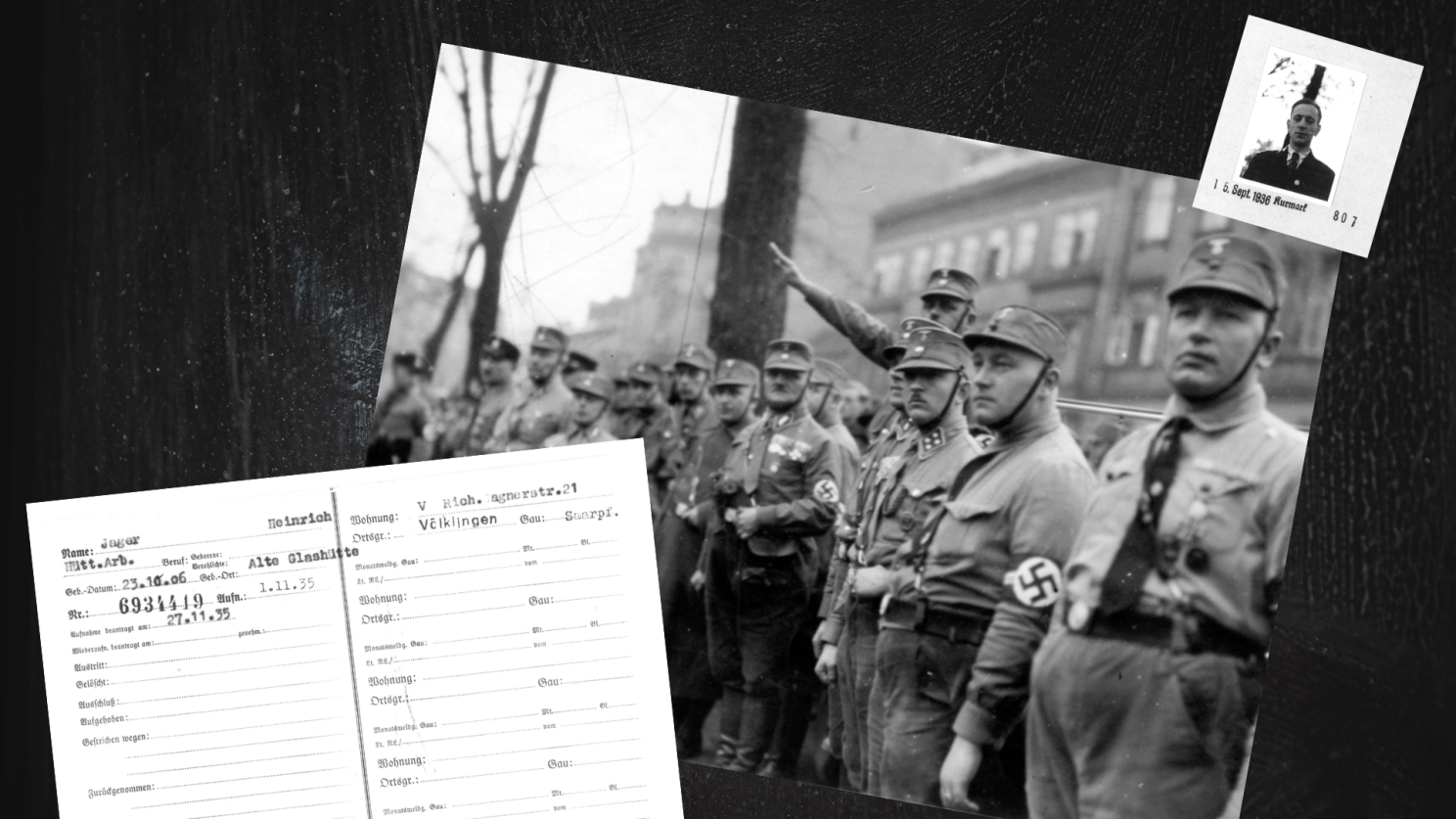
The researchers used vision-language artificial intelligence to digitize membership cards for more than 10 million members of the National Socialist German Workers’ Party, expanding on an existing database of 55,000, to illuminate who joined the fascist movement, when, and in what communities. Their findings were published in April by the National Bureau of Economic Research.
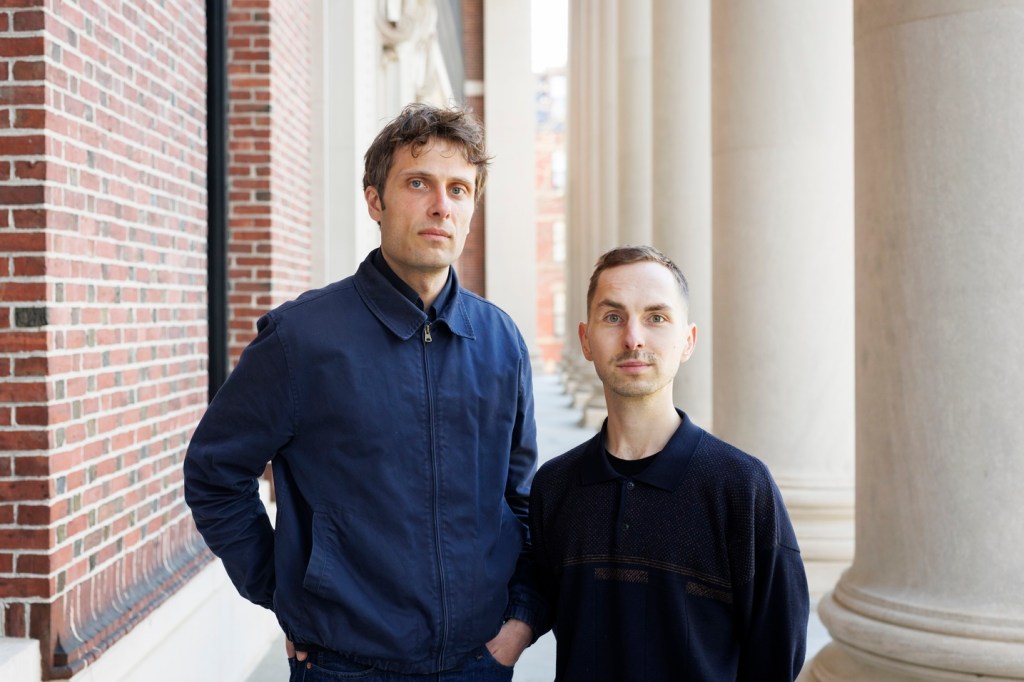
“What we can do with this new resolution is zoom in much more fine-grained, temporally speaking, but also geographically speaking,” said Luis Bosshart, a co-author of the paper and a researcher at the Harvard Academy for International and Area Studies at the Weatherhead Center. “What we find is that mass entry occurred in discontinuous waves and that representativeness increased over time. By the end of the regime, the joiners looked much more like the population at large.”
Led by Adolph Hitler, the Nazi Party, officially the National Socialist German Workers’ Party, established a totalitarian regime in Germany that triggered World War II and carried out the murder of 6 million Jews in the Holocaust. At its height, one in six German adults was a registered member of the movement.
Nazi functionaries tracked information about members’ ages, occupations, addresses, and dates of party entry. Microfilm images of the cards, many of which were handwritten, are held by the U.S. National Archives and Records Administration and open to researchers — but efforts have been stymied by the laborious task of manual transcription.
“Entries are edited. Someone moves, so an address gets crossed out. Some cards are written all over,” said co-author Matthias Weigand, an econ graduate student and an affiliate at the Harvard Center for International Development. “Thus, people have been taking random samples for their purposes, transcribing them, and trying to work with that. We now observe the near-universe of membership cards, including features such as membership portraits.”
The team used Google Gemini’s vision-language AI model to extract and standardize the data. The development of their algorithm occurred over a long process in collaboration with the German Federal Archives. They then conducted manual checks to validate the model’s accuracy.
After a gradual buildup that ran into the early 1930s, the first sharp wave of entry into the Nazi Party occurred in 1933 after Hitler became chancellor of Germany; the second in 1937 after a nearly four-year membership ban was lifted. Early joiners, the researchers found, were predominantly middle-class, male, and from non-agricultural industries. But those differences narrowed over time. When the party dissolved in 1945, new members closely resembled their county demographics.
https://flo.uri.sh/visualisation/28887631/embed?auto=1
Much of the existing literature, in line with data constraints, has focused on differences between counties. But by linking the millions of membership cards to census data, the researchers have revealed that 95 percent of variation in Nazi Party membership occurred within counties, not between them.
Even within the same county, municipalities differed drastically in their party membership share, with no clear differences in population density, demographic composition, or dominant industries.
Municipalities that were early Nazi strongholds remained so — and municipalities with no early membership were unlikely to develop it later on. In fact, they found that 40 percent of municipalities recorded no Nazi Party members at all.
The findings suggest that those who joined the party before 1933 were more committed ideologically, but those who joined later were likely responding to social pressures and to changes in the political winds.
“Historical research suggests this is working through social pressure, social norms, local spearheads flipping,” Weigand said, noting parallels in sociological models of riots. “The first person throwing the stone is always the radical, but the last person maybe not.”
The research does not explore joiners’ ideological beliefs, Bosshart said, but sets out parameters for future explanations.
“Any explanation needs to be able to explain the very different trajectories among neighboring and seemingly similar municipalities,” he said, “and it needs to be able to explain the nonlinear mass entry dynamics.”
An analysis of hundreds of first-person accounts, collected in 1934 by U.S. sociologist Theodore Abel, shows that “national renewal/order” and “social belonging” were the top two reasons given for joining the Nazis, ranking above anti-communism, economic hardship, and antisemitism.
https://flo.uri.sh/visualisation/28838059/embed?auto=1
“Our research points to coordination as a central force in institutional change,” Bosshart said. “Regime transitions are moments of fundamental political uncertainty, and what people believe about the new equilibrium matters. We see this in the cascade dynamics around 1933. One might also say that similar dynamics were at play after 1945, when former party members rapidly accommodated the new democratic order. There’s a cost of not being aligned. You don’t want to be in favor of the old regime in a stable new democratic equilibrium, just as you don’t want to be the big democrat in a new autocratic equilibrium.
“These patterns are consistent with an Arendtian point of view,” Bosshart continued, referencing philosopher Hannah Arendt’s argument that mass political violence can be sustained by ordinary people conforming to a dominant order. “If that view is right, the mechanism is general and might not be limited to interwar Germany.”


