
–17 June 2026 – Secure your place nowalert Sign in or create account Support us
Chatham House – International Affairs Think Tank
Main navigation
Breadcrumb
Trump’s approach to Taiwan could jeopardize its future. Indo-Pacific allies are taking note
Trump’s comments on Taiwan after his meeting with Xi and an apparent move towards ‘strategic stability’ with China could have consequences for Taiwan’s future and erode trust among US allies.
Expert comment
Published 19 May 2026 —4 minute READ
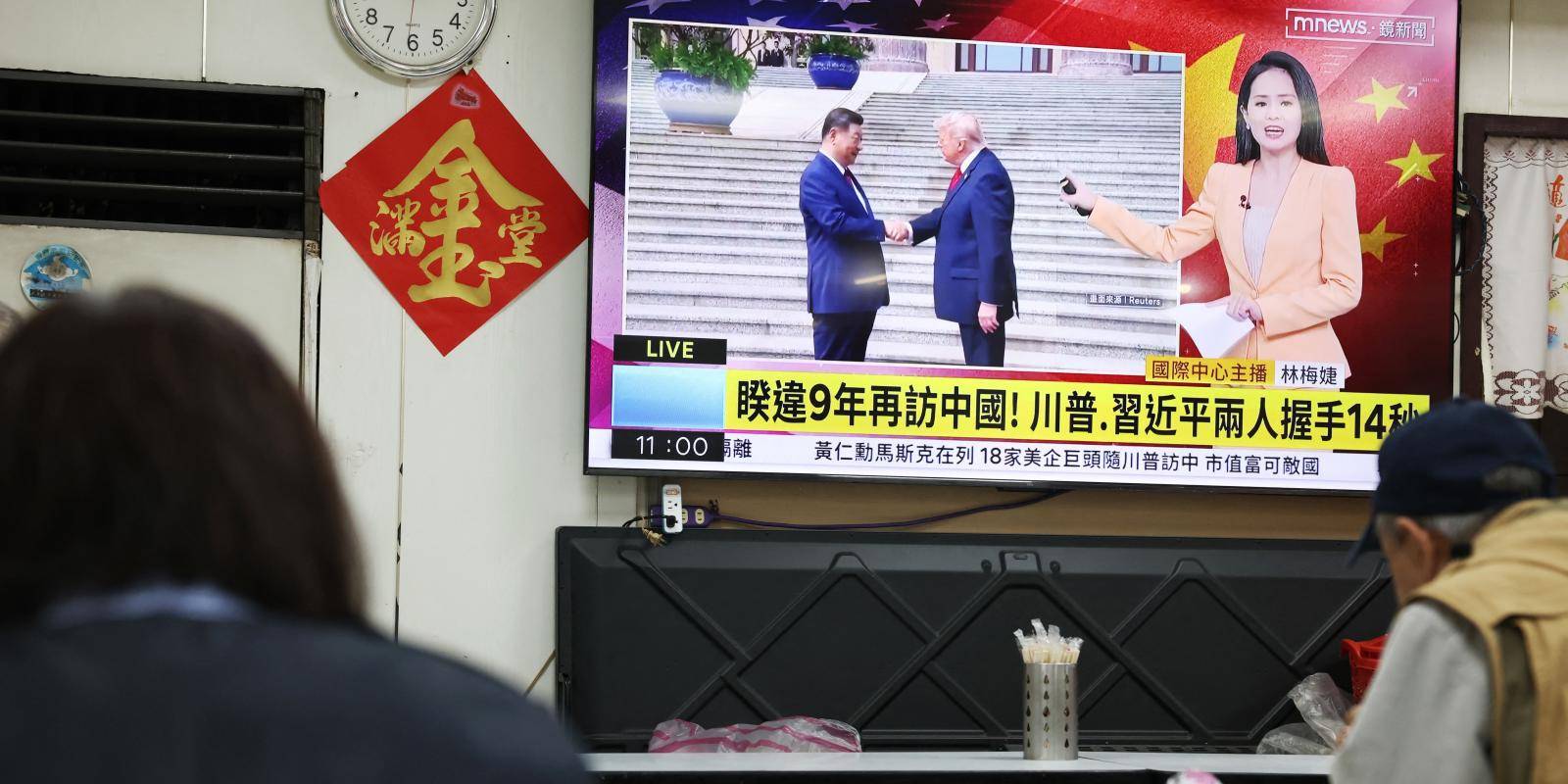
Image — A television news programme at a restaurant in Taipei on 14 May 2026 shows the meeting between the US President Donald Trump and China’s President Xi Jinping in Beijing. Photo by I-Hwa Cheng / AFP via Getty Images.

Kanishkh Kanodia
Academy Associate, US and the Americas Programme
When US President Donald Trump met with China’s President Xi Jinping in Beijing last week, there was concern that he might negotiate the future of Taiwan to strike a deal with China. For Beijing, Taiwan is the most important issue in the US-China bilateral relationship. Xi even warned that if the issue is mishandled, it could trigger ‘clashes and even conflicts’.
Reports in the run-up to the meeting suggested that China would seek a change in America’s long-standing position on Taiwanese independence. Rather than merely ‘not support’ it, China wants the US to ‘oppose’ Taiwan’s independence and to endorse Beijing’s goal of unification. Such a shift in US policy might appear symbolic, but it would be disastrous not only for the self-governing island, but also for America’s posture in the Indo-Pacific and the region’s security.
In the end, such a shift did not materialize. US Secretary of State Marco Rubio even asserted that America’s position remains unchanged. But the momentary respite has merely deferred the underlying anxiety.
Endangering Taiwan’s security
A better insight into Trump’s thinking on Taiwan comes from an interview with Fox News, that aired soon after he departed Beijing. Three things stood out. First, Trump said that he will use a $14bn weapons sales package to Taiwan that requires his approval as a ‘very good negotiating chip’ to deal with China. Earlier this year, the president deferred the multi-billion-dollar sale of missiles, anti-drone equipment and air-defence systems until after the summit to avoid derailing it.
Trump also said he has consulted with Xi on the matter and seems willing to negotiate a future arms sale to Taiwan with Beijing. This runs against one of the 1982 US Six Assurances to Taiwan, which states that the United States will not consult with China on its arms transfers to Taiwan. The assurances serve to reassure Taipei to restrain it from provocations and bolster its defensive capabilities to deter Beijing. Further delaying arms deliveries could operationally weaken Taiwan’s defensive capabilities, upend the military deterrent – and make Taiwan more jittery.Related workThe Trump-Xi summit: What does the US want from China and will Trump get it? Independent Thinking podcast
With Trump and Xi reportedly set to meet at least three more times this year, the temptation to hold back US arms transfers in order to preserve the summit cadence will only grow. It could also tempt Beijing into asking for more concessions that weaken US security guarantees, such as restrictions on cabinet visits to Taiwan or curtailing US transits by the Taiwanese president.
Second, when asked about whether the United States would come to Taiwan’s aid in case of a conflict, Trump maintained the US line of strategic ambiguity. But he also said that the US was not looking to fight a war 9,500 miles away. Ambiguity only works as deterrence when underwritten by credible resolve – and Trump’s comments cast doubt over that. The statements also come as US military resources have been diverted from the Indo-Pacific to the Middle East and its munitions stockpiles are depleted. Beijing could read this as an opportunity to test American credibility, and slowly chip away at Taiwan’s resolve by ramping up its intimidation tactics.
Third, during the interview Trump parroted Beijing’s view of who is to blame for tensions in the Taiwan Strait. ‘We are not looking to have somebody say let’s go independent because the United States is backing us’, he said. Beijing has framed Taiwan’s desire for independence as the main reason for the deterioration of relations. Trump also failed to mention Beijing’s relentless coercive pressure on Taiwan and actions in the Taiwan Strait. His tacit endorsement could serve to legitimize Beijing’s narrative and tactics.
Taken together, Trump’s comments undercut the precarious balance that has characterized US policy on Taiwan for decades. It would sow doubt among the Taiwanese public about the credibility of the US security guarantee and their own ability to defend the island. They could also embolden Xi, who seeks a fourth term next year and has vowed to not let the Taiwan issue pass onto the next generation.
Implications of US–China ‘strategic stability’
Another concern arising from the summit is Beijing’s new framing of the US-China bilateral relationship as pursuing ‘constructive strategic stability’. Marco Rubio also echoed this phrase in his interview with NBC News during the summit, implying Washington has endorsed this idea, at least rhetorically. What it actually means is unclear. Beijing has long preferred vague formulations because it can change their substance based on its interest. This could have implications for Taiwan. Any US action contrary to Beijing’s core interests on the issue could be framed as a violation of this strategic stability, with Washington cast as the disruptive party. How much the Trump administration cares about the framing is unclear. But if it does, the pattern of withholding assistance to Taiwan as leverage could harden into the new baseline.
Topics
Regions
Departments
Subscribe to our weekly newsletter
Our flagship email provides a round-up of content, plus the latest on events and how to connect with the institute.Enter emailSubscribe
content
The implications of this send ripples beyond the Taiwan Strait. America’s allies in the region depend on treaty commitments that, however formal, ultimately rest on the willingness of a US president to honour them. There are already growing concerns among allies about US reliability under the Trump administration. Now there is the added worry that a US-China relationship based on strategic stability could see Washington, either explicitly or tacitly, fold the interests of its allies into a bilateral framework with China, rather than deal with them on their own terms. Related workUS Indo-Pacific allies are unhappy about Trump’s defence demands. But they have to comply
If US allies in the region grow more anxious about being managed rather than defended they may begin pursuing more aggressive measures for their own security, including nuclearization. Two key allies, Japan and South Korea, are already ramping up their defence spending and strengthening their domestic defence industries, as well as bolstering security partnerships with other regional partners. Japan also recently overhauled its decades-old ban on defence equipment exports. But nothing can replace American security guarantees.
It also further complicates any discussions of burden-sharing between the Trump administration and Asian allies. The US is already pressing South Korea to allow US Forces Korea to be re-oriented away from North Korea and towards China and should open negotiations with Japan later this year on the renewal of the Special Measures Agreement, due to expire in March 2027, which determines the financial and logistical burdens of the US–Japan alliance. After the Trump–Xi summit, such conversations may sit within a broader discussion about whether American alliances are strategic assets or bargaining chips.
For decades, peace in the Indo-Pacific has rested on the consistency of US policy towards the Taiwan Strait and a belief in America’s willingness to honour its commitments. Absent that, the region would enter uncharted and dangerous waters. Even without a ‘grand bargain’ on Taiwan, Trump’s Beijing visit may have left the US with a weaker hand, Taiwan’s security more precarious, and the region more volatile.

 canisgallicus