VIDEO | Netanyahu and late warmonger Lindsey Graham conspired to undermine ICC Documentary footage and reports published by The New York Times have brought to light a private phone call from 29 October 2024, involving the late US Senator Lindsey Graham and Israeli Prime Minister Benjamin Netanyahu.
Captured by British filmmaker Alex Holder during years of behind-the-scenes access, the recording reveals a coordinated effort to pressure and undermine the International Criminal Court (ICC) just before the court’s decision on arrest warrants for Netanyahu and former War Minister Yoav Gallant regarding war crimes in Gaza. The leaders discussed political and legal strategies to obstruct the ICC’s proceedings. This included leveraging external pressures—such as allegations against then-ICC Prosecutor Karim Khan—to cast doubt on the court’s legitimacy and stall the issuance of the warrants. The initiative involved rallying bipartisan backing in the US Congress, with Graham working alongside House and Senate members to issue formal expressions of opposition.
Around one billion people struggle with stress-related illness globally – and that figure is rising. What protects those with good mental health? Is their resilience innate? Or is the ability to withstand chronic stress and crisis something that can be learned?
In the search for answers, the film visits some of the leading figures in resilience research. The filmmakers also interview epigeneticists and neuroscientists.
In the largest European resilience center in Mainz, Germany, researchers conduct a long-term study to explore the mechanisms deployed by people who enjoy good mental health despite stress and crisis.
In southern France, the film meets Boris Cyrulnik, a pioneer of resilience research. His credo: when it comes to resilient behavior, it’s not just down to us – society and politics also have a responsibility to create appropriate conditions for stable psychological health.
And the film tells the moving story of two families united by tragedy: following the violent death of their two sons, who were friends, they struggle to find their way back to some semblance of normal life.
Our experiences, our environment and our genes – all influence our powers of mental resilience. Resilience isn’t a magic word or a promise of happiness, but a life-long learning process.
Can’t-miss innovations from the bleeding edge of science and tech Email address Sign Up
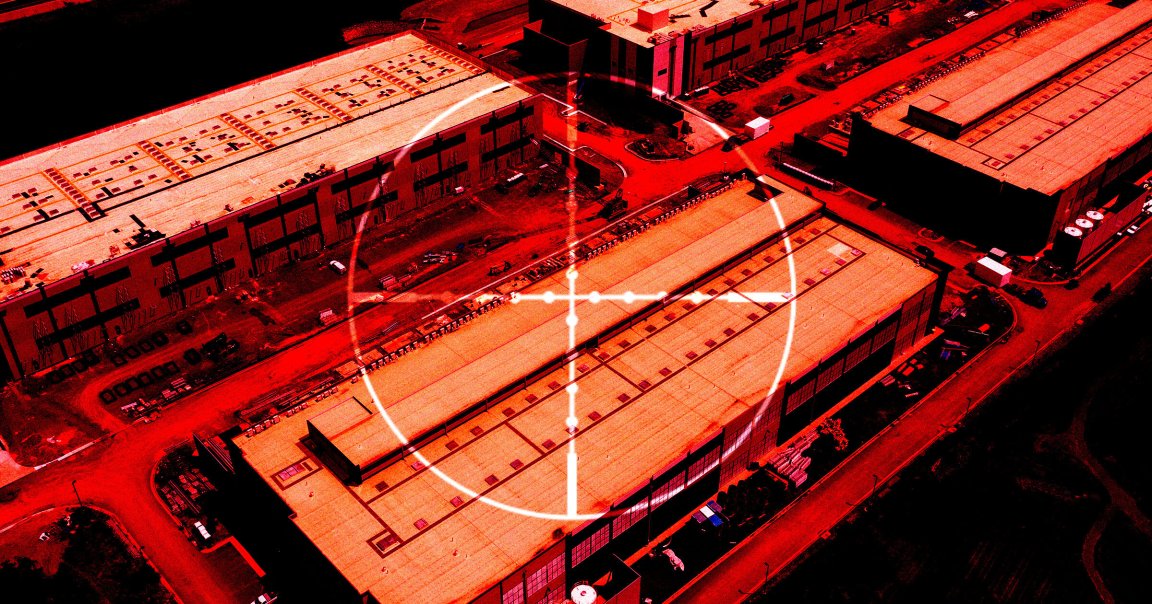
There’s data center activism, fought with Facebook groups and petitions, and then there’s data center annihilation, fought with guided missile and suicide drones.
Recently, the Iranian military announced it had hit and damaged two Amazon data centers in the island country of Bahrain with a volley of cruise missiles.
After the attack, the Iranian state media outlet Tasnim published a partial statement from the Islamic Revolutionary Guard Corps, saying that the “IRGC Aerospace warriors… in response to the aggression and assault… by the child-killing American army on the under-construction and civilian facilities of DarKhoveyn, attacked and destroyed the central data infrastructure of the American company Amazon in Bahrain with several cruise missiles.”
Using images from the European Space Agency’s Sentinel-2 satellites, Bloomberg confirmed an attack on the data center campus had taken place, though noted it’s difficult to say how bad the damage is (Amazon refused to comment on Bloomberg‘s reporting.)
“Analysis of Sentinel-2 images shows evidence of damage to both facilities, but does not provide insight into the extent of the damage,” Adam Farrar, Bloomberg‘s senior geoeconomics analyst said.
Overall, it marks the fourth such attack on a data center since the US began the war in February. Back in March, the IRGC announced a number of US tech companies as “Iran’s new targets,” including Google, Microsoft, Palantir, IBM, Nvidia, and Oracle.Now that the war is heating back up, it seems that they’re becoming targets yet again.
Militarily, it’s a logical move, as US tech companies have been integral to the American war effort. The Pentagon is using a host of AI models to gather intelligence and select military targets for annihilation, most notably the Shajareh Tayyebeh primary school, which was destroyed in a triple-tap strike resulting in the deaths of over 120 school children, as well as parents and teachers.
Perhaps above all, it’s a statement to American president Donald Trump: the longer the hostilities linger, the more economic and technological havoc Iran is willing to unleash on the region.
Douglas Murray EXPOSES The Emergency Meeting Labour Called After The Lowe-Farage Poll Numbers Labour called an emergency meeting. Not the kind that gets briefed to journalists. The other kind — the one that happens when internal polling data arrives and the numbers are so far outside what the models predicted that senior figures need to be in the same room before anyone decides what to do. The data was the Lowe-Farage numbers. Combined, Restore Britain and Reform UK now account for over a third of the British electorate. Douglas Murray breaks down what happened in that meeting, what it reveals about a government that has run out of honest arguments, and why the response will make everything worse.
⏱ TIMESTAMPS
00:00 — The Meeting The BBC Will Never Report On 02:30 — The Numbers That Caused The Panic — What The Data Actually Shows 05:00 — Labour’s Response — And Why It Will Fail Again 07:45 — What Lowe Said In Parliament That Made The Numbers Worse 10:30 — Why The Emergency Meeting Ended With No Real Answer 12:15 — The Constituency Data That Should Terrify Every Labour MP #DouglasM#LabourCrisis#RupertLowe#NigelFarage#ReformUK#RestoreBritain#UKPolitics#WestminsterPanic ⚠️ DISCLAIMER This channel presents political commentary and opinion based on publicly available information. All views expressed are those of the commentator and do not constitute legal, financial, or professional advice. Clips and footage are used for the purposes of commentary and criticism under fair dealing provisions.
We believe the Sovereign AI revolution is the most important movement since the advent of LLMs. This is a rebellion against the harvesting and migration of institutions’ and individuals’ data into the weights of closed models, only for their own knowledge to be rented back or used to replace them. It is a rebellion against the statistical tendency of these models towards the average and mediocrity.
We believe every great institution is differentiated, and sovereignty is what enables that institution to own, protect, and compound its differentiation. We are the leader because we have been doing this for twenty years. Everything we have built has been in service of giving institutions maximal control over their operations, data, decisions, and their future.
We are the sovereignty company. We do not exist by extracting value from our customers. We are confident enough to take on the risk of failure, and unlike any other company, we succeed only when our customers do.
We are pushing the frontier and creating genuine impact in the world’s most important institutions.
Thank you to all the Palantirians currently building, to our hundreds of commercial and government partners around the world, and to those who paved the way. The revolution is just beginning. Join us. https://jobs.lever.co/palantir/dab396d4-2f14-4796-aac0-0d82883dccf0
Can’t-miss innovations from the bleeding edge of science and techEmail addressSign Up
Don’t worry about the death toll and economic devastation. There’s money to be made!
As the United States launches a “heavy wave” of strikes against Iran, a conflict that turned from a limited incursion into an extremely expensive and painfully drawn-out war, some clear winners are starting to emerge — and we’re definitely not talking about the American people.
As the Wall Street Journal reports, British fossil fuel giant Shell is reaping enormous profits thanks to spiking oil prices triggered by the conflict in Iran. Its second-quarter adjusted earnings rose from just shy of $7 billion the previous quarter to a stunning $9.84 billion in the most recent one. That’s well above already-lofty expectations from analysts, who predicted earnings of $8.92 billion. It’s also double compared to the same period last year, indicating a major surge in profits, in large part due to the violence in Iran.
Shell isn’t alone in the oil industry. Both Chevron and ExxonMobil are expected to report “monster earnings,” as CNBC put it, later this week.
Beyond the oil and gas industry, major banks including JPMorgan are making record profits during the ongoing war thanks to heavy trading volumes as investors rush to dump volatile assets or buy the dip.
Then there’s the Department of Defense’s many contractors, which are also seeing strong growth in sales and profits. Three of the biggest defense contractors, Lockheed Martin, Boeing and Northrop Grumman, reported record sales backlogs boosted by the Iran war earlier this year, from anti-ballistic missile systems to Patriot drones and intercontinental ballistic missiles.
In short, it doesn’t take much reading between the lines to see who the real winners and losers of Trump’s prolonged war are. It’s a conflict lining the pockets of the military industrial complex and fossil fuel companies — the last thing a society suffering the effects of human-induced climate change and reeling from political instability needs.
I’m a senior editor at Futurism, where I edit and write about NASA and the private space sector, as well as topics ranging from SETI and artificial intelligence to tech and medical policy.