Discover the forgotten story of Fred Trump Jr in this deep-dive historical documentary. Known as the tragic black sheep of the Trump family, Freddy Trump was the eldest son born to inherit Fred Trump Sr.’s massive New York real estate empire. Instead, he chose his own path, walking away from billions to become a commercial airline pilot for TWA. This full documentary explores the complex family dynamics, intense pressure, and personal struggles of Donald Trump’s older brother. Through historical archives, personal records, and character analysis, we unpack the hidden history of the Trump family dynasty, from the boardroom battles of Queens and Manhattan to the heartbreaking downfall of the reluctant heir who tried to escape his family’s shadow. Why did the firstborn son walk away from the crown? How did his life and untimely death shape the future of his family forever? Watch to uncover the real story behind the most misunderstood figure in modern American political and business history. Please subscribe here. / @peopleprofiles Our second channel. / @peopleprofilesextra ollow us on Spotify. https://open.spotify.com/show/7fKALbr… Support us on Patreon / thepeopleprofiles Follow us on Twitter. / tpprofiles
When Norway discovered North Sea oil, it was already stable and prosperous; oil enabled it to solve problems with money. Over the following decades, petroleum wealth financed an expanding state, generous social protections, and broad investments that allowed Norway to raise living standards while postponing many of the difficult trade-offs faced by other countries.
Today, Norway remains one of the world’s wealthiest societies, yet it faces a new generation of structural challenges. Increasingly, these challenges are proving resistant to higher spending alone, forcing long-delayed choices about work, welfare, efficiency, and the role of the state back into public debate.
Norway’s greatest challenge may no longer be creating prosperity, but adapting a model built during an era of exceptional abundance.
Hours after President Trump halted a planned bombing campaign in Iran, Democratic Sen. Mark Kelly argued on “Face the Nation with Margaret Brennan” that the Trump administration “got us into this without a strategic goal, without a plan, without a timeline.” He also pushed back on the administration’s request for supplemental Pentagon funding. “Face the Nation” is America’s premier Sunday morning public affairs program. The broadcast is one of the longest-running news programs in the history of television, having debuted Nov. 7, 1954, on CBS. Every Sunday, “Face the Nation” moderator and CBS News senior foreign affairs correspondent Margaret Brennan welcomes leaders, newsmakers, and experts to a lively round table discussion of current events and the latest news. Subscribe to the “Face the Nation” YouTube channel: https://youtube.com/facethenation/ Watch full episodes of “Face the Nation”: https://www.cbsnews.com/face-the-nati… Follow “Face the Nation” on Instagram: / facethenation Like “Face the Nation” on Facebook: / facethenation Follow “Face the Nation” on Twitter: / facethenation Subscribe to our newsletter: https://cbsnews.com/newsletter/ Download the CBS News app: https://cbsnews.com/mobile/ Try Paramount+ free: https://paramountplus.com/?ftag=PPM-0… For video licensing inquiries, contact: licensing@veritone.com
Save2,906 views Jul 5, 2025 The Garda PodcastIn this episode, Detective Superintendent Joe O’Reilly of the Garda National Drugs and Organised Crime Bureau takes us behind the MV Matthew operation. The previous Garda Podcast episode – EP 26, outlines the timeline of the MV Matthew interdiction and subsequent conviction of eight men. Background: On September 23 2023, a Panama flagged cargo ship called the MV Mathew entered Irish territorial waters, having set off from Curacao, an island off the coast of Venezuela. Unbeknownst to its crew, suspicions about the ship’s activities had been communicated by international intelligence agencies to An Garda Síochána’s Drugs and Organised Crime Bureau. The ship was being monitored, with the belief that its cargo may contain illegal drugs. On September 22nd, the day before the MV Matthew entered Irish waters, two men, bought a fishing trawler called the FV Castlemore in West Cork. The activities of the crews on board both vessels would result in a dramatic joint task force operation carried out at sea in gale force winds and would lead to the largest drug seizure in the history of the State. The seizure of devices and the interception of messages between both sea fairing crews and their criminal gang members on land, led to the conviction and sentencing of eight men – six from the MV Matthew and two from the Castlemore trawler.
This handout picture released by the Israeli Government Press Office (GPO) Shows Israel’s Prime Minister Benjamin Netanyahu (L) posing for a picture with US President Donald Trump in the Oval Office of the White House in Washington DC, ahead of their meeting on July 28, 2026 [AFP]
As Benjamin Netanyahu began his latest visit to Washington, DC, to reaffirm Israel’s indispensable alliance with the United States, a public opinion survey offered a remarkable measure of how profoundly that relationship has changed. An Economist/YouGov poll released on July 28 found that 49 percent of Americans believe the Israeli prime minister should be arrested under the warrant issued by the International Criminal Court.
Even more striking, 47 percent said they believe the prime minister has committed war crimes in Gaza. Only a decade ago, such findings would have been politically inconceivable. Today, they are the clearest evidence that Netanyahu has accomplished what generations of Israeli leaders worked to avoid: transforming Israel from a bipartisan cause into one of the US’s most polarising foreign policy issues.
That transformation did not begin with the October 7, 2023, attack, nor solely with the genocide and devastation in Gaza. Those events accelerated a process Netanyahu set in motion years earlier. His greatest strategic failure was political. By tethering Israel ever more tightly to one US party, treating Republicans as permanent guarantors while dismissing Democratic concerns, he undermined the broad bipartisan consensus that had anchored the relationship for decades.
For generations, Israeli leaders understood that Israel could never afford to become a partisan issue. The alliance endured because both parties regarded Israel as a strategic partner whose security transcended domestic politics. That consensus was as valuable as any military aid package. Netanyahu inherited that asset. He is now in danger of squandering it.
Ironically, few Israeli politicians knew America better. Educated partly in the US, fluent in its political language and deeply connected to Washington’s establishment, he understood how power operated. Yet that familiarity bred miscalculation. Convinced that demographic and ideological changes favoured a permanently ascendant Republican Party, Netanyahu abandoned his predecessors’ careful balancing act and invested heavily in one side of the US’s widening partisan divide.
The decisive rupture came in 2015, when he accepted a Republican invitation to address a joint session of Congress in open defiance of President Barack Obama during the Iran nuclear debate. Conservatives celebrated the speech as an act of courage; strategically, it marked a watershed. Never before had an Israeli prime minister intervened so directly against a sitting president. Millions of Democrats concluded that Israel’s leader had chosen sides, and the consequences outlasted the Iran deal.
Donald Trump’s presidency appeared to vindicate this strategy. He recognised Jerusalem as Israel’s capital, moved the US embassy, recognised Israeli sovereignty over the occupied Golan Heights, withdrew from the Iran nuclear agreement, abandoned pressure over settlements and discarded demands for a Palestinian state. Netanyahu mistook those victories for proof that bipartisan support had become obsolete, believing Republican loyalty could permanently replace Democratic consensus. That belief was strategically short-sighted. Alliances survive because they are rooted in institutions, shared values and broad legitimacy — not because they depend on one administration. By allowing Israel to become identified with Republican politics, Netanyahu weakened the alliance precisely when it needed to remain strongest.
Israel’s genocidal war on Gaza exposed the consequences. President Joe Biden, despite unprecedented pressure from his Democratic Party, extended extraordinary military, diplomatic and political support to Israel after the October 7, 2023 attacks. He visited Israel during wartime, accelerated military assistance, defended it at the United Nations and absorbed fierce domestic criticism. Netanyahu answered with repeated public confrontations, accusing Washington of withholding weapons, rejecting US proposals for post-war governance, resisting humanitarian access and contradicting the White House on strategic questions. Even as Biden invested enormous political capital, Netanyahu appeared more intent on demonstrating independence to his domestic base than preserving the confidence of Israel’s most important ally.
Meanwhile, the conduct of the war fundamentally altered global perceptions. Relentless bombardment devastated Gaza, destroying hospitals, schools, universities and entire neighbourhoods, while severe humanitarian restrictions produced warnings of famine. Senior ministers openly advocated permanent displacement, collective punishment and indefinite military control. Whether the alleged conduct meets the legal definition of war crimes will be determined by courts; politically, the verdict is already forming — not only worldwide but increasingly within the US.
The poll findings are significant beyond Netanyahu personally. The fact that nearly half of Americans believe the Israeli prime minister should be arrested, and nearly half believe he has committed war crimes, reflects a profound shift in how Americans view Israel under his leadership. Polls fluctuate; strategic realignments do not. Once public attitudes harden across generations, rebuilding trust becomes extraordinarily difficult.
Want to come back to this article? Save it for later.Save
The political consequences are visible. Within the Democratic Party, unconditional support has given way to demands that military assistance be made conditional on compliance with international humanitarian law. Younger voters discuss the conflict in terms of occupation, apartheid and universal human rights rather than traditional alliances. Members of Congress once reluctant to criticise Israel now openly challenge successive governments. Even Republican support can no longer be assumed to be permanent; younger conservative populists have become sceptical of unconditional foreign commitments. The bipartisan consensus that once protected Israel is steadily giving way to a far more volatile environment.
Netanyahu’s governing coalition has deepened that crisis. By empowering ultranationalist ministers who openly advocate annexation, reject Palestinian self-determination and defend collective punishment, his government has blurred the line between extremist rhetoric and official state policy. Settler violence and the near absence of accountability have further eroded Israel’s standing.
Most revealing is the complete absence of any serious political vision for ending the conflict. Netanyahu has consistently rejected meaningful discussion of Palestinian statehood, opposed the return of the Palestinian Authority to Gaza and offered no credible framework for reconstruction beyond prolonged military control. Nor is this simply Netanyahu’s project; a clear majority of Israelis and virtually all mainstream political leaders share these convictions. Military power can destroy infrastructure and weaken armed groups; it cannot by itself resolve a national conflict rooted in competing claims to land, sovereignty and self-determination. By refusing a viable political horizon, Netanyahu has made perpetual conflict appear not as an unintended consequence but as official policy.
History may be kinder to tactical victories than to strategic failures. Netanyahu secured significant diplomatic gains during favourable administrations, but those achievements rested on a foundation built over decades: bipartisan confidence that Israel remained both a strategic ally and a democratic partner. That foundation is now visibly cracking.
The timing of the poll could scarcely be more symbolic. As Netanyahu met US leaders to reinforce the alliance, nearly half of the American public viewed him not as a trusted ally but as a leader who should face arrest, while almost as many regarded him as a war criminal. These numbers suggest that Netanyahu’s political strategy has fundamentally altered Israel’s standing in American public life.
Military superiority can deter enemies. Political legitimacy cannot be manufactured once lost. Trust, credibility and bipartisan support are strategic assets accumulated over generations and squandered far more quickly than they are rebuilt. If future historians search for the moment when Israel’s unrivalled position in Washington began its most consequential decline, they will not begin in Tehran, Gaza or Beirut. They will begin in Washington itself — and with the decisions of Netanyahu.
The views expressed in this article are the author’s own and do not necessarily reflect Al Jazeera’s editorial stance.
Said ArikatWashington-based journalistSaid Arikat is a Washington-based Journalist
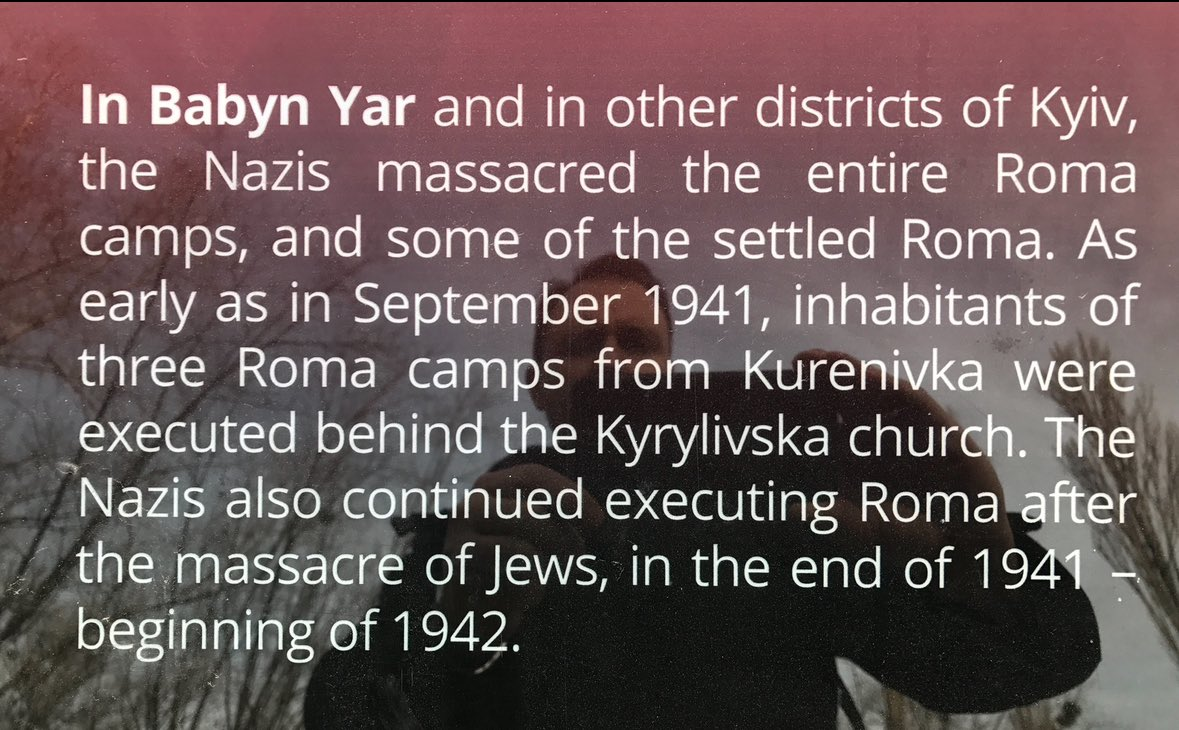
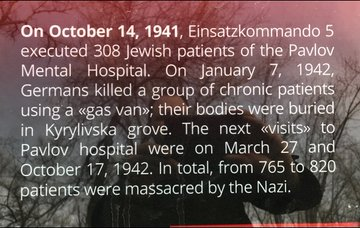
The new memorial at Babyn Yar in Kyiv — as opposed to the old Soviet memorial — has an exhibition about Roma and mental patient victims.
===========
BBC below:
Nazi disabled victims memorial unveiled in Berlin
Published2 September 2014
Share
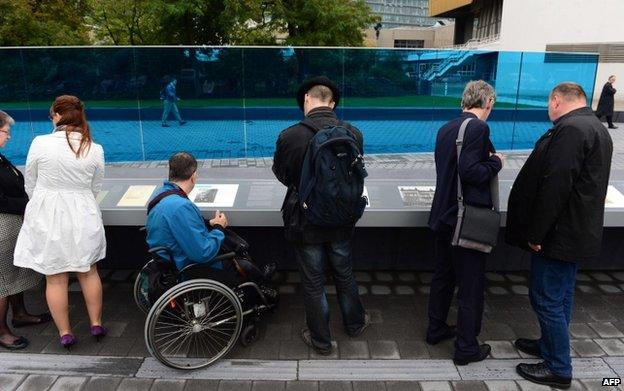
Image caption,The Nazi programme officially ended in 1941 but carried on covertly until the end of the war
A glass monument has been publicly opened in Berlin to 300,000 victims of the Nazis with mental and physical disabilities or chronic illnesses.
The 24m-long (80ft) blue, glass wall is in front of the Berlin Philharmonie building, where the office housing the Nazi “euthanasia” programme once stood.
It is the fourth monument in the German capital to victims of the Nazis.
In the past 10 years, memorials have been erected to Jewish, Roma (Gypsy) and gay victims.
Under Adolf Hitler’s initial programme, the Nazis killed more than 200,000 people from early 1940 to August 1941, focusing on patients in mental health clinics and care homes.
It was known as T4, after the Tiergartenstrasse 4 office from which it was directed.
The T4 programme continued covertly for another four years, with gas chambers and killing centres used in Germany and Austria.
It was considered a precursor to the Holocaust in which six million Jews were murdered.
Image caption,Patients from hospitals and nursing homes were among those systematically murderedImage caption,The memorial was designed by architects Ursula Wilms and Heinz Hallmann, and artist Nikolaus Koliusis
A special look for AM readers at Axios CEO Jim VandeHei’s political briefing, published first in his weekly Axios C-Suite newsletter:
President Trump doesn’t much care if Republicans lose the House and/or the Senate in November.
Yes, he’d prefer a big win. But he seems indifferent to the election and the possibility of endless Democratic investigations of his family, wealth and policies, close advisers tell us.
A big reason: Trump knows he’ll emerge just as strong, or even stronger, heading into his final two years, at least among Republicans.
The big picture: Trump is not a share-the-stage, pass-the-torch, groom-your-successor kind of guy. Instead, he’ll exploit his leverage:
A more MAGA Senate. Almost all of his critics will be gone through defeat or retirement. The incoming class is very Trumpy. If they keep the Senate, Trump loyalists like Mike Lee (Utah), Ron Johnson (Wis.) and Rick Scott (Fla.) will chair committees.
A more MAGA House. Trump already serves as de facto speaker, but his few outspoken GOP critics — Rep. Thomas Massie (Ky.) and former Rep. Marjorie Taylor Greene (Ga.) — will be gone, replaced by members who won because of him.
A ’28 kingmaker. Trump’s firm hold on the base means he will dictate the GOP’s nominee and shape their message. He wants a Vance-Rubio ticket and will likely get it if his mind doesn’t change. Imagine any ’28 hopeful, especially Marco Rubio or JD Vance, trying to break with the boss while working for the boss.
Cashing in. Trump will use levers of power to keep raising money to expand his clout beyond the presidency. “He likes the fact that when he tells someone, ‘Give me money,’ they give him money,” an adviser told us.
3 dramas to watch post-November:
Trump will flirt with running again in ’28 until the bitter end, but it’s all about PR and keeping Vance and Rubio in their place.
As potential outside-the-walls competition in ’28, the White House is watching Florida Gov. Ron DeSantis, Sen. Ted Cruz (Texas) and Sen. Josh Hawley (Mo.).
A constitutional clash over congressional oversight, among the last and most vital powers lawmakers hold dear. What happens if Trump orders his entire administration, family and friends to just ignore Congress?If you’re a CEO or on a CEO’s team: Ask to join Jim’s new weekly Axios C-Suite newsletter.Share this briefing.

 / @peopleprofiles Our second channel.
  / thepeopleprofiles Follow us on Twitter.
  / tpprofiles

 / facethenation
  / facethenation

 50 episodes






 A more MAGA Senate. Almost all of his critics will be gone through defeat or retirement. The incoming class is very Trumpy. If they keep the Senate, Trump loyalists like Mike Lee (Utah), Ron Johnson (Wis.) and Rick Scott (Fla.) will chair committees.
 A more MAGA House. Trump already serves as de facto speaker, but his few outspoken GOP critics — Rep. Thomas Massie (Ky.) and former Rep. Marjorie Taylor Greene (Ga.) — will be gone, replaced by members who won because of him.
 A ’28 kingmaker. Trump’s firm hold on the base means he will dictate the GOP’s nominee and shape their message. He wants a Vance-Rubio ticket and will likely get it if his mind doesn’t change. Imagine any ’28 hopeful, especially Marco Rubio or JD Vance, trying to break with the boss while working for the boss.
 Cashing in. Trump will use levers of power to keep raising money to expand his clout beyond the presidency. “He likes the fact that when he tells someone, ‘Give me money,’ they give him money,” an adviser told us.
 3 dramas to watch post-November:
 If you’re a CEO or on a CEO’s team:


