Elon Musk and Mark Zuckerberg have muscled their way back into AI’s elite ranks, closing the gap on a new generation of Silicon Valley startups, Axios’ Madison Mills and Zachary Basu write.
Why it matters: Recent gains by tech giants SpaceX and Meta — long stuck in AI’s second tier — are putting pressure on a hierarchy dominated by OpenAI and Anthropic.
Both companies released models this week with performance and pricing that would’ve been hard to imagine from either lab a year ago.
SpaceX’s Grok 4.6 scored essentially even with OpenAI’s GPT-5.6 Sol Max and just behind Anthropic’s Fable 5 Max on the closely watched Artificial Analysis Intelligence Index.
Promising “something special,”Musk said Grok 4.7 should arrive in three to four weeks and predicted it will “exceed all current models” after additional training on a massive trove of SpaceX data.
Meta is trying to squeeze the frontier from below. Its new models deliver competitive performance at dramatically lower cost — including Muse Glimmer, an open-weight system small enough to run locally on a laptop.
Zoom in: As OpenAI and Anthropic pulled ahead, Musk and Zuckerberg answered with the full force of their empires — spending billions on talent, infrastructure and acquisitions.
Zuckerberg overhauled Meta’s AI effort after the disappointing launch of Llama 4, then invested $14.3 billion in Scale AI and brought aboard its CEO,
Musk went even further, folding xAI into SpaceX and agreeing to acquire Cursor for $60 billion — bringing massive computing power, proprietary SpaceX data and a fast-growing AI coding platform under one roof.
Between the lines: The AI race is starting to reward more than raw intelligence, as price becomes a decisive advantage for many users.
Reality check: Anthropic and OpenAI still hold pole position — with even more capable models waiting in the wings, including systems deemed too sensitive for public release.Share this story.
Graduating illiterate has become the new norm in American public schools
A teacher broke down in tears describing what he’s seeing in the classroom.
His seniors, kids about to graduate, couldn’t fill in 4 simple words on a basic assignment.
The correlation between reading levels and incarceration has been documented for decades, yet the country acts surprised by where so many of them end up.
Can’t-miss innovations from the bleeding edge of science and tech Email addressSign Up
The good guys protecting us from people who want to work and live here will continue their morally upright quest by electrocuting their foes into submission.
As the Associated Press reports, the US Immigration and Customs Enforcement agency is planning to spend up to $20 million to purchase thousands of “conductive distraction and de-escalation devices” that officers and agents can wear in the field to zap anyone they don’t like.
The devices are called GLOVEs, short for Generated Low Output Voltage Emitters. Their manufacturer, Compliant Technologies, says that they behave like normal gloves until activated with a switch, and need to make direct contact with someone’s skin. The painful shock they administer can help an ICE agent “gain compliance within seconds,” per the AP‘sreporting, citing the company.
“It’s immediate and sharp, and it will distract you. I call it like a bee sting,” John Peters, president of the Institute for the Prevention of In-Custody Deaths, who’s studying how the device is being used, told the AP. “If the officer is getting any type of resistance from the person, this is certainly an effective tool.”
These plans were disclosed in a notice published Monday by the Department of Homeland Security, which states that the devices would be delivered by the end of next March. It’s unclear exactly how many the DHS intends to buy, or how long it will be until agents would start using them.
The news has left left civil rights advocates horrified.
“ICE spent the last year showing this country they are too quick to use force. Now they will be able to deploy electric shocks with the slight push of a button that maybe nobody else can see them do,” Jenn Rolnick Borchetta, deputy project director on policing at the American Civil Liberties Union, told the AP. “Introducing gloves that can so easily be used to deliver terrible pain in encounters is a recipe for harm to the public.”
“This is a rogue agency with an $80 billion slush fund that allows them to concoct and fund new ways to visit cruelty upon our communities,” Kica Matos, the president of the National Immigration Law Center, told CNN, calling the the possible use of the gloves “disgusting and barbaric.”
Naively, or simply to exonerate itself of any future wrongdoing, Compliance Technologies warns that its capital-G GLOVEs should not be used as punishment, against people merely exhibiting “verbal defiance or belligerence” or on children, pregnant women or elderly or disabled people, per the AP.
We’ve already seen how regular law enforcement can misuse the devices. In 2022, two corrections officers at the Laurens County Detention Center in South Carolina were arrested and charged with brutalizing an inmate and using a GLOVE device to repeatedly stun them, CNN noted.
I’m a tech and science correspondent for Futurism, where I’m particularly interested in astrophysics, the business and ethics of artificial intelligence and automation, and the environment.
Ever heard the phrase “hat in hand”? Ever tried to embody it?
It’s perhaps the least natural way for me to operate in the world. But I’ve been trying it more, Axios’ Natalie Daher writes.Why it matters: For all sorts of reasons, we can default to defensiveness when a partner, friend or co-worker tells us we’re doing something wrong. That pesky habit can end a conversation that’s supposed to clear the air.
TIME’s Angela Haupt recently put together a useful guide to getting less defensive.
The big picture: Defensiveness often feels more like setting the record straight. But it can make us more entrenched in our own perspective and less able to hear someone else’s.
“The more defensive we become, the lonelier we become,” psychiatrist Jeff Katzman tells TIME.
A few tactics for waving the white flag: 1.Notice your physical warning signs. Maybe your chest tightens or your pulse spikes.
That can tell you to slow down and take a beat before responding.
2. Figure out what feels threatening. Often, it’s not the point you’re arguing about. It’s your sense of yourself: that you’re thoughtful, caring or good at your job.
That can make a simple request seem like a personal attack.
3. Trade certainty for curiosity. One of my favorite parts of aging is the creeping acceptance that I’m not nearly as certain as I once thought. In fact, I know very little at all.
I took improv for two weeks and quit out of shame and mortification. But one tenet survives: “Yes, and.
“The idea applies here: Acknowledge the other person’s experience. Hearing somebody out doesn’t require surrendering your own viewpoint.
4. Find the 2% truth. New York clinical psychologist Eli Kraiem, who specializes in couples therapy, uses this frame: Even if you think 98% of a critique is bunk, identify and own a small piece of it.
5. “Always” and “never” are devil words. “But” isn’t your friend either. They invite generalizations, and can incite the other party.
6. Keep a repair line handy.
Try: “Help me understand what I’m missing here.
“Or go for the apology: “I’m sorry. Can we try that again?
“The bottom line: Hat in hand doesn’t mean admitting you’re wrong about everything. It means dropping the impulse to win long enough to hear what the other person is trying to tell you
Soros broke the Bank of England in 1992, shorting the pound and walking away with $1 billion in a single day. You want to hate him for his politics, fine. But the man read central bank stupidity better than almost anyone alive and bet his own capital on it. That’s the part collectivists never credit. He didn’t steal that billion.
The Bank of England’s bureaucrats handed it to him by defending an indefensible exchange rate with other people’s money.Soros recognized the math before they admitted it. Disagree with how he spends his fortune? As do I. But intellectual honesty demands you separate the trader from the activist. He was a predator who hunted government overreach for profit. In a free market, that’s called discipline.
In 1906, the journalist W.T. Stead warned in A Plea for the Revival of Reading that Britain faced a reading crisis. People, he complained, no longer read books. Instead, they skimmed newspapers on trains, forgot what they had read by lunchtime and increasingly preferred distraction to sustained attention.His proposed solution? A national revival of reading.
One hundred and twenty years later, 2026 is the UK’s National Year of Reading. After years of concern about declining rates of reading for pleasure, the headlines are dramatic. The Times recently warned: “If humans stop reading, barbarians will live among us again”. Screens, smartphones and short-form video social media platforms like TikTok are regularly presented as the culprits.
So, reading Stead’s pamphlet (1906) today is an uncanny experience. While researching Stead’s journalism for my book The Americanisation of W.T. Stead (2026), I found that many of the arguments we assume belong to the digital age were already being made in Victorian Britain.
Stead begins with a distinction that still lies at the heart of debates about reading: “Millions have never yet found out that books were interesting,” he writes. “They can read, but they do not care for reading”.
This observation chimes with our contemporary moment. The problem is not literacy alone, but reading identity. Someone may possess the technical ability to read without ever coming to think of themselves as a reader. Current reading research makes a similar distinction. There is now broad agreement that developing a love of reading depends not simply on decoding words but on motivation, confidence and finding books that feel relevant.
Stead also rejected the idea that this love of reading could simply be imposed: “The love for the reading of books is an acquired taste,” he argued. Children might have to be compelled to learn to read, but learning to love reading required something quite different, “instead of coercion there is needed a good deal of coaxing”.
Join our readers who subscribe to free evidence-based news
Get newsletter
Again, this sounds very familiar today. Modern initiatives promoting shared reading, reading for pleasure and child-led book choice all rest on the principle: readers are made through encouragement rather than compulsion.
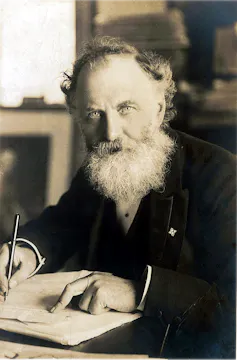
WT Stead was worried about the death of reading. Wikimedia
Stead’s advice began with children. He believed that one of the most effective ways of creating readers was simply reading aloud. Good oral reading, he claimed, was “the surest, simplest, and speediest way of awakening a love of reading”.
More than a century later, spoken language is once again moving up the educational agenda. The government’s proposed oracy framework, expected to be introduced by 2028, reflects a renewed recognition that speaking, listening and reading are closely connected – even if the framework’s primary focus extends beyond literacy alone.
It is in Stead’s discussion of attention, however, that the similarities with today’s debates become most apparent.
The attention debate
Stead worried that newspapers had fundamentally altered reading habits. Circulation libraries, newspapers and magazines encouraged “a habit of skimming rather than reading”. Newspapers, he complained, had become “mere rag bags of shreds and patches”. Readers looked through them “as we look into kaleidoscopes”, producing only “an evanescent effect upon our minds”.
Replace “newspapers” with “social media feeds” and the argument would sound entirely contemporary.
“Memory, judgement, the critical faculty are unexercised”, Stead lamented. It is difficult not to hear echoes of today’s debates about social media and, increasingly, concerns about generative-AI technologies. Critics now ask whether the use of AI assistants to process information and endless scrolling on screens fragments attention, weakens memory and encourages rapid emotional reactions rather than sustained reflection. While the technologies are radically different, the underlying concern is remarkably familiar: the way we consume information shapes how we think.
Where Stead relied on cultural observation, researchers today investigate these questions empirically. There is growing evidence that sustained, immersive reading supports concentration, reflection and aspects of mental wellbeing, while regular reading has also been associated with lower stress levels and, over the longer term, healthier cognitive ageing.
At the same time, experts caution against simplistic comparisons between books and screens. Different media support different kinds of reading, and much depends on what people are reading and how they engage with it.
Stead quotes the Liberal MP and editor John Morley, who argued that people needed to make time in each day – half an hour ideally, but even a quarter of an hour, if pushed – for what he called “good and disinterested reading”. The value of this practice, he suggested, lay not simply in acquiring knowledge but in cultivating “happiness, fortitude, wisdom and calm”. To translate those words into modern terms, we might say reading supports our mental health, emotional resilience and everyday wellbeing. The language has changed, but the aspiration is the same.
Although Stead worried that newspapers encouraged superficial reading, he also recognised that books would have to adapt. “Books”, he wrote, “must struggle for existence by the use of the same weapons as those which have secured the ascendency of the newspaper”.
This is perhaps the most surprising insight in the pamphlet. Rather than defending books against modern media, Stead argued that they should borrow modern media’s strengths. Books should become cheaper, shorter, regularly issued and more accessible.Far from resisting new communication technologies, he believed reading could flourish by adapting to them. Today’s equivalent might be publishers embracing audiobooks, podcasts, readings apps and BookTok. The principle is the same: meet readers where they already are.
Of course, Stead did not get everything right. Like many of his contemporaries and forebears, he worried about the dangers of “habitual novel reading”. He discussed proposals from America that would have restricted children’s access to popular fiction in a similar way to how tobacco sales were regulated. Today, those fears seem excessive. Yet they offer a useful reminder that every generation identifies certain forms of reading as uniquely dangerous.
The recent resurgence of book challenges and bans reminds us that debates about reading have always been as much about what people read as whether they read at all. Whether such restrictions are justified or not, history suggests these debates often reveal broader anxieties about childhood, attention and morality as much as the medium itself. Each generation, it seems, has its preferred media villain.
That is not to say current concerns should be dismissed. Reading for pleasure has genuinely declined among children, and many adults struggle to sustain the time and concentration that long-form reading demands. These are important educational and cultural questions, but they are best understood as part of a much longer story. Every major communications revolution has prompted fears that serious reading was disappearing. Yet reading has repeatedly adapted rather than vanished.
Stead understood something that remains true today. The challenge is not merely persuading people that books matter. It is, as he put it in 1906, helping people who “can read” become people who “care for reading”.
Helena GoodwynAssistant Professor of English Literature and Creative Writing, Northumbria University, Newcastle
Disclosure statement
Helena Goodwyn does not work for, consult, own shares in or receive funding from any company or organisation that would benefit from this article, and has disclosed no relevant affiliations beyond their academic appointment.
Republish our articles for free, online or in print, under Creative Commons licence.Republish this article
The most frequent question we’re asked as arts editors: “Have you seen anything good lately?”
Our newsletter is the answer. We all lead busy lives, with countless things demanding our attention: work, chores, childcare. Free time is precious. But with so many options for what to watch and read at the end of day, listen to on our commute, or visit in town, we don’t want to waste it sifting through them all. Something Good cuts through the noise, with a carefully curated selection of the latest film, TV, book, video game and music releases, as well as live events and exhibitions – straight to your inbox, every fortnight, on Friday afternoons. And unlike other roundups, our selection is chosen by academic experts.
Henry Comerford (c. 1795/1796–1861) was a classic self-made Galway merchant who rose from modest origins to become a substantial landowner, magistrate, and shipowner — only for his aggressive post-Famine land speculation and one notorious shipping disaster to define his legacy.
Family background
His father, George Comerford, was a Galway builder and coachmaker based on or near Merchant’s Road. In 1827 George contracted to build/complete the pier/quay at Seafield (near Quilty), Co. Clare, for £253, with his son Henry (already a merchant) as one of the sureties. George provided the commercial foothold that allowed his sons to advance. Henry’s brother Isaac Comerford (c. 1797–1869) was his closest associate. Both became prosperous merchants and Justices of the Peace in Galway.
Isaac acted as draper and shopkeeper in Kinvara, served as treasurer of the Galway Magistrates from 1847, and was sole executor of Henry’s will.After Henry’s death Isaac continued (and intensified) the high-rent policy on Kinvara lands, raising the rental from £335 to £1,150 before being adjudged bankrupt in 1866. Their relationship was one of close business partnership and mutual support; Isaac erected the family mausoleum inscription describing Henry as “a fond parent, a faithful friend, a prudent adviser, and in all his dealings just.” Henry married Margaret McDonagh (d. 31 August 1851 at Salthill). They had a large family (sources say up to 12 children), but high infant and child mortality left few survivors to adulthood. The two principal heiresses were the daughters Mary Josephine and Henrietta Emily.
Rise as merchant and civic figure
Operating from Merchant’s Road, Henry built a successful trade (including timber and general merchandise) and owned the brig St. John. On 18 September 1832 he was admitted a Freeman of the City of Galway (listed as merchant of Merchant’s Road). In the early 19th century a Freeman held the traditional civic freedom of the corporation. This conferred the right to trade freely within the city, participate in certain municipal privileges, and (before the reforms of the 1830s–40s) vote in parliamentary elections for the borough. Admission was a mark of established mercantile status, especially significant for Catholic merchants after the 1793 Relief Act opened the freedom more widely.
Henry was also sworn to the Galway Town Grand Jury (1840) and subscribed to local relief funds. As a Justice of the Peace he sat at Petty Sessions (minor criminal matters, debt, licensing, public order) and on the Grand Jury (local taxation, roads, bridges, and administration). No high-profile or especially “interesting” individual cases involving him as magistrate have been highlighted in surviving published records; his role appears to have been the routine local administration typical of a substantial merchant-JP of the period. He is not recorded as sitting in higher courts as a judge.
The St. John tragedy (1849) Henry owned the Galway brig St. John (c. 200 tons). It sailed from Galway on 7 September 1849 for Boston with roughly 100 passengers (many from north Clare — Ennistymon, Lahinch, Kilfenora — and Galway/Connemara) plus crew. On 7 October 1849 it wrecked on Grampus Ledge off Cohasset, Massachusetts, in a gale. Nearly 100 people drowned. The first mate was Henry Comerford Jr. (widely identified as a nephew), who survived along with the captain. About 45 bodies were recovered and buried in a mass grave in Cohasset Central Cemetery (later marked by the 1914 Celtic Cross). Henry David Thoreau visited the scene two days later and described it in the opening chapter of Cape Cod. No evidence has been found that Henry paid compensation to victims’ families; mid-19th-century maritime law offered limited owner liability for such losses.
Land purchases and rack-renting
Henry married a McDonagh and received Ballykeale House near Kilfenora, Co. Clare, in 1839. In the 1850s, using the Encumbered Estates Court, he spent over £35,000 on roughly 4,440 acres in Co. Galway, including the heavily indebted Kinvara estate of Sir William Gregory (purchased 1857 for about £23,000, including tolls, customs, Delamaine Lodge, and town properties). He financed the purchase with a Dublin bank loan secured against expected higher rents, then immediately doubled or trebled existing rents. Tenants had no security of tenure. Local clergy (Monsignor Jerome Fahy and Fr Francis Arthur) recorded the rapid ruin of over a thousand homesteads in the parish within about twenty years; Kinvara became one of the most distressed districts in Ireland. Isaac continued the high-rent regime after 1861 until his own bankruptcy.
Daughter Mary Josephine and the inheritance
Henry’s eldest surviving daughter, Mary Josephine Comerford (1827–1862), married Captain Francis Blake-Forster (1817–1881) of Forster Street, Galway, in 1846. Under Henry’s will (dated 3 September 1861, he died three days later at Ballykeale):
He devised to Mary Blake-Forster for her life the lands of Ballykeale, Lettermullen, Bishops Quarter, and Doorus (purchased from Baron de Basterot), with remainder to her two eldest sons in equal shares, then to other sons, then to daughters as tenants in common.
Isaac received the Galway town properties outright and was appointed trustee for 300 years to raise and pay off mortgages and charges on the other lands (one-third charged on Mary’s portion, two-thirds on the rest).
Isaac was sole executor.
In practice the estates passed under the control of Francis Blake-Forster (and later their descendants). Mary Josephine died young in 1862; the properties (including Ballykeale) continued in the Blake-Forster line. By 1876 the representatives of Henry Comerford still held over 2,000 acres in Co. Galway.
Detail Henry Comerfords properties and how much land he owned; how much land transferred to his daughter
Thought for 33s
Henry Comerford’s landholdings peaked in the late 1850s after aggressive purchases through the Encumbered Estates Court. Exact modern acreage figures for every individual townland are not fully itemised in surviving summaries, but the main published totals and the terms of his 1861 will provide a clear picture.Total land owned
In the 1850s he spent over £35,000 acquiring approximately 4,440 acres in County Galway. This included:
The Kinvara/Gregory estate (sources cite either “over a thousand acres” or specifically 2,700 acres from Sir William Gregory, purchased 1857 for around £23,000).The core town portion (Tolls and Customs of Kinvara, Delamaine Lodge, Town Parks, Fair Green, gatehouse and animal pound) totalled about 331–333 acres.
The de Basterot property at Doorus/Duras.
Portions of the estates of J. Lambert and J. Browne.
Additional Galway holdings recorded in Griffith’s Valuation and elsewhere: five townlands in the parish of Kilcummin, two in Killannin (barony of Moycullen), Dawros (parish of Kilmoylan), Rineen (with a mill), and other smaller parcels.
County Clare lands:Ballykeale (Ballykeel) House and demesne near Kilfenora (purchased 1839 from the Lysaght family), plus holdings in the parishes of Drumcreehy and Kilfenora in the Burren barony.
By the time of the 1876 Return of Owners of Land, the representatives of Henry Comerford still held over 2,000 acres in County Galway. His brother Isaac separately held 444 acres in Galway in the 1870s (before his bankruptcy). He also retained commercial premises and houses in the County of the Town of Galway (Merchant’s Road area).
Transfer under the 1861 will
Henry’s will (dated 3 September 1861, three days before his death) divided the landed estate primarily between his two surviving daughters for life, with remainders to their sons. His brother Isaac received the Galway town properties outright and was appointed trustee (for a 300-year term) to raise and pay off mortgages and charges, with one-third of the charges falling on Mary’s portion and two-thirds on the remainder. To daughter Mary Josephine Blake-Forster (for her life, then to her two eldest sons equally, then other sons, then daughters as tenants in common):
The lands of Ballykeale (Ballykeel House and associated lands, Co. Clare)
The lands of Lettermullen
The lands of Bishops Quarter (Bishop’s Quarter, Co. Clare — site of the family mausoleum)
The lands of Doorus/Dooras (purchased from Baron de Basterot), with their several denominations
The town and lands of Kinvara and all the estates Henry had purchased that formerly belonged to Mr (Sir William) Gregory
The lands of Dangan
The lands of Derreen
The lands of Cahermahoon
The lands of Cahernagoul
The lands of Douras as held by Mr Clancy, with their several denominations
In practice, much of the Kinvara property later passed through Henrietta’s husband Isaac Breen Daly (who went bankrupt) and was subsequently controlled or leased by Francis Blake-Forster.
Summary of scale transferred to Mary Josephine No precise acreage total for her specific parcels alone is given in the published sources. However, Ballykeale + Doorus + Lettermullen + Bishops Quarter constituted a substantial and prestigious portion of the overall estate (the Clare heartland plus the important Doorus demesne). The bulk of the large Kinvara/Gregory acreage went to her sister Henrietta. The residual “representatives of Henry Comerford” holding of over 2,000 acres in Galway by 1876 reflects the combined ongoing interests of both daughters’ lines (primarily the Blake-Forsters after the Daly bankruptcy).
Thought for 12s
Specific acreage figures for the lands left to Mary Josephine Blake-Forster are limited. Contemporary sources (Griffith’s Valuation, the 1876 Return of Owners, and the Landed Estates database) do not publish a precise combined total for the exact parcels named in Henry’s will. The available data are as follows:
Lands devised to Mary Josephine (for life, then her sons)/ From Henry Comerford’s will (3 September 1861):
Ballykeale (Ballykeel House and associated lands, parish of Kilfenora, Co. Clare) — purchased by Henry in 1839. No exact historic acreage for the full demesne is recorded in the main published summaries. The house and core demesne formed the principal Clare seat; surrounding townlands in Kilfenora and nearby areas contributed to the broader Clare holdings later associated with the Blake-Forsters.
Doorus / Dooras (Doorus Demesne, purchased from Baron de Basterot) — the core Doorus Demesne townland measures approximately 92 acres (92.17 acres / 37.3 hectares). Henry was already the lessor of the house and demesne by the time of Griffith’s Valuation (mid-1850s).
Lettermullen
Bishops Quarter (Bishop’s Quarter, Co. Clare — location of the family mausoleum)
No individual acreage figures for Lettermullen or Bishops Quarter under Comerford ownership appear in the standard secondary sources. Broader context after transfer. Mary’s husband, Captain Francis Blake-Forster, is recorded in the 1870s as owning:
3,593 acres in County Galway
1,308 acres in County Clare
These totals include the lands inherited through Mary Josephine plus the pre-existing Blake-Forster family estates. They therefore represent an upper bound rather than a pure figure for the Comerford inheritance alone. By 1876 the “representatives of Henry Comerford” (the combined interests of both daughters’ lines) still held over 2,000 acres in County Galway.
Summary
Henry’s overall Galway purchases in the 1850s totalled roughly 4,440 acres (plus the earlier Ballykeale acquisition and other Clare lands). Of this, the will assigned the Kinvara/Gregory block and several other named townlands primarily to the younger daughter Henrietta, while Mary received the Ballykeale–Doorus–Lettermullen–Bishops Quarter group.The only firmly quantified parcel among Mary’s inheritance is the ~92-acre Doorus Demesne townland. Exact historic acreages for Ballykeale demesne, Lettermullen, and Bishops Quarter as held by Henry/Mary are not stated in the principal published records. The Blake-Forster totals of 3,593 acres (Galway) + 1,308 acres (Clare) in the 1870s provide the best post-inheritance snapshot of the scale that passed into that family.
Synopsis
Henry Comerford rose from the son of a Galway tradesman to a wealthy merchant, Freeman (1832), magistrate, Grand Juror, and major landowner through trade, shipping, and opportunistic post-Famine purchases. The wreck of his emigrant brig St. John in 1849 and the subsequent rack-renting of the Kinvara estate — which devastated the local community — overshadowed his commercial success. His closest ally was his brother Isaac, who shared his mercantile and magisterial world, executed his will, and briefly continued the same hard-landlord policy before his own financial collapse. The bulk of the landed fortune was settled on daughter Mary Josephine for life and then her Blake-Forster sons, effectively transferring the estates into that family.
“If you buy one self-help book this year, pick this one,” wrote New York Times writer Tara Parker-Pope about How to Change: The Science of Getting from Where You Are to Where You Want to Be, adding the book to the paper’s list of eight favorites for healthy living in 2021. What sets How to Change apart is its focus on the internal obstacles that plague efforts to develop healthier habits and move forward in our lives. The author, University of Pennsylvania professor Katie Milkman, PhD ’09, says she organized the book this way in order to enable readers to identify common barriers and the best strategies for overcoming them. This month on Colloquy, Milkman discusses her research and how insights from economics and psychology can be harnessed to change consequential behaviors for good.
I want to ask a really basic question to make sure that we’ve got the right terms here and to see which are interchangeable. Are behaviors and habits the same thing, at least with the way that you talk about them in the book, and what are the obstacles that make them so hard to change?
I would say that habits are distinct from behaviors, and the way that they’re distinct is that habits are repeated behaviors that have begun to feel automatic, that we engage in without necessarily deliberating on, you know, do I want to bite my nail right now? Is that the right thing to do? Do I really need to take another bite of this snack or sip of this coffee? When we are doing something without a lot of conscious deliberation just because we’ve done it before, and it’s the natural progression of things, that looks like a habit.
But behaviors are any action we take, whether they’ve been deliberated on extensively or result from this sort of automaticity that habits tend to have.
So why are they so hard to change, whether they’re a habit or not?
Yes, both are hard to change. Habits are particularly hard to change because we’re literally not thinking about them. And so we have to re-alert ourselves to the fact that this is a decision point, and I might not want to take this action that is self-destructive in some way. So, habits are particularly hard to change, but behaviors writ large tend to be hard to change for quite a number of reasons.
And really, the sort of central thesis of my book is there’s no one answer to that question. In fact, there are several different answers, and figuring out which one is holding you back is critical to employing the right scientific tools to help you succeed. So, a common barrier, though, and one that I actually really first discovered and that helped me fall in love with behavioral science by taking classes as a graduate student at Harvard, is present bias.
So present bias is our tendency to care much more about whatever we can get right now, in the present moment, than anything we’ll have to wait to get, any delayed rewards. So I care much more about how good it will feel to eat the pizza right now than all the long-term implications of having had an unhealthy meal.
Habits are particularly hard to change because we’re literally not thinking about them. And so we have to re-alert ourselves to the fact that this is a decision point, and I might not want to take this action that is self-destructive in some way.
I care much more about how great it will feel to skip the gym right now than how good it will feel in the long run if I stay in shape. So that’s present bias. It’s a major barrier to taking steps that are good for us in the long run and making the kinds of decisions that we generally prefer to make if we’re thinking globally, but we often don’t make when we’re focused narrowly on the here and now.
There’s also just the motivation we need to get started on something new and figuring out, you know, how do I convince myself that now is a good time to make an adjustment or make a change? Because we’re inertial; we like to sort of keep doing what we’ve been doing. And so getting that sort of escape velocity for making a change itself is a barrier because we can always put off until tomorrow what we’d rather not do today. Very related to present bias is procrastination. Because of present bias, we often put things off. And so again, this is related to that escape velocity. So these first three ideas that I’ve mentioned, they’re all tightly interwoven. Some of them start to get a little bit more differentiated though here. So one is forgetting.
That’s very distinct from present bias. Often it’s just not top of mind to take action at a moment when we can to make a change. And if we forget, if it’s not salient enough to us when we can do something, then we’ll miss out on important opportunities. Another barrier is confidence. If you don’t actually believe you have what it takes to make a change, you may never bother to try.
So that’s important. You started this question by asking about habits. And habits are a barrier to change, but they’re part of a category of barriers that I like to think of as laziness, which sounds insulting, but you should remember actually that, when I was in the graduate school program at Harvard, it was a program where I was spending a lot of my time in the computer science department, and in the computer science department, laziness is a virtue. And I don’t mean that the students are lazy. I mean the algorithms are lazy. You want to build the most efficient possible algorithm to solve any problem. And so it’s, I think, no wonder that the human mind and the human condition involve a lot of laziness and a lot of desire for shortcuts and easy solutions, because that’s what a good algorithm does. It looks for the easiest path.
So habits are a form of laziness. It’s our mind putting on autopilot a decision that we don’t want to have to deliberately make over and over again. Those habits are hard to change because you have to short-circuit this loop that’s built. Also, just anything that takes more effort, we’re less willing to do, and a lot of the time change does take effort. It requires deviating from the status quo, deviating from the set of priorities that you’ve laid out day in and day out. So that’s a barrier.
And then finally, the last thing that I have studied and written about is: do we see other people like us doing this, and are we getting social support? We look to other people around us for cues about what is possible for someone like us. And when the people around us are showing us that change is hard or they’re sticking to old patterns, it’s much more difficult for us to break out of our ways and make a positive change than if we surround ourselves with people who are showing us, “Yeah, actually getting in shape is straightforward. I ran a marathon recently. You know, I get straight A’s. I’m an excellent student.”
So, who we surround ourselves with shows us what is possible. And that can be a barrier or a solution. But when it’s a barrier, it’s an important one to recognize so that you can try to make adjustments that will support your goals.
You’ve done some pioneering research on something called the fresh start effect. What is that and what does your work on it tell us about the timing of habit change?
This is one of my favorite topics that I’ve ever studied. The fresh start effect is going to sound intuitive, I hope, when I mention the first instance of it, which is New Year’s. Everybody’s familiar with the phenomenon where at New Year’s people suddenly put down what they’ve been doing and set resolutions. About 40 percent of Americans do this, and it’s sort of like a weird communal ritual that every news program that you watch on TV or listen to on the radio or, you know, whatever newspaper you pick up, they’re all covering New Year’s resolutions like clockwork, every New Year’s, and people are talking about them. Then it goes away.
That is an example of the fresh start effect, the phenomenon that at moments that feel like new beginnings, we are more motivated to pursue change and set new goals. But what my collaborators and I have shown is that New Year’s is just one such date. There are actually many moments in our lives that feel like new beginnings and propel the same kind of behavior, maybe not to the same communal degree. They don’t maybe get the same headlines, but anytime we cross a boundary into what feels like a new chapter in our lives—and we do think about our lives as if we’re characters in a book living through chapters as opposed to completely linearly—we think these chapter breaks really matter.
Chapter breaks come when you move to a new job, when you move to a new city or a new home. They come when you become a parent. They come when you celebrate a birthday. They can even come on Mondays and at the start of a new month, or after the celebration of a meaningful holiday that you associate with new beginnings. So think something like Easter if you’re religious and Christian.
These are moments that come up consistently in our lives, and they give us this sense that because of this chapter break—who I was before, what I was not accomplishing, say, last year—that was the old me in the last chapter. And this is the new me. And things could be different. So any failures we can set further behind us, and they also tend to kickstart us into thinking big picture about our lives and about, you know, what do I want to accomplish this week or this year or in this new decade I’m entering as I enter my 40s or my 50s or my 60s, or in this new job or in this new community.
We think bigger picture at these fresh start moments, and we feel disconnected from our failures like a new me and more capable of optimism. Yeah, last year I didn’t get in shape, but that was the old me, and this will be the new me. So what we’ve shown in our work on fresh starts is that all these moments that feel like new beginnings give rise to this increased motivation to pursue our goals, and also by highlighting fresh start dates and giving people the opportunity to goal set on fresh start dates.
We can increase the attractiveness of behavior change because people are drawn to moments that feel like fresh starts for making a change; we can make it more attractive to change by highlighting them.
I watch a lot of videos of the Buddhist monk Thich Nhat Hanh and also the Buddhist nun Pema Chödrön. They talk about the ability to come back to your breath at any moment as essentially starting again. And you can do it at any time of the day; any time can be a fresh start for you.
I think it’s an idea that’s in many religions. And it resonates very deeply with people, in part, I think, for that reason. What I find really interesting is that, you know, in data set after data set for every type of behavior that people might be trying to change, whether it’s behaviors related to the environment, their education, or health, we see these consistent patterns where there’s upticks at the start of a new week in goal setting around these behaviors.
There are upticks at the start of a new month; there are upticks following people’s birthdays. There are upticks following holidays that we associate with fresh starts. So think Memorial Day and Labor Day in the US much more so than Valentine’s Day; we just see it so consistently. And then I think the other interesting part, which is what I think you’re highlighting with this point about we can make fresh start moments by taking a breath, is that we do have the ability.
In our research, we’ve shown we can increase goal pursuit by drawing attention to the opportunity to create a fresh start. In one of my favorite experiments, we let people who weren’t saving for retirement begin saving by checking a box on a postcard and mailing it back and signing their name. We’d take care of the rest; we’d get them enrolled in their employer-sponsored savings program, but we varied the offering. They could either start saving right away, always, or they could start saving after an upcoming birthday or after the start of spring. So fresh start dates—they could check that box, or in another condition, they could start saving in two or three months. You know, they could check that box, and it’s literally identical. So if you have a birthday in two months, we’re flipping a coin, and you’re either invited to save now or in two months—that’s condition one—or now or after your upcoming birthday. So I’ve offered you exactly the same thing. But by associating that opportunity with a fresh start date, that upcoming birthday, I make it more attractive.
And we see that people save significantly more over the next eight months just because we’ve put a different framing of that opportunity in front of them that highlights this fresh start. So there is an ability to create a fresh start simply by drawing people’s attention to a different moment that they might have otherwise not noticed that they associate with a fresh start.
We haven’t been able to, or, I should say, we haven’t run studies where we say, you know, turn today into a fresh start moment or this moment into a fresh start moment by taking deep breaths. So we have not been able to do that, nor have we tried to do things like say, hey, it’s the 100th day of the year. It could be a great fresh start moment for you. Don’t you want to start pursuing a goal? And we found that when we try to do things like that, we haven’t been successful. Whereas when we peg the date to a moment that already naturally has fresh start associations for people, like the start of spring or an upcoming birthday, we get big effects. But not for these sort of “we just tried to convince you it was a fresh start” moments.
But I do think there’s an interesting line of research that can be done on how we help people feel that there is a fresh start and a sense of renewal, even on an ordinary day? And are there ways, through ritual or other practices, that you can create a fresh start truly out of any ordinary Thursday?
I’ve come across the work in recent years of two scientists who study habits and how to change them. Wendy Wood is at the University of Southern California, and she emphasizes the importance of changing the cue or the context of a behavior. Judd Brewer is an addiction psychiatrist and behavioral neuroscientist at Brown who says it’s more important to get people to pay attention to the consequences of the behavior itself. So, on the one hand you have “change the context.” On the other hand, it’s more like “change the reward value.” What have you found in your research on behavior and habit change?
It’s a great question. First, I want to say that I respect both of these points of view and both of these streams of research. And Wendy Wood is a member of the Behavior Change for Good Initiative team of scientists and a friend and mentor. And I think her work is incredible, in particular on habits. I don’t think there’s anything wrong with either of these perspectives, and I don’t think they’re really in conflict.
I think there are many things that you tend to need to do in order to make a change stick. Changing a situation to remove cues and to give yourself essentially a clean slate is incredibly powerful. It can be very powerful to change incentives, which is how I would interpret this idea of making people more aware that their behavior is actually being destructive, making it clear to feel that this is not good. It’s not rewarding instantly the way that you’d want it to be. We know from lots of research that that’s the case.
In my own work on habits, I would say the most interesting thing we’ve found is really around habit start-up. And how do you build good habits? In terms of habit disruption, which is what you’re more focused on? That’s actually not an arena where I’ve done as much work. Most of my work is around trying to build healthy habits as opposed to disrupt harmful ones. But when I look at that literature, the most impressive findings that I point to are findings around using what’s called a commitment device, or a tool that allows you to constrain your future self in some way.
So this is very much in line with Wendy’s work, but I think it’s also aligned with Judd’s work of saying, let’s, you know, change the way you perceive the incentives. My favorite study using commitment devices, which I did not do, is a study that invited people who were smokers to put money on the line that they would have to forfeit if they failed a urine test for nicotine or cotinine six months in the future. And that was an experiment. Some people were offered this opportunity to put money they would have to forfeit on the line, essentially to fine themselves for failure, and others were not given that opportunity. And being able to fine yourself, being just given this opportunity, led to a 30 percent higher quit rate because people had the tool they needed to create a constraint.
I think it’s very related to Wendy’s work and very related to Judd’s work because you’re giving yourself the opportunity to change the situation, and you’re also changing the value proposition of the behavior. And doing those two things together through this kind of a commitment device, that’s very effective. Or creating any kind of friction, making it more costly in any way. You know, you lock up the unhealthy foods in a pantry with a padlock, and now you have to take the time to unlock the pantry in order to get to those foods. Well, now you’re going to have to deliberate about it and reflect: do I really want to do that? And that kind of friction could be very helpful. Or you can reduce friction and make it easier to get on your workout machine by buying one and putting it in your house instead of joining a gym that’s a five-mile drive and having to get all the way there in order to get your exercise in.
I think there are many things that you tend to need to do in order to make a change stick. Changing a situation to remove cues and to give yourself essentially a clean slate is incredibly powerful. It can also be very powerful to change incentives, which is how I would interpret this idea of making people more aware that their behavior is not rewarding instantly the way that you’d want it to be. We know from lots of research that that’s the case.
So I believe in the importance of both of these ideas. And in my own work, I have focused less on that disruption question and more on building habits.
So let’s talk about building positive new habits. And this goes back to your original experience as a graduate student. Why does “fun” trump “effective” when it comes to behavior change?
This is really building on an insight that I will say, while I had it as a graduate student, I didn’t have the clarity that I have now. And there’s some wonderful research that was done in the interim by Ayelet Fishbach at the University of Chicago and Kaitlin Woolley at Cornell University, showing that we persist longer on activities that we enjoy pursuing than on activities that are good for us in the long run but are unpleasant in the short run.
Most people think if there is some big goal I have, I should look for the most efficient route to getting there. Like I want to get in shape. Let me find the maximally punishing workout machine that will help me do it. That’s what we think we should do when we have some big goal: efficiency.
What [Fishbach and Woolley] show is that’s a mistake. If you actually encourage people to pursue a less efficient but more fun route to achieving a goal, you end up with better results because people are less likely to quit. So instead of getting in shape on the maximally punishing StairMaster, I take Zumba classes with a friend. Well, yeah, it takes more visits to the gym to get in shape, but I don’t quit after my first visit because I actually enjoy it. I look forward to doing it.
Ultimately, this is the insight at the heart of my work on temptation bundling, that we have to find a way to make it instantly gratifying by combining a temptation with a chore so that we all want to engage in that chore. But I don’t think that it was until after I’d done my research and found that temptation bundling was effective, and then years later, Ayelet and Kaitlin wrote their paper about the importance of fun, that I sort of put it all together and said, oh yeah, this is the fundamental principle, is that we misunderstand ourselves in this way where we think, let me structure the path to get to my end goal as efficiently as possible. Instead of recognizing that we’re better off structuring the path to get to the end goal a little more slowly but enjoying the journey. And that, ultimately, is what will keep us on the path and get us to the end goal.
Back in the early ’90s, when PBS used to do their fundraising drives, they had a popular figure on there, a man named Covert Bailey, who wrote a book—I guess it was a bestseller—called Fit or Fat? And I remember seeing him, you know, he used to do these shows in front of these big audiences, and he said people all the time would ask him, “What’s the best exercise?” And he would say to them, “Whatever one you will do.”
That’s right. And he would have been even more useful if he’d said, “Whatever one you’ll enjoy,” because that’s the one you’ll do. And we can misforecast what we’ll do because we don’t appreciate the importance of enjoyment.
You mentioned the person who picks the most punishing workout because that’s supposed to be the most efficient way to get into shape. Going hand in hand with that, then, is this notion that an iron-willed discipline and a rigid adherence to routine are the keys to developing good habits and good behaviors. But what did you find about the importance of flexibility when you and your Wharton colleagues studied Google employees who wanted to start exercising?
I love that you brought up this study. And I do want to make a shout-out because Harvard professor John Beshears, who was one of my graduate school classmates at Harvard as well, was a key collaborator on this project. And we were both really interested at the time in this question of whether or not it would be more effective when building habits to have real consistency in the timing of when you perform the behavior. We thought, you know, maybe that would be incredibly helpful if at the same time each day, you knew, this is my gym time, and we can put things on autopilot more easily if the cue is really consistent.
So we randomly assigned Googlers—that’s what they like to call themselves—who wanted to build exercise habits to different incentive schemes during a month when they were trying to build a new workout habit. We either invited them to exercise any time of day and earn cash rewards for showing up at the gym, or they could only earn cash rewards if they showed up at a consistent time of day.
Now, everyone across our study chose their preferred time of day for workouts and signed up for reminders at that preferred time, but only for a subset of those people would their payment depend on showing up in that narrow window. It was a two-hour window that they picked that was their preferred time. This study involved, first, a 30-day payment period.
What we were interested in was not what happened for that month when we were paying them, but what happened when the rewards go away, the habit-building period is over. And now it’s time to look and see who has built habits that stick, who’s still going to the gym even when they’re not being rewarded for doing so. And also, when are they going? Are they going during that sort of sweet-spot time that they’d identified as their best time?
We went into the project thinking the people who had been paid for going at this consistent time, if we look at them, they’re going to have built a more consistent habit, and they’re also going to have built a longer-lasting habit compared to another person who went just as often during our reward phase—because we know frequency matters for forming habits—but in a more variable structure, right?
So we had, in the end, two groups of people that we were able to identify from our random assignment study. One group went about half the time during that sweet spot, and the other group went at the same frequency, but 80 percent of their visits were during that sweet-spot time. And we compared who is more likely to make it to the gym in a given week after the program ended, and we actually found it was the people who had had more variability in when they visited the gym, the people who only half the time went in that sweet spot.
And initially, I will tell you, we were puzzled. We were like, “What? This doesn’t make any sense. Consistency does not breed habit? How could that be?” But then we dug into the data a bit more. What became clear was where this effect was coming from. It was that the people who we had trained to be all about that sweet spot, we saw that they visited the gym after the rewards period a little bit more often during their sweet-spot time. But if they missed that window, they didn’t go at all. It was all or nothing.
However, the people who had been rewarded less and visited the gym more variably—they’d been rewarded for going whenever—they had developed a more robust habit such that they’re a little less likely to go in that magic time, but if they missed that time, they would still find some other time to go. So they’d gotten used to a Plan B and a Plan C, and that meant they were more likely to make it, because life does not always serve us a simple menu of, you know, yes, everything went exactly according to plan, and you can make it to the gym at your preferred time. Sometimes there’s a traffic jam, an emergency, you know, something comes up that gets in the way. And the people who’d built those habits that were more variable ended up being more flexible and less rigid about exercise and more likely to stick to it.
So for us, this was a really surprising finding, given what we knew about the importance of cues and habits. And I’ve talked to Wendy Wood about this, whom you mentioned earlier in our conversation, who’s an expert on habits and cues. And, you know, we have slightly different interpretations of what this teaches us. But I think everyone who reads this study agrees that it was not what we would have expected based on our theory of how habits form, but a really helpful study to point out that when we are building habits, we want to avoid rigidity and build flexibility so that we have fallback plans as opposed to a one-and-only plan.
Durable change is all about having systems that are resilient to the inevitable slip-ups that we will face, and that can be having a growth mindset or a learning mindset.
You’ve alluded in your discussion of the Google study that a lot of the time attempts at positive habit change don’t take, you know, at least not at first. When you were talking about your fresh start research, you started out with New Year’s resolutions. But of course, so many New Year’s resolutions die after January. So, as we wrap up, I’d love you to talk about the importance of having a learning orientation to the inevitable slip-ups and trip-ups of building new habits in general.
When we look at how we help people sustain behavior change in the long run, which is the holy grail of all of this work, and as you point out, fresh starts are only helpful for getting us started. The reason that I study behavior change for good is because we need to find durable solutions, not just springboards that get us moving but then we freeze moments later.
It is so critical that we be resilient to setbacks. One of the ways we can be resilient is by practicing flexible routines so that we are ready to fall back when something goes wrong. Another way we can be resilient is in having a growth mindset, recognizing that any setback is just a learning opportunity.
Another way we can be resilient is by planning for those kinds of setbacks and even giving ourselves what my colleague Marissa Sharif calls emergency reserves: psychologically setting tough goals but giving yourself “get out of jail free” cards if you don’t, say, meet those tough goals. Not so many that you’ve given yourself freedom to fail all the time, but enough that you forgive yourself when there’s a slip-up. You know, “I mean to exercise seven days a week, and that’s always my goal. But I get one emergency reserve per week.” And in my colleague Marissa’s work, she shows that that actually helps people achieve more because they keep pushing and aiming for the highest rung, the highest achievement. But when they have a setback, they can forgive it and keep pushing.
It’s very much like the idea of a growth mindset. When I have a setback, I don’t interpret it as meaning I’m incapable. Instead, I interpret it as an opportunity to learn and grow and do even better next time. So I do think durable change is all about having systems that are resilient to the inevitable slip-ups that we will face, and that can be having a growth mindset or a learning mindset.
Harvard Griffin GSAS Newsletter and Podcast
Get the Latest Updates
Join Our Newsletter
The latest research from PhD students and alumniEmail
Subscribe to Colloquy Podcast
Conversations with scholars and thinkers from Harvard’s PhD community
In Syria, Bashar al-Assad’s cousin Atef Najib has been sentenced to death. It is known that in 2011 in Daraa he was involved in the kidnapping and torture of 15 children who had written anti-regime slogans. According to Syrian investigations, Najib directed security operations in Daraa, and his actions are classified as crimes against humanity. Unlike Assad himself, who fled to Russia and was convicted in absentia, Najib heard the verdict in person while standing in the courtroom in a prison uniform. He became the first high-ranking official of the former regime to appear before an in-person tribunal of Syria’s transitional authorities.


 Zoom in: As OpenAI and Anthropic pulled ahead, Musk and Zuckerberg answered with the full force of their empires — spending billions on talent, infrastructure and acquisitions.
 Reality check: Anthropic and OpenAI still hold pole position — with even more capable models waiting in the wings, including systems deemed too sensitive for public release.Share this story.



 It’s perhaps the least natural way for me to operate in the world. But I’ve been trying it more, Axios’ Natalie Daher writes.Why it matters: For all sorts of reasons, we can default to defensiveness when a partner, friend or co-worker tells us we’re doing something wrong. That pesky habit can end a conversation that’s supposed to clear the air.
 The big picture: Defensiveness often feels more like setting the record straight. But it can make us more entrenched in our own perspective and less able to hear someone else’s.
 A few tactics for waving the white flag:
  Notice your physical warning signs. Maybe your chest tightens or your pulse spikes.
 Figure out what feels threatening. Often, it’s not the point you’re arguing about. It’s your sense of yourself: that you’re thoughtful, caring or good at your job.
 Trade certainty for curiosity. One of my favorite parts of aging is the creeping acceptance that I’m not nearly as certain as I once thought. In fact, I know very little at all.
 Find the 2% truth. New York clinical psychologist Eli Kraiem, who specializes in couples therapy, uses this frame: Even if you think 98% of a critique is bunk, identify and own a small piece of it.
 “Always” and “never” are devil words. “But” isn’t your friend either. They invite generalizations, and can incite the other party.
 Keep a repair line handy.