ChatGPT is changing education, AI experts say — but how?Alarm bells for Google. Source: DW

SCIENCEGLOBAL ISSUESChatGPT is changing education, AI experts say — but how?Lukas Stock8 hours ago

Experts say artificial intelligence chatbots like ChatGPT are changing the way students are taught and study. These “language model” AIs can write flawless-looking academic essays. Is it a threat or opportunity, or both?

ADVERTISEMENT

When Doris Wessels logged into ChatGPT for the first time, it was a “magical moment,” she told DW. That’s coming from a professor of business informatics who has researched artificial intelligence (AI) and its effects on education for years.It was only a few days after ChatGPT, an AI-powered chatbot, had been released to the public on November 30, 2022, by a company called OpenAI.Anyone can interact with ChatGPT via an internet browser. You type in questions or commands and ChatGPT responds (to almost anything). Within five days of its release, 1 million people had signed up to use it.The claim is that ChatGPT can explain, program and argue with humanlike efficiency.Wessels, who is based at Kiel University of Applied Sciences, is amazed by the technology. “It’s like entering another world,” she said.Mike Sharples, an emeritus professor at the Open University in the United Kingdom, has seen a few such “major breakthroughs” during his 40–year career in artificial intelligence — including a precursor to ChatGPT called GPT-3.Sharples warns that “GPT democratizes plagiarism.” Some students have been open about using the technology to help them write essays in perfect academic language. It’s like free ghostwriting for everyone, but there are examples that show ChatGPT’s responses can be factually incorrect.

Is ChatGPT a threat to university education?

ChatGPT can be used to write research papers. Sharples had the AI generate a scientific article that he said “could pass a first academic review.”This worries Wessels, who said universities were in danger of being left behind. On the one hand, there’s the software industry, which is developing ever-more-powerful AI systems. And, on the other hand, there are the students, who are learning how to use AI in education faster than their teachers can keep up with the developments.Students often learn about new AI technology rapidly in real time via social media and are keen to try new methods, while some academic staff and professors may be slower on the uptake, or set in their ways.Wessels sees a “possible horror scenario” in which unsuspecting professors might think that they have done an excellent job of teaching if all their students submit error-free assignments — when, in fact, it’s all down to ChatGPT or a similar system.

Too little data to assess the threat from ChatGPT

Debarka Sengupta, an AI expert based in New Delhi, has similar concerns.”Everyone in India knows about ChatGPT,” said Sengupta, who leads the Infosys Centre for Artificial Intelligence at the Indian Institute of Technology Delhi.Sengupta worries that academic standards could suffer if students start to depend on the technology. If they stop learning how to write essays themselves and use ChatGPT instead, Sengupta said, they could become “extremely incompetent and addicted.”But there is still far too little data to support such fears — ChatGPT has only been out for two months.Sengupta said “plagiarism and cheating have always existed,” and students’ motivation to learn should not be underestimated. Sharples added: “Students go to university to learn, not to cheat.” 

How AI chatbots can help students

Bernadette Mathew is one of Sengupta’s students, and she is researching cancer growth for a PhD in biology.Mathew’s experiments generate large amounts of data that need to be analyzed, but that can’t be done by hand. So she has been learning how to code to help her use computers to automate and speed up the process of analyzing the data — but learning to code left her struggling to keep up with her research.Sengupta heard about Mathew’s difficulties and introduced her to ChatGPT, and Mathew has found it to be a big help.The chatbot explains what she doesn’t understand about coding, it finds errors in her own coding, and sometimes Mathew lets it code for her.Mathew said it works in “99%” of the time. The best part, she said, is that ChatGPT doesn’t just do her work, but helps her to understand coding. The AI makes her feel “empowered” to work independently, Mathew said. “Chatting with ChatGPT is like chatting with a real person,” Mathew added. “If I had known this earlier, I could have saved myself so much time and work.”Mathew said these chatbots would “revolutionize” the work of experimental biologists, allowing the researchers to focus on their research, rather than on having to learn how to code.Wessels said ChatGPT could also help students in other areas. It can prompt them to write the difficult first words or first paragraph of an essay, for example, to get them past their “fear of the blank page.” 

Think of ChatGPT as the calculator in math

Daniel Lametti, a Canadian psycholinguist at Acadia University in Nova Scotia, said ChatGPT would do for academic texts what the calculator did for mathematics.Calculators changed how mathematics were taught. Before calculators, often all that mattered was the end result: the solution. But, when calculators came, it became important to show how you had solved the problem — your method.Some experts have suggested that a similar thing could happen with academic essays, where they are no longer only evaluated on what they say but also on how students edit and improve a text generated by an AI — their method.

Artificial intelligence is not all-intelligent

ChatGPT does not understand the essays it writes — it does not understand the meaning of the language. Like a parrot in a professor’s office that listens to conversations and “parrots them,” an AI chatbot merely processes and presents the language and facts that it has been fed. And that can lead to problems.There are examples of ChatGPT texts in which the language reads as though it was written by an expert — but the text is factually incorrect.So, as with other AI technologies, humans are still required to review and correct AI-generated texts. That editing is often complicated and requires real knowledge of a subject, and that could be graded at universities in the future.The experts DW spoke with said the technology is not going away. Adapting to ChatGPT will be a challenge for teaching, they said, but it can also be an opportunity for universities to get better at educating and teaching.And, Sengupta said, tech-savvy India will be particularly quick at making use of the opportunities that AI presents.The article was originally written in German.

Posted in Uncategorized | Leave a comment

Neuroscience Explains Why Video Calls Are So Exhausting…Sometimes called “Virtual Fatigue”: Article from Psychiatrist.com

Neuroscience Explains Why Video Calls Are So Exhausting

by STAFF WRITER JANUARY 18, 2023 AT 10:25 AM UTC

Video chats are harder on the brain.

Clinical Relevance: Virtual communication has its place, but meeting face-to-face is easier on your brain and helps foster communication

  • A new study used electroencephalogram to measure brain activity in mothers and their children during in-person and virtual chats.
  • The experiment captured nine key “cross brain links” between the pairs when they were in the same room but only one link during the technological exchange.
  • This suggests that virtual interactions eliminate the rich right-to-right brain linkage making it harder to connect emotionally or pick up on social cues.
  • Over-reliance on tech-based communication has particularly worrisome implications for developing brains and deserves further study.

If you’ve experienced “Zoom fatigue” after a long string of virtual calls, it may be because your brain has been forced into overdrive, a new study suggests.

Montreal investigators found that when conversations take place through a screen versus face to face, our brains work a lot harder to make a connection with others. It renders communication less effective and requires greater focus and concentration, the researchers said. 

To test this theory from a two-brain perspective, the researchers used an electroencephalogram to measure the electrical activity in the brain between 62 mothers and their child (ranging in age from 10 to 14) as they chatted first in person and then by remote video. They used a specialized technique known as hyperscanning, which simultaneously records the brain activity in multiple subjects.

How Cyberbullying Relates to Current Symptoms and History of Early Life Trauma

Mother’s and Father’s Serious Mental Illness and Risk of Child Injury

Identifying Pediatric Mood Disorders

When they were in the same room, the brains of the moms and kids were in sync; the researchers measured nine key “cross brain links” between them. But during the virtual chat, only one link between the pairs was observed. Notably, the single brain link between mother and child that occurred during the video-chat communication lit up the mother’s right frontal region and the child’s left temporal region. 

“Remote interaction, therefore, eliminates the rich right-to-right brain linkage repeatedly found during naturalistic cross-brain studies that are theorized to transmit the partners’ non-verbal social cues and affective states,” the researchers wrote in the open access journal, NeuroImage. 

Simply put, video chatting makes it more challenging to pick up on many of the non-verbal signals like eye contact and facial expressions we rely on to understand how another person is feeling. This, in turn, can diminish empathy and other emotional connections that come naturally when conversing in real life. 

“It’s the saying of being on the same wavelength,” lead researcher Guillaume Dumas, of the Université de Montréal and Sainte-Justine Children’s Hospital, told the Canadian Press, adding that what’s clear from the study is that certain cross-brain connections are missing when people talk through video conferencing software.

The researchers admit that they can’t say for sure whether brain overload and the more limited inter-brain connections during remote interactions are the entire cause of Zoom fatigue or “virtual fatigue,”  as it’s sometimes called. Delayed social feedback, people turning off their video and audio, tech fails, and poor posture probably also make a contribution to that wrung out feeling many people report after a long day of slogging through virtual calls.

But it certainly raises some red flags for how developing young brains might be changed when exposed to more Facetime and less face-to-face time, the researchers warned.

Although tech savvy, “adolescents and young adults who use technology daily are still experiencing severe hardships in adjusting to Zoom chats and remote communication,” the researchers wrote. “We need to understand the cross-brain consequences of technological communication at different stages of child development and with different familiar and unfamiliar partners.”

For example, previous research reported a severe reduction in academic skills that are gained during a typical school year of junior or senior high school as compared to a year of the COVID-19 pandemic when learning took place remotely via technology. Most college undergraduates rated online learning “somewhat difficult” to “extremely difficult.” 

There are also broader implications to consider such as how remote communication impacts parenting, falling in love, couple relationships, social communities, self-identity, and resilience the researchers pointed out. Experiencing the bulk of social interaction through a screen might also lead to a rise in cyberbullying, spurred on by a lack of understanding for the consequences, they added. 

“People who would not have acted (in person) have much less difficulty engaging in toxic behavior online,” Dumas said.

The paper concluded that there needs to be more research to fully understand the impact of technological encounters on the brain, especially its effects on neural maturation. “This has critical implications for the future,” they wrote.

Posted in Uncategorized | Leave a comment

Dr Jordan Peterson: ‘Naive’ to think Russia will lose the war. Also: recommend you listen to his essay Russia Vs. Ukraine or Civil War in The West …

Posted in Uncategorized | Leave a comment

There may have been as many as 272 more deaths attributable to suicide than official figures reflected for the years 2015 to 2018. Are we masking the death by suicide numbers in Ireland? The Irish Probable Suicide Deaths Study…. Refer Irish Examiner. (Search canisgallicus.com Suicide)

“According to the report: “A coroner who is unable to conclude intent beyond reasonable doubt can return an undetermined or open verdict or a verdict of death by accident or misadventure.

“In other jurisdictions [eg, the UK], deaths may be classified by coroners as suicide ‘on the balance of probabilities’ ie it is more likely than not, based on the weight of evidence, that the death was a suicide.”

Number of deaths by suicide in Ireland may be far higher than official statistics record
The new study applied a broader ‘balance of probabilities’ test than the ‘beyond reasonable doubt’ test coroners use. If you have suicidal thoughts, please see the links at the foot of this article. Stock picture

Fri, 25 Nov, 2022 – 02:03

Noel Baker, Social Affairs Correspondent

There may have been as many as 272 more deaths attributable to suicide than official figures reflected for the years 2015 to 2018.

A major new report shows that almost 80% of those who died by suicide in that four-year period had experienced an adverse life event in their past.

The Irish Probable Suicide Deaths Study (IPSDS) — a collaboration between the HSE National Office for Suicide Prevention, (NOSP), the Coroner Service, and the Health Research Board (HRB) — applied a broader definition of suicide than that used in official mortality statistics and found that, in the four-year period, there were 2,349 deaths by probable suicide.

That is 272 higher than the latest official data issued last September in a report by the Central Statistics Office. 

The research also paints a picture of those who died in the period, finding that 76% were men, that two thirds had a history of a mental health condition, and that just over half had been in contact with medical services before their death. It also found that 23% had a prior history of self-harm.

Significantly, it also found that 79% had past adverse life events or stressors, including the death of a loved one, a divorce, moving location, exposure to violence, financial issues, and childhood adversity.

Fundamentally, the report compared the current practices of determining death by suicide at inquests with a broader, ‘balance of probabilities’ model used in other countries, such as the UK.

Adverse life events — from the death of a loved one to divorce or childhood difficulties — affected 79% of people whose deaths were described by the report as 'probable suicides'. Stock pictureAdverse life events — from the death of a loved one to divorce or childhood difficulties — affected 79% of people whose deaths were described by the report as ‘probable suicides’. Stock picture

According to the report: “A coroner who is unable to conclude intent beyond reasonable doubt can return an undetermined or open verdict or a verdict of death by accident or misadventure.

“In other jurisdictions [eg, the UK], deaths may be classified by coroners as suicide ‘on the balance of probabilities’ ie it is more likely than not, based on the weight of evidence, that the death was a suicide.”

The research found that 69% of the IPSDS cohort deaths met coroners’ standard of evidence (beyond reasonable doubt) for a suicide or equivalent verdict, while in 12% of IPSDS cohort deaths, an undetermined or open verdict was returned by the coroner — something that was more prevalent in cases involving women than men.

In 3% of the IPSDS cohort, deaths received an accident/misadventure verdict at inquest, again more likely to be cases involving women, and in 16% of all IPSDS cohort deaths, there was no formal verdict available or recorded. It said drownings and poisonings were more likely among the cases analysed to have received an undetermined or open verdict.

People aged 35-44 received the highest proportion of suicide verdicts (beyond reasonable doubt) compared with other age groups, while children aged 14 and under were less likely to receive a suicide verdict (40%) compared with those in other age groups. It concluded that the findings had the potential to support the development of suicide prevention and intervention efforts, as well as in the implementation of key relevant actions of the State’s Connecting for Life plan.

Men more likely to take their own lives

Men are more than three times as likely to die from suicide as women, according to the Irish Probable Suicide Deaths Study (IPSDS), and the major new report also shows that those aged between 35–54 years are most at risk.

Men and those aged between 35 and 54 are most at risk of taking their own lives. If you are having suicidal thoughts, please see the links at the foot of this article. Stock pictureMen and those aged between 35 and 54 are most at risk of taking their own lives. If you are having suicidal thoughts, please see the links at the foot of this article. Stock picture

The study found that, in addition to an average of an extra 68 deaths by suicide each year, above official figures, between 2015 and 2018, major themes emerged in relation to the lives of those who died.

For example, half of the IPSDS cohort were single at the time of death, while a higher proportion of women (6%) were widowed in comparison with men (2%). 

It also found that 66% of the IPSDS cohort had a history of a mental health condition, 33% had a lifetime substance use history, and 23% had a recorded prior history of self-harm. Half of the IPSDS cohort were known to have been in contact with medical services prior to their death. Of these, 49% were in contact with their GP. 

For those in contact with medical services, 83% had a history of a mental health condition and 37% had a history of substance use. 

For individuals with a prior history of self-harm, 90% had a history of a mental health condition and 49% had a substance use history. For 65% of the IPSDS cohort, it was unknown whether they had a history of self-harm.

One key aspect was the very high prevalence of adverse events or stressors that may have affected their emotional state — present in 79% of the cases analysed. Current mental health issues were present in 43% of cases, and 19% had experienced relationship difficulties. 

The research also analysed the methods employed and the most recent communication before the person died. The report also found that while two thirds of deaths took place in private areas, mostly at home, 30% of the suicides between 2015 and 2018 occurred in public places, adding that this data was “an important tool in restricting access to means”.

“For example, deaths in public locations can attract harmful media attention and can have significant psychological consequences for those who witness the incident or those directly involved (such as a train driver),” it said.

The report analyses a range of information relating to the cases that came before inquest and, according to a lived experience reviewer of the IPSDS: “Being single and possibly isolated is also a key risk factor and something that can be targeted by community services.”

• If you are affected by any of the issues here, please remember that you are not alone. You can find help by clicking on Samaritans.org online, or talk to somebody now by phoning 116 123 from anywhere in the EU, 24 hours a day, seven days a week. 

• The report is available in a PDF file here on the HSE website.

Posted in Uncategorized | Leave a comment

Dr Ramani. “Don’t ARGUE or Fight with a narcissist”. Examine soul distancing – this is “grey rock”. Do not share vulnerabilities, ambitions, secrets. Avoid those who mock you, manipulate you, gaslight you, rage at you, exploit you. Remember narcissists are looking to engage with you so that they can feed off you for their ego but at your expense. Dr Ramani has 1.24 million subscribers. Date: November 2022

Posted in Uncategorized | Leave a comment

Narcissism. Tools to protect yourself from it. You cannot change the behaviour of a narcissist. Narcissism is not a diagnosis. It is a personality style just like agreeable (counter weight to narcissism). But Diagnosis is Narcissism Personality Disorder. Style. A person who has a lack of empathy; low empathy, very entitled, arrogant, ego centric, chronically in need of validation and admiration, they need to be in control at all times, they are thin skinned, pretentious, superficial, grandiose. But what you must understand is core to these characteristics is deep insecurity. (Dr. Ramani, world leading expert). Narcissists are not born, they are made. Temperament is the genetic part of a baby. Crier, demanding, look at me, always doing things for attention, reprimand by parents, teachers means they lack invalidation and this can lead to narcissism in the person. Then there is the over indulged child where the child is told they are more special than another child is where the damage starts. Narcissists are made in childhood. They are in the offensive and defensive at the same time. Their empathy is very superficial. Beware of RAGE and GASLIGHTING. Narcissistic parent … “this is not TikTok” … hard learning process. Examples: the golden child as opposed to the scapegoat; the helper; the fixer; the truth teller. ie excommunication from the family; the brainwashed child. Narcissists see you as object. Everyone is a function as far as the narcissist is concerned; they are not interested in you. Never call out a narcissist. Advice: “Stop taking the bait”. “You can’t change the weather in Chicago”….you cannot change the narcissist. Don’t be a narcissist’s punching bag. Narcissists need supply…reactions…endorsements

recommend also

Posted in Uncategorized | Leave a comment

Churchill called it “Black Dog” and so do I. I must share this excellent TED talk. It is about being enough; not the perfection your inner voice keeps chanting. Perfection can be your undoing.

Posted in Uncategorized | Leave a comment

‘Determined to have her story told’: Retrospective casts new light on Yayoi Kusama’s seven-decade career. (Known in Ireland as Outsider Art) this woman entered and remains in a psychiatric hospital since the 1970’s.

arts

‘Determined to have her story told’: Retrospective casts new light on Yayoi Kusama’s seven-decade career

Updated 31st December 2022

‘Determined to have her story told’: Retrospective casts new light on Yayoi Kusama’s seven-decade career

Share

Written by Stephy ChungKristie Lu StoutHong Kong

CNN International will air an inside look at the Yayoi Kusama show as part of its New Year’s Eve Live special on December 31.

Advanced age and the pandemic have done little to deter Japan’s Yayoi Kusama. At 93, the world’s best-selling living female artist is still painting daily at the psychiatric hospital she voluntarily checked into and has lived in since the 1970s.

Some of her latest creations feature alongside early drawings in a new exhibition at Hong Kong’s M+ museum. Bringing together more than 200 works, “Yayoi Kusama: 1945 to now” spans seven decades as the largest retrospective of her art in Asia outside her home country.

Best known for her signature pumpkin sculptures and polka-dot paintings, which can command millions of dollars at auction, Kusama’s success has skyrocketed in the past decade. The most photogenic parts of her oeuvre — including her immersive “Infinity Mirror Room” installations, tickets for which sell out at museums the world over — have achieved mainstream appeal in the era of social media.

Needless to say, her new Hong Kong exhibition is filled with Instagram-friendly moments. But the museum’s deputy director Doryun Chong, who co-curated the show, says he hopes visitors take the opportunity to dive deeper.

“Kusama is so much more than pumpkin sculptures and polka-dot patterns,” he explained. “She is a thinker of deep philosophy — a ground-breaking figure who has really revealed so much about herself, her vulnerability (and) her struggles as the source of inspiration for her art.”

The artist's self-portraits on show.

The artist’s self-portraits on show. Credit: Noemi Cassanelli/CNN

Infinity and beyond

Arranged chronologically and thematically, the show explores concepts that Kusama has revisited across multiple mediums over the course of her career. The notion of infinity, for example, appears in the form of repetitious motifs inspired by the vivid hallucinations experienced in childhood, when she would see everything around her consumed by seemingly endless patterns.

Visitors are given a sense of how these forms have evolved, beginning in a room filled with her “Infinity Net” paintings — including a breakthrough work she created after seeing the Pacific Ocean for the very first time from a plane window when she moved to the US from Japan in 1957.

These nets appear again in “Self-Obliteration,” an installation created between 1966 and 1974, a period after Kusama established herself in New York’s male-dominated art world despite the discrimination she faced as a woman, and a Japanese one at that. (She believed male peers like Andy Warhol copied her ideas without credit). Comprised of six mannequins stood around a dinner table, every inch of the sculpture — from the human figures down to the furniture and cutlery — is covered with little looping brushstrokes.

  • 06 Yayoi Kusama M+ 01-15-'Self-Obliteration'-(1966-1974)
  • 16 Yayoi Kusama M+ 01-47
  • 15 Yayoi Kusama M+ 01-46-"Dots-Obsession---Aspiring-to-Heaven's-Love"-(2022)
  • 07 Yayoi Kusama M+ 01-22-"The-Moment-of-Regeneration"-(2004)-
  • 01 Yayoi Kusama M+
  • 04 Yayoi Kusama M+ 01-08
  • 08 Yayoi Kusama M+ 01-26
  • 03 Yayoi Kusama M+ 01-03-"Pumpkins",-2022
  • 11 Yayoi Kusama M+ 01-32
  • 09 Yayoi Kusama M+ 01-27
  • 14 Yayoi Kusama M+ 01-44

1/11

“Self-Obliteration” is part of the M+ collection. Scroll through to see more works on show at the new retrospective “Yayoi Kusama: 1945 to Now.” Credit: Noemi Cassanelli/CNN… Read More

The motif later re-emerges to bold, vibrant effect, filling the bodies of amoeba-like forms in selected works from “My Eternal Soul,” a hundreds-strong series of acrylic paintings that she began in 2009 and completed last year. They appear in the retrospective’s colorful “Force of Life” section, which immediately follows one titled “Death,” a contrast that speaks both to the dichotomies of Kusama’s work and the internal struggles underpinning it.

“Nowadays we’re very used to (people) talking about their mental health challenges, but this was 60 to 70 years ago that she started doing this,” said Chong. “It really runs throughout her life and career, but it never really stays in a dark place. She always proves that, by talking about death and even her suicidal thoughts and illness, she reaffirms and regenerates her will to live.”

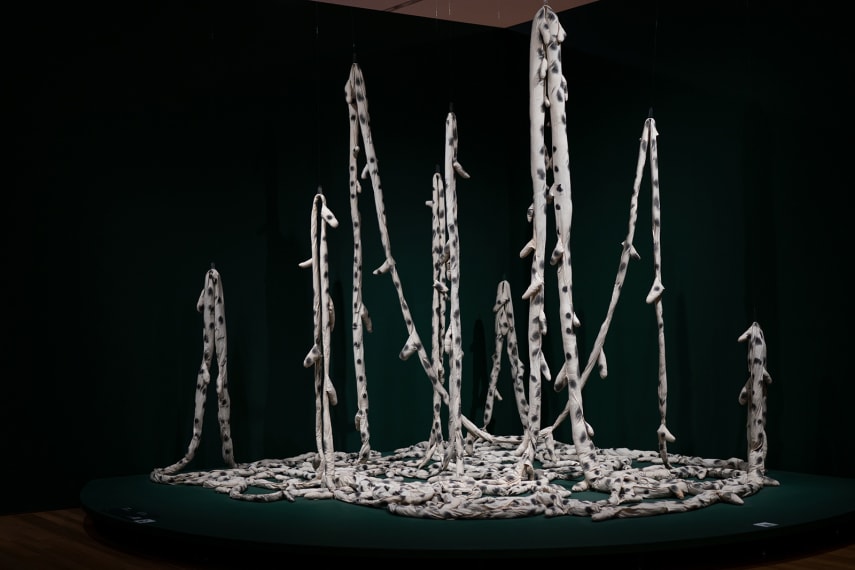
Elsewhere, the exhibition features lesser-known pieces from the artist’s repertoire, shining a light on what she created mid-career, when she returned to Japan depressed and disillusioned. Among them is a black and white stuffed fabric sculpture from 1976 called “Death of a Nerve.”

While lesser known, the exhibition's curators consider "Death of a Nerve" to be a key piece. It was made in 1976, the year before she voluntarily checked herself into a psychiatric hospital.

While lesser known, the exhibition’s curators consider “Death of a Nerve” to be a key piece. It was made in 1976, the year before she voluntarily checked herself into a psychiatric hospital. Credit: Noemi Cassanelli/CNN

A 2022 version of the artwork, created for M+ and slightly renamed “Death of Nerves,” is also on display. Realized to a much grander scale and rendered in color, it embodies a sense of resilience and even optimism in contrast to the original. An accompanying poem acknowledges that, after a suicide attempt, her nerves were left “dead and shredded.” After some time, however, a “universal love” began “coursing through my entire body,” she wrote; the revived nerves “burst into beautifully vibrant colors… stretching to the infinitude of eternity.”

"Death of Nerves" can been seen from multiple levels of the museum.

“Death of Nerves” can been seen from multiple levels of the museum. Credit: Noemi Cassanelli/CNN

“It’s an unusual piece for Kusama because most people associate her with the pumpkins, or the mirror rooms, or with more Pop forms, but this is a very soft sculpture that she has always been working on, since the beginning,” explained Mika Yoshitake, an independent curator who worked on the M+ show with Chong, as well as previous Kusama shows at the Hirshhorn Museum in Washington, D.C. and the New York Botanical Garden.

“I think she’s incredible to be able to sustain her strength through art,” added Yoshitake, who last saw Kusama in 2018, before the pandemic. “She’s determined to have her story told.”

Small by comparison is a group of 11 paintings the artist began in 2021 and completed this summer, called “Every Day I Pray for Love.”

“She has always said ‘love forever,’ said Yoshitake. She wants people to be at peace, and have this warmth and to care for each other. There’s so much strife and war, terrorism, a lot of things she sees in the world, especially through this pandemic.”

An image of Kusama wearing a signature red wig, featured in exhibition materials.

An image of Kusama wearing a signature red wig, featured in exhibition materials. Credit: Noemi Cassanelli/CNN

In a short email interview with CNN, Kusama explained her dedication to her art.

“I paint every day,” she said. “I am going to continue creating a world in awe of life, embracing all the messages of love, peace and universe.”

Since her teens, Kusama has read Chinese poems and literature “with deep respect,” she said. As such, she added, she is “happy” to have her work on show in Hong Kong.

According to M+, the exhibition has now been described as “the most comprehensive retrospective of the artist’s work to date,” by curator and critic Akira Tatehata, who serves as director of the Yayoi Kusama Museum in Tokyo. Tatehata, who visited the museum in November, has long supported the artist, and was the commissioner of her solo representation of Japan at the Venice Biennale in 1993.

Art’s healing power

The retrospective also carries special meaning for M+, which used the show to mark its one-year anniversary.

Since its conception over a decade ago, the museum has been touted as Asia’s answer to the London’s Tate Modern or New York’s Museum of Modern Art. When it finally opened last year, it faced unique challenges, from Hong Kong’s changing political environment, which continues to raise censorship concerns across sectors including the arts, to pandemic restrictions that closed the museum for three months and, until recently, barred most international visitors from the city. But Chong sees the latter, at least, as “a blessing in disguise.”

“For a global museum to have opened and be embraced by our local audiences, first and foremost, in its first year couldn’t have been a better way to start the museum,” he said.

Polka dot pumpkins located at the museum entrance.

Polka dot pumpkins located at the museum entrance. Credit: Noemi Cassanelli/CNN

Recently welcoming its 2-millionth visitor, M+ hopes that eased Covid restrictions will allow more people from abroad to see its vast collection, which includes the largest trove of Chinese contemporary art, and the Kusama exhibition, which runs through May.

“(Kusama is) living proof that art is indeed therapy and has a powerful healing power,” said Chong. “And that’s such an important lesson, especially for us during this period of post-pandemic.”

Posted in Uncategorized | Leave a comment

Social Anxiety Documentary: Afraid of People. Please if this is in genetics and there are children in next generation; it is so important to understand

Posted in Uncategorized | Leave a comment

Happy New Year 2023

Happy New Year 2023

“No kind action ever stops with itself. One kind action leads to another. Good example is followed. A single act of kindness throws out roots in all directions, and the roots spring up and make new trees. The greatest work that kindness does to others is that it makes them kind themselves.”

― Amelia Earhart

Posted in Uncategorized | Leave a comment