What happens when lonely men, embittered by a sense of failure in the sexual marketplace, find each other and form communities on the internet? The result can be deadly.
A new paper by Harvard psychology postdoc Miriam Lindner explores the rise of male “incels,” short for involuntary celibates, and their susceptibility to extremist ideologies and behaviors. Linder argues that despite a string of mass shootings and violent attacks by men espousing incel ideologies in recent years there has been a relative lack of research into the drivers behind the phenomenon.
Lindner uses an evolutionary psychology framework to understand the behavior of these men amid the accelerating social and economic shifts in gender roles and the ways the internet makes possible an “ecology where incel beliefs can thrive and make violence attractive.”
Essentially, Lindner finds these behaviors are rooted in those that proved to be most evolutionarily advantageous and so more likely to be passed along to a next generation. Our ancestors have, according to scholars, passed down a set of inherited tendencies involving male aggression and female selectivity of mates.
“An evolved male psychology makes them, on average, more likely to respond negatively to sexual aggression, and is inclined to coerce women, sexually,” Lindner said. “If we assume that that male psychology exists, we can see how the environment can amplify or dampen that.”
She went on to explain that while men might desire greater control over the selection process, the balance of power has shifted even more decidedly in favor of women. Female empowerment and medical advances (especially birth control), along with greater economic independence, means modern women have greater freedom to choose whom they want on their own terms, or even not at all.
“Women, now that we are in a position where we don’t need to rely on a man to be financially stable, we have that freedom to express more the types of attributes that we are looking for in a long-term partner,” Lindner said.
In fact, a significant percentage of women are choosing to be celibate or single. Lindner cites research by Anna Brown at the Pew Research Center, which found that, “Sixty-one percent of single men were looking for a relationship or dates, but only 38 percent of women reported doing so.”
Most incels do not commit violent acts, but some have asserted violent domination through mass shootings.
— Miriam Lindner
All of these factors, paired with online dating — an environment that amplifies users’ perceptions of being desirable — have contributed to the rise of violent male ideologies.
“We’re seeing that on dating apps, a lot of cues are being amplified,” she said. “And so you can go onto the internet and what you will see is that women will say, ‘Oh, my God, I got like, 100 matches.’ And it’s very difficult for [these] men to achieve the same thing.”
Lindner explained, “The way I view male psychology is that there is this kind of machinery that is sensitive to cues pertaining to sexual conflict. When male psychology registers failure in the sexual marketplace, it will often respond aggressively.”
Those responses, Lindner said, become amplified in online forums and chat rooms.
“I posit that hateful online communities allow low-status men to engage in virtual or simulated coalitional bargaining with a sympathetic audience of like-minded others, providing private but futile satisfaction,” Lindner writes. “Existing accounts construe aggression as a response to the perceived failure to live up to male identity, such that aggressive acts [are] intended to ‘repair’ masculinity in the eyes of others.”
Most incels do not commit violent acts, but some have asserted violent domination through mass shootings, Lindner says.
“They are trying to prove their potency, their mattering, their ability to wield power by inflicting harm. This impression of potency could (in an ultimate sense) make them more respected and hence sexually successful,” Lindner writes.
Quoting a 2019 study by Jillian Peterson and sociologist James Densley, co-founders of the think tank The Violence Project, Lindner notes that we can see this type of violence also is connected to a wider cultural shift as, “Twenty percent of all mass shootings in the past 50 years occurred in just the last five years, with more than half of the shootings occurring since 2000 and 33 percent since 2010.”
Incels don’t always select others as their targets, either. Lindner writes they also often turn their anger against themselves — using threats of suicide to regain some form of power and communicate their willingness to go to extremes.
“Like other forms of extremist violence, incel violence thus constitutes more than simply an attack, but an information exchange,” Lindner notes.
She went on to say it’s unclear why the mechanisms at play diverge down the two violent routes and that she is currently in the process of developing an assessment tool that will help identify men who are more at risk of committing “self-directed violence, suicide, or self-harm, versus more outward directed aggression.”
Lindner has accepted a position at the University of Rhode Island to continue her work on evolved male psychology and incels.
Murthy says social media hurting kids, time for government, tech firms to help
U.S. Surgeon General Vivek Murthy (center) spoke at the launch of the GSE’s Center for Digital Thriving with moderator Emily Weinstein (left) and Destinee Ramos ’26.Jill Anderson/HGSE
Surgeon general calls mental health risks ‘pivotal issue in public health’
It’s time for government and private industry to step up and reduce the mental health risks of social media for young people, according to U.S. Surgeon General Vivek Murthy.
Murthy called the impact of digital platforms on teen well-being a “pivotal issue in public health” during an event last Friday afternoon marking the launch of the Center for Digital Thriving at the Harvard Graduate School of Education. Up till now the burden has been placed on parents, he said, but it’s clear that resolving the problem will require a broader effort.
A 2022 survey found that teens, on average, spend 3.5 hours a day on social media, but a more recent poll found that the average could be as high as 4.8 hours. A survey showed that children and teens who spend more than three hours a day on social media double their risk of developing anxiety and depression. It is a concerning picture, said Murthy.
Just as safety standards made driving safer by requiring seatbelts, airbags, car seats, and crash testing, policymakers should act based on a safety-first approach and set up guidelines to protect children’s privacy and welfare, said Murthy. Technology companies also should be held accountable for not doing enough to mitigate the harms social media pose to children’s mental health and well-being.
“If we don’t put safety standards in place and provide more support for young people and their parents, we’re going to look back five, 10 years from now and say, ‘What were we thinking?’” said Murthy.
“We’ve unleashed this force into the country without any guardrails, without any follow up, without any accountability,” he said.“We have fallen short when it comes to taking care of kids with regard to social media and safeguarding them against harms. We’ve got to close that gap.”
Social media platforms emerged nearly 20 years ago, and the lack of guidelines to safeguard children’s mental health and safety is alarming, said Murthy, who took part in a conversation hosted by the Askwith Education Forum with Destinee Ramos ’26, research assistant on teens and digital well-being at the center. The event was moderated by Emily Weinstein, the new center’s co-director and principal investigator at Project Zero.
“We have fallen short when it comes to taking care of kids with regard to social media and safeguarding them against harms. We’ve got to close that gap.”
— Vivek Murthy, U.S. surgeon general
“Everywhere I traveled across America the most common question I was getting from parents was about social media,” said Murthy. “What they wanted to know was very simple: ‘Is social media safe for my kids?’ And they were not getting an answer even though millions of children are on social media.”
In May, the U.S. Surgeon General issued an advisory, the first-ever government report on social media and youth mental health. The report included data that rendered a disturbing picture.
Among them was a survey that found that nearly half of adolescents said being on the digital platforms made them feel worse about their bodies. Another showed that six out of 10 girls said they were approached by strangers on social media in ways that made them feel uncomfortable. All the data highlighted that young users are exposed to bullying, harassment, extreme violence, and hate speech, which can lead to depression and anxiety.
Safety standards should be put in place by both policymakers and technology companies, but until that happens, parents can establish some safeguards, such as creating tech-free zones for children and their families, said Murthy. Children can also regulate their social media use, block unhealthy content, and take breaks from their phones. Educators can also help train both young people and parents in digital literacy.
“There’s really nothing that’s helping young people understand the content that’s coming at them or how to navigate it,” said Murthy. “How do you recognize when there’s something that’s making you feel poorly? How do you even know that you should be monitoring how you’re feeling, and then responding to that? What tools do you have available to help you alter your experience and make it healthier? These things are very difficult for people to understand and just figure it out on their own.”
With the growing demands for social media companies to take accountability, there is also a greater sense of agency and awareness among teens about their social media usage, said Ramos.
“I’ve talked to so many teen girls and teens in general, who are really excited to be regulating their own usage and be able to speak up and understand what exactly it’s doing for their lives and their experiences,” said Ramos, a College sophomore. “It makes me very hopeful that teen girls and teens in general are realizing this completely and taking agency in their own usage.”
The recent approval of the California Age-Appropriate Design Code Act, which sets safeguards for children and teenagers online, as well as the increasing calls for tech companies to implement age-appropriate design, make Murthy feel hopeful too. But the problem remains pressing.
“Our job, as parents, educators, and just people who care about children, is to make sure that they have a foundation on which they can build a healthy and fulfilling life, and that means creating a healthy, safe digital experience for children,” said Murthy. “That is where I feel we need to continue to make this an urgent issue.”
The Daily Gazette
Sign up for daily emails to get the latest Harvard news.
Небольшой рассказ на адаптированном английском. Уровень сложности ниже среднего.
Fifty years ago, Judge Comyn sat in a first class railway compartment reading the Irish Times. The train was about to leave Dublin on its four hour journey to Tralee. Judge Comyn was going to be the judge at the County Court.
A small man came into the compartment and sat opposite the judge. Then, just before the train left the station, a redfaced priest joined them, breathing heavily.
‘You almost missed the train, Father,’ said the small man.
‘Yes, my son,’ the priest replied, ‘I had to run to catch it.’
At first, the three strangers were silent. The judge read some legal papers which he had put on the table in front of him.
‘Excuse me,’ said the small man. ‘Do you mind if I use the edge of the table?’
‘You’re welcome, certainly,’ said the judge.
‘Thank you, sir,’ said the small man. He took a pack of cards out of his pocket and started to play patience on the table.
The judge tried to read his legal papers, but he kept looking at the game of patience. The small man was playing badly.
Finally, the judge spoke. ‘Put that king on the queen and you can finish the game.’
‘Thank you sir,’ said the small man, ‘but I’ve never finished a game of patience in my life.’
The priest had put down his book to watch the end of the game.
‘You will, you will,’ said the judge. Put the red nine on the black ten. There you are, you see, you’ve finished.’
‘But only with your help, sir,’ said the small man. ‘I can tell that you are good at cards.’
‘Thank you,’ said the judge, feeling pleased with himself. The small man began to deal hands of poker on the table. He looked at each hand carefully then put the cards down.
Time passed. After a while, the small man grew tired of playing cards by himself. He put the cards down. ‘It’s a long way to Tralee,’ he said.
‘I saw you were dealing hands of poker,’ said the judge. ‘Perhaps we could play a few hands of poker together?’
‘Of course,’ said the small man. ‘My name’s O’Connor.’
‘And my name’s Comyn,’ said the judge.
They dealt a few poker hands and looked at them. Of course, they were not playing for moneys.
‘We need some way of counting who has won,’ said O’Connor.
‘I’ve got some matches,’ said Judge Comyn.
‘That’s what we need,’ said O’Connor. The judge counted out twenty matchsticks each.
It is difficult to play poker with only two players. After a time, O’Connor asked the priest, ‘Father, would you like to play with us?’
‘Oh, no,’ said the red-faced priest with a laugh. ‘I don’t know how to play.’
‘It’s not a difficult game,’ said O’Connor. ‘You get five cards from the dealer at the beginning of each game. At the beginning, you can ask the dealer to change three of your cards, to try to make a better hand. If your hand is good, you bet on it. If your hand is bad, you fold — which means you put the cards down and don’t bet any more.’
‘Bet?’ asked the priest. ‘Do you mean play for money?’
‘Oh, no, Father,’ O’Connor smiled. ‘We’re only playing for matchsticks.’
‘But I don’t know what is a good hand and what is a bad one,’ said the priest.
‘I’ll write down the hands,’ said O’Connor. He took a pencil and a piece of paper from his pocket. ‘Keep this paper on the table, so you’ll know what a hand is worth.’
‘Very well,’ said the priest. ‘I’ll play for matchsticks.’
For the first two games, the priest had bad hands. So he folded and watched the other two bet. The judge won four matchsticks. Then, on the third game, the priest’s face lit up.
‘Is this not good?’ asked the priest, showing three jacks and two kings.
The judge looked angry and put his cards on the table.
‘Yes, Father,’ said O’Connor quietly. ‘It’s a good hand, but you must not show us until we’ve finished betting.’
‘Oh, I’m sorry,’ said the priest.
They played for an hour. The judge won nearly all the matchsticks and was pleased with himself.
‘It’s not very interesting playing with matches,’ said O’Connor.
‘I’ve enjoyed the game,’ said the judge.
‘Perhaps we could make it more interesting,’ said O’Connor. ‘Why don’t we bet for a few shillings?’
‘If you like,’ said the judge. ‘But your luck is bad today.’
‘My luck must change,’ smiled O’Connor.
‘I cannot gamble,’ said the priest. ‘I cannot play for money. It’s a sin.’
The judge thought for a moment, then said, ‘Mr O’Connor, shall we lend the Father some money? If he loses, we shall not ask him to return the money. If he wins, he can pay it back.’
‘An excellent idea, O’Connor agreed.
‘No, no,’ said the priest. ‘I cannot play for money.’
‘But,’ said the judge, ‘if you win, you can give the money to charity.’
The priest thought for a moment or two. ‘I’m not sure,’ he said. ‘Well, I’m going to visit an orphanage and they need some money. Yes, I could play if the money is for charity.’
‘Excellent,’ said the judge. ‘Now, Mr O’Connor, how much shall we play for? How much is one matchstick worth?’ ‘Ten shillings,’ said O’Connor. The judge was surprised. Ten shillings was a lot of money.
They began to play again, but now the matchsticks were worth money. The priest was lucky and won matchsticks from both the judge and O’Connor. He paid back the money they had lent him in the beginning.
Shortly before the train reached Tralee, the judge got a very good hand — four queens. He bet ten pounds, then another ten. O’Connor folded. The priest was still in the game and bet all his money.
‘I’m sorry, Father,’ said the judge, turning over his cards. ‘I have four queens.’
‘What a pity,’ said the priest. ‘I was hoping to give the money to the orphans. Does your hand beat this?’
The priest turned over his hand — four kings.
‘I owe you fifty pounds,’ said the judge, writing out a cheque. ‘The bank will give you fifty pounds in cash for this cheque.’
‘And I owe you this,’ said O’Connor, handing over twelve one pound notes.
‘Bless you,’ said the priest. ‘The orphanage will be pleased to have so much money.’
The train arrived at Tralee.
Judge Comyn stayed the night at a hotel. He went to the courthouse before nine o’clock the next morning. His first two cases were simple and easy to decide. The third case was about gambling and cheating at cards.
‘Call Ronan O’Connor,’ shouted the clerk of the court.
Judge Comyn looked up and saw the man he had played cards with on the train. O’Connor looked back at the judge in amazement.
‘Are you guilty or not guilty?’ asked the judge.
‘Not guilty,’ said O’Connor.
A lawyer told the court the case against Mr O’Connor. On 13th May, Lurgan Keane, a grocer from Tralee, had travelled on the train from Dublin to Tralee. He had played poker with O’Connor and lost sixty two pounds. At Tralee railway station, Keane had called the police. He said that O’Connor had cheated him and the police arrested O’Connor. They found a special pack of cards in O’Connor’s pocket. The cards were cut and marked in a special way so that they could be used for cheating.
O’Connor did not want a lawyer to help him. He stood up and asked Lurgan Keane some questions.
‘Did I speak to you first on the train?’ he asked.
Lurgan Keane thought for a moment. ‘No, I spoke to you, because you were playing patience so badly.’
Judge Comyn put his hand over his eyes.
‘So,’ O’Connor went on, ‘you spoke to me first, and you also suggested playing poker for money.’
‘No,’ said Lurgan Keane, ‘you suggested playing poker.’
‘But for matchsticks,’ said O’Connor. ‘I suggested playing poker for matchsticks. It was you who suggested playing for money.’
Lurgan Keane thought again. ‘Yes, perhaps it was,’ he said. ‘But,’ he turned to Judge Comyn, ‘isn’t it a trick, sir? The cheat gets the other man to suggest playing for money.’
‘Money?’ O’Connor said loudly. ‘How much money did you pay me?’
‘Sixty-two pounds,’ said Keane angrily.
‘No,’ said O’Connor, ‘how much money did you pay me?’ Lurgan Keane thought carefully. ‘I didn’t pay you any money. I paid the farmer. It was the farmer who won.’
‘And did I win money from the farmer?’ asked O’Connor. ‘No,’ said Lurgan Keane. ‘You lost about eight pounds to the farmer.’
‘No more questions,’ said O’Connor.
The judge spoke to Lurgan Keane. ‘Who was the farmer?’
‘The other man in the train compartment, sir,’ said Lurgan Keane. ‘He was a bad poker player, but he had good luck.’
‘What was his name?’ asked the judge.
‘I don’t know,’ answered Keane. ‘He was a farmer from Wexford. He almost missed the train at Dublin. But it wasn’t him who cheated me. It was O’Connor. O’Connor had the cards. O’Connor was the cheat!’
The judge thought for a moment, then spoke. ‘We have been told that Mr O’Connor won money by cheating at cards. The police took a pack of cards from Mr O’Connor. Mr O’Connor told the police he found the pack of cards on the train. Also, we have heard that Mr O’Connor did not win money from Mr Keane. In fact, both men lost money to an unknown farmer from Wexford. The case against Mr O’Connor is not proved. I find Mr O’Connor not guilty.’
Everyone in the courtroom stood up as the judge left. It was time for lunch.
Judge Comyn went to his room at the back of the court house and took off his robe. He went out of the courthouse and crossed the road to the town’s main hotel.
Lurgan Keane was standing on the pavement staring at an expensive car that was leaving the hotel. Judge Comyn stood beside him and looked into the car.
O’Connor was driving. Beside him sat the priest who had played cards with the judge on the train. The priest waved to the judge.
‘Why is he dressed in those clothes?’ asked Lurgan Keane.
‘Because he’s a priest,’ answered the judge.
‘No he’s not,’ said Lurgan Keane. ‘He’s the farmer from Wexford.’
O’Connor was driving. Beside him sat the priest who had played cards with the judge.
These days, the word is most commonly used as an insult—shorthand for somebody who doesn’t understand new technology, is skeptical of progress, and wants to remain stuck in the ways of the past.
That perception couldn’t be more wrong, according to Brian Merchant. In his new book, Blood in the Machine, Merchant argues that understanding the true history of the Luddites is vital for workers today grappling with the rise of artificial intelligence (AI) and automation in the workplace.
“At least in my lifetime, the Luddites have never been more relevant,” Merchant, 39, tells TIME. “We are confronting a series of cases where technology is being used by tech companies and executives in different industries as a means of trying to drive down wages and worsen conditions so that the entrepreneurial class can make more money.”
More From TIME
Who were the Luddites?
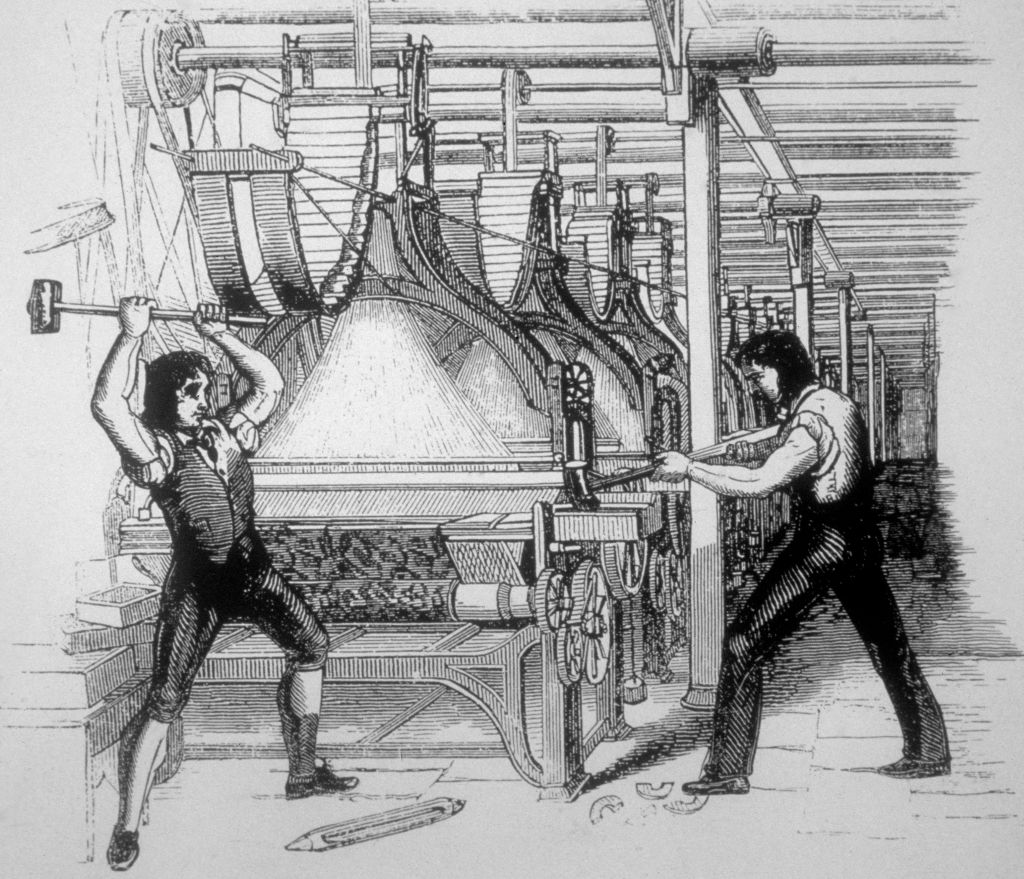
If you know anything about the Luddites, you probably know that they were English textile workers who, at the dawn of the industrial revolution, resisted the introduction of new machinery. They would sneak into factories in the dead of night and destroy the power-looms they believed were threatening their jobs.
That much is true. But, as Merchant’s book outlines in detail, it is an incomplete picture. The Luddites were not anti-machinery; many of them were machine experts and welcomed the introduction of new equipment that made their work easier. What they opposed was a choice—presented as an inevitability—made by a class of factory owners in the early 19th century. Instead of seeing machines as a way to support their expert workers, they introduced industrial machinery that could make large quantities of textiles faster and more cheaply than clothworkers working by hand. These simple new machines meant factory owners began employing more lower-skilled and therefore lower-waged workers—often child laborers—instead of skilled clothworkers with years of training. The cloth these machines produced was lower quality, but it was so cheap to churn out, and there was so much of it, that the factory owners still turned a profit.
The Luddites correctly recognized that this shift was not only debasing their art and depressing their wages, but also changing the very nature of what it meant to work. In the place of a “cottage industry” where clothworkers, often working from home, could work as many or as few hours in the day as suited them, a new institution was arising: the factory. Inside the factory, workers would work long hours at dangerous machinery, be fed meager meals, and submit to the punitive authority of the foreman. The Luddites saw that the winners from this technological “progress” would not be workers—neither the expert textile makers losing their jobs, nor the exploited children replacing them. The winners were the factory owners who, having found a new way to disempower their workers, were able to amass a greater share of the profits those workers generated.
Labor organizing at the time was illegal, so workers had few legal means of protest. The Luddites decided, instead of going after factory owners, to destroy the machines. But not any machines. They would target only the factories whose owners they believed were using new machinery as a pretense to erode their livelihoods. They would warn them in advance, giving them a chance to change their practices; some owners took it. Eventually, however, industrialists and the state came together, and British troops were sent to violently crush the Luddite movement.
How are the Luddites relevant today?
Merchant is far from the first to argue the Luddites are deserving of a historical reappraisal. The social historian E.P. Thompson documented their movement in the 1960s and argued it was the first time industrial workers began to conceive of themselves being members of a single political group: the working class. But where Blood in the Machine is unique is in the parallels it draws with the 21st century economy.
The story of the Luddites has never been more relevant, says Brian Merchant, author of ‘Blood in the Machine.’Jaclyn Campanaro, courtesy Brian Merchant
Those parallels, Merchant says, are visible across industries: from the art world—where AI-generated imagery is depressing illustrators’ wages—to transit, where ride-hailing services like Uber and Lyft have turned taxi-driving into an unprofitable and insecure profession. And in the entertainment industry, Merchant notes, writers and actors have been striking to protest attempts by studios to use AI to degrade their pay and job stability.
“If you look at the writers and the actors who are on strike today, they’re not worried that AI is going to write the next Martin Scorsese movie,” Merchant told TIME on Sept. 13. “They’re worried that it’s going to churn out something deemed good enough by the studios, who will then send it to the writers for a rewrite fee, and not give them full ownership of the script, and the writers will make less money. That technology is being used deliberately as leverage against the workers. And that pattern is eerily similar to what was happening in the Luddite day: the way that technology doesn’t really replace workers, because it can’t, but it is used to degrade their livelihoods, to cut down their wages, and to break their power.”
The Luddites, of course, failed. Automated machinery of the kind they were resisting kicked off the industrial revolution—and while many millions of people were immiserated in factories as a result, there is no denying that this process made goods cheaper and more accessible, driving up the average standard of living. But in the process, Merchant argues, the ruling classes popularized the pejorative definition of Luddism that exists to this day, not only to discourage workers from coming together and threatening their property, but also to dilute their wider political message. That message? That if new technologies erode wages and increase wealth inequality, it’s a result of a political choice by the owners of that technology, not a result of the inevitable and unstoppable march of progress. And that therefore, a more equitable way forward is possible—keeping the benefits of technology, but sharing its proceeds more widely. As Merchant puts it: “we can absolutely decide how we want technology to be used.”
It’s that political message, not the machine-smashing, that Blood in the Machine attempts to rehabilitate. (Not that destroying AI or other forms of automation would even be possible in most cases, Merchant notes, given that taking a hammer to globally-distributed software corporations is pretty difficult.) The book casts Luddites not as backward technophobes, but as a prescient movement from whom a new generation of worker activists can learn plenty. “We should be Luddites,” Merchant says. “The Luddites were making a powerful complaint. If we reclaim what they were actually trying to say, we can apply the lessons of their story to today, and prevent a lot of misery.”
The trafficking and consumption of fentanyl has become a major health problem in the United States; it has given new wings to international drug trafficking —especially to the powerful Mexican cartels —, created unprecedented international tensions and now threatens to spread on a scale affecting Europe. This is a scenario in which European authorities — at the EU and national level — still have room to prevent. Without being alarmist, but aware of the seriousness of the threat.
Fentanyl is a drug 50 times more powerful than heroin. Developed in the field of anesthesiology, it has jumped from operating rooms to the streets and, once distributed in its illegal form, has swelled the so-called opiate epidemic, responsible for hundreds of thousands of deaths. In the United States alone, according to official data, 91,799 people died in 2020 from overdoses of these substances. In 2021 the figure rose to 106,699 and in 2022 these drugs were responsible for at least two thirds of the 110,000 deaths recorded from this cause. It is considered the worst health crisis in recent history, only on a par with AIDS in the 1980s and the Covid-19 pandemic.
An especially outrageous aspect of this crisis is that its introduction into regular consumer habits was not done through clandestine drug dealing on the streets, but in medical offices, where fentanyl was prescribed by tens of thousands of doctors for the treatment of non-oncological chronic pain. Tens of thousands of people sued the manufacturer for manifest deception regarding the dependency created by the drug — OxyContin — whose economic benefits made the laboratory, Purdue Pharma, a pharmaceutical giant that has become the target of massive legal action. In this way, international drug trafficking was able to land in a pre-existing market with much more powerful and dangerous doses. The Mexican cartels have especially benefited from this new route, which has led to friction between Mexico and China — the world’s main supplier of the substances used to manufacture the drug — and with the United States, where the most extremist voices are demanding direct military intervention against drug trafficking. For its part, the United States has decreed sanctions against 17 Chinese individuals and companies that it accuses of profiting from this illegal trafficking. Last July, Washington called on 84 countries to establish a “global alliance” against this substance.
The consumption of fentanyl in Europe has not reached such dramatic dimensions, but its lethality, its addictive power and the relative ease of transportation make it necessary to take the relevant measures on the legal, police and information fronts to prevent the Old Continent from becoming the new backdrop for this scourge.
Sign up for our weekly newsletterto get more English-language news coverage from EL PAÍS USA Edition
Brain Injury Increases Risk of Cardiovascular Disease
Screenings, early interventions could limit harm
By SONIA EPSTEIN | Mass General Brigham Communications September 21, 2023 ResearchCare Delivery
3 min read
Image: wenht/iStock/Getty Images Plus
At a glance:
Traumatic brain injury is under-recognized as a risk factor for cardiovascular disease.
Increased risk of cardiovascular and cognitive dysfunction likely important drivers of high levels of disability and early death in people with TBI.
Screening and preventative care may lessen this harm.
Traumatic brain injury (TBI) is a leading cause of long-term disability and premature death, especially among military personnel and those playing contact sports. While substantial research has examined acute and chronic neurological consequences of TBI, the surprising associations between TBI and cardiovascular disease and an array of other non-neurological conditions need more study.
People who sustain a brain injury have an increased risk of developing chronic cardiovascular disease than people without a brain injury. A better understanding of the links between brain injuries and long-term cardiovascular health could help prevent significant disability and premature death.
These are the conclusions reached by a group of investigators from Harvard Medical School, Brigham and Women’s Hospital, Spaulding Rehabilitation Hospital, Massachusetts General Hospital, and elsewhere, whose research focused on the long-term consequences of TBI.
After reviewing more than a dozen recent studies of people who play contact sports, serve in the military, and are in the general population, the researchers’ analysis of the overarching lessons of these studies, published in The Lancet Neurology, emphasizes the need for future cardiovascular research, surveillance, and intervention in TBI survivors.
The authors note that the studies they evaluated offer important clues about the ways that nervous system dysfunction, neuroinflammation, changes in the brain-gut connection, and post-injury comorbidities may elevate the risk of both cardiovascular and cognitive dysfunction in TBI survivors compared to people in the general population.
How to improve outcomes for people with brain injuries
“Despite decades of extensive traumatic brain injury-focused research, surprisingly, there has been minimal progress in mitigating long-term outcomes and mortality following injuries. The cardiovascular effects of TBI may be a missing link in advancing our efforts to improve long-term quality of life and reducing mortality rates in TBI patients,” said first author Saef Izzy, HMS assistant professor of neurology at the Stroke and Cerebrovascular Center of Brigham and Women’s. “We have the opportunity to identify and improve targeted screening for high-risk populations, build preventative care strategies, and improve outcomes for survivors of TBI.”
Existing research has identified a strong link between TBI and neurological conditions such as Alzheimer’s disease and dementia. However, the mechanisms driving neurological disease after TBI remain poorly understood, despite decades of research.
Based on their analysis, Izzy and colleagues suggest that non-neurological effects of TBI, such as cardiovascular, metabolic, and endocrine dysfunction, may act as intermediaries contributing to neurological disease decades after TBI. For example, hypertension, hyperlipidemia, diabetes, and hypopituitarism can negatively affect cognitive function and are established risk factors for dementia. These risk factors were all elevated in people who experienced TBI, according to the meta-analysis.
Unlocking mysteries of the brain-body connection
The authors note that there are many potential links between TBI and cardiovascular and cognitive dysfunction. Neuroinflammatory pathways triggered by TBI could predispose individuals to atherosclerosis. Weight gain and sleep disturbances after an injury could pose independent or additive risks. Disruptions to connections between the nervous and gastrointestinal systems could throw off the balance of microbes in the gut, contributing to cognitive and cardiovascular effects.
It remains unclear how single versus repetitive injuries, age at injury, TBI severity, and other comorbidities impact cardiovascular risk, the researchers noted. This is in part due to methodological limitations to current research, such as retrospective study designs and reliance on self-reported health data. The authors noted that prospective studies could clarify what risk factors and biomarkers may be most relevant to cardiovascular dysfunction post-TBI.
“This review is a clarion call to conduct better assessments and earlier intervention for survivors of TBI who may have increased cardiovascular risk. It calls for new or expanded datasets that capture, over time, changes in biomarkers and targets associated with cardiovascular disease,” said corresponding author Ross Zafonte, the Earle P. and Ida S. Charlton Professor of Physical Medicine and Rehabilitation at HMS and president of Spaulding Rehabilitation Network.
“There is a growing recognition that many systems interact to produce multilevel dysfunction after TBI, with a series of nuanced comorbidities,” said Zafonte, who is also principal investigator of the Football Players Health Study at Harvard. “Clinicians can begin to treat some of these conditions, and in the future, management guidelines can more directly address the cardiovascular health of TBI survivors.”
Authorship, funding, disclosures
Additional authors include Rachel Grashow, Farid Radmanesh, Patrick Chen, Herman Taylor, Rita Formisano, Fiona Wilson, Meagan Wasfy, and Aaron Baggish.
Izzy reports grants from the U.S. National Institutes of Health (NIH) and 2023 Stepping Strong Innovator Award. Zafonte reports receiving grants from the NIH and royalties from Springer and Demos publishing for serving as a co-editor of Brain Injury Medicine. Zafonte has also served as an advisor to Myomo, Oncare.ai, Nanodiagnostics, and Kisbee. He reports evaluating patients in the Massachusetts General Hospital Brain and Body–TRUST Program, which is funded by the NFL Players Association.
‘Our health data is about to flow more freely, like it or not’: big tech’s plans for the NHS
Photograph: Sean Justice/Getty Images
The government is about to award a £480m contract to build a vast new database of patient data. But if people don’t trust it, they’ll opt out – I know, because I felt I had to
by Cori CriderThu 14 Sep 2023 05.00 BSTLast modified on Thu 14 Sep 2023 16.06 BST
Last December, I had an abortion. Most unwanted pregnancies set a panic-timer ticking, but I was almost counting down the seconds until I had to catch a flight from London, where I live, to Texas, where I grew up, and where the provision of abortion care was recently made a felony. You bleed for a while after most abortions, and I was still bleeding when I boarded the plane home for Christmas.
Going to Texas so soon after the procedure made me consider where the record of my abortion – my health data – would end up. When I phoned an abortion clinic in late November to book an appointment, one of the first questions staff asked was: “May we share a record of your treatment with your GP?”
I hesitated. There’s nothing wrong, in principle, with this question, and a lot that’s right. It’s not just that a complete health record helps my GP treat me. My Texan parents, both scientists, taught me that sharing information with organisations like the NHS can help it plan services and research ways to improve care. I’ve joined clinical studies in the past.
But I also help run a legal campaign group, Foxglove, that takes action against the government and tech companies when they infringe people’s rights. In a series of cases about NHS data since the start of the pandemic, we have defended people’s right to a say about who sees their medical information. This work has exposed me to worrying details about how our medical data can be used, including the Home Office practice of tracking migrants using their health records.
NHS data is special. For decades the government has required GPs to store patients’ records in a standardised way: as well as longhand notes, every interaction with a GP is saved on a computer database in a simple, consistent code.The NHS may hold the richest set of population-wide, machine-readable health data in the world. Many see in that data a source of immense potential – and profit. Ernst & Young has valued NHS patient data at £9.6bn a year. It is particularly valuable to tech giants, who would like to get their hands on NHS datasets to build AI machine-learning systems.
As things stand today, I believe my local GP would safeguard the record of my abortion. By Christmas next year? I’m not so sure. It may no longer be up to them. The government is seeking to overhaul the way it handles every health record in England, and its plans have filled some healthcare workers with alarm.
There is clearly a need to make patient data more consistent and accessible across the NHS. At the moment, caregivers in one part of the NHS often can’t access the records of care their patients received elsewhere. Imagine you have had knee pain for years. Doctors want to operate. At various times you have seen your GP, and been to a hospital in south London, but the surgery is due to be carried out in a different borough. (This kind of thing happens all the time.) A doctor is trying to judge how risky your operation is, to decide if you can go to a health centre, where you might be seen sooner and released quicker, or must be sent to a hospital.
Because your health data is held in many places – at your GP and across various hospitals where you have been – there is not one complete picture of you as a patient they can use to check. Of course the clinician will ask about your health before the operation; but you may not remember, or even know, every detail that could affect how your surgery could go. If this data was better shared, they could create a clearer picture of your health. Without this information, their assessment of your risk for surgery is, at best, an educated guess.
This partial view of the patient is commonplace in the NHS, and it is one reason the government is trying to create a vast new NHS England database, known as the federated data platform (FDP). (Health data is managed nationally, so this system is England-only.) If data from the nation’s hospitals, GPs and social care were fed into a single system, accessible in one place to health service doctors and planners, it could potentially help planners by showing trends across regions, and the population as a whole.The contract to build and run the platform is worth a huge sum – £480m over five years – with the winning bidder expected to be announced any day.
Putting so much data under central control may increase efficiency – but it also risks failing because of poor consultation and low patient trust. Many would prefer that NHS England invested in its own capacity, instead of farming out to private enterprise. The frontrunner for the contract to run the FDP is the US tech firm Palantir, which has performed data analytics work for the US security services, border forces and police. If you don’t know Palantir, you may be familiar with the company’s chair, Peter Thiel, a tech billionaire and Trump supporter, who has funded anti-abortion candidates and invested in anti-birth-control startups. Contacted for this article, Palantir emphasised that it is “not in the business of mining data, nor do we sell or monetise it in any way. What we do is provide tools that help customers understand and organise the information that they hold.” NHS England said that it, not the platform, will control the patient data inside it. It also points to contractual safeguards “to prevent any supplier gaining a dominant role in NHS data management”.
Still, the FDP gives government a lot of power over health data – and it hasn’t always earned our trust. In 2019, the head of NHS England and other top health officials discussed nine “commercial models” for access to the nation’s health data with tech and drug executives. A bill currently going through parliament, the data protection and digital information bill, would significantly dilute some of the laws that protect patient privacy. Data protection law – including the EU 2018 General Data Protection Regulation (GDPR) and its UK equivalent – limits what can be done with sensitive data such as health records. We mostly associate GDPR with infuriating website pop-ups, but it is a useful safeguard. It was one of the reasons the abortion clinic needed my permission to share my medical record with anyone, including my own doctor.
One of the most important of the proposed changes is the move to redefine what counts as personal data. Through a process of “pseudonymisation”, the system can detach your name and other identifying details. But this process is imperfect and reversible – and patients consistently say they want control over how their health data is used. If the government amends or interprets data protection law to take this choice away from us, it is hard to see how patient confidentiality as we know it will still exist. Our health records are precious to us. We come to the doctor as supplicants. We share worry, fear, pain. Our ability to do so depends on trust, which itself depends on the guarantee of privacy.
After a summer of strikes over pay and conditions, everyone can see that the NHS urgently needs more resources. The NHS could use our data – with strict safeguards – to streamline clinical decision-making and take pressure off doctors and nurses. But the government’s weakening of data protection rules, set against its cosying up to tech industry, is worrying. In the US in 2021, Google won a deal to access patient records at more than 2,000 clinics to develop healthcare algorithms. Google, like Microsoft and IBM, seeks to access patient records at scale in order to train algorithms to develop apps or organise care. In this troubling scenario, my pain, and yours, may become training data for someone else’s AI.
All this lingered in my mind on the call with the abortion clinic.
“I asked, was it all right if we shared this record with your doctor?”
“I’m sorry, but no,” I said.
Having an abortion was the most isolating experience of my adult life. It taught me how stigma lingers over abortion even in the UK, where treatment is widely available. It also changed how I think about health data: not only mine, but that of my family in Texas, and of patients across the UK. It spurred me to reflect on what is at stake if these changes to patient data go ahead.
With the drive towards AI in healthcare (from triage to diagnosis to drug research), we in England face a choice: will we privilege care and the public sector, or profit? People in the UK treasure the sanctity of our health record – we want control over who sees it, when, and why. What will it mean when we no longer believe a conversation with an NHS doctor is private?
As I was flicking through Twitter on the early morning train to the clinic, a promoted post I’d never seen before popped up. It was a jokey meme showing a contraceptive pill pack, with the line: “Take your magic pills ladies, you don’t want any Baby Jesuses for Christmas.” Living under surveillance capitalism makes you paranoid. I snapped a screenshot, sent it to two female friends on Signal, then panicked, deleted the picture and turned my phone off.
It was 8am when I sat down at the abortion clinic in Ealing, west London, where a range of women awaited their appointments. Some wore fur coats, others tracksuits and false eyelashes; a few had been crying. A middle-aged woman, who looked as if she was rushing out to her next meeting, just seemed verypissed off. The only man in the waiting room was a teenager who had come along with his girlfriend.
At first I thought my reluctance to share my abortion record had mainly to do with data. I later realised it also had to do with shame. A cloud hangs over abortion. There is a strong residual stereotype of the woman who aborts: someone young, a bit careless, who knows no better.
In the parallel systemyou enter in England to access abortion, the language reveals a world shadowed by female vulnerability and male violence. I could hear it when I phoned the clinic: “Are you alone?” “Are you safe?” “Please choose a password and a memorable number; we will only use these to contact you about your treatment.” The clinic never used the word “abortion” by text or email. All this signals that you have ventured to a space outside normal healthcare. Nobody hassled me outside the clinic that day, but I’ve seen the protesters with signs outside another London clinic.
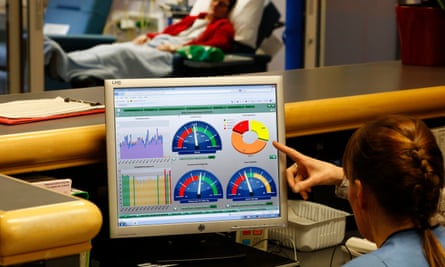
Nurses examining data on a computer in a hospital ward in Glasgow. Photograph: Murdo MacLeod/The Guardian
Go for surgery, a friend at a party had whispered; the pills cause far more pain. I remembered lying on the bathroom floor a decade ago during a miscarriage, the weeks of bleeding and pain, and decided to investigate. At the clinic, a seasoned Danish nurse told me I needed an internal ultrasound to assess possible treatments. I asked how soon I could have the surgery. The nurse said there would be a wait, until just before I was due to go to Texas, where there would be no aftercare.
It was only then, when I was lying on the table and the nurse prodded my ovaries and my vagina, that the sobs came. I didn’t want another child. But bodies tend to hold on to the remnants of pregnancies, miscarriages and births; I remembered watching other ultrasounds: the child who developed and the child who did not. I lay on the shore of life and death and felt utterly alone.
The nurse told me it was early, about six weeks, and handed me a tissue. (Six weeks is the criminal threshold in Texas.) She had had this conversation thousands of times. “Were you hoping I wouldn’t see anything?” No, I blubbered, I am just tired. I didn’t mention my rage: at every Baptist or Lutheran or Methodist minister in the small town where I was raised, at Texas, at myself. It was clear the surgery would be too late, as I had to fly to the US. Before leaving the clinic I took the first lot of pills.
You may support abortion rights on principle, as I do. You may also, as I do, admit privately that you find its ethics ambiguous. Having an abortion taught me that a woman’s ability to sustain or end life is simultaneously an awful burden and an awful power. Mulling over the complexity of it all now seems like wallowing in a warm bath. When the reality appears, you are thrown in a cold river. The cells are dividing; a choice must be made. Swim on, or turn back? I felt the power and I hated and feared it, and I realised why so many men hate it too, and seek to control it.
In most of the UK, abortion is still a technically a crime. The 1967 Abortion Act does not legalise abortion; it excuses it if a doctor considers that pregnancy (before 24 weeks) poses a risk to the mental or physical health of the mother. (Northern Ireland is different, with abortion legal on demand to 12 weeks.) This teaches women that to access care they must construct a narrative that continuing the pregnancy would be damaging to mother or baby, or both.
Perhaps that’s why I didn’t want the clinic to share my data. Having reduced a complex experience into a just-so story once, I didn’t want that story to be fed into a mass data system that could, I worried, one day be shared with the health division of Google, or the German drug giant Merck, or some other company. I saw my abortion as my story, and not one from which I was keen to permit any corporation, however modestly, to profit.
You emerge from this ordeal with a story you guard fiercely. This doesn’t mean you don’t tell it to others: it means you want absolute authority to tell the story as and when you see fit. It was months before I told my Texan family about the abortion; in the service of a wider point, I am writing about it now.
In German legal language, this is “informational self-determination”, or informationelle Selbstbestimmung. This idea means something slightly different to me from privacy. Privacy connotes a turning away, a hiding. But I didn’t want to hide my abortion: I wanted agency over when the story was told. Real data protection means you deal with your record on your terms.
In some places, the data trails we leave have become a way to criminalise us. Earlier this year, a heartrending photo from Nebraska showed a girl of 19 sobbing as she was escorted from court after being sentenced to 90 days in prison after having an abortion at the start of her third trimester. Police had obtained her Facebook messages with her mother about organising the pills. Her mother was given five years for procuring the pills and hiding the body.
In Texas, over Christmas lunch with my sister and her teenage daughter, I wondered what I would do if they needed help. On what platform could we speak safely? How could I send them information, or bootleg them pills? Texas, like most of the US, has no GDPR equivalent, meaning women have no real control over their data. This allows apps such as period trackers to share location and other data with the authorities when the law requires.
This summer, a British woman was sentenced to prison after her search history revealed that, during the pandemic, she had a late-stage abortion. A couple of phrases typed into Google – one was “I need to have an abortion but I’m past 24 weeks” – helped to convict her. (The sentence, which drew broad condemnation from MPs, doctors and feminist groups, was later suspended, but her criminal record stands.)
“The fundamental thing to understand about NHS England is that it is the government,” says Marcus Baw, a GP and IT specialist. By this he means that officials, not clinicians, will make many of the critical decisions about which data flows into the new NHS platform. These officials, not doctors, will interpret the law about who will have access to it, including other government departments. I have yet to see an official give a clear answer to this question: once a copy of my health data has gone into the central platform, who decides what happens to it? The answer will seriously affect the public’s trust in the scheme.
Peter Thiel, cofounder of Palantir, which is bidding for the contract to run the NHS federated data platform. Photograph: Marco Bello/Getty Images
This is not a new problem. In 2013, NHS Digital was set up to develop and operate digital services for NHS England. Its first chair, Kingsley Manning, stepped down in 2016 because he said he got fed up with the Home Office demanding to see migrants’ health data, to check their location for border enforcement. This, understandably, deterred so many migrants from seeking care that the government had to run an information campaign during Covid to encourage people who had migrated to Britain to come for their jabs.
NHS Digital was also set up to protect patient data, with decisions about data-sharing theoretically insulated from central government control. It was abolished last year, in a move Manning described as a “retrograde step” with “the potential for undermining the relationship between clinicians and their patients”.
It is jarring to set these serious questions of patient trust against Rishi Sunak’s breezy promises, last November, about “using our new Brexit freedoms to create the most pro-innovation regulatory environment in the world in sectors like life sciences, financial services, artificial intelligence and data”. Palantir’s CEO, Alex Karp, has praised the UK’s “pragmatic but serious understanding of data protection”. He recently told the BBC: “If you’re a pharmaceutical company and you want to do research on a medicine, you’re going to be able to do things in the UK you would not be able to do easily in the continent.”
The winning bidder for the contract to run the federated data platform will soon be announced. The data protection and digital information bill, which weakens individual control over personal data, has had a second reading, a key step on its way to passing into law. In the name of progress, our health data is about to flow more freely, like it or not.
Palantir has spent years preparing the ground for its FDP bid. At the start of the pandemic, with the normal procurement rules suspended, Palantir was given a contract to build a national Covid-19 data store for the NHS for the nominal fee of £1, collecting vast sets of patient data to track the pandemic and, for example, create a list of vulnerable people who needed to shield at home. This data was used to distribute ventilators and manage the vaccine rollout. But the scale of the data collection caused alarm: one Whitehall observer described the level of sensitive patient data being swept into the Covid data store as “unprecedented”, and claimed there was insufficient regard to privacy and data protection. In December 2020, it was given a two-year, £23m contract to continue working on the project. That was renewed for another six months at a cost of £11.5m in January this year. Officials had promised to delete that data store when the pandemic was over – instead, Palantir is being paid £24.9m to migrate its data store to the new system. The procurement documents describe the purpose of the FDP as “to replace the Covid-19 datastore provided by Palantir”. If it’s anything like its predecessor, the central platform of the FDP will retain a copy of at least some patient data for all of England.
The rules of the FDP – the framework for handling patient records – are crucial. In particular, the public needs to know exactly which parts of their health record are being pooled or accessed nationally. Patients are also likely to ask what specific uses the FDP will be put to, and what may be bolted on later. (The procurement documents for the FDP explicitly say the purposes are set to expand.) Once the FDP is built and a permanent national flow of patient data is established, the main thing standing between that data and otheruses is the health minister. There will be information governance advisers, and a watchdog, the national data guardian, but at this scale, these soft power checks and balances will be severely tested.
If the data protection and digital information bill passes, there will be even more reason to be concerned about the security of national health data. “Taken together, this bill maximises data and minimises governance of data fed to AIs,” says the privacy group medConfidential. Given Sunak’s stated enthusiasm for the use of AI in healthcare, the concern is that a senior official will later seek to open up the data for commercial purposes. Without clear, strong safeguards, more people will opt out, and the FDP may fail.
A protest in London in 2019. Photograph: Tolga Akmen/AFP/Getty Images
The NHS is a boneyard of failed data-centralisation programmes. The first version of a national IT structure for the NHS was proposed by Tony Blair’s government in 2002. The idea was to replace paper records with a single digital version accessible to patients and doctors. The National Programme for IT ran into serious problems with software, and an over-centralised delivery. It cost more than £12bn over 10 years, and it failed partly because the proposed scale of data-sharing was seen as “highly problematic”. In 2014, David Cameron’s government tried again, with a programme called care.data. Again unresolved questions about corporate access, particularly insurance companies, sparked an outcry, provoking more than a million people to opt out of sharing health records. The government eventually gave up and cancelled the programme in 2016. Five years later, the government launched anotherproject, General Practice Data for Planning and Research, to pool the most detailed data the NHS has: GP records. Following an outcry over government plans to make health data available to private companies, there was another huge wave of opt-outs. In August 2021, the scheme was paused. (My organisation, Foxglove, was involved in a legal case that precipitated the freeze.)
This adds up to more than 20 years of health centralisation plans – costing billions – and all of it foundered on the shoals of patient trust. Every scandal over centralising patient data also tends to increase the numbers of people exercising their right to “opt out” of sharing.
Statistics for the national opt-out serve as a rough measure of patient trust. It’s not a good picture: the number of patients who have opted out has ballooned over the years to some 3.3 million. (More than a million of those were added during the row over GP records in 2021.)
Opting out is currently the only practical way to register disapproval with state health plans, but it’s a blunt instrument. If you don’t want to give Google access to healthcare records to develop its algorithms, for example, or support the tobacco firm Philip Morris to develop inhalers, you’re also refusing positive uses of health data – say, helping NHS wards to plan ahead for numbers of patients vulnerable to flu. The current rate of opt-out is “incredibly problematic”, warns Dr Jess Morley, a researcher at Oxford University who has worked on patient data systems, because it makes the dataset “more random” and damages the value of the health data to the NHS. But to get these 3.3 million people to opt back in, the state will have to persuade them of its intentions – and its competence.
Recent polling by YouGov that Foxglove organised for a report also suggests that if the FDP were to go ahead in a form that is both managed by and accessible to private companies, around 48% of the residual population of England who have not opted out will do so. Anything like that figure will be disastrous for the NHS, because it would make the data useless.
Palantir isn’t the only contender for the platform. A team at Oxford University developed an open-source system called openSafely to support researchers during the pandemic. The system was secure and transparent – every question the system is asked is logged, and all approved projects are published. But it seems no one asked openSafely to help set up the FDP. There were other bidders, from Oracle Cerner to IBM to a “best of British” consortium of small UK companies and universities – but it’s not clear any of them had a serious shot. By the time the procurement opened in January, Palantir had its feet under the NHS table.
Palantir seems an odd choice of partner for the NHS. Originally funded by the CIA’s venture capital arm, In-Q-Tel, its early corporate history mainly involves supporting mass surveillance and the wars in Iraq and Afghanistan. In 2021, Palantir’s CTO, Shyam Sankar, said he hoped to see “something that looks like Palantir inside of every missile, inside of every drone”. (The company notes its services are also used by Ukrainian armed forces to resist Russian aggression, and by the World Food Programme.) Palantir helped the US and UK’s digital spy agencies (NSA and GCHQ) manage mass surveillance programmes such as XKeyscore, a system that tracked millions of people online. In Los Angeles, the police have used Palantir to build a tool, Laser, that claimed it would “extract” suspected offenders from the community like “tumors,” until community organisers forced the LAPD to scrap it. Not once have I seen a senior British official publicly reflect on how this history may affect trust in public healthcare among, say, migrant groups, or Muslims.
Palantir’s values appear to sit uncomfortably with the NHS. In January this year, Thiel described Britons’ affection for the NHS as “Stockholm syndrome” and said the best thing to do would be to “rip the whole thing from the ground and start over”. The company quickly distanced itself from its chairman’s remarks, which they said he made as a private individual.
This summer Karp hosted Sunak at a baseball game in the US, one in a string of lobbying efforts over the past four years. In 2019, Palantir served watermelon cocktails to the then-chair of the NHS, and Palantir representatives joined a closed-door chat at Davos with the then trade secretary Liam Fox and other tech executives. Fox’s briefing notes for that meetings said: “We have a huge and as yet untapped resource through the UK’s single healthcare system … We aim to treble industry contract and R&D collaborative research in the NHS over 10 years, to nearly £1bn.” (Again, there’s no suggestion that Palantir was seeking to sell data – just that UK officials were courting it and others to help the UKmake health data commercially available.)
Views of Palantir’s usefulness to NHS staff vary. One hospital, Chelsea & Westminster, says its operating platform, called Foundry, which they have been trialling since early 2022, has helped cut waiting lists by 28%. Other local trials of Palantir’s software were apparently less successful. An answer to a parliamentary question earlier this year said that of the pilots of Foundry software at local NHS hospitals, 11 had been paused or suspended. Some have resumed, but a spokesperson for Liverpool Heart & Chest hospital stated that it had stopped using Foundry because staff had decided “it didn’t meet our needs”. Other trusts said they had more pressing problems to fix, and at least one said they had no one who could manage the system. A more recent letter to the health and social care committee updated these figures to say there are now 36 trials underway at various stages of rollout, with three of those paused due to restart, and five still suspended.
Turning to Palantir for so much of England’s infrastructure and analysis exposes a deeper problem: our own lack of data science staff. The NHS badly needs data scientists to make it fit for the future. (Palantir has hired two of its senior people.) In February, it was reported that the NHS has more than 3,000 vacant tech roles. NHS data scientists have warned that Foundry is not “user friendly”, and that the cost is “ridiculous”.
What would a better future for NHS data look like? It would probably start more humbly, with broad democratic engagement. The government could ask the public how they would like their data managed. Who do you trust to handle it, who would you like to be able to use it, and under what conditions? Should the opt-outs be reformed to give you more choice?
With a £480m contract about to be awarded, and the DPDI bill trundling ahead, expect to see a pitched battle over these questions in the coming months. It is a battle the government seemingly hopes to avoid, as it so often has in the past, by dodging debate rather than meeting tricky questions head on. Most people want to see the NHS use data better. But they also care deeply about who is given the keys to the kingdom.
Every prior effort to centralise NHS data has failed; this chapter is yet to be written. We can still get it right, and win trust for a better solution. If we don’t, many patients will do as I did, and turn away.
This article was amended on 14 September 2023 to update the number of ongoing pilots of Foundry software.
“How democracy can defend humanity against AI’s catastrophic outcomes….”
25,199 views Sep 17, 2023 How will AI impact our immediate and near future? Can the technology be controlled, and does it have agency? Watch DeepMind co-founder Mustafa Suleyman and Yuval Noah Harari debate these questions, with The Economist Editor-in-Chief Zanny Minton-Beddoes.
The Stoics were right – emotional control is good for the soul
‘Choose not to be harmed – and you won’t feel harmed’. A bust of Marcus Aurelius, part of the Ryedale Hoard. Courtesy York Museums Trust
István Darabánis a freelance writer covering science, philosophy and anthropology. He is a graduating master’s student in neuroscience and science communication at the University of Amsterdam.
Both neuroscience and psychotherapy agree that you can change your mental framework as the Stoic Marcus Aurelius described
To become more forgiving, we are often told to be more empathic. Empathy is a powerful social adhesive, one that most people believe helps us mediate forgiveness as it increases the likelihood of feeling together with someone who has hurt us. But there are serious problems with empathy, as the psychologist Paul Bloom has argued.
He points out that empathy is inherently biased and we shouldn’t rely on it as a moral guide. ‘Empathy’s design failings have to do with the fact that it acts like a spotlight,’ he said in a 2017 interview. ‘It zooms you in. But spotlights only illuminate where you point them at, and for that reason empathy is biased.’ Feelings of empathy arise unequally across situations, and people tend to empathise more with in-group members. In negative settings, empathy can even lead to emotional distress and burnout.
Fortunately, empathy is not the most effective way to foster kindness and lenience. The Stoic philosophy of the Roman emperor Marcus Aurelius offers a compelling alternative, one that bypasses the flimsy nature of empathy and focuses on finding equanimity instead:
Someone despises me. That’s their problem. Mine: not to do or say anything despicable. Someone hates me. Their problem. Mine: to be patient and cheerful with everyone, including them.
A most despicable action for me was to have an uncle and not to realise his level of hatred towards me. In his 90’s he passed away but had instructed someone to send a letter he had written to me of just how deep his disdain and dislike of me and my partner, to arrive before his funeral mass. It hurts deep but I follow the wise words of Stoicism and the quote above. Cognitive Behavioural Therapy is another avenue to this more healthy way of thinking about life. Empathy makes you vulnerable and therefore slow to realise others see you as that and abuse you … they see your weakness. Written by Michelle
Back to article:
At the imperial court, Marcus Aurelius witnessed the ancient world’s most conniving social environment. It was often challenging to maintain a moral high ground, so he frequently contemplated the theme of forgiveness, which he wrote about in his Meditations. Adopting a Stoic framework, he focused on taking control of his own emotions and achieving tranquillity independent of the social context:
It’s not what they do that bothers us. That’s a problem for their minds, not ours. It’s our own misperceptions. Discard them. Be willing to give up thinking of this as a catastrophe … and your anger is gone.
Implementing these principles made Marcus Aurelius a righteous ruler. And today his ideas offer a pragmatic path to make kindness and forgiveness fundamental principles in one’s life. Taking responsibility for our emotions – thereby constructing a resilient mindset that is unfazed by others’ provocations – is a more practical way of building character than depending on empathy. By focusing on our thoughts and actions instead of those of the perpetrator, we magnify our accountability to ourselves: our ego and its associated sense of entitlement, indignation and victimhood diminish. As neuroscience and psychotherapy suggest, changing our mental framework along the lines Marcus Aurelius describes can, in turn, ‘rewire’ our emotional brain, leading to a more patient temperament that is conducive to kindness.
Sign-up to our weekly newsletter
Intriguing articles, practical know-how and immersive films, straight to your inbox.
If you can’t stop thinking about the incident after it has happened, you further amplify the rage in your head
To explore the psychological act of forgiveness, we must first look at how anger is wired in the brain. Biologically, anger is a fight-or-flight stress response. Our amygdala detects or predicts a threat in the environment, and floods the brain with a flurry of stress hormones that increase heart rate, blood pressure and respiration, riling us up to fight.
But crucially, the emotional reactivity of the amygdala – which makes us lose our heads in anger, stress or fear – can be consciously regulated by our prefrontal cortex. This brain area – involved in emotional regulation, behavioural control and complex decision-making – is always assessing what the amygdala is trying to convey to make sense of our situation. In response, the cortex can either inhibit or amplify this more visceral and emotional signal.
Let’s say you are at a concert, and someone steps on your shoe. You turn around ready to confront them, but you notice it was just a kid. So you refrain from acting out and instead let it go, forgiving him. Here, your cortex consciously appraises the emotional signal of the amygdala and inhibits it.
However, if you turn around and see it was the same large man who had already stepped on you twice before, you might begin shouting at the disrespectful idiot, not only failing to inhibit the anger response from the amygdala but amplifying it. Your appraisal of the context, in this case, makes it all the more infuriating. And to add further fuel to the fire, if you can’t stop thinking about the incident after it has happened, you further amplify the rage in your head, consciously keeping yourself riled up.
So while we often blame the fast-acting, emotional amygdala for our anger, it is the cortex that regulates what we allow ourselves to feel and how we manifest that feeling. This dynamic interaction between the amygdala and the cortex allows for the rational brain to override the emotional signals – or vice versa.
And this is where the mechanism of neuroplasticity – which underpins the learning of new behaviour – comes in. If we keep reacting to each triggering event with rage, the amygdala’s influence over our conscious brain strengthens with each instance.Conversely, if we practise calming ourselves down or rationalising such incidents, our cortical inhibition of anger is potentiated and can, over time, become more effortless. This idea is summarised beautifully by Marcus Aurelius:
The things you think about determine the quality of your mind. Your soul takes on the colour of your thoughts.
I cannot recommend this advice highly enough.
This is a critical notion to understanding the practical wisdom of Stoicism. It means that, by deliberately constructing a frame of thinking about the world, we can determine what quality our emotions – and, by the same token, our lives – will take. Adjusting the value judgments in our cortex shapes the colour of our soul.
Our emotional responses, like frustration or rage, are modulated by our minds – by how we frame our experiences
Clear-mindedness, according to the Stoics, is the surest path to virtue. And someone can become clear-minded only by understanding the Stoic principle often called the ‘dichotomy of control’ – the clear distinction between what we have control over in life, and what we don’t. They believed that most of our turbulent, fluctuating emotions arise from the refusal to accept what’s beyond our control, as Marcus Aurelius points out:
You take things you don’t control and define them as ‘good’ or ‘bad’. And so of course when the ‘bad’ things happen, or the ‘good’ ones don’t, you blame the gods and feel hatred for the people responsible.
To embrace this dichotomy means recognising that our emotional responses, like frustration or rage, are modulated by our minds – by how we frame our experiences. And this subjective veil over the objective event differs from person to person: some get triggered more easily, while others are calmer; some find a specific thing hurtful, while others laugh it off. That is why Stoicism asks for personal accountability to gain control of our perceptions, weakening our trigger, shrinking our ego, and reducing our sense of entitlement by focusing only on ourselves. As Marcus Aurelius writes:
Choose not to be harmed – and you won’t feel harmed. Don’t feel harmed – and you haven’t been.
TBI (traumatic brain injury) and amnesia makes it easier to engage with Stoicism but it is important to decide which attitude you want to apply ‘Good’ or ‘Bad’. Michelle again
This leads to an important choice in life. We can either feel entitled to express anger when others hurt us, hold grudges and even retaliate, or adopt a more Stoic frame of mind, acknowledging that we cannot control others’ behaviour, but we can make a conscious choice not to be bothered by it, and therefore excuse it. This perspective doesn’t deny our right to feel emotions, but suggests examining how they shape our mind in a world that will inevitably cause more pain along the way.
This rationale of Stoicism – and its capacity to ‘rewire’ the brain through conscious thinking – is fundamental to modern psychotherapy. In the 1950s, the pioneering psychologist Albert Ellis used Stoic philosophy to develop the first cognitive therapy called rational emotive behaviour therapy (REBT). As a predecessor and inspiration to the prevailing cognitive behavioural therapy (CBT), REBT is effective in treating various psychological disorders, including depression, anxiety, and anger issues – through methods that build value judgments, as well as healthier emotional and social responses based on Stoicism.
REBT emphasises that irrational beliefs, and the way those beliefs influence how we think about our lives, are the main causes of our psychological distress. It operates on the so-called ‘ABC model’. ‘A’ denotes the ‘activating event’, the trigger from the environment. ‘B’ stands for the underlying ‘belief’ about the event – how we interpret it based on the situation and our worldview. And ‘C’ is the ‘consequence’ of our belief, the emotional result. Echoing the Stoic dichotomy of control, the ‘ABC’ model suggests it is not ‘A’ (the event) that leads to ‘C’ (the consequence), but ‘B’ (our belief) that dictates how we end up feeling. As Marcus Aurelius puts it:
External things are not the problem. It’s your assessment of them. Which you can erase right now.
If someone is easy to anger by others’ innocent behaviour, an REBT practitioner assists them in identifying their underlying cognitive distortions (like jumping to conclusions, over-generalisation, or emotional reasoning) and helps them eliminate harmful beliefs through reframing and rationalising. In this Stoic school of life, clients are trained to appraise situations consciously, and behave accordingly, reducing both the frequency and the emotional intensity of their anger responses by strengthening their cortical control over the amygdala.
For Marcus Aurelius, Stoicism offered a framework to be more forgiving in the vileness of ancient Rome, keeping his emotions in check to be a wise and just ruler. With the rising popularity of Stoicism, his ideas are resonating with people facing similar assaults on their sanity from contemporary society. They are drawn to the empowering notion that the world and its events do not have to determine our feelings. Instead, following the example of REBT, we can actively work to ‘rewire’ our consciousness to rid ourselves of suffering.
Applying the dichotomy of control to find our cognitive distortions and regulate our emotions can lead not only to mental wellbeing, but also to something bigger than us. Genuine patience, kindness and forgiveness could nurture deeper social connections and greater understanding of our common humanity – which is more enduring than the transient and selective virtue offered by empathy. As the emperor wrote:
To feel affection for people even when they make mistakes is uniquely human. You can do it, if you simply recognise: that they’re human too … And, above all, that they haven’t really hurt you. They haven’t diminished your ability to choose.