The War of Independence Memoirs of Andrew O’Donoghue, Ex Commander, 5th Batallion, Mid-Clare Brigade from recordings made by Anne Nelligan, Andrew’s daughter.
<< War of Independence in West Clare: Introduction<< History Mid Clare Brigade Back: A. O’Donoghue, Michael Flanagan, P. Haran, Dan Clare, Mick O’ Donohue, Thos. Gallagher, Michael Maher, John Regan, Seamus Davenport Front: Michael Long, Pat Finn, Sonny Hanrihan, Mickey Vaughan, Peter Scales, Thos. Liddy, John Davoren, Micko Laferty or Peter Williams Clare County Library wishes to thank Clare Local Studies Project for preparation of raw text for this publication.
But in Ireland too many are now unemployed; too many are under employed; too many young people will become driftwood as a small open economy on the Atlantic off the UK and Europe becomes the Detroit, USA (now bankrupt); the main difference being that the population of Detroit diminished from 1951 at 1.5 million to its present population of 700,000+. What can Ireland learn and learn now?
Interesting post about Eddie Hobbs and his recommendation to our millionaires to take the risk and go to Detroit. Sad really because we need those very same people to innovate and invest in the Island of Ireland where people from foreign countries have chosen to emigrate to and where the population is increasing. Thankfully, the MNC’s still are keen to locate in Ireland based on factors like we speak the English language, we are in the Eurozone, the EU, we have a high standard of education, we have a young population and so much more. We need to take hope from the fact that Google plan to invest further with a conference centre (which will compete with the one we already have) but theirs will host 15,000 people. This is a commitment on their part. The Celtic Tiger moved us up several notches and then dropped us down but maybe now we are near a platform and we need to learn and start climbing again upwards. We can start by asking the MNC’s to use their financial power to negotiate with the Troika to write down a significant proportion of the debt that can never be repaid and soon.
Who has heard of the Robin Hood? We all have. Robin Hood is needed in Ireland so try Google and catch up with the plans of the modern day Robin Hood drive in the US and the UK. The EU are mooting for Financial Transaction Tax but the UK lose out so there must be a give and take. Ireland needs to be a beneficiary of this Robin Hood initiative, if only he could influence the powers that be to write down the debt.
Today the OECD has said Ireland is not a tax haven. However we do provide sweet deals for the MNC’s and it is time for us to ask for a greater return from these engines of economic growth potential to provide opportunities through a Robin Hood type programme to create employment for those who are now unemployed in our country. Trade Unionists have failed utterly to be innovative to create work initiatives; their concern is feathering their own nests and sitting on the sidelines. Shame on the reckless management of the IMO, Siptu and others – similar to the banks and developers there is a culture of gross misconduct that if properly investigated by the Gardai would suggest corrupt practices.
The trade unions have faltered, they have lost sight of the people who kept them in their present standing, they are too lazy to invest their money in projects alongside the multi-nationals to get the people away from the dole queues and create jobs. It is possible. Ireland is a small country and education is the only way forward.
Google undertake to help the over 55’s with 1 hr hand’s on training in Barrow Street. We need more of these initiatives. The time has come again in another century this time for proper corporate social responsibility. Guinness did it with the Beano and the Iveagh Hostels so today’s MNC’s can create opportunities for the unemployed.
450,000+ unemployed this summer. We are not Detroit, we don’t want to be the Detroit of Europe. We have the education, we have the MNC’s but we must tackle the public sector and we must address the bureaucracy and create a fairer society and to side step the rot of corruption that will fuel the black economy to our detriment. There must be hope. We are not in the awful Civil War that destroys Syria.
Reply:
Michelle … Google are no “Robin Hood” … perhaps they are
“Robbing with Hooded Veil” of tax exemptions. What really
attracts the likes of Google as a Multinational, like all of the
Multinationals are People that are just poor enough to put up
with the drudgery of the work they employ, and just sufficiently
“educated” enough to engage with, and work their system/machine/engine etc.
Google put NO PROFITS from their tax exemptions and cheap
labour back into any community and nor do any Multinationals.
They are here to rape and pillage the People, because the State
and Puppet Government of the day capitulate to them, then they
WILL move on to the next State that will accommodate them &
capitulate to their Financial whims, and have a State deEducation
programme in place.
Most People are NOT Critically educated, nor do most Critically think.
D.
Inclusivity Of The Vulnerable In Society And Empowerment
Monday October 19, 2009 21:32 by Michelle Clarke – Social Justice and Ethics: Dignity
Baggot Street Hospital (formerly Royal City of Dublin Hospital)
Something for people to consider during a irksome Recession (2009) and when vulnerabilities multiply, and people become further ostracised:-
‘Where is the Life we have lost living?
Where is the wisdom we have lost in Knowledge?
Where is the knowledge we have lost in information?
Ireland has now embracing the status within the EU as an Knowledge Economy, so let us use the Knowledge minus the unwanted information to make proper health provision for the vulnerable and aged.
Subject: The Johns Hopkins Department of Psychiatry and Behavioral Sciences and the Restoration of ‘Baggot Street Hospital’ for the people in need. (Nothing ever happened 2023 Christmas
The Origin of Ireland is the Sinn Fein Constitution drafted in 1905 (a good place to start, I would think to arrive at all the parties that seek to govern Ireland)
In the past I have highlighted my personal experience at the Royal City of Dublin i.e. Baggot Street hospital – yes as a ‘neuro-psychiatric patient’ and my hope of a restoration to former glory of said hospital. In the absence of a response, I am going to use an alternative approach. If you choose to look at this link, it might give Sinn Fein the ‘vision’ for the decrepid, under utilised Baggot Street hospital. St. Patrick’s Hospital, Dublin 8, is presently developing additional mental health accommodation and a centre of Wellness. This is needed in Dublin 4 with the same motivational resources or even better! http://www.hopkinsmedicine.org/psychiatry
By chance, I noticed that somebody (at some level, maybe spiritual) decided to pay heed and rather than convene those with drug addiction problems to a ‘dirty’ side entrance, it was deemed more appropriate to put a note on the door that now advises people to use the ‘Main Entrance’. Yes, somebody has taken note of the word ‘Equality’.’
Space utilisation in the area of Dublin 4 merits some incentived thinking! We need to always remember that Dublin 4 had people from all backgrounds, the rich, the poor – the first buildings of local authority houses, and flats in Ringsend after the Civil War. The place is ‘History’ but veiled and masked in shame.
The time for Revival is here (2009) . There was an interesting article concerning the views of Constantin Gurdgiev, Economist, Trinity College which embibes a glimmer of hope about ‘potential’, in the free paper PORTfolio for the Dublin 2, 4, 6 areas, which I suggest you is well worth reading. Creativity at a central location, near the Canal, near the sea, several available modes of transport to the airports, hotels, and under utilised, as we head full belt into recession, merits Vision and some piggy backing of ideas from say John Hopkins University and its psychiatric provision. Add to this Neurological capacity, addictions, talent seeking capacity from those categorised as homeless/troublesome, a sanctuary for those not catered for by our restricted education system and other ideas from sociologists, community workers and all sources.
One point we can establish is that during the Celtic Tiger the infrastructure of Dublin 4 was enhanced. The inroads were created as the ‘Dreams’ of Sean Dunne, Bernard McNamara, Ronan and Barrett, inspired the architects to create locations that would bear resemblance to say Knightsbridge, Chelsea, Kings Road. Well, it hasn’t happened. Fate has determined otherwise. Sinn Fein stands challenged to find its soul and to have the vision that many of its forefathers had, back then in 1905 when the first Constitution of Sinn Fein was drafted.
Atlantic Philantropies (Chuck Feeney) are based in 32 Lower Leeson Street and I consistently write to them with ideas. I have received the occasional favourable reply but alas (I am only me – an idea mind with experience of illness). There is a great need for integration, community and working together. The ‘degenerate’ Baggot Street hospital stands there with open arms begging to be able to give to the people of Dublin, the people who are in need, those in the area that includes Ringsend and the oppulent roads of Waterloo, Pembroke and Wellington. People in this area have to travel to St. Vincents hospital now for their bloods. I know you say ‘take the bus’ but I will reply ‘you make being ill, like a full time job’. One task one day, another task another day, get medications another day.
The pharmacies, the hospital, the general practice service, the nurses, a place where carers can assist and empower some of the homeless people on the streets, if that is their choice….it is winter and if you talk to the homeless around here, you quickly learn there are no facilities. They are beholden to people who own coffee shops to use the facilities. If they go to the hostels, they need to be out the next morning by 9.00 a.m. This is sinister and people have died in this area from the cold. By sheer coincidence the Disgraced Head Office of FAS is across the road. There is most definitely another opporturnity for this state body that has been so susceptible to corruption.
The Constitution of Sinn Fein Point No 4. 1905:
‘Whereas no law made without the authority and consent of the Irish people is or ever can be binding on their conscience
Therefore in accordance with the Resolution of Sinn Fein adopted in Convention, 1905, a Constituent Assembly shall be convoked, comprising persons chosen by the Irish Constituencies as the supreme national authority to speak and act in the name of the Irish people and to devise and formulate measures for the welfare of the people of Ireland’
Sinn Fein needs to acknowledge its ‘birthplace’ by location. It needs to step aside from ‘Class orientation and opinion’ and review history. The real history is the people and let us acknowledge the people, from all backgrounds, by invigorating a vision and where best but with a Hospital that stands dishevelled yet resplended on Upper Baggot Street. Do people realise that it was at Beggars Bush that so many men were shot i.e. executed or that the James Connolly library was situated on Pemborke Road (No 37.) The Developers did but then I don’t think they would have been interested in the history. That is up to Sinn Fein!!
The Website: It is worth looking at the original Sinn Fein Constitution and the emphasis on the welfare and this means the health of the people of the Island of Ireland. The website is a good place to start
Tapping Talents and Accepting difficult employeesMon Dec 07, 2009 17:24
Scary article in the Irish Times today about mental health patients and involuntary ECT at the selection of the Medical Team.
You may think mental health is the glitzy part of the medical profession given the upbeat media coverage of groups involved in suicide, mental health for the youth programmes, and all the not for profit organisations representing people with mental health problems.
But let me assure you, there is a darker side and this headline in the Irish Times deeply concerns me.
Private medicine if you have a psychiatric condition has an element of transparency and ethics but the other side is not transparent. You may say about Regulation but the fact is that the Regulatory body, if you have been blessed with the lucidity to get that far is made up of the medical profession only. Also if you have mental health problems you need to be alert to the motives of your siblings and family members. This will be more apparent for some with experience of being the defined mental patient – the one who is left to fight the uphill battle and yet be lauded and taunted with the label.
The state provides the services of the Mental Health Commission but what can one say about a faceless organisation in Dublin 4 that is only represented by its all encompassing webpage and an inability of its personnel to relate to visit from one of the ‘Tainted’ – yes the ‘bothered and bewildered’ subset of society ranging from homeless, to former prisoners of either mental hospitals our or prisons, to those in community care and humbled by inadequate housing conditions and fear.
The Maudsley in the UK is a public facility but then diversity in the UK always provides different dimensions.
The Sunday Times article 6th December in the Appointments Section makes interesting reading for those who differ from the so called Norm in Society.
The title simply reads ‘Make a Maverick your wingman’. and the warning ‘Handle with Care’.
This message is not for the benefit of private only mental health, it ought to equally apply across the board to our public mental health system.
Yes, posting no. 1 – what about Baggot Street, and a Psychiatric Hospital along the lines of John Hopkins in the US or the Maudsley in the UK or for that matter along the lines of successful private hospitals like the Priory. Where is the transparency in Mental Health in Ireland – yes the visibility factor. The research is hidden away in our Universities and basically after that is presented via conference links worldwide and through networks. The fodder is forgotten to easily.
The appointment section is promoting Vision in those making appointments in employment. It highlights that talented employees can ‘be hard to control, so give them freedom and let them shine’ The article is written by Frank Dillon. He talks about dealing with these employees and the huge problem they can create for management. They often are referred to as unpredictable and loose canons but why forsake them! Why distance them out of society, condemning them to a form of mental health institutionalisation, when if given the encouragement and scope, they can link into creativity and create economic growth.
John Lennon spoke of Giving Peace a Chance. The Recession is so bad now, we really need to give these Mavericks a chance and who knows!! We are talking about harnessing talent and promoting creativity.
The Budget is this Wednesday. Savage is the word about town. But all I ask is stop the savage onslaught on the needy, look to the well of research done in our Universities over the last 20 years and starting using the material more productively and economically. Don’t waste our hidden talent.
by Michelle Clarke Musket – Island of IrelandMon Feb 08, 2010 16:09
Why can’t we think using a little imagination for a change.
12th April is the next significant date… and albeit Martin McGuinness and Peter Robinson failed to ‘Shake hands’ they shared ‘humour’ and what a good place to move forward from.
Last night, Gay Byrne interviewed Former Taoiseach Mr. Ahern. Mr. Ahern gave a good insight into his regard for the Revd. Ian Paisley. It was an evolving acceptance that culminated in an interlude. Mr. Paisley withdrew to say a prayer and Mr. Ahern joined in and this created a foundation for a mutual discussion that led to greater acceptance…..Thankfully.
Discussion needs to take place about the Parades but why not consider a change of Location. Why not focus on the Boyne where history emanates from or even Tara Hill. John Hume spoke of ‘Diversity’ in unity’. Now it is up to the people of Ireland to make this happen and to include our diaspora in the celbration of a successful forging ahead for Peace on the Island of Ireland.
Who gave the Musket? When to legends met at a Boyne site? Who are the legends and what is the meaning?
Learning from the past and to compete in the present for a future
Our young people’s inheritance has been squandered. What can we do?
The Gardai were either ordered to or chose to use batons last night. Shame to our Nation that we felt we had to reduce ourselves to violence for peaceful protest by people who feel justifiably wronged by this financial crisis and eurozone disaster. Our proclamation is about Freedom and we must observe and ensure these basic human rights.
We became part of the Euro and forfeited two major control features that operate to protect a Nation and its currency. In the days of the Irish Punt, we could devalue it to make it more competitive and in relation to money deposited we via our Central Bank had power to raise or lower interest rates as necessary.
It is not so very long ago that we had three major banks (AIB, Bank of Ireland, Ulster Bank) leaving it quite an uncompetitive market for people who had funds to be retained in Ireland on deposit. This is where the speculative Anglo Irish Bank found its core market. It pushed up the interest rates and encouraged people to take a chance and move from the major banks to their bank. What went wrong! Greed, Envy, Sloth, Pride – there are a myriad of interpretations but the fact of the matter is that we the people of Ireland are now in a serious financial crisis that is pushing our unemployment levels beyond acceptable levels.
The people marched last night and it is said they plan to march next week and going forward. Their needs to be a focus and also knowledge of where we are at, the reasons why, the fact that there is an international level, that as a country we are not on our own – we are, like Iceland, part of the PIGS (Portugal Italy Greece Spain).
Austerity is the big word these days and as always it is those at the grassroots that have to pay the price or do they? Here is where a little knowledge can help people enlist changes and learn from past experience.
The crisis of the 1980’s, the 1950’s, the 1930’s are to be repeated and if so, this crisis may be worse. Ireland has had a boomtime if one goes down the Celtic Tiger route. Well we do know that in line with the Celtic Tiger, government policy ran a parallel to the property and financial service centre ideation. We forget so easy about how the Tribunals came about and the distinct benefits to the economy at that time.
In 2003 the Revenue celebrated its 80th year serving the state. The 2003 annual report states that there were two major developments:-
a) wide ranging investigation into tax evasion involving offshore accounts and investments. Initially there was a voluntary disclosure which was hugely successful. The success related to increased powers granted to the revenue and international co-operation to combat tax evasion.
b) the major restructuring of the organisation of the revenue to attain greater flexibility from the staff. Part of this was to punish those who were non compliant with their taxes.
Lest we forget, we must acknowledge that by 2003 net tax and duty receipts to the Revenue in 2003 amounted to just over 32 billion. This was some 400 million over the budgeted amount and nearly 3 billion above the corresponding figure for 2002.
Now let us put into perspective the crisis of today. While the Revenue focused on catching all the tax evaders of the 1990’s a new breed were replacing them and now the Revenue and the Government have to do a replay and catch these funds. Worldwide there is pressure being brought to bear on the like of the Swiss Banks to release details of people who hold accounts. Countries like Germany, the US, the UK are legislating against Bribery and Corruption and Insider Dealing has seen people put in prison for the first time.
In 2003 tax collection performance resulted in the collection of 32 billion but then one must add to this the powers the revenue have with regard to protecting society. In 2003 illegal drugs with a street value of 600,000 were seized. In this case, the Revenue worked closely with the Criminal Assets Bureau. Add to this other seizures like illegal cigarettes, illegal proceeds from oil laundry plants and counterfeit goods and this should reiterate to the people of Ireland that with the right attitude and will, we can adjust ourselves to the Stabilisation and Austerity pact regime enforced upon us by the Eurozone.
Housekeeping can be discussed within the home or by the powers that be in Government. The key factor is that with the power of the internet we can all contribute and we know as with did in the 1990’s via our Revenue machine we can target people who negligently, recklessly and wilfully defrauded us by using the Revenue, the Criminal Assets Bureau, the Fraud Detection unit, the ECB, the IMF and organisations like Transparency International.
A society can be judged by how it treats its vulnerable people. The Austerity programme and NAMA are the nominated route as per Minister Brian Lenihan. We need to re-adjust our thinking and focus on our vulnerable, the young population, and those who have retired and start looking for the money to pay of our excess debt in a prompt way. We need to consider Debt Forgiveness for people who bought homes at the height of the celtic tiger and this can be done by planning, policies, reducing social welfare fraud, and shaming the people who are tax exiles into supporting the Irish economy that has enabled them to become so wealth e.g. the horse racing contigent.
Scruples says that if the people march they are expressing their feelings…
information from revenue commissioners Annual Report site (year 2003)
A letter to Joe Biden from 9 year old Doireann Foley.
56,345 views 9 Jul 2015 Legendary folk musician John McCutcheon presents the world’s most famous song about the Truce of 1914, “Christmas in the Trenches,” as part of his Christmas in the Trenches Centenary Concert at the National World War I Museum. Recorded December 19, 2014 in J.C. Nichols Auditorium at the National World War I Museum at Liberty Memorial. For more information about the National WWI Museum and Memorial visit http://theworldwar.org
Most of us experience bittersweet emotions when nostalgia strikes. Here’s how to use your longing … [+]getty
Though we understand that nostalgia—a sentimental longing for the past—is a powerful emotional state, we often fall short in harnessing it effectively to transform our lives. A 2014 study published in Self and Identity found that experiencing nostalgia not only evokes positive emotions but also fosters personal growth. This growth is largely driven by an increase in positive self-regard, one of the key psychological resources bolstered by nostalgic feelings.
Interestingly, the study also found that nostalgia strengthened feelings of belongingness and provided a sense of meaning. These are both crucial elements in countering feelings of loneliness. Here are two tips on how to make the most of your nostalgic reveries to counter feelings of loneliness and disconnection.
1. Understand ‘Rosy Retrospection’ To Help You Connect Better With The People Around You
A prescient quote from the hit show The Office goes: “I wish there was a way to know you’re in ‘the good old days’ before you’ve actually left them.”
The crucial insight here is that people often do not recognize the value of experiences while living through them, but tend to view them more positively in retrospect. And this isn’t just anecdotal.
A classic study published in the Journal of Experimental Social Psychology explored how people anticipate, experience and remember significant life events. Participants were divided into groups, each assigned to different events like vacations or trips. They were asked to anticipate these events, record their actual experiences during them and then recall these experiences after some time had passed.
The study found that when participants recalled these events later, their memories were predominantly positive, more so than the actual experience. Negative aspects seemed to fade, leaving a “rosier” memory of the event.
Forbes Daily: Get our best stories, exclusive reporting and essential analysis of the day’s news in your inbox every weekday.
By signing up, you accept and agree to our Terms of Service (including the class action waiver and arbitration provisions), and you acknowledge our Privacy Statement.
Once you embrace the fact that you will long for your past, no matter how lonely it may seem in the present, you are more likely to create experiences and memories that are joyful. This can involve taking steps like striking up a conversation with your barista, joining a volunteer group or even something as simple as going for a stroll in a park—you never know who you may run into while you’re there.
Rosy retrospection empowers us to invest more in our daily interactions, not necessarily with grand expectations, but with an appreciation for their future value in our memories. The trick is recognizing the potential in ordinary moments to become extraordinary, nostalgic memories.
2. Being ‘Mindfully Nostalgic’ Can Provide A Sense Of Meaning In A Lonely Life
A recent study published in Emotion sheds light on how being nostalgic can be particularly beneficial for individuals grappling with loneliness. The study found that for those who often feel a lack of direction or meaning in life—a common issue among the lonely—engaging in nostalgia can have a significant positive impact.
This likely has to do with a recalibration of your sense of self in relation to the people around you. Think of it this way: Lonely individuals often tend to feel like side characters in their own lives, often being overwhelmed by their isolation. Experiencing nostalgia (either spontaneous or self-induced) can help re-center their narrative, provided they contextualize the emotions and memories that are associated with the experience.
If you’d like to contextualize and make the most of your nostalgia to regain a sense of meaning in your life, you can give the Hero’s Journey Method a try. This approach involves effective storytelling, where you take charge of your life’s narrative through seven key steps:
Self-discovery. Reflect on past experiences that shaped you. Nostalgic moments can reveal personal strengths and values.
Control over reactions. Understand how you’ve responded to past changes and use these insights to manage current circumstances.
Goal setting. Identify past ambitions and achievements through nostalgic reflection, helping to clarify current and future goals.
Choosing relationships. Recall past relationships that were meaningful. This can guide current choices in friendships and confidants.
Responding to challenges. Use memories of past challenges and successes to inform your approach to current obstacles.
Personal growth evaluation. Look back to see how far you’ve come, using nostalgic memories as milestones.
Assisting others. Utilize your experiences and learnings to help others on their paths, enriching your own sense of purpose and connection.
By mindfully engaging with nostalgia, you can weave a narrative that highlights your journey, underlines your growth and reinforces your place within a larger community. This approach can be a powerful tool in combating loneliness and finding meaning.
Conclusion
Our memories are not just a source of comfort but also a bridge to a more fulfilling present. Nostalgia can be a powerful ally in easing loneliness, especially if you are able to look beyond the passive experience of it. Reflecting on positive past experiences can reframe how you view your current life situation. This, in tandem with the fact that we generally remember the past as rosier than it actually was, can help us appreciate the people in our lives more and foster better connections.
Research on dyslexia is identifying the many factors — neural to societal — that are linked to the condition
December 2023
by Molly McDonough
8 minute read
Roberto Olivardia
As a child, Roberto Olivardia didn’t enjoy reading. Processing the words on a page fatigued him. But Olivardia — now a psychologist at McLean Hospital and a lecturer at Harvard Medical School — never considered that he might have dyslexia. He remembers watching an episode of the ABC Afterschool Specials series about a boy with dyslexia who wrote words backwards. Since Olivardia’s writing looked normal, he thought “that’s not me.”
Decades later, Olivardia witnessed his six-year-old son experiencing a similar fatigue. Only the six-year-old’s was worse. “His vocabulary was off the charts, it was so extensive,” Olivardia recalls, “but with reading, there was a real difference between him and other kids.” Only after his son’s diagnosis of dyslexia did Olivardia become aware of the condition’s complexities: how misunderstood it is among parents, teachers, and doctors; how it manifests in myriad ways; and how a diagnosis can change everything.
The road to diagnosis
Yet getting that diagnosis is not always easy because physicians and scientists are still putting together the many puzzle pieces of dyslexia, a language-based learning disability that affects an estimated 7 to 10 percent of the population. The condition is marked by a person’s difficulty to accurately and fluently read words and to accurately decode and spell words.
Although the causes for dyslexia are complex, a main factor is a person’s difficulty with phonological and phonemic awareness; that is, their ability to recognize and manipulate the spoken parts of words, which sets the stage for decoding, blending, and, ultimately, reading words. Imagine, for example, being presented a word from a language other than your native language, written using symbols or an alphabet associated with that language. It may be possible to get a sense of the sounds in the word — but remembering all of them and blending them together could be hard. Each letter would need to be deciphered, and their sounds stitched together to form a word. It’s a process that can take time.
Doctors in Europe began talking about dyslexia in the nineteenth century — around the time compulsory schooling became more common.They described a curious paradox: cases of individuals who, despite being otherwise healthy, had trouble reading. In 1896 in the British Medical Journal, physician William Pringle Morgan wrote about a 14-year-old patient who he described as a bright and intelligent boy whose “great difficulty has always been … [an] inability to learn to read.”
In the ensuing decades, various hypotheses for the causes came and went. It wasn’t laziness. It wasn’t a vision problem. It wasn’t the result of an infection. Some scientists began to suspect structural differences in the brain.
Neural enigma
Searching for dyslexia clues in the brain is not simple. In part, that’s because there isn’t a single region of the brain devoted to reading. In the course of human history, reading is a relatively recent innovation. Unlike with spoken language, humans haven’t evolved a natural capacity for learning to read through exposure. Instead, learning to read requires that different areas of the brain that evolved for other purposes — including vision and sound perception — be retrained to work together to recognize and interpret written words. If scientists wanted to pinpoint the basis of dyslexia, they would need to explore the many brain regions involved in reading, as well as the neural pathways connecting them.
Another hurdle? “It’s not really a disease,” says Albert Galaburda, the Emily Fisher Landau Professor of Neurology, Emeritus, at HMS. When Galaburda began searching for brain evidence of dyslexia back in the 1970s, advanced imaging techniques like functional magnetic resonance imaging (fMRI) were not yet available; instead, researchers studied postmortem brains. And since people didn’t typically die of dyslexia, it was rare to find a donated brain linked to a recorded case of the condition.
In 1979, Galaburda found an exception: a donated brain from a young man who had fallen through an elevator shaft to his death because his dyslexia prevented him from reading a cautionary sign. In one of the first studies exploring anatomical brain differences in people with dyslexia, published in Annals of Neurology in 1979, Galaburda and a colleague highlighted some interesting patterns that he would later also find in brains of other dyslexic people, including unusual symmetry between the two hemispheres and anomalies in the development of the cortex. Along with his mentor, Norman Geschwind, MD ’51, Galaburda’s work raised myriad associations for researchers to test, such as links between dyslexia and autoimmune disorders or levels of sex hormones.
“Geschwind and Galaburda were among the first ones thinking about a multifactorial model — looking at all the different factors that sort of work together to cause atypical reading development,” says Nadine Gaab, an associate professor of pediatrics at HMS and a professor at the Harvard Graduate School of Education.
Clues found in the developing brain
By the time Gaab began her own research into dyslexia in 2007, new neuroimaging techniques were available for researchers to examine the brains of children living with dyslexia or those who had a familial risk for the condition — that is, a biological parent or sibling with dyslexia. At that point, “we knew a lot about how the brain of a person with dyslexia differed in activation patterns and different tasks,” Galaburda says. But an important question remained: Did dyslexia cause these differences, or did these differences cause dyslexia?
Gaab focused on answering this question. An MIT research group she was a part of focused its study on one white matter tract called the arcuate fasciculus, or the “the arc,” which connects key brain areas involved in reading: those related to vision and sound processing at the back of the brain and the inferior frontal gyrus, an area responsible for comprehension and meaning. In a subsequent longitudinal study in which the brains of kindergartners were scanned, Gaab and colleagues demonstrated that children who had lower phonological processing skills, a risk factor for dyslexia, also had smaller arcs.
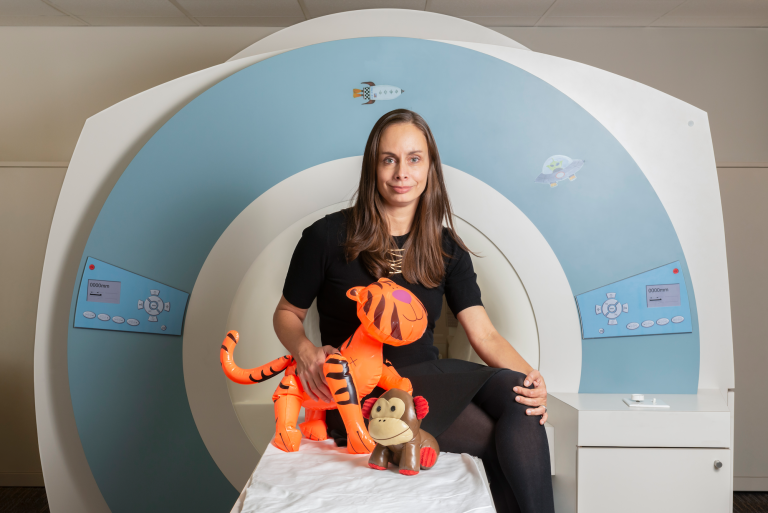
Nadine Gaab
After identifying that link, Gaab and colleagues set out to learn when these differences emerge. They compared brain scans from children with a familial risk for dyslexia with those from children without the familial risk and found that children at risk for the condition showed differences in the arc even before beginning formal schooling. Moreover, the rate of the structure’s development was slower among those who later developed poor reading skills regardless of familial risk. To the researchers, this suggested that some children began kindergarten with brains that were less well equipped for learning to read.
To explore how early these differences emerged, the researchers examined the brains of participants who had thus far been largely neglected in dyslexia studies: babies. Their initial study, published in Cerebral Cortex in 2017, found that infants of parents who had struggled with reading showed alterations the arc compared to infants of parents who hadn’t struggled to read. In subsequent studies, they observed a link between these alterations and phonological processing and oral language skills in kindergarten. They also found that the microstructure of the arc can be shaped by lifestyle factors, such as how early and often a child is read to.
We now know that some kids who step into kindergarten on their first day, with their little backpacks, have a heightened risk for struggling with learning to read.
While the arc is only one of several brain areas exhibiting differences in people with dyslexia, Gaab’s findings have provided an impetus for action. In addition to linking risk factors for dyslexia to specific parts of the brain, her work shows that some of these risks can be inherited. And the findings indicate that while genetics matter, environment can matter, too. Perhaps more important, they suggest that risk factors for dyslexia exist early — very early. “We now know that some kids who step into kindergarten on their first day, with their little backpacks, have a heightened risk for struggling with learning to read,” Gaab says. “That’s a really important distinction in terms of policy and how early we should find these kids and intervene.”
The value of early intervention
Despite so many children already at risk before starting school, U.S. school systems tend to identify children with dyslexia only after it’s clear that something is wrong — at around nine or ten years old. Gaab, who describes herself as a “translational neuroscientist,” has become a tireless proponent of early intervention. She advocated for a new Massachusetts law that was signed by the governor in 2018, requiring screening for dyslexia for children in kindergarten.And she’s been developing a tablet-based tool that can be used to screen children for reading problems as early as age four. This latter tool is especially useful because fMRI data, while good for exploring overall patterns of brain differences between groups, is impractical in educational contexts and does not have the sensitivity and specificity necessary to identify at-risk children.
Gaab hopes that pediatricians — who often screen for autism and ADHD — will adopt dyslexia risk screening, too. “We embrace preventive medicine; we get mammograms and checkups to identify risk factors and try to address them so that we don’t get sick,” she says. “That’s the same idea with dyslexia, to find at-risk kids early and intervene early, so that they never develop problems with reading. We call it preventive education.”
Dyslexia itself is not hazardous to anyone’s health. It really is the fact that they’re not being identified, they’re not being diagnosed, and they’re not getting the services that they need.
Proper early identification is key, adds Gaab, because studies indicate that 50 to 90 percent of at-risk readers can reach average levels of performance with targeted instruction, and that interventions are more effective in kindergarten and first grade than later on.
According to Olivardia, children who are never identified, or who live in communities without access to these interventions, might get lumped into generic remedial reading classes. But if their instruction isn’t tailored to dyslexia, “it’s as if you don’t understand the language someone is speaking, so they just speak louder,” he says. “You’re like, that doesn’t help me at all.”
Early intervention does more than help get reading levels on track. Children with dyslexia are more likely to experience depression, anxiety, and other mental health issues. But that’s not due to differences in their brains; it’s because in our society, literacy is key to academic and workplace success. “Dyslexia itself is not hazardous to anyone’s health,” says Olivardia, whose private psychotherapy practice specializes in treating children with learning disabilities. “It really is the fact that they’re not being identified, they’re not being diagnosed, and they’re not getting the services that they need.”
Education provides perspective
Olivardia understands the importance of reframing dyslexia for his patients. He talks to them about the many successful people who are thought to have had dyslexia — from Einstein to Picasso to British business magnate Richard Branson — and stresses his own observations that people with dyslexia exhibit above-average creativity and entrepreneurial skills. Research backs this up: A 2009 study in Dyslexia found a prevalence of dyslexia three times higher among entrepreneurs than people in the general population, while a higher prevalence of dyslexia has also been identified among students who pursue art or engineering. Other research points to a superior ability to connect unusual combinations of ideas among people with dyslexia.
Olivardia also draws from his experience parenting a child with dyslexia. Following his son’s diagnosis, they practiced role-playing conversations with teachers and peers about the learning disability. One day, a few weeks after diagnosis, Olivardia’s son was given lyrics to read in music class, but his dyslexia was so severe at that point that he couldn’t read the words at all.
Olivardia’s son asked a classmate to sit and sing along with him. The girl, confused, asked him why he couldn’t read. Instead of shrinking away, he calmly explained that his brain was just different — and pointed out that Tom Cruise has the same thing. “She was like, oh, OK,and that was it,” Olivardia says. “And he sat next to her. And when I picked him up, he said, ‘Dad, it was a great day.’”
“There’s a lot of hope in a label and a name,” Olivardia adds. “It gives parents, teachers, and doctors the opportunity to emphasize that these kids’ brains are wired differently — but that different does not mean they are defective.”
Molly McDonough is the associate editor of Harvard Medicine magazine.
Images: John Soares (Olivardia); courtesy of Anna Olivella and the Harvard Brain Science Initiative (Gaab)

 Early Days


 by Michelle Clarke (Rainman)
 Mon Dec 07, 2009 17:24