
-
Archives
- October 2026
- September 2026
- August 2026
- July 2026
- June 2026
- May 2026
- April 2026
- March 2026
- February 2026
- January 2026
- December 2025
- November 2025
- October 2025
- September 2025
- August 2025
- July 2025
- June 2025
- May 2025
- April 2025
- March 2025
- February 2025
- January 2025
- December 2024
- November 2024
- October 2024
- September 2024
- August 2024
- July 2024
- June 2024
- May 2024
- April 2024
- March 2024
- February 2024
- January 2024
- December 2023
- November 2023
- October 2023
- September 2023
- August 2023
- July 2023
- June 2023
- May 2023
- April 2023
- March 2023
- February 2023
- January 2023
- December 2022
- November 2022
- October 2022
- September 2022
- August 2022
- July 2022
- June 2022
- May 2022
- April 2022
- March 2022
- February 2022
- January 2022
- September 2021
- August 2021
- July 2021
- June 2021
- May 2021
- April 2021
- February 2021
- January 2021
- December 2020
- November 2020
- October 2020
- September 2020
- August 2020
- July 2020
- June 2020
- May 2020
- April 2020
- March 2020
- February 2020
- January 2020
- December 2019
- November 2019
- October 2019
- September 2019
- August 2019
- July 2019
- June 2019
- May 2019
- April 2019
- March 2019
- February 2019
- January 2019
- December 2018
- November 2018
- October 2018
- September 2018
- July 2018
- June 2018
- May 2018
- April 2018
- March 2018
- February 2018
- January 2018
- December 2017
- November 2017
- October 2017
- September 2017
- August 2017
- July 2017
- June 2017
- May 2017
- April 2017
- March 2017
- February 2017
- January 2017
- December 2016
- November 2016
- October 2016
- September 2016
- August 2016
- July 2016
- June 2016
- May 2016
- April 2016
- March 2016
- February 2016
- January 2016
- December 2015
- November 2015
- October 2015
- September 2015
- August 2015
- July 2015
- June 2015
- March 2015
- January 2015
-
Meta
“The Mature Mind: Aging Resiliently. Source: Knowledge magazine.
Posted in Uncategorized
Leave a comment
Ageing: YouTube “How to Deal With Caregiver Resentment and Anger”
Posted in Uncategorized
Leave a comment
Israel slaughter in Gaza; beyond all comprehension. Russia 24th February 2022 invades Ukraine and that savage war continues. Songs lay pathways to emotions and many of us have become numbed to the horrors of our World at War. We cannot forget history; we have the opportunities now through social media to engage … “Ceasefire called to bury the dead”
Posted in Uncategorized
Leave a comment
Nicola Hanney RTE programme Monday night; a brave woman, who decided to waive anonymity and declare the details of her horrific experience of Coercive Control. It used to be just physical abuse and protection from the courts but now verbal and emotional abuse leaves a person exposed.
Posted in Uncategorized
Leave a comment
OCD – Obsessed with Writing. (Age 12 new school, it was Mr Mangan history teacher, class exam, the walls were a shocking pink. You see I had a problem, my handwriting was an obsession. I changed from backwards to straight to forward but then I had the answer, I would write with a ruler underneath but the key was not to let anyone notice. Mr Mangan stood by me and that was the end of the test for me. My writing would not have been perfect enough, for me!) The same applies to order in the kitchen, working until all work done leaving a clear desk was core to my workaholic philosophy. Aged 60’s now and the warning signs were there all those decades ago.
Posted in Uncategorized
Leave a comment
Harvard Medical News: Building Models of the Brain to Take Them Apart: Computational neuroscientist probes how the brain learns, remembers, and decides. By CATHERINE CARUSO December 5th, 2023.
Building Models of the Brain to Take Them Apart
Computational neuroscientist probes how the brain learns, remembers, and decides
By CATHERINE CARUSO December 5, 2023 Research
6 min read
Image: MicroStockHub/iStock/Getty Images E+ Collection
Kanaka Rajan describes herself as an ever-curious, “stick-my-finger-in-the-electrical-socket kind of person” who enjoys working with her hands. Forays into engineering and experimental neuroscience led Rajan to her true calling: computational neuroscience.
Rajan spends her time building and manipulating models of the brain — an approach that affords her a great deal of freedom. One day she may be modeling complex social behavior in mice, and the next mapping neuronal connections in an octopus brain.
“My energy comes from that freedom; I basically see everything as a rich source of problems,” said Rajan, who in September became an associate professor of neurobiology in the Blavatnik Institute at Harvard Medical School. She is also a founding faculty member of the Kempner Institute for the Study of Natural and Artificial Intelligence at Harvard University.
In a conversation with Harvard Medicine News, Rajan spoke about her wide-ranging research, her interest in science communication, and why she’s excited to join the Kempner.
HMNews: What do you study and why?
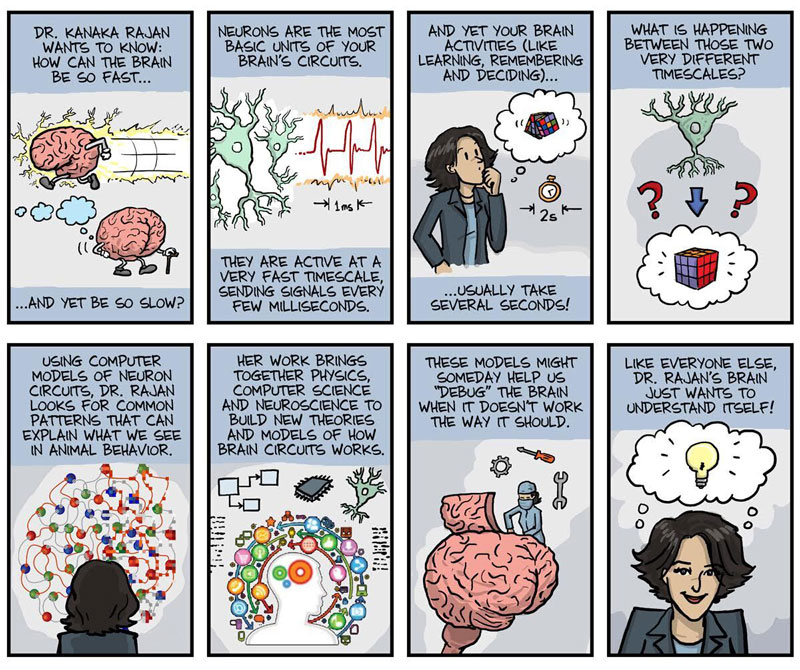
Rajan: I want to understand how animals and humans learn, remember, and make decisions. To do this, I use tools from mathematics, physics, and engineering, including artificial intelligence, to build models of different brains that are as close as possible to the learning and deciding of real brains. The advantage of building a model is that we have access to all the pieces, so we can take it apart in ways we cannot take an actual brain apart, which allows us to identify core operating principles that may exist in the biological system. The overarching goal of this work is to understand the foundations of natural and artificial intelligence: What makes us sentient? What makes us “us”?
HMNews: When you talk about brain models, what do you mean?
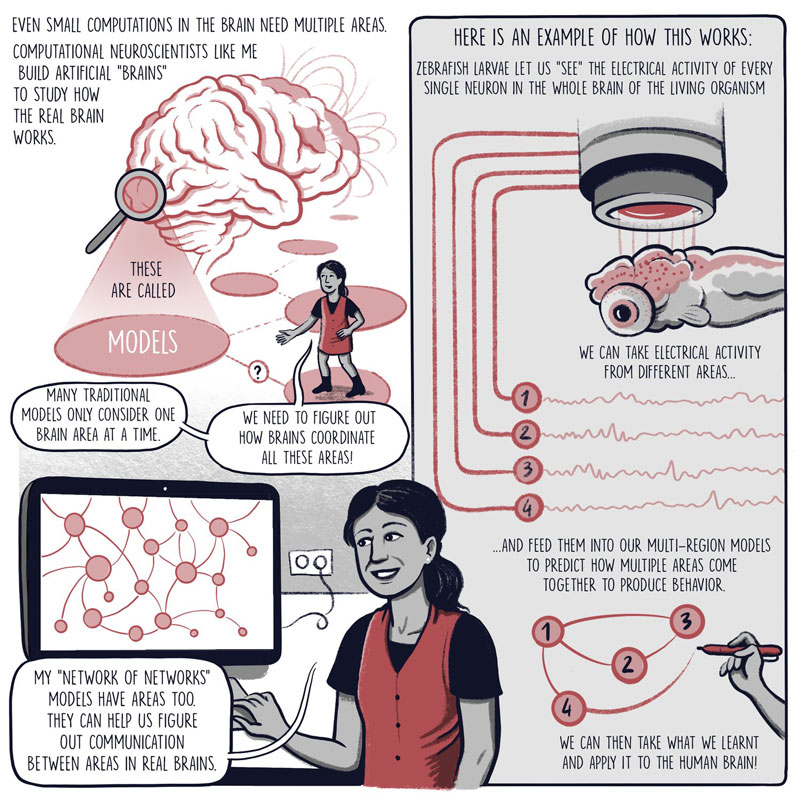
Rajan: These are computational models, or artificial “facsimiles” of real brain circuits. Sometimes they are computer simulations and sometimes they are mathematical equations. A model is like an unformed block of clay: it consists of equations and mathematical terms that we sculpt using our knowledge of the biological system until it resembles the real brain or behavior. Then, we take that model to colleagues in experimental neurobiology and compare it to the system or behavior it was designed to copy. As a result, I work closely with experimentalists in everything that I do. It’s an iterative process of going back and forth between models and experiments.
HMNews: How are you using these computational models in your research?
Rajan: One area is building models that are constrained by biological data. Experimentalists are collecting more and more data from the brain as they’ve progressed from recording activity in single neurons to entire brain regions. As a result, we’re faced with the problem of trying to organize and make sense of huge amounts of data — which is where models come in. For example, I’ve worked with an experimentalist who can image the activity of neurons in the entire brain of larval zebrafish. Using this information, I built a model that essentially replicates the fish brain and we figured out how neurons communicate within and across brain areas while the animal is “just hanging out.” We can use a model like mine to design new experiments, including drug screens.
HMNews: How else are you applying models in your work?
Rajan: I have another project that focuses on learning trajectories — work that is relevant to education. When we think about how we learn math, for example, we don’t just memorize formulas and equations. Instead, we learn addition, then we progress to multiplication, then we build these skills into formulas and equations. In other words, we break the subject down into conceptual building blocks that we stack on top of one another. We do this until we get good at the more complex skill and at using the various concepts we learned along the way.
In my research, rather than looking at “expert” animals — mice that are already experts at navigating a maze, for example — and trying to reverse engineer their learning process, we explicitly model the entire learning trajectory. We compare our model to experimental data collected during training to ask basic questions about how tasks are broken down into conceptual building blocks. Models like mine provide a roadmap for how animals learn different tasks, which we hope will help us understand how humans learn subjects such as math and music, and how to improve learning across domains. This may be relevant for people with traumatic brain injuries who need to relearn basic skills.
HMNews: What new areas of research are you excited to pursue at HMS?
Rajan: I am especially excited about a more out-there project on the neural mechanisms responsible for the emergence and stabilization of social groups. Many neurobiology labs interested in social neuroscience are looking at brain activity in pairs of animals interacting. Their data sets are large and rich, but two animals can interact in only a few ways. By contrast, physicists look at collective behavior in large ensembles of animals such as flocks of birds or schools of fish. They build elegant mathematical models, but those models essentially treat each animal in a group as a particle rather than as an individual with complex behaviors.
My lab thinks there may be an optimal, more informative zone in the middle of these extremes, between three and 10 animals. People in evolutionary and developmental biology and neuroeconomics have observed that 10 seems to be the threshold for the nervous system’s ability to process complex information from multiple members. We want to understand why this may be the case.
To this end, we’re building computer programs that contain artificial agents — think video game avatars of animals — that we force to interact socially in different digital environments. For example, we have mouse avatars forage in an environment with trees and bushes as we add elements like predators, obstacles, or droughts. We can then ask experimentalists to run lab experiments with actual mice interacting in similar situations and compare the data.
HMNews: Do you think this project will tell us anything about humans?
Rajan: We hope to use our model to simulate human social concepts like loneliness. For example, if a mouse avatar that was social becomes isolated, does it show similar deficits that a profoundly, chronically lonely person showed during the COVID-19 pandemic? Does it now have trouble reentering society? Loneliness is an epidemic and a documented precursor to many neurologic and neurodegenerative disorders. We need to understand the neural basis of social interactions so that we can begin to develop interventions for the human condition.
HMNews: You recently joined HMS, but you will also be working at the Kempner. What attracted you to the institute?
Rajan: I came to computational neuroscience circuitously; I started off in engineering and moved to biology in graduate school, thinking that I wanted to be an experimentalist. Eventually, I realized that I wanted to be in a field that merges the two, but to do that, I needed to learn both the language of quantitative analysis and the language of biology, which took a long time. Institutions like the Kempner will speed up this process by providing the tools and a physical location where everybody can come together: animal researchers, engineers, coders, basic biologists, and people like me who have always wanted to exist between fields. The Kempner is saying to me and to the next generations of young minds that we don’t care about traditional labels. We just want you to study big, interesting problems and we will teach you whatever languages you need, and provide you with whatever resources you need.
HMNews: You are also interested in science communication. Why?
Rajan: In computational neuroscience, we’ve created high barriers to entry because it may be convenient at times. I believe these barriers are completely made up. I’ve come to realize that you don’t need an advanced degree in math to be a computational neuroscientist. You don’t need to be the world’s best programmer to quickly ramp up to a research problem. We have taken on the biggest question facing humanity — how the brain works — and we need as many brains as possible to answer it. If we keep writing inscrutable papers, we silo knowledge away from those who can help. If we don’t learn how to communicate clearly in a jargon-free manner, and if we don’t lower the barrier to entry, my field will miss out on promising talent and radical new ideas, including from groups that have been historically underrepresented and marginalized. How I communicate what I do to students at all levels is as important as what I do.
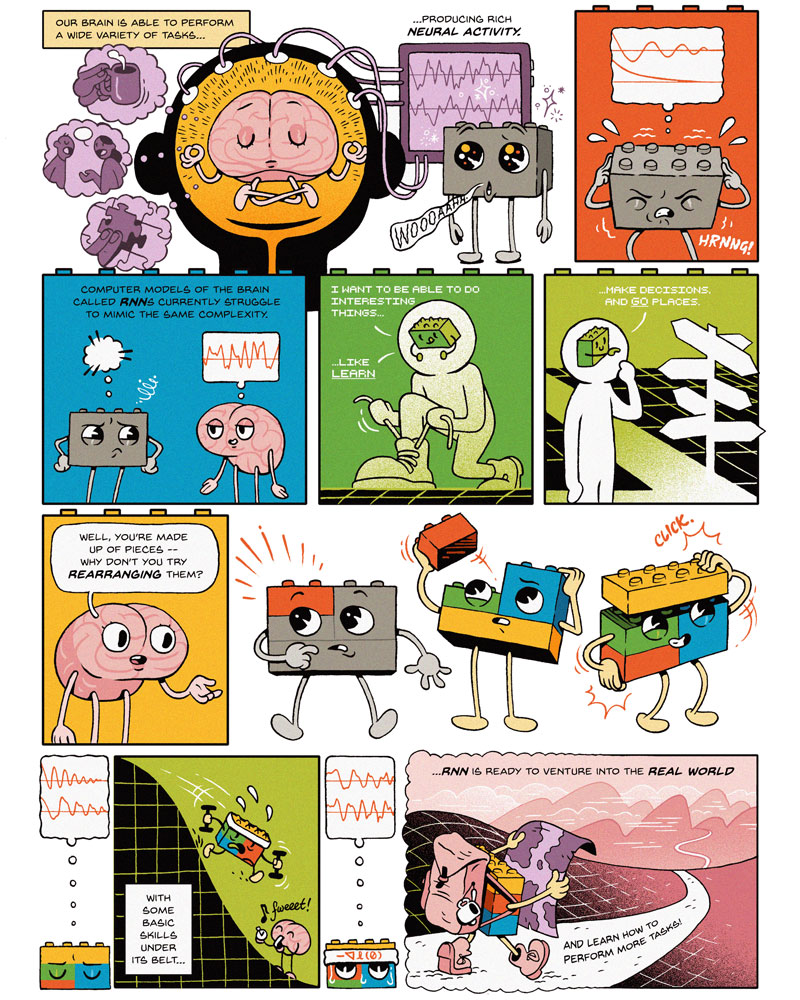
Visual media have been shown to increase engagement and retention of hard topics, so my lab began creating science comics. We turn content from scientific papers into comic strips that we distribute to underserved high school students, with the goal of promoting discussions about the papers. I hope that by making computational neuroscience more accessible, we can eventually help the field become more inclusive and diverse.
This interview was edited for length and clarity.
Posted in Uncategorized
Leave a comment
Christmas is coming; for some tension is in the air and fear too. Recommend identifying situations and learning a skillset to cope. This is an interesting one. “Narcissistic Deflection”.
Posted in Uncategorized
Leave a comment
Israel wages all-out war against the people of Gaza Fr. Shay Cullen
Israel wages all-out war against the people of Gaza
Fr. Shay Cullen
8 December 2023
The massive on-going invasion by Israel of the Gaza Strip and its blockade of humanitarian aid to 2.2 million Palestinian civilians deprive them of the means of survival and force them to live in drastic subhuman conditions. The bombing has destroyed their homes and livelihoods in Northern Gaza in the past two months and they were ordered to evacuate to the South of Gaza where the bombing continues unabated.
An estimated 1.5 million are confined there to a small section of land in Southern Gaza without shelters, water, sanitation, food, or medical help. Sickness is spreading. Perhaps a million more are in other parts of Gaza refusing to flee South.
There is no safe place for them to shelter North or South of Gaza and the head of the UN humanitarian relief said it is not possible to even give them aid because of the non-stop bombing nearby. This continues without mercy or concern. As many as 15,000 are estimated to have been killed already, almost 5,000 of them children. It is for sure a great crime against humanity as half of the hospitals have been attacked and destroyed or made non-functional.
All this retaliatory and disproportionate violence is because of a surprise vicious and evil military attack on Israeli soldiers and civilians on October 7 by the Palestinian Hamas militant group that killed and massacred as many as 1,300 Israelis and took 240 hostages. Some have been released.
Everyone acknowledges that Israel has a right to defend itself but killing 7,000 women and children is not self-defense. It is a worse crime against humanity than what Hamas did. Cutting off humanitarian aid is to force Hamas to release more hostages.
The Palestinians were driven out of their homeland in 1948 by armed Israeli settlers from Europe that came after WWII and millions of Palestinians were driven from their homelands into refugee camps. They have been confined in the West Bank and Gaza and in refugee camps in Lebanon. Described by commentators as “open air prisons,” these areas have been occupied by Israeli troops ever since and the Palestinians have never been allowed to form an independent nation-state of their own. A two-nation solution has been backed internationally for many years. That is something right-wing Israelis do not want. What they want is to be rid of the Palestinians and take all the land of Palestine for themselves as seen in continuing violent attacks by Israeli settlers against Palestinians in the West Bank, it seems.
Huge, kilometer- long walls seal the Palestinians off from their ancestral homelands that now make up the State of Israel presently ruled by the extremist right-wing government of Prime Minister Benjamin Netanyahu who has vowed to destroy Hamas and declared war on the group. The years of occupation, oppression, confinement and long-time inhuman restrictions of the Palestinians by Israel turned Hamas resistance fighters into vicious killers and their heinous attack against Israelis on 7 October 2023 incited the ire and revenge-seeking by the extremist right-wing Israeli government of Prime Minister Benjamin Netanyahu. He is no saint or savior of Israel. He will be facing an upcoming trial accused of past crimes of bribery, breach of trust, and fraud. His hope is to stay in power by waging war and stay out of jail. He is detested by more than half of moderate Israelis that demonstrated for months against Netanyahu’s plan to pass laws to reduce the power and authority of the Israeli Supreme Court. A way to save his own skin.
However, his political and personal future is facing a grim challenge since the tragedy of the Hamas attack happened on his watch, a serious failure of intelligence in defending Israel. Hamas had practiced and rehearsed their attack “hidden in plain sight” in Northern Gaza for two years and were ignored by Israeli intelligence. They united and trained the Islamic Jihad groups in Gaza for the coordinated attack on Israel.
Media reports say outsiders had known of the pending attack because there was a rush of short selling on the stock market of Israeli shares days before the attack. They knew what Benjamin Netanyahu did not and should have. Now he hopes his war will end the threat and redeem himself.
Despite previous attacks in the past, they were not wiped out by Israel and left in power, a useful tool for Israel. Hamas would never negotiate a two-nation solution and that is just fine with Benjamin Netanyahu and his right-wing Zionists that don’t want a two-nation solution either. They want a one-nation solution and to remove the Palestinians and occupy the whole of Palestine. They are doing that at present with as many as 17,000 or more Palestinians dead, most of them women and children.
The latest plan of Netanyahu is to divide Gaza and occupy the northern half and possibly build a bigger wall to contain and imprison the 2.2 million Palestinians. The United States is against it and Turkey, too. So, who will rule in Gaza after the war? No one knows.
The two-nation solution is seemingly the only feasible, long-term solution for these implacable enemies. World opinion is apparently turning against Israel. The latest bill in the US Congress to give more billions to Israel and Ukraine is blocked by Republicans.
The support by Joe Biden for the military action by Israel no matter how many Palestinians die is linked to his prospects of reelection next year. He will be looking for the US Jewish communities’ donation money for his reelection campaign.
He also has to be mindful of the votes of the US Evangelical Christians. Christians United for Israel claim they are 10 million strong. (They voted for Trump) They believe that the State of Israel has to be fully established before the Second Coming of Christ, the end-of-time event when the dead and the living will experience the “rapture” and ascend bodily into heaven and meet the Lord.
Most European countries are still burdened with guilt for allowing or supporting the Holocaust when Hitler and his SS massacred six million Jews. The German nation is totally in support of Israel. Chancellor Olaf Scholz, told the Bundestag, Germany’s Parliament, “At this moment, there is only one place for Germany. That is the side of Israel. That’s what we mean when we say, ‘Israel’s security is German ‘reason of state.”
Ireland is outspoken on behalf of the Palestinians and voted to fly the Palestinian flag for seven days over Dublin City Hall in solidarity with the people of Gaza. Politicians have spoken strongly in support of the people of Gaza.
United Nations Secretary-General Antonio Guterres has invoked Article 99 of the UN Charter last Wednesday. This is an official warning to the Security Council that there is a wider global threat because of the war on Gaza. He has called for an immediate cease fire for humanitarian reasons. The Security Council has not called for a cease-fire and motions have been vetoed.
The needs of the people in Gaza are dire and he said, “We are simply unable to meet those in need inside Gaza. The entire humanitarian system is on the edge of total breakdown. Such an outcome must be avoided at all cost.”
*****
*Need help? Contact:
newsletters@preda.org
*Privacy Policy:
We will never share, sell, or rent individual personal information with anyone without your advance permission or unless ordered by a court of law. Information submitted to us is only available to employees managing this information for purposes of contacting you or sending you emails based on your request for information and to contracted service providers for purposes of providing services relating to our communications with you.*Physical Address:
CONTACT US:
PREDA Foundation, Inc. P.O Box 68 Olongapo City 2200
Preda Main Center Upper Kalaklan, Subic Bay Olongapo City 2200 Philippines
E-mail: shaycullen@gmail.com, Information Officer: predainfo@gmail.com
TO SUPPORT THE WORK OF PREDA FOUNDATION, you may freely pass on the article or republish it in various print or online publications. To know more about other ways to SUPPORT the WORK of PREDA FOUNDATION, contact us directly through our email: shaycullen@gmail.com or predainfo@gmail.com*Unsubscribe:
https://preda.org/mailings/mail.cgi/t/AjUW3YuyUiiZNzphUJZuUFByUYmYoDcz6MCi7rNO/
Posted in Uncategorized
Leave a comment
9th December 2023. Our world at war. Ukraine The President’s Wife Mrs Zelenska pleads for US and other supporters to have MERCY. Meanwhile GAZA is pummeled by weapons and IDF from all directions, leaving ruins in its wake and too many dead and injured people by ISRAEL; Gaza is being wiped to the ground by IDF in search of Hamas; their wish; and that of US, to have exterminated Hamas so that it never raise can any of its “snakes heads” again. Piers Morgan (Talk TV) interviews a historian I greatly admire; he used to write for the Sunday Times, Professor Niall Ferguson. I highly recommend this conversation … and reference to any of his books, his Hoover Institution talks, and so much more. To date ie since October 7th 2023 – the “Scale of Grief” accounts for people carrying out their work, literally doing their duty: 100 aid workers have been killed, 220 doctors, nurses and paramedics have been killed and 61 journalists have been killed (4 Israelis, 3 Lebanese and 54 Palestinians). We are talking about Palestine … December month as Religious lore tells us the month of the birth of the Baby Jesus. Religion is driving these wars. Islam and its splinter groups; Christian be it the Pope in Rome of Christian Orthodox in Russia. War must end. There has to be another way to stop the slaughter of innocents.

Posted in Uncategorized
Leave a comment
World at War: Yesterday, I suggested Cistercian Monk Thomas Merton, an article dated 2018 from the Irish Times and then his poem Original Child. Today: in order to remain aware of the horrors of what is happening in both Ukraine and Gaza … a levelling exercise of those who wish to be empirical and in control. Nuclear weapons – we need to know the details because anger can lead to trigger happy and if we listen to Medvedev Russia – he is master of threats! Did you know about Nuclear Ban Week November 27th to December 1. Being aware is essential. ICAN won the Nobel Peace Prize in 2017. Please take the time to explore. Gaza … could be the incendiary device to World War III.
Posted in Uncategorized
Leave a comment

