Carmen Estrada, neuroscientist: ‘Science and God cannot coexist’ Source: EL PAIS

Science

Silicon ValleyYoutubeGoogleLatest News

SCIENCE

Carmen Estrada, neuroscientist: ‘Science and God cannot coexist’

In ‘The Inheritance of Eve,’ the Spanish researcher and classical philologist claims the biblical character as a symbol of science, curiosity, and the transmission of knowledge

The neuroscientist and philologist Carmen Estrada, in Madrid
The neuroscientist and philologist Carmen Estrada, in Madrid.Moeh Atitar
Nuño Domínguez

Nuño Domínguez

May 02, 2024 – 18:07 CEST

For most of her career, the physiologist Carmen Estrada, 74, dedicated herself to scientific research, specializing in the blood supply of the brain and its ability to form new neurons throughout life. “The more we exercise a function, the more neurons are recruited, so we can model our brain,” she says. After retiring, this native of Seville, in southern Spain, turned her career around: she studied and graduated in Greek philology. After publishing a first book about the adventures of her father, José Estrada, a young socialist who was deputy mayor of Seville when the Spanish Civil War broke out in 1936 and who fled from Franco’s rebels with the help of a far-right Falangist friend, there was a second one about the role of women in Homer’s The Odyssey. Now, Estrada has just published La herencia de Eva [The Inheritance of Eve], a book in which she traces the history of science, its influence on culture and its current role in society.

Question. Many people come to the humanities fleeing the sciences, but almost no one comes to the sciences fleeing the humanities, why is that?

Answer. Due to an incorrect idea of what science is. I try to convey a more open vision that does not focus only on mathematics and physics, for which, I believe, you must have a special mind. Science has a much broader scope. It is about observing the world and trying to explain it by natural causes. This can be done in many subjects. However, when kids in high school have to choose between science and the humanities, they are not offered this other side of science. If the majority of people saw that range of possibilities, perhaps they would have a more scientific attitude and would be less fooled by pseudoscience.

Q. Are we more or less gullible than in times past?

A. Human credulity remains the same. What happens is that now we have a tailored bombardment through mobile phones. The information we are providing is being used by algorithms, which will send you the content to which they believe you are most vulnerable, in order to convince you to consume, which is the ultimate goal.

Q. Is there a good side to technology that offsets this problem?

A. The internet is wonderful. I couldn’t have written this book without it. But what are we giving in return? It would be necessary to have ethical control of the technology. But since the dominant thing is not ethics, but business, we are lost.

Carmen Estrada, after the interview.
Carmen Estrada, after the interview.Moeh Atitar

Q. You warn against faith in science.

A. It’s a contradiction. Science and faith are antagonistic. But there are people, especially in the business and technology world, who blindly believe in science as the solution to all our problems, as long as people continue to consume. And then there is the other extreme.

Q. Which one?

A. The one that some environmentalists maintain. Their message is: if you are told that science says so, be suspicious. There are books that go so far as to say that Descartes is to blame for global warming. Because it was in the 17th century when the thought was born that science should be at the service of humans, that we are the owners of the planet. And from there we are already lost. They themselves fall into pseudoscience. They say ‘don’t buy the drugs, because what the pharmaceutical companies want is to do business’ — which is true. But instead they say ‘buy this other product that my cousin told me about and which is sold by a herbalist.’ Distrusting science in general and thinking that it will solve all the planet’s problems are two equally blind positions.

Q. Even so, in your book he maintains that science is the only thing that can get us out of the quagmire.

A. Science has to serve the human community. But who represents it? Economic interests are in control, and inequality is increasing. These are such basic contradictions that it would require us to stop and think, but that is not highly valued in our society. Everything goes very fast and you constantly have to be saying something clever and putting it on your mobile. Young people are growing up with that, and they have no other point of reference. It makes me very worried. I see my grandson very unprepared for today’s world, despite having a family that strives to give him the right tools, but the outside influence is stronger.

Q. Don’t you believe that everything will be corrected, that the next generation is always the best prepared one?

A. No. The current generation of young people will be very well prepared, but they are unmotivated, desperate, and frustrated. It’s a bad time to be young.

Q. What is Eve’s heritage that you defend in your book?

A. If you read about the myth of Eve freely — I used a direct translation of the Bible from Hebrew that is not so contaminated by the Church — what it says is that, guided by her instinct of curiosity, which is the instinct that guides science, Eve eats from the fruit of knowledge and then transmits it to others so they may continue it. Science is a collaborative and collective task. So Eve represents science, the instinct of curiosity, the acquisition and transmission of knowledge. The misogynistic interpretation that has been predominant until now maintains that the fruit was forbidden, so curiosity only leads to transgression. And hence this whole idea of guilt of the Judeo-Christian tradition, which has done a lot of damage.

P. Are science and God incompatible?

R. Yes, they cannot coexist. There are scientists who say they are believers, but either they are not believers or they are not scientists. A truth that is not demonstrated is not a scientific truth. God may exist as a hypothesis, but a demonstration of his existence has not been nor can ever be made. That is why they are incompatible.

Sign up for our weekly newsletter to get more English-language news coverage from EL PAÍS USA Edition

More information

Música conexión cerebral

Music scientists find the connection between music and emotion: ‘Our neurons dance to the same rhythm’

Enrique Alpañés

View of Earth taken from 'Apollo 8' with the curve of the Moon in the foreground.

A life without purpose

Javier Sampedro

Archived In

Adheres to

The Trust Project

More information

If you are interested in licensing this content, please contact ventacontenidos@prisamedia.com

Sponsored Content

Dublin: Say goodbye to expensive solar panels (if you own a home)The Eco Experts Solar Quotes|

Deepest Hole On Earth Was Permanently Sealed After Finding Mysterious FossilGeology & Archaeology|

Man Thought He Found A Puppy In The Forest – Then Vet Calls The Policehealthnfits.com|

And Also…

Hollywood has ‘Ozempic face’: Why you can look 10 years older after going all in on the slimming drugEl País

Watch: the terrifying moment a train is swallowed by a tornadoAS

Frightening footage of tornado over Nebraska InterstateAS

newsletter

Sign up to EL PAÍS in English Edition bulletinApúntate

Most viewed

  1. Excessive use of words like ‘commendable’ and ‘meticulous’ suggests ChatGPT has been used in thousands of scientific studies
  2. Disney: ‘Why do we need a cast made up of only women or Blacks?’: How Nelson Peltz, Beckham’s father-in-law, is trying to change the company
  3. Freddie Highmore says goodbye to ‘The Good Doctor’: ‘It has given me stability in years of great uncertainty’
  4. Cuba sentences 22-year-old mother to 15 years in prison for publishing videos of protests
  5. Ana de Armas turns 36: How the Oscar nominee jumps between dramas and action movies
https://83eaa5c5fc643b8d84414cc71bcc164d.safeframe.googlesyndication.com/safeframe/1-0-40/html/container.html

Posted in Uncategorized | Tagged , , , , | Leave a comment

Why data centers want to have their own nuclear reactors. EL PAIS. Comment: Ireland are you prepared … there are many plans to host the F (now Meta)AANGs+ needs for Data storage and Cloud too. AI is here.

Technology

Artificial intelligence

Why data centers want to have their own nuclear reactors

Big technology companies see this energy source as a way to satisfy their extremely high power demand, which has skyrocketed since the advent of AI

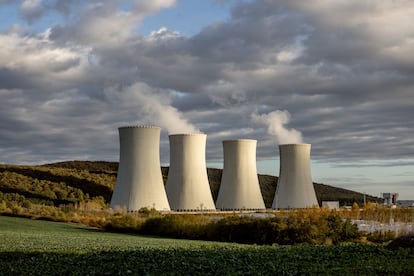
Mochovce nuclear power plant
General view of the four cooling towers of the Mochovce nuclear power plant in Slovakia.Janos Kummer (Getty Images)
Manuel G. Pascual

Manuel G. Pascual

Apr 30, 2024 – 17:32 CEST

Sam Altman, CEO of OpenAI, the company that created ChatGPT, issued a warning in January at the World Economic Forum in Davos: the artificial intelligence (AI) industry is about to cause an energy crisis. The new generation of generative AI will consume much more energy than expected, he told the world’s leaders and entrepreneurs, to the point of straining global energy grids. “There’s no way to get there without a breakthrough,” he said curtly.

The breakthrough he was alluding to is the so-called advanced nuclear energy, a term that includes small reactors and nuclear fusion, both still in the experimental phase. Several companies are focusing on this alternative, which would provide them with energy autonomy and greater cost control. In March, Energy Secretary Jennifer Granholm met with representatives of several technology companies, including Amazon, Google and Microsoft, to explore imaginative ways to cover their energy needs. One of the topics discussed was the possibility of using small nuclear reactors in data centers, the extensive warehouses full of processors running day and night.

According to the latest estimates, 8% of the world’s energy is already being used for AI; this energy powers the processors on which the models are trained and the systems are hosted. That figure, as Altman recently predicted, will soon fall short, as new users are added and new versions of ChatGPT, Gemini and Copilot emerge, which will require more and more computing power. “I’m glad he said that in Davos. “I’m glad he said it. I’ve seen consistent downplaying and denial about the AI industry’s environmental costs since I started publishing about them in 2018,” wrote Kate Crawford, one of the leading researchers on the AI footprint, in Nature.

Big tech has already taken the first steps towards the nuclear age, a declining energy source in the West (where plant closures outpace openings) with some major exceptions: the United States, France, the United Kingdom and several Eastern European countries. Companies, for their part, see nuclear power as a way to ensure a stable and lasting supply of energy in a context in which the existing supply is not enough. Senior Google executives told The Wall Street Journal that they are considering signing a power purchase agreement (PPA) with developers of small modular reactors (SMRs). “I do think nuclear, especially advanced nuclear, is making a lot of progress,” said Maud Texier, Google’s global director of clean energy and decarbonization development, in statements to The Wall Street Journal. Texier compared the cost of nuclear projects to where wind and solar were 15 years ago. “Cost decline is going to be a function of deployment,” she said. Company sources did not confirm to EL PAÍS whether the nuclear route is an option for the future, although they did not deny it either. Google recently signed an agreement with Microsoft and Nucor to accelerate advanced clean energy technologies, including “advanced nuclear.”

In October 2023, Microsoft closed PPAs with the American company Helion Energy to have the latter supply it with energy obtained from nuclear fusion starting in 2028. This technique is still more theoretical than practical and, unlike fission, does not produce radioactive waste. Asked by this newspaper about its strategy in the nuclear field, Microsoft alluded to a policy brief from December titled Accelerating a carbon-free future, which makes it clear that advanced nuclear and fusion energy, as well as traditional reactors, are one of the pillars on which Microsoft’s green policy will pivot, although there is no talk of deadlines or dates.

Image of the interior of the US Lawrence Livermore National Laboratory, a facility where nuclear fusion has been achieved.
Image of the interior of the US Lawrence Livermore National Laboratory, a facility where nuclear fusion has been achieved.HANDOUT (AFP)

AWS, Amazon’s cloud computing division, has recently purchased a large data center in the United States located next to the country’s sixth largest nuclear power plant, which supplies it with 100% of its energy at a fixed price. “To complement our wind and solar projects, which depend on weather conditions to generate energy, we are also exploring innovations and technologies and investing in other sources of clean, carbon-free energy. The agreement with Talen Energy [the company that owns the aforementioned US nuclear power plant] for carbon-free energy is a project that goes in that direction,” company sources told EL PAÍS.

Silicon Valley’s nuclear flirtation

The idea that nuclear energy is AI’s salvation is catching on among the Silicon Valley jet set. Sam Altman is one of its great supporters. He is so convinced about the good prospects of the proposal from Helion Energy, a pioneer of nuclear fusion, that he has invested $375 million in the company. Altman also chairs a startup, Oklo, that aims to design and manufacture nuclear fission reactors like those used today, but much smaller (the so-called SMRs, short for small modular reactors).

Bill Gates is another technology tycoons with interests in SMRs. His company TerraPower is working on a sodium nuclear reactor, an experimental variant that, if successful, promises to be 25 times cheaper than nuclear fission.

Meta’s chief generative AI engineer, Sergey Edunov, said a few months ago that only two large nuclear reactors would be needed to cover the entire global energy demand projected for 2024 in terms of AI, including powering already operational models and training new ones.

Does the nuclear route have a future? “There are no advances on the horizon that would allow for the immediate deployment of SMRs, which are currently in the initial prototyping phase in numerous countries. This option would only be viable if we are talking about a period of decades,” says engineer Heidy Khlaaf, a specialist in evaluation, specification and verification of complex computer applications in safety-critical systems. Some countries, such as the United Kingdom, France, Canada and the United States, have plans to develop this type of facilities, but not before 20 years.

Khlaaf is especially concerned that Microsoft has put generative AI to work on streamlining the bureaucracy to achieve nuclear licenses, a process that can take years and cost millions of dollars. “This is not a box-ticking exercise, but a process of self-assurance. Considering these regulatory processes as mere cumbersome paperwork says a lot about your understanding, or lack thereof, of nuclear safety,” he says.

Is it realistic to trust the future of AI to nuclear fusion? Helion Energy’s most optimistic estimates say that in 2029 it will be able to produce enough energy to supply 40,000 average homes in the United States. It is estimated that ChatGPT already consumes the equivalent of 33,000 homes today.

Why so much energy consumption?

The emergence of AI has shaken the global energy scene. Most of the consumption associated with generative AI models occurs before they are used, during the training phase. This is a key process in the development of deep learning models that consists of showing the algorithm millions of examples that help it establish patterns with which to predict situations. In the case of large language models, such as ChatGPT, the system is expected to conclude that the series of words “the color of the sea is” has a high probability of being followed by the word “blue.”

Most data centers use advanced processors called GPUs to train AI models. GPUs require a lot of energy to operate, about five times more than CPUs (conventional processors). Training large language models requires tens of thousands of GPUs, which need to operate day and night for weeks or months.

“Large language models have a very large architecture. A machine learning algorithm that helps you choose who to hire might need 50 variables: where the candidate works, what salary they have now, previous experience and so on. The first version of GhatGPT has more than 175 billion parameters,” explains Ana Valdivia, a lecturer in Artificial Intelligence, Government & Policy at the Oxford Internet Institute.

Once the model has been trained, it is necessary to host and exploit the data on which it works. This is also done in data centers, which have to operate day and night.

What is the total consumption of AI? How much energy is dedicated to training and feeding the most commonly used models? Companies don’t publish that information, so all we have are estimates. For example, Google’s Gemini Ultra model, one of the most advanced today, required 50 billion petaFLOPs to train it, according to a recent report from Stanford University. To achieve that kind of computing power with commercial computers (although supercomputers are used in these tasks) would require about 10,000,000,000,000,000 (10 to the power of 16) computers. The cost associated with this training was $191 million, largely attributable to the energy it consumed.

A single AI model can consume tens of thousands of kilowatt-hours. Generative AI models, such as ChatGPT, can have 100 times greater consumption, according to estimates by the technology consulting firm IDC.

Apart from powering the systems themselves, energy also goes to the cooling systems of the processors. The most common techniques include electric ventilation and the use of water to cool the environment and the machines. This latter system is beginning to cause problems in places with water scarcity, although the most modern techniques involve the use of closed circuits that minimize losses of water resources.

Sign up for our weekly newsletter to get more English-language news coverage from EL PAÍS USA Edition

More information

Robert Oppenheimer

Oppenheimer: Why was the father of the atomic bomb accused of working with the Soviets?

Alonso Martínez

A group of Palestinians carry the body of a man killed in an Israeli attack in Gaza, on Tuesday.

The Doomsday Clock places humanity 90 seconds away from the apocalypse

Iker Seisdedos | Washington

Archived In

Things getting racy between Taylor Swift and Travis KelceAS

Long-time Simpsons character becomes 8th to be killed off in over three decadesAS

newsletter

Sign up to EL PAÍS in English Edition bulletinApúntate

Most viewed

  1. Excessive use of words like ‘commendable’ and ‘meticulous’ suggests ChatGPT has been used in thousands of scientific studies
  2. Disney: ‘Why do we need a cast made up of only women or Blacks?’: How Nelson Peltz, Beckham’s father-in-law, is trying to change the company
  3. Freddie Highmore says goodbye to ‘The Good Doctor’: ‘It has given me stability in years of great uncertainty’
  4. Ana de Armas turns 36: How the Oscar nominee jumps between dramas and action movies

  5. A rare mammal with a trunk-like snout and webbed feet: The Iberian desman faces extinction

https://45d10ad4925b41081e9fcb65bc46081c.safeframe.googlesyndication.com/safeframe/1-0-40/html/container.html

Posted in Uncategorized | Tagged , , , , | Leave a comment

7 years Trinity College, circumstances prevented final exams so no degree. Education has been greatest experience of the last 21 years in survival. I highly recommend what Niall Ferguson says in this interview with Intelligence Squared. Did we make a mistake with “DEI” (Diversity Equity and Inclusion). Hard questions must be asked this day that endorses Freedom of the Press and the importance of Journlism

Posted in Uncategorized | Leave a comment

TEDMED: Exploring the role of AI in medicine with Bapu Jena, MD, PhD

97 views 1 May 2024 TEDMED Conversations

The role of artificial intelligence (AI) in healthcare and medicine is rapidly evolving. In this TEDMED Conversation, Bapu Jena, MD, PhD, Physician, Economist & Author of Random Acts of Medicine, explores the dual role of AI–as a surveillance system that may aid in accurate medical diagnosis and as a predictive tool that may provide insights to improve medical diagnosis. He also shares why he has hope that natural experiments will continue to improve the future of medicine with host, Kelly Thomas, PhD. Related resources: -Book: Random Acts of Medicine: The Hidden Forces That Sway Doctors, Impact Patients and Shape Our Health. https://www.amazon.com/Random-Acts-Me… -Podcast: Freakonomics, M.D. https://freakonomics.com/series/bapu/ Related Playlist: https:    • Transforming healthcare with technology  

Posted in Uncategorized | Leave a comment

Ireland – there is a massive housing/homes shortage; some say the Census stated that as many as 180,000 houses+ or potential homes are vacant. What can we learn from Japan experiencing drop in birth rates? Article in The Guardian “Akiya houses: Why Japan has 9 million empty homes?

The Guardian – Back to homeThe Guardian

Support the Guardian

An abandoned akiya house is pictured in a small village in Miyoshi, Japan

Abandoned akiya house in a small village in Miyoshi, Japan. Figures released this week shows the number of vacant houses in Japan has topped 9m. Photograph: Carl Court/Getty Images

Japan

Akiya houses: why Japan has nine million empty homes

New figures show nearly 14% of all houses in Japan are empty – but this real estate glut is attracting growing interest from foreigners

Gavin Blair in Tokyo Wed 1 May 2024 07.15 CEST Last modified on Wed 1 May 2024 10.49 CEST

As the declining population continues to impact Japan’s society and economy, the number of vacant houses has topped nine million – enough to accommodate the entire population of Australia at three people per dwelling.

Government figures released on Tuesday show the number of empty houses, known as akiya, as of October 2023 was up by more than half a million since the previous survey in 2018.

At the root of the issue is rural depopulation combined with many of those who inherit such properties being unable or unwilling to live in them, refurbish or even demolish them. Cities are not immune though, and there are hundreds of thousands of long-term empty houses in urban areas.

That total figure of vacant homes represents nearly 14% of all houses in Japan, though the real number could be higher. The Nomura Research Institute estimates there are nearly 11m akiya and that they could account for more than 30% of houses within a decade.

An abandoned house on a beach, Uchinada, Ishikawa, Japan.

An abandoned house on a beach, Uchinada, Ishikawa, Japan. Photograph: Toby Howard/Alamy

More than 4.4m of the properties surveyed are available to rent – but have been empty long-term and are mostly away from the main population centres. The status of more than 3.8 million is unknown and only 330,000 of the 9m were up for sale.

Vacant land attracts higher taxes in Japan than land with buildings, adding to the financial burden of knocking down old houses and leading some people to avoid inheriting properties.

https://35d939eaf4d348c871eed5b305a558c7.safeframe.googlesyndication.com/safeframe/1-0-40/html/container.html

However, there is growing interest among foreigners in this glut of empty properties, particularly kominka(traditional) houses as an option for cheap and unusual accommodation, holiday homes or to rent out to tourists.

Hana Sakata and her husband have been renovating and renting out houses for almost a decade through their New Heritage venture, beginning with a holiday home on the Izu peninsula that had lain vacant and fallen into utter disrepair. They acquired a traditional kominka house in a village in mountainous Nagano after part of it collapsed under the weight of uncleared snow while its elderly owner was in a care facility.

An empty house in Kanazawa, Ishikawa, Japan.

An empty house in Kanazawa, Ishikawa, Japan. Photograph: Toby Howard/Alamy

However, the cost of restoring such properties to their former glory is enormous, warns Sakata, who is still grappling with the kominka project.

https://35d939eaf4d348c871eed5b305a558c7.safeframe.googlesyndication.com/safeframe/1-0-40/html/container.html

“There is a lot of hype now, particularly among foreigners, about these gigantic farmhouses in Japan being available very cheaply or free. But it’s a huge commitment and there aren’t many contractors that can fix them up – the traditional carpentry skills are dying out,” she says. “In 10 years we could see a lot of foreign-owned akiya.”

Nevertheless, interest among foreign tourists in experiencing a stay in traditional Japanese accommodation is high, with demand currently outstripping supply, notes Sakata.

The yen being at multi-decade lows against major currencies has helped drive a tourism boom, with a record 3 million overseas visitors in March.

Japan is far from the only nation grappling with demographic fallout. In neighbouring South Korea the birthrate per woman fell to a record low of 0.72 last year, well below even the 1.26 figure Japan logged in 2022. Both Singapore and Taiwan have also dropped below one child per woman, while fertility rates in the US are also at their lowest in a century.

Posted in Uncategorized | Tagged , , , , | Leave a comment

TED: “How AI is unlocking the secrets of nature and the universe” Demis Hassabis

Posted in Uncategorized | Leave a comment

A tragic ripple: The post-October 7 mental health crisis. Source: Blog – The Times of Israel. Comment: Mental illness/Mental Health … any source of experience can be of benefit to many who suffer with mental illness or in the case of war those who have PTSD.

Featured Post

A tragic ripple: The post-October 7 mental health crisis

First responders and survivors suffer from the failure to integrate mental health care into emergency response and recovery plans

Zaka personnel collect clothes that belong to the victims of the October 7 massacre, near the Israeli-Gaza border, southern Israel, November 19, 2023. (Chaim Goldberg/Flash90)

Apr 28, 2024, 4:45 PM

Please note that the posts on The Blogs are contributed by third parties. The opinions, facts and any media content in them are presented solely by the authors, and neither The Times of Israel nor its partners assume any responsibility for them. Please contact us in case of abuse. In case of abuse,
Report this post.

In the wake of a catastrophic event, the focus often swiftly shifts to physical injuries and the immediate restoration of infrastructure. Yet, the profound emotional and psychological scars borne by those on the front lines and the survivors can linger long after, often overlooked and inadequately addressed. The recent tragic news from Israel serves as a painful reminder of this neglected aspect. An operator from the Magen David Adom’s (MDA) national call center, overwhelmed by the distressing calls during the horrific events of October 7 tragically succumbed to death by suicide. This incident, alongside recent reports of over 50 deaths by suicide among the survivors of the Nova festival, underscores a deep-seated mental health crisis—a crisis exacerbated by systemic failures and governmental shortfalls in mental health support.

The Overlooked Burden on First Responders

First responders, including emergency call center operators like the MDA staff, are the unsung heroes of disaster response. They manage the influx of distress calls, make critical decisions under pressure, and absorb the emotional weight of the community’s panic and fear. However, the psychological toll on these individuals is profound, enduring, and often invisible. The death of the MDA operator is a stark indicator that the support systems currently in place are insufficient and that the mental health of first responders is severely neglected. It’s a failure of the system that calls for immediate rectification.

The Silent Suffering of Survivors

Similarly, the survivors of traumatic events such as October 7th, which in some affects each and every citizen in Israel, face enormous psychological hurdles. Post-traumatic stress disorder (PTSD), other traumatic disorders, depression, and anxiety are common, yet support and treatment are frequently proving to be inaccessible or inadequate. The startling number of suicides among these survivors points to a dire need for a more robust mental health infrastructure, one that provides immediate and long-term support tailored to the unique needs of trauma survivors.

A Critique of Government Action

The response of governmental agencies to these mental health challenges has been woefully inadequate. There is a persistent underinvestment in mental health services, a lack of proactive mental health policies for trauma exposure, and an overall bureaucratic sluggishness in addressing the urgent needs of affected communities. Governmental bodies often resort to manifestly ineffective shortcuts while patting themselves on the back: temporary solutions, insufficient funding, and reactive strategies that fail to address the root of the crisis.

It’s time to end these shortcuts and establish comprehensive, preventative mental health care strategies. The current approach fails to protect vulnerable populations and places an unsustainable burden on healthcare systems, emergency response units, and the broader social fabric.

A Continual Call for Comprehensive Reform

This ongoing crisis demands a strategic overhaul of how mental health care is integrated into emergency response and recovery plans. The government must take responsibility for the following:

1. Implementing Robust Support Systems for First Responders: All emergency personnel must receive mandatory, regular psychological support and counseling. This should include routine debriefings after distressing calls and incidents, along with access to mental health days and support resources.

2.  Expanding Access to Mental Health Services: Increase funding and resources for mental health care, ensuring that trauma-informed care is accessible in all communities, particularly those most susceptible to disaster and crisis.

3. Building Awareness and Removing Stigma: Launch comprehensive public education campaigns to elevate awareness of mental health issues, the importance of early intervention, and the critical nature of seeking help. These campaigns should also work to dismantle the stigma surrounding mental health, which often prevents individuals from accessing necessary care.

4. Fostering Research and Policy Innovation: Invest in research to better understand the long-term effects of trauma exposure (NOT JUST PTSD) and use this data to inform policy changes and the development of targeted mental health interventions.

Conclusion

The tragedies of the MDA operator and the Nova festival survivors are grim reminders of the cost of inaction. These are not isolated incidents but indicators of a systemic issue that demands bold, decisive, and immediate government action. As we mourn the loss of lives, we must channel our collective grief into advocacy for a system that not only responds to mental health needs after tragedies but actively works to prevent such crises from leaving an indelible mark on our society. The time for half-measures and shortcuts is over; a comprehensive, preventive, and adequately funded approach must be our path forward.

About the Author

Stuart is a co-founder of the Nafshenu Alenu mental health educational initiative founded in 2022. He currently serves on the Board of Visitors of McLean Hospital, affiliated with Harvard University Medical School. He serves as Chairman of the Board of OGEN – Advancement of Mental Health Awareness in Israel; chairman of Mental Health First Aid Israel and a partner in “Deconstructing Stigma” in Israel. He is on the Board of Directors of the Religious Conference Management Association. He has counseled over 7,000 individuals and families in crisis

Posted in Uncategorized | Tagged , , , , | Leave a comment

What will happen if the ICC charges Netanyahu with war crimes? The Guardian. (Kenneth Roth)

Close-up of man wearing suit

‘Can war crime charges make any difference?’ Photograph: Ronen Zvulun/Reuters

OpinionBenjamin Netanyahu

What will happen if the ICC charges Netanyahu with war crimes?

Kenneth Roth

The Israeli prime minister has good reason to worry, and the defenses he has offered so far are unlikely to help him

Mon 29 Apr 2024 19.47 CEST Last modified on Mon 29 Apr 2024 20.13 CEST

The Israeli government believes that the international criminal court (ICC) in The Hague is about to file war crimes charges against Benjamin Netanyahu and other senior Israeli officials. We can’t know for sure – the ICC has kept its plans close to the vest – but the Israeli prime minister has good reason to worry, and the defenses he has offered so far are unlikely to help him.

The ICC chief prosecutor Karim Khan’s most likely target is Netanyahu’s starvation strategy for Palestinian civilians in Gaza. Because the Israeli government has refused to let ICC staff enter Gaza, it will take time for Khan to complete the detailed investigation required to demonstrate other possible Israeli war crimes, such as indiscriminately bombing civilian areas and firing on military targets with foreseeably disproportionate civilian consequences. But the facts surrounding Israel’s obstruction of humanitarian aid are readily available.

I believe in another Israel – one not defined by Benjamin Netanyahu and his cronies

Naama Lazimi

Naama Lazimi

During his two recent visits to the region, Khan stressed that, as international humanitarian law requires, Palestinian civilians in Gaza “must have access to basic food, water and desperately needed medical supplies, without further delay, and at pace and at scale”. He warned the Israeli government: “If you do not do so, do not complain when my Office is required to act.” The standard he cited is endorsed by virtually every government in the world including Israel, Britain, the United States, and, as a United Nations observer state, Palestine.

For much of the war Israel has allowed just enough food into Gaza to avoid widespread death, but not enough to prevent pervasive hunger and, in some parts of Gaza according to the USAid administrator, Samantha Power, “famine”. Oxfam calculated that hundreds of thousands of people in northern Gaza were receiving on average only 245 calories a day, about one-tenth of normal requirements. At least 28 children younger than 12 were reported to have died of malnutrition as of 17 April.

Israeli authorities have been blaming anyone but themselves for this deprivation, but the evidence points primarily to Netanyahu’s government. Israel understandably wants to stop the smuggling of arms to Hamas, but its understaffed, convoluted procedures for inspecting aid trucks can take three weeks, with trucks often rejected for carrying a single innocuous item that Israel deemed of military value, forcing them to start the process all over again.

Items rejected include anesthetics, cardiac catheters, chemical water quality testing kits, crutches, maternity kits, oxygen cylinders, surgical tools, ultrasound equipment, wheelchairs and X-ray machines. When the UN secretary general, António Guterres, visited the Egyptian side of the Gaza border in March, he saw “long lines of blocked relief trucks waiting to be let into Gaza”. Israel has allowed much-publicized airdrops and sea delivery of food, but they provide only a tiny fraction of what land transport could deliver.

It is thus not surprising that Khan reportedly will initially charge Netanyahu, as well as the defense minister, Yoav Gallant, and Israel Defense Forces chief of staff, Lt Gen Herzi Halevi, for having “deliberately starved Palestinians in Gaza”. Just as Khan initially charged Vladmir Putin and his children’s rights commissioner with abducting Ukrainian children, and only later began to address Russia’s factually more complicated bombing campaign starting with attacks on electrical infrastructure, so is Khan likely to start with the straightforward charges in Gaza before moving on to more complex ones.

Khan will undoubtedly also charge senior Hamas officials in the military chain of command, as he should. The killing and abduction of Israeli civilians on 7 October are clear war crimes. But a basic premise of international humanitarian law is that war crimes by one side never justify war crimes by the other. The duty to comply is absolute, not reciprocal.

An Israeli bomb destroyed 4,000 embryos at a Gaza IVF centre. Where is the outrage?

Arwa Mahdawi

Arwa Mahdawi

Netanyahu has already begun to offer his defense. In a post on Twitter/X, he said: “Israel will never accept any attempt by the ICC to undermine its inherent right of self-defense.” But that is nonsense. ICC charges will have nothing to do with Israel’s right to self-defense. Rather, they will focus on the way the Netanyahu government has chosen to carry out that defense – by not only targeting Hamas but also committing war crimes against civilians.

Assuming that starvation is the ICC’s focus, Netanyahu may note that in recent weeks, the Israeli government has allowed more food into Gaza. Indeed, after the 1 April killing of seven World Central Kitchen staff members, when Joe Biden on 4 April implicitly threatened to condition future US military aid and arms sales on an easing of Israel’s obstruction of humanitarian aid, Netanyahu promised to open an additional border crossing and allow somewhat more aid into Gaza. Since then, humanitarian deliveries have increased, but are reportedly still insufficient. But this calibration according to US pressure only underscores the deliberateness of the starvation strategy. And easing that strategy now is no defense to having pursued it for many months.

The Israeli government may argue that Israel has a well-developed legal system and can prosecute its own war criminals. Under what is known as the principle of complementarity, the international criminal court is supposed to defer to conscientious national justice efforts. But Israel has no history of prosecuting senior officials for war crimes, and no case has been brought for Netanyahu’s starvation strategy in Gaza.

The Israeli government undoubtedly will argue that because it never joined the ICC, Israeli officials shouldn’t be prosecuted by it. But the Rome Statute creating the ICC gives it jurisdiction not only over the nationals of governments that have joined the court, but also over crimes committed on the territories of its members. That makes sense because addressing crimes on a country’s territory is a key attribute of sovereignty. Palestine has joined the court and granted it jurisdiction over crimes in its occupied territory – the West Bank, East Jerusalem and Gaza.

During the negotiations to establish the ICC, the US government opposed territorial jurisdiction, but the other governments present overruled it. US opposition to territorial jurisdiction was behind the sanctions outrageously imposed by Donald Trump on the prior ICC prosecutor, Fatou Bensouda, when she opened investigations in Afghanistan that could have implicated George W Bush-era torturers and in Palestine that could reach Israeli officials.

Civilian deaths in Gaza rival those of Darfur – which the US called a ‘genocide’

But Biden lifted Trump’s sanctions. When the ICC charged Putin based on territorial jurisdiction, Biden said the charges were justified. It would be profoundly unprincipled for Washington to accept territorial jurisdiction for Russian war crimes in Ukraine but not for Israeli war crimes in Gaza.

Moreover, any effort to interfere with the prosecution, such as by invoking the much-maligned American Servicemembers Protection Act that authorizes even military action to protect US allies from ICC prosecution – and hence has been dubbed the Hague Invasion Act – would probably yield enormous protests in the United States and endanger Biden’s re-election prospects.

Can war crime charges make any difference? The Israeli government is not about to surrender Netanyahu or his deputies for trial. But their travel would suddenly be limited. Although the US never joined the court, European governments have, meaning that suddenly Europe and much of the rest of the world would be out of bounds for those charged without risking arrest. It would also make it more difficult for Washington and London to pretend that their ongoing arming of the Israeli military is not contributing to war crimes.

In addition, an initial round of charges would be an implicit threat of more. As Netanyahu contemplates a potential invasion of Gaza’s southernmost city of Rafah despite 1.4 million Palestinians sheltering there, he must worry about whether more civilian deaths would spur Khan to intensify investigation of Israel’s apparently indiscriminate and disproportionate attacks on civilians. The ICC thus may live up to its potential not only to provide retrospective justice, but also to deter future war crimes.

  • Kenneth Roth, former executive director of Human Rights Watch, is a visiting professor at Princeton’s School of Public and International Affairs
Posted in Uncategorized | Tagged , , , , | 2 Comments

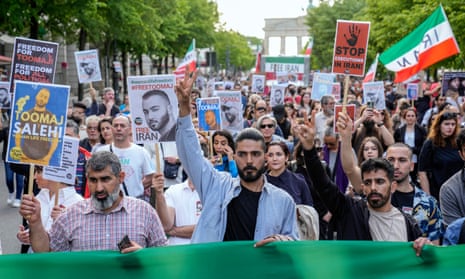
Iran’s death sentence for rapper sparks protests and undermines criticism of US. Source: The Guardian

Protesters hold signs with photographs of the Iranian rapper and banners reading: 'Stop executions in Iran'

Protesters at a rally in Berlin against the death sentence given to Toomaj Salehi. Photograph: Ebrahim Noroozi/AP

Iran

Iran’s death sentence for rapper sparks protests and undermines criticism of US

Regime’s effort to exploit US campus crackdown damaged by treatment of Toomaj Salehi

Patrick Wintour Diplomatic editor Mon 29 Apr 2024 14.27 CEST Last modified on Mon 29 Apr 2024 15.28 CEST

An Iranian court’s decision to pass the death sentence against Toomaj Salehi, a popular Iranian rapper and regime opponent, has led to international protests and damaged Iran’s fledgling efforts to exploit crackdowns on unrest in US university campuses over Gaza as an abuse of human rights.

Crowds gathered in the US, Europe and Canada on Sunday to support Salehi, while dozens of political prisoners in Iran’s Ghezel Hesar prison issued a statement condemning the death sentence, calling it “the culmination of gross human rights violations in Iran”. Salehi has also won the support of major US rappers, as well as human rights groups.

The Iranian press has been closely following the campus unrest in the US and France, including reports that 900 American students have been detained in April. The social media account of the supreme leader, Ayatollah Ali Khamenei, said: “See what is happening in the world. In western countries, in England and France, and in states across the US itself, people are coming out in huge numbers to chant slogans against Israel and America. US & Israel’s reputation has been ruined. They truly have no solution.”

This UGC image posted on Twitter reportedly on October 26, 2022 shows an unveiled woman standing on top of a vehicle as thousands make their way towards Aichi cemetery in Saqez, Mahsa Amini's home town in the western Iranian province of Kurdistan, to mark 40 days since her death, defying heightened security measures as part of a bloody crackdown on women-led protests. - A wave of unrest has rocked Iran since 22-year-old Amini died on September 16 following her arrest by the morality police in Tehran for allegedly breaching the country's strict rules on hijab headscarves and modest clothing. (Photo by UGC / AFP)

But even some reformist Iranian newspapers said the regime’s propaganda in the international arena had suffered reputational damage as a result of the surprise decision to issue the death sentence against a singer associated with defiance, but not violence against the regime.

Ever since he shot to prominence, Salehi has been distinguished by his personal bravery and determination to help unite the Iranian Women, Life, Freedom movement.

A woman attends a rally in New York and holds a sign that reads: ‘Islamic Republic, morality police still assaulting Iranian women’

A rally in New York supports the Women, Life, Freedom protest which was also backed by rapper Toomaj Salehi. Photograph: Lev Radin/ZUMA Press Wire/REX/Shutterstock

Salehi was arrested in October 2022 in Chaharmahal and Bakhtiari province after making public statements in support of the nationwide protests caused by the death in police custody of Mahsa Amini, a 22-year-old Kurdish Iranian woman arrested for allegedly wearing an “improper” hijab.

After reports by UN experts that he had been beaten in jail, in July 2023 he was handed a jail sentence of six years and three months.

In November last year, after more than a year in jail including more than 200 days’ solitary confinement, the supreme court released him on bail due to a technical flaw in the sentencing – only for him to be arrested again by plainclothes officers two weeks later. He had recorded a song outside the jail in which he had been held, claiming he had been tortured in jail including through adrenaline shot injections.

In a surprise move last week the Isfahan revolutionary court raised his punishment to the death penalty, a decision that has been described as unprecedented. In what may be a sign of a power struggle between the two courts, he was sentenced for “corruption on Earth”. He has 20 days to appeal.

The actor Nazanin Boniadi told a rally at the weekend: “When he takes to the streets, when he puts pen to paper, when he uses his voice, the regime trembles. Why? Because he speaks for the people. Things that the people do not dare to say, he says.”

Kaveh Shahrooz, a Canadian activist in Toronto, said he was personally blown away by Salehi’s courage. “There are people outside Iran in this city who are scared of talking and Toomaj was talking about them inside. His talent and his empathy and social conscience are hard to deny and his courage is hard to believe and his courage is contagious.”

Iran is in the throes of a new crackdown against women deemed to be flouting the Islamic dress code and is also increasing executions, the number of which, according to the Norway-based Iran Human Rights, has already reached 147 this year.

Salehi has previously said that Iranians “are living somewhere horrific. You are dealing with a mafia that is prepared to kill an entire nation in order to keep its power, money and weapons.”

His uncle in Germany Iqbal Iqbali said Iran was “at a stage where the explosion of the anger of the Iranian people against boundless tyranny is imminent”.

Posted in Uncategorized | Tagged , , , , | Leave a comment

Less work for the same pay won’t fly – but here’s a four-day week that might. Source: The Guardian

Print subscriptions

Support the Guardian

Fund independent journalism with €10 per month Support us

Close up white paper desk calendar with blurred bokeh background appointment and business meeting concept

The four-day workweek is an idea that could do with a little rebranding. Photograph: Kwangmoozaa/Getty Images/iStockphoto

US small business

Less work for the same pay won’t fly – but here’s a four-day week that might

Don’t be deluded by media hullabaloo – but smart employers can get creative with schedules to attract and retain talent

Gene Marks Sun 28 Apr 2024 13.00 CEST Last modified on Sun 28 Apr 2024 13.02 CEST

According to CNN “4-day workweeks may be around the corner. A third of America’s companies are exploring them.” CNBC says: “This US company tested a 4-day workweek – and says it made workers happier and more productive.” Newsweek tells us: “Millennials Are Ready For a Four-Day Week.” So why do all of my clients say nope?

According to an advocacy organization, more than 300 companies have four-day workweeks and, per the reports above, many others are apparently “testing” the concept. I admit that I’ve spoken to none of these companies but I’m not sure I have to. I spend my life working with small and mid-sized businesses and I know a PR stunt when I see one. Hey, good for them. In these times of tight labor – it’s a great marketing campaign. “People! Come work for us except you don’t have to do as much work and we’ll still pay you the same!” Now that’s a company I want to work for.

a house under construction

But ask any business owner about the four-day workweek and you’ll get the eye-roll. No employer who’s currently paying a worker $1,000 a week for 40 hours is going to agree to pay that same worker the same amount for a 32-hour week.

My firm has 600 clients. These companies slit paper, coat films, design strip malls, buy and sell auto parts online, mow lawns and repair roofs. They’re mostly owned by people who wake up at 5am and work till 7pm. They don’t have enough people to do the work needed. They don’t have enough money to pay for good health insurance, let alone a robot. Their parking lots need resurfacing, their internet needs upgrading and their coffee pots need to be replaced by Keurigs.

https://27102ea9ff0ff8ce0dbed25b5123652d.safeframe.googlesyndication.com/safeframe/1-0-40/html/container.html

These businesses – like most their size – suffer when a single person calls out sick. Their owners are battling customers who don’t pay, suppliers who don’t deliver and services that don’t function. My little subset of clients – who represent a tiny sliver of the country’s 30m businesses – can’t fathom a four-day workweek. To them, this is a fairytale, a dream, a misguided workplace concept driven by media interest that is so unrealistic that few even pay attention to the stories about it.

But that doesn’t mean there isn’t a place for the four-day workweek. All this idea needs is a little bit of rebranding.

If you’re an advocate of the four-day workweek you’re going about this all wrong. Instead of working fewer hours for the same pay – which, again let me confirm, is never going to happen – you should be pushing for changes in work schedules. Many industries – like healthcare, home services and retail – allow flexibility in scheduling so that workers put in four 10-hour days and then have three days off. I know younger workers who have this arrangement at their employers and they love it. Working a 10-hour shift isn’t that much different than an eight-hour shift, but having three days off in a week makes a big difference.

This is the kind of four-day workweek an employer should embrace. Allowing your people more flexibility in their scheduling satisfies a very reasonable (and admirable) value championed by today’s younger generations to have a better work-life balance. They’re right about this and smarter than my generation. By adopting a more flexible 10-hour-day schedule your company can tout its own “four-day workweek” program to current and prospective employees and leverage the current news cycle to help retain and attract more talent.

There will always be wily politicians who will take up silly causes like the four-day workweek to fire up their base. There will always be companies aiming to grab the headlines. But here’s the reality: workers who think that corporate America is going to a four-day workweek anytime soon are dreaming. It’s not going to happen. Not in the foreseeable future. Probably not ever. It simply doesn’t make economic sense. But employers can be more flexible and should be if they want to recruit the best talent. That’s the kind of “four-day” workweek that does make sense to a businessperson.

Posted in Uncategorized | Tagged , , , , | Leave a comment