With the shocking death of Iran’s president, Sir Richard Dalton, former British Ambassador to Iran, joins UnHerd’s Freddie Sayers for a conversation on the future of the Middle East, Israel and Western interventionism.
By transitioning treatments to remote platforms, advancing rehabilitative care, and redefining prenatal treatment, Sheba showcased inspiring healthcare innovation under pressure.
Amidst the recent conflict in Israel, Shebafaced an unprecedented challenge. With a surge in casualties and medical personnel being called to military duty, Sheba found itself under immense pressure to deliver care while ensuring the safety of patients and staff.
In response, Sheba turned to innovative technologies, to optimize patient care and streamline operations. Leading this effort were Prof. Zimmlicman, Sheba’s Chief Transformation and Innovation Officer, and Dr. Avi Tsur from Sheba Beyond, the center’s innovation arm, who played pivotal roles in deploying AI-driven solutions.
==================================
Leveraging AI for Remote Care
One pressing issue was relocating patients to missile-proof shelters while maintaining essential medical care. Using AI-powered remote monitoring systems, Sheba transitioned many treatments to virtual platforms, allowing patients to receive care safely from their homes or shelters. This ensured continuity of care and reduced strain on resources.
Sheba’s commitment to innovation was evident in its proactive crisis management. By harnessing AI and automation, Sheba augmented its workforce and optimized treatment protocols, saving lives during adversity. Prof. Zimmlicman and Dr. Tsur integrated AI into patient care, from remote monitoring to predictive analytics.
Sheba turned to technology and innovation to support rehabilitative care programs. AI-powered tools guided patients through essential, repetitive physical and mental exercises, crucial for their recovery.
We also redefined pre-natal treatment by enhancing its virtual pregnancy service for comprehensive remote care. This allowed high-risk pregnant patients to receive necessary monitoring and care while staying safe at home.
The recent conflict underscored the importance of innovation in healthcare, especially during crises.Sheba’s proactive use of AI enabled it to meet the conflict’s challenges and positioned it as a leader in healthcare innovation.
As Israel’s largest medical center, Sheba remains committed to leveraging technology to improve patient outcomes and drive healthcare innovation. By embracing AI and other cutting-edge technologies, Sheba ensures that patients receive the highest quality of care, even in the most challenging circumstances.
China’s is developing its own version of the internet Image: Jade Gao/AFP
Right now, two competing versions of the internet are evolving. The US-based version is dominated by companies such as Meta, Alphabet and Apple, which are leading consumption and commerce.
The Chinese internet, on the other hand, is designed as a service and surveillance platform. Chinese companies such as ByteDance, Alibaba and Tencent have almost unrestricted market sovereignty in this internet.
The Chinese version is being promoted by Beijing in as the “Digital Silk Road,” as a digital arm of the wider Belt and Road Initiative (BRI).
A recent report from the London-based think Article 19 on China’s exporting of “digital repression in the Indo-Pacific” says “China is seeking to influence global norms through technical standards and multilateral forums,” by, for example, organizing the annual “World Internet Conference,” which has been held in China since 2014.
“China’s ambition to become a global technological superpower by developing the technology and policy to reshape global norms,” the report says.
The Chinese model emphasizes “digital sovereignty,” a concept that promotes internet fragmentation “in contrast to the universality of human rights and internet freedom principles.”
China’s idea of the internet also rests on state control and focuses on “cybersecurity, censorship and surveillance,” the report adds.
How China is reining In its tech titans
One origin, two systems
There are two different worldviews behind these two versions of the internet, which becomes evident when looking at differences in how the internet is regulated in the United States and China.
In a recent essay, “Variants of Digital Capitalism: A comparison of China and the US,” Stefan Schmalz, a sociologist at the University of Erfurt in Germany, wrote that the difference is based on “guaranteeing entrepreneurial freedom” in the United States, while in China national security, and, therefore, political considerations, play a key role.
Both versions of the internet are still based on the same basic technology (HTML, TCP/IP, etc.). However, they have diverged in the age of Web 2.0.
In Web 2.0, which has existed since the turn of the millennium, easy-to-use applications provided by tech giants such as Instagram, WhatsApp and Amazon dominate the landscape.
Parallel platforms have been developed in China. WhatsApp is WeChat in China. For the vast majority of users, both versions represent two separate worlds that do not communicate with each other.
China cuts its own digital path
China began to decouple itself from the US-dominated internet in 1998 at the latest. At that time, the Chinese Communist Party created a “great firewall” to filter unwanted content from abroad.
In 2010, Google withdrew from China as it was unable to agree on censorship guidelines with the government, among other things.
This was followed in 2011 by the establishment of the now renamed Cyberspace Administration of China, which regulates the national internet and is responsible for online censorship. It also organizes the World Internet Conference.
In this way, the party created a sharply defined market, with 1.4 billion Chinese users, in which its own digital companies grew and prospered.
And China’s internet has seen some level of success, as is evident in the growth of Chinese internet giants that are no quite competitive with those in the United States.
For example, the only social network that does not originate from the United States and is nevertheless globally competitive is TikTok, which originated in China.
The struggle to shape the internet of the future
As the case of TikTok shows, China is no longer content to decouple itself, but seeks to expand and play a leading role in developing key technologies.
TikTok challenges potential US ban in court
The rivalry with the United States on this front involves the interplay of corporate, political and geopolitical interests.
Huawei, one of the world’s most important telecommunications equipment and hardware companies and the largest provider of 5G technology, is a prime example.
Critics in the United States and the West repeatedly accuse Huawei of providing a Trojan horse for Chinese authorities with its technology, as it is ultimately obliged to provide information to the Chinese Communist Party (CCP).
In their book, “The Silent Conquest,” Clive Hamilton and Mareike Ohlberg describe Huawei as the best example of “how the CCP combines espionage, intellectual property theft and influence operations.”
Huawei has always denied allegations of data transfer to the CCP, and to this day there is still no proof that Huawei actually installs “backdoors” for espionage.
The divide grows
Despite this, the division of the internet continues to spread. In November 2022, for example, the US Federal Communications Commission (FCC) banned the import and marketing of certain Huawei products in the US for national security reasons.
At the end of 2023, China issued a directive stating that government computers should not use Intel chips or Microsoft software as soon as possible.
Under the Biden Administration, the United States has also sought to cut off China from accessing critical semiconductor technology.
Third countries that do not have their own tech industry are increasingly having to decide which camp to join.
For a long time, the United States was the leader, but, in the Indo-Pacific, and particularly in Cambodia, Pakistan and Thailand, as well as Malaysia and Nepal, China has clearly gained influence, according to think-tank Article 19.
No other country has gone as far as Cambodia. “It is the best example of how the country is embracing Chinese-style digital authoritarianism. Since 2021, Cambodia has been working to introduce its own version of the Great Firewall as part of a ‘National Internet Gateway,'” the Article 19 study says. According to the authors, China is increasingly successful in curtailing the free, open and interoperable internet with its Digital Silk Road.
Who benefits from China’s surveillance technology?
“Decoding China” is a DW series that examines Chinese positions and arguments on current international issues from a critical German and European perspective.
Feeling angst? Better call your philosophical therapist
José Barrientos-Rastrojo is an expert in ‘philosophical advice’ that helps people deal with their existential problems. He also heads a pioneering project that applies the methodology at prisons in Spain, Colombia, Mexico, Argentina and Brazil
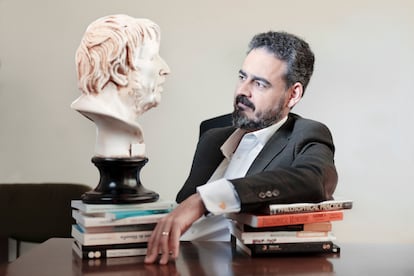
José Barrientos-Rastrojo, in his office at the University of Seville.Laura Léon
José Barrientos-Rastrojo, 47, awaits the arrival of a package at his home in Seville, in southern Spain. Although he is anticipating the sound of the doorbell, it never happens — instead, the doorbell rings in this reporter’s home just as our telephone interview has begun. The truth is, Barrientos does not have much time to wait around for packages. In addition to teaching at the University of Seville, he directs the BOECIO project, a pioneering applied philosophy program taught in prisons in Spain, Colombia, Mexico, Argentina and Brazil. “It is the first initiative of this type in prisons, the first empirical research that involves more than 500 prisoners,” says this scholar whose intense work schedule requires him to make frequent transcontinental trips.
The most striking thing about his career is the natural way in which he overcomes the intuitive discrepancy between philosophy and entrepreneurship. He has the same ability to organize an international conference of philosophers as he does to explain Heidegger in a couple of minutes.“I have always been very forward-thinking,” admits Barrientos, who before teaching philosophy wanted to study medicine but didn’t get a high enough grade and so went into nursing. He remembers: “It was clear to me that I wanted to help people have a better life.”
His life took a decisive turn the day he discovered that philosophy also served to improve people’s lives. He describes it as “an Ortegian revelation” (after the philosopher Ortega y Gasset): the immediate understanding of a fundamental truth that is revealed to the individual not through arguments, but as an evident and direct manifestation of reality. “Once you discover that truth, you can no longer be the same person you were before,” says Barrientos, alluding to the moment when he joined the philosophical advice group at the University of Seville.
He was a third-year college student pursuing a dual degree in Philosophy and Nursing. At that point he had never heard of a practice that goes by various names, including philosophical consultation, philosophical guidance or philosophical advice, and which back then was even more obscure in Spain than it is today. The dynamic is as follows: a client goes to a philosopher’s office, explains their existential dilemmas and together they explore the latter’s philosophical dimensions.It was the perfect synthesis of Barrientos’ passion for critical thinking and desire to directly help people. “There are problems that are frequently confused with psychological issues, when they really have a philosophical background. A great scourge of our society is not being able to respond to people’s philosophical conflicts,” he explains.
A bust of Seneca and a suit ready to use in Barrientos’ office, in case it is needed.Laura Léon
He was captivated by this methodology and opened a practice where he offered free philosophical advice to friends and acquaintances. At the same time, he continued to train through intense research work and by attending talks and conferences. At the age of 25, he organized the International Congress of Philosophical Counseling in Seville, the first in Spain. This early achievement was replicated the following year when, after being invited as a teacher to a summer course, he accumulated enough information to write what would become the first philosophical guidance manual in Spanish, a work that continues to be an essential work of reference in the field. “The important things in my life have almost always arisen by chance, as if I came across them,” he reflects.
After several years of teaching at the University of Seville and working as a philosophical consultant, he decided to change tack. “I realized that many of my clients would not need to come here if they had more critical thinking tools and philosophical habits to face the dilemmas for which they were coming in,” he says. As a result, he chose to replace individual visits with philosophical prevention workshops.The Center for Practical Wisdom at the University of Chicago funded him to launch philosophy workshops in prisons. It was the germ of what would later become the BOECIO project.
This is based on four objectives:strengthening critical thinking, improving interpersonal relationships, managing emotions and increasing the resilience of people deprived of liberty. There are several sets of workshops, each focused on a specific exercise. For example, critical thinking proposes a reverse debate, where participants must defend an opinion contrary to their own. In another type of activity, the objective is for participants to realize that their emotions depend on the way they interpret reality. For example, photos are exchanged in which someone is seen eating chocolate and a cockroach. Participants then reflect on the construction of disgust and the rejection that the second image universally provokes.
The Spanish researcher emphasizes that his workshops do not seek to turn philosophy into a tool to make his patients more functional and productive within the system. “Certain philosophically-oriented therapies or trends such as modern stoicism are often pre-configured with specific objectives that do not necessarily benefit the individual, but rather companies or the health system.Our goal is to promote autonomy and allow people to develop their own thinking, and ensure that their goals and objectives are not imposed by an external power,” he says.
He criticizes the notion of positive thinking as a construct of capitalist society designed to increase worker productivity.He calls it superficial and manipulative. Faced with the tendency to avoid feelings of angst, he believes that philosophy should help people explore it and use it as a resource for self-discovery and recovery of one’s own existence: “Our society labels anguish as something negative, but in reality it is an inherent aspect of being human that, properly harnessed, can become a valuable resource to recover personal authenticity and overcome existential blindness.”
Sign up for our weekly newsletterto get more English-language news coverage from EL PAÍS USA Edition
Generative AI digs the graves of traditional search engines and virtual assistants
The latest advances are aimed at creating more human-like systems that are capable of planning and executing complex tasks as well as, or better than, people
The latest advances in artificial intelligence (AI) that have been presented this past week aren’t trivial. So, where are things heading?
Demis Hassabis, director of Google DeepMind, the company’s research division, is clear in his response: “Towards artificial general intelligence (AGI), which equals or surpasses human intelligence.”
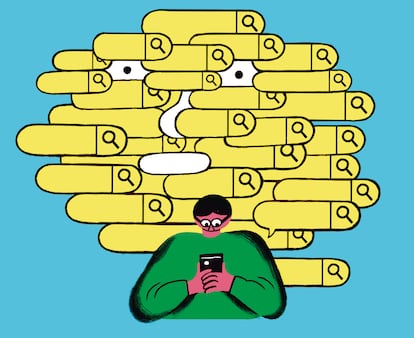
Over the last decade, we’ve had devices — such as the virtual assistants Siri, Alexa, Hey Google or Bixby — with limited capabilities to respond and execute actions on linked devices. On the other hand, since the end of the last century, search engines have helped find answers and provide offers to user demands. But both have their days numbered. Advances in the field of AI have begun to dig the graves for both services, in order to unify them into a single platform that’s capable of dialoguing like a human, analyzing documents (text, images or videos) in different domains, offering complex answers and solutions, and executing them on behalf of the user. The search engine and the virtual assistant are going to become a single tool or a “super-competent colleague” according to Sam Altman, the CEO of OpenAI, that will be present in all aspects of our lives.
The new developments represent a crucial step in artificial intelligence. Until now, we had AI tools such as voice assistants (Siri or Alexa), which already understood natural language, or applications that could convert a text request into images or videos (Sora), or chatbots that created text, or summarized documents and meetings (ChatGPT). The evolutions released in recent days by both Google and OpenAI do much more. A document from DeepMind and a dozen universities and entities defines them as “artificial agents with natural language interfaces, whose function is to plan and execute sequences of actions on behalf of a user — across one or more domains — in line with the user’s expectations.”
According to the latest research, the key is in the use of natural language, which facilitates interaction with the machine. This is in combination with the machine’s autonomy to develop plans and carry them out “on behalf of the user,” in its transversality in terms of sources that can be used, as well as in its ability to contextualize the user’s situation to meet expectations. AI is no longer a simple tool: it’s a complex robot that knows who it’s talking to and what results it should produce. “[Artificial general intelligence] will have a profound impact on our individual and collective lives,” the document warns.
Aside from the innumerable ethical problems that this same work identifies, the transition that’s now beginning has an immediate technological consequence: the AI tools that we’ve been using become obsolete in a singular way. The evolution of AI has begun to bury the search engine and the virtual assistant as we’ve known them until now.
The conventional search engine is dying
Larry Page and Sergey Brin founded Google in 1998, after meeting at Stanford University and publishing The Anatomy of a Large-Scale Hypertextual Web Search Engine. With this research, they developed a search engine that, in just one year, began to register 3.5 million queries a day. It’s now the most-used search engine in the world, with more than 3.5 billion daily information requests. But in this ephemeral era, the Google search engine (as we know it) is beginning its decline. Sergey Brin himself acknowledged this process last Tuesday, at Google’s headquarters in Mountain View, California.
“Over the last 25 years, we’ve invested a lot in the search engine. But we need to think about how we can meet the new needs of users… and I really think that [we can achieve this via] Google Gemini,” says Liz Reid, the new head of Search at Google, tasked with ushering in a new era. Google Gemini is the firm’s AI chatbot tool, a competitor to Open AI’s ChatGPT.
Reid explains that the conventional system — which, she acknowledges, has been an “incredibly powerful tool” — requires “a lot of work” to maintain. The traditional search function (known as “googling”) for a restaurant or any other service near the user’s location offers a map of addresses and a list of web pages. The information seeker has to complete the process by scrolling through each page, one by one.Of course, those that pay to be at the top of the results get to be seen first. A Google user can also narrow down a search and specify what type of food or specific service they require, until they get a more precise list of websites.
This tedious process – apparently – is coming to an end. “We radically changed how it works,” says Sundai Pichai, Google’s CEO. And Reid concurs: “We’ve built a custom Gemini model, designed specifically for Search, that combines our real-time information with unprecedented quality and classification systems.”
The directive assures that, in the tests carried out, “people also click on a greater diversity of websites.” This trend will compel the modification of SEO strategies (Search Engine Optimization), which are the techniques utilized to improve the position of a website in search engine results. Now, firms will have to adapt to how artificial intelligence processes information.
The new search engines plan, reason, understand the user’s context and — at the person’s request — can execute the purchase order for a product or service, suggest add-ons, or make a reservation.
Understand, see, reason and plan
The new search engines have the ability to reason in steps. In this way, they can ask you for a weekly menu that, based on your interactions with them, or with the details provided, will adjust to your tastes. The next step may be to adapt it to a vegetarian and modify the already-selected recipes to this preference.
The new AI chatbots are also able to plan ahead.The user can ask them to schedule a trip anywhere, taking into account activities for children and adults. Requests can be tailored based on the user’s interests, whether they’re a nature lover, or passionate about culture.
Likewise, these new chatbots can make purchases based on images. The user only has to upload a video and indicate, by voice or text, which character is wearing the item they’re looking for. The results will subsequently show locations, prices and availability. Or, a user can simply circle an image of the piece of clothing in question with their finger. Or the user might provide the sequence of an appliance malfunction, and the chatbot can offer information regarding repair services.
Google has been the first to launch its new search engine. However, other companies such as Microsoft are advancing with Copilot, which has similar features, along with the support of OpenAI.
AI Assistants
OpenAI, which has served as a driving force in the rapid development of artificial intelligence, still hasn’t presented a similar product. However, the firm has made inroads with other major advances this past week. Back in April, on the other hand, Google already presented its next-generation AI assistants to its customers who use Google Cloud, which houses a large part of developers’ work.These new assistants are responsible for making tools such as Siri, Alexa or Hey Google obsolete.
On May 13, just 24 hours before Google announced Project Astra — its vision for the future of AI assistants — OpenAI presented ChatGPT-4o, a conversational robot that’s also capable of seeing, hearing, solving and executing tasks on behalf of the user. It will be accessible through the web and mobile application for free, although the most advanced version — five times more capable — will cost $20 per month.
Sam Altman, the CEO of OpenAI, agrees with DeepMind that these new assistants will revolutionize lives, according to comments he made to MIT Technology Review. Altman also feels that AI tools that generate images through voice or text requests, such as DALL-E or Sora, or those that generate text via cues, such as the first versions of ChatGPT, have been just that: simple tools. He thinks that, while they’re used for isolated tasks, they have limited capacity to learn about us from our conversations with them.
The advanced AI assistant, according to Altman, is capable of helping us outside the chat interface and taking real-world tasks off our hands.He describes the previous generation of AI tools as a “super-competent colleague that knows absolutely everything about my whole life, every email, every conversation I’ve ever had… but doesn’t feel like an extension [of me].”
Chirag Shah – a professor at the University of Washington who has no ties to the large firms that are leading these AI developments – concurs with this assessment. “This [new AI assistant] really knows you well… it can do many things for you and can work on multiple tasks and domains,” he told the MIT Technology Review.
Google’s new assistant is called Astra. It will be fully operational at the end of 2024. Its most advanced version will be available in the AI Premium version of Google One and will be offered for free for two months.Subsequently, it will cost users about $20 per month.Google is working to include this assistant on its mobile phones, smart glasses and other devices. “We’re open to all formats… but if OpenAI maintains a limited free version, we may have to do the same,” a Google executive admits to EL PAÍS, during an interview in the United States. They ask not to be identified.
Astra combines the new capabilities of the Gemini search engine with humanized robotic abilities, such as empathy and senses (hearing and vision) to analyze and record context. This is in order to respond to any interactions with users that are related to what passes through the camera and microphones of a device.
Demis Hassabis explains further: “We’re processing a different flow of sensory information. These [AI assistants] can see and hear better what we do, understand the context in which we find ourselves and respond quickly in the conversation, making the pace and quality of the interaction [between the user and their device] much more natural.”
With these abilities, Astra and ChatGPT-4oare able to accompany the user from their mobile phone. They can learn the context in which an interaction is occurring, while they simultaneously answer a specific question, solve a mathematical problem, identify a page of code, or explain where we may have left a missing object.
The principal use of these spectacular capabilities would take place in the workplace or the home. Users, for instance, can ask these next-generation AI assistants to identify expenses — such as a pending insurance payment or an electricity bill — analyze them, display them on a spreadsheet and identify savings options.
The assistant will sift through emails, stored documents and any file or website that contains information about expenses (so long as access is granted by the user). This will all be organized and summarized, while the webpages of the providers of the services in question will also be consulted. The virtual assistant will subsequently propose a plan of savings and — if the user demands it — the AI, for instance, will execute renewals or cancellations of subscriptions.
There are numerous applications for these next-generation AI assistants. The objective is to have them support users across the board. Minsu Jang, the lead researcher at the Social Robotics Laboratory at South Korea’s Electronics and Telecommunications Research Institute, is working on the development of AI for task planning: “We plan to research and develop technologies that can predict task failures in uncertain situations and improve the response to the human when they ask for help. This technology is essential to achieving the era of one robot per home.”
Advantages and risks
The work done by a dozen universities and entities and commissioned by DeepMind examines the new developments in the field of artificial general intelligence, while identifying their advantages and risks. The experts highlight that these advanced assistants can “empower users” to achieve their goals or well-being, or act as “mentors, friends or trusted advisors.”In this sense, a new study recently published in the Journal of the American Medical Informatics Association (JAMIA) reveals how AGI is capable of responding to different emotional states.
In an evaluation of ChatGPT, Gemini and Llama (Meta), the University of Illinois has shown the importance of this skill. “[Next-generation AI assistants] can, for example, help increase user awareness about healthy behaviors, bolster their emotional commitment to change and [make users] realize how their habits could affect the people around them,” explains Michelle Bak, a researcher in the field.
These assistants can also help users make better-informed decisions, or help them develop their creativity, personal training, or problem-solving. They can also help them schedule more efficiently, to provide more time for personal activities and familial relationships.
But this utopian world also has its shadows. This past week, there was a resignation in the OpenAI security department. Jan Leike, one of the firm’s leading researchers, has been blunt, writing on social media that the company values the creation of new products more than security.While walking out the door, he offered a harsh reflection on X: “Building smarter-than-human machines is an inherently dangerous endeavor.”
AI assistants could also violate privacy and be potentially unsafe if they return an incorrect or even harmful answer to the user, despite it having the appearance of truth. Hallucinations, as these errors are called, are common in existing tools.
In the same way, these next-generation AGI assistants can respond to the particular interests of the developers and limit the responses only to their objectives, which may be monetary, and not those of the users. They may also be programmed to prioritize the benefit of an individual user over the consequences that could be felt by a community.
Furthermore, these virtual assistants can impose values on society, creating certain currents of opinion, or be used for malicious cyberattack campaigns. “We’ve investigated 36 parliamentary, regional and presidential elections held between September of 2023 and February of 2024 and discovered that, in at least 10 cases, videos and audio recordings with voice cloning were used for disinformation campaigns. In the context of the [upcoming] European elections, we can expect a new wave of deception in all countries,” explains Sergey Shykevich, director of the threat intelligence group at Check Point Research.
Sign up for our weekly newsletterto get more English-language news coverage from EL PAÍS USA Edition
Professor and legal scholar Alan Dershowitz and Pulitzer Prize-winning journalist Glenn Greenwald debate the resolution, “The U.S. should strike Iran’s nuclear facilities.” Taking the affirmative is Dershowitz, an American lawyer and law professor known for his work in U.S. constitutional law and American criminal law. From 1964 to 2013, he taught at Harvard Law School, where he was appointed as the Felix Frankfurter Professor of Law in 1993. He is the author of several books about politics and the law, including The Case for Israel, and The Case for Peace. His two most recent works are The Case Against Impeaching Trump, and Guilt by Accusation: The Challenge of Proving Innocence in the Age of #MeToo. In January 2020, he joined President Donald Trump’s legal team as Trump was being tried on impeachment charges in the Senate. He is a strong supporter of Israel, self-identifing as both “pro-Israel and pro-Palestine.” Taking the negative is Greenwald, a constitutional lawyer, investigative journalist, and best-selling author. Acclaimed as one of the 25 most influential political commentators by The Atlantic, one of America’s top 10 opinion writers by Newsweek, and one of the Top 100 Global Thinkers for 2013 by Foreign Policy, Greenwald has won the highest awards in journalism, including the 2014 Pulitzer Prize for Public Service for the NSA-Snowden revelations. This debate was moderated by Soho Forum Director Gene Epstein.
After growing up in poverty he became a millionaire as a highly successful trader at Citibank, then quit at 26, feeling exhausted. These days Stevenson is an activist trying to stop the global economic system from collapsing due to rising inequality
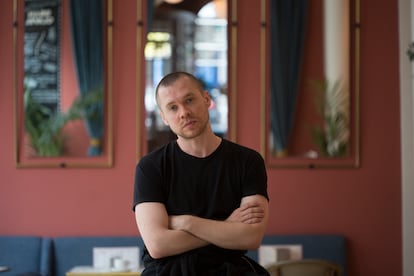
Gary Stevenson, this Tuesday in Madrid.Santi Burgos
At age 12, Gary Stevenson sold candy. At 16, he was kicked out of high school for selling cannabis. At 23, Citigroup gave him a bonus of €47,000 for lending money, selling loans. It was double the annual salary of his father, a postal worker.By the age of 26, he was a millionaire, but he had holes in his shoes and was unable to buy a sofa for his empty house. Mentally and physically exhausted, he decided to quit, even though he says that they threatened him to try to make him stay. Now 36, the British economist has become an activist who dedicates his time to warning about the impending collapse of the economy due to inequality. He tells his story in The Trading Game: A Confession.
Question. Why did you write this book? Is it a warning or a confession?
Answer. Both. It is part of a political project. The economy is getting worse and worse without most economists realizing it. I try to raise awareness about this by writing in newspapers, with my own YouTube channel… but to connect with people you have to tell them a story and I wrote about my own experience. I think it is much more powerful politically than any purely economics book I could write.
Q. You say that shortly before entering Citigroup an employee committed suicide by jumping from the 20th floor. Did you think about that man while you worked there?
A. The truth is, not really. Bankers have a long history of jumping from skyscrapers. This guy could have jumped from the outside, but he jumped in the internal atrium, because he wanted everyone to see, for traders to have a peek before going back to their desks. And my reaction was “so it goes.” It was a powerful metaphor for the way this world works, the level of obsession. It is an example of dehumanization.
Q. What should a trader in the City be like? What do you need to survive?
A. There is a book, Catch-22, that tells what lots of different people do to survive the war: some become obsessed with money, others with escaping, and others with enjoying everything as much as they can. Different traders do different things, some go out drinking, take drugs, go to Vegas... Cocaine addiction is a massive problem, gambling is a massive problem. Others, like me, were obsessed with being the best trader. The question to me is how humans survive in traumatic spaces. And a lot of people do not survive in many ways because they become dehumanized, they become aggressive people who hate others.
Q. You say in the book: “Many rich people expect the poor to be dumb.” Did you use it as an advantage?
R. It definitely was. They assumed I was an idiot. It happened at the London School of Economics, at Oxford… But, on the trading floor, I realized that they thought: ‘If this guy got here with that accent, it must be because he must be very smart, because if not, how did he get here?’ There is an irony because at that time I had no idea what I was doing, but they thought I was going to be the best, and in the end I became the best.
Q. You once lost eight million pounds before making much more. In your book you write that “the best trading is made with the nose. It smells like stupidity.” What does that mean?
A. In the world of trading, you do not make big money just for being right, but when you are right and everybody else is wrong. And that’s the kind of trading I specialized in, in being able to smell the bullshit when everybody believes it. My big trade was in 2011 because everybody thought things were going to get better and everybody was wrong.With the nuclear crisis in Japan, everyone went crazy: no one really knew what it was about, but everyone pretended that they did. Economists have been all wrong about almost everything for 15 years now. Lots of very intelligent people, with the most expensive suits and haircuts and with elite degrees from elite universities, have got it all wrong for a long time now. That’s fascinating to me and I have made a lot of money thanks to that.
Q. You were betting on disaster. What would have happened if there hadn’t been people like you who were betting that the economy was going to crash?
A.The story of the last 15 years in economics has been one of incorrect optimism because there is an undiagnosed structural crisis of inequality. If you have cancer and are not diagnosed, if doctors treat the symptoms, but not the cause, you will get worse. That’s what’s happening in the economy. Nobody looks at the distribution, the inequality. People like me make no difference if we’re working as traders, even though we can get paid millions to work at a bank. Politicians are not paid to do the right thing, but to win elections. Nobody in the public sphere is paid to be right. There are no incentives in the public sector to get it right, to do the right thing.
Q. But if they don’t do the right thing, they can lose the next election.
A.Yes, but David Cameron earned £10 million within one year after leaving. Tony Blair’s son is one of the richest men in the world. The current prime minister’s father-in-law is one of the richest men in the world. Politicians who lose elections end up really rich.
Q. When they transferred you to Japan you were devastated. Your girlfriend, who only joined you when she had her own job and income, was asking you to leave Citigroup, but at that time, you left the girl, not the job. Did you exchange money for happiness?
A. Right now I could be on a beach in the Philippines, I don’t have to be making this book or videos for YouTube. I come from a poor family, from a bad neighborhood, from a difficult childhood. I don’t do what I do for money, but because I don’t want the bad guys to win.Sometimes I wonder why nice kids from nice families aren’t doing the work I’m doing.I do it because I don’t want the world to go down the toilet. That money that I was fighting for then [a bonus he was owed] is what funds the work I do now.
Q. Who are “the bad guys”?
A. Many people who read the book will think they are the bankers. That is not all I want to say. I have a lot of empathy for my former colleagues, although they are multimillionaires and can take care of themselves. I am very confident that poverty will grow massively in the next 10 years because the system guarantees a flow of wealth away from the middle class, increasing inequality.That means that your grandchildren will live in desperate poverty. It would very nice to be able to say that the bad guys are guys like Elon Musk or George Soros, but that won’t get us anywhere. We get somewhere by stopping the economy from collapsing.I don’t want to have a big meeting on the Titanic to decide who the bad guys are, I want to steer the ship away from the iceberg. Being a banker helped lift my family out of poverty. The bad guys aren’t them, it’s the system.
Q. Caleb, your mentor, retired at age 29, but later returned. Have you been tempted to return?
A. I still sometimes have a recurring dream that I am still trading really well but I don’t get the bonus. I still check the markets every day. I don’t need the money, but I miss being known as the best. But I don’t think I’ll ever go back. I think what I do now is important.
Q. What relationship do you have with money now?
A. I don’t spend much. I live frugally. I don’t wake up and think about money, I think about how to win this fight. In my life I went very quickly from being judged for being poor to being judged for being rich.
Q. Your book says: “Rich people get the assets, poor people get the debt.”How do you see the future of the middle class?
A.It’s going to get smaller and smaller. The future? Look at Colombia, Mexico, Brazil… Europeans are somewhat naive about the economy. They think that what happens in those places cannot happen here, but countries with a lot of inequality end up like this. When you read Dickens you see the poverty of my own country 150 years ago. We are losing the standards of well-being that our forefathers fought for.
Q. You signed a letter with other British millionaires asking the prime minister to raise your taxes. But people who will never smell the amount of money that you handle oppose the rich paying more. What do you attribute it to?
A. There are several reasons.The right is building a narrative that is not correct, but is compelling: ‘You are poor because of the immigrants, who occupy your homes and your job,’ when it is because of inequality, because the rich are the children of the rich, who are the ones who take the money, not the immigrants. And the left does not have a clear message on the economy, it is not able to explain that things can be changed. There are many rich people who own many newspapers capable of convincing people that the problem is immigrants. We are going towards a more xenophobic Europe and we could end up where we were 100 years ago.
Q. You talk about the economy of inheritance,but education also works against that, right? You are living proof: from a poor neighborhood to the London School of Economics and from there to Citigroup.
A.Yes, I come from a poor neighborhood and I got a good job and a lot of money. But almost everyone I know is exactly as rich as their father and I know people who can’t afford a house on their salary alone. It is not a meritocracy. Wealth is hereditary.
Gary Stevenson, this Tuesday, in Madrid. Santi Burgos
Sign up for our weekly newsletterto get more English-language news coverage from EL PAÍS USA Edition.
========================
91,420 views 28 Mar 2024 He went from working-class east Londoner to Citibank’s most profitable trader. He made his millions by predicting that inequality dooms our economic model. We discuss his bestselling new book – The Trading Game: A Confession – and why our economic model dooms us to falling living standards, and unless we can get our act together, fascism will triumph.