66,802 views May 20, 2024Gabor Mate tells Imran Garda that the ongoing war in Gaza has weighed heavily on him. A holocaust survivor and world-renowned expert on trauma, Mate talks about the impact of generational trauma in the conflict as well his journey from being a young Zionist to a critic of Israel and supporter of Palestinian rights. He also discusses dehumanization, why the legacy of colonialism is a driver of extremism and explores how we can find healing in our “toxic” culture. Gabor Mate’s website: https://drgabormate.com/
Reflections by Fr. Shay Cullen, – True freedom is to reveal the truth without retaliation
Remove label Inbox from this conversation
PREDA Foundation, Inc <newsletters@preda.org>
10:01 AM (20 minutes ago)
to me
True freedom is to reveal the truth without retaliation Fr. Shay Cullen 29 June 2023
Publishing the truth, revealing war crimes, atrocities, murders, and crimes against women and children and rights advocates are part of the onerous and sometimes dangerous work and duty of media people such as writers, journalists, publishers, editors, photographers. Many journalists are courageous, fearless and pay the ultimate price for revealing the truth about corruption and serious wrong-doing by police, military, politicians and business people. Frequently, there is retribution for those with the courage to expose evil.
It is reported that 45 journalists were murdered around the world in 2023 alone. The worst year was 2012 when 147 writers and journalists were killed for their work reporting the truth. In 2022, four journalists were murdered in the Philippines. This brings it to a total of 140 Filipino journalists killed between 2000 and 2022. The Philippines is one of the most dangerous places to be a writer or journalist.
Retaliation for reporting the truth is not uncommon. This past week, the long-drawn-out confrontation between the United States prosecutors and Julian Assange, 52, publisher and free speech and human rights advocate, came to an end. Julian Assange founded Wikileaks which is an on-line “Drop Box” that welcomes any sensitive secret information, which is then published on the Internet for all to see, read and republish if they dare.
The biggest challenge to Julian Assange came when the Wikileaks “Drop Box” became overloaded with videos and hundreds of US secret documents on the war in Iraq. In April 2010, he uploaded the classified information that the US intelligence community was keeping secret from the world. It showed the shocking video of a US attack helicopter swooping down and opening fire on civilians, killing 11 of them, among them two journalists. Then, the same helicopter attacked a vehicle van that came to help the wounded people. That and other incidents of alleged war crimes started a huge media outrage against the atrocities.
The United States military intelligence agencies were understandably outraged that their military could do such atrocities and the camera didn’t lie. Wikileaks founder Julian Assange was blamed for making it public. That same year in July 2010, Wikileaks published as many as 91,000 secret US military documents on the war in Afghanistan.Its exposure showed how weak was the security guarding state secrets.So, US prosecutors and intelligence agencies made Julian Assange the number one target. Then Wikileaks released another 400,000 more secret US documents.They contained secret diplomatic cables and the history of the war in Iraq, including alleged war crimes.That sparked a renewed effort to extradite him, convict him and to deter others from doing similar.
He was in the United Kingdom and was served with 18 criminal charges by the US prosecutors. They wanted him to be extradited to the United States to stand trial where he would face life in prison or the death penalty under the Espionage Act of 1917. He and his many supporters fought the extradition request, claiming that the United States could protect national security classified secrets but not hide evidence of war crimes and atrocities by its troops. The public had a right know to the truth of crimes committed in their name, they said.
Under the US Espionage Act of 1917, criticism of the US government’s involvement in WW1 were considered possible crimes. That, many claimed, was a restriction of free speech under the First Amendment of the US Constitution. Julian Assange and his lawyers challenged that 1917 law.Were any non-citizens, visitors, asylum seekers, and migrants protected by the First Amendment? That is the unresolved legal question today. Are constitutional rights only for US citizens?
One of Assange’s leading lawyers, Barry Pollack, said “The prosecution of Julian Assange is unprecedented. . . In the 100 years of the Espionage Act, it has never been used by the United States to pursue a publisher, a journalist, like Mr. Assange. Mr. Assange revealed truthful, important and newsworthy information including revealing that the United States had committed war crimes, and he has suffered tremendously.”They would argue all the way to the Supreme Court that Assange was and is protected as a non-citizen by the US First Amendment. If not, no journalist is safe from extradition and trial for criticizing the United States actions.
Besides, Anthony Albanese, Australian Prime Minister (labor) elected in 2022 demanded Assange be freed. After more than a year of negotiations, a plea bargain was made.Julian Assange would admit in a US court in Saipan to one single charge of espionage, admitting he got and published US secrets. There, the District Judge Ramona Manglona handed down a sentence of five years and two months in prison that was already served in a UK prison so he was free to go home, a free man after almost 14 years of fighting for justice.
How precious is the right of free speech, to do our duty to speak the truth and expose evil, to fight for justice on all fronts and never to give up in the face of persecution.
I was sent to the Philippine immigration court by local officials to stand trial after I wrote an article published by Jose Burgos, a brave Filipino newsman in We Forum in 1983. I exposed the secret child sexual abuse of Filipino children as young as nine years old by US servicemen in Olongapo City. I was acquitted and declared innocent of damaging the reputation of the city.
Only one US officer was charged but not in the Philippines as US officials would not allow him to be extradited from the US. He escaped Philippine jurisdiction. Amid public outcry demanding justice, he was put on trial in Guam for multiple sex acts against a nine-year old. He was found guilty and given a light sentence but no jail time.
Exposing the truth and promoting justice whatever the cost is the challenge that must be faced by all. The greatest secrets that need to be told are the acts of sexual abuse of children. When revealed, only then will the truth set them free.
We will never share, sell, or rent individual personal information with anyone without your advance permission or unless ordered by a court of law. Information submitted to us is only available to employees managing this information for purposes of contacting you or sending you emails based on your request for information and to contracted service providers for purposes of providing services relating to our communications with you.*Physical Address:
CONTACT US:
PREDA Foundation, Inc. P.O Box 68 Olongapo City 2200
Preda Main Center Upper Kalaklan, Subic Bay Olongapo City 2200 Philippines
TO SUPPORT THE WORK OF PREDA FOUNDATION, you may freely pass on the article or republish it in various print or online publications. To know more about other ways to SUPPORT the WORK of PREDA FOUNDATION, contact us directly through our email: shaycullen@gmail.com or predainfo@gmail.com*Unsubscribe:
Unhoused shows us the public health crisis under our nosesSHARE
WRITTEN BY
Julia M. Klein
PUBLISHED
June 26, 2024
An exhibition on the living might seem an odd fit for a museum best known for its collections of skulls, body parts, and medical oddities. But with Unhoused: Personal Stories and Public Health, the Mütter Museum, run by the College of Physicians of Philadelphia, is both gesturing to the college’s late-18th-century origins in fighting epidemics and signaling a possible new direction.
Elsewhere in the museum, a saponified corpse known as “the soap lady,” preserved fetuses, and slides of Albert Einstein’s brain vie for attention. Another exhibition highlights the issues of consent, provenance, representation, and medical racism that have shadowed the Mütter’s past.
In Unhoused, however, the museum’s motto, “Disturbingly Informative,” assumes a different meaning. What may be most disturbing is our failure to pay attention to the public health problem on our doorsteps.
Sign up for Harvard Public Health
Exploring what works, what doesn’t, and why.
Delivered to your inbox weekly.
Email addressBy clicking “Subscribe,” you agree to receive email communications from Harvard Public Health.
EmailThis field is for validation purposes and should be left unchanged.
Confined to a single gallery, Unhoused doesn’t purport to offer a definitive account of the complex links between homelessness and public health. Instead, it provides a space to contemplate individual perspectives.
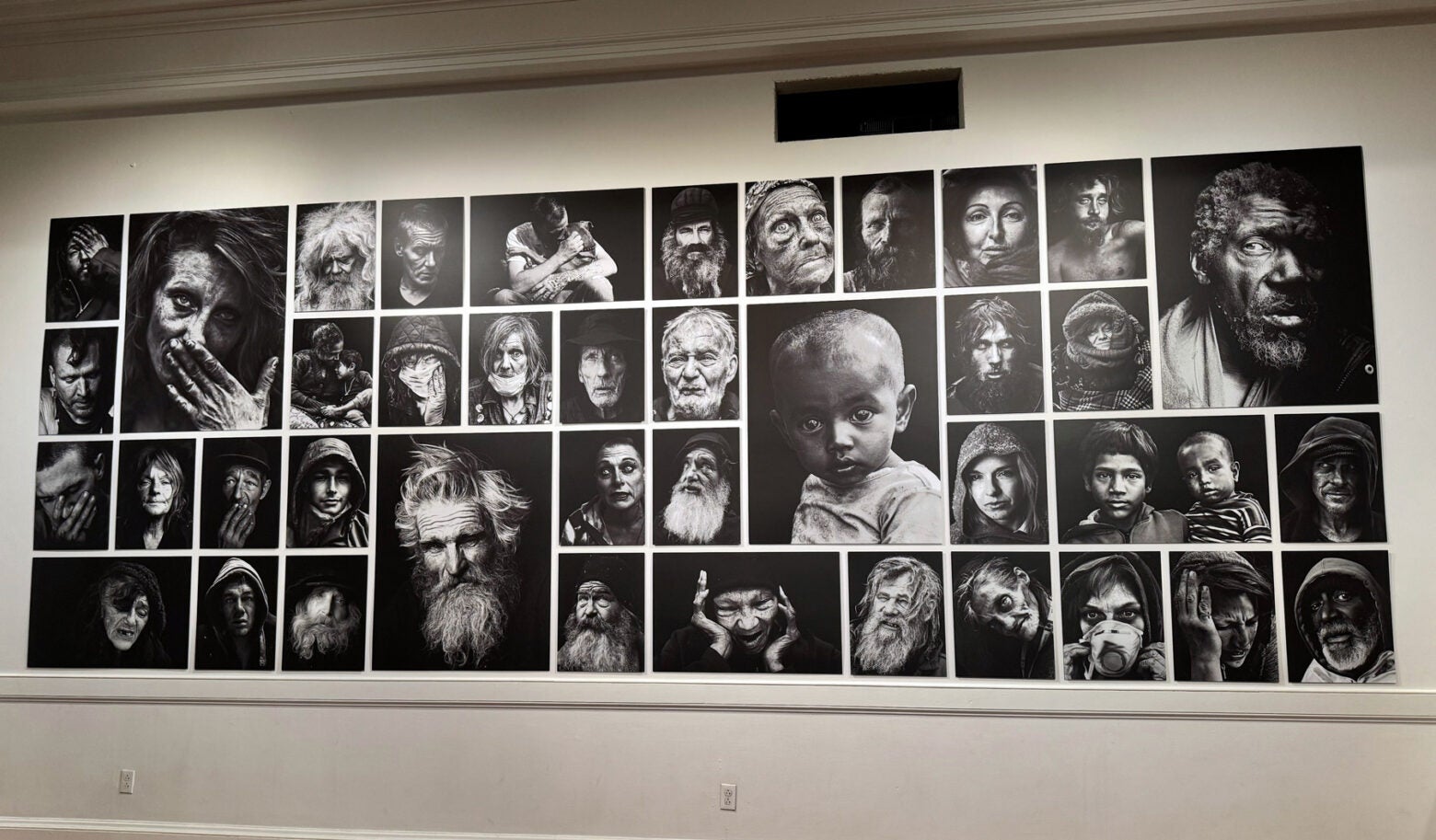
The focal point of the exhibition is two displays of art—both, in effect, collages. Leah den Bok, a Toronto-based photographer, supplies 40 large, exquisitely detailed black-and-white portraits from an ongoing project she titles Humanizing the Homeless.
Photographs from Leah den Bok’s project “Humanizing the Homeless” displayed at the Mütter Museum’s exhibition, “Unhoused: Personal Stories & Public Health.”Courtesy of The College of Physicians of Philadelphia
Set against black backgrounds, den Bok’s subjects, ranging from a two-year-old to a man in his 80s, are grimy, occasionally wild-eyed, often visibly sad. They can seem lost, or confrontational. Some face the viewer directly; others look away. A catalog offers quotations and bare-bones background information from interviews conducted by the photographer and her father, Tim den Bok. (It would be better if key quotes also were highlighted via wall labels.) The men and women, from Canada, the United States, India, and elsewhere, talk of family cutoffs, drug addiction, mental illness, and the challenges of life on the streets.
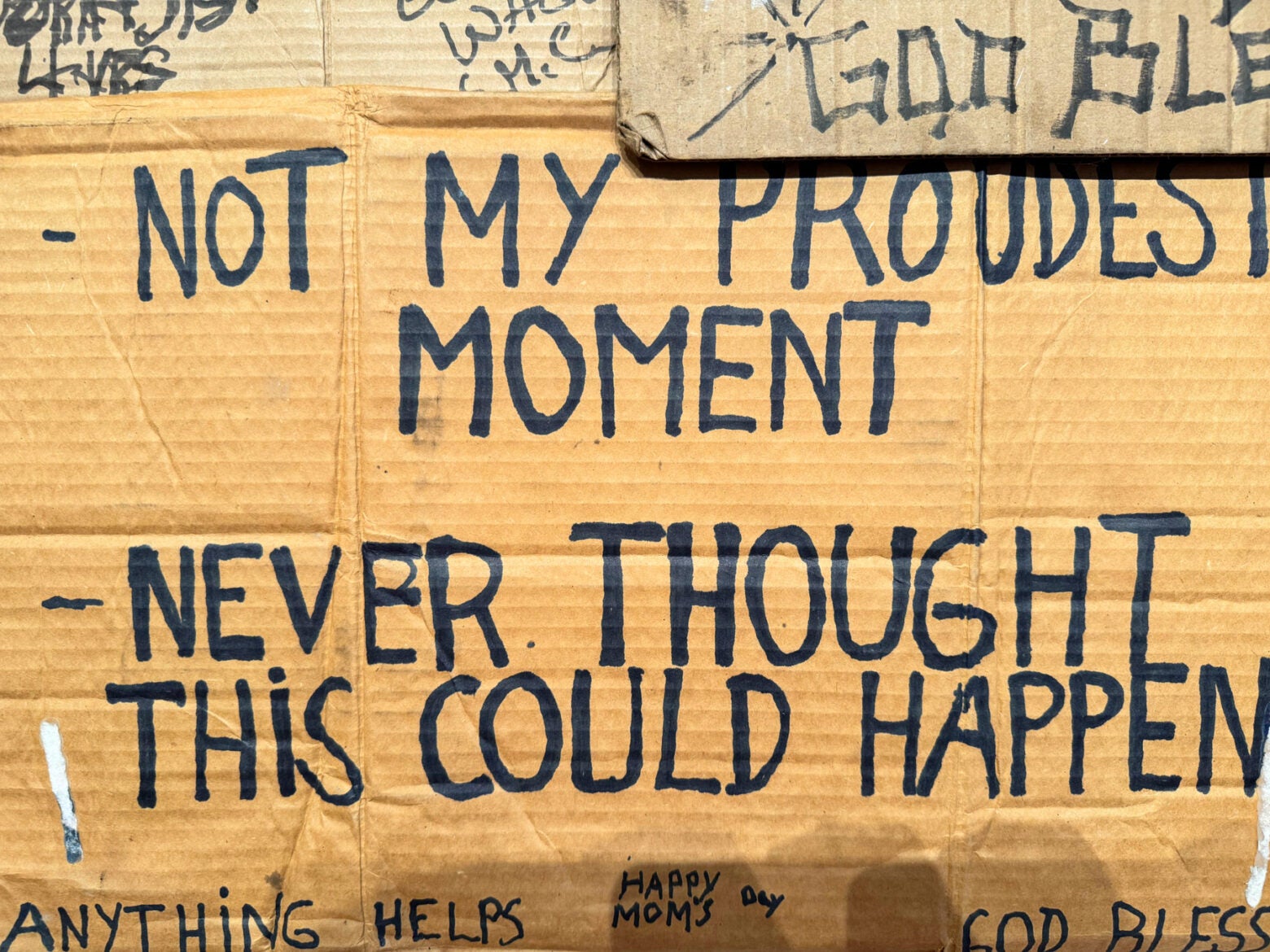
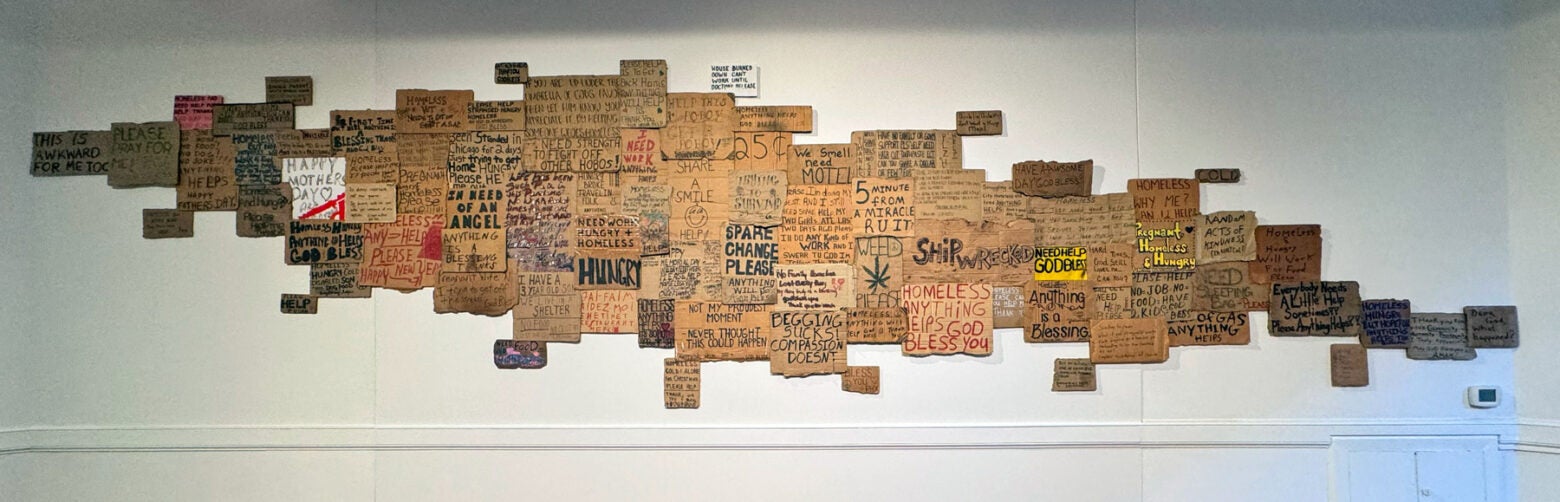
Across from the photographs is an assemblage of cardboard signs, purchased by the artist Willie Baronet during cross-country travels for a project he calls We Are All Homeless. Often wrenching and sometimes wryly comic, they entreat passersby for help. “Begging sucks! Compassion doesn’t,” says one. Another cries out, “Shipwrecked.” Together, they send a clear and powerful message: Stop and look. Take notice.
Four benches arrayed in the center of the gallery encourage reflection, and three bulletin boards allow visitors to post comments on their own attitudes and experiences with homelessness and to respond to those of others. One comment, from a recovering heroin addict from the streets of Philadelphia’s drug-plagued Kensington neighborhood, assures visitors, “There’s hope.”
Unhoused provokes empathy, as it is meant to do.The unhoused are not alien to us; homelessness is a profoundly human affliction, it suggests. But in making its case, the exhibition at times says either too much or too little, belaboring some points and shying away from others.
The introductory label includes a trigger warning about “images that some visitors may find upsetting.” But isn’t part of the point to jar people out of complacency and avoidance? The text also offers some unnecessary moral bludgeoning. “The artists, organizations[,] and public health experts working together on this project regard the topics and people represented in this space with respect and ask that you do the same,” it states. It seems unlikely that the openly disrespectful would tarry here—and heavy-handed to dictate visitors’ responses.
Courtesy of The College of Physicians of PhiladelphiaCourtesy of The College of Physicians of PhiladelphiaCardboard signs collected by artist Willie Baronet for his project “We Are All Homeless,” displayed at the Mütter Museum’s exhibition, “Unhoused: Personal Stories & Public Health.”Courtesy of The College of Physicians of Philadelphia
Missing is the discussion of the roots of homelessness, a complicated problem with no single cause and no one-size-fits-all solution. Here the exhibition, in its reluctance to dilute its call to compassion, seems to pull its punches.
Its text rightly notes that “[l]ack of affordable housing, coupled with low-paying jobs, contributes to homelessness.” It adds, “People experiencing homelessness are further impacted by more limited access to doctors, mental health care, and other resources. In addition, unhoused people are at greater risk for mental illness and substance use disorders.”
What this wording fails to grapple with is the extent, however difficult to quantify, that mental illness and substance abuse contribute to the plight of the long-term unhoused. One text label does reveal that an astonishing 76 percent of people entering a federal program, the Collaborative Initiative to Help End Chronic Homelessness, had a mental illness. “It’s a little bit of a chicken-and-egg problem,” says René Najera, director of public health at the College of Physicians, who helped curate the exhibition. Given the sketchiness of the evidence, he says, the museum “didn’t want to stigmatize any further. Ultimately, the message was that people who are unhoused are people. We need to think of them as our neighbors.”
The smartphone market can no longer grow and AI is promising to revolutionize our habits. Experts say that voice commands and virtual assistants will gain prominence over screens. For the moment, new devices such as glasses, buttons or watches will coexist with the cellphone
The smartphone market can no longer grow and AI is promising to revolutionize our habitsMIGUEL PANG LY
An essential personal accessory, a helpful assistant in our daily lives and a status symbol, the mobile phone has been, since the emergence of the iPhone in 2007, a product with a prominence that is difficult to match in other aspects of human life. But perhaps that phase as we know it is over. There are symptoms of fatigue and, along with them, alternatives that suggest an unavoidable decline. Screen addiction is a growing stigma for which the smartphone bears almost all the blame. Almost a third of users are at high risk of suffering from a serious addiction, according to a study published last year in the International Journal of Mental Health and Addiction. The mobile phone has gone from being seen as an object of desire to becoming a harmful device. Digital disconnection is recommended as a synonym of better mental health.
There is also a fact: fewer phones are being sold. “People are still buying smartphones, I’m not saying that suddenly no one uses mobile phones, but the numbers are going down,” stresses Amy Webb, CEO of the Future Today Institute, an advisory firm that helps companies detect technological trends. This consultancy decreed in 2017 that the beginning of the end of the smartphone had begun, as sales had stagnated (we all already have a mobile phone, this market is not going to grow anymore). Although the figures have never returned to the previous days of bonanza, “if we think about the next decade, instead of using just a phone there will be many different devices. And these devices will replace the smartphone. This has already started to happen.” The era of the human who is permanently crouched over a rectangle, the days of faces illuminated by the blue light of a screen, the times of two thumbs moving at the speed of light on a protective plastic are on their way out.
The new Apple Vision Pro.JUSTIN SULLIVAN (GETTY IMAGES)
In 2022 there was a sharp drop in units shipped globally: 11.3% less than in the previous year. In the last quarter of the year, when Christmas was supposed to multiply consumption, the decline was even more pronounced, 18.3%. You would have to go back a decade to find such low figures. And the trend persisted last year, with falls of 3.2% or 4%, according to different analysts.
Smartphone manufacturers are looking for other sources of income. The case of Apple is the most representative, because more than half of its turnover depends on iPhone sales, which in the first quarter of 2024 was 10% lower than last year. But the company has made efforts to fish in other waters.It has developed an entire ecosystem of applications that work by subscription, such as Apple Music, News or Fitness. It even produces and distributes its own series through Apple TV to attract users to its universe.
But the mobile phone, understood not only as a device but as a multipurpose knife that has revolutionized the way we communicate, will remain. Several gadgets could be the alternatives to the uses that we have given it.The AI Pin, for example, is a small square electronic medal that hangs on clothing. It receives voice commands: ask it for the weather forecast, if there is a restaurant in the area, or any question you would ask Google. It responds by audio thanks to artificial intelligence. It also projects, if we want, a screen of green phosphorescence on the user’s hand that allows small texts to be read.
Rabbit R1 plays with a similar concept. It is a device halfway between retro and sophisticated that also receives voice queries (and also has a small screen). “The Rabbit R1 does exactly the same thing as an advanced voice assistant,” says Alexander Manu, a professor at the Faculty of Design at OCAD University in Toronto, who has studied technological trends for decades. “I can ask it to book me a flight and a hotel. In fact, by using it I have gone back 25 years, when I called my travel agent to book me a ticket to a destination.”
The list of gadgets that seem born from an Isaac Asimov novel goes on and on. Apple’s latest major launch, for example, are the Vision Pro glasses, which allow users to see their surroundings through the images captured by its high-resolution cameras.They combine this visual perception with the playback of videos and other content. It is as if the user were in a giant, private cinema with a window to the world.
According to their creators, none of these products are intended as an alternative to mobile phones, but it is inevitable to think that they are going in that direction. Devices such as Lucyd smart glasses follow along the same lines, and are the first, according to their creators, to integrate ChatGPT: they understand requests in natural language. But they are not the only ones. Meta launched its own, in collaboration with Ray-Ban, and mobile manufacturers TCL and Oppo have presented their own smart glasses.
This is not the first time that electronic glasses have been tested. Google Glass emerged in 2013 and that name still resonates in the Google offices as a resounding commercial failure. But at that time we were talking about a little toy. Now we are talking about a trend.
For Manu, the abundance of alternatives that dare to challenge the mobile phone is a symptom of the latter’s growing weakness. “People are now very critical of the AI Pin and the Rabbit R1, but if we stop to think about it, people were also very critical of the iPhone when it came out. They made fun of it and said that Apple was going to fail.”
“You have to keep in mind that this is a transition,” says Webb. “We will go from one device to many. If I think back to 1998, I had a laptop, a portable DVD player, my MP3 player and my MiniDisc. And later all these devices became one, which was the smartphone. With artificial intelligence we are going towards a constellation of many devices. I don’t know if the ones that are there now will stay. We will see many others. There will be a lot of experimentation.” Webb’s idea is that each person will have an arsenal of gadgets, and that artificial intelligence will connect them all. It will be this technology that delivers the death blow to the mobile phone as we know it.
Is the mobile phone starting to die?MIGUEL PANG LY
In the end, a smartphone is a toolbox. It is full of applications, such as Google, WhatsApp, Gmail, Netflix or Spotify. And we use that box to carry all the tools and use them anywhere. “We have created many applications. And, over time, we have realized that in the end what we want is not the application itself but the benefit it brings us.And artificial intelligence will be what generates those beneficial results that we want,” says Manu.For the professor, this toolbox is now unnecessary. A ChatGPT-type artificial intelligence service will allow you to use the headphones to call or make a query using your voice alone. The role of the smartphone is reduced.
As technology laboratories go, voice communication between people and machines is going to be much more effective than it has been so far with Siri or Alexa. The preferred way to communicate with machines is by talking, just like with people. And what fosters artificial intelligence like the one that exists on the market today is only the beginning. We are getting closer to starting a fluid conversation with an artificial intelligence, in the style of Robert Downey Jr. – that is, Tony Stark – in Iron Man, when he is capable of joking even with Jarvis (his digital assistant). Or Jarvis’ cinematic generational precedent: the supercomputer Hal 9000 from 2001: A Space Odyssey, which had ethical and almost philosophical discussions with its astronaut on duty.
Sonia Villanueva, a consultant specializing in user experience and a professor at the International University of La Rioja, Spain, describes the changes that all this will bring about in our relationship with technology: “We are in a moment of explosion of artificial intelligence. When it evolves, it will materialize into a true personal assistant. And with this, sooner rather than later, we will have a voice relationship, that is, a conversational relationship.” The transformation promises to be an earthquake. “It is much easier to speak than to write,” Villanueva insists.
Such a change will also have an impact on the economy. According to forecasts, artificial intelligence will generate a business of $1.3 trillion in 2030, compared to $150.2 billion last year. It stands to reason that it will be everywhere and on every possible device. Among them, in the so-called wearables: smart watches, bracelets, headphones and even rings. “Nowadays, a cellphone involves seeing, reading and using your hands,” Villanueva adds. “We’ll probably be able to do more things with a voice interface. It’s not that the screen as an interface is going to disappear, but we are going to interact more by voice. This is a revolution,” she says.
The theory of the end of the mobile phone has a powerful enemy: a very visual culture.Instagram, TikTok and YouTube are based on videos and images that are compulsively consumed on a screen.That is one powerful reason for not considering the cellphone dead yet.Even wearable devices require larger screens to view the data they collect. “The reason you need your cellphone is because it’s a bigger window to see information,” Webb admits. “But with some devices, like headphones or glasses, you don’t need a phone. That’s why I think cellphone use will shrink. We are going to be less dependent on it over time.”
Screening of the Humane AI Pin, a personal assistant that receives voice commands.
Villanueva is also among those who believes that mobile phones will decrease in number but will not disappear. It all depends on what we need to do. “We must distinguish between microtasks, which are activated with simple voice commands, for example: ‘How much does this cost?’ or ‘Open Netflix’, and other uses, such as reading, complex work tasks, viewing a graph or writing an e-mail. This second group of tasks needs visual support,” says this user experience specialist. “That’s why I say that mobile phones are not going to be eliminated in any way. But maybe we will not be glued to the phone all the time for so many things.”
Then again, new technologies could bring another way to introduce the visual element without the need for a mobile phone. Manu throws a question out there: “What would happen if any surface could become a screen? You need this surface to be electronic, of course. But now there are technologies to do it, such as graphene, which is extremely thin and resistant.” Like in Minority Report, where Tom Cruise explored representations of data on glass walls.
There is still a lot of uncertainty ahead. But perhaps the era of the Homosmartphonus that we have become, with our heads down to look at the screens and our fingers flying to write on them, is coming to an end. Perhaps evolution will take a turn and we will go back to standing upright, communicating by voice with our devices. And talking to yourself on the street will seem quite natural.
Sign up for our weekly newsletter to get more English-language news coverage from EL PAÍS USA Edition
In this episode of the Therapy Works podcast, I’m speaking with Charles Spencer, who shares his traumatic experiences at a boarding school where he faced physical, emotional, and sexual abuse. Charles discusses the profound impact these experiences had on his life, the complex process of healing, and the importance of speaking out to help others. Key Points Discussed: Enduring Abuse: Charles recounts the harrowing abuse he endured during his time at a particularly abusive boarding school, including sexual abuse, and the lasting impact on his psyche. The Healing Journey: The conversation delves into Charles’s extensive journey through therapy, including EMDR, and the role of writing his book as a form of therapy. Impact of Trauma: Charles reflects on how the trauma influenced his views on trust, relationships, and self-worth, emphasizing the importance of working through past pain for personal growth. Advocacy for Change: Highlighting the importance of advocating for the protection of children and raising awareness about the long-term effects of abuse, Charles discusses his hope that his story will inspire others to seek help and speak out. This episode is a testament to the strength and resilience of the human spirit, offering hope and solidarity to others who have experienced similar traumas. Charles Spencer’s candidness provides valuable insights into the complexities of healing from childhood abuse and underscores the power of vulnerability and truth in overcoming the shadows of the past. Thank you so much to Riverstone Living Kensington for hosting this important conversation: https://www.riverstoneliving.com/our-…
Then there is Gordonstoun where members of the Royal Family were educated…
‘Harvard Thinking’: How far has COVID set back students?
In podcast, an economist, a policy expert, and a teacher explain why learning losses are worse than many parents realize
Samantha Laine Perfas
Harvard Staff Writer
May 8, 2024 long read
We’re now three academic years beyond the pandemic. A lot of families think things are back to normal. Thomas Kane disagrees.
“A lot of parents misperceive how much students have lost,” said the faculty director for the Center for Education Policy Research. “That has been one of the biggest things hampering the recovery, parents thinking things are fine now that kids are back in school.”
According to Kane’s research, on average students have lost about a half a grade level in math and a quarter of a grade level in reading. But that’s on average; individually, some schools are doing even better than before the pandemic, while others have lost as much as two grade levels in education.
Heather Hill, a co-director of the teacher education program at Harvard’s Graduate School of Education, said one thing she noticed was that students forgot how to “student.” Gone were skills in studying, sitting in classrooms, and taking notes.
“When teachers came back they said, ‘Wow, these kids have forgotten how to be students,’ and one of the things we saw pretty immediately was a rise in behavior issues,” Hill said. While a lot of those issues have been addressed, she said, others — like the rising absenteeism rates that are nearly double pre-pandemic levels — have not.
Stephanie Conklin, Ed.M.’06, a New York State Master Teacher who teaches math at Colonie Central High School, said educators are facing higher expectations than ever.
“We’re asked to be counselors, social workers, teach math, teach writing, and teach students how to be students,” Conklin said, pointing to rising rates of turnover and burnout. Guests talked about the need to better support teachers and what that might look like beyond pay raises.
In this episode, host Samantha Laine Perfas talks with Kane, Hill, and Conklin about post-pandemic challenges in the classroom and how to fix them.
Nicole Vignola is a neuroscientist, corporate consultant, and speaker committed to making neuroscience tangible for laymen and experts alike. Through her group and one-on-one coaching, she helps individuals improve their mental capacity and acuity by teaching best practices for healthy cognitive habits.
Negative emotions elicit a much larger response in the brain than positive ones, meaning that we tend to pay more attention to bad things and overlook the good ones, probably as a result of evolution. This means that sometimes, we tend to dwell on the negative and fail to see our accomplishments.
These negative biases can show up as stories we tell ourselves, like, It won’t work out for me. I’m fat and ugly. I am not unique. I am not smart enough. Or, they can show up as a behavior, for example, you always come home to recount the malevolent and unfortunate events of the day in a melodramatic and embellishing tone, making it sound as if your day was worse than what it was.
Neuroscience studies support that we tend to give more weight and attention to negative experiences and emotions and also that the brain registers negative stimuli more easily than positive events. The good news is that we can change this. Neuroplasticity is the ability of your brain to reorganize itself, create new pathways, and dismantle habits and behaviors that are no longer serving you. Rewire equips you with the tools to ditch the negative.
2. How to rewire your subconscious
It is estimated that the majority of your brain (around 90% to 95%) is subconscious, and it’s driving your everyday actions and decisions. Have you ever said you were going to do something on a Monday, and then by Friday you have forgotten that you wanted even to try? It’s not you; it’s your brain. Your brain will revert to mental shortcuts called mental heuristics whenever possible.
This is because your brain tries to be efficient and save energy for more cognitively demanding tasks. You don’t think about how you brush your teeth or make your coffee; you do it without thought. This is a positive because if you had to pay attention to every single thing you did all the time, you would be exhausted by lunchtime. However, this means that sometimes it can feel hard to adopt new habits, yet by understanding the neuroscience of how your brain creates new pathways and the neurobiological prerequisites to make plastic change, you’re better equipped on a path for change.
Fundamentally, your brain requires attention and repetition to make changes. Sometimes, we think that if we can’t commit to something for an hour a day, it’s not worth pursuing, but even five minutes of repetition can help maintain the thing you are trying to change in your conscious mind and lay down the foundations for a new path.Neurons are responsible for communicating information in our brain. The more we repeat something, the stronger the communication pathways become—like a small footpath that turns into a dirt road that eventually becomes a tarmac highway.
3. The power of your thoughts
Have you ever heard the saying, “If you knew how powerful your thoughts were, you’d never think a negative thought again?” I want you to imagine that it’s a hot summer day, and you’re making lemonade. You grab a handful of shiny lemons from the fridge; they’re cold, bright yellow, and waxy. You cut into one, and the juice pours out. You begin to squeeze it, releasing a burst of zesty fragrance. Something compels you to take a big bite, and your teeth wrap around the flesh, which is so juicy that it runs down your chin. Did you salivate? If you did, you just evoked a physiological mouth-watering response as if it were right before you. This shows us how important our thoughts are. We can change our physiological response according to what we’re thinking. So, if you’re perpetuating a negative narrative about yourself, you’re reinforcing these pathways in your brain and strengthening these beliefs.
Neuroscience studies show that we can create neuroplasticity through thought alone. Our thoughts are extremely powerful, and what we perpetuate in our heads becomes a reality. We can use this knowledge to our advantage. Research shows that mental imagery stimulates the same brain regions as when we physically perform the same movements and actions. Mentally rehearsing your performance with repetition means that the actions become habituated in your mind. If you’ve already imagined executing something, then it will be easier to execute later because you’ve created a blueprint for new pathways to form.
4. Dopamine doesn’t care about your happiness, dopamine wants more
Have you ever thought to yourself that as soon as you get to place B, you will be happy? When I asked my social media community, the most common themes were weight loss, work or academic accomplishments, and money. There were other examples, too, like gaining Instagram followers or buying a first house. Some were professional athletes who never felt satisfied with any of their wins. The underlying theme is that whenever they got what they thought they wanted, they were underwhelmed and dissatisfied.
The thing is, that’s dopamine. Dopamine doesn’t want you to be happy. Dopamine wants you to have more.It’s always on to the next thing. So, if you’re relying on being happy after you get what you want, after you achieve your goals, after you get the promotion, then you will always be chasing happiness. Your happiness has to be now.
Dopamine isn’t the chemical of pleasure; it’s the chemical that motivates us in pursuit of pleasure. It helps reinforce pleasurable experiences by linking them to the desire of wanting to do them again, knowing they’ll make you feel good. Studies show that when we achieve a goal, dopamine levels actually drop. This is because dopamine is responsible for anticipating and driving you toward a reward. To maintain dopamine balance and avoid overstimulation, dopamine drops quickly after reaching your goal.
Therefore, if you are relying on reaching your goals to finally be happy, you will always be chasing that feeling. Real pleasure comes from the journey, not the destination. The only race is against yourself. Live easy in the moment. You won’t get it again.
5. The neuroscience of growth mindset and mental resilience
The brain is a remarkable piece of machinery that uses information from previous experiences to better equip for future occurrences.Every failure and downfall updates our brain’s software with more data points to communicate what we should or shouldn’t do to get a better outcome next time. Failure is information for the brain.
When we have a fixed mindset, we attach our identity to the outcome. Meaning that if we fail at something, we begin to believe that it’s a direct indicator of our self-worth. Individuals with a growth mindset, on the other hand, understand that fear and failure are part of the process.
Neuroscience shows that we can increase the size of the area of the brain responsible for growth mindsets. Deep within the layers of the cerebral cortex, lodged between the two hemispheres, right behind the frontal cortex, is a worm-shaped structure called the dorsal anterior cingulate cortex, and scientists have shown that this area becomes more active when we adopt a growth mindset. In an experiment, teachers told their students they were very smart. Later, when the students were asked to select problems to solve, they favored fewer challenging ones for fear that it would jeopardize their beliefs about being smart. They chose problems that would reinforce their beliefs and allow them to continue demonstrating good performance. Other students who were congratulated for their efforts demonstrated a greater ability to choose difficult problems because they didn’t fear that they would fail. They knew that even if they failed, it was a learning opportunity.
Fear and failure never disappear, but we can learn how to deal with them better. Over time, we can increase our mental resilience to withstand more stress and fear.
This article originally appeared in Next Big Idea Club magazine and is reprinted with permission.
Recognize your technological breakthrough by applying to this year’s Next Big Things in Tech Awards before the final deadline, July 12.
Sign up for Next Big Things in Tech Awards notifications here.
Real-World Recall Cramming is less effective for remembering something than repeat learning sessions spread over time, numerous experiments have confirmed.Psychologists call this the spacing effect. But the spacing effect may not work as well for “associative memory,” that is, recalling real-world mixes of information, which often involves remembering a single item, say a new co-worker’s name, in a variety of different contexts, say in another location or after your co-worker has a new haircut. In recent experiments, people better remembered information if it was presented in variable scenes or contexts than if it was always paired with the same scene, write cognitive neuroscientist Emily T. Cowan and colleagues. Study subjects also better remembered the paired pieces of information in crammed learning sessions than in sessions spread out over time. Key takeaway:If you’re trying to remember someone’s name in a limited amount of time, simply repeating their name in your mind might not be the most effective approach. Instead, think of their name plus their hair color, their name plus where you met them, and their name plus their favorite food, Cowan writes.
What the experts say:Cramming and repetition both have a place when it comes to remembering material, Cowan writes. In the classroom, “depending on what a teacher wants their student to learn, class materials could be either repeated across lessons identically or embedded within a new lesson plan each time.”
16 Nobel Prize-winning economists warn Trump would ‘reignite’ inflation
Joseph E Stiglitz and other Nobel laureates say former president threatens US’s standing in the world.
Joseph E Stiglitz is among 16 signatories of the letter [Alessandro Della Bella/EPA]
Published On 26 Jun 202426 Jun 2024
Sixteen Nobel prize-winning economists have signed a letter warning that the re-election of former United States President Donald Trump would harm the US economy and lead to higher prices for consumers.
In the letter released on Tuesday, the economists said that the Republican candidate would stoke instability and revive high inflation with his “fiscally irresponsible budgets”.
“Among the most important determinants of economic success are the rule of law and economic and political certainty. For a country like the US, which is embedded in deep relationships with other countries, conforming to international norms and having normal and stable relationships with other countries is also an imperative,” the letter said.
“Donald Trump and the vagaries of his actions and policies threaten this stability and the US’s standing in the world.”
The signatories also praised President Joe Biden’s record on the economy, including a “remarkably strong and equitable” recovery in the labour market since the COVID-19 pandemic.
“While each of us has different views on the particulars of various economic policies, we all agree that Joe Biden’s economic agenda is vastly superior to Donald Trump’s,” the economists said.
“In his first four years as President, Joe Biden signed into law major investments in the U.S. economy, including in infrastructure, domestic manufacturing, and climate. Together, these investments are likely to increase productivity and economic growth while lowering long-term inflationary pressures and facilitating the clean energy transition.”
The signatories of the letter, which was first reported by Axios, include Columbia University Professor Joseph Stiglitz, Yale professor Robert Shiller and Sir Angus Deaton.
Trump and Biden, a Democrat, are running neck and neck in opinion polls ahead of their first presidential debate on Thursday.
Prospective voters, however, have repeatedly rated Trump as more trustworthy on the economy.
Sign up for Al Jazeera
Americas Coverage Newsletter
US politics, Canada’s multiculturalism, South America’s geopolitical rise—we bring you the stories that matter.
Please check your email to confirm your subscription
Trump has pledged to slash taxes, crack down on undocumented immigration, raise tariffs on imports and reverse many of Biden’s clean energy initiatives if re-elected to a second term as president.
In an ABC News/Ipsos poll released last month, respondents said they trusted Trump to do a better job on the economy and inflation than Biden by a margin of 14 percentage points.






 Please check your email to confirm your subscription

