War of words as Erdogan says Turkey could intervene in Israel’s war on Gaza…Turkey is again comparing Netanyahu to Hitler, while threatening more than a trade ban for the first time.

War of words as Erdogan says Turkey could intervene in Israel’s war on Gaza

Turkey is again comparing Netanyahu to Hitler, while threatening more than a trade ban for the first time.

FILE PHOTO: Turkey's President Recep Tayyip Erdogan speaks during a joint statement to the media in Baghdad, Iraq April 22, 2024. AHMAD AL-RUBAYE/Pool via REUTERS/File Photo

Video Duration 00 minutes 37 seconds00:37

Published On 29 Jul 2024

A war of words has broken out between Israel and Turkey after President Recep Tayyip Erdogan threatened his country could intervene militarily in Israel’s war on Gaza.

Turkish and Israeli officials unleashed barbs at one another on Sunday and Monday after Erdogan said in a speech on Sunday that “there is no reason” that Turkey could not act, noting military interventions made in the past in other countries.

Keep reading

list of 3 itemslist 1 of 3

Turkey says it halts trade with Israel over Gaza aid access

list 2 of 3

‘Heinous massacre’: Israel’s attack on Rafah tent camp widely condemned

list 3 of 3

Turkey’s Erdogan urges Palestinian unity after meeting Hamas chief

end of list

While crude rhetoric between the two countries has been regular amid the war in Gaza, the threats and insults come as fears of a wider escalation rise once again.

Shortly after Erdogan’s speech, Israeli Foreign Minister Israel Katz said in a post on X that the Turkish president was “following in the footsteps” of former Iraqi dictator Saddam Hussein by threatening to attack Israel.

“Just let him remember what happened there and how it ended,” he wrote in reference to the Iraqi president’s infamous 2003 capture by United States forces while hiding in a hole in the ground near a farmhouse in Tikrit. Hussein was later executed.

In retaliation, Turkey – not for the first time – compared Israeli Prime Minister Benjamin Netanyahu to Adolf Hitler.

“Just as genocidal Hitler ended, so will genocidal Netanyahu,” said the Turkish Ministry of Foreign Affairs.

“Just as the genocidal Nazis were held accountable, so will those who try to destroy the Palestinians,” the post continued. “Humanity will stand by the Palestinians. You will not be able to destroy the Palestinians.”

‘Humanity’s conscience’

Erdogan, who has consistently issued strong rhetoric during Israel’s 10-month war in Gaza, made the suggestion that Turkey could intervene militarily in a speech to his ruling Justice and Development (AK) Party on Sunday.

“We need to be very strong so that Israel cannot do these ridiculous things to Palestine. Just as we entered Karabakh, just as we entered Libya, we can do something similar to them,” he said.

Sign up for Al Jazeera

Weekly Newsletter

The latest news from around the world. Timely. Accurate. Fair.Subscribe

By signing up, you agree to our Privacy Policy

protected by reCAPTCHA

Turkey, which backs the Tripoli-based government of Libyan Prime Minister Abdul Hamid Dbeibah, in 2020 sent soldiers to the fractured North African country to support its United Nations-backed administration.

In the breakaway region of Nagorno-Karabakh, over which Ankara ally Azerbaijan has fought for decades against Armenia, Turkey has denied engaging in any direct military operations.

But it has pledged support for Azerbaijan with “all means”, which has included military training and modernisation, along with the provision of advanced combat drones and other military equipment.

In a post on X on Monday, Turkish Foreign Minister Hakan Fidan boasted that Erdogan “has become the voice of humanity’s conscience”.

“International Zionist circles, especially Israel, who want to suppress this righteous voice, are in great alarm,” he wrote. “History ended the same way for all genociders and their supporters.”

Turkey restricted some exports to Israel in April – six months into the war on Gaza – and said it halted trade with Israel altogether in early May.

Israel said it would scrap the country’s free trade agreement with Turkey in retaliation, with Israeli Finance Minister Bezalel Smotrich signalling the move is reversible when Erdogan is replaced by a leader who is “sane and not a hater of Israel”.

  • Turkey might enter Israel to help Palestinians: ErdoganTurkey might enter Israel to help Palestinians: Erdogan
  • War on Gaza: Palestinians have nowhere to go as Israel orders more evacuationsWar on Gaza: Palestinians have nowhere to go as Israel orders more evacuations
  • Video Duration 02 minutes 40 seconds02:40Surfing competition in Tahiti: Decision to hold event on Teahupo’o island criticised
  • Video Duration 02 minutes 19 seconds02:19Tortured, raped and traumatised: Thousands of refugees in Chad need counselingTortured, raped and traumatised: Thousands of refugees in Chad need counseling

Source: Al Jazeera

Posted in Uncategorized | Tagged , , , , | Leave a comment

Wisdom sometimes comes with age. Decades ago I was diagnosed and remain taking medications for bipolar and anxiety complicated by a traumatic brain injury; then breast cancer. I must admit I have found great solace listening, reading, watching YouTube of Dr Gabor Mate. He is a medical doctor who is human and admits to his own “hungry ghosts”; he never ceases to look for the reasons why. This is so important because it takes us back to the philosophers who too stated the importance in finding a purpose in life. Below is the latest culmination of Dr Gabor Mate’s work. If you know of someone badgered, beaten down, stigmatised, dismissed by society, please share this, it means you care.

Conversation opened. 1 read message.

Skip to content
Using Gmail with screen readers

2 of 27,942

Trauma is not what happens to you

Inbox

The Wisdom of Trauma <support@scienceandnonduality.com> UnsubscribeFri, Jul 26, 6:46 PM (2 days ago)
  Dear Michelle,

According to Dr. Gabor Maté, if you suffer from anxiety, chronic illness and substance abuse, you are normal.

“ So much of what we call abnormality in this culture is actually normal responses to an abnormal culture. The abnormality does not reside in the pathology of individuals, but in the very culture that drives people into suffering and dysfunction.”
— Gabor Maté


According to the CDC:
One in five Americans is diagnosed with mental illness in any given year. Suicide is the second most common cause of death in the US for youth aged 15-24. It kills over 800,000 people a year globally—48,000 in the US. Drug overdose kills 81,000 in the US annually. The autoimmune epidemic affects 24 million people in the US
“Trauma is not what happens to you.
Trauma is what happens inside you, as a result of what happens to you.”
— Gabor Maté


In The Wisdom of Trauma, we travel alongside physician, bestselling author and Order of Canada recipient Dr. Gabor Maté to explore why our world is facing such epidemics. This is a journey with a man who has dedicated his life to understanding the connection between illness, addiction, trauma and society.

Dr. Maté gives us a new vision: a trauma-informed society in which parents, teachers, physicians, policy-makers and legal personnel are not concerned with fixing behaviors, making diagnoses, suppressing symptoms and judging, but seek instead to understand the sources from which troubling behaviors and diseases spring in the wounded human soul.

Who is Dr. Gabor Maté?

Dr. Gabor Maté is an internationally renowned speaker and bestselling author, whose books are published in over twenty-five languages. He is an expert on addiction, trauma, childhood development, and the relationship between stress and illness.

Rather than offering quick-fix solutions to complex issues, Dr. Maté weaves together scientific research, case histories, and his own insights and experience to present a broad perspective that enlightens and empowers people to promote their own healing and that of those around them.

After 20 years of family practice and palliative care, Dr. Maté worked for over a decade in Vancouver’s Downtown EastSide with patients challenged by drug addiction and mental illness. For his groundbreaking medical work and writing he was awarded the Order of Canada, his country’s highest civilian distinction, and the Civic Merit Award from his hometown, Vancouver.

His books include In the Realm of Hungry Ghosts: Close Encounters With Addiction; When the Body Says No; The Cost of Hidden Stress; Scattered Minds: The Origins and Healing of Attention Deficit Disorder; and (with Dr. Gordon Neufeld) Hold on to Your Kids: Why Parents Need to Matter More Than Peers.

He is currently writing his next book, The Myth of Normal: Illness and Health in an Insane Culture, out in early 2022. Dr. Maté is also co-developer of a therapeutic approach, Compassionate Inquiry, now studied internationally by hundreds of therapists, physicians, counselors, and others.


    FREE GIFT WITH YOUR 2-DAY PASS
When you register for a 2-day pass, you’ll get instant access to The Wisdom of Trauma Companion Booklet.

Inside the Trauma Companion Booklet, you’ll learn about trauma symptoms, the different types of trauma, how trauma affects the brain and the nervous system, and various trauma healing modalities.


  Click below to get a 2-day Access Pass to the film.
 
ACCESS MOVIE NOW When you click the link, we‘ll ask you for a small donation of your choice. You won’t be turned away for lack of funds if you’re unable to donate today. But if you can, please know that your support will help us distribute the film to a wider audience. Let’s help one another. Thank you for supporting our vision for a trauma-informed society, so that together we can start to break the cycles of trauma.
  Love,

Zaya, Maurizio and the whole SAND team


See what others had to say about the film:

“We watched it last night, and were awestruck. I’ve always deeply admired Gabor’s work, but your synthesis and storytelling, complete with wonderful illustrations, music and pacing, and great great people. As you might imagine, with its healing message being so closely aligned with my own sense of my soul’s purpose in this life, I wept throughout much of it. Truly blown away by its power, its simplicity and its magnificent portrayal of this man whose medicine for the world couldn’t be more timely or more needed. I immediately wanted to share it with everyone I know.”

– Kenny

Go deeper with the All-Access Pass
 
What you’ll receive:
Returning to Wholeness: A Guide to Understanding and Integrating Trauma. A 7-hour course with Gabor Maté including downloadable audio and transcriptsTalks on Trauma Parts 1 & 2: 34 conversations with 70+ leading experts, including downloadable video and audio5 additional webinars on trauma from SANDPrivate membership site to access all of your content online for a year, with download optionsBONUS #1: Downloadable access to the 20 most frequently asked questions with Gabor MatéBONUS #2: Conversation on Trauma, Compassion and MagicBONUS #3: Speaker GiftsBONUS #4: Film music14-day purchase guarantee
 
PURCHASE THE ALL-ACCESS PASS


      Science and Nonduality (SAND) is a community inspired by timeless wisdom, informed by cutting-edge science, and grounded in personal experience. We come together in an open-hearted exploration of the big questions of life to embody our interconnectedness and celebrate our humanity. You are receiving this email because you are part of the SAND Community.
unsubscribe from this list.

Science and Nonduality, Sebastopol, CA, Sebastopol, CA 95472, United States

…

[Message clipped]  View entire message

Posted in Uncategorized | Tagged , , , , | Leave a comment

Best of Hitchens on Islam… Timeless piece of analysis, recorded 7 years ago. “Islam claims to be the last and final religion…” “Takes care of all you life” total solution all aspects of living. It is absolute and unanwerable. It does not want questions. Totalitarian. Can there be a perfect human primate and flawless book that can have no changes. This to Islam is heresy ie schism. Very easy to be found the wrong side and called say an apostate. Hanging from a crane for some minor indiscretion is Islam’s remedy from the restricted never changed words of their bible which initially was spoken word to book. There can only be one conclusion – it is not about achieving Peaceful Solutions.

Posted in Uncategorized | Leave a comment

DW: Indian students look to Europe for educational opportunity

Education India

Indian students look to Europe for educational opportunity

Pooja Yadav 27th July 2024

Indian students are the top recipients of a prestigious EU scholarship program, which is celebrating its 20th year. Europe and India are seeking new ways to cooperate on academics and research.

A full lecture hall at Cologne University
European university exchange programs have become an attractive option for Indian studentsImage: Christoph Hardt/Geisler-Fotopress/picture allianc

Abhishek Kumar had spent seven years working with the Indian government and the Central Bank of India when he realized he wanted to launch an international career.

“I always felt like I was behind a glass wall, longing to be more connected with the world,” he told DW.

In 2022, Kumar was awarded a scholarship to take part in the EU’s Erasmus Mundus Joint Master’s Degree (EMJMD) program. He left home in Mumbai to study financial journalism at City, University of London, in the UK, which despite not being an EU member still has limited cooperation with the EMJMD.

“The quality of education here is top-notch, and the opportunity to study in two European countries offers a broader perspective,” said Kumar. “Receiving a scholarship makes it significantly easier to focus on studying.”

Kumar is one of a growing number of Indian students who have received the highly competitive Erasmus Mundus scholarship to study in Europe.

Abhishek Kumar on a rooftop
Abhishek Kumar left a banking job in India to study in EuropeImage: privat

Indian students top list of scholarship recipients

In 2024, 146 Indian students were awarded the scholarship. Since the program began in 2004, over 2,000 Indian students have received the scholarship, making India the “the largest beneficiary of the program,” according to a press release by the EU’s delegation to India marking the 20th anniversary of the scholarship program.

The EU’s Erasmus program was established in 1987 to promote academic and cultural exchange between universities and higher education institutions across Europe. Over the years, the program has been expanded and is now called Erasmus+.

This expansion has also created opportunities for students outside of Europe, including the EMJMD program. The scholarship fully covers tuition and, travel costs, and provides a living stipend. The student gets an opportunity to study and do research at two or more universities in different European countries, earning joint or double degrees. 

Combining all of Erasmus+ scholarship opportunities for students coming from outside of the EU, more than 6,000 Erasmus+ short and long-term scholarships have been awarded to Indian students since 2004.

In June, Herve Delphin, ambassador of the European Union to India, congratulated the 2024 Indian recipients of the Erasmus Mundus scholarship at an event in New Delhi.

“The fact that India ranks as the top recipient of Erasmus+ scholarship since its inception, despite its competitive nature, speaks volumes about the caliber of Indian students,” Delphin said, according to a press release.

“Over 80,000 Indian students are studying in Europe, reflecting a growing appreciation for the continent’s diverse academic offerings, rich cultural heritage and unparalleled opportunities for personal and professional growth,” he added.

Indian applicants remain competitive

Bettina Anderson, coordinator for the Erasmus Mundus Journalism, Media and Globalization program, told DW that Indian students “seem to have one of the highest success rates in terms of scholarships.”

“Indian applicants are always among the top three in numbers, which also statistically increases their chances of receiving scholarships,” she added. However, Anderson emphasized that quality, not nationality, is the main criteria when awarding a scholarship.

“We select students based on their academic background and portfolio. We have never given a scholarship to someone who was not good enough. In recent years, we have incorporated application essays to ensure a fair evaluation of students from different backgrounds. Grades alone are difficult to compare across countries, so we look at both academic and practical experience,” she said.

“Indian students have consistently demonstrated high quality in both academia and journalism,” added Anderson.

Germany tries to woo foreign students and skilled workers

https://static.dw.com/image/66278674_605.webp

Remaining Time -0:00

Hailing from Mumbai, 24-year-old Priyal Shah is currently enrolled in media studies at Germany’s Ludwig Maximilian University of Munich. Shah comes from a humble economic background, and the scholarship was necessary to allow her to study in Europe.

“When I found out I had been awarded the Erasmus Mundus scholarship, I was relieved to know that I would get the best education without worrying about financing,” she told DW.

EU–India partnerships increase chances to study abroad

The Indo-Pacific strategy of the EU also includes collaboration with India through higher education programs.

European institutions, supported by Erasmus+ and Horizon 2020, the EU’s research and innovation funding program, have developed partnerships with Indian counterparts.

Similarly, India’s New Education Policy also promotes internationalization, allowing dual degrees, joint programs and foreign campuses in India.

The number of Indian students studying abroad is projected to more than double from the 2019 total, potentially reaching up to 1.8 million by 2024, according to data from the International Consultants for Education and Fairs.

“Many Indian students who join the Mundus Journalism program aspire to return to academia and teach future generations with their gained perspectives,” said Anderson. “The broader perspectives and freedom of speech they learn in this program are often more comprehensive than in their national programs.”

Indian institutions are intensifying what is being called “internationalization at home” through formal and informal curriculums, seeking to make up for the limited study abroad opportunities for Indian students.

This has led to more collaborative online international learning programs, where online courses bring together students and teachers from the around the world in a virtual learning space.

Edited by: Wesley Rahn

Posted in Uncategorized | Tagged , , , , | Leave a comment

NATURE: Memory for music doesn’t diminish with age

Memory for music doesn’t diminish with age

Eighty-year-olds are able to identify familiar tunes just as well as teenagers can.

Facebook Email

A young girl and her grandmother play a piano duet together.
Musical memory might be resistant to age-related cognitive declines because it stirs emotions and becomes more encoded in memory.Credit: SDI Productions/Getty

The ability to remember and recognize a musical theme does not seem to be affected by age, unlike many other forms of memory.

“You’ll hear anecdotes all the time of how people with severe Alzheimer’s can’t speak, can’t recognize people, but will sing the songs of their childhood or play the piano,” says Sarah Sauvé, a feminist music scientist now at the University of Lincoln in the United Kingdom.

Past research has shown that many aspects of memory are affected by ageing, such as recall tasks that require real-time processing, whereas recognition tasks that rely on well-known information and automatic processes are not. The effect of age on the ability to recall music has also been investigated, but Sauvé was interested in exploring this effect in a real-world setting such as a concert.

In her study1, published today in PLoS ONE, she tested how well a group of roughly 90 healthy adults, ranging in age from 18 to 86 years, were able to recognize familiar and unfamiliar musical themes at a live concert. Participants were recruited at a performance of the Newfoundland Symphony Orchestra in St John’s, Canada. Another 31 people watched a recording of the concert in a laboratory.

The study focused on three pieces of music played at the concert: Eine kleine Nachtmusik by Mozart, which the researchers assumed most participants were familiar with, and two specially commissioned experimental pieces. One of these was tonal and easy to listen to; the other was more atonal and didn’t conform to the typical melodic norms of Western classical music. A short melodic phrase from each of the three pieces was played three times at the beginning of that piece, and participants then logged whenever they recognized that theme in the piece.

The melodic phrase from the Eine kleine Nachtmusik was equally well recognized across all ages and musical backgrounds, with no loss of recognition as age increased. All participants were less confident in recognizing the theme in the unfamiliar tonal piece, and even less confident with the unfamiliar atonal piece. This pattern, too, did not vary with age. The study also found no age-related difference in the results between the participants at the concert and those in the lab.

Steffen Herff, a cognitive neuroscientist at the University of Sydney, Australia, says the reason musical memory seems to be resistant to age-related cognitive declines might have to do with the emotions that music stirs in people, which makes it more encoded in memory. “We know from general memory research that, effectively, the amygdala — or emotional processing — operates a little bit like an importance stamp,” he says.

Music also tends to follow certain rules, so “it’s relatively easy to have a pretty good guess of what happened in-between,” Herff says.

The study collected limited data on some participants’ cognitive health, and so did not provide detailed insights into how cognitive impairments or neurodegenerative diseases affect memory recall. But Herff says there is great interest in using music as a form of ‘cognitive scaffolding’ — that is, as a memory aid for other information — in individuals with neurogenerative conditions such as dementia.

doi: https://doi.org/10.1038/d41586-024-02369-7

References

  1. Sauvé, S. A. et al. PLoS ONE 19, e0305969 (2024).
Posted in Uncategorized | Tagged , , , , | Leave a comment

JSTOR DAILY: From Gamification to Game-Based Learning

Education

From Gamification to Game-Based Learning

Use the JSTOR Daily Sleuth game to highlight the dangers of AI within academic research.

Daily Sleuth image

Share

By: Fiona Warburton

July 23, 2024

4 minutes

The icon indicates free access to the linked research on JSTOR.

There’s no escaping talk of AI and its burgeoning capabilities, as artificial intelligence now permeates all aspects of life, streamlining both simple administrative tasks and the painstaking process of researching something on the internet. But when it comes to academia, concerned as it is in the pursuit of research, education, and scholarly activity, AI offers new tools and approaches for literature searching, content analysis, report writing, and other academic processes.

JSTOR Daily Membership Ad

There’s been heated debate amongst academics about the challenges that AI poses to staff and students in higher education in terms of academic integrity and the potential for AI-assisted “cheating”. This has led universities worldwide hurrying to rewrite policies which incorporate the new set of ethical responsibilities that AI brings to the research process and to assessment. In the United Kingdom, new declarations of authenticity are signed by students to declare their use of specific AI tools in planning, preparing, or writing parts of their research projects or evidence for assessment.

As a member of staff working in dual roles in a higher education institution in the UK, (teaching within faculty for two days a week and working in the university’s library learning and teaching team the rest of the week), it’s clear to me that students aren’t offered the same transparency about AI-generated content for the information sources they access when carrying out research. University students have been using tools such as the CRAAP test, RADAR, and the 5 Ws for decades to evaluate sources of information and, more recently, to root out potential items of fake news. But can they use these tools successfully to detect AI-generated research articles amongst the proliferation of real academic research at the touch of a button?

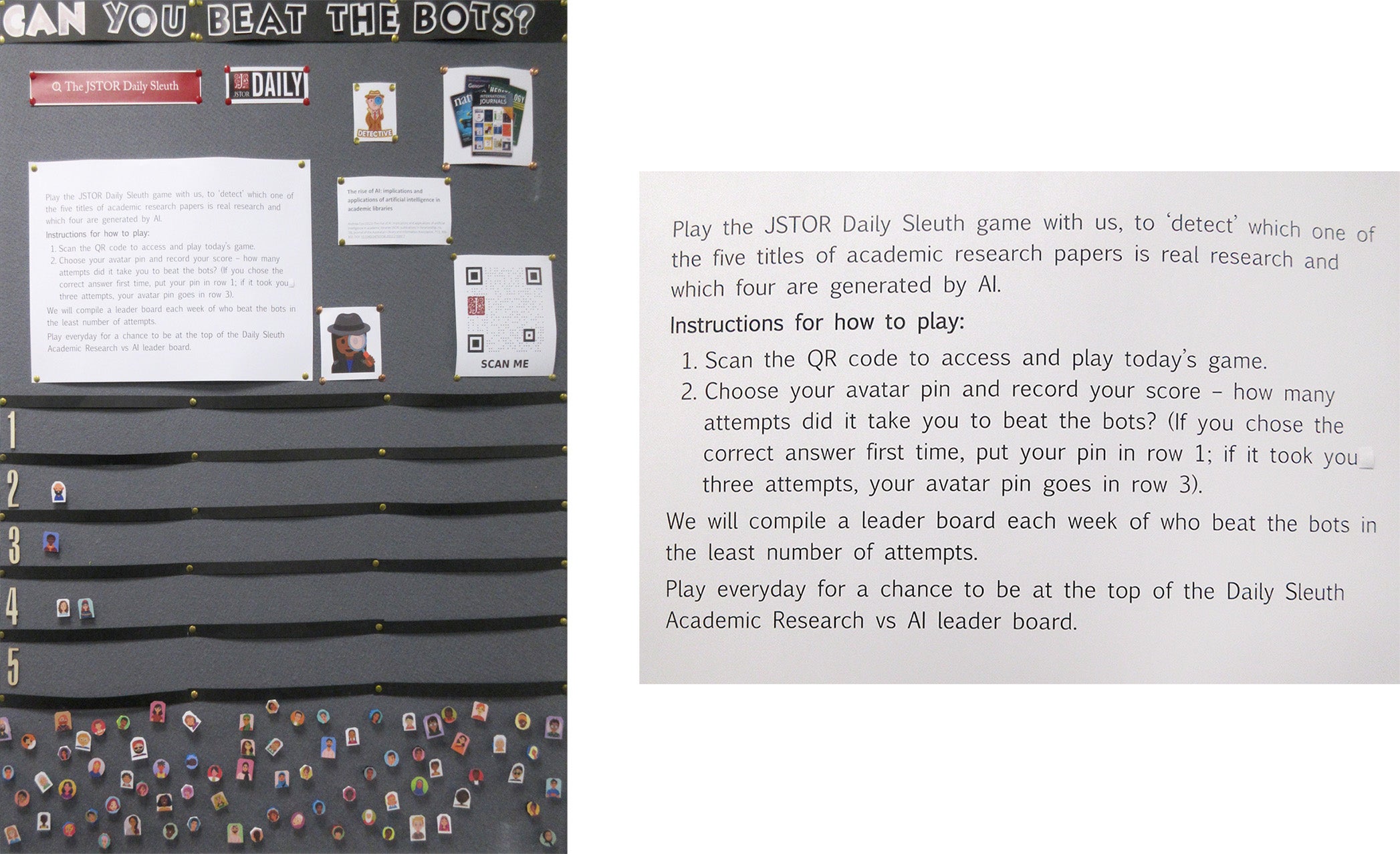
Raising awareness of the existence of AI-generated research has presented academic libraries with a new information literacy agenda. Enter the JSTOR Daily Sleuth—a game that tests your ability to detect whether the title of an academic research paper is authentic or generated by AI. Each day, five new journal article titles are shared within the game, and you try and work out which four are AI -generated, and which one is real. ​

Steven Chopade describes how gamification can be used within eLearning to improve knowledge retention. A gamification strategy involves the use of unique gaming techniques and elements to increase the learner’s participation and stimulate their interest. Gamification involves elements such as badges, levels, and leader boards to create an interactive experience that encourages learners to take part and achieve specific goals. Game-based learning embeds a game into teaching so that the game itself becomes the learning, that is to say, there are defined learning outcomes attached to playing a game.

In April 2024, one of the site libraries at my university installed an interactive display called “Can You Beat the Bots?” incorporating the JSTOR Daily Sleuth game. A trackable QR takes the player directly to the game each time it’s scanned. Avatar pins are provided, along with a set of instructions and a leader board grid, so that players can record their score each day—to show whether they found the real title amongst the four AI-generated titles at first, or at fifth, attempt. The library staff keeps a record of the number of unique scans made and of the leader board each week. Only those library users who want to play do so.

Weekly Newsletter


Get your fix of JSTOR Daily’s best stories in your inbox each Thursday.


Privacy Policy   Contact Us


You may unsubscribe at any time by clicking on the provided link on any marketing message.

By May 2024, a move away from gamification and towards game-based learning was made at another of the site libraries. The QR code was incorporated into the library induction for a new cohort of international postgraduate students at the university’s Business School. More than a hundred unique scans were made that day, with many repeat plays in the weeks that followed.

The next step for the inclusion of the Daily Sleuth as an integral part of information literacy learning has already been made. From September 2024, the university will incorporate the same trackable QR code within its Moodle module library learning page so that all first-year undergraduate students can take on beating the bots by becoming daily sleuths themselves, learning how to spot real research amongst a sea of AI-generated research articles.

In addition to this, the Daily Sleuth will take its place in game-based learning beyond the library with plans to integrate the game within faculty-led teaching before the end of 2024.  Can you beat the bots? Why not take on the challenge and become a JSTOR Daily Sleuth yourself.


Support JSTOR Daily! Join our membership program on Patreon tod

Posted in Uncategorized | Tagged , , , , | Leave a comment

The Guardian: Assisted dying bill to be introduced into House of Lords

Assisted dying

Assisted dying bill to be introduced into House of Lords

Keir Starmer under pressure to allow vote as private member’s bill to be introduced in upper chamber

Harriet Sherwood

Fri 26 Jul 2024 07.00 CEST

Keir Starmer is under pressure to fulfil a promise to allow a parliamentary vote on legalising assisted dying as a bill is to be introduced into the House of Lords on Friday.

Lord Falconer, who was lord chancellor in Tony Blair’s government, will propose a private member’s bill to allow assisted dying for terminally ill adults after coming second in a ballot of peers last week.

In March, Starmer said he was in favour of changing the law. He promised Esther Rantzen, the television presenter who has terminal cancer and is campaigning for assisted dying, that if he became prime minister he would ensure parliamentary time to debate the issue and allow a free vote. He repeated the pledge after winning the general election.

But some advocates for a change in the law fear that the prime minister may decide to wait for a private member’s bill to be introduced in the Commons. A ballot of MPs is due to be held in September.

https://1a0f2f9ab39fcaea51273d200df04d21.safeframe.googlesyndication.com/safeframe/1-0-40/html/container.html

Starmer was committed to ensuring parliamentary time for a bill on assisted dying, said Falconer. But a Commons bill was a “much more certain route” than a bill originating in the Lords.

There were “a number of MPs who are keen to take this issue forward” if they were successful in a ballot, he told the Guardian. “It’s a significant social reform and it has a really good chance of success. It would be a bill for which an MP would be remembered. It might not be my bill, but I just want to get this through. And there is a sense now that the stars are aligned and a bill will get through one way or another.”

Falconer’s bill would allow terminally ill, mentally competent adults to have the option of assisted dying alongside access to high-quality end-of-life care. The individual would need to meet strict eligibility criteria, be assessed by two independent doctors, and self-administer the medication if their request was approved.

Some campaigners have criticised the bill for limiting assisted dying to terminally ill patients rather than extending the option to people with incurable conditions such as multiple sclerosis or locked-in syndrome.

Falconer said: “My bill is designed for people who will die in the near future. I don’t think the state should be helping people who are not terminally ill to take their own lives.”

At the moment, assisting someone to end their life is a criminal offence in England and Wales, carrying a maximum prison sentence of up to 14 years.

Moves to legalise assisted dying are under way in Scotland, the Isle of Man and Jersey.

The issue was last put to a vote in the Commons in 2015, when a motion on legalisation was defeated by 330 votes to 118. However, there has been a marked shift in opinion among MPs since then, and the recent general election may have produced a Commons majority in favour of a change in the law.

Public opinion polls have consistently shown a majority of people in favour of legalising assisted dying. A survey of 10,000 people in March found 75% backed assisted dying, with 14% opposed.

Sarah Wootton, the chief executive of Dignity in Dying, said: “Assisted dying is a movement whose time has come. The prime minister has doubled down on his promise to make time for this debate and dying people will be holding him to account; they simply do not have time to wait. As reform grows closer in the Isle of Man, Jersey and Scotland, we are on the brink of historic change across the British Isles.”

A bill to allow assisted dying passed its third reading in the Isle of Man’s legislature, the House of Keys, this week. It will now move to the upper house, which cannot block the bill but may amend it.

The bill permits assisted dying for terminally ill, mentally competent people who have lived in the Isle of Man for at least five years.

Posted in Uncategorized | Tagged , , , , | Leave a comment

Hindustan Times: JD Vance’s “childless cat lady” remark. Petty, sly, peevish comments by Republicans who are worried about demographics and immigrants filling the need for people to work to ensure pensions are paid to those who have worked for decades.

Mom of Kamala Harris’ step kids reacts to JD Vance’s ‘childless cat lady’ dig at ‘Momala’

ByShweta Kukreti

Jul 25, 2024 04:13 PM IST

Mom of Kamala Harris’ step kids, Kerstin Emhoff, has defended the presumptive Democratic presidential nominee against JD Vance’s “childless cat lady” remark.

Kerstin Emhoff, the ex-wife of Kamala Harris‘ husband, has defended the presumptive Democratic presidential nominee against JD Vance’s “childless cat lady” remark.

Kerstin Emhoff, who shares two kids with Doug Emhoff , rejected criticism of Kamala Harris over her lack of biological children as “baseless”. (AP/Getty)

https://7ec78e5ba3fc75c5d13b58d182ad749f.safeframe.googlesyndication.com/safeframe/1-0-40/html/container.html

Responding to a viral clip of Vance, Kerstin Emhoff, who shares two kids with Doug Emhoff , rejected criticism of Harris over her lack of biological children as “baseless”. She asserted that Harris is an equal parent of their children.

Looking for Instant Cash? Get Best Personal Loan offers upto 10 lakh. Apply and Get Money in your bank account Instantly

“For over 10 years since Cole and Ella were teenagers, Kamala has been a co-parent with Doug and I,” she told CNN.

Hailing Harris for being loving and nurturing, Kerstin said the US VP has fiercely protective of their kids. “I love our blended family and am grateful to have her in it.”

JD Vance takes brutal dig at Kamala Harris

Her comments came after Vance’s 2021 interview with Tucker Carlson, a former Fox News host, went viral on social media.

In the interview, Vance stated that the US was led by those who don’t have a “direct stake” in the country that is “a bunch of childless cat ladies who are miserable at their own lives and the choices that they’ve made and so they want to make the rest of the country miserable too.”

Trump’s running mate went on to say, “Look at Kamala Harris, Pete Buttigieg, AOC—the entire future of the Democrats is controlled by people without children.”

Kamala Harris reveals why her step kids call her ‘Momala’

Harris has been affectionately referred to as “Momala” by two kids of Emhoff, with whom she got married in 2014.

In a 2019 essay in in Elle Magazine, she explained how the name “Momala” was introduced and called her stepchildren as her “endless source of love and pure joy.”

“A few years later when Doug and I got married, Cole, Ella, and I agreed that we didn’t like the term “stepmom.” Instead they came up with the name “Momala”,” she wrote.

Harris further lauded Kerstin as a “dear friend” and and “incredible mother”.

News / World News / US News / Mom of Kamala Harris’ step kids reacts to JD Vance’s ‘childless cat lady’ dig at ‘Momala’

You May Like

Posted in Uncategorized | Tagged , , , , | Leave a comment

Warning: many offices under construction in Dublin and other cities, more are vacant. Reuters report on Blackstone who have experienced battered mortgage fund slumps as empty offices intensify pressure

Blackstone’s battered mortgage fund slumps as empty offices intensify pressure

https://www.reuters.com/business/finance/blackstones-battered-mortgage-fund-slumps-empty-offices-intensify-pressure-2024-07-24/

=============

Reuters

Blackstone’s battered mortgage fund slumps as empty offices intensify pressure

Michelle Conlin and Matt Tracy

Updated Wed, July 24, 2024 at 7:16 p.m. GMT+1·2 min read

FILE PHOTO: Signage is seen at the Blackstone Group headquarters in New York City

In this article:

  • BXMT-11.61%

By Michelle Conlin and Matt Tracy

NEW YORK (Reuters) -Shares of commercial real estate finance company Blackstone Mortgage Trust fell 10% on Wednesday as the firm cut its dividend 24%, facing continued strains from vacant offices.

It is the latest sign of mounting woes in commercial real estate. Analysts are predicting more weakness for lenders and owners in the sector as American workers maintain their pandemic-era remote work habits.

The shift has left broad swaths of office space empty, while elevated interest rates have left many borrowers struggling to make timely payments on their loans.

“For Blackstone to have to come out and cut dividends, I have to imagine that’s going to weigh on some people’s minds,” said Stephen Buschbom, research director at Trepp, an industry data provider. “It wouldn’t surprise me to see ripple effects throughout the industry when the biggest player is having to cut.”

Blackstone Mortgage Trust set aside an additional $140 million in reserves for expected credit losses. Of its holdings in U.S. office space, 55% is “watch-listed or impaired,” according to an earnings presentation.

Still, borrowers for higher-quality offices are keeping up repayments, it said.

Industry participants remain concerned about a sharp downturn for commercial office space as nearly $1 trillion of the $4.7 trillion of outstanding commercial mortgages come due in 2024, according to the Mortgage Bankers Association.

The looming maturity comes against a backdrop of declining property values and lower rent rolls.

Blackstone Mortgage Trust cut its dividend to $0.47 per share in the third quarter, down from $0.62 paid in the second quarter.

The company reported a loss of $61.06 million in the second quarter and also authorized $150 million in stock buybacks, it said on Wednesday.

Despite the loss, the company’s CEO Katie Keenan cited “long-term earnings potential” backed by its “strong liquidity, accelerating repayments, and an emerging investment pipeline,” the presentation showed.

The gloom in the office sector has also affected other companies, including KKR Real Estate Finance Trust which slashed its dividend amid souring loans in February.

(Reporting By Michelle Conlin and Matt Tracy; Editing by Megan Davies, Lananh Nguyen, Chris Reese and Rod Nickel)

Posted in Uncategorized | Leave a comment

Vish Gain is a journalist with Silicon Republic: Amethyst Care: AI assistant to help older people live at home for longer. Comment: Care in the home is essential; £6,000 a month is too much to pay to be in a care home when technology can assist a person especially those with neurological conditions, the elderly to remain in their homes. Irish people need to support this company Amethyst Care … it is about Hope

START-UPS

Amethyst Care: AI assistant to help older people live at home for longer

by Vish Gain

22nd July 2024

Headshot of Rebecca McManus, founder of Amethyst Care, leaning against a table in an indoor space.

Founder and commercial lead Rebecca McManus. Image: Amethyst Care

Based in the SFI Adapt research centre at Trinity, Amethyst Care is led by Rebecca McManus and Prof Vinny Wade.

Click here for more Research Week stories.

Rebecca McManus is no stranger to the many challenges and complexities of being a caregiver, having assumed the role for both her parents at various stages of life.

With both dementia and Parkinson’s in the family, she saw first-hand how mobility-related illnesses can drastically reduce the chances of people living independently at home for longer.

“Problems older people living alone face include loneliness, remembering to take medications on time and cognitive decline,” McManus tells SiliconRepublic.com. “Meanwhile, problems caregivers face can be stress, anxiety and time spent on caregiving for their loved ones.”

The alternative is not the most viable: putting loved ones in nursing homes, which according to her can cost up to €6,000 per month. “Private home care costs around €30 per hour,” she says, adding that this comes in the context of a rapidly ageing population in Europe.

To address this issue, McManus, who has more than a decade of experience in sales across companies such as FlowForma, Citrix and Pluralsight, founded a start-up that uses an AI voice assistant that provides care for older people living at home.

How it works

Known as Amethyst Care, the research project founded this year is based in Adapt, the Science Foundation Ireland Research Centre for AI-driven Digital Content Technology at Trinity College Dublin. The research side of the project is led by Prof Vinny Wade, chair of AI at Trinity’s School of Computer Science and Statistics and former director at Adapt.

“Our goal is to delay the time in which an older person suffering with mobility-related issues needs to go into full-time care. Along with improving delays in the healthcare system, we hope to use technology to coincide with face-to-face care, to keep vulnerable people at home for longer,” McManus, who is commercial lead for the start-up, explains.

The proposition is compelling: Amethyst Care’s product can provide continuous monitoring of vital signs and detect abnormalities; remind patients about medication and appointments daily; provide emergency alerts in case of falls or accidents; offer tools for memory enhancement and mental stimulation; and give real-time updates to family members and healthcare professionals.

“The data will be tracked through our analytics hub over time to allow medical professionals and carers to have a detailed view of the patient’s progress and ability to live at home,” McManus says. “This service [not only] reduces the cost of care and enables organisations to provide a better service but also improves patients’ lives and gives more data to improve patient outcomes.”

Diseases such as Parkinson’s and early dementia have been rising steadily around the world. According to World Health Organization statistics posted last year, there are currently around 55m people living with dementia – with 10m new cases every year.

How it’s going

Last week, Amethyst Care raised more than €500,000 from Enterprise Ireland through its Commercialisation Fund Programme, which supports third-level researchers in translating their research into innovative and commercially viable products, services and companies.

The project aims to begin user trials in January next year, focusing its pilots on hospitals, assisted living groups, home care and health insurance groups in Ireland, the UK and the US.

The US is the big prize, according to McManus, where the start-up has already lined up trial partners. In the meantime, Amethyst Care is looking to fill a few key roles by September across full stack development, AI research, quality control and a clinical lead.

By February 2026, McManus hopes to raise a round of investment as the project spins out of Adapt and begins its commercial journey, by which time AI will have advanced even more.

“So much has changed in recent years regarding AI,” she says. “A couple of years ago AI was something people had in their strategies – but not necessarily executing. Now, since OpenAI and GPT came along, it’s so important that AI is being built into the product from day one.”

Find out how emerging tech trends are transforming tomorrow with our new podcast, Future Human: The Series. Listen now on Spotify, on Apple or wherever you get your podcasts.

Post Share Email More

In-Depth: Research Week, Start-up of the Week

Related: AI, healthcare, research, Trinity College Dublin, entrepreneurs, Enterprise Ireland, Adapt

Vish Gain is a journalist with Silicon Republic

editorial@siliconrepublic.com

Posted in Uncategorized | Tagged , , , , | Leave a comment