Eurasia Review: The Saudi Price For Normalization – OpEd

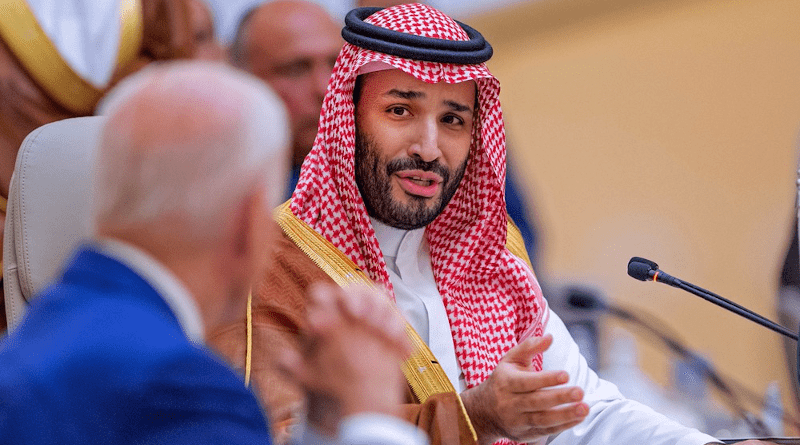
Saudi Crown Prince Mohammed bin Salman delivers a speech at the summit as US President Joe Biden listens. (SPA)

Saudi Crown Prince Mohammed bin Salman delivers a speech at the summit as US President Joe Biden listens. (SPA)

The Saudi Price For Normalization – OpEd

   0 Comments

By Neville Teller

On August 14 the US digital news medium, Politico, published an exclusive report.  It was based on accounts from three separate sources who had been privy to talks between the Crown Prince of Saudi Arabia, Mohammed bin Salman (MBS), and members of the US Congress. 

These talks were the latest in a series of detailed discussions that have been taking place for years between the US and Saudi Arabia  They began during the presidency of Donald Trump, and preceded the Abraham Accords.  Over time the shape of a complex agreement of major significance has emerged, clearly aimed at boosting MBS’s ambitious program for securing Saudi’s future development – his Saudi Vision 2030, launched in 2016, aimed at breaking the nation’s total dependence on oil and promoting additional means of developing the nation’s potential.

In exchange for commitments by the US to Saudi Arabia covering, among other issues, security, technical assistance with developing a civilian nuclear program and investment in areas such as high technology, Saudi Arabia would limit its dealings with China and normalize its relations with Israel.  

MBS had one proviso before agreeing to breathe life into the draft deal.  In line with long-standing Saudi policy, he required firm approval by Israel to the establishment of a Palestinian state.  This stark condition has been somewhat modified during the negotiating process.  MBS now requires the inclusion in the agreement of “a credible path toward a Palestinian state”. 

Despite widespread global support, including that of the US, for the two-state solution, Benjamin Netanyahu has so far refused to countenance fostering the development of a sovereign Palestine.  It could, he has pointed out, bring Iran-sponsored terrorism into the heart of Israel, and place Tel Aviv and Ben Gurion airport under permanent threat of attack.  

The territories earmarked to form the putative Palestinian state – the West Bank, east Jerusalem and Gaza –  were overrun by Jordan and Egypt during the 1948 Israel-Arab conflict, and administered by them for twenty years.  When originally seized, Mandate Palestine had been dissolved and the land belonged to no sovereign state.  During the subsequent two decades neither Jordan nor Egypt, which occupied those territories, made the slightest effort to form a Palestinian state.  The areas were won back by Israel in the Six Day War in 1967 – and in the following years, through astute Palestinian propaganda, they morphed in the public consciousness into “occupied Palestinian land”.  A political reality has been created, and Israel has been increasingly pressured to support establishing a Palestinian state on them. 

Politico’s revelations about the latest round of talks include two apparently contradictory elements.  On the one hand the reports indicate that MBS seems intent on striking this mega-deal with the US and Israel; on the other that he appears worried by the possibility of assassination if he does so.  He is reported to have cited the fate of the Egyptian leader Anwar Sadat following his 1979 peace treaty with Israel.  Sources say that he questioned whether the US had offered Sadat effective protection, and appeared to be requesting personal protection if or when the deal is ratified.

MBS could have indicated that the same considerations might apply to Netanyahu, who might have in mind the tragic end of his predecessor, Yitzhak Rabin.  Having signed the first Oslo Accord in 1993 and finalized a peace treaty with Jordan in 1994, Rabin died at the hands of an Israeli extremist in November 1995.  In truth, though, Netanyahu is more likely to be considering the implications for his precarious government coalition if he gave way on the two-state solution – which would, incidentally, be as unacceptable to Hamas and its followers as to his right wing ministers.  

The reason for Saudi Arabia’s insistence on “a credible path toward a Palestinian state” is entirely understandable.  The 2002 Arab Peace Initiative was conceived and proposed by King Salman’s predecessor on the throne, his half-brother then-Crown Prince Abdullah.  The Plan, endorsed on a number of occasions by the Arab League, advocates a two-state solution to the Israel-Palestine dispute.  Given that, and a just resolution of the Palestinian refugee issue, the Plan promises full normalization of relations between the Muslim world and Israel.

 In September 2021, when King Salman addressed the UN General Assembly, he reiterated Saudi Arabia’s commitment to the 2002 Plan, ignoring the fact that it was drafted well before Hamas gained control of Gaza in 2007.  Members of the League must now take into consideration that Hamas, with the support of much of the Arab world, is dedicated to eliminating Israel from the Middle East, and would certainly never endorse the idea of Israel continuing to exist alongside a Palestinian state that occupied only a portion of what was once Mandate Palestine.

In short, in signing up to the US-Saudi-Israel deal MBS would be facing not only the fear of assassination, but also – whether or not a Palestinian state was part of the deal – endless conflict with Hamas or whatever jihadist organizations succeed it.  For it is morally certain there is no foreseeable end to the rejectionist struggle to overthrow Israel and acquire the land “from the river to the sea”.

World opinion, including Saudi Arabia, that supports the two-state solution needs to face up to this awkward truth: it will never work until the majority of the Palestinian leadership acknowledges that the State of Israel is here to stay and endorses its legitimacy.  Since Saudi Arabia and the Arab world are promoting the two-state solution, the ball is in their court.  Only they can convert, circumvent or disempower rejectionist organizations like Hamas. 

If that is too great an ask, then Saudi Arabia – despite its unique position as leader of the Sunni Muslim world – will need to consider aligning its position with that of other Abraham Accord signatories.  All maintain their support for Palestinian aspirations, but not at the expense of their own self interests.  They have decided to put establishing a Palestinian state on the back burner, and prioritize the substantial benefits to their countries and the region of normalizing relations with Israel.

In practical terms, therefore, is the price that Saudi Arabia is asking for a normalization deal with Israel unrealistic?  Or will MBS’s compromise formula be enough to kick the issue into the long grass and finalize the normalization deal?  Or will current US policy and the weight of public opinion in favor of the two-state solution finally prevail?  Time will tell.

Facebook Twitter Email Flipboard Mastodon LinkedIn Share

Neville Teller

Neville Teller’s latest book is “”Trump and the Holy Land: 2016-2020”. He has written about the Middle East for more than 30 years, has published five books on the subject, and blogs at “A Mid-East Journal”. Born in London and a graduate of Oxford University, he is also a long-time dramatist, writer and abridger for BBC radio and for the UK audiobook industry. He was made an MBE in the Queen’s Birthday Honours, 2006 “for services to broadcasting and to drama.”

Posted in Uncategorized | Leave a comment

EL PAIS: Bitcoin mining uses the same amount of energy as Argentina, while laptops need a ton of material

Climate

Digitalization

Bitcoin mining uses the same amount of energy as Argentina, while laptops need a ton of material

The United Nations has released a new report warning of the environmental impact of digitalization. ‘Tech companies are monetizing the Anthropocene,’ argues one expert

Raúl Limón

Raúl Limón

AUG 20, 2024 – 22:01 CEST

Basura electronica
A group of young people during an e-waste recycling event last September at the Agbogblosgie landfill in Ghana.Juan Ignacio Incardona

Digitalization leaves a mark, even if it is invisible. To manufacture a typical laptop weighing 4.4 pounds, almost a ton of materials is needed, about 1,760 pounds. The extraction of these resources leaves an even bigger footprint. For example: two million liters of water are needed to extract one ton of lithium, the basic material for today’s batteries. And then there are the other activities linked to these products. For example, global energy consumption of bitcoin mining increased 34-fold between 2015 and 2023, reaching 121 terra-watt hours (TWh) of energy annually — the equivalent of what is consumed by a country like Argentina. That’s according to the U.N. Trade and Development (UNCTAD) experts, which warns of these issues in its Digital Economy Report 2024.

The trail left by an airplane is a small, perceptible sample of the pollution generated by air traffic. But digitalization does not leave smoke, and its effects are less evident. However, according to the UNCTAD report, the information and communications technology sector’s carbon footprint accounted for 1.5 to 3.2% of global greenhouse gas emissions.

If all the world’s digital information were stored on stacked compact discs, the tower would reach beyond the Moon, according to a study published in Science. In 2022 data centers — which transport, store and process this huge amount of global information — consumed 460 TWh of electricity, almost double the consumption of a country like Spain. And this figure is expected to double by 2026.

Another problem is the extraction of critical minerals, such as graphite, lithium and cobalt — which is expected to increase by 500% in 25 years — or physical waste from digitalization, which grew by 30% in the last decade. Developed countries generate on average 3.25 kilograms of waste per person, compared to 1 kg and 0.21 kg in developing countries. Of all this digitalization-related waste, not even 24% is formally collected.

The report blames the rise in e-waste to growing digitalization, which has led the production of semiconductors to quadruple; the push for more devices, which are expected to number 39 billion by 2029; and the rise of e-commerce, which saw $27 trillion in business sales in 43 countries in 2022.

This reality, according to António Guterres, Secretary-General of the United Nations, “highlights the direct environmental impact of our increased reliance on digital tools – from raw material depletion, water and energy use, air quality, pollution, and waste generation. These are accentuated by emerging technologies such as artificial intelligence and the internet of things.”

Rebeca Grynspan, head of UNCTAD, agrees: “The digital economy, often praised for its virtual and intangible nature, has created the illusion of a world unburdened by material waste. However, this Digital Economy Report 2024 starkly reveals the fallacy of this perception.”

However, Grynspan argues that digitialization “also holds immense potential for environmental good. Digital technologies can drive energy efficiency, optimize resource use and enable innovative solutions for climate change mitigation and adaptation.”

“We must harness the power of digitalization to advance inclusive and sustainable development, while mitigating its negative environmental impacts. This requires a shift towards a circular digital economy, characterized by responsible consumption and production, renewable energy use and comprehensive e-waste management.,” she says in the foreword to the report.

Water exploitation

“The United Nations report highlights that, although digitalization is driving global economic growth and offers unique opportunities, for developing countries, it is causing environmental repercussions that are increasingly serious and increasingly grave,” says Pablo Gámez Cersosimo, a Costa Rican advisor based in the Netherlands, where he heads Naturally Digital, an organization specializing in sustainability, human behavior, ethics and digital well-being.

Gámez — who has worked as a researcher and consultant for UNCTAD — says the study identifies how, in addition to the carbon footprint, digitalization requires large amounts of water, which he believes is one of “the most complex and problematic problems.”

“I would venture to say that the sum total of water consumed by all the agents involved in the operation of the digital wheel, so to speak, could equal or exceed that of the chemical or textile industry in the world,” he says.

Water is needed in all phases of the digitalization cycle: in device manufacture, in operating data centers, in keeping artificial intelligence active and in the creation of semiconductors.

Gámez explains that “the projected consumption per person per year of water in Europe will increase from 0.29 cubic meters to 1.2 in 2030” — quadruple today’s figure. “This means that any European will use approximately three liters of water per day for internet activities, and this exceeds the usual amount needed,” he explains.

The researcher wants technology companies to be more transparent, arguing they prevent oversight, monitoring and the application of corrective measures. “Cyberspace has a limit with respect to the planet’s natural resources; it is completely dependent on mining, on the entire periodic table. The large multinationals know this, but they are not acting sufficiently to correct it, despite the solutions from the point of view of technological maturity,” he says. “These large technology corporations are profiting, they are monetizing the Anthropocene [geological epoch marked by the global impact of human activities].”

“Cyberspace is literally the largest infrastructure created by humans, and it doesn’t stop growing,” he concludes.

Sign up for our weekly newsletter to get more English-language news coverage from EL PAÍS USA Edition

Posted in Uncategorized | Leave a comment

Al Jazeera: How Germany burned its ‘bridge to the Islamic world’

OPINION

How Germany burned its ‘bridge to the Islamic world’

German-Middle East dialogue platform Qantara’s biased output under its Foreign Office-affiliated interim editorial team exposes the government’s true perception of Palestine and Muslims.

Published On 29 Aug 202429 Aug 2024

Palestinians gather at the site of an Israeli strike that destroyed several houses, amid Israel-Hamas conflict, in Khan Younis in the southern Gaza Strip August 27, 2024. [Mohammed Salem/Reuters]

In March 2003, the German Foreign Office established an online platform, named Qantara, which means “bridge” in classical Arabic, in response to the 9/11 attacks in the United States and the hostility they triggered in the West against Muslims. The declared aim of the independent portal, run by German public broadcaster Deutsche Welle, was to “bridge” cultural differences between the West and the Islamic world and provide a neutral platform for interreligious dialogue.

The portal, which publishes content in English, German and Arabic, operated successfully for more than 20 years, seemingly with no editorial guidance from the German government. This changed, however, when it began publishing content critical of German debates on anti-Semitism in the context of the Gaza genocide. Earlier this year, it was announced that Qantara would be restructured, and its management would be transferred from Deutsche Welle to the Institute for Foreign Cultural Relations (Institut für Auslandsbeziehungen – IFA),  which is affiliated to and funded by the Federal Foreign Office.

The ministry claimed the move was “purely” structural and unrelated to the editorial direction and output of the site. German Foreign Minister Annalena Baerbock, however, contradicted this claim, suggesting in an interview that concerns about content published by Qantara, particularly content on anti-Semitism, were a factor in the decision.

Following the announcement, 35 members of Qantara’s editorial staff published an open letter addressed to Baerbock, expressing doubt that the IFA possessed the editorial capacities needed for the successful continuation of this complex project, which had been painstakingly built over many years and has proved to be a great source for those interested in the Middle East and Europe’s relationship with it. The letter had no effect, and all editorial staff resigned in protest.

On July 1, the management of Qantara, which no longer had any editorial staff members, was transferred from Deutsche Welle to IFA. IFA said the portal will remain under its editorial control until the new editor-in-chief, Jannis Hagmann, forms a new editorial board and officially begins work sometime in the coming weeks.

This transitional period at Qantara represents a unique opportunity to observe and assess the true views of the German government about the Middle East and its peoples, given that state officials are now openly editing a platform advertised as Germany’s “bridge” to the Islamic world.

Before the change in management, Qantara was respected for its objective, informative, in-depth reporting and analysis on the Middle East and the wider Islamic world, both in Germany and the region itself.

This is no longer the case. Right now, under the editorial direction of the Foreign Office-affiliated IFA, Qantara appears focused not on initiating intercultural and interreligious dialogue and discussion, but on confirming the German government’s biases and prejudices about Muslims, specifically Palestinians, through poorly researched and edited opinion articles.

Perhaps the best example of Qantara’s new editorial stance – and by extension the German government’s true views on the Middle East and its peoples – is an opinion piece, titled “Crisis Communication and the Middle East: Like and Share”, published on July 25.

The op-ed, supposedly analysing the media coverage of Israel’s war on Gaza, by Moroccan-German author Sineb El Masrar, frames Palestinians as an inherently violent and anti-Semitic people who are lying about their suffering, their history, their culture and their political motivations to malign Israel and destabilise Western democracies.

Sign up for Al Jazeera

Weekly Newsletter

The latest news from around the world. Timely. Accurate. Fair.Subscribe

By signing up, you agree to our Privacy Policy

protected by reCAPTCHA

It authoritatively states, without evidence or anything that resembles a supporting argument, that Palestinian journalists reporting on genocide are Hamas operatives in disguise, that images of death and suffering from Gaza are “staged”, that Palestinians hate Zionist occupiers on their land solely because of “Islamic anti-Semitism”, that there is actually no famine in Gaza and the international media are intentionally not publishing photos of “full market stalls and barbecue stations” in the Strip.

The author claims, for example, famine in the Gaza Strip, “according to the recently published Integrated Food Security Phase Classification (IPC) Report, did not and does not exist.” Of course, the report linked in the article clearly states: “While the whole territory [of the Gaza Strip] is classified in Emergency (IPC Phase 4), over 495,000 people (22 percent of the population) are still facing catastrophic levels of acute food insecurity (IPC Phase 5).” The IPC defines Phase 5 in its fact sheet as “famine” and says this ranking is only attributed to an area when it “has at least 20 percent of households facing an extreme lack of food, at least 30 percent of children suffering from acute malnutrition, and two people for every 10,000 dying each day due to outright starvation or to the interaction of malnutrition and disease”.

It seems, according to Qantara and the government officials currently controlling it, even famine as confirmed by the IPC is not really famine when it is happening to Palestinians and is facilitated by Israel.

The blatant distortions of fact in the article do not end there. The author also argues that “Islamic anti-Semitism” was the reason why Muslims in Palestine resisted the Zionist takeover of their lands. She adds, “Unlike Germany, the Middle East itself has never come to terms with its Nazi past.”

This is, obviously, an Orwellian lie that has no place being repeated in any serious journalistic publication. What suggests that the Middle East actually has a “Nazi past” that it needs to come to terms with? Of course, nothing. Nazism is an exclusively Western – and specifically German – ideology with no basis in or connection to the Middle East and Muslim populations living there.

Muslims in the region are prejudiced against not Jews and Judaism – which was itself born and codified in the Middle East and prospered under Muslim rule in various countries across the region for centuries – but the Zionists ruling Israel, who have been killing their loved ones, stealing their land and confining them in heavily policed ghettos for decades.

“The Palestinian issue has been instrumentalised to destabilise Western democracies,” the article further says.

It seems the author, much like the German government, is annoyed that people across the world, including in Germany, are objecting to Israel’s attempt at exterminating an entire people.

So is it really the instrumentalisation of the “Palestinian issue”, whatever that means, that is destabilising Western democracies? Or could it be that facilitating and defending the genocide of the Palestinians is what destabilises them? After all, killing innocents en masse – or providing financial, legal and diplomatic cover for the carnage – is not in line with self-declared values of Western democracies, such as respect for human rights and international law. This is perhaps why the article tries to argue the devastation we are all watching in real time in Gaza is somehow “staged” – the German government needs it to be staged to keep telling the people that it has the moral high ground.

With this one article, published under the editorial control of a Foreign Office-affiliated institute, the German government burned its “bridge” to the Islamic world. That the article is still up on Qantara, without any correction or clarification – even to correct the most blatant “no famine” lie – after significant backlash from its supposed target audience, suggests Germany has lost all interest in initiating dialogue with the Islamic world. It wants the platform to basically abandon all journalistic integrity, and publish content that supports – at any cost – the government’s foreign policy.

Why is this?

It seems since the beginning of Israel’s genocide in Gaza 10 months ago, the opinions, thoughts and aspirations of the Muslim world, and the wider Global South, do not matter to the German government. It is not interested in any dialogue or discussion, it only wants to continue with its existing foreign policy towards the region, which cares about one thing and one thing alone: cleansing itself of the burden of the Holocaust in the eyes of fellow Western nations through defending Israel unconditionally and framing those resisting Israeli abuse as modern-day Nazis. Thus, it labels Palestinians, and by extension all Muslims defending them, as “Nazis”.

Qantara’s incoming editor, Jannis Hagmann, said in a recent interview that he and his team, once they officially start work, will not allow themselves to be “interfered with in terms of content, neither by the IFA nor by the Foreign Office”.

He said he was “annoyed” by El Masrar’s offering and that “the article would not have appeared in this form under the new Qantara team”.

Perhaps he will be proven right, and once the new team takes control, we will see a return to old Qantara, where articles like El Masrar’s would not find themselves a place on the homepage. Yet, once a bridge is burned, it takes time and significant effort to rebuild it. The platform is now facing an uphill battle to prove it is more than a government propaganda outlet.

Whatever the future brings, however, this transitional period in Qantara, and El Masrar’s article, already taught us a lot about the German government and its approach to the Middle East. They showed us that the German government sees Israel as a righteous and moral entity even when it commits genocide, and the Muslims as anti-Semitic, simple but manipulative hordes hell-bent on destabilising Western democracies.

And this, however upsetting, is indeed valuable information if we are to understand and counter the German response to Israel’s ongoing genocide in Gaza.

The views expressed in this article are the author’s own and do not necessarily reflect Al Jazeera’s editorial stance.


  • Esad Širbegović Bosnian writer and analyst based in Zurich, Switzerland. Esad Širbegović was born in Banja Luka, Bosnia. He left Bosnia in 1992 due to the Bosnian Genocide, an event that deeply shaped his life and career. After leaving his homeland, Esad lived in the United States, Austria, and eventually settled in Switzerland. Esad pursued his education across continents, completing his bachelor’s degree in the United States before moving to Austria, where he earned a master’s degree in computer science from the Technical University of Vienna. He worked for the Austrian government at the Federal Computing Center (Bundesrechenzentrum) in Vienna for many years. Currently residing in Zurich, Switzerland, Esad is a writer and analyst for various Bosnian media outlets. His work is deeply influenced by his experiences and focuses on the issues of Islamophobia and genocide.
Posted in Uncategorized | 1 Comment

Al Jazeera: WhatsApp novelists use messaging app to write and sell books in Zimbabwe. Comment: arrived Zimbabwe 1993 and what a shock it proved to be having worked in The City, London. I thought I could read but no bookshops, the British Council library was the only haven. Search canisgallicus.com Zimbabwe and you will come across letters I wrote about my experiences then. Eventually I wrote book when I got cancer. “Fortune favours the Brave” … Amazon

WhatsApp novelists use messaging app to write and sell books in Zimbabwe

Emerging authors and eager readers are finding more accessible and affordable ways to get their literary fix.

Whatsapp
The WhatsApp messaging app is has gained popularity among readers in Zimbabwe [Dado Ruvic/Illustration/Reuters]

By Chris Muronzi

Published On 31 Aug 202431 Aug 2024

Harare, Zimbabwe – Sitting on a plastic chair, Kingston Dhewa stares intently at his smartphone, his thumbs jabbing furiously at the screen.

He stops briefly and looks up to attend to a customer at his outdoor fruit and vegetable stall in Budiriro 5, a busy, low-income suburb south of Zimbabwe’s capital Harare.

Keep reading

list of 3 itemslist 1 of 3

In Zimbabwe, a small publisher that helped launch big voices shuts down

list 2 of 3

A library of the ‘future’: Can it make the world a better place?

list 3 of 3

The hidden dangers of Zimbabwe’s informal savings clubs

end of list

When the customer leaves, he grabs his phone and resumes typing in a Google Doc.

It’s around midday and the sun blazes mercilessly. Next to him, an elderly woman throws heaps of peeled and neatly cut potatoes into a gas fryer.

Loud local gospel music blasts from a solar-powered radio.

Dhewa presses on writing.

“Customers disturb my train of thought,” he tells Al Jazeera.

Dhewa has been writing for hours now and has to proofread before sending the latest chapter of his new novel to awaiting readers.

After carefully poring over the text for 20 or so minutes, he stops, highlights everything, and copies and pastes it to the WhatsApp messaging app where he sends it to his more than 1,000 followers.

Dhewa is one of the new crop of authors in Zimbabwe selling novels on WhatsApp to customers.

Sign up for Al Jazeera

Weekly Newsletter

The latest news from around the world. Timely. Accurate. Fair.Subscribe

By signing up, you agree to our Privacy Policy

protected by reCAPTCHA

‘I could be writing more’

While some people write in English, Dhewa chose the local Shona language after he was inspired by other Shona authors. His books have a traditional, pre-colonial setting, and generally explore life and themes related to African rural life.

The 52-year-old first tried his hand at writing in high school and almost got published in 1992. But he could not afford the fees needed to publish traditionally.

When COVID-19 hit and authorities in the Southern African country imposed a national lockdown to stem the spread of the virus in March 2020, Dhewa found himself stuck at home. To pass the time, he read some stories that were being shared on WhatsApp – a trend that had started some years before, but really took off during the pandemic.

One group he had joined, called Read and Write, was a common group for budding writers and readers to share their work and recommendations.

“I felt that I could do a much better job [than the authors I read on that group], and wrote a story and submitted it into the group and people encouraged me to keep writing,” he tells Al Jazeera.

Kingston Dhewa
Kingston Dhewa writes his novel on a smartphone [Chris Muronzi/Al Jazeera]

His first novel was well received and he earned enough money to pay rent and buy food for his family. He charged each reader $2 for the whole book.

Since then, Dhewa has written and published 43 novels via WhatsApp groups, he says – stories that range from 35 to 45 chapters long.

“I spend three to four hours writing a chapter on average. And I could be writing more if I had a laptop,” he says. For now, he is unable to afford a computer.

Authors like Dhewa begin by writing a story and releasing it on the app in serialised form, typically one chapter at a time. Readers interested in the author or genre typically join.

“I now have four groups that follow my writing on WhatsApp,” he says, as the app has a limit of 1,024 members per group and he has to create new groups to reach his readers as his popularity grows.

The first few chapters of a book are often shared for free to attract readers and build interest. Authors then promote their work on social media, including WhatsApp and Facebook, encouraging readers to join their groups and channels.

Thousands of readers

In the Budiriro 5 suburb of Harare, Clever Pada, a fan of another WhatsApp author, Pamela Ngirazi, opens and reads a chapter of her new book.

Pada runs a small tuckshop in the area where people sometimes gather. He is currently reading Ngirazi’s new book called Prior Replica, written in English.

Ngirazi, who has more than 21,000 followers on WhatsApp, is a full-time writer and very popular.

While Dhewa prefers sharing stories in Groups – that enable two-way communication, with all members able to send and respond to messages – Ngirazi uses a WhatsApp Channel.

Channels are one-way broadcast tools within the app that allow businesses and individuals to communicate with large audiences without the recipients being able to reply directly. Subscribers join the channel to receive messages, which can include text, images, videos, documents and links.

For chapters 1 to 20 of Prior Replica, Ngirazi shared it to the channel for free. But chapter 20 is her last offering.

“Prior Replica is now on sale from chapter 21 to final chapter and will be available on Boom Application that we will give you when pay for the book,” a message sent on the Channel reads.

The Boom Story app streamlines the e-publishing process, making it easier for authors and publishers to produce and distribute digital content.

Books in Zimbabwe
A stall holder at a book fair in Harare [File: Reuters]

Pada finds Prior Replica, which is a romance novel, quite intriguing and plans to pay to read the rest of it.

“It doesn’t seem like I have much of a choice now,” the reader says.

To access a full book, readers have to make a payment to the author via mobile money transfer services. Some authors also allow readers to buy their content by paying with mobile phone airtime.

Upon confirmation of payment, the author sends the full book to the reader, typically in PDF format, via WhatsApp. This ensures quick and direct delivery of the content.

e-Books market

Some 5 million of Zimbabwe’s 16 million people use WhatsApp. As of early this year, there are more than 2.05 million social media users aged 18 and above, representing approximately 22.8 percent of the adult population, according to a DataReportal Global Digital Insights report.

In a country where the economy has tanked and high inflation has eroded purchasing power for the majority, the high cost of data forces many Zimbabweans to use WhatsApp as a social tool.

Meanwhile for authors, the messaging app has proven to be a boon as they are able to charge directly for their services. By leveraging the app’s popularity, they are also able to engage and monetise their works.

With the rise of digital platforms and devices, more people around the world, including Zimbabweans, have access to e-books and digital reading options, such as e-readers.

Advertisement

But the economic crisis in the Southern African country means the majority of Zimbabweans do not have disposable incomes for such services and internet access. For instance, 250MB of data – which enables about three hours of internet use – costs $1. In comparison, salaries are not high. A teacher earns close to $300 a month while other average workers earn less.

“Of course, we can turn to Amazon, but how many Zimbabweans can buy stuff on Amazon?” Philip Chidavaenzi, a Zimbabwean author and publisher, tells Al Jazeera via a messaging service.

In 2023, the African e-books market was approximately $173.7m in revenue, with the average revenue per user at $1.47. By 2027, the number of e-Book readers on the continent is expected to reach 147.3m, with the market growing at a compound annual growth rate (CAGR) of 3.76 percent to reach $201.3m. User penetration in the African e-books market is forecast to increase to 10.7 percent by 2027.

‘Elitist’ traditional publishing

Despite the popularity of self-publishing on WhatsApp, Chidavaenzi does not consider it a threat to traditional publishing.

“This would not be considered serious because of the possibility of breaching industry standards,” he says.

“Publishing is a very sensitive area requiring a vigorous gate-keeping process to ensure quality control. Anyone can publish anything on WhatsApp, good or bad,” Chidavaenzi adds.

He says the industry has not been spared by what he described as the “economic scourge in the country”.

Zimbabwe is in the grips of a longrunning economic crisis characterised by hyperinflation that has eroded purchasing power, foreign currency shortages and soaring unemployment.

“Publishing is generally an elitist business, and relies on a market with limited disposable incomes that compete with bread and butter … Buying books is the last option after every other commitment has been funded from the available financial resources,” Chidavaenzi says.

In his view, traditional publishing has fallen victim to several economic factors.

Even the traditional cash cow of the industry, textbook publishing, has not been spared.

“Where we could find success in textbook publishing which, all things being equal, should be a cash cow, you will realise piracy has caused havoc in the industry,” he says.

A man reads in Zimbabwe
A man reads a book in Zimbabwe [File: Ben Curtis/AP]

It’s a point Weaver Press founder, Irene Staunton, a veteran industry executive, underscored earlier last year in an interview with Al Jazeera.

Staunton recalled that when she was at Baobab Books, the now-defunct publisher of prize-winning literary works, if one of their titles was a set book on the school curriculum, they could sell as many as 250,000 books. To illustrate the collapse, Staunton said when author Shimmer Chinodya’s novel, Tale of Tamari, was on the school syllabus between 2018 and 2022, her company only sold 2,000 copies in four years.

The industry’s demise has been primarily driven by the widespread illegal photocopying of books, which has reached epidemic levels in the country, rendering a viable publishing industry unsustainable.

Intellectual property

For new digital publishers, copyright and intellectual property may also become a concern, as copies of their works can easily be shared around.

“Zimbabwe’s copyright laws do cover literary works published on digital platforms like WhatsApp,” Jacob Mtisi, an IT expert, told Al Jazeera. “The Copyright and Neighbouring Rights Act of Zimbabwe protects the rights of authors, including those who publish their works online or through messaging apps,” Mtisi added.

He said authors can register their works with the Zimbabwe Copyright Office to formally establish their copyright and make it easier to enforce.

“Authors can include clear terms and conditions about how their works can be used, such as prohibiting unauthorised sharing or distribution,” he said.

Additionally, authors could watermark or embed “identifiable metadata in their works to track unauthorised copies”, he added.

Although the legal instruments to deal with the massive intellectual property crime in Zimbabwe exist, Chidavaenzi says that “enforcement is lax”.

The growing number of authors opting for self-publishing has prompted significant changes in Zimbabwe’s publishing industry. Emerging and lesser-known authors are more likely to use WhatsApp publishing, but some like Ngirazi have since achieved popularity and relative success.

https://ef8e146a27ed7c716087fb99dc8339e0.safeframe.googlesyndication.com/safeframe/1-0-40/html/container.html

Many of the most talented and established Zimbabwean writers are being published by international companies, primarily due to the considerable advantages they receive – such as higher advances, better royalties, and superior book promotion. International exposure also helps them build a global reputation.

But this is a far-fetched dream for most – especially newer writers who have leaned into the alternatives.

“Even if authors resort to WhatsApp, how much are you going to sell?” Chidavaenzi asks. “Can you sell enough to be able to purchase a house or residential stand? It’s impossible,” he adds.

For Dhewa, the serialised self-publishing on WhatsApp has made him a more efficient writer, he says.

It has also allowed him to share local stories that are dear to him with a wider audience. “I want the rest of the world and its people to know [and] love our culture as Africans and how we live as Black people in the rural areas,” he says.

As for his literary career, he hopes WhatsApp can take him places.

“I want to achieve literary success and recognition like that achieved by [popular Shona novelist] Patrick Chakaipa,” Dhewa says.

Source: Al Jazeera


listen to these podcasts

podcast episode artwork

play

From: The Inside Story PodcastHow will Russia respond to Ukraine drone attack in Moscow?Ukraine’s drone attack on Moscow was one of the largest since the start of the war. The Kyiv government controls more than…

podcast episode artwork

play

From: The Inside Story PodcastWhy is there a spread of violent far-right protests in the UK?Days of rioting in England and Belfast. Social media has been used by the far-right to spread rumours about immigrants, an…

podcast episode artwork

play

From: The Inside Story PodcastWhy was Telegram’s CEO arrested in France?The CEO of Telegram, Pavel Durov, is being held by French police. The detention of the Russian-born billionaire has been c…

More from Features

Most popular

AL JAZEERA PODCASTS

podcast episode artwork

Al Jazeera News UpdatesOccupied West Bank shooting, Tel Aviv protestsstart listeningfollow

https://imasdk.googleapis.com/js/core/bridge3.663.0_en.html?gdpr=1#goog_579899783

https://imasdk.googleapis.com/js/core/bridge3.663.0_en.html?gdpr=1#goog_579899784

https://imasdk.googleapis.com/js/core/bridge3.663.0_en.html?gdpr=1#goog_579899785Top StoriesIsrael recovers bodies of six captives held in GazaPenguins on the precipice: Survival in the ‘noisiest bay in the world’Russia-Ukraine war: List of key events, day 919Kicked out at 18 to live on the streets – a teenage migrant in SpainTwo Israelis killed in West Bank shooting amid deadly Jenin raidsTop seeds Sinner, Swiatek continue US Open march as ex-champions fall‘Why was my child killed?’ Parents grieve a month after Bangladesh clashesHow important is the central bank to Libya’s politics?Read MoreSeven dead, dozens injured after bus overturns in MississippiUS rapper Fatman Scoop dies after collapsing on stageFirst children in Gaza given polio vaccines a day before planned UN rolloutFIFA delays again review of Palestinian call to suspend IsraelHow important is the centralbank to Libya’s politics?How important is the central bank to Libya’s politics?

Advertisement

Follow Al Jazeera English:

Al Jazeera Media Network logo

© 2024 Al Jazeera Media Network

Posted in Uncategorized | Leave a comment

The Neil Oliver show ‘Madness of Crowds’. Passivity has consumed the minds of the British people. Awaken and ask questions that change policies and bring some equality that ensures the poor people can live a life

Posted in Uncategorized | Leave a comment

Oxford Union 9 years ago; essential to watch. Freedom of Speech and Right to Offend. Brendan O’Neill is orator. Brilliant piece

Posted in Uncategorized | Leave a comment

Humanity’s newest brain gains are most at risk from ageing

Nature

  • NEWS
  • 29 August 2024

Humanity’s newest brain gains are most at risk from ageing

The large prefrontal cortex provides evolutionary and cognitive advantages over non-human primates — but there’s a cost.

Coloured CT scan highlighting the blood vessels in a human brain.
In humans, the largest declines in grey matter in the brain — a sign of ageing — occurred in the frontal cortex.Credit: Samunella/Science Photo Library

In the more than six million years since people and chimpanzees split from their common ancestor, human brains have rapidly amassed tissue that helps decision-making and self-control. But the same regions are also the most at risk of deterioration during ageing, finds a study1 that compared images of chimp brains with scans of human brains.

Previous studies have shown that regions of the human brain that are the last to mature, such as parts of the frontal lobe, are the first to show signs of ageing2, a theory known as ‘last in, first out’. The latest study shows that some of those regions that mature later, and are most susceptible to ageing, also evolved most recently in humans.

The results tend to support the “important hypothesis that our cortical expansion came at the price of age-related decline”, says Rogier Mars, a neuroscientist at the University of Oxford, UK. The results were published in Science Advances on 28 August.

Mind maps

Researchers created data-driven maps of human and chimp (Pan troglodytes) brains using noninvasive magnetic resonance imaging (MRI) scans. They analysed scans from 189 chimps between the ages of 9 and 50, and 480 people between the ages of 20 and 74.

Overall, they found that the brains of the two species were generally symmetrical across both hemispheres and had many similar clusters of anatomical structures, especially in areas of the prefrontal cortex. This region is involved in complex cognitive functions, such as language, working memory, time perception and decision-making, says study co-author Felix Hoffstaedter, a big-data neuroscientist at the Research Centre Jülich, who is based in Bonn, Germany. Damage to this region is linked to Alzheimer’s disease and several types of dementia, he says.

The researchers then measured how much grey matter in the brain shrank over time — a sign of ageing — in chimps up to the age of 50, and in humans up to the equivalent age of 58. In humans, they found the largest declines in the frontal cortex, including the prefrontal cortex, whereas chimps experienced the largest declines in a central structure involved in habit-forming and reward behaviours, called the striatum. Regions of the brain involved with visual processing and motor skills were less susceptible to ageing in both species.

Rapid growth

Finally, the researchers assessed which regions of the human brain had expanded most compared with the chimp brain and compared scans of human and chimp brains of equivalent age and sex. The speediest evolutionary growth had occurred in areas of the prefrontal cortex — one of the regions most susceptible to ageing. A structure hidden deep in the brain and involved in processing emotions and bodily signals, called the insula, also showed rapid evolutionary growth and increased risk from ageing.

“Evolutionarily, the latest, greatest changes”, says Hoffstaedter, are “where the ageing is happening the most”.

The researchers also compared chimps with olive baboons (Papio anubis) and rhesus macaques (Macaca mulatta). Here, they found no such link between the areas of the brain that had experienced rapid evolutionary expansion and those that went through accelerated ageing, suggesting that this feature could be unique to human brain evolution.

Mars says it would be interesting to look at age-related changes beyond grey-matter decline, including changes in the connections between brain regions and gene expression profiles.

doi: https://doi.org/10.1038/d41586-024-02784-w

References

  1. Vickery, S. et al. Sci. Adv. 10, eado2733 (2024).Article Google Scholar 
  2. Douaud, G. et al. PNAS 111, 17648-17653 (2014).Article PubMed Google Scholar 

Download references

Reprints and permissions

Posted in Uncategorized | Leave a comment

Finally Royal City of Dublin, Baggot Street hospital (search canisgallicus.com as above) may be acted upon. Dublin InQuirer have written the article. This is just an introduction from someone who for years has written about this hospital.

City Desk

Council investigating deterioration of Baggot Street Hospital

The owner, the HSE, has a legal obligation to take care of this Victorian-era building of “exceptional architectural merit”.

by Sam TranumAugust 28, 2024

Baggot Street Hospital on Friday. Credit: Sam Tranum

Dublin City Council has “initiated planning enforcement procedures” against the owner of the vacant, deteriorating Baggot Street Hospital in Dublin 4, it says. 

The building is on Dublin City Council’s record of protected structures, meaning its owner – the HSE – has a legal obligation to take good care of it.

On 15 April, a guy called Jamie Robinson posted a video on TikTok showing the inside of the hospital. 

Sign up to continue reading

You’ve read your free article for the month, but we have so many more stories for you. Already have an account? Sign in.

Register

Get two free articles a month instead of just one, and a weekly email newsletter too.

Sign up

It’s free

Digital

Unlimited access to all articles on our website, old and new + email newsletter. Cancel anytime.

€6/month

€72/year

Print

Unlimited website accesss + email newsletter + monthly print edition by post. Cancel anytime.

€9/month

€108/year

Really can’t afford to join at the moment? Send an email to lois@dublininquirer.com and we can arrange a discount subscription, at any rate, all the way down to zero.

Dublin Inquirer is an independent, subscriber-funded newspaper serving Ireland’s capital since 2015, publishing online weekly and in print monthly.

This publication supports the work of the Press Council of Ireland and the Office of the Press Ombudsman, and our staff operate within the Code of Practice. You can obtain a copy of the code, or contact the council, at presscouncil.ie, Lo-call 1890 208 080 or email: info@presscouncil.ie.

Editor
Lois Kapila

Deputy editor
Sam Tranum

Reporters
Lois Kapila
Michael Lanigan
Shamim Malekmian
Laoise Neylon
Sam Tranum

CRO #559820

Dublin Inquirer
The Digital Hub
Thomas Street
Dublin 8
D08 TCV4
Ireland

info@dublininquirer.com

© 2024 Dublin InquirerPowered by NewspackPrivacy Policy

This Site Uses Cookies

This site, like many others, uses small files called cookies to help us improve and customize your experience. Learn more about how we use cookies in our privacy policy.

Posted in Uncategorized | Leave a comment

JSTOR: Policing the Holocaust in Paris

Politics & History

Policing the Holocaust in Paris

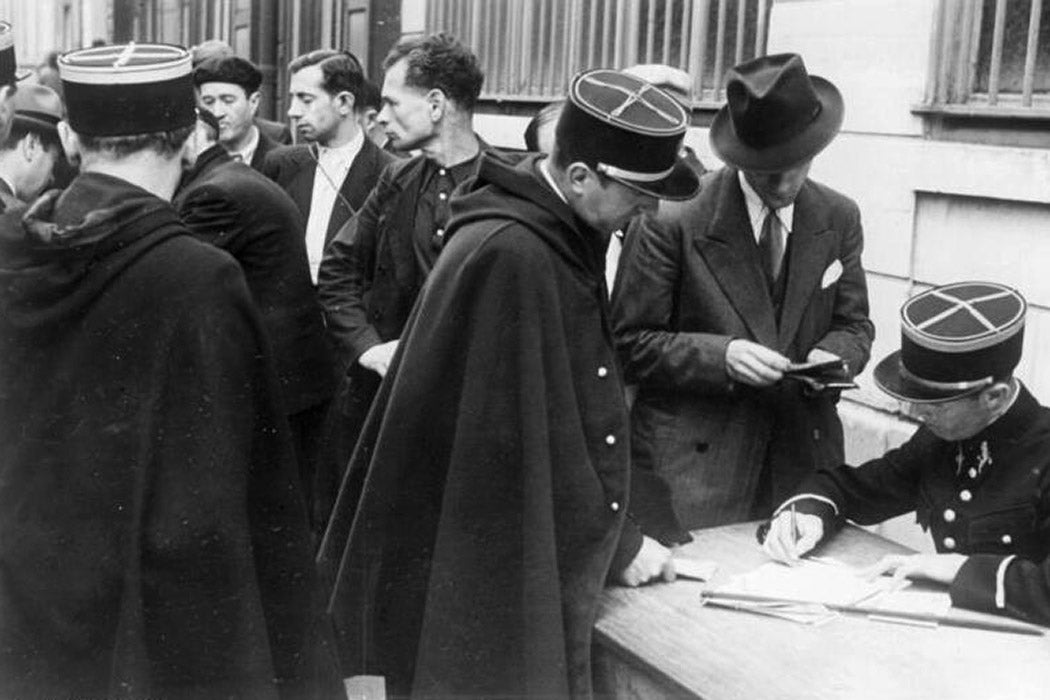
Unlike in the rest of Nazi-occupied Europe, the arrest of Jewish people was largely in the hands of ordinary policemen in France, especially in Paris.

The French police arrest the Jews on the orders of the German occupiers and take their personal details, Paris, 1941

The French police arrest Jewish people on the orders of the German occupiers and take their personal details, Paris, 1941

via Wikimedia Commons

 Share

By: Matthew Wills 

August 25, 2024

 4 minutes

The  icon indicates free access to the linked research on JSTOR.

In France during World War II, the French police had a large part in implementing the Nazi’s Final Solution. These “ordinary agents of the state,” as historian Laurent Joly calls them, arrested 38,500 of the 74,150 Jews deported from the prefecture of the Seine (Paris and its suburbs) to the murder-factories of the concentration camps. This makes the Paris part of the Shoah almost unique.

JSTOR Daily Membership Ad

The Paris Police Prefecture was “one of France’s most prestigious institutions, founded in 1800 by Napoleon,” writes Joly. It was given a task—rounding up both French Jews and Jewish refugees—that was usually undertaken in other countries under Nazi occupation by the SS, Gestapo, or other special “parallel police forces.” In Paris, the “Gestapo made the decision to rely” on the regular police, whose “reputation for efficacy was too well established to not be respected—and used.” A German-only operation wasn’t seen as feasible for political and strategic reasons.

“Militant antisemitism and collaborationist zeal held little place within the Paris Police Prefecture. But the occupier could profit from its professional savoir-faire, from its spirit of obedience, and its allegiance to Vichy,” Joly writes.

The police carried out their orders in the “institutional logic” of bureaucracy and Vichy collaboration.

Although there were zealous and anti-Jewish flics, French slang for cops, on the whole the police not as efficient as the special forces used in other occupied countries.

“Vichy” is the shorthand name for France under German occupation. Between July 1940 and November 1942, France was divided into two parts: a northern section occupied by the Germans and a southern section, nominally a “free zone” administered by a Nazi-approved government headquartered in the town of Vichy. Beginning in the autumn of 1940, the Vichy regime started interning refugee Jews in the unoccupied zone—internment was the first step towards the death camps. Following the Allied invasion of North Africa in November 1942, Germany and Italy occupied the southern half of France, ending any pretense of independence for the authoritarian Vichy collaborationists headed by Marshal Philippe Petain.

Although there were zealous and anti-Jewish flics, French slang for cops, on the whole the police were not as efficient as the special forces used in other occupied countries. For many of the street cops and desk-bound higher-ups, the round-ups “were a drudgery imposed [on them], and professional honor dictated that they accomplish the thankless task to the best of their abilities,” Joly explains. Some alerted Jewish friends in advance. Some were horrified but nonetheless followed orders.

Because most of the cops were bureaucrats rather than ideologues—Joly does note there was a strong stain of institutional xenophobia in the force—the round-up operations carried out by the police were uneven. Arrondissements closer to the center of Paris had proportionally fewer arrests than arrondissements farther away. Not a few targets managed to evade arrest.

“Despite the round-ups and daily arrests, so many Jews in Paris were able to escape the worst (approximately 50,000 Jews remained in the capital at the Liberation), whereas in Warsaw, Berlin, or Amsterdam, nearly all of the Jewish communities were exterminated,” Joly writes.

In all, about a quarter of the Jews counted within France in 1940–41 were sent to death. This compares with nearly 75 percent of the Jewish population of the Netherlands and 90 percent of the Polish Jewish population. Only the small Danish Jewish population largely survived German occupation—almost all of them were saved by being ferried to neutral Sweden.

Weekly Newsletter


Get your fix of JSTOR Daily’s best stories in your inbox each Thursday.


Privacy Policy   Contact Us
You may unsubscribe at any time by clicking on the provided link on any marketing message.

After the Liberation, overtly collaborationist French police offers were dismissed. But many returned to policing in subsequent years. When the Paris police massacred dozens—some counts are in the low hundreds—of Algerians in October 1961, the man who ordered them into action was Maurice Papon, who had also been a high police official during the Vichy period.

Papon’s active collaboration with the SS during the Occupation didn’t hinder his post-war career in France’s Fifth Republic. In addition to overseeing torture and murder as head of the Paris police during the Algerian War (1954–1962), Papon’s post-war career also included serving as Minister of the Budget and as a Deputy in the National Assembly. His awards include the Legion of Honour, France’s highest order of merit, given him by Charles de Gaulle in 1961. Finally, in 1998 at the age of eighty-eight, Papon was found guilty of crimes against humanity for his role in the deportation of over 1,600 Jews from Bordeaux, including 130 children, to Auschwitz and other extermination camps.


Support JSTOR Daily! Join our membership program on Patreon today.

Posted in Uncategorized | Leave a comment

Robert Reich … this piece gives a great insight into Bullies!!!!

US Vice President Kamala Harris with Minnesota Governor Tim Walz. Photo Credit: Kamala Harris, X

US Vice President Kamala Harris with Minnesota Governor Tim Walz. Photo Credit: Kamala Harris, X

Robert Reich: The Real Fight, Now – OpEd

   0 Comments

By Robert Reich

I’m feeling optimistic about Kamala Harris and Tim Walz. 

I want to put this extraordinary moment into context. 

Like many of you, I’ve worked my heart out during elections. (My first one was in 1968, when I went “clean for Gene” — Eugene McCarthy — shaved off my beard and organized volunteers to go door-to-door for the anti-Vietnam War candidate.) And like many of you, I’ve been heartbroken by some election outcomes. 

This one feels different. 

Over my lifetime there’s been a shift in power: from small businesses, local and regional banks, labor unions, and political parties to giant corporations, Wall Street, and a handful of obscenely wealthy donors. 

Today, Kamala Harris and Tim Walz, and the Democratic Party, have a real chance to take back some of that power on behalf of all of us. 

In the 1950s and 1960s, America created the largest middle class the world had ever seen. It gave America enough confidence to pass the Civil Rights Act and Voting Rights Act. It enabled people of color and women to begin to gain ground. And we had a Supreme Court that encouraged this. 

Then around 1980, progress stopped. The bullies began taking over. 

As a kid, I was always a head shorter than other boys, which meant I was bullied, mocked, threatened, sometimes assaulted. 

Over the last four decades, America has allowed fiercer bullying than anything I experienced as a kid. Wealthier Americans have bullied poorer Americans, CEOs have bullied their workers, white people have bullied people of color, men have bullied women, people born in America have bullied new arrivals and undocumented workers. 

Sometimes bullying involves physical violence, but more often it entails intimidation, displays of dominance, demands for submission, or arbitrary decisions over the lives of those who have no choice but to accept them. 

At some point, those who are bullied fight back. 

I remember the day I did, when I had had enough. I was 10 years old. One morning when I was waiting for the school bus, a local bully started shaking me down. He wanted my lunch box and the change in my pocket. He began threatening me physically, as he had done several times before. 

I felt power well up inside me. I quietly put down my lunch box and punched the bully in the nose. 

It was a mild punch. It merely stunned him. (It stunned me, too. I had never delivered even a mild punch before — nor have I since.) But it demonstrated that I wouldn’t take his bullying any longer. And from that day onward, he left me alone. 

Donald Trump is a bully. He has used his wealth to gain power, and used his power to target people of color, harass and abuse women, lie, violate the law, trample on our Constitution, and rage at anyone who calls him on his bullying. 

Since Joe Biden passed the torch to Kamala Harris, Trump has been on the defensive. But make no mistake: He became president by exploiting the anger of millions of white working-class Americans who for decades have been economically and culturally bullied by corporate executives, Wall Street, and upper middle-class urban professionals. 

The bullied are still there; Trump is still exploiting their anger. 

For nearly a decade, Trump has channeled that anger into racism, nativism, and misogyny. He has encouraged his followers to feel powerful by bullying those with even less power: poor Black and Latino people, immigrants, LGBTQ+ people, Muslims, families seeking asylum, undocumented workers, pregnant women who can’t afford to travel to a state where abortions are legal. 

This bullying game has been played repeatedly in history by self-described strongmen who pretend to be tribunes of the oppressed by scapegoating the truly powerless, but who are actually fronting for the rich and powerful. 

In reality, Trump and his lackeys work for the oligarchs — cutting their taxes, rolling back regulations that protect the public but that cost the oligarchs, and dividing the rest of us into warring factions so we don’t look upward to see where most power and wealth have gone. 

The good news is that Americans are catching on. 

Kamala Harris and Tim Walz are part of a movement to make America more inclusive, strengthen our democracy, and stop the bullying.

The real fight between now and Election Day is not between Democrats and Republicans, as the two parties came to be known in the decades after World War II. 

It is a fight that began to take shape in 1968 when Nixon won the presidency, that became bellicose after 1980 when Ronald Reagan took office, and that came into full view in 2016 when Trump won the electoral vote. 

It is between democracy and oligarchy, between self-government and tyranny. It is a fight between the bullies and the bullied. 

I have much the same feeling now as I had when I was 10 years old at the bus stop. I believe tens of millions of other Americans are experiencing it, too — including you. 

We are feeling the power well up within us. We are quietly putting down our lunch boxes and are about to demonstrate to the bullies — peacefully, through the power of our votes — that we will no longer take their bullying.

FacebookTwitterEmailFlipboardMastodonLinkedInShare

Robert Reich

Robert B. Reich is Chancellor’s Professor of Public Policy at the University of California at Berkeley and Senior Fellow at the Blum Center for Developing Economies, and writes at robertreich.substack.com. Reich served as Secretary of Labor in the Clinton administration, for which Time Magazine named him one of the ten most effective cabinet secretaries of the twentieth century. He has written fifteen books, including the best sellers “Aftershock”, “The Work of Nations,” and”Beyond Outrage,” and, his most recent, “The Common Good,” which is available in bookstores now. He is also a founding editor of the American Prospect magazine, chairman of Common Cause, a member of the American Academy of Arts and Sciences, and co-creator of the award-winning documentary, “Inequality For All.” He’s co-creator of the Netflix original documentary “Saving Capitalism,” which is streaming now.

Posted in Uncategorized | Leave a comment