
-
Archives
- October 2026
- September 2026
- August 2026
- July 2026
- June 2026
- May 2026
- April 2026
- March 2026
- February 2026
- January 2026
- December 2025
- November 2025
- October 2025
- September 2025
- August 2025
- July 2025
- June 2025
- May 2025
- April 2025
- March 2025
- February 2025
- January 2025
- December 2024
- November 2024
- October 2024
- September 2024
- August 2024
- July 2024
- June 2024
- May 2024
- April 2024
- March 2024
- February 2024
- January 2024
- December 2023
- November 2023
- October 2023
- September 2023
- August 2023
- July 2023
- June 2023
- May 2023
- April 2023
- March 2023
- February 2023
- January 2023
- December 2022
- November 2022
- October 2022
- September 2022
- August 2022
- July 2022
- June 2022
- May 2022
- April 2022
- March 2022
- February 2022
- January 2022
- September 2021
- August 2021
- July 2021
- June 2021
- May 2021
- April 2021
- February 2021
- January 2021
- December 2020
- November 2020
- October 2020
- September 2020
- August 2020
- July 2020
- June 2020
- May 2020
- April 2020
- March 2020
- February 2020
- January 2020
- December 2019
- November 2019
- October 2019
- September 2019
- August 2019
- July 2019
- June 2019
- May 2019
- April 2019
- March 2019
- February 2019
- January 2019
- December 2018
- November 2018
- October 2018
- September 2018
- July 2018
- June 2018
- May 2018
- April 2018
- March 2018
- February 2018
- January 2018
- December 2017
- November 2017
- October 2017
- September 2017
- August 2017
- July 2017
- June 2017
- May 2017
- April 2017
- March 2017
- February 2017
- January 2017
- December 2016
- November 2016
- October 2016
- September 2016
- August 2016
- July 2016
- June 2016
- May 2016
- April 2016
- March 2016
- February 2016
- January 2016
- December 2015
- November 2015
- October 2015
- September 2015
- August 2015
- July 2015
- June 2015
- March 2015
- January 2015
-
Meta
Harvard Medical School: Bouncing back from Stress, recommended. Comment: search canisgallicus.com William James – also Navy Seals
Bouncing back from stress

| Harvard Medical School <healthbeat@mail.health.harvard.edu> Unsubscribe | 1:15 PM (28 minutes ago) |  | |
| to me | |||
SUBSCRIBE | SHOP THE BOOKSTOREBouncing back from stress We all experience stress in our lives. Traffic. Monthly bills. Health concerns. Relationship issues. Because the mind and body are so closely linked, these constant worries can take a toll on health, contributing to a host of diseases.While you can’t erase all sources of stress, you can learn how to reduce stress and also build resilience—which is your ability to bounce back from stress. Get your copy of Stress Management While some stress is inevitable, when your body repeatedly encounters a set of physiological changes dubbed the stress response, trouble can brew. Stress may contribute to or exacerbate various health problems. But it’s possible to dismantle negative stress cycles. This Special Health Report, Stress Management: Enhance your well-being by reducing stress and building resilience, can help you identify your stress warning signs and learn how to better manage stressful situations. SHOW ME MORE → William James was a notable Harvard philosopher-psychologist of the late 19th century and a graduate of Harvard Medical School. James was also a stressed-out melancholic. He marveled at people he called “the healthy-minded”—optimistic and positive people who appeared to live happier and healthier lives. Amid the run-of-the-mill volatility everyone must deal with, James observed that the healthy-minded seemed to turn challenges and potential failures into grist for opportunities and successes.The characteristics that James saw as “healthy-minded,” statistician and risk-management specialist Nassim Nicholas Taleb called “antifragile.” In his book Antifragile: Things That Gain from Disorder, Taleb defines fragility as the tendency to be damaged by volatility and uncertainty—the kinds of things that often create a chronic stress response. By contrast, says Taleb, the antifragile person realizes that stress is just the price we pay for being alive. Cultivating antifragility helps us use our strengths to overcome challenges and become stronger in the process. A prime example of antifragility is the Navy Seals. The Seals are able to manage high degrees of stress and still function admirably. Faced with life-threatening situations, they can rapidly change the focus of their attention and address the issue at hand efficiently and flexibly.Brain scans show that Seals have altered activation in a prefrontal brain region called the insula, which is involved in managing stress signals. As a group, Navy Seals exhibit at least seven characteristics of resilient people:Calm, innovative, nondogmatic thinkingThe ability to act decisivelyTenacity Interpersonal connectedness Honesty Self-control optimism and a positive perspective on life. Whether adopting a “healthy-minded” mindset, cultivating antifragility, or thinking like a Navy Seal, building resilience is a powerful tool against stress. People tend to think of resilience as a trait that you either have or don’t have, but it’s actually a capacity that you can develop with the right approach.For additional information on the dangers of stress and ways to relieve and manage it, buy Stress Management , a Special Health Report from Harvard Medical School. |
Posted in Uncategorized
Leave a comment
Tortois ….
| The Nibs |
| Capital economy, business and finance Irish surplus It’s a position that most governments can only dream of: a projected budget surplus of €8.6 billion. Ireland has been fortunate: thanks to record corporation tax receipts from global firms based there, like Apple and Pfizer, it’s been in the black for three years running. The (good) problem now is how to spend it: the government is setting up a sovereign wealth fund to cover future pension and climate liabilities – anticipating that the corporation tax windfall can’t be counted on indefinitely – but is facing calls for serious spending ahead of its October budget on housing, infrastructure and public transport. A (less good) problem: it turns out the government spent €336,000 installing a bike shelter at Leinster House, the seat of the Irish parliament in Dublin. Simon Harris, the prime minister, called the cost “inexcusable”. |
Posted in Uncategorized
Leave a comment
Eurasia Review: Children Of Big Brother: What It Means To Go Back-To-School In The American Police State – OpEd. “Instead of being taught the three R’s of education (reading, writing and arithmetic), young people are being drilled in the three I’s of life in the American police state: indoctrination, intimidation and intolerance.”
Children Of Big Brother: What It Means To Go Back-To-School In The American Police State – OpEd
It’s not easy being a child in the American police state.
Danger lurks around every corner and comes at you from every direction, especially when Big Brother is involved.
Out on the streets, you’ve got the menace posed by police officers who shoot first and ask questions later. In your neighborhoods, you’ve got to worry about the Nanny State and its network of busybodies turning parents in for allowing their children to walk to school alone, walk to the park alone, play at the beach alone, or even play in their own yard alone.
The tentacles of the police state even intrude on the sanctity of one’s home, with the government believing it knows better than you—the parent—what is best for your child. This criminalization of parenthood has run the gamut in recent years from parents being arrested for attempting to walk their kids home from school to parents being fined and threatened with jail time for their kids’ bad behavior or tardiness at school.
This doesn’t even touch on what happens to your kids when they’re at school—especially the public schools—where parents have little to no control over what their kids are taught, how they are taught, how and why they are disciplined, and the extent to which they are being indoctrinated into marching in lockstep with the government’s authoritarian playbook.
The message is chillingly clear: your children are not your own but are, in fact, wards of the state who have been temporarily entrusted to your care. Should you fail to carry out your duties to the government’s satisfaction, the children in your care will be re-assigned elsewhere.
This is what it means to go back-to-school in America today: where parents have to worry about school resource officers who taser teenagers and handcuff kindergartners, school officials who have criminalized childhood behavior, school lockdowns and terror drills that teach your children to fear and comply, and a police state mindset that has transformed the schools into quasi-prisons.
Instead of being taught the three R’s of education (reading, writing and arithmetic), young people are being drilled in the three I’s of life in the American police state: indoctrination, intimidation and intolerance.
Indeed, while young people today are learning first-hand what it means to be at the epicenter of politically charged culture wars, test scores indicate that students are not learning how to succeed in social studies, math and reading. Rather, government officials are churning out compliant drones who know little to nothing about their history or their freedoms.
In turn, these young people are being brainwashed into adopting a worldview in which rights are negotiable rather than inalienable; free speech is dangerous; the virtual world is preferable to the real world; and history can be extinguished when inconvenient or offensive.
What does it mean for the future of freedom at large when these young people, trained to be mindless automatons, are someday running the government?
Under the direction of government officials focused on making the schools more authoritarian (sold to parents as a bid to make the schools safer), young people in America are now first in line to be searched, surveilled, spied on, threatened, tied up, locked down, treated like criminals for non-criminal behavior, tasered and in some cases shot.
From the moment a child enters one of the nation’s 98,000 public schools to the moment he or she graduates, they will be exposed to a steady diet of:
- draconian zero tolerance policies that criminalize childish behavior,
- overreaching anti-bullying statutes that criminalize speech,
- school resource officers (police) tasked with disciplining and/or arresting so-called “disorderly” students,
- standardized testing that emphasizes rote answers over critical thinking,
- politically correct mindsets that teach young people to censor themselves and those around them,
- and extensive biometric and surveillance systems that, coupled with the rest, acclimate young people to a world in which they have no freedom of thought, speech or movement.
This is how you groom young people to march in lockstep with a police state.
As Deborah Cadbury writes for The Washington Post, “Authoritarian rulers have long tried to assert control over the classroom as part of their totalitarian governments.”
In Nazi Germany, the schools became indoctrination centers, breeding grounds for intolerance and compliance.
In the American police state, the schools have become increasingly hostile to those who dare to question or challenge the status quo.
America’s young people have become casualties of a post-9/11 mindset that has transformed the country into a locked-down, militarized, crisis-fueled mockery of a representative government.
Roped into the government’s profit-driven campaign to keep the nation “safe” from drugs, disease, and weapons, America’s schools have transformed themselves into quasi-prisons, complete with surveillance cameras, metal detectors, police patrols, zero tolerance policies, lock downs, drug sniffing dogs, strip searches and active shooter drills.
Students are not only punished for minor transgressions such as playing cops and robbers on the playground, bringing LEGOs to school, or having a food fight, but the punishments have become far more severe, shifting from detention and visits to the principal’s office into misdemeanor tickets, juvenile court, handcuffs, tasers and even prison terms.
Students have been suspended under school zero tolerance policies for bringing to school “look alike substances” such as oregano, breath mints, birth control pills and powdered sugar.
Look-alike weapons (toy guns—even Lego-sized ones, hand-drawn pictures of guns, pencils twirled in a “threatening” manner, imaginary bows and arrows, fingers positioned like guns) can also land a student in hot water, in some cases getting them expelled from school or charged with a crime.
Not even good deeds go unpunished.
One 13-year-old was given detention for exposing the school to “liability” by sharing his lunch with a hungry friend. A third grader was suspended for shaving her head in sympathy for a friend who had lost her hair to chemotherapy. And then there was the high school senior who was suspended for saying “bless you” after a fellow classmate sneezed.
Having police in the schools only adds to the danger.
Thanks to a combination of media hype, political pandering and financial incentives, the use of armed police officers (a.k.a. school resource officers) to patrol school hallways has risen dramatically in the years since the Columbine school shooting.
Indeed, the growing presence of police in the nation’s schools is resulting in greater police “involvement in routine discipline matters that principals and parents used to address without involvement from law enforcement officers.”
Funded by the U.S. Department of Justice, these school resource officers have become de facto wardens in elementary, middle and high schools, doling out their own brand of justice to the so-called “criminals” in their midst with the help of tasers, pepper spray, batons and brute force.
In the absence of school-appropriate guidelines, police are more and more “stepping in to deal with minor rulebreaking: sagging pants, disrespectful comments, brief physical skirmishes. What previously might have resulted in a detention or a visit to the principal’s office was replaced with excruciating pain and temporary blindness, often followed by a trip to the courthouse.”
Not even the younger, elementary school-aged kids are being spared these “hardening” tactics.
On any given day when school is in session, kids who “act up” in class are pinned facedown on the floor, locked in dark closets, tied up with straps, bungee cords and duct tape, handcuffed, leg shackled, tasered or otherwise restrained, immobilized or placed in solitary confinement in order to bring them under “control.”
In almost every case, these undeniably harsh methods are used to punish kids—some as young as 4 and 5 years old—for simply failing to follow directions or throwing tantrums.
Very rarely do the kids pose any credible danger to themselves or others.
Unbelievably, these tactics are all legal, at least when employed by school officials or school resource officers in the nation’s public schools.
This is what happens when you introduce police and police tactics into the schools.
Paradoxically, by the time you add in the lockdowns and active shooter drills, instead of making the schools safer, school officials have succeeded in creating an environment in which children are so traumatized that they suffer from post-traumatic stress disorder, nightmares, anxiety, mistrust of adults in authority, as well as feelings of anger, depression, humiliation, despair and delusion.
For example, a middle school in Washington State went on lockdown after a student brought a toy gun to class. A Boston high school went into lockdown for four hours after a bullet was discovered in a classroom. A North Carolina elementary school locked down and called in police after a fifth grader reported seeing an unfamiliar man in the school (it turned out to be a parent).
Police officers at a Florida middle school carried out an active shooter drill in an effort to educate students about how to respond in the event of an actual shooting crisis. Two armed officers, guns loaded and drawn, burst into classrooms, terrorizing the students and placing the school into lockdown mode.
These police state tactics have not made the schools any safer.
The fallout has been what you’d expect, with the nation’s young people treated like hardened criminals: handcuffed, arrested, tasered, tackled and taught the painful lesson that the Constitution (especially the Fourth Amendment) doesn’t mean much in the American police state.
Likewise, the harm caused by attitudes and policies that treat America’s young people as government property is not merely a short-term deprivation of individual rights. It is also a long-term effort to brainwash our young people into believing that civil liberties are luxuries that can and will be discarded at the whim and caprice of government officials if they deem doing so is for the so-called “greater good” (in other words, that which perpetuates the aims and goals of the police state).
What we’re dealing with is a draconian mindset that sees young people as wards of the state—and the source of potential income—to do with as they will in defiance of the children’s constitutional rights and those of their parents. However, this is in keeping with the government’s approach towards individual freedoms in general.
Surveillance cameras, government agents listening in on your phone calls, reading your emails and text messages and monitoring your spending, mandatory health care, sugary soda bans, anti-bullying laws, zero tolerance policies, political correctness: these are all outward signs of a government—i.e., a monied elite—that believes it knows what is best for you and can do a better job of managing your life than you can.
This is tyranny disguised as “the better good.”
Indeed, this is the tyranny of the Nanny State: marketed as benevolence, enforced with armed police, and inflicted on all those who do not belong to the elite ruling class that gets to call the shots.
This is what the world looks like when bureaucrats not only think they know better than the average citizen but are empowered to inflict their viewpoints on the rest of the populace on penalty of fines, arrest or death.
So, what’s the answer, not only for the here-and-now but for the future of this country, when these same young people are someday in charge?
How do you convince someone who has been routinely handcuffed, shackled, tied down, locked up, and immobilized by government officials—all before he reaches the age of adulthood—that he has any rights at all, let alone the right to challenge wrongdoing, resist oppression and defend himself against injustice?
Most of all, how do you persuade a fellow American that the government works for him when, for most of his young life, he has been incarcerated in an institution that teaches young people to be obedient and compliant citizens who don’t talk back, don’t question and don’t challenge authority?
As I make clear in my book Battlefield America: The War on the American People and in its fictional counterpart The Erik Blair Diaries, if we want to raise up a generation of freedom fighters who will actually operate with justice, fairness, accountability and equality towards each other and their government, we must start by running the schools like freedom forums.
FacebookTwitterEmailFlipboardMastodonLinkedInShare
John and Nisha Whitehead
John W. Whitehead is an attorney and author who has written, debated and practiced widely in the area of constitutional law, human rights and popular culture. He is founder and president of The Rutherford Institute. Whitehead can be contacted at johnw@rutherford.org.
Posted in Uncategorized
Leave a comment
NATURE: The biology of smell is a mystery — AI is helping to solve it. Comment: TBI 30+ years ago interalia, deafness in my right ear but the loss of smell too. So often the comment you would receive is how lucky you are!!! This explanation is long overdue.
- NEWS FEATURE
- 03 September 2024
The biology of smell is a mystery — AI is helping to solve it
Scientists are beginning to crack the fiendishly complex code that helps us to sense odours.

The smell in the laboratory was new. It was, in the language of the business, tenacious: for more than a week, the odour clung to the paper on which it had been blotted.
To researcher Alex Wiltschko, it was the smell of summertime in Texas: watermelon, but more precisely, the boundary where the red flesh transitions into white rind.
“It was a molecule that nobody had ever seen before,” says Wiltschko, who runs a company called Osmo, based in Cambridge, Massachusetts. His team created the compound, called 533, as part of its mission to understand and digitize smell. His goal — to develop a system that can detect, predict or create odours — is a tall order, as molecule 533 shows. “If you looked at the structure, you would never have guessed that it smelled this way.”
That’s one of the problems with understanding smell: the chemical structure of a molecule tells you almost nothing about its odour. Two chemicals with very similar structures can smell wildly different; and two wildly different chemical structures can produce an almost identical odour. And most smells — coffee, Camembert, ripe tomatoes — are mixtures of many tens or hundreds of aroma molecules, intensifying the challenge of understanding how chemistry gives rise to olfactory experience.
Another problem is working out how smells relate to each other. With vision, the spectrum is a simple colour palette: red, green, blue and all their swirling intermediates. Sounds have a frequency and a volume, but for smell there are no obvious parameters. Where does an odour identifiable as ‘frost’ sit in relation to ‘sauna’? It’s a real challenge to make predictions about smell, says Joel Mainland, a neuroscientist at the Monell Chemical Senses Center, an independent research institute in Philadelphia, Pennsylvania.How do we smell? First 3D structure of human odour receptor offers clues
Animals, including humans, have evolved a remarkably complex decoding system befitting the enormous repertoire of odour molecules. All sensory information is processed by receptors, and odour is no different — except in its scale. For light, the human eye has two types of receptor cell; for smell, there are 400. How the signals from these receptors combine to trigger a particular perception is unclear. Plus, the receptor proteins themselves are hard to work with, so what they look like and how they function has mostly been guesswork.
Things are beginning to change, however, thanks to improvements in structural biology, data analytics and artificial intelligence (AI). Many scientists hope that cracking the olfactory code will help them to understand how animals use this essential sense to find food or mates, and how it feeds into memory, emotion, stress, appetite and more.
Others are trying to digitize smell to build new technologies: devices that diagnose disease on the basis of odours; better, safer insect repellents; and affordable or more-effective aroma molecules for the US$30-billion flavour and fragrance market. At least 20 start-up firms are trying to make electronic noses for applications in health and public safety.
This all adds up to a surge of research into the biology of olfaction, says Sandeep Robert Datta, a neuroscientist at Harvard Medical School in Boston, Massachusetts. “Smell is having a moment,” he says.
Smelling machines
Even for experts, the physical properties of an odour molecule typically offer little insight into how it will actually smell.
Researchers have come up with a few computational models that can relate structure to odour, but early versions tended to be based on quite narrow data sets or could only make predictions when smells had been calibrated to have the same perceived intensity. In 2020, one team reported a model that could predict how similar real-world mixtures were to each other, correctly identifying that rose and violet odorants are more similar to one another than either is to the pungent spice asafoetida, often used in Indian cuisine1.
Previous attempts to use machine learning were good, but not great. For example, when researchers ran a competition to create the best odour-predicting model, algorithms from 22 teams could effectively predict only 8 out of 19 smell descriptors2.Could rats and dogs detect disease better than the finest lab equipment?
Last year, Wiltschko’s team — then part of Google’s AI research division — collaborated with researchers at Monell, including Mainland, to publish a map for smell3 that made use of AI.
Their program was trained by feeding the model thousands of descriptions of molecular structures from fragrance catalogues, along with smell labels for each — terms such as ‘beefy’ or ‘floral’.
Then, the researchers compared the AI system with human noses. They trained 15 panellists to rate a few hundred aromas using 55 labels, such as ‘smoky’, ‘tropical’ and ‘waxy’.
Humans have a hard time with this task because smell is so subjective. “There’s no universal truth,” says Mainland. Most smell descriptions lack detail, too. For one smell, panellists chose the words ‘sharp, sweet, roasted, buttery’. A master perfumer, asked to describe the same smell, noted ‘ski lodge, fireplace without a fire’. “That shows you the gap,” says Mainland. “Our lexicon is not good enough.” Nonetheless, a human panel is one of the best available tools for coming up with consistent smell descriptors because the average rankings of the group for different smells tend to be stable.
Using the structure of these molecules alone, the AI algorithm did well at predicting the smell of compounds compared with the average group assessments (see ‘Same but different’), and it performed better than the typical individual sniffer. And although the map it produced was very complicated — it has more than 250 dimensions — it was able to group smells by type, such as meaty, alcoholic or woody.
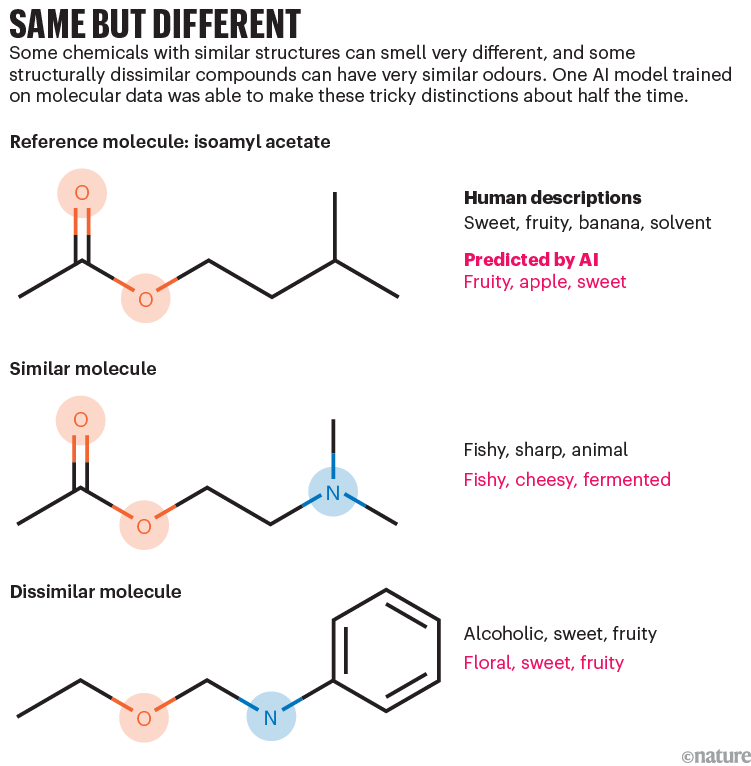
Mainland says that the algorithm’s thoroughness helped it to perform. Humans might rate an odour as fruity but forget to rate it as sweet. The model, exhaustive and patient, churns through all possibilities each time.
One challenge that both Mainland and the Osmo team are working on now is to work out whether the model can predict what mixtures of compounds smell like, on the basis of their components. Another goal is to have the model design new odours, for instance chemicals that mimic a specific scent, or that are safer, more sustainable or biodegradable.
AI probably can’t do this alone, says Jane Parker, a flavour chemist at the University of Reading, UK, who helped the smell-mapping team with quality control of their compounds. “The model could give you an idea of what might work,” she says. But the expertise and ingenuity of human chemists and flavourists — plus their highly trained noses — will still be necessary for innovation.
Mysterious code
For both expert and amateur sniffers, the biological equipment for smell detection is the same. The nose has millions of olfactory neurons, and each typically expresses just one type of odorant receptor (OR). The gene family that encodes them was discovered4 in the early 1990s and won Linda Buck and Richard Axel a Nobel prize in 2004.
Each of these receptor types might recognize one or more odorants — and each odorant might be recognized by more than one receptor. Together, the roughly 400 human ORs can respond to a trillion different chemicals. It’s a fiendishly complex, exquisitely tuned, flexible system — and it needs to be, because the chemistry of nature is incredibly diverse, says Aashish Manglik, a biochemist at the University of California, San Francisco. “The breadth of chemicals that make odours is enormous.” One important step in cracking the code of smell is to know what the receptors look like and how they recognize chemicals. But they have been notoriously difficult to study. “They’re the most recalcitrant membrane proteins to work with,” says Manglik. Many are too unstable to be expressed in cells in the lab and to generate enough protein to analyse.
Scientists have deciphered the structure of two ORs from insects5,6. These receptors are of a totally different type to those in mammals, although the olfactory ‘logic’ by which they work together is likely to be similar, says sensory neuroscientist Vanessa Ruta, whose lab at the Rockefeller University in New York solved both the structures.
Two more receptor structures7,8, from the olfactory system in mice, followed last year. Both of them sense a bunch of chemicals with distinctly unlikeable fishy, musky or putrid odours, many of which are key components of bodily odours in animals.
Getting at these structures has required some “funky approaches”, says Manglik, because ORs are so hard to grow in the lab. But last year, he was part of a team that succeeded in publishing the first protein structure of a human olfactory receptor bound to an odorant9.
Having tried almost every OR that they could, Manglik and colleagues found one that is richly expressed outside the nose, in the gut and prostate, and which could, as a result, be made more readily in commonly used cell lines. It’s a receptor called OR51E2 and it responds to the chemical propionate, which has a pungent, cheesy odour.
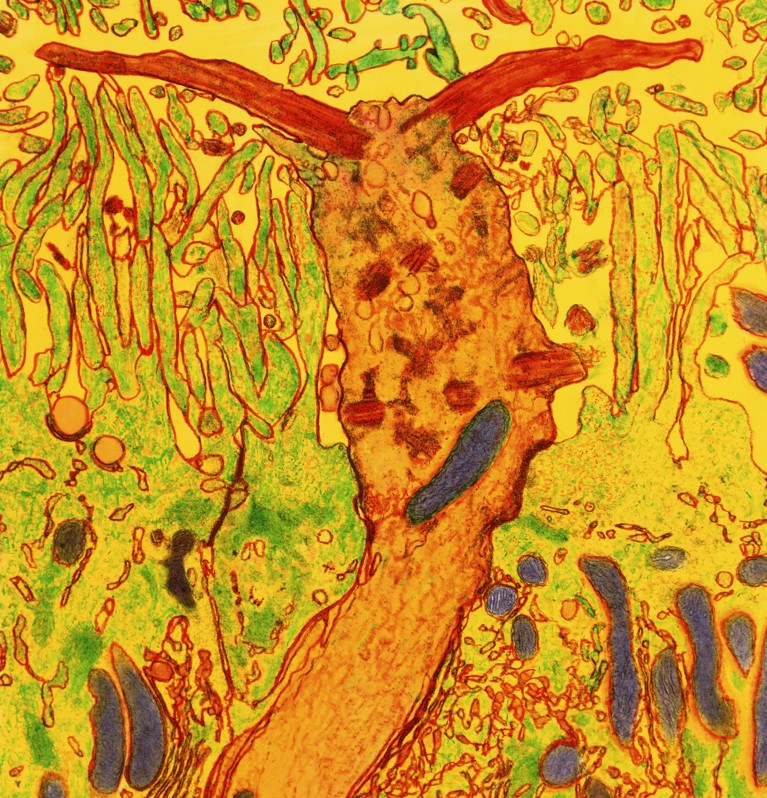
Using cryo-electron microscopy, the team looked at how propionate binds to the receptor in a little pocket, and how that binding changes the receptor’s shape and conveys information onwards. Seeing the structure “was really thrilling”, says Buck, whose lab at the Fred Hutchinson Cancer Center in Seattle, Washington, studies olfactory neuroscience.
But ORs can detect so many odorants that “the structure of one OR can’t tell us much”, says Hiro Matsunami, an olfaction biologist at Duke University in Durham, North Carolina, who collaborated with Manglik on the study of OR51E2.
Alongside trying to grow more of them, Matsunami and his colleagues have attempted to understand the OR by re-engineering it. They made some synthetic receptors using OR51E2 and parts from two dozen similar receptors. They aligned the amino-acid sequences of these existing ORs, and chose the most frequent amino acid at each position to build an average, or ‘consensus’, structure. Then they expressed the structure in cells. When they compared their synthetic structure with its real-life counterpart, OR51E2, it looked and behaved just like its sibling10.
Next, they tried building another averaged receptor based on an OR with no published structure — OR1A1 — which recognizes a broad range of odorants including some that smell fruity, floral and minty. They used a computational model to explore how it bound to two compounds that both smell of menthol; the compounds bound to the receptor in different places.
The team thinks that different odorants probably engage a single OR in distinct ways. That would help to explain the level of complexity in the smell code — and could explain why, for example, two disparate chemicals can have similar odours, or why chemically similar compounds can smell so different. The compound carvone, for instance, comes in two varieties that are mirror images of each other; one smells of spearmint, the other of caraway or dill. “There must be a receptor that can explain this,” says Matsunami.
Some researchers are using machine learning to accelerate the search for structures and their preferred chemical partners. Right now, scientists have identified odour molecules that bind to only about 20% of human ORs.
The protein-prediction algorithm AlphaFold has suggested thousands of structures for mammalian odorant receptors11. And machine learning and modelling has helped Matsunami and his colleagues to screen millions of compounds to see which ones might bind to two candidate OR structures12. One of the molecules they found smells of orange blossom; another strongly of honey.
The dream end point is to gather data on hundreds of ORs and how their activation lines up with the chemistry of millions of odorants, says Manglik.
Lead with the nose
Once a smell is processed by receptors, this information proceeds to a brain region called the olfactory bulb, which sits behind the bridge of the nose, and onwards to the olfactory cortex. The circuitry for olfaction before information enters the cortex is well understood, particularly in model organisms such as fruit flies and mice. But the olfactory cortex is more of a mystery. “It’s difficult to figure out what’s happening there,” says Buck.
Many researchers want to understand how information from receptors is organized in the brain, and what rules govern perception. If that were understood, it might be possible to get an animal to perceive a certain smell without even presenting an odorant, simply by recreating the pattern it generates in the brain, says Dima Rinberg, a neuroscientist who studies smell at New York University School of Medicine.Human nose can detect 1 trillion odours
Another big unknown, Datta says, is how the olfactory system interacts with other crucial brain circuits, such as those that control movement or navigation. Several labs, including his own, are interested in how animals actively sense scent and move towards or away from odours.
Capturing the connection between scent and behaviour is already possible to some extent in the brains of insects. In fruit flies, for instance, scientists can explore chemical structure, receptors and the brain in a single system. “In insects you can start to span the whole spectrum,” says Ruta.
Insects’ sense of smell is also relevant to human health. Mosquitoes evolved to sniff out humans, and many insects prey on crops that humans rely on. Last November, Osmo announced a $3.5-million grant from the Bill & Melinda Gates Foundation in Seattle, Washington, aimed at discovering and producing compounds that repel, attract or destroy insects that carry disease.
Meanwhile, detecting scents is also big business. For some tasks and applications, ‘electronic noses’ are already commercially available: some are designed to detect off odours in food or to pick up smells in waste water. They are being intensively studied as diagnostics for diseases such as TB, diabetes and various cancers.
But natural sniffers still have an edge, and even without a full understanding of how brains process smell, scientists can exploit biological noses to improve chemical sensing for safety, security or health care.
The classic example is the sniffer dog, widely used to sense chemicals in explosives or narcotics — but these animals are expensive to train and there are limits to what they can detect.
Rinberg’s team is aiming to blend animal and digital odour detection. They developed a nose–computer interface in mice13, using electrodes that record signals from the olfactory bulb as mice smell different compounds. The researchers can decode odour identities from neural activity, and then use the patterns to flag these smells under natural conditions. Their device, which is now being developed by a start-up called Canaery, co-founded by Rinberg, retains the precision of the animal’s sense of smell without researchers having to train the animal to respond. “The biological nose is the best chemical detector,” Rinberg says. “The whole machinery is hard to beat.”
Despite the pre-eminence of biology, many scientists dream of a time when a digital smell sensor will rival those for other senses. “Smartphones can do image and audio recognition,” says Ruta. “But for olfaction there’s nothing like that.”
And although they know how well biological noses work, researchers still have a lot of outstanding questions. For Buck, the simplest to pose could be the most difficult to answer. “It would be nice to know how you get a perception of a particular odorant,” she says — how the brain, beyond the nose, creates a sense of rose, for instance, and how it distinguishes it from the essence of fish. “How does that happen in the brain? No one knows,” she says. “We don’t have the techniques to figure that out yet.”
Nature 633, 26-29 (2024)
doi: https://doi.org/10.1038/d41586-024-02833-4
References
- Ravia, A. et al. Nature 588, 118–123 (2020).Article PubMed Google Scholar
- Keller, A. et al. Science 355, 820–826 (2017).Article PubMed Google Scholar
- Lee, B. K. et al. Science 381, 999–1006 (2023).Article PubMed Google Scholar
- Buck, L. & Axel, R. Cell 65, 175–187 (1991).Article PubMed Google Scholar
- Butterwick, J. A. et al. Nature 560, 447–452 (2018).Article PubMed Google Scholar
- del Mármol, J., Yedlin, M. A. & Ruta, V. Nature 597, 126–131 (2021).Article PubMed Google Scholar
- Guo, L. et al. Nature 618, 193–200 (2023).Article PubMed Google Scholar
- Gusach, A. et al. Preprint at bioRxiv https://doi.org/10.1101/2023.07.07.547762 (2023).
- Billesbølle, C. B. et al. Nature 615, 742–749 (2023).Article PubMed Google Scholar
- de March C. A. et al. Preprint at bioRxiv https://doi.org/10.1101/2023.11.16.567230 (2023).
- Akdel, M. et al. Nature Struct. Mol. Biol. 29, 1056–1067 (2022).Article PubMed Google Scholar
- Jabeen, A., de March, C. A., Matsunami, H. & Ranganathan, S. Int. J. Mol. Sci. 22, 11546 (2021).Article PubMed Google Scholar
- Shor, E. et al. Biosens. Bioelectron. 195, 113664 (2022).Article PubMed Google Scholar
Related Articles
Posted in Uncategorized
Leave a comment
Democracy at Work (Professor Richard D. Wolff) – LABOR DAY AND ABE LINCOLN, HONORING BOTH TOGTHER
Posted in Uncategorized
Leave a comment
Eurasia Review (Ron Paul): Trump And Harris Ignore A Great Danger Facing America – OpEd

Dr. Ron Paul
Ron Paul: Trump And Harris Ignore A Great Danger Facing America – OpEd
By Ron Paul
The Penn Wharton Budget Model, a think tank headquartered at the University of Pennsylvania, recently released a study claiming former President Donald Trump’s economic plans would add about four trillion dollars to the national deficit over ten years while Vice President Kamala Harris’s economic plans would add about two trillion dollars.
Vice President Harris would increase the deficit largely through expanding refundable tax credits such as the child tax credit. Low-income Americans can qualify for refundable tax credits even if they have less federal tax liability. So this proposal includes a welfare program disguised as a tax credit. Vice President Harris also proposes spending 40 billion dollars on an “innovation fund” to increase the supply of “affordable” housing. Another of the vice president’s proposals is providing first-time homebuyers with up to 25,000 dollars in downpayment assistance.
Harris’s proposals could contribute to a new housing bubble. This bubble would inevitably burst, leading to an economic crisis likely worse than the “Great Recession” that followed the bursting of the last housing bubble. One reason it could be worse is that it may be accompanied by the bursting of several other bubbles and the rejection of the dollar’s world reserve currency status.
According to the study, President Trump will increase the deficit by cutting taxes without also cutting spending. President Trump has pledged to renew the 2017 tax cuts and also promised to stop taxing Social Security benefits. Trump’s tax cuts would help spur economic growth, job creation, and higher tax revenue. The study indicates that the pro-growth effects of Trump’s tax cuts are the reason it projects Trump’s tax policy will “only” increase the federal deficit by 4.1 trillion dollars over ten years as opposed to 5.8 trillion dollars.
It is common to describe tax cuts as “costing” the government. Saying tax cuts cost the government assumes that the government has a moral claim over an individual’s earnings, so anytime those running the government allow individuals to keep more of their money the rulers are being generous. The truth is that income belongs to the people who earn it and that saying tax cuts cost the government is like saying burglar alarms cost thieves. Therefore, any legislation that cuts taxes is a victory for liberty.
We should never allow concerns about government debt to prevent us from supporting tax cuts. Instead, we must focus on the real cause of the debt crisis — ever-increasing spending in a futile effort to run the world, run the economy, and run our lives. Increasing federal deficits will result in tax increases, either directly via Congress and the IRS or indirectly via the Federal Reserve’s inflation tax that results from the Fed’s monetization of federal debt.
Unless the federal government starts cutting spending and paying down the debt, America will experience an unprecedented economic crisis. Yet, neither Donald Trump nor Kamala Harris is even talking about this issue, much less proposing a serious plan to roll back the welfare-warfare state, reduce spending, and start to reduce the debt. Instead, both candidates are likely to increase spending. This is one reason it is difficult to take seriously the claim that this is the most important election in history.
This article was published by RonPaul Institute
Facebook Twitter Email Flipboard Mastodon LinkedIn Share

Ron Paul
Ronald Ernest “Ron” Paul (born August 20, 1935) is an American physician, author, and politician who served for many years as a U.S. Representative for Texas. He was a three-time candidate for President of the United States, as a Libertarian in 1988 and as a Republican in 2008 and 2012.
Posted in Uncategorized
Leave a comment
Inside Iran: The proxy war on the brink of eruption. Source: ABC is an Australian public broadcast service
Posted in Uncategorized
Leave a comment
Freedom of Speech: Aim is The Truth. Even if what is said offends… Please watch this. The son of well known Gabor Mate
Posted in Uncategorized
Leave a comment
Change. German Elections and geopolitics.
Russia’s best friends in Germany: AfD and BSW
Hans Pfeifer17 hours ago17 hours ago
The far-right Alternative for Germany and the left-wing populist Sahra Wagenknecht Alliance both won substantial gains in Sunday’s state elections. Both parties have close ties with Russia and oppose support for Ukraine.
NB: For videos and photos, Google DW, source of this article
Sahra Wagenknecht and her newly founded party, Bündnis Sahra Wagenknecht (BSW) (Sahra Wagenknecht Alliance) are staunch critics of any military engagement. Their election manifesto states that war foments fear and leads to instability.
As for Russia’s war of aggression against Ukraine, they blame the United States and NATO: “A military alliance whose leading power has invaded five countries in violation of international law in recent years and killed more than 1 million people in those wars.” The BSW wants to integrate Russia into a European security architecture.
The BSW is a populist party that blends left-leaning economic policies with conservative migration and pro-Russian foreign policy initiatives.
One of the party’s main topics is harsh criticism of the military aid provided by Europe and the US for Ukraine. Although foreign policy is not the remit of the federal states, Wagenknecht is scoring points with her call for a U-turn on Russia.
In Sunday’s regional elections in the eastern states of Thuringia and Saxony the party won nearly 16% and 12% respectively.
The demand for rapprochement with Putin’s Russia is particularly successful in the eastern German states that made up the former nation of East Germany. It was closely allied with the former Soviet Union until the end of the Cold War and German reunification.
How German politics could be reshaped by the BSW party
Traditional proximity to Russia
The far-right Alternative for Germany party (AfD) is also focusing heavily on the Ukraine war in its election campaign in the eastern states. It is also calling for an end to German military aid for Ukraine. When Ukrainian President Volodymyr Zelenskyy appealed to the German Bundestag in June 2024 for more support for his country, a large number of AfD lawmakers left the building — as did members of the BSW.
AfD district chairman of Chemnitz in Saxony, Nico Köhler, told DW he felt the federal government was fawning over the Ukrainian leader. “I don’t really like that,” Köhler said, “because it doesn’t solve anything.”
He said he approves of “some members of the German Bundestag who are not in favor of constantly shoving weapons and money up his ass.”
Like many AfD and BSW politicians, Köhler said he thinks Russia’s attack on Ukraine was wrong, but that NATO and the US are partially to blame.
Germany’s AfD party and its ties to Russia
Russia — A champion for a free world?
AfD politician Björn Höcke goes particularly far in his desire for rapprochement with Vladimir Putin‘s Russia. Höcke is considered one of the most radical German politicians.
In the January 2023 edition of the AfD’s Maximilian Krah video debates “Dresdner Gespräche” (Dresden conversations), Höcke offered a favorable view of Russia under Putin: “Today, Russia — whether the mainstream media want to hear it or not — is a country which not only provokes negative associations but is also a country that hopes it could possibly be a pioneer for a world of free and sovereign states without hegemonic influence.”
Russia as the champion of a world of free states? Historian Ilko-Sascha Kowalczuk warned against the rise of parties such as the AfD and the BSW.
“It’s not that they somehow see Putin as a savior or particularly like the guy — they know that he’s a bloodthirsty dictator,” Kowalczuk told DW. Kowalczuk grew up in East Germany and is now one of the leading experts on the country’s history.
Kowalczuk said he is convinced that the AfD and BSW are influenced by the policies of the totalitarian Socialist Unity Party of Germany (SED), which ruled East Germany until German reunification. “What the AfD and BSW want to copy from Putin are, so to speak, these ideas of how to keep society in check and under control — which is a tradition in Russia — and his way of implementing this through his authoritarian state model. And that is how he sets an example.”
Like Putin, the AfD and BSW reject many of the social changes of recent years. They are all skeptical of issues such as immigration and Islam and debates about gender and the LGBTQ+ movement.
This goes down well with voters in eastern Germany. In Sunday’s vote, the AfD won 30% in Saxony and 31% in Thuringia.
Why is the far-right AfD so powerful in eastern Germany?
Longing for authoritarian leadership
A large-scale study conducted by the University of Leipzig in 2023 showed that many people in eastern Germany are longing for authoritarian leadership.
Kowalczuk said he sees this as a legacy of the dictatorship: “Authoritarian systems provide a very clear framework for how you have to act. And in authoritarian regimes, if you don’t rebel, if you adapt, you can live quite well.”
He said many in eastern Germany see the “open society” as fueling insecurity rather than giving them new opportunities. Authoritarian politicians such as Putin and their politics of strength seem to satisfy the longing for security, for a strong leader who will define the way forward and rid them of difficult decision-making.
This is apparently also leading to a shift in the understanding of the law: Several AfD politicians are suspected of having accepted illegal funds from Russian propaganda channels and thus made themselves liable to prosecution. But this is no longer an issue in the current election campaign in Germany.
Foreign policy dominates regional elections in Germany
Federal government mired in controversy
The two parties also appear to be benefiting from the lack of trust in the federal government’s center-left three-party coalition. In August 2024, the trio only garnered a total of 32% in nationwide opinion polls. In Thuringia and Saxony, the figure is much lower.
Even if the state elections will not have a direct impact on German foreign policy or immigration policy, the strong showing by the AfD and BSW could increase the pressure on policymakers to rethink support for Ukraine.
AfD politician Björn Höcke once promised that if he were ever to become German chancellor, his first trip abroad would not be to Washington — but to Moscow.
This article was originally written in German.
While you’re here: Every Tuesday, DW editors round up what is happening in German politics and society. You can sign up here for the weekly email newsletter Berlin Briefing.
https://www.dw.com/webapi/iframes/widget/en/56812933

Hans Pfeifer DW reporter specializing in right-wing
Posted in Uncategorized
Leave a comment

