New Atlas: Regular nut consumption after this age wards off dementia and disease (Monash University, Australia)

New Atlas logo

Diet & Nutrition

Regular nut consumption after this age wards off dementia and disease

By Michael Franco

November 21, 2024

Nuts notch up another win a new study showing their power to keep people healthy after 70

Nuts notch up another win a new study showing their power to keep people healthy after the age of 70

Depositphotos

Adding another plus in the “nuts are good for you” column, new research shows that regular consumption of the superfood not only holds off death, but it also keeps the mind sharp and limits persistent disability. But age was a factor in the study.

In the world of nutrition, nuts are a bit of a show off. In addition to their well-known abilities to improve cardiovascular health, the tiny protein-packed snack has also been shown to improve sperm count and motility, and fight obesity, diabetes, and inflammation. Plus the magnesium they contain has been linked to warding off DNA damage, while their omega-3 and omega-6 fatty acids have been shown to reduce the risk of 19 types of cancer.

Now, a new study from Monash University has given nuts another public relations boost.

A team of researchers there looked at data from the ASPREE Longitudinal Study of Older Persons. While the ostensible purpose of the ASPREE study is to look at aspirin’s effects in older adults (the acronym stands for ASPirin in Reducing Events in the Elderly), the effort has produced an impressive database of multiple health markers across populations in Australia and the United States. Information from this database has previously been used in a study that showed the potential for “good” cholesterol to adversely affect dementia; one that found a relationship between having close family and friends and reducing heart disease risk by up to 30%; and another that highlighted which activities are best for warding off cognitive decline.

For the most recent study, the Monash researchers examined the records of 9,916 Australians over the age of 70 who had completed a 49-item food-frequency questionnaire. After screening out other factors, they found that those who reported eating a handful of nuts as part of their diet either once or twice per day had a better chance of enjoying disease-free survival than those who reported no or very little nut consumption.

“The endpoint of disability free survival is a composite measure that is recorded when participants in the … study report an event of dementia, persistent physical disability or all-cause mortality,” study first author Holly Wild told us. “In this study we established that daily nut consumers were 23% less likely to record these events compared to those that consumed nuts rarely or infrequently, and thus more likely to live longer free from dementia and persistent physical disability.”

Of note, the type of nuts people reported consuming wasn’t specific, so the study hints at the idea that any assortment of the snack would be a good addition to the diets of older people.

As far as what a handful of nuts looks like, Wild had this advice:

“What 30 grams of nuts looks like depends on the type of nut, but typically a ‘handful’ is equivalent to around 25 almonds, 10 walnuts or 40 peanuts. Choosing a mixture of nuts means you get the benefits of the varying amounts of nutrients found in different types of nuts. Nuts taste best and have the highest nutritional content when fresh, so store in an airtight container in a cool, dark place to maintain freshness.”

The study has been published in the journal Age and Ageing.

Source: Monash University

Tags

Diet & NutritionNutritionDiet

Posted in Uncategorized | Tagged , , , , | Leave a comment

The Rabbit Hole: sharing information with the public rather than leaving to headless politicians and bureaucrats

See new posts

Conversation

The Rabbit Hole

@TheRabbitHole84

Subscribe

Some of the most successful people in the United States are from minority groups. America is the land of opportunity 🇺🇸

Posted in Uncategorized | Leave a comment

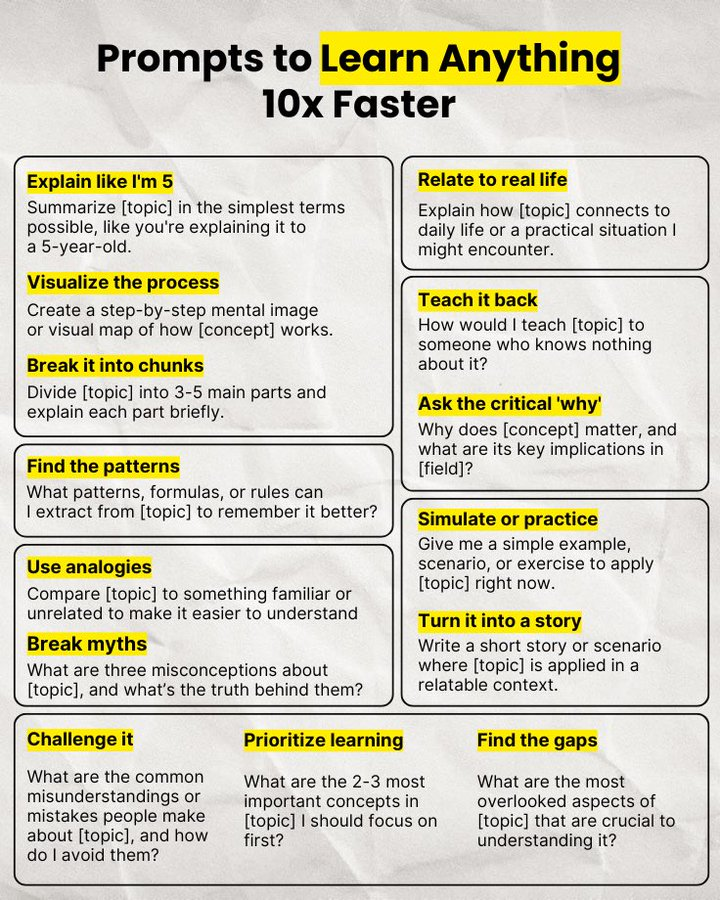
Sharing what you learn: “Prompts to Learn Anything 10X Faster. Comment: Fascinating for me because the statement endorses what I experience a lack of ability to do having sustained brain injury … loss of short term memory, no ability to visualise (Aphantasia), extreme difficulty putting words together (Brocas) so much more. My own method to attempt to recall is find a pre-accident memory and then try to attach current memory to it but it is only an ineffective way of memory

Nelly R Q (@nrqa__) posted at 4:57 am on Fri, Nov 22, 2024:

Prompts to Learn Anything 10X Faster; 

https://t.co/vUCIronLph
(https://x.com/nrqa__/status/1859823535096725539?t=KVYm7Q79vcps8uSm3N4i2g&s=03) 

Posted in Uncategorized | Leave a comment

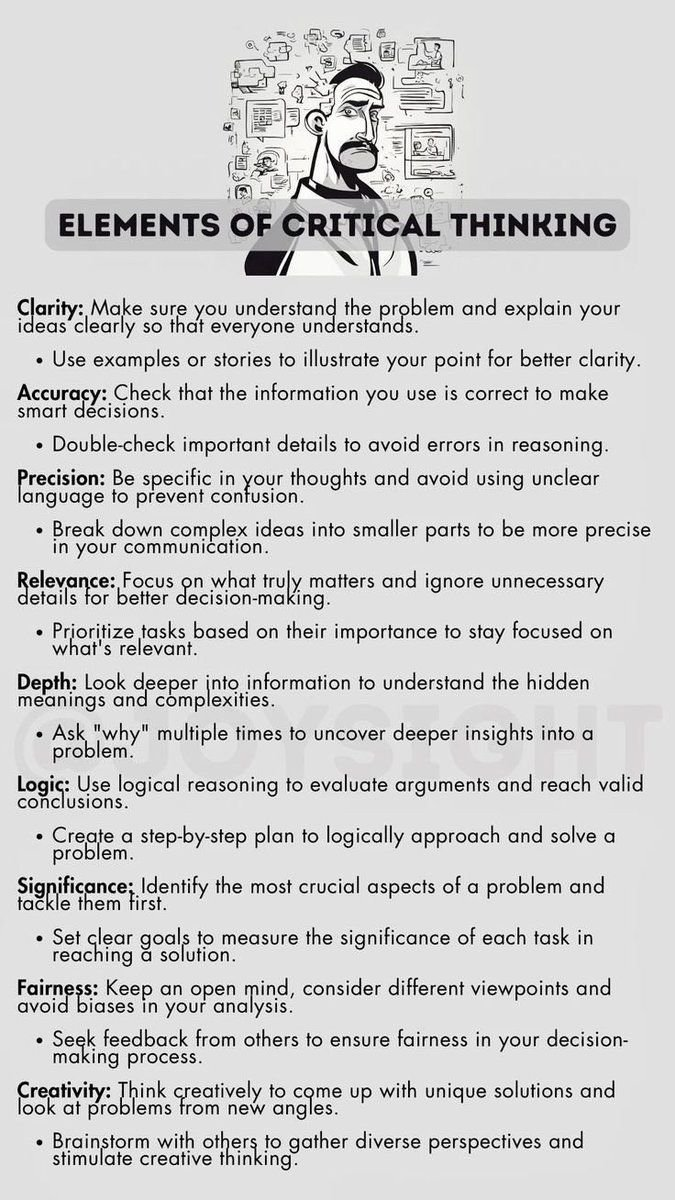
Scholarship for PhD, a person who shares what he is learning. Elements of Critical Thinking

Scholarship for PhD

@ScholarshipfPhd

Elements of Critical Thinking

Posted in Uncategorized | Leave a comment

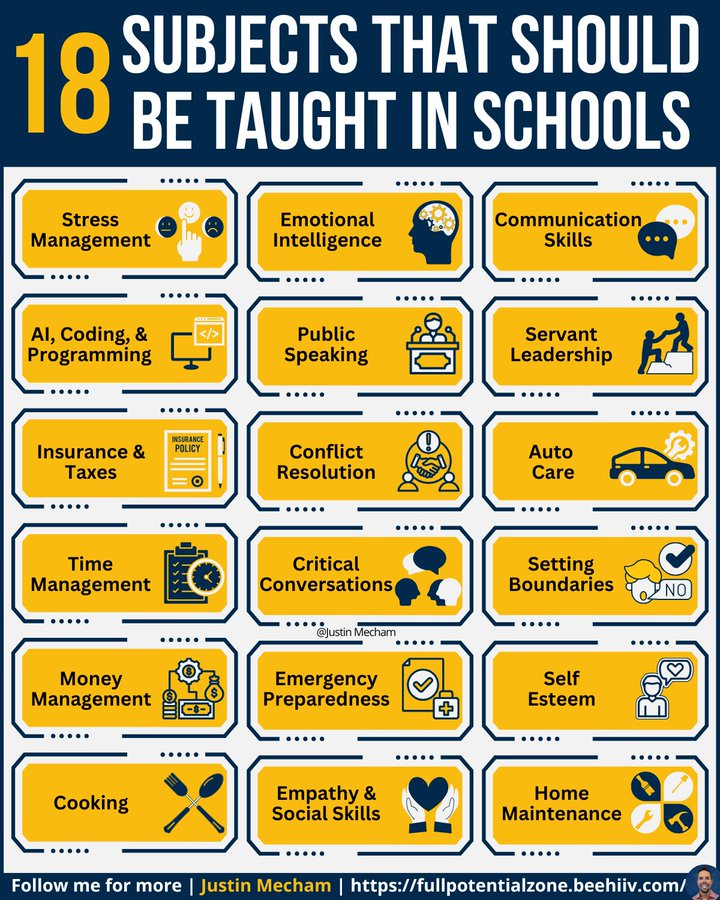
18 SUBJECTS THAT SHOULD BE TAUGHT IN SCHOOLS. “Life skills are the key to a balanced and successful life. By learning them, we empower ourselves.” Justin Mecham, a person who is prepared to share his abilities

Justin Mecham (@thejustinmecham) posted at 1:39 pm on Thu, Nov 21, 2024:

Life skills are the key to a balanced and successful life.

By learning them, we empower ourselves.

Btw, I have a gift for you in my bio link 🙂 

https://t.co/10GHrytcRn
(https://x.com/thejustinmecham/status/1859592488891064794?t=z49JTp9RxxH8WHUWceJZBA&s=03) 

Posted in Uncategorized | Leave a comment

X Dan O’Brien, Economist of significance especially now in Ireland in its own “swamp”. “Irish political parties need to stop raising expectations of endless windfalls + start preparing for the worst.”

Dan O’Brien (@danobrien20) posted at 7:50 pm on Fri, Nov 22, 2024:

This accurately reflects US political opinion.

Irish political parties need to stop raising expectations of endless windfalls + start preparing for the worst.

When something is too good to last, it will eventually come to an end. The end of profit tax windfalls may be nigh.


(https://x.com/danobrien20/status/1860048280174100817?t=RmgrzFfe745Ho28yf9JR-w&s=03) 

Posted in Uncategorized | Leave a comment

Amazon to publish a book and living in Ireland. Has anyone experienced problems selling their books especially since Brexit. I have sold none since Brexit, while sold same before. Someone else told me of their difficulties so I Googled it. Amazon are coming to Ireland so maybe things will change.

Support Us|Sign in

Advertisement

More Stories

Inside Court 24: How Nikita Hand took on Conor McGregor and won

Storm Bert: Severe flooding and 34,000 without power; people urged to avoid unnecessary travel

Jury finds Conor McGregor sexually assaulted a woman in a Dublin hotel in 2018

File image of Amazon Fulfilment Centre in Baldonnel Business Park, Dublin Alamy Stock Photo

Kenny’s Bookshop

‘Swallows up competition’: Galway bookshop ‘fearful’ for sector’s future ahead of Amazon.ie launch

Online retail giant Amazon is set to launch an Irish website and online store in 2025.

3.21pm, 10 May 2024

21.3k

57

 LAST UPDATE | 10 May 2024

A LEADING IRISH bookshop has warned that Amazon will “swallow up the competition” when it launches an Irish website and online store next year.

Amazon made the announcement yesterday and said it will mean faster delivery and return times for customers and do away with additional customs fees and currency conversion charges.

In 2022, Amazon launched a “fulfilment centre” in Dublin, which is a warehouse where incoming orders are received, stored, packed and shipped out to customers.

This sped up delivery times within Ireland.

“We view it as very serious competition,” said Tom Kenny, director of Kenny’s Bookshop in Galway.

While Kenny remarked that “competition is not a bad thing”, he added that Amazon.ie is “certainly going to have a major impact on Irish bookshops”.

GI8GtdXW8AAb4lgFile image of Kenny’s Bookshop in Galway

“Amazon is a behemoth, an absolute monster that kind of swallows up a lot of competition,” Kenny told The Journal.

“Even if you’re working with them, they keep changing the rules as you’re going along.”

‘Fear for the book business’

Yesterday, Minister for Enterprise, Trade and Employment Peter Burke said he was “delighted to see Amazon continuing to grow its presence in Ireland”.

“The launch of an Irish store will provide a significant platform for Irish SMEs to expand their online presence and grow their business,” Burke added.

However, Kenny claimed that “Burke doesn’t seem to know much about small businesses in this country” and voiced concern for those who will join the platform.

“If you’re joining Amazon, you have to work by their rules,” said Kenny, “and they take a big percentage of whatever you sell through them.

“It’s a big platform and it has its uses, we’ve been working with them as well for a very long time, but they keep changing the rules.

“We’ve been working for, and against, Amazon for a long time and we know the kind of power they will have and that’s why I fear for small, independent bookshops in this country.”

As of 2020 in the United States, Amazon controlled more than 50% of the print book market and over 80% of the e-book market.

Kenny also remarked that when Amazon launched as an online book retailer in 1995, there were close to 6,000 independent bookshops in the US, but fewer than 2,000 remain today.

“The figures in the UK are not quite as stark,” said Kenny, “but they’re not good since Amazon’s UK domain was set up.”

‘We’re passionate about books’

Kenny added that places like his are “interested in books” and doubted that Amazon has “any interest in authors or individual titles”.

“We host authors all the time and we had three here yesterday signing their books.

“Books are not just commodities for us, we’re passionate about them.”

Kenny added that he hopes the “patriotic movement” of the pandemic can be maintained amid the launch of Amazon.ie

“When the lockdown came with COVID, a lot of bookshops simply had to close,” said Kenny.

“But a lot of them went online and stayed in business as a result.

“At the same time, there was this huge kind of patriotic movement that we must buy Irish, buy local, we should support our local traders and that worked very much to the advantage of bookshops.

“Competition is not a bad thing, but this is certainly going to have a major impact on Irish bookshops, some of whom live and work on very fine margins a lot of the time.”

‘It’s called the internet’

Kenny’s Bookshop claims to be the first Irish company to set up a website, and the second bookshop in the world to have an online presence.

The website launched in 1994, a year before Amazon made its debut as an online bookseller.

Recalling how they got online so early, Kenny said he was approached by a man who was setting up websites and wanted to start with a Galway business that was “camera friendly and looks decorative”.

“I told him ‘what are you talking about?’ And he replied, ‘it’s called the internet’.”

In a statement to The Journal, an Amazon spokesperson said small and medium-sized businesses account for more than half of all physical product sales on Amazon, which include books.

The spokesperson added: “The launch of a dedicated store in Ireland will provide great opportunities for small and medium sized Irish businesses to reach customers both at home and abroad.

“Over 1,000 small and medium sized Irish businesses already sell on Amazon, and generated over €150 million in export sales in 2022 alone.”

Readers like you are keeping these stories free for everyone…

A mix of advertising and supporting contributions helps keep paywalls away from valuable information like this article. Over 5,000 readers like you have already stepped up and support us with a monthly payment or a once-off donation.

Learn MoreSupport The Journal

Author

Diarmuid Pepper

Posted in Uncategorized | Tagged , , , , | Leave a comment

Neuralink: Yes Mr Elon Musk. Just watch this and share it with anyone who has a neurological brain dysfunction to give them hope that progress is spearheaded by someone who can send satellites to space with the aim of putting a person on Mars. This link is fascinating.

https://twitter.com/i/status/1791208277327438004

Posted in Uncategorized | Leave a comment

Harvard Public Health Magazine: Is bereavement a public health crisis in the U.S.? This advocate thinks so.


Subscribe

Purple, human figures hold hands across the bottom of the illustration. One figure holds a rainbow umbrella over the head of the figure on its right, protecting it from an abstract rain cloud and raindrops. The composition has a patchwork background of orange, green, pink, blue, and green shapes.

 People

Is bereavement a public health crisis in the U.S.? This advocate thinks so.

Joyal Mulheron believes we need more face time (and less screen time) in the wake of death.

Harvard Public Health Magazine

Is bereavement a public health crisis in the U.S.? This advocate thinks so.

Share This

Filed Under

Mental Health

Tagged

Wellness

Written by

Bill Donahue

Published

November 19, 2024

Read Time

4 min

Joyal Mulheron is on a mission to get federal action on bereavement in response to what she calls “an invisible public health crisis.” Her ten-year-old nonprofit, Evermore, advocates for gathering data related to bereavement and establishing a national center for its study. Its website is a repository for information about how to discuss the death of loved ones in different contexts, facts and figures about how such losses affect mortality and health, and scores of conversations with people who’ve lost loved ones. She’s been featured on PBS Newshour and submitted testimony to Congress.

Mulheron’s advocacy comes from her own experiences after losing an infant daughter and, later, her father. She came to believe that in the United States, families and communities are losing the capacity to give bereaved people the support they need. She sees the driving factors as smartphone fixation and the monetization of death, especially through digital innovations like AI-based grief therapy apps. Besides worrying that such apps might widely share sensitive personal data, Mulheron is concerned that “you don’t talk to a counselor—you talk to your phone. I don’t think we should be going down a path where we have less human connection.” Mulheron spoke with Bill Donahue for Harvard Public Health.

This interview was edited and condensed.

Harvard Public Health: One of your interviews is with a woman who, after her son committed suicide, was treated with disrespect by the police. How does this disrespect manifest at a societal level?

Mulheron: Let’s look at how the CDC guidelines tell first responders how to handle a sudden unexpected infant death. Within hours, they ask the family to reenact the death event with a fabric doll, and they photograph everything, often while calling Child Protective Services to talk about taking the family’s other children away. This is largely intended to investigate and prevent infant homicide. But if you look at infant mortality data, infanticide is [rare]. It does happen, but why are we almost assuming that you have murdered your child?

Sign up for Harvard Public Health

Exploring what works, what doesn’t, and why.

Delivered to your inbox weekly.

  • Email addressBy clicking “Subscribe,” you agree to receive email communications from Harvard Public Health.
  • EmailThis field is for validation purposes and should be left unchanged.

HPH: You’ve also talked about the medicalization of grief.

Mulheron: Grief is now, officially speaking, a disease. If, in the wake of a death, you’re deemed maladaptive, you can be diagnosed with something called prolonged grief disorder. That “disease” was added to DSM-5 in 2022, with its own diagnostic code, and there’s a drug for it in clinical trials, Naltrexone. It’s already being used to fight addiction, so now researchers are conducting clinical trials to test if it works on prolonged grief disorder.

More from HPH

 Feature

One man’s recovery is helping other families through the grief of overdose deaths

 Feature

I was alone and sick of it. Technology to the rescue?

 News

Therapy apps are a phenomenon. Or maybe a fad.

HPH: What’s the unifying thread here?

Mulheron: An app, a pill—these things alleviate us from having to knock on someone’s door, from sitting with them, from taking time off our phones and our video games to be with others in community for the collective good of all of us. And when you rely on an app or a pill, it feels scientific. There’s a quantifier at work, so we as a society can say, “How many protocols did we run? How many people got a script for this?” We quantify and tokenize what should be a shared human experience.

HPH: So what are you doing to make life easier for the bereaved?

Mulheron: I’ve begun talking to Capitol Hill staff about the possibility of paid bereavement leave. [Evermore doesn’t] have a lot of money, but in the field we are trying to support weeklong projects focused on helping people who’ve experienced bereavement. We did one in the South Bronx for hip hop therapy and we’re dialoguing [with] another group—this one’s in Seattle—about a project called Pongo Poetry to get people to express their grief through a modality other than [talk therapy]. We’re also working on hosting a national meeting of scientists. We want to understand the demography of bereavement. If we know the shape of the problem, we can begin to fix it.

Image: stellalevi / iStock

Contributors

Bill_Donahue_Headshot_sq

Bill Donahue

Bill Donahue is a New Hampshire-based writer who has written for Outside, Wired, and The New York Times Magazine. Read more from Bill Donahue.

More in Mental Health

Posted in Uncategorized | Leave a comment

Highly recommend: Have followed them for months now. Col. Douglas Macgregor interview in Judging Freedom Podcast Judge Andrew Napolitano 20th November 2024

Posted in Uncategorized | Leave a comment