Want to bookmark your favourite articles and stories to read or reference later? Start your Independent Premium subscription today. Subscribe Already subscribed? Log in
Sign up for the daily Inside Washington email for exclusive US coverage and analysis sent to your inbox
SIGN UPI would like to be emailed about offers, events and updates from The Independent. Read our privacy policy
Senator Mitch McConnell is warning that Donald Trump’s turn towards “America First”-style isolationism is dangerous for the country and the world, and recalls the times before World War II.
“We’re in a very, very dangerous world right now, reminiscent of before World War Two,” the Kentucky Republican told the Financial Times in an interview Tuesday, “Even the slogan is the same: ‘America First.’ That was what they said in the ’30s,” he added.
The senator noted that “the cost of deterrence is considerably less than the cost of war,” and called on Republicans to return to a more internationalist version of American leadership, like that of Ronald Reagan during the Cold War.
“To most American voters, I think the simple answer is, ‘Let’s stay out of it,’” McConnell said. “That was the argument made in the ’30s and that just won’t work. Thanks to Reagan, we know what does work — not just saying peace through strength, but demonstrating it.”
The Independent has contacted the Trump transition team for comment.
McConnell, who announced earlier this year he would step down as Senate Republican leader while serving out the rest of his term, has been increasingly vocal in his criticism of Trump’s foreign policy goals in recent days.
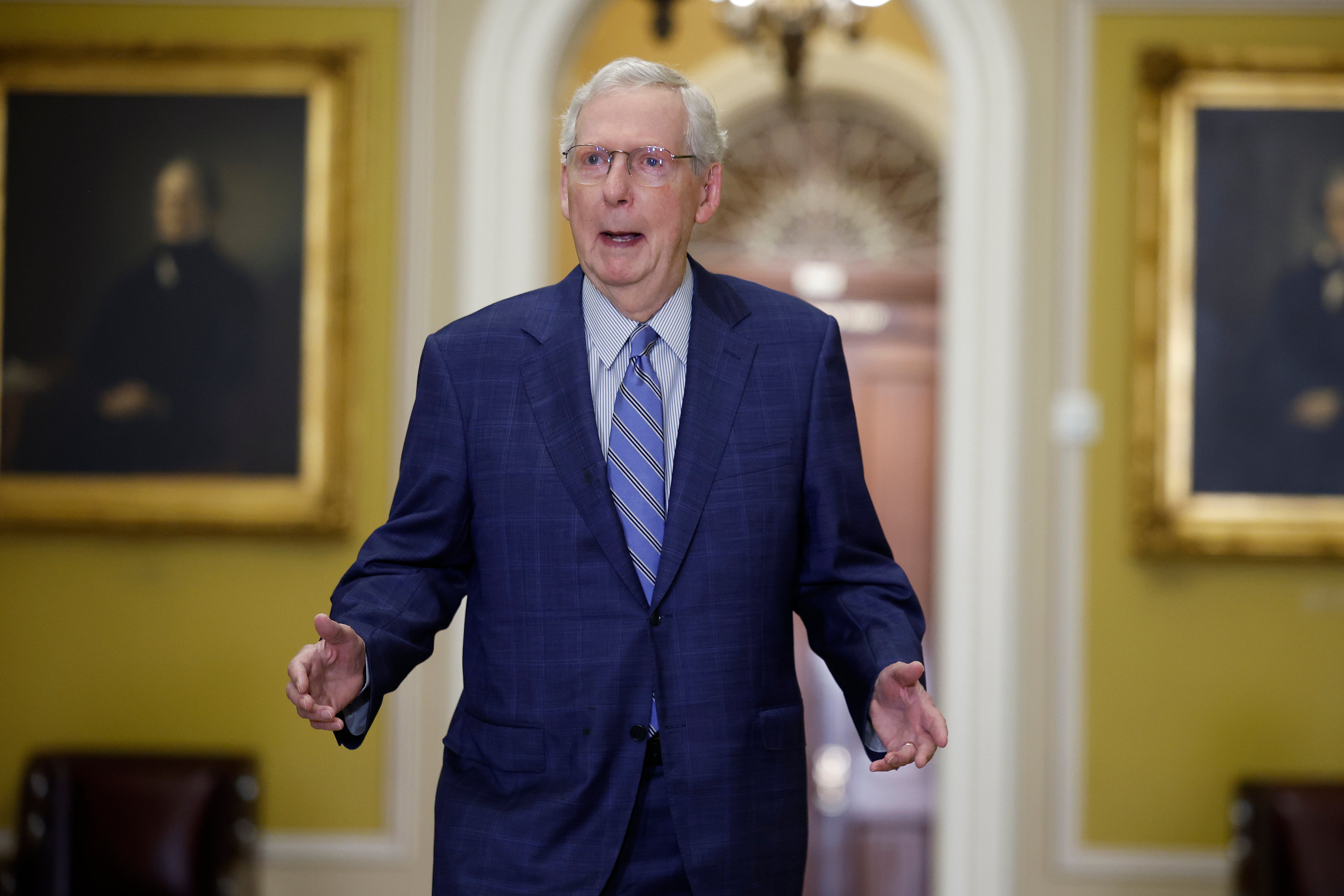
McConnell endorsed Trump in 2024 (Getty Images)
“Within the party Ronald Reagan once led so capably, it is increasingly fashionable to suggest that the sort of global leadership he modeled is no longer America’s place,” McConnell said at the annual Reagan National Defense Forum this month.
“But let’s be absolutely clear: America will not be made great again by those who are content to manage our decline,” he added, referencing Trump’s campaign slogan of Make America Great Again.
McConnell also claimed in a recently published biography that the MAGA movement “is completely wrong,” and Donald Trump has “done a lot of damage” to the Republican Party.
After the January 6, 2021 insurrection, the Kentucky senator called Trump’s actions a “disgraceful dereliction of duty,” though he did not vote to impeach his fellow Republican, and later endorsed him in the 2024 election.
Summary: A recent study explores how connections across the entire brain predict human intelligence, moving beyond traditional focus on specific brain areas like the prefrontal cortex. Using fMRI data from over 800 individuals, researchers analyzed communication between brain regions to predict fluid, crystallized, and general intelligence scores.
Findings reveal that distributed brain-wide connections play a crucial role, surpassing existing models that emphasize localized regions. This research highlights intelligence as a global property of the brain, offering fresh perspectives for understanding cognitive processes.
Key Facts:
Global Brain Property: Intelligence is influenced by connections distributed across the whole brain, not just specific regions.
Predictive Intelligence Types: General intelligence was predicted best, followed by crystallized and fluid intelligence.
Enhanced Models: Adding complementary connections to existing theories improved predictions, showing unexplored aspects of intelligence.
The human brain is the central control organ of our body. It processes sensory information and enables us, among other things, to form thoughts, make decisions and store knowledge. With how much our brain is capable of, it seems almost paradoxical how little we still know about it.
Jonas Thiele and Dr. Kirsten Hilger, head of the “Networks of Behavior and Cognition” research group at the Department of Psychology I at Julius-Maximilians-Universität Würzburg (JMU), are among those who are on the trail of the most complex and complicated organ.
Their latest study was recently published in the scientific journal PNAS Nexus.
Predicting Intelligence from Brain Connections
The researchers used data sets from a large-scale data sharing project based in the US: the Human Connectome Project. With the help of fMRI – an imaging method that measures changes in brain activity – over 800 people were examined. Both at rest and while they performed various tasks.
The Würzburg-led team looked at various connections that map the communication strength between different brain regions and made predictions about individual intelligence scores based on these observations.
“Many studies predicting intelligence from brain connections have been published in the last years and they also achieve quite good predictive performance,” says Kirsten Hilger. However, the neuroscientists question their deeper meaning, as the predictions would never be as accurate as the results of an intelligence test.
“We therefore intended to move away from the pure prediction of intelligence scores and instead better understand the fundamental processes in the brain. We hope that this will give us a better understanding of the neural code of individual differences in intelligence.”
Kirsten Hilger hopes that colleagues will follow her example and that more studies will be designed in the future aiming at improving the conceptual understanding of human cognition with a focus on interpretability.
Three Types of Intelligence
The team distinguished three types of intelligence in their predictions: Fluid intelligence refers to the ability to solve logical problems, recognize patterns and process new information, independent of existing knowledge or learned skills.
Crystallized intelligence encompasses the knowledge and skills that a person acquires over the course of their life. This includes general knowledge, experience and understanding of language and concepts. It arises through education and experience.
Various theoretical considerations determined which different connections in the brain were examined. Credit: Neuroscience News
Together, these two forms make up general intelligence. The best predictive performance was achieved with general intelligence, followed by crystallized and fluid intelligence.
Brain-wide Connections Best Predict Intelligence
Various theoretical considerations determined which different connections in the brain were examined.In addition, randomly selected connections were also tested.One crucial observation: the distribution of connections across the entire brain as well as the pure number of connections were most important for predictive performance, more important than between which exact brain regions the individual connections were located.
“The interchangeability of the selected connections suggests that intelligence is a global property of the whole brain. We were able to predict intelligence not just from a specific set of brain connections, but from different combinations of connections distributed throughout the brain,” says Hilger.
Results Outperform Established Theories
While established theories of intelligence often focus on specific areas of the brain – such as the prefrontal cortex – the results of the study suggest that connections between additional brain regions are important for intelligence.
“The connections of brain regions proposed in the most popular neurocognitive models of intelligence produced better results than randomly selected connections. However, the results were even better when complementary connections were added,” reports Kirsten Hilger.
Overall, this suggests that there are even more aspects of intelligence than previously assumed that are waiting to be understood in future.
About this intelligence and neuroscience research news
Here’s a novel idea that DOGE is bringing to D.C.: read the law. Not an agency rule, or a bureaucrat’s summary of the law, or the media’s distillation of it, but the actual *statute* itself. I’m hearing “experts” say all kinds of things we can or can’t do, when it usually turns out they’ve actually never read the statutes themselves (and exhibit shockingly little interest in doing so).
Study suggests how the brain, with sleep, learns meaningful maps of spaces
Place cells are well known to encode individual locations, but new experiments and analysis indicate that stitching together a “cognitive map” of a whole environment requires a broader ensemble of cells, aided by sleep, to build a richer network over several days.
On the first day of your vacation in a new city your explorations expose you to innumerable individual places. While the memories of these spots (like a beautiful garden on a quiet side street) feel immediately indelible, it might be days before you have enough intuition about the neighborhood to direct a newer tourist to that same site and then maybe to the café you discovered nearby. A new study in mice by MIT neuroscientists at The Picower Insitute for Learning and Memory provides new evidence for how the brain forms cohesive cognitive maps of whole spaces and highlights the critical importance of sleep for the process.
Scientists have known for decades that the brain devotes neurons in a region called the hippocampus to remembering specific locations. So-called “place cells” reliably activate when an animal is at the location the neuron is tuned to remember. But more useful than having markers of specific spaces is having a mental model of how they all relate in a continuous overall geography. Though such “cognitive maps” were formally theorized in 1948, neuroscientists have remained unsure of how the brain constructs them. The new study in the December edition of Cell Reports finds that the capability may depend upon subtle but meaningful changes over days in the activity of cells that are only weakly attuned to individual locations, but that increase the robustness and refinement of the hippocampus’s encoding of the whole space. With sleep, the study’s analyses indicate, these “weakly spatial” cells increasingly enrich neural network activity in the hippocampus to link together these places into a cognitive map.
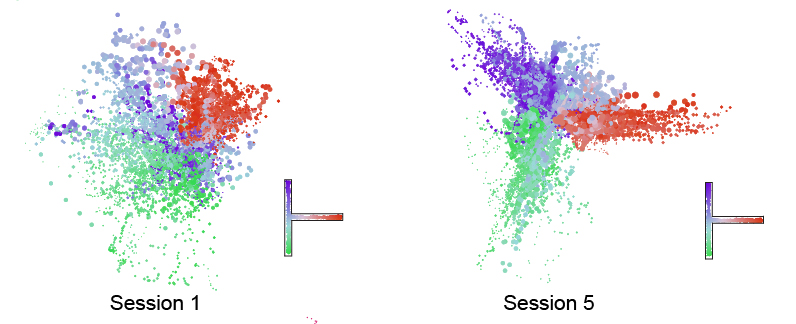
“On day 1, the brain doesn’t represent the space very well,” said lead author Wei Guo, a research scientist in the lab of senior author Matthew Wilson, Sherman Fairchild Professor in The Picower Institute and MIT’s Departments of Biology and Brain and Cognitive Sciences. “Neurons represent individual locations, but together they don’t form a map. But on day 5 they form a map. If you want a map, you need all these neurons to work together in a coordinated ensemble.”
Mice mapping mazes
To conduct the study, Guo and Wilson along with labmates Jie “Jack” Zhang and Jonathan Newman introduced mice to simple mazes of varying shapes and let them explore them freely for about half an hour a day for several days. Importantly, the mice were not directed to learn anything specific through the offer of any rewards. They just wandered. Previous studies have shown that mice naturally demonstrate “latent learning” of spaces from this kind of unrewarded experience after several days.
To understand how latent learning takes hold, Guo and his colleagues visually monitored hundreds of neurons in the CA1 area of the hippocampus by engineering cells to flash when a buildup of calcium ions made them electrically active.They not only recorded the neurons’ flashes when the mice were actively exploring, but also while they were sleeping. Wilson’s lab has shown that animals “replay” their previous journeys during sleep, essentially refining their memories by dreaming about their experiences.
Analysis of the recordings showed that the activity of the place cells developed immediately and remained strong and unchanged over several days of exploration. But this activity alone wouldn’t explain how latent learning or a cognitive map evolves over several days. So unlike in many other studies where scientists focus solely on the strong and clear activity of place cells, Guo extended his analysis to the more subtle and mysterious activity of cells that were not so strongly spatially tuned. Using an emerging technique called “manifold learning” he was able to discern that many of the “weakly spatial” cells gradually correlated their activity not with locations, but with activity patterns among other neurons in the network. As this was happening, Guo’s analyses showed, the network encoded a cognitive map of the maze that increasingly resembled the literal, physical space.
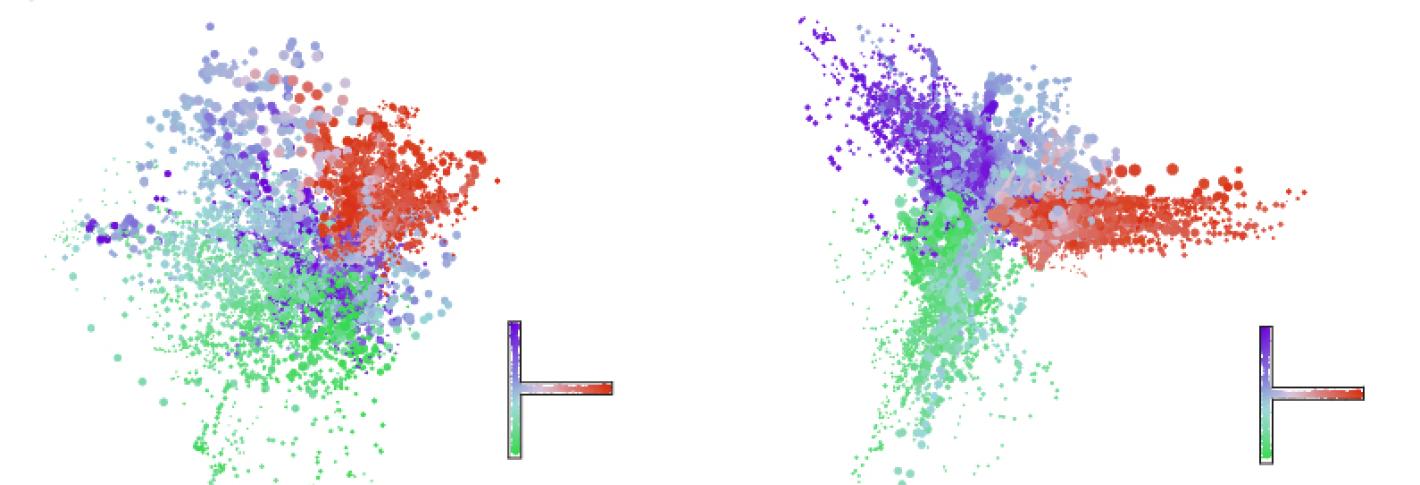
An edited panel from a figure in the paper shows how neural representations of a cognitive map of a sideways T-shaped maze evolved over five sessions. Each dot is a point in time and each color corresponds to a location in the actual maze (see smaller T’s). Over time the cognitive map better resembles the actual maze geometry.
“Although not responding to specific locations like strongly spatial cells, weakly spatial cells specialize in responding to ‘‘mental locations,’’ i.e., specific ensemble firing patterns of other cells,” the study authors wrote. “If a weakly spatial cell’s mental field encompasses two subsets of strongly spatial cells that encode distinct locations, this weakly spatial cell can serve as a bridge between these locations.”
In other words, the activity of the weakly spatial cells likely stitches together the individual locations represented by the place cells into a mental map.
The need for sleep
Studies by Wilson’s lab and many others have shown that memories are consolidated, refined and processed by neural activity, such as replay, that occurs during sleep and rest. Guo and Wilson’s team therefore sought to test whether sleep was necessary for the contribution of weakly spatial cells to latent learning of cognitive maps.
To do this they let some mice explore a new maze twice during the same day with a three-hour siesta in between. Some of the mice were allowed to sleep but some were not. The ones that did showed a significant refinement of their mental map, but the ones that weren’t allowed to sleep showed no such improvement.Not only did the network encoding of the map improve, but also measures of the tuning of individual cells during showed that sleep helped cells become better attuned both to places and to patterns of network activity, so called “mental places” or “fields.”
Mental map meaning
The “cognitive maps” the mice encoded over several days were not literal, precise maps of the mazes, Guo notes. Instead they were more like schematics. Their value is that they provide the brain with a topology that can be explored mentally, without having to be in the physical space. For instance, once you’ve formed your cognitive map of the neighborhood around your hotel, you can plan the next morning’s excursion (e.g. you could imagine grabbing a croissant at the bakery you observed a few blocks west and then picture eating it on one of those benches you noticed in the park along the river).
Indeed, Wilson hypothesized that the weakly spatial cells’ activity may be overlaying salient non-spatial information that brings additional meaning to the maps (i.e. the idea of a bakery is not spatial, even if it’s closely linked to a specific location). The study, however, included no landmarks within the mazes and did not test any specific behaviors among the mice. But now that the study has identified that weakly spatial cells contribute meaningfully to mapping, Wilson said future studies can investigate what kind of information they may be incorporating into the animals’ sense of their environments.We seem to intuitively regard the spaces we inhabit as more than just sets of discrete locations.
“In this study we focused on animals behaving naturally and demonstrated that during freely exploratory behavior and subsequent sleep, in the absence of reinforcement, substantial neural plastic changes at the ensemble level still occur,” the authors concluded. “This form of implicit and unsupervised learning constitutes a crucial facet of human learning and intelligence, warranting further in-depth investigations.”
The Freedom Together Foundation, The Picower Institute for Learning and Memory and the National Institutes of Health funded the study.
Financial Times (@FT) posted at 8:30 pm on Wed, Dec 11, 2024:
A pivotal politician in a tumultuous time, McConnell earned power and used it to shift the country to the right during his 17-year tenure. At the age of 82, he is ‘ready to do something else’
Joe Brolly (@JoeBrolly1993) posted at 4:34 pm on Tue, Dec 10, 2024:
Shocking that this seat was won from Chris Andrews, a lifelong community activist & courageous supporter of the Palestinian people. Turns out Mr Hayes profited to the tune of almost a quarter of a million euros from the Israeli death machine.
Mark Henry (@Mark_J_Henry) posted at 7:51 am on Tue, Dec 10, 2024:
Ireland is the world’s 3rd largest exporter of digital services. Companies here exported $328bn to the rest of the world last year – only the USA and UK exported more. Ireland benefits as the European HQ of many multinational companies, of course.