Harvard Public Health Magazine: Health care AI, intended to save money, turns out to require a lot of expensive humans

Abstract blue technology photo illustration with binary code, US dollars and a stethoscope

 Feature

Health care AI, intended to save money, turns out to require a lot of expensive humans

You need people, and more machines, to make sure the new tools don’t mess up.

Harvard Public Health Magazine

Health care AI, intended to save money, turns out to require a lot of expensive humans

Share This

Filed Under

Tech & Innovation

Tagged

Management

Written by

Darius Tahir

Published

January 14, 2025

Read Time

6 min

This article was originally published by KFF Health News.

Preparing cancer patients for difficult decisions is an oncologist’s job. They don’t always remember to do it, however. At the University of Pennsylvania Health System, doctors are nudged to talk about a patient’s treatment and end-of-life preferences by an artificially intelligent algorithm that predicts the chances of death.

But it’s far from being a set-it-and-forget-it tool. A routine tech checkup revealed the algorithm decayed during the COVID-19 pandemic, getting 7 percentage points worse at predicting who would die, according to a 2022 study.

There were likely real-life impacts. Ravi Parikh, an Emory University oncologist who was the study’s lead author, told KFF Health News the tool failed hundreds of times to prompt doctors to initiate that important discussion—possibly heading off unnecessary chemotherapy—with patients who needed it.

He believes several algorithms designed to enhance medical care weakened during the pandemic, not just the one at Penn Medicine. “Many institutions are not routinely monitoring the performance” of their products, Parikh said.

Sign up for Harvard Public Health

Exploring what works, what doesn’t, and why.

Delivered to your inbox weekly.

  • Email addressBy clicking “Subscribe,” you agree to receive email communications from Harvard Public Health.
  • PhoneThis field is for validation purposes and should be left unchanged.

Algorithm glitches are one facet of a dilemma that computer scientists and doctors have long acknowledged but that is starting to puzzle hospital executives and researchers: Artificial intelligence systems require consistent monitoring and staffing to put in place and to keep them working well.

In essence: You need people, and more machines, to make sure the new tools don’t mess up.

“Everybody thinks that AI will help us with our access and capacity and improve care and so on,” said Nigam Shah, chief data scientist at Stanford Health Care. “All of that is nice and good, but if it increases the cost of care by 20 percent, is that viable?”

Government officials worry hospitals lack the resources to put these technologies through their paces. “I have looked far and wide,” FDA Commissioner Robert Califf said at a recent agency panel on AI. “I do not believe there’s a single health system, in the United States, that’s capable of validating an AI algorithm that’s put into place in a clinical care system.”

“There is no standard right now for comparing the output of these tools.”Jesse Ehrenfeld, immediate past president of the American Medical Association

AI is already widespread in health care. Algorithms are used to predict patients’ risk of death or deterioration, to suggest diagnoses or triage patients, to record and summarize visits to save doctors work, and to approve insurance claims.

If tech evangelists are right, the technology will become ubiquitous—and profitable. The investment firm Bessemer Venture Partners has identified some 20 health-focused AI startups on track to make $10 million in revenue each in a year. The FDA has approved nearly a thousand artificially intelligent products.

Evaluating whether these products work is challenging. Evaluating whether they continue to work—or have developed the software equivalent of a blown gasket or leaky engine—is even trickier.

Take a recent study at Yale Medicine evaluating six “early warning systems,” which alert clinicians when patients are likely to deteriorate rapidly. A supercomputer ran the data for several days, said Dana Edelson, a doctor at the University of Chicago and co-founder of a company that provided one algorithm for the study. The process was fruitful, showing huge differences in performance among the six products.

It’s not easy for hospitals and providers to select the best algorithms for their needs. The average doctor doesn’t have a supercomputer sitting around, and there is no Consumer Reports for AI.

“We have no standards,” said Jesse Ehrenfeld, immediate past president of the American Medical Association. “There is nothing I can point you to today that is a standard around how you evaluate, monitor, look at the performance of a model of an algorithm, AI-enabled or not, when it’s deployed.”

Perhaps the most common AI product in doctors’ offices is called ambient documentation, a tech-enabled assistant that listens to and summarizes patient visits. Last year, investors at Rock Health tracked $353 million flowing into these documentation companies. But, Ehrenfeld said, “There is no standard right now for comparing the output of these tools.”

And that’s a problem, when even small errors can be devastating. A team at Stanford University tried using large language models—the technology underlying popular AI tools like ChatGPT—to summarize patients’ medical history. They compared the results with what a physician would write.

“Even in the best case, the models had a 35 percent error rate,” said Stanford’s Shah. In medicine, “when you’re writing a summary and you forget one word, like ‘fever’—I mean, that’s a problem, right?”

More from HPH

 Ideas

Three ways AI is improving public health

 Ideas

AI is already tracking the next pandemic

 Ideas

As AI-based eye exams prove their worth, lessons for future tech emerge

Sometimes the reasons algorithms fail are fairly logical. For example, changes to underlying data can erode their effectiveness, like when hospitals switch lab providers.

Sometimes, however, the pitfalls yawn open for no apparent reason.

Sandy Aronson, a tech executive at Mass General Brigham’s personalized medicine program in Boston, said that when his team tested one application meant to help genetic counselors locate relevant literature about DNA variants, the product suffered “nondeterminism”—that is, when asked the same question multiple times in a short period, it gave different results.

Aronson is excited about the potential for large language models to summarize knowledge for overburdened genetic counselors, but “the technology needs to improve.”

If metrics and standards are sparse and errors can crop up for strange reasons, what are institutions to do? Invest lots of resources. At Stanford, Shah said, it took eight to 10 months and 115 man-hours just to audit two models for fairness and reliability.

Experts interviewed by KFF Health News floated the idea of artificial intelligence monitoring artificial intelligence, with some (human) data whiz monitoring both. All acknowledged that would require organizations to spend even more money—a tough ask given the realities of hospital budgets and the limited supply of AI tech specialists.

“It’s great to have a vision where we’re melting icebergs in order to have a model monitoring their model,” Shah said. “But is that really what I wanted? How many more people are we going to need?”

Image: Viorika / iStock

Contributors

DT

Darius Tahir

Darius Tahir is based in Washington, D.C. He reports on health technology.

More in Tech & Innovation

Posted in Uncategorized | Tagged , , , , | Leave a comment

Thomas Sowell: Being informed as a voter and realising the game and benefits the politicians engage in.

Posted in Uncategorized | Leave a comment

Greenland – I’m Danish. I’m strongly in favour of striking a deal with Trump regarding Greenland. Today, the state of Greenland is a mess economically and sociologically. Here’s the big lines of why a deal with the United States is a win-win-win

Ulrik K. Lykke

@ulriklykke

I’m Danish. I’m strongly in favour of striking a deal with Trump regarding Greenland. Today, the state of Greenland is a mess economically and sociologically. Here’s the big lines of why a deal with the United States is a win-win-win

:

Posted in Uncategorized | Leave a comment

Quora: If an IQ of 130 is so common (1 in 50), why do people treat it as super special? Comment: How do people with high IQ’s with people who sustain TBI, have amnesia, aphasia, partially deaf, no smell, vision problems or for that matter people who have strokes.

David Gardner · 

Follow

Works at U.S. Department of Defense Sep 14

If an IQ of 130 is so common (1 in 50), why do people treat it as super special?

Because 98% of the population has a lower IQ. A lot of people will say that these people are able to act as a bridge between true genius and the average person because truly intelligent people can’t communicate with average people. But I will tell you, coming from an IQ of 172, that it’s not a communication problem. It’s a frustration problem. Believe it or not, we have difficulty understanding why you don’t understand things that seem simple to us.

In addition, IQ tests can be deceptive. For example, a person with an idedic memory remembers almost everything. They may seem incredibly intelligent but do they comprehend what they see? Or is it just a parlor trick. The better tests, though not flawless, are those that test your ability to solve a problem as fast as you can. The faster you solve the problem, supposedly the smarter you are.

People with high IQ’s can typically learn anything quickly and be good at any field they apply themselves to. For example, i have 7 degrees including computer and math science, psychology, aerospace engineering, astrophysics, astronomy, and mechanical engineering. I also went to law school and passed the bar just because I had to go through a divorce and custody court. However, I wouldn’t use a field to define someone as intelligent. You could be a rocket scientist or physicist with an IQ barely above average. You just need to persistently take the classes until you pass them all. I once met a physicist with their doctorate that had an IQ of 107.

It’s also not a marker of success. High IQ people read everything. Learn everything. Everything moves too slowly. Everyone does things too slowly. So you get bored. Distracted. It’s hard to stay focused. I’ve met true geniuses that don’t comprehend basic common sense.

I would argue that truly intelligent people not only have rapid comprehension and problem solving skills but are also more aware of their surroundings. They tend to have high EQ as well. They can more easily put themselves in someone else’s shoes and understand how they might feel and why they think and feel the way they do. They’re not just aware of themselves and what they want at that moment.

The mean IQ is 98. That means that half the population is at, and mostly, below that. Chimps have IQ’s from about 70-90. That means that half the population has the intelligence of a chimp or is barely above. Not to sound superior but these people vote and likely have no idea of what they’re voting for. That’s why free money giveaways that never actually happen get so many votes and so many people fall for it.

The biggest takeaway is that it’s isolating and difficult living in a world where you can never truly communicate with someone on your level. The phrase “ignorance is bliss” is something we can never obtain. So feel lucky if you’re not high IQ. Your mind isn’t racing everyday thinking through multiple problems that you can easily provide solutions to but will never have the opportunity to use. Nobody becomes glassy eyed while having a conversation with you.

562.4K views

View 775 upvotes

View 6 shares

Posted in Uncategorized | Tagged , , , , | Leave a comment

Matt Goodwin & Ayaan Hirsi Ali EXPOSE Britain’s Rape Gang CRISIS

Matt Goodwin

34,594 views Premiered 19 hours ago #MattGoodwin#AyaanHirsiAli#RapeGangs

In this powerful discussion, Ayaan Hirsi Ali and I delve into the cultural roots of Britain’s ongoing rape gang crisis. Drawing from her book Prey, Ayaan unpacks the misogynistic and segregated mindsets prevalent in certain communities that have enabled these horrific crimes. Together, we explore why the Labour government refuses a national inquiry and why silence reigns in the face of overwhelming evidence. This is a must-watch for anyone seeking truth and justice in Britain today.

Posted in Uncategorized | Leave a comment

Novara Media: Steve Bannon Calls Elon Musk A Racist

13th January 2025

Posted in Uncategorized | Leave a comment

60 Minutes: FBI Director Christopher Wray: (to stand down ahead of 3 years term…)

Posted in Uncategorized | Leave a comment

Professor Richard D. Wolff. “BE CAREFUL! This Is Serious…. Last Warning. “Tell your family to prepare…”

Posted in Uncategorized | Leave a comment

Bulletin of the Atomic Scientists: Spreading like wildfire: How Trump’s misinformation about water and fire in Los Angeles inflames the situation

The authoritative guide to ensuring science and technology make life on Earth better, not worse.

Watch the 2025 Doomsday Clock announcement on January 28

Spreading like wildfire: How Trump’s misinformation about water and fire in Los Angeles inflames the situation

By Peter Gleick | January 9, 2025

two firefighters spraying burning buildings with hoses with a destroyed building in flames in the backgroundFighting the Palisades Fire in Los Angeles, California. (Photo: Cal Fire)Share

As devastating wildfires sweep over parts of southern California, it is vital that media, the public, and our policymakers understand what’s happening and how to best respond. The first and most important need is to ensure that local communities have accurate, real-time information about the risks they face, and that emergency responders have the resources they need. In the coming months and years, however, it will be critical to improve our understanding of these risks and how they are changing with accelerating climate change and with changing population and development patterns, and to improve our ability to manage worsening disasters.

What’s not helpful are inaccurate statements from politicians. But that’s what Donald Trump offered up when he posted a statement on TruthSocial falsely laying the blame for the fires and for firefighting problems on democratic governor Gavin Newsom and state water policies.

The first thing to understand is that reported problems with water supply for firefighters are the direct result of the massive demands for fire-fighting water, the destruction of pipes and pumps by the fires, and homeowners leaving hoses and sprinklers running to try to protect their property. All of these demands overwhelmed the water-supply infrastructure, causing some water tanks and hydrants to lose pressure or dry up. They have nothing to do with the overall availability of water to southern California and nothing to do with the state’s efforts to protect endangered and threatened fish and ecosystems.

For more than a century, Californians have argued over how to allocate the state’s water among farmers, industry, cities, and homeowners, and how to reverse longstanding policies that simply take more and more water away from the environment. Only in recent years have efforts been made to try to protect the state’s remaining endangered and threatened aquatic ecosystems and to restore a modicum of water for them. Disputes over these policies will continue, but no state policies have led to water shortages for southern California cities or had any effect on firefighting resources.

RELATED:

‘We’re not going fast enough’: Sherri Goodman on climate change as security threat

Indeed, there is no water-supply shortage in the region right now. California reservoirs, including major southern California reservoirs, have far more water than average for this time of year. And most of the water for Los Angeles doesn’t come from the Central Valley water systems Trump is referring to, but from local sources, the Colorado River, and the Owens Valley aqueduct.

Trump’s attempt to score political points with inaccurate statements about California water policy and wildfires is unhelpful, to say the least. Using this disaster as an excuse to pressure a roll-back of environmental protections is dangerous and counterproductive.

Of course, Trump is also ignoring another key factor at play here: climate change. Scientists are increasingly improving our understanding of the links between climate change and wildfires. The fires we’re now seeing in southern California are unprecedented in timing, scope, and intensity, and they are certainly influenced by accelerating human-caused climate change. The region is experiencing some of the driest conditions on record for early January, three months into what should be California’s rainy season. Los Angeles and the region have received almost no rain for 10 months (see figure). Soils and vegetation are suffering bone dry conditions because higher temperatures are driving increased evaporation. And extraordinarily strong Santa Ana winds approaching 100 mph are spreading fires with uncontrollable speed.

Water year-to-date Precipitation for California, from http://www.cnrfc.noaa.gov. Created January 8, 2025

If leaders really wanted to be helpful in dealing with disasters like fires, hurricanes, droughts, floods, and other extreme climate-related events, the best thing they could do would be to stop spreading misinformation, to acknowledge the reality of climate change, to expand federal investments in understanding and preparing for disasters, to accelerate efforts to slow the rate of climate change, and to provide adequate disaster response resources for devastated communities. Let’s prioritize science over politics.

Posted in Uncategorized | Tagged , , , , | Leave a comment

Fast Company: Quote: The national office vacancy rate has hit a new record high, according to the commercial real estate advisory firm Moody’s. But for a variety of reasons, the tide may soon begin to turn. Comment: Ireland needs to stand on the shoulders of giants and act accordingly, otherwise it will be similar to the 1980’s with offices empty and investment funds and pension funds in the doldrums

01-13-2025 DESIGN

Offices are still sitting empty, but that’s about to change

Return-to-office mandates may be only part of the reason offices are repopulating.Offices are still sitting empty, but that’s about to change

[Source Photo: Thomas Barwick/Getty Images]

BY Nate Berg3 minute read

The national office vacancy rate has hit a new record high, according to the commercial real estate advisory firm Moody’s. But for a variety of reasons, the tide may soon begin to turn.

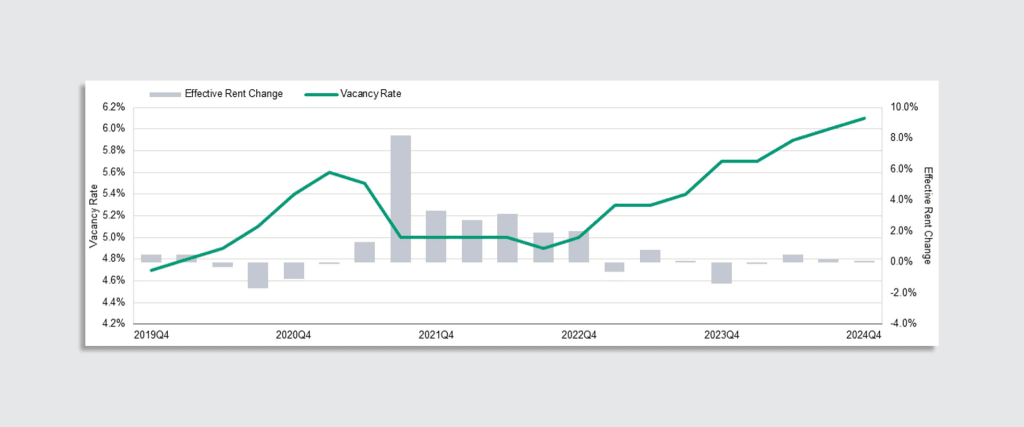
Moody’s year-end report shows that office vacancy reached 20.4% as of the fourth quarter of 2024, 3.6% higher than it was five years ago. That was before the pandemic, and much has changed for office real estate since then, with hybrid work becoming commonplace and companies adjusting their lease terms and office square footage to accommodate uncertainty and lower demand. This new record vacancy rate is a reflection of just how long-lasting the impacts of the pandemic have been on offices.

But the emptying of the American office may soon come to an end. “Over the course of this next year, we’re probably expecting it to eventually bottom out,” says Nick Luettke, associate economist at Moody’s and a coauthor of the year-end report.

[Image: Moody’s]

Part of the reason is that more companies are once again requiring their workers to come into the office regularly, whether three, four, or five days a week.

Design Newsletter logo

Subscribe to the Design newsletter.The latest innovations in design brought to you every weekday

SIGN UP

Privacy Policy

|Fast Company Newsletters

Another reason vacancy rates may go down is that we’re now five years past the onset of the pandemic, and five years is a common lease term used in office real estate. Large offices that were leased for five years in 2019 only to go nearly empty in early 2020 are now able to have their leases renegotiated or simply not renewed. Any company that found itself with way more space than it needed in the era of hybrid work can simply downsize, saving money and bringing down the overall vacancy rate.

The other side of that coin is that some companies are finding the office space reductions put in place during the pandemic are now causing issues with workplace capacity. “Early on, there was an expectation that firms might look to permanently reduce their foot space in terms of splitting what days are in-office,” Luettke says. “Instead, we’ve seen, even for a lot of hybrid models, there’s bottlenecking effects on those Tuesdays, Wednesdays, and Thursdays. And so that that prevents demand from reducing beyond a certain point.”

During the pandemic many companies reconfigured their spaces for hybrid work, luring workers back to the office by redesigning spaces, providing amenities, or simply moving to newer, nicer buildings. “There’s definitely a flight to quality in terms of the newest construction,” Luettke says. These offices—including one designed for Moody’s—tend to emphasize collaboration over rooms full of individual workstations, meaning they have lower capacities than the typical offices of the recent past. As more companies create or move into these kinds of offices, vacancy will continue to drop.

Counterintuitively, given the vast amount of empty offices around the country, there may also be a shortage of supply—at least of the kind of offices people actually want to move their companies into. Moody’s report shows that construction of new offices was still below pre-pandemic levels in 2024, at just 17.5 million square feet. It’s a trend that’s expected to continue. “Interest rates are going to remain elevated for the next year or two, so that’s going to dampen the construction market,” Luettke says.

It’s difficult to predict exactly when the office vacancy rate will reverse its climb, but record high vacancy rates could be disappearing soon. However, the state of office real estate is likely forever changed, and few expect it to fully recover to what it was in 2019. “Even after we bottom out and have some recovery, in the upcoming years, we’re not expecting to return to pre-pandemic vacancy rates,” Luettke says. That’s looking like it’s very likely out of the question.”


ABOUT THE AUTHOR

Nate Berg is a staff writer at Fast Company, where he writes about design, architecture, urban development, and industrial design. He has written for publications including the New York Times, the Los Angeles Times, the Atlantic, Wired, the Guardian, Dwell, Wallpaper, and Curbed More


Explore Topics

advertisement

Featured Video

of metal screws and string found inside them,

0 of 2 minutes, 34 secondsVolume 0%

Trader Joe’s exposed: The real story behind the quirky grocer

advertisement

advertisement

Posted in Uncategorized | Tagged , , , , | Leave a comment