Neuroscience News.com: How the Brain Uses Place Cells to Anchor Episodic Memories

Neuroscience News Logo

How the Brain Uses Place Cells to Anchor Episodic Memories

FeaturedNeuroscience

·January 15, 2025

Summary: Researchers have developed a model explaining how place cells in the hippocampus anchor both spatial and episodic memories. Grid cells in the entorhinal cortex interact with hippocampal cells to create a scaffold, linking memories to specific neural patterns.

This model mirrors biological memory systems, addressing phenomena like gradual memory degradation and the memorization technique of memory palaces. Unlike older models, it avoids a “memory cliff,” where adding new memories erases old ones, and instead allows for sequential and flexible recall. It bridges decades of research on hippocampal circuits, offering insights into how spatial and episodic memories coexist.

Key Facts:

  • Memory Mechanism: Place and grid cells form a scaffold linking spatial and episodic memories.
  • Memory Accuracy: The model explains gradual memory decay and sequential recall, avoiding “memory cliffs.”
  • Memory Palaces: It mirrors how associating memories with spatial environments strengthens recall.

Source: MIT

Nearly 50 years ago, neuroscientists discovered cells within the brain’s hippocampus that store memories of specific locations. These cells also play an important role in storing memories of events, known as episodic memories.

While the mechanism of how place cells encode spatial memory has been well-characterized, it has remained a puzzle how they encode episodic memories.
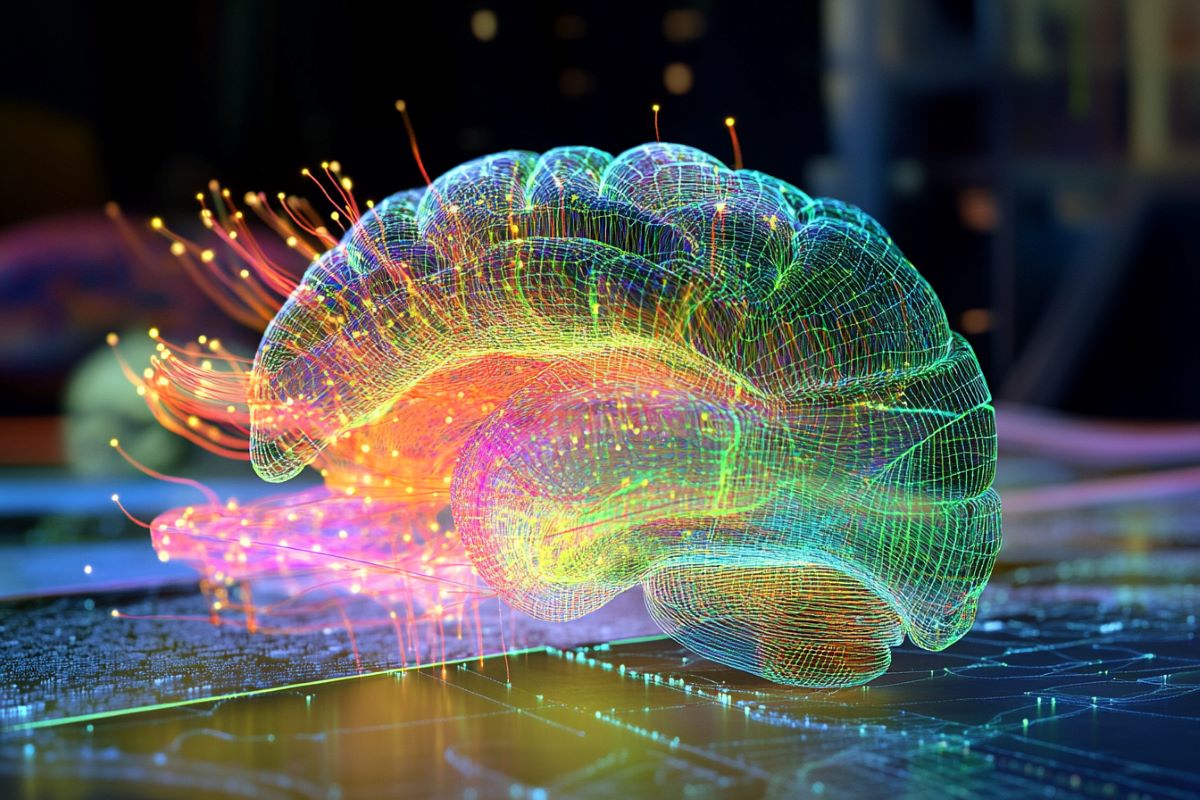
This shows a brain.
Each well in the grid cell-hippocampal network efficiently stores the information that is needed to activate the next well, allowing memories to be recalled in the right order. Credit: Neuroscience News

A new model developed by MIT researchers explains how those place cells can be recruited to form episodic memories, even when there’s no spatial component. According to this model, place cells, along with grid cells found in the entorhinal cortex, act as a scaffold that can be used to anchor memories as a linked series.

“This model is a first-draft model of the entorhinal-hippocampal episodic memory circuit. It’s a foundation to build on to understand the nature of episodic memory. That’s the thing I’m really excited about,” says Ila Fiete, a professor of brain and cognitive sciences at MIT, a member of MIT’s McGovern Institute for Brain Research, and the senior author of the new study.

The model accurately replicates several features of biological memory systems, including the large storage capacity, gradual degradation of older memories, and the ability of people who compete in memory competitions to store enormous amounts of information in “memory palaces.”

MIT Research Scientist Sarthak Chandra and Sugandha Sharma PhD ’24 are the lead authors of the study, which appears today in Nature. Rishidev Chaudhuri, an assistant professor at the University of California at Davis, is also an author of the paper.

An index of memories

To encode spatial memory, place cells in the hippocampus work closely with grid cells — a special type of neuron that fires at many different locations, arranged geometrically in a regular pattern of repeating triangles. Together, a population of grid cells forms a lattice of triangles representing a physical space.

In addition to helping us recall places where we’ve been, these hippocampal-entorhinal circuits also help us navigate new locations. From human patients, it’s known that these circuits are also critical for forming episodic memories, which might have a spatial component but mainly consist of events, such as how you celebrated your last birthday or what you had for lunch yesterday.

“The same hippocampal and entorhinal circuits are used not just for spatial memory, but also for general episodic memory,” Fiete says. “The question you can ask is what is the connection between spatial and episodic memory that makes them live in the same circuit?”

Two hypotheses have been proposed to account for this overlap in function. One is that the circuit is specialized to store spatial memories because those types of memories — remembering where food was located or where predators were seen — are important to survival. Under this hypothesis, this circuit encodes episodic memories as a byproduct of spatial memory.

An alternative hypothesis suggests that the circuit is specialized to store episodic memories, but also encodes spatial memory because location is one aspect of many episodic memories.

In this work, Fiete and her colleagues proposed a third option: that the peculiar tiling structure of grid cells and their interactions with hippocampus are equally important for both types of memory — episodic and spatial.

To develop their new model, they built on computational models that her lab has been developing over the past decade, which mimic how grid cells encode spatial information.

“We reached the point where I felt like we understood on some level the mechanisms of the grid cell circuit, so it felt like the time to try to understand the interactions between the grid cells and the larger circuit that includes the hippocampus,” Fiete says.

In the new model, the researchers hypothesized that grid cells interacting with hippocampal cells can act as a scaffold for storing either spatial or episodic memory. Each activation pattern within the grid defines a “well,” and these wells are spaced out at regular intervals.

The wells don’t store the content of a specific memory, but each one acts as a pointer to a specific memory, which is stored in the synapses between the hippocampus and the sensory cortex.

When the memory is triggered later from fragmentary pieces, grid and hippocampal cell interactions drive the circuit state into the nearest well, and the state at the bottom of the well connects to the appropriate part of the sensory cortex to fill in the details of the memory. The sensory cortex is much larger than the hippocampus and can store vast amounts of memory.

“Conceptually, we can think about the hippocampus as a pointer network. It’s like an index that can be pattern-completed from a partial input, and that index then points toward sensory cortex, where those inputs were experienced in the first place,” Fiete says.

“The scaffold doesn’t contain the content, it only contains this index of abstract scaffold states.”

Furthermore, events that occur in sequence can be linked together: Each well in the grid cell-hippocampal network efficiently stores the information that is needed to activate the next well, allowing memories to be recalled in the right order.

Modeling memory cliffs and palaces

The researchers’ new model replicates several memory-related phenomena much more accurately than existing models that are based on Hopfield networks — a type of neural network that can store and recall patterns.

While Hopfield networks offer insight into how memories can be formed by strengthening connections between neurons, they don’t perfectly model how biological memory works.

In Hopfield models, every memory is recalled in perfect detail until capacity is reached. At that point, no new memories can form, and worse, attempting to add more memories erases all prior ones.

This “memory cliff” doesn’t accurately mimic what happens in the biological brain, which tends to gradually forget the details of older memories while new ones are continually added.

The new MIT model captures findings from decades of recordings of grid and hippocampal cells in rodents made as the animals explore and forage in various environments. It also helps to explain the underlying mechanisms for a memorization strategy known as a memory palace.

One of the tasks in memory competitions is to memorize the shuffled sequence of cards in one or several card decks. They usually do this by assigning each card to a particular spot in a memory palace — a memory of a childhood home or other environment they know well. When they need to recall the cards, they mentally stroll through the house, visualizing each card in its spot as they go along.

Counterintuitively, adding the memory burden of associating cards with locations makes recall stronger and more reliable.

The MIT team’s computational model was able to perform such tasks very well, suggesting that memory palaces take advantage of the memory circuit’s own strategy of associating inputs with a scaffold in the hippocampus, but one level down: Long-acquired memories reconstructed in the larger sensory cortex can now be pressed into service as a scaffold for new memories. This allows for the storage and recall of many more items in a sequence than would otherwise be possible.

The researchers now plan to build on their model to explore how episodic memories could become converted to cortical “semantic” memory, or the memory of facts dissociated from the specific context in which they were acquired (for example, Paris is the capital of France), how episodes are defined, and how brain-like memory models could be integrated into modern machine learning.

Funding:

https://00986fffc8a8e7f321e3eb0c1868120a.safeframe.googlesyndication.com/safeframe/1-0-40/html/container.html

The research was funded by the U.S. Office of Naval Research, the National Science Foundation under the Robust Intelligence program, the ARO-MURI award, the Simons Foundation, and the K. Lisa Yang ICoN Center.

About this memory research news

Author: Sarah McDonnell
Source: MIT
Contact: Sarah McDonnell – MIT
Image: The image is credited to Neuroscience News

Original Research: Closed access.
“Episodic and associative memory from spatial scaffolds in the hippocampus” by Ila Fiete et al. Nature


Abstract

Episodic and associative memory from spatial scaffolds in the hippocampus

Hippocampal circuits in the brain enable two distinct cognitive functions: the construction of spatial maps for navigation, and the storage of sequential episodic memories.

Although there have been advances in modelling spatial representations in the hippocampus, we lack good models of its role in episodic memory.

Here we present a neocortical–entorhinal–hippocampal network model that implements a high-capacity general associative memory, spatial memory and episodic memory.

By factoring content storage from the dynamics of generating error-correcting stable states, the circuit (which we call vector hippocampal scaffolded heteroassociative memory (Vector-HaSH)) avoids the memory cliff of prior memory model, and instead exhibits a graceful trade-off between number of stored items and recall detail.

A pre-structured internal scaffold based on grid cell states is essential for constructing even non-spatial episodic memory: it enables high-capacity sequence memorization by abstracting the chaining problem into one of learning low-dimensional transitions.

Vector-HaSH reproduces several hippocampal experiments on spatial mapping and context-based representations, and provides a circuit model of the ‘memory palaces’ used by memory athletes.

Thus, this work provides a unified understanding of the spatial mapping and associative and episodic memory roles of the hippocampus.

Join our Newsletter

 I agree to have my personal information transferred to AWeber for Neuroscience Newsletter ( more information )

Sign up to receive our recent neuroscience headlines and summaries sent to your email once a day, totally free.

We hate spam and only use your email to contact you about newsletters. You can cancel your subscription any time.

Tags

brain researchepisodic memoryMemoryMITneurobiologyNeuroscienceplace cells

Posted in Uncategorized | Tagged , , , , | Leave a comment

Scientific American: Decoding Deception: The Psychology of Combating Misinformation

Multimedia

Video

1 min read

Decoding Deception: The Psychology of Combating Misinformation

The world is in a battle for truth. A cadre of researchers is eagerly seeking ways to stymie the spread of mis- and disinformation. The stakes are high.

This film was supported by the Pulitzer Center.

October 29, 2024

https://www.youtube-nocookie.com/embed/NoI8QzUAeiA?si=gh8NDLz2uv3Ofs6o

Social media have become an accelerant for the spread of misinformation about everything from climate change to public health to politics. The rise of generative AI is making the problem even more intractable. Left unchecked, misinformation will do real damage to people and institutions. But now, interdisciplinary researchers are coming together to pinpoint the nature of this infodemic and seek solutions. Surefire remedies remain elusive, but their insights could be crucial. The stakes are high: Nothing less than shared sense of truth.

View related content in PNAS:

How to mitigate misinformation

Stymieing the deceptive notes and news that spread with reckless abandon via social media may require a new approach–or several of them.

Finding a vaccine for misinformation

With deliberate deception a growing threat online, social scientists are devising ways to fight back with “cognitive inoculations”

The genuine problem of fake news

Intentionally deceptive news has co-opted social media to go viral and influence millions. Science and technology can suggest why and how. But can they offer solutions?

Research Papers Mentioned in the Film:

J.B. Bak-Coleman et al. Combining interventions to reduce the spread of viral misinformation, Nat Hum Behav, 6, 1372-1380 (2022). https://www.nature.com/articles/s41562-022-01388-6

G. Ceylan et al. Sharing of misinformation is habitual, not just lazy or biased, PNAS, 120, 1-8 (2023). https://www.pnas.org/doi/10.1073/pnas.2216614120

J. Roozenbeek et al. Psychological inoculation improves resilience against misinformation on social media, Sci. Adv. 8, 1-11 (2022). https://www.science.org/doi/10.1126/sciadv.abo6254

Additional Resources:

Posted in Uncategorized | Tagged , , , , | Leave a comment

Fast Company Works: Consultants beware, AI is coming for your job

Fast company logo

01-16-2025 APPLIED AI

Consultants beware, AI is coming for your job

The management consulting industry transformation provides not just a snapshot of the changes AI is driving but also a blueprint for how economies will adapt.Consultants beware, AI is coming for your job

[Source Photo: Xu Haiwei/Unsplash]

BY Lauri Pietinalho, T. Alexander Puutio, and Matt Statler6 minute read

The Singularity—a future where AI exceeds our human capacity for cognition— may no longer be a distant horizon. Currently, in almost any cognitive task, AI is matching, and often exceeding human accomplishments. 

For many observers, this prompts a question that is as urgent as it is unsettling: In a world where AI can generate insights and outcomes at blazing speed, what’s left for humans to do?

As we’ve explored the dimensions of this question at NYU Stern through research and teaching, the management consulting industry has emerged as the ideal benchmark for understanding what lies ahead for all of us. The industry’s transformation provides not just a snapshot of the changes AI is driving but also a blueprint for how economies will adapt to this new reality. And no, it’s not all doom and gloom, or a tale of human obsolescence even if it is perfectly clear that AI can now do much of what the “smartest people in the room” should accomplish.

Instead, what we’ve identified is an opportunity for humans to return to craftsmanship roots and excel again in the areas that make our species truly special. 

Compass Newsletter logo

Subscribe to the Compass newsletter.Fast Company’s trending stories delivered to you daily

SIGN UP

Privacy Policy

|Fast Company Newsletters

The future is here and unevenly distributed

Nowhere is the arrival of the singularity more evident than in our Consulting Capstone course, where seniors tackle complex, real-world business challenges. 

The extent to which both our students and clients leverage AI in their engagement is growing with each iteration, and AI is increasingly becoming a seamless extension of their natural capabilities. In the past, it took weeks to arrive at an engagement plan and set of hypotheses, while today students mix pre-built solution frameworks and lessons from past cases with AI tools to generate insights and roadmaps all in the span of one class session.

For the next generation, answers are the new commodities and immediate access to insights are table stakes. 

All of this raises a pressing question: What kind of a career are we preparing them for? 

What role can we expect our students to take in a world where AI can hold conversations, anticipate needs, and deliver insights, optimizations, and strategic recommendations at a pace and quality that surpass theirs?

Answering these questions properly requires a reassessment of what makes management consultants valuable to their clients in the first place, as well as a determination of where AI is likely to carve out its role in the consulting value chain. 

Answering this also uncovers the fate of the broader skilled labor economy. If even strategy consultants can be replaced, then maybe there truly are no knowledge-based roles safe from disruption. 

To understand what lies ahead we’ll need to begin by understanding more clearly what management consultants actually do for their clients. 

Disruption lies ahead

Asking management consultants to explain what they actually do for a living might make for a great running joke online, but there’s no reason to doubt whether the profession brings value to those they serve. 

In fact, seeing how the industry generated revenues of $385.1 billion in 2023 in the United States alone, they are clearly engaged in something others find worth their hard-earned dollars.

In a very technical sense, clients call in management consultants to help with three main functions:

  • Providing a set of extra hands
  • Lending credibility to decisions and processes already underway
  • Delivering innovative, strategic insights that cannot be generated in-house

As of today, all three are under existential threat by AI. 

ChatGPT launched to the general public in November 2022, bringing about the current AI wave that we are yet to see swell to its final proportions, let alone crest. However, foundational AI models are quickly establishing themselves as powerful tools in the consultant’s arsenal, if not entirely passable replacements.

We see the evolution of AI in management consulting is unfolding in three distinct stages (and we’ve passed through the first two). 

In the first stage, both consultants and their clients begin experimenting with publicly available AI tools, such as large language models (LLMs) like ChatGPT and Claude with a view of doing what they do today, but faster. 

Next, the integration becomes deeper, and the focus moves from task to outcome automation. Work processes begin to adapt to what AI needs to excel when working with humans, and the early adopters become more like AI-human hybrids, or Cyborgs and Centaurs as coined by our colleagues at Harvard Business School.

In the final stage, both management consultants and their clients will operate as human-AI Agent ecosystems, solving problems in unison. Some are already all-in with creating the agentic future of business, including blue chips like IBM with their Watsonx Orchestrate and newcomers like Fetch.ai in areas outside consulting, and it won’t take long until we see vertical AI solutions that target management consulting as well. 

This is the agentic future that awaits all knowledge-based workers in all of its supercharged, automated, and devastatingly efficient glory. 

A return to what clients value most

Our economy will be disrupted by AI. The changes will be deep, structural, and long-lasting, in ways that will both mirror and exceed what globalization and the expansion of free trade accomplished, only this time in years instead of decades. 

However, we don’t foresee a future where AI leaves humans with nothing but crumbs on the table. We’re confident in saying this because we see a future where management consultants will play a key role, even after they are no longer the “smartest” and most cognitively capable entities in the building. 

Just like management consultants, the AI onslaught will take us all back to the first principles of business, and in each case, those principles are fundamentally grounded in personal relationships and the human capacity for creativity, empathy, and connection.

More importantly, they are built on a sense of understanding and value that only humans can create when working together. 

As AI encroaches on the toes of the knowledge workers, it is not only taking over tasks that used to belong to Patagonia-vested associates at Bain or BCG, it is revealing what the true value of most white-collar work has been all along.

The real reason why leading management consultancies are remunerated handsomely for their time isn’t that no one else could arrive at the same answers. 

Instead, we argue that the true value of management consulting has always been in the act and experience of advising itself, the intricate dance of ideas, concepts, and a multiverse of paths forward that are built on the relationship between the advisor and advisee. 

Defaulting to corporate jargon, management consulting has always been about engagement and client success more than the answers themselves. 

It’s the dialogue and relational perspective-shifting that brings about the unique human knowing, involving also the unconceptualized senses of what truly matters, as consultants accompany clients through a myriad of possibilities of which many are possible but one in particular feels just right. 

This is consulting’s true essence, and as long as AI knows everything but understands nothing, there will always be room for humans in consulting. The same is true for most other knowledge-based tasks as AI strips layers of mundanity from the work we all do.  

The rise of the authentic advisor

In a sense, the future of consulting circles back to what it always should have been: a practice built on relational trust, deep listening, and a genuine investment in clients’ long-term success. 

AI may manage data and generate predictions, but only humans can meaningfully engage in the nuanced decision-making required to align technology with a client’s unique goals and values while also making the output authentically theirs and trustworthy. 

As we tell our students, it’s this intimate process of guiding clients through uncertainty that will distinguish them in the era of intelligent machines.

This means consultants must also embrace their role as ethical and strategic stewards more deeply than they have today. The real frontier lies not in the Singularity, but in building advisory relationships that embody judgment, morals, ethics, and integrity in ways that technology cannot match. 

It’s the same for everyone whose brain does the heavy lifting, and we see no sense in fearing or avoiding a future where we all get to go back to what made working with other humans so great in the first place.


ABOUT THE AUTHORS

Lauri Pietinalho is an organizational philosopher and advisor exploring collaborative organizing and the role of human work in the age of AI.  More

T. Alexander Puutio, PhD is a founder, author, and professor. More

Matt Statler, PhD is a philosopher, professor, and musician who teaches ethics, leadership,p and consulting at NYU Stern School of Business. More

Posted in Uncategorized | Tagged , , , , | Leave a comment

Quora: As “DEI” is being demolished; we need to learn about Intelligence.

Bruno Campello de Souza · 

Follow

Professor at Federal University of Pernambuco (UFPE) (2004–present)5y

What requires a high IQ to understand?

It is hard or perhaps even impossible to state something that “only” the very intelligent will understand, but there are certainly things which most people struggle with that those with high IQs are more likely to grasp.

In my own personal and anecdotal experience, the following ideas and notions are unknown, misunderstood and/or rejected by the vast majority of those with normal IQs (90–110) and even by most of those with above-average IQs (111–125), but are far more likely to be known, correctly understood and/or embraced by those with a gifted-level IQ (126+). In no particular order:

  • If you agree to the premises, then you have, wittingly or not, agreed to their consequences or implications, and the only way to revert this is to go back to the premises and disagree with at least one of them;
  • It is possible to predict and, yet, not control, i.e., there is a difference between correlation and causation, i.e., knowing “how” does not tell you “why”;
  • There are statements that are always true no matter what, and they are utterly useless precisely for that reason (tautologies);
  • One cannot “prove” a scientific hypothesis empirically no matter how many confirmations are observed, but only “disprove” it through counterexamples (which may be just a single trustworthy case), proofs only existing in Logic and Mathematics (Modus Tollens);
  • By definition, conspiracy theories cannot be falsified, for it can always be said that any evidence that would contradict them was secretly fabricated by the hidden powers that be in order to hide the truth, therefore, they are logical fallacies;
  • In random independent events, no matter how unlikely a given series of observations is, this has no bearing on the likelyhood of the next element in the series, even if the next element makes the increased series much less unlikely (ex: in a fair coin toss, obtaining a series of 100 “heads” in a row does not change the chance that the next toss will come up “heads” as well);
  • Natural selection does not work through environmental challenges leading to the an increased rate of offspring born with the capacity to overcome such challenges, but rather through an increased chance of procreational success (intergenerational genetic transmission) of specific random mutations that happen to coincide with a higher ability to overcome said challenges;
  • Predictability has no bearing whatsoever on free will, for the existence of a pattern for one’s behavior, even at the level of preferences and decisions, does not imply that such behavior was not a choice, for the possibility of choosing according to one’s preferences is the very definition of free will;
  • Any and all things are quantifiable, even love, justice, and beauty, among all other things, for different instances of the same phenomenon vary in amount and/or intensity, which is not to say that such quantification is always easy;
  • “When you can measure what you are speaking about, and express it in numbers, you know something about it; but when you cannot measure it, when you cannot express it in numbers, your knowledge is of a meager and unsatisfactory kind: it may be the beginning of knowledge, but you have scarcely, in your thoughts, advanced to the stage of science, whatever the matter may be” – Lord Kelvin;
  • Mathematics is not science, but there is NO science without Mathematics, with human and social sciences being no exception (there are no exceptions);
  • The fundamental rules of the scientific method do not change according to the subject or phenomena under study, be it Physics, Chemistry, Biology, Psychology, Sociology or any other field, and straying from that method is always bad science, regardless of the field;
  • Electron, force, mass, gravity, space-time and any other concepts from Physics or any other natural science have the same nature as those of motivation, emotion, unconscious, intelligence or any other concept from Psychology, i.e., they have no objective existence, being purely made-up abstract ideas put forth to explain observable phenomena;
  • It has always and will always be impossible to tell fact from perception, i.e., whatever is considered to be known about any empirical phenomenon can always be false, no matter what the evidence, i.e., one cannot separate Metaphysics from Epistemology;
  • The inevitable fallibility of all empirical knowledge, along with the psychological and sociocultural nature of knowledge, are no justification for a “free-for-all” or “anything goes” epistemic nihilism;
  • It is impossible to truthfully state that someone is making a misleading argument based on sophisms and/or fallacies unless one clearly points out said sophisms and/or fallacies, in other words, one cannot say that they are losing an argument solely because of rhetorical “cheats” or “tricks” from their opponent unless such “cheats” or “tricks” are explicitly identified (otherwise, the statement becomes unfalsifiable and, therefore, tautological and useless).

Due to their logical-mathematical nature, which is not subject to empirical validation, none of the above statements is an “opinion”.

Even among those with a very high IQ it is not uncommon to find someone with difficulties regarding one or more of the aforementioned statements . This is a particularly annoying case, for not only one expects such individuals to be more able to deal with the concepts involved, but also they tend to be very good at rationalizing their viewpoints through convoluted arguments which, of course, are wrong, but often require considerable time and effort to debunk.

676K views

View 2,433 upvotes

View 108 shares

Posted in Uncategorized | Tagged , , , , | Leave a comment

BIG THINK: The “friendship divide” explained: How your education affects your ability to connect. “We use technology to fill in the gap that at one point we would rely on another human being for.” Online spaces and forums are important to many people, but they are an inferior surrogate for real third spaces. We need to physically go to a bar, a ballgame, or a library. We need to reach out to each other and not to the smartphone.

Neuropsych — 

The “friendship divide” explained: How your education affects your ability to connect

“The primary way that people make friends is through institutions.”

Two friends walking up outdoor stairs, holding books and smiling at each other, their camaraderie evident in every step.
Archive Photos / Getty Images

Key Takeaways

  • Recent research led by Daniel Cox, director of the Survey Center on American Life, shows that college graduates tend to have more friends than those without degrees. 
  • The decline of community hubs, such as churches and civic groups, has disproportionately affected non-college-educated individuals, reducing their opportunities to form meaningful social bonds outside work and home. 
  • Cox suggests that to combat isolation, people need to engage more with their surroundings, participating in real-life activities and interactions instead of relying on technology to fill social gaps.

Jonny Thomson Copy a link to the article entitled

Share The “friendship divide” explained: How your education affects your ability to connect on FacebookShare The “friendship divide” explained: How your education affects your ability to connect on Twitter (X)Share The “friendship divide” explained: How your education affects your ability to connect on LinkedIn

Sign up for the Smarter Faster newsletter

A weekly newsletter featuring the biggest ideas from the smartest people

Fields marked with an * are required

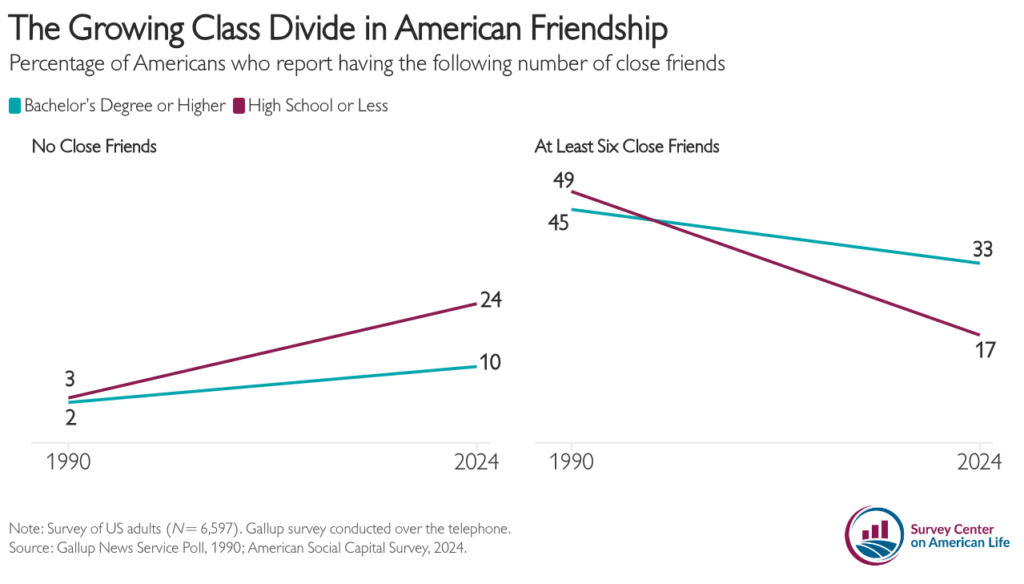
A lot has been written about the loneliness epidemic and the huge spike in isolation. It’s not just a post-COVID thing but has been in the works for a while. Study after study shows that, across a range of very different countries, people have fewer friends than previous generations, and they see those friends far less often.

But every country has its own version of this trend. In the US, the erosion of close social bonds is a many-headed beast driven by factors like geography, family, religious beliefs, and governmental policies. Another is education. It used to be commonly thought that people with a college degree were more likely to be lonely: The more educated you were, the fewer friends you tended to have.

Graph illustrating trends in American friendships from 1990 to 2024. The number of people with at least six close friendships declines, while those with no close friends increases. Data is segmented by education level, revealing shifting social dynamics.

According to a new study led by pollster Daniel Cox, that’s not true. Or, if it were true, it’s certainly changing now. To make sense of the “friendship divide” in the United States, Big Think spoke with Cox about his findings and suggestions for anyone suffering from friendlessness.

Office banter and lunch breaks

Cox recently co-authored a piece for The Survey Center on American Life called “Disconnected: The Growing Class Divide in American Civic Life” where he looked at the various trends and possible reasons behind loneliness, friendship loss, and disconnection. Who has the most friends? Why are some people more disconnected than others?

One of the most curious insights of the piece is that it shows a positive correlation between those who went to college and having more connections. In other words, if you go to university, you are more likely to have more friends than someone who does not. Cox highlighted two reasons for this.

The first is that college graduates find it easier to find a job and keep it when they get it. “College graduates have steadier working lives,” Cox said. “They’re less likely to be unemployed for prolonged periods of time.” That’s important not only for financial security but also for our sense of connection. As Cox put it, “Workplaces are critical ways Americans form fast friendships and lifelong friendships.”

To form any kind of meaningful relationship with someone, you have to spend a sustained period of time around them. In our normal, day-to-day lives, this isn’t possible. You might swap a few pleasantries with your cashier at the store, but you probably won’t invite them to your birthday drinks. You might enjoy talking about your holiday with your cab driver, but they likely won’t be at your wedding. Working eight hours a day in the same space helps facilitate these kinds of closer bonds.

The second reason college graduates are more likely to have meaningful connections is the skills and mindset that college often provides.

For most students, college is more than just a rung on the career ladder — it also plays a fundamental role in shaping social lives. Educational institutions provide spaces where people form long-lasting friendships and tend to get involved in various activities, from joining a choir to playing as a quarterback, that help individuals build broader social networks. Those with college degrees, therefore, are naturally placed in environments that foster connection. As Cox tells Big Think, “The primary way that people make friends is through institutions… you’re a member of a sports league, you go to a college or university, and you meet friends there.”

As college students grew up, graduated, and joined the wider workforce, they left behind their fraternities and sororities but still retained their willingness to engage with what was around them.
“College graduates just seemed to be more involved [in things like] informal book clubs and meetups in the neighborhood,” Cox said.

The third space

When Cox talks about book clubs and meetups, he’s referring to something sociologists call the “third space.” In the late 1980s, Oldenburg defined the third space as anywhere you get to meet other humans, which isn’t your home or the workplace. At home, your first space, you live with your family or housemates. At work, your second space, you talk with colleagues and go to meetings.

Both, of course, have their place. Your home is essential to your well-being, and, as Cox argued, the second place of work is essential to forming connections. We need family, and we need to work. But we also need a third place. We need a playing field, a coffee shop, or a pub — a place where we can meet other people and exchange ideas. In other words, we need somewhere, which isn’t the home or the workplace, where we can shoot the breeze and relax a little.

Cox pointed out that college graduates are more likely to use these third spaces, but the problem goes beyond a simple educational divide; there is a wider decline in both the availability and use of shared community spaces. Historically, churches, unions, and other civic organizations served as hubs for social interaction, especially for Americans without a college degree. However, as these institutions decline — for whatever reason — so does the opportunity for those without degrees to form meaningful social bonds. Community spaces, once vital to the social fabric, have eroded, and this has disproportionately affected those with fewer resources.

Getting out to get connected

At the heart of Cox’s paper and Big Think’s interview is a simple message: We need to be around other people if those “people” are to become friends. College facilitates this in two ways: It allows you to join communities and activities, and it means securing longer exposure to a consistent workplace.

It’s popular, if controversial, to rail against the damage of technology. Technology is often blamed for many things, and not all of them fairly. But one of the legitimate concerns is, as Cox puts it, “We use technology to fill in the gap that at one point we would rely on another human being for.” Online spaces and forums are important to many people, but they are an inferior surrogate for real third spaces. We need to physically go to a bar, a ballgame, or a library. We need to reach out to each other and not to the smartphone.

In other words, if the problem is that the friendship recession is caused by increased isolation, we need to consciously and determinedly buck the trend. We need to, as Cox puts it, “just get out of the house and spend time around where you live.”

Posted in Uncategorized | Tagged , , , , | Leave a comment

BIG THINK: Psychopathy

Posted in Uncategorized | Leave a comment

BIG THINK: AI … The Future (Apathy Fear)

Posted in Uncategorized | Leave a comment

BIG THINK: Sam Harris

Posted in Uncategorized | Leave a comment

BIG THINK: Ian Bremmer 2025’s Top Threats

Posted in Uncategorized | Leave a comment

Big Think; “DEFIANCE DOMINO EFFECT”. Quote from article “When you think of the long and gloomy history of man, you will find far more hideous crimes have been committed in the name of obedience than have ever been committed in the name of rebellion.”

How the “defiance domino effect” can improve your life and transform society

Sunita Sah hopes that by redefining defiance, we can build societies that allow people to live more authentic lives.

Two children displaying defiance as they make faces at each other on the left; a close-up of fingers holding dominoes on the right.
Getty Images / Unsplash

Key Takeaways

  • Societies tend to associate defiance with rudeness and disorder. 
  • But defiance isn’t about boldly challenging others; it’s about acting according to your values when faced with the pressure to do otherwise. 
  • Values-based defiance is a skill that can be developed through daily practice in small moments.

Kevin DickinsonCopy a link to the article entitled http://How%20the%20“defiance%20domino%20effect”%20can%20improve%20your%20life%20and%20transform%20society

Share How the “defiance domino effect” can improve your life and transform society on FacebookShare How the “defiance domino effect” can improve your life and transform society on Twitter (X)Share How the “defiance domino effect” can improve your life and transform society on LinkedIn

Sign up for the Smarter Faster newsletter

A weekly newsletter featuring the biggest ideas from the smartest people

Fields marked with an * are required

On January 28, 1986, the space shuttle Challenger exploded over the Atlantic Ocean mere seconds after launching from Cape Canaveral. All seven crew members perished. An investigation later revealed the explosion was caused by faulty O-rings, rubber gaskets that sealed joints inside the rocket boosters. Due to the cold weather preceding the launch, the O-rings became compromised, leading exhaust gas to escape from the booster and ignite.

If only someone had known, the launch could have been postponed and disaster avoided. Except someone did know — several people, in fact. 

Engineers at Morton Thiokol, an aerospace company NASA contracted to help build the rocket boosters, worried that the O-rings would lose resiliency in the forecasted freeze, so the company officially recommended that NASA hold off. Unfortunately, the O-ring safety data was inconclusive at the time, and NASA had grown overconfident and complacent about the space shuttle’s risk analysis. Under mounting pressure, Morton Thiokol complied and, despite their engineers’ warning, withdrew their concerns.

Sunita Sah, an organizational psychologist and associate professor at Cornell, recounts this story in her new book, Defy, to illustrate the everyday pressure we feel to comply even when we believe an action or decision to be unwise or immoral. This can push us to often err on the side of compliance, and the consequences of such obedience can be devastating.

Big Think recently spoke with Sah to discuss what we get wrong about defiance, why it can be such a powerful stance, and how we can learn to bring more defiance into our lives.

Big Think: You write in your book that we’re raised to view compliance as good and defiance as bad, but you have a different take. What is it?

Sah: Once, when I was young, I asked my dad what my name meant, and he said in Sanskrit Sunita means “good.” I mostly lived up to that. I did what I was told, got up when I was told to, and even had my hair cut the way my parents wanted. These were the messages I received, not just from my parents but also teachers: be good, be polite, don’t question authority, don’t make a scene.

[But] I was fascinated by people who could defy. After studying influence, authority, and why people either comply or defy, I found problems with the level of compliance we have. For example, a study found that only one in 10 healthcare workers, most of them nurses, felt comfortable speaking up when they saw a colleague making an error or taking a shortcut. These could be life-and-death situations where we want people to speak up. 

I came to the realization that we need a new definition for defiance. The Oxford English Dictionary defines defy as “to challenge the power of another person boldly and openly.” Now, I was brought up in England, so I’m not usually one to disagree with them, but my definition of defiance is “to act according to your true values when there is pressure to do so otherwise.”

Big Think: In defense of compliance, it serves a purpose. It can keep us safe. How should we understand finding the balance between compliance and defiance?

Sah: I’m proposing “values-based defiance” because what I’ve found is that there’s often a gap between who we think we are and what we do. We say integrity, benevolence, and compassion are important, yet we don’t always act like they are. We can be compliant in ways that impinge on those values.

We want to consider: Does the situation go against our values? That’s the key question. If it does, if it’s something that you would not feel comfortable with, then that is the moment to defy.

There are times we decide to comply because it isn’t safe or effective to defy. I use the phrase “conscious compliance” to reflect those moments. You need the freedom to say no because if you don’t have it, you may comply, but you don’t consent. [In this view], compliance is going along with something that is externally imposed on you by another person or a system. It’s not coming from within.

There are situations where you want to defy, but you go along with it. Maybe the costs are too great, the benefits too meager, or the situation is dangerous. We all have to do that at times, even our defiant heroes like Rosa Parks. How many times did she comply with the segregation laws? A lot, but there comes a moment when we decide now is the time to defy. It’s figuring out when that time is.

A police officer takes fingerprints from a woman wearing glasses and a jacket in an office setting.
Rosa Parks being fingerprinted during the Montgomery bus boycott (1956). The method and timing of her famous act of defiance wasn’t erratic. Both were aimed at promoting the her values at the opportune time. (Credit: Gene Herrick / Wikimedia Commons)

Big Think: Our culture has a widespread caricature of defiance — the angry, rabble-rousing, fist-in-the-air kind. Do you think this cliché bears on our willingness to be defiant?

Sah: I think it does. We get socialized to think that defiance is loud, bold, angry, and even violent. [We can also] think about it in a Rosa Parks way — as being heroic and superhuman. Both of those are wrong. Defiance is simply living by your values.

You don’t have to be a superhero or have a strong personality or be larger than life. You don’t even have to be brave. Sometimes you can be motivated by fear of what happens if you don’t defy. We can all defy in our unique way.

I always had a self-concept of being a compliant person, and then people showed me things I did that could be viewed as defiant. [For instance], once a job candidate came to Cornell, and I was walking her to her next appointment when she asked me, “How do you break all the rules?” I was like, “What are you talking about?” She mentioned how I publish in medical and psychology and law journals as well as management ones. 

Now, in business school, we’re told to only publish in management journals, but it didn’t matter to me. I wanted to publish my work in the places that would have the most impact, and I knew that certain papers would have more impact in medical or psychology journals.

So, there are different ways to defy. People probably have their own ways that they haven’t even registered as defiant.

Big Think: In what situations should we be more defiant?

Sah: There are many places where we comply and we shouldn’t. Situations where people feel regret afterward. For example, we can almost predict that at this or that meeting, a certain person will say something offensive or suggest excluding someone that we shouldn’t. They’ve said it so many times before, and if we don’t speak up, it will be harmful to people.

That’s a great place to start because anticipation enables defiance. If something catches you off guard, your default reaction is to be compliant. But if you anticipate those common situations, you can start visualizing and practicing. You can come up with this action plan and practice role-playing it. That way, you get used to hearing and saying the words for when the moment arises.

There is a powerful quote that I like to use because it really brings this home. It is often attributed to the Greek poet Archilochus: “Under duress, we don’t rise to the level of our expectations. We fall to the level of our training.”

This element of defiance is a skill. It’s not a personality trait. We need to learn the skill and practice it every single day — even in those smaller moments of speaking up.

“Does the situation go against our values? That’s the key question. If it does, if it’s something that you would not feel comfortable with, then that is the moment to defy.”Sunita Sah

Big Think: Imagine more people took on the responsibility of defiance. What would you like to see happen as a result of that shift?

Sah: There are three main things. First, I’m focused on the individual decision to defy. When you defy, it transforms you because you can be more yourself. You’re more authentic. You have a more joyful, honest life. That fascinates me as a psychologist.

[The second thing] is what I call the “defiance domino effect.” This is how defiance transforms the people who observe it.

One of my earliest memories of defiance is of my mother. She’s petite — 4’10” at most — but one day we were stopped on the street by a group of teenage boys. They blocked our path and told us to “go back home.” I grabbed my mother’s arm and wanted to look at the ground and move past them as quickly as possible.

But my mother put her hand on her hip, looked at those boys directly, and said, “What do you mean by that?” They didn’t know what to say, and she started telling them off, and one of them whispered to the other, “Let’s go,” and they dispersed.

That moment affected me. It changed how I thought about defiance, and what I would like to see in the world on a larger scale. Society is built on all of these smaller moments, and I want to see a society where one of the teens would’ve spoken up against his peers so my immigrant mother wouldn’t have to. That’s the type of social change that I would like to see in the world — one where every individual makes a difference.

[The final thing] is setting up systems, workplaces, institutions, and organizations that give us the freedom to defy. Too often, many of our systems and workplaces want us to comply, to sign on the dotted line and not have a choice. America is supposed to be the land of the free, so give us the freedom and the right to say no and set up the systems that enable us to do that.

Big Think: Is there a final message you’d like to leave our readers with?

Sah: There’s this quote from C.P. Snow: “When you think of the long and gloomy history of man, you will find far more hideous crimes have been committed in the name of obedience than have ever been committed in the name of rebellion.”

That’s a powerful [statement] to think about. Why do we have such a negative connotation of defiance and such a positive framing for obedience when that is when the worst crimes can be committed? 

Discovering your true “yes” and your true “no” is a way of understanding yourself. It’s a necessary step in discovering your own voice.

Tags

mental healthpsychology

Topics

The Learning Curve

Posted in Uncategorized | Tagged , , , , | Leave a comment