Today’s column argues that it is Ireland’s own interests to reduce dependence on a single gas pipeline from Britain and bolster its feeble defence forces by, respectively, buying American LNG and weapons. This would enhance relations with the Trump administration too.
BlackRock Chairman and CEO Laurence D. Fink and G42 CEO Peng Xiao discussed US restrictions on semiconductor technology, meeting power demands with natural gas, the role of crypto and the risk of elevated inflation in a conversation with Bloomberg’s Francine Lacqua at Bloomberg House in Davos.
Canadian startup Nirvanic hopes to prove quantum consciousness theories by creating sentient AIs and robots. And yes, this is a company to be taken seriously
As science wrestles with the thorny job of proving, defining and understanding human consciousness, one pioneering startup aims to apply cutting-edge theories of consciousness to AI models – and create the first sentient AI. This is wild stuff.
The last time we spoke to Suzanne Gildert, she was, as it turned out, just days away from leaving her former post as Co-Founder and CTO at Sanctuary AI, where she oversaw the development of the extraordinary Phoenix humanoid robot, one of the most advanced AI-driven robots in an exploding market
This is one fascinating cat; Gildert holds a Ph.D from the University of Birmingham, UK, on the effects of superconductivity in quantum computers. She moved to Canada in 2010 to work for the world’s first quantum computer company, D-Wave. By 2014, she had co-founded Kindred AI, an early Artificial General Intelligence (AGI) research lab focusing on training robots to learn by imitation. The Kindred AGI lab was spun off and sold for US$262 million in 2018, and Gildert immediately co-founded Sanctuary, staying long enough to get Phoenix working autonomously like this: https://www.youtube.com/embed/FH3zbUSMAAU?enablejsapi=1
Sanctuary AI – Phoenix at Human-Equivalent Speed
So she’s been involved in some very early, frontier-level tech companies – but perhaps none earlier than her newest startup, Nirvanic Consciousness Technologies, which launched in 2024.
“If you’re someone like me that wants to start something, like 10 years too early,” she tells Puneet Seth, host of the North of Patient podcast in a fascinating interview published this week, “then you essentially have a green field of opportunity. No-one else is doing this yet, so … you can [establish] a good IP position early on. I like to work at that really early, cutting-edge, way before you’re trying to commercialize something, way before it’s ready. You build a really strong foundation so that when that wave does start to come, you have a really strong position in the field.”
Nirvanic, says Gildert, is focused on “bridging the gap between AI and consciousness, by building systems that harness quantum mechanics to simulate conscious-like behavior. It’s not about creating consciousness for its own sake, but about using these principles to design better, more adaptive AI.”
Quantum consciousness: A controversial theory
At this point, we start getting into some far-out thinking. Some would argue that the definitive statement on consciousness was written in 1637, when French philosopher and mathematician René Descartes penned the famous phrase “Cogito, ergo sum” – I think, therefore I am – in his book Discourse on Method.
Without a particularly robust definition of what consciousness even is, that’s still about all we can say for sure; I’m pretty sure I’m sentient, I’ve got no idea about you lot.
But that doesn’t mean science hasn’t been trying, and one particularly fascinating idea, proposed by a Nobel Prize-winning physicist and an anesthesiologist in 1998, suggests that quantum effects could explain the ghost in the human machine, and might be the place where our consciousness and free will – the soul, you might say – reside, capable of perceiving the fractal possibilities stretching out into the future and choosing a path through them.
Roger Penrose’s Nobel Prize might be for the prediction of black holes rather than neuroscience, but he’s certainly a well-respected figure and a thoroughly remarkable man, as illustrated by the fact that he once saw an M.C. Escher exhibition, then came up with his own impossible “Penrose triangle,” above, which he then sent to Escher, inspiring two of the artist’s most famous works. For his part, Stuart Hameroff has certainly spent plenty of practical time dealing specifically with consciousness in the operating theater.
The (heavily disputed) Penrose-Hameroff theory is known as Orch OR, or Orchestrated objective reduction, and it proposes that consciousness doesn’t arise from the electrical activity between neurons in the brain. This kind of “computable” processing, which could conceivably be carried out by a regular computer crunching complex algorithms, leaves little wiggle room for free will.
Instead, the pair proposes, perhaps there are structures in the brain that act more like quantum computers – that aren’t fixed into a binary 0/1 position like a classical computer bit, but are instead able to hold a ‘superposition’ including vast numbers of possible states, all co-existing simultaneously together, like the qubits in quantum computers.
The theory proposes that tiny “microtubules” – tubular protein structures found within the cells of all plants, animals, fungi and many unicellular organisms – “may be ideal quantum computers,” and that they could operate in networks using quantum entanglement as an instant means of communication.
In this (very confusing) model, consciousness is portrayed as “brain activities linked to fundamental ripples in spacetime geometry,” and the outputs of these quantum networks effectively represent the collapse of the superpositions into a single outcome. Schrodinger’s cat is revealed as either dead or just very quiet, a spectrum of future possibilities becomes a single path forward, and this nice, simple new reality can then interact with the binary synaptic machinery of the brain.
According to Penrose and Hameroff, consciousness and free will arise in the imagining of these many future states, and the ‘choice’ of which to collapse the superposition into, in a way that’s “neither totally deterministic nor random, but influenced by a non-computable factor ingrained in fundamental spacetime. “https://www.youtube.com/embed/R6G1D2UQ3gg?enablejsapi=1
Brain Really Uses Quantum Effects, New Study Finds
As explained by international treasure Sabine Hossenfelder in the video above, the theory has recently been given somewhat of a boost with the discovery that microtubules can indeed exhibit quantum effects in biological systems – and they can do so at room temperature rather than close to absolute zero like what’s required for many quantum qubits – and that this “superradiant” quantum effect isn’t affected by environmental noise.
Make no mistake, it’s still an extremely controversial theory with opponents across many disciplines. But it’s interesting enough to Suzanne Gildert that it’s central to what Nirvanic has been set up to pursue.
“I have a background in quantum computing, so I’m obviously predisposed to be interested in this,” Gildert tells Seth. “But there are a growing number of scientists that are finding evidence of quantum effects in the human brain, and also a growing number of philosopher/scientists who have theories on how some of the odd properties of quantum mechanics could explain some of the properties of the human mind… That’s what I’m trying to explore, both theoretically and practically, by trying to build a system whose mind computation works on a quantum computer rather than a classical computer, like AI does.”
A working definition of consciousness
One of the first challenges for Nirvanic has been defining exactly what it is the company is shooting for. Gildert tells Seth there are plenty of different ideas out there about what consciousness actually means, but she’s settled on a two-part definition focused on practical outcomes.
The first part of consciousness, she says, is the first-person experience, and the ability to focus that experience on different things through attention. “When I’m reading a book,” she says, “I’m focusing my consciousness on the text, and I’ve forgotten about everything else that’s going on around me. So that idea of having, like, a subjective experience… It seems like data is somehow loaded into an observer that then watches the movie playing out around you.”
The second part is the ability to choose. “That movie that’s playing out in the theater of your mind,” she continues, “the information from that is now used to present options, or choices to you. The movie becomes a ‘choose your own adventure’ movie, it’s interactive, like a video game… There’s a sense, a feeling we have of having a choice, or choosing.”
Nirvanic: The rubber hits the road for quantum consciousness theory
Today’s AI models, Gildert tells Seth, do an excellent job of mimicking the unconscious processes of the human brain. “The way I think AI works,” Gildert tells Seth, ” is it just takes in data, it crunches that data mathematically, and it just outputs an action based on what it’s seen before.”
The human brain does this too, she goes on. Most of what we do all day is on some kind of unconscious, reflexive autopilot. When we start to learn to drive, or play the guitar, we devote huge amounts of attention to building the basics of these skills – but by the time we reach an expert level, we can nearly do it in our sleep, and our mind meanders around other things.
That’s super useful – but it doesn’t help you in an unfamiliar situation. “There’s these two different buckets of operation,” says Gildert, “one where it’s unconscious, where you’ve seen lots of training data before, just like an AI. But what I think AI needs is a second mode where you’re in an unfamiliar situation, something novel is happening that you’ve never experienced before. You become hyper aware, you become conscious of what’s going on, and then you’re able to make intuitive decisions about what to do.”
So how will Nirvanic work toward a similar system?Initially, says Gildert, it’ll be a matter of integrating quantum computers in with classical AIs. “You take in data through sensors,” she tells Seth. “You take it from the classical realm, where it’s zeroes and ones, and you turn it into quantum information. You then kind of massage or evolve that quantum state so that it comes up with different action options that the system could choose… And then the quantum system goes through something called collapse, or measurement.”
“In quantum mechanics,” she continues, “once you measure a system, or observe a system, it changes into a definite value. It kind of chooses which state to end up in. So you measure the quantum system, and it essentially chooses an action, and then you use that action to do something with your AI – if it’s a robot, you actually execute that action in the real world. It could also be one of these browser control AI systems, where an AI literally takes control of your mouse and keyboard and it can click around and do things for you.”
So assuming it all goes well, what would a ‘conscious’ AI of this nature even look like?
“The answer is, we don’t know,” she says. “In the best case scenario, within the next year to two years, we have big enough quantum computing systems, and we’ve come up with smart enough experiments to start seeing little signatures. By no means will we have a system that’s anything like our own consciousness, but we might have something that shows a spark of conscious decision-making, that’s making slightly better choices than its unconscious AI companion, right?”
“That’s what I’m looking for at the moment, in these early scientific experiments – can you see a signature of a smart decision, or choice being made? You might ask, how do you even know it’s made a smart decision? Well, if you think about an AI system before it’s been trained at all, it’ll choose actions at random, because it doesn’t know anything. So what I think of as a smart decision is that the quantum system chooses an action that’s slightly better than random, without having seen as much training data. That’s what we’re looking for– if it’s learning faster, making slightly more intuitive, smarter decisions than what an AI would, with a lot less training data.”
What else could AI consciousness do for humanity?
Beyond better-performing AIs and robotics, Gildert sees an important role for this research in terms of mental health.“Consciousness is basically who we are, it’s what we experience every moment of the day,” she tells Seth. “And what really is mental health? It’s about how we’re experiencing the world, how that makes us feel, and how there could be disorders associated with that.”
Thus, she believes Nirvanic’s work on artificial consciousness could make an impact on organic consciousness in two key ways. “One is in trying to understand ways in which we can improve people’s conscious experience in the future,” she says. Technological interventions for changing our state of mind that go beyond positive thinking and meditation.
The second, oddly enough, is about getting humanity away from screens again. “A lot of how we feel,” she explains, “is all about the systems we interact with, whether they’re other people or technology. We’re interacting increasingly with technology over time, and I think things like how much time we spend staring at screens, our phones and social media is impacting our mental health. So maybe, by having machines that have more of a conscious component to them, we can re-humanize technology.”
“You could say that sounds kind of dystopian,” she continues, “but it’s a choice among options, right? You could just say we have to stop interacting with technology, or you could say we have to start re-humanizing the technology we’re interacting with.”
From here, the discussion carries on into even wilder futurism, around the transferring of consciousness between organic and manufactured substrates. Then it goes back to where this quest began for Gildert, in her own struggles to overcome major anxiety disorder and panic attacks, and runs up against the edges of spirituality as she speaks of how meditation training gave her an intuitive sense of consciousness as something beyond the binary capabilities of computers.
It’s a terrific conversation, and you can catch it uncut in the video below. Meanwhile, I hope you’ve enjoyed this glimpse into a truly pioneering initiative at its earliest stages. Certainly, there’s a dozen Black Mirror episodes in everything she’s talking about here, but in an age where technology is rapidly becoming impossible to tell apart from magic, I find it fascinating to see how these frontier projects plunge scientists deep into philosophical and spiritual territory.https://www.youtube.com/embed/cdi1_mP-icY?enablejsapi=1
Episode 13: Dr. Suzanne Gildert – the frontier of AI consciousness
Wind energy is the cheapest source of new electricity in the U.S.—something that has been true for the past decade, according to annual energy reports from financial services company Lazard. When President Donald Trump issued an executive order on Monday to pause approvals for wind development, he said the opposite: that wind projects are “the most expensive form of energy that you can have, by far.”
Trump has claimed to be an expert on “windmills.” (It’s worth noting that windmill is an outdated term that originally referred to centuries-old tech that used wind power to turn stones to grind up grain; the modern tech designed for producing electricity is a wind turbine.)
But while actual experts say that wind is an important piece of meeting energy needs in the U.S., Trump has ignored the benefits to the grid, repeatedly claiming that the noise from wind turbines causes cancer (not true), that they “ruin the environment” (definitely not true), and that if the wind stops blowing, you won’t be able to watch Trump on TV (not true: renewable energy is part of a mix on the grid, and batteries can also store power for use when it’s needed).
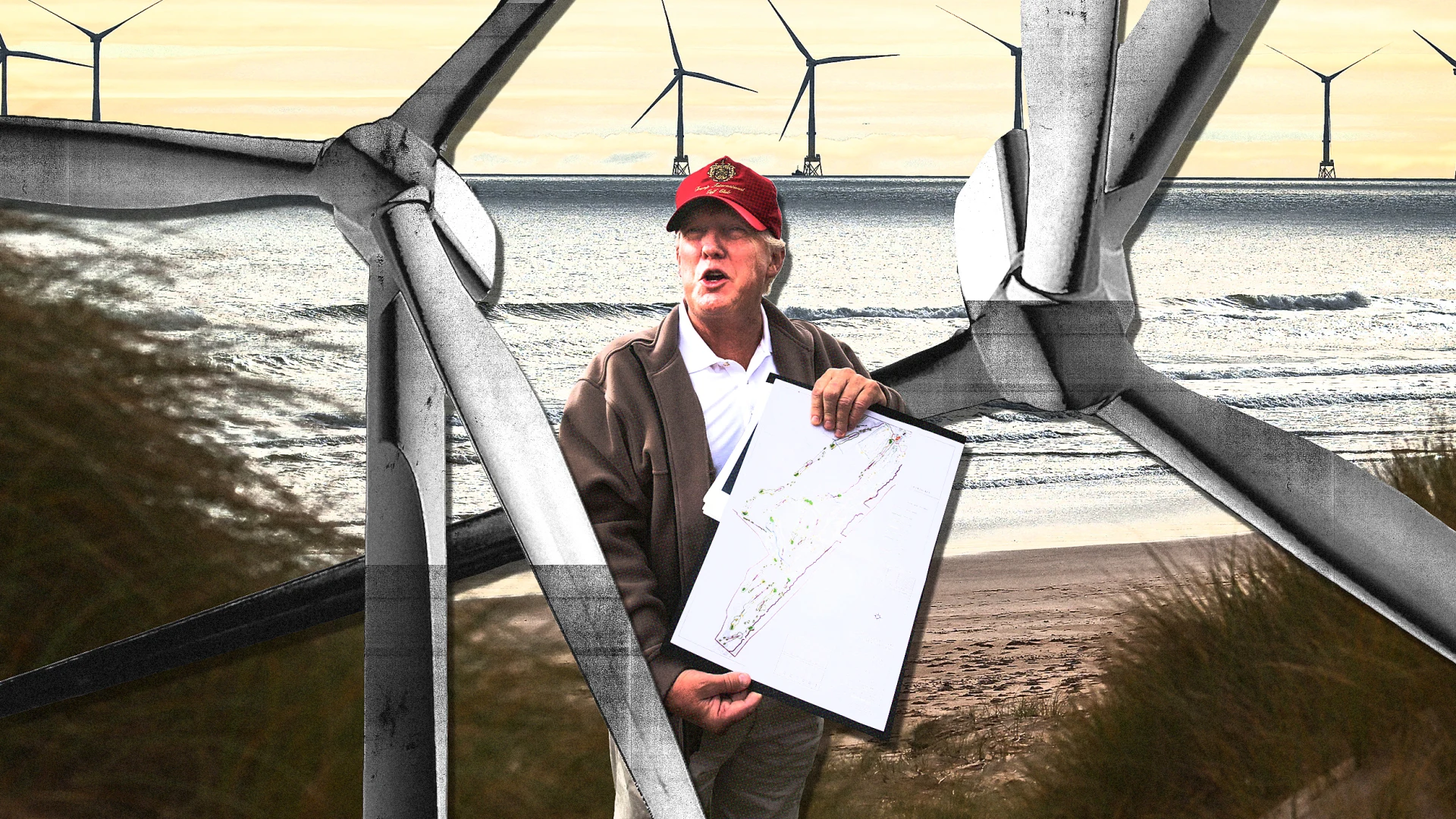
A view from Trump International Golf Links in Balmedie, Aberdeenshire, Scotland, in October 2024; the wind farm in the distance—completed in 2018—produces enough energy for 80,000 homes. [Photo: Andy Buchanan/AFP/Getty Images]
One of his most frequent arguments against wind power is that wind farms are ugly—and that’s where Trump’s own antipathy began.In 2006, he bought land along the coast in Scotland to build a golf course. Then he learned that an offshore wind farm was planned for the area. Worried about the view, he filed a complaint with the government, describing the wind farm as “an ugly cloud hanging over the future of the great Scottish coastline,” and arguing that the wind farm should be relocated or shouldn’t be built at all.
Subscribe to the Compass newsletter.Fast Company’s trending stories delivered to you daily
At the time, Trump wasn’t yet a vocal opponent of climate science.In 2009, two years before he started fighting the wind farm, as the world gathered for climate talks in Copenhagen, Trump signed an open letter calling for climate action that ran as an ad in The New York Times. It said, “If we fail to act now, it is scientifically irrefutable that there will be catastrophic and irreversible consequences for humanity and our planet.”
A photograph taken in October 2024 shows one of the clubhouses of Trump International Golf Links in Scotland, with wind turbines in the background. [Photo: Andy Buchanan/AFP/Getty Images]
It’s not clear that he ever understood what that meant, or the fact that wind turbines could help. But as his feud with the Scottish government grew, Trump ramped up his complaints about the energy source. In hundreds of tweets, he talked about how wind turbines are “bad for people’s health,” “ruining the beautiful parts of the country,” and “disgusting looking.” (By 2012, he was also claiming that climate change was a hoax created by China.)
In Scotland, the wind farm near Trump’s golf course was completed and started running in 2018, producing enough energy for 80,000 homes. The country now has so many wind farms that by 2022, it was generating more renewable electricity than it used.
Wind is already a meaningful source of energy in the United States. Eight of the ten states that rely most on wind power voted for Trump; Iowa, for example, gets around 60% of its electricity from wind. “Restricting wind development in these regions is certain to increase consumer energy bills,” the American Clean Power Association said in a statement after Trump issued the new executive orders.
ELON: IRRATIONAL REGULATIONS ARE AN INVISIBLE TAX ON HUMANITY “You really can think of the United States and many countries – it’s arguably worse in the EU – as being like Gulliver, tied down by a million little strings. Any one given regulation is not that bad, but you’ve got millions of them. Eventually, you just can’t get anything done. This is a massive tax on the consumer, on the people. It’s just that they don’t realize that there’s this massive tax in the form of irrational regulations. I’ll give you a recent example that is just insane. SpaceX was fined by the EPA [U.S. Environmental Protection Agency] $140,000 for, they claimed, dumping potable water on the ground, drinking water. This is at Starbase, and we’re like, we’re in a tropical thunderstorm region. That stuff comes from the sky all the time. You know, it was just water to cool the launch pad during liftoff. And there’s zero harm done. And they agree: Yes, there’s zero harm done. We’re like, okay, so there’s no harm done, and you want us to pay a $140,000 fine? Yes, because you didn’t have a permit. We didn’t know there was a permit needed for zero-harm, fresh water being on the ground in a place where fresh water falls from the sky all the time. I mean, sometimes it rains so much the roads are flooded. So we’re like, how does this make any sense? And they were like, we’re not going to process any more of your applications for Starship launch unless you pay this $140,000. They just ransomed us. And we’re like, okay, so we paid $140,000. At this rate, we’re never going to get to Mars.” Source: The All-In Podcast, September 2024
The move will likely bring on legal challenges from unions.
Marine One is seen outside the U.S. Capitol building on the inauguration day of Donald Trump’s second presidential term in Washington, U.S. January 20, 2025. [Photo: Elizabeth Frantz/REUTERS]
President Donald Trump on Monday signed an executive order requiring most federal employees to return to work in person full-time, a move that is likely to spark backlash and legal challenges from unions.
WHAT DOES TRUMP’S ORDER DO?
Trump directed the heads of all federal agencies to “take all necessary steps to terminate remote work arrangements” and require employees to report to “their respective duty stations” full-time. The two-sentence order says the directive “shall be implemented consistent with applicable law.”
CAN TRUMP PROHIBIT FEDERAL EMPLOYEES FROM WORKING REMOTELY?
It depends. The president has broad authority over the federal workforce, including the power to tell agencies to stop allowing remote work for employees who are not unionized. That includes supervisors and managers, who cannot join unions, and Trump could move quickly to order them back to the office.
But, about 26% of federal employees are unionized and many are covered by bargaining agreements that allow for remote work or hybrid arrangements.The Trump administration will have to wait for those to expire or try to renegotiate the agreements.Bargaining agreements between federal agencies and unions can only be challenged in court if they contain illegal terms or were the product of coercion, bribery, or some other wrongdoing.
Subscribe to the Compass newsletter.Fast Company’s trending stories delivered to you daily
In some cases, federal agencies may also be required to allow employees with disabilities to work remotely.Federal law requires employers to grant “reasonable accommodations” to workers with chronic medical conditions as long as they can still perform their job duties.
HOW MANY FEDERAL EMPLOYEES WORK REMOTELY?
The Trump White House said on Monday that only 6% of federal employees currently work in person, but government data shows that remote work is more limited. About 46% of federal workers, or 1.1 million people, are eligible for remote work, and about 228,000 of them are fully remote, according to a report issued by the White House Office of Management and Budget in August.
The U.S. Department of Defense and Department of Veterans Affairs, which have far more employees than other agencies, have the most remote workers, along with the Department of Health and Human Services. For federal employees who are eligible for remote work, about 61% of regular working hours are spent in person, according to OMB. That figure excludes fully remote workers.
WHY DOES TRUMP OPPOSE REMOTE WORK?
Trump’s order may also represent an effort to encourage some federal workers to quit, opening up positions that can be filled by political loyalists.
Elon Musk, who will lead a commission created by Trump to rein in government spending, said in a November 20 Wall Street Journal opinion piece that federal workers should not be paid for “the COVID-era privilege” of telework.“Requiring federal employees to come to the office five days a week would result in a wave of voluntary terminations that we welcome,” Musk wrote.
But, agencies may be leery of engaging in a large number of firings or layoffs, especially when they involve workers who hold important roles or are difficult to replace.
Trump’s agenda, including potentially repealing thousands of federal regulations, coordinating a large number of deportations, and overhauling U.S. health policy, will require fully staffed agencies to execute. Experts said that in many instances, Trump will likely have to choose between culling the federal workforce and carrying out other initiatives.
CAN THE PRESIDENT FIRE WORKERS WHO RESIST RETURN TO OFFICE MANDATES?
The president and agency heads have broad authority to fire nonunion workers for cause, which could include defying a mandate to return to the office. But federal employees must be given written notice that they are being fired at least 30 days in advance, including an explanation of the reason for their termination and an opportunity to respond.
And federal workers who lose their jobs can bring a challenge before the Merit Systems Protection Board, an independent three-member panel appointed by the president, seeking to be reinstated. Employees could argue to the board that they were not fired for cause, that agencies did not follow the proper procedures and violated their due process rights, or that they were targeted for discriminatory reasons. The board’s decisions are binding unless they are set aside by a federal appeals court.
The Greenletter Club is 100% independent. To help us, click here 👉 https://bit.ly/3ppLx68
In this previously unpublished interview, Joseph Stiglitz, winner of the Nobel Prize in Economics, denounces the decline of freedom in the United States and the rest of the world. Trump, a creature of neoliberalism, will continue to destroy democratic institutions. By destroying institutions, neoliberal policies have enabled populists to emerge in Europe, South America and the United States. In a previous book, The Price of Inequality, Joseph Stiglitz warned of the risk of populists seizing power. Interview by Maxime Thuillez in Paris