


27th Janaury 2025
Interesting

Ukraine was the most corrupt country in the world in Pandora Papers leak. With 38 people including Zelensky. Zelensky’s childhood friend Ivan Bakanov, former head of the security service of Ukraine was also on the list.


|
01-24-2025 WORK LIFE
Based on research, it seems like promoting rigid masculinity in the workplace is not the best solution for an arguably already struggling Meta.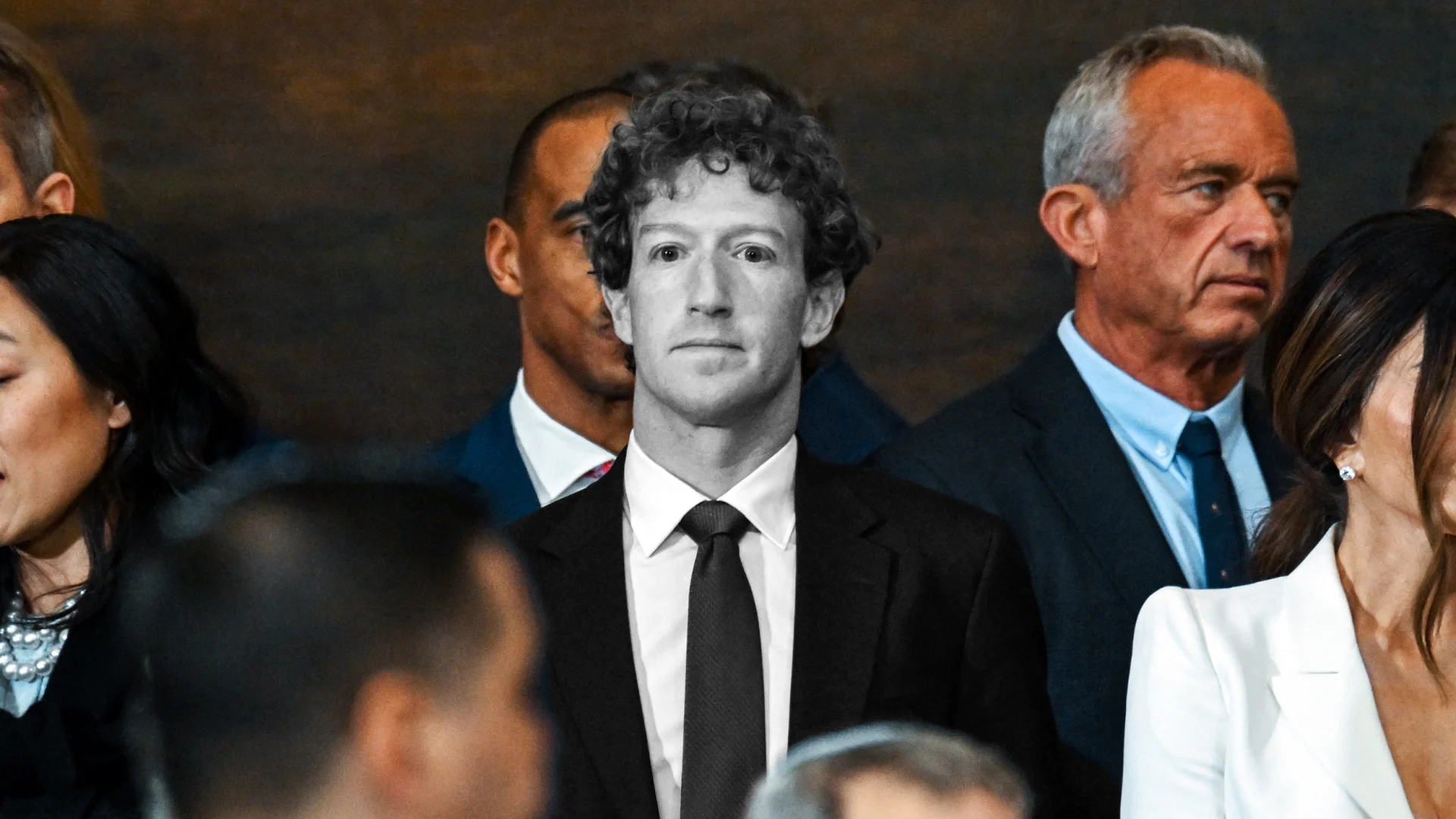
[Photo: KENNY HOLSTON/POOL/AFP via Getty Images]
BY The Conversation 4 minute read
When Meta CEO Mark Zuckerberg appeared on a January 10, 2025, episode of The Joe Rogan Experience, he lamented that corporate culture had become too “feminine,” suppressing its “masculine energy” and abandoning supposedly valuable traits such as aggression.
The workplace, he concluded, has been “neutered.”
Perhaps not surprisingly, Zuckerberg has also embraced stereotypically masculine pursuits in his personal life. He’s become a mixed martial arts aficionado and has shared his affinity for smoking meats. On his expansive Hawaii compound, he’s even taken up bow-and-arrow pig hunting.
He’s come a long way from the geeky image of his youth.

Subscribe to the Compass newsletter.Fast Company’s trending stories delivered to you daily
SIGN UP
But is Zuckerberg right? Do workplaces in the U.S. need to embrace a more diesel-fueled, street-fighting, meat-eating mentality?
As a social psychologist who studies masculinity and aggression, I think it’s important to evaluate what the science says about Zuckerberg’s claims—and to consider what it means for the future of workplace culture in the U.S.
In 2018, sociologist Jennifer Berdahl and her colleagues coined the term “masculinity contest culture” to describe workplaces rife with cutthroat competition, toxic leadership, bullying, and harassment. Expand to continue reading ↓
============
Integrating decades of prior research on masculinity in the workplace, Berdahl and her collaborators were able to map how masculinity contest cultures operate, as well as show how they affect organizations and individual employees.
In her experiments, she had participants agree or disagree with statements such as “expressing any emotion other than anger or pride is seen as weak,” based on their perceptions of their own organization. Using advanced statistical techinques, Berdahl’s team was able to distill masculinity contest cultures down to four components: “showing no weakness,” “strength and stamina,” “putting work first,” and “dog eat dog.”
Then they were able to show how these cultures are tied to a host of negative outcomes for workers and companies, such as burnout, turnover, and poor well-being. And at the organization level, they can foment a dysfunctional office environment, toxic leadership, and even bullying and harassment.
Based on this research, then, it seems like promoting rigid masculinity in the workplace is not the best solution for an arguably already struggling Meta.
What, then, led Zuckerberg to claim that the workplace has been neutered and must be infused with masculine energy? Has the American office really gone full Legally Blonde?
Zuckerberg’s own company isn’t exactly a paragon of parity: Its total workforce, as of 2022, was nearly two-thirds male, while its tech workforce was three-quarters male. Furthermore, according to psychologists Sapna Cheryan and Hazel Markus, workplaces in the U.S. still reflect what they call “masculine defaults”—cultures that reward characteristics or behaviors generally associated with men.
This can range from how companies describe themselves—for example, as places that are “aggressive” and “unrestrained”—to hosting events catering to traditionally male pursuits, such as golf outings.
Although Cheryan and Markus’s analysis centers on how masculine defaults make it harder for women to carve out their professional paths, they can harm everybody, including men.
My research, for example, has shown that when men feel pressured to fulfill certain masculine expectations, they can develop fragile masculine identities, which are linked with aggression and anxiety.
Although the pervasiveness of masculinity norms can give men an upper hand in the workplace, I wonder whether men are contorting themselves to fit into outdated molds of who succeeds at work. Indeed, research shows that successful organizations promote a healthy mix of stereotypically masculine and feminine qualities.
In other words, it’s best when people of all genders feel comfortable showcasing traits such as cooperation and agency, qualities that don’t necessarily fall into one gender camp.
If many workplaces still possess dog-eat-dog cultures and celebrate masculinity—with evidently poor outcomes—you might wonder why billionaire corporate leaders would advocate for them.
The most generous explanation is ignorance. Zuckerberg could simply be unaware that most offices in the U.S. still possess competitive environments and traits associated with traditional masculinity.
Although this could be the case, I think there could be two other explanations for Zuckerberg’s promotion of rigid masculinity norms.
There could be an economic motive. Perhaps Zuckerberg thinks that promoting his company as an arena of high-stakes competition and aggression is the best way to attract talent and spur innovation in a field already dominated by men. It’s often thought that competition drives innovation. So “Meta needs to be more masculine” could actually be code for “Meta needs to breed more internal competition, which will spur innovation and turn a profit.” This assumption is also misguided: Recent research has shown that internal competition may actually stifle innovation.
There could also be a psychological motive. I’ve found in my research that men are most likely to cling to notions of rigid masculinity when they feel pressure to “man up” and are insecure about themselves.
Perhaps Zuckerberg sees diversity efforts as a challenge to his power. Maybe he thinks aligning himself with President Donald Trump’s version of masculinity will help him gain and retain power, especially as he faces challenges from other tech giants. So his promotion of an aggressive workplace, along with his slashing of policies that could make him look “weak,” are moves to reinforce his status as a leader, as an innovator, and as a man.
This isn’t to say that activities such as hunting and mixed martial arts are inherently bad, or even inherently masculine: There are plenty of female hunters and UFC fighters. Nor is it to say that certain masculine characteristics in the workplace are inherently bad.
But when I see middle-aged billionaires—Zuckerberg isn’t the only one—exhibiting the signs of fragile masculinity that I’ve observed among young adult men and adolescent boys, I can’t help but wonder what the country’s future holds.
Adam Stanaland is an assistant professor of psychology at the University of Richmond.
This article is republished from The Conversation under a Creative Commons license. Read the original article.
ABOUT THE AUTHOR
The Conversation is a nonprofit, independent news organization dedicated to unlocking the knowledge of experts for the public good. More
The Nasdaq 100 could be set for its largest one-day fall since 2022 if this DeepSeek correction extends much further this Monday. Potentially, this technology could be a game-changer, and questions are being asked about the huge amounts of money the traditional tech players, the so-called Magnificent 7, have been ploughing into AI development. We look at the implications for FX and Treasury yields should these falls be sustained
In this article
The real and perceived DeepSeek threat. The Fed will be watching closely Nasdaq sell-off sparks broader unwind
Nasdaq futures have briefly been off by more than 4% this Monday. Should the index close down by that magnitude today, it would mark the largest one-day sell-off since September 2022. We have not seen that kind of a sell-off in tech stocks since then, which reflects the conviction held by most investors for nearly two years that the ‘Magnificent 7’, the likes of Microsoft, Alphabet and Meta, would deliver. Some buy-side investor surveys point to being long ‘Magnificent 7’ as being the most crowded financial market trade for that period.
At the heart of this is the Chinese artificial intelligence company DeepSeek. Its app soared in popularity after releasing a free-to-air model last week. It’s said to use less data at a fraction of the cost of its more traditional rivals. It’s potentially a major challenge to the incumbents, and questions are being raised about the billions of dollars they’ve pumped into developing their own AI models.
The breakthrough could be that DeepSeek can achieve a state-of-the-art model without state-of-the-art equipment. The current notion is that for larger models, one needs more computing power – if you want more context, you need more calculations. The often dreamed-about shortcut could be the use of smart algorithms.
DeepSeek now seems to show that we can do more with existing computing power than previously thought. Moreover, DeepSeek is offering its model for free right now. The market, therefore, needs to price in a slower adoption rate of high-performance computing and revenues of companies selling AI models. And this is at a time when traditional company valuations are already highly sensitive to small changes in expectations. The valuation of the companies depends on their discounted earnings which can be approximated by a multiple. ASML, for instance, trades at a current share price over earnings per share multiple of 33.6x, Nvidia at a multiple of 48.5x.
So, perhaps we don’t need these enormous amounts of calculations in AI text, video, audio and graphics and we can do more with existing equipment. And that has repercussions for the revenue expectations of the operators of those models (Microsoft, Meta, Grok), and especially the hardware vendors on which these models run, such as semiconductors designed and sold by Nvidia and SK Hynix, often produced by TSMC on equipment from ASML.
But here’s a word of warning. Although the alarm bells are ringing for the ‘Magnificent 7’ today, things could turn quickly. There is still uncertainty about exactly how DeepSeek works, whether it is safe, and how robust it is.
The Fed is worried about the stock market insofar as how it feeds back into the real economy. Primarily, this is via the wealth effect – will a stock market fall lead to consumers feeling less wealthy and therefore inclined to pull back on spending? This is incredibly important given consumer spending is 70% of the economy. Other effects can come through the corporate sector. Will it impact financing (less able to raise money via equity offerings or through venture capital funds), or will it also make businesses more cautious about hiring and investment?
At this stage, we are talking about a relatively modest move for equity markets. At the time of writing, NASDAQ futures are down around 4%, wiping out around $1.2tn of market capitalisation. But this is in an environment where household net worth has increased by more than $50tn since the pandemic. Investors may not be particularly happy, but we are not going to see broader consumer spending trends shift on the back of this.
That said, the Fed will remain watchful. If this leads to a broader correction, then the Fed will be much more inclined to cut rates and will come under intense pressure to do so from President Trump! After all, the US consumer has been the key driver of US exceptionalism, and it is primarily higher-income households, which typically have larger equity portfolios, who have been leading that growth story.
The top 20% of households by income spend the same dollar amount as the bottom 60% of households by income. For the top 20% – who make more than $250k per year – inflation has been an irritation but not a constraint on spending, while they have disproportionally benefited from the surge in financial and real estate wealth. They have also benefited from higher interest rates – locked in at low mortgage rates but investing money in higher interest-paying money market funds.
If a sense of worry starts to hit these free-spending households, they may well start to pull back on some of their consumption, and the Fed will be much more inclined to respond with lower interest rates.
The initial reaction in the FX space today was familiarly defensive. The Japanese yen and the Swiss franc are the clear outperformers and those high beta currencies that trade on higher volatilities, such as the Norwegian krone, Swedish krona plus Australian and New Zealand dollars are all under-performing.
Probably the biggest question for the FX market from today’s Nasdaq developments is whether the correction proves significant enough to substantially shift market pricing of the Fed’s easing cycle. Recall that on Friday the market was pricing 42bp of Fed easing this year and now prices 54bp. Were the Nasdaq correction large enough to see those Fed easing expectations move out to 75bp this year, that would probably be worth another 2% drop in USD/JPY towards 152 – a clear vehicle for a story such as this.
Treasuries can show a meaningful reaction lower in yields from here should there be a multi-week reaction to the downside for stocks or at least a 10% fall in broad indices. So far, we’re on a one-day move, so that’s still to be seen. As it is, the 10yr Treasury at 4.5% is what we’d call a relatively neutral valuation. It coincides with 10yr SOFR at around 4%. The forward market discount for the funds rate is now in the 3.75% area. That would need to dip much deeper to inspire rationale for further large falls in the 10yr yield from here.
We’d been tactically bullish in the past week looking for a reaction lower in US yields in any case, partly on core inflation optimism and benchmark revisions to payrolls data likely coming next week. Today’s move pushes in that direction. Significant dips below 4.5% on the 10yr will need more than a one-day dip in tech stocks. Note that we remain structurally bearish for Treasuries through 2025, meaning that we’d need something more seismic to shift that longer-term view.
DownloadDownload article

26th January 2025
So. Thats not an exam then is it?

By Kayla Robbins | January 23, 2025 | Awareness | Criminalization

Trump’s campaign promises on homelessness lean heavily on fearmongering, xenophobia, and punitive measures that threaten to worsen the crisis rather than solve it.
It’s difficult to predict what Trump will do in an attempt to address homelessness during his second term in office. He’s promised a lot of different things on the campaign trail, and there’s no telling which of those plans, if any, he’ll choose to follow through on. We do know that things are likely to get a lot worse. We must focus on surviving this time together without leaving each other behind.
Here are some of the things Trump has said about homelessness and some ideas for weathering the oncoming storm:
In yet another campaign riddled with xenophobia and violent anti-immigrant sentiment, Trump has many times alluded to his big plans for mass deportation. He claims this will have the happy side effect of solving the homelessness crisis since immigrants are taking our houses and our jobs and everything.
This is not true. Very few immigrants without documentation are able to buy a house in this country. The majority live in low-cost rental housing alongside many other members of their family across all different generations.
Furthermore, the construction industry relies on exploiting undocumented people as low-wage workers that they can pay under the table and freely mistreat without repercussions. Nationwide, immigrants make up a total of 20% of all construction workers. These are the people building the very homes we so desperately need. Mass deportation may result in a negative impact on housing overall.
Another plan of Trump’s is to “work with states” to make it illegal to camp on the street. Any homeless people who must sleep on the street will be arrested or “given the option” of being concentrated in designated little camps on “inexpensive land” that we’re calling tent cities for now. That sounds like the opening lines to several of history’s most chilling chapters.
He’s also proposed taking several steps backward and reallocating tons of federal funding away from actual housing and toward treatment programs for drug addiction and mental health. Considering the idea of involuntary commitment of homeless people has already been tossed around a fair bit in the last few years, this also does not sound good.
Even in a best-case scenario where these programs are voluntary and helpful, they’re not going to do much of anything for people who are homeless but don’t have debilitating substance use or mental health issues. All they need is housing; for some reason, we consistently refuse to give it to them.
Lest any of these horrific, punitive plans make him seem insensitive, Trump tries to soften that perception a bit by following up with the line that politicians never fail to trot out, saying, “There is nothing compassionate about letting these individuals live in filth and squalor rather than getting them the help that they need.”
If that sounds incredibly familiar to you, it may be because California Governor Gavin Newsome, a politician who wants to be seen opposing Trump on everything else, recently gave us his rendition. Months before ramping up his efforts to sweep encampments across the state, Newsome said, “There is no compassion in allowing people to suffer the indignity of living in an encampment for years and years.”
Or it could be familiar from any of the other countless times this line has been repeated without the benefit of critical thinking. It keeps getting used because it keeps working to placate voters for the most part. Too many seem satisfied with that empty sentiment without sparing a thought for what would be compassionate. After all, if you’re not going to help people, not intervening to make things worse is the compassionate choice.
It’s unclear what Trump’s administration will end up doing to try and address the rising rates of homelessness in the USA. It could be any combination of these things, none of them, or something else entirely.
What is clear is that there is no help on the way. We can expect an exacerbation of harm and an increase in criminalization from the federal government and most state and local governments.
These plans rely on being able to scoop up and disappear unhoused people without their housed neighbors noticing or caring. We need to resist that.
Instead, we must rely on one another. Our local communities and the organizations that have been tirelessly supporting our homeless neighbors for years must embrace this responsibility as a collective effort. Ensuring their safety is our shared duty—because we keep each other safe.
Get to know the members of the unhoused community in your area. Learn their names, connect with them, and keep in touch. Form a relationship deep enough that they would let you know if they were planning to leave the area. If they go missing without telling you their plans, try to find them. No one is disposable, and everyone deserves to have someone or a group of someones who will stick up for them, protect them, and become a thorn in the side of any system that seeks to sweep them away.
And if you’re feeling resistant to this idea like it’s not your business and you don’t want to get involved, rest assured that just because they’re coming for homeless people first does not mean they will be the last. If we ignore the mistreatment of society’s most vulnerable people, it’s not like they’ll leave the rest of us in peace. We need to oppose every overstep.

Kayla Robbins is a freelance writer who works with big-hearted brands and businesses. When she’s not working, she enjoys knitting socks, rolling d20s, and binging episodes of The Great British Bake Off.


