ELON: AI EDUCATION WILL BE LIKE HAVING EINSTEIN AS A TEACHER FOR EACH CHILD
“I think the parents will still be responsible for values and morals. [But] I do think AI will dramatically affect education, because the AI is an extremely knowledgeable teacher. It will be very patient, will be almost always correct, and can tailor the lessons specifically to the child. It will be like each child has Einstein for a teacher. So, it will be something quite profound.” Source: Viva Technology Paris, May 2024
“Ultimately, the choice rests with each individual: whether to take the convenient route of allowing AI to handle our critical thinking, or to preserve this essential cognitive process for ourselves.”
Adobe Stock / Collective Offset / Prostock Studio / Big Think
Key Takeaways
As we increasingly offload cognitive tasks to artificial intelligence, researchers are concerned that our critical thinking skills will atrophy.
A recent study finds exactly that: Participants who reported higher use of AI scored worse on measures of critical thinking.
In an interview with Big Think, study author Dr. Michael Gerlich suggested that AI isn’t inherently bad for our cognitive abilities — like any tool, it needs to be used correctly.
A weekly newsletter featuring the biggest ideas from the smartest people
Fields marked with an * are required
In a series of experiments described in Science Magazine in 2011, a trio of researchers found evidence to support a sneaking suspicion bubbling up in the minds of many Google aficionados: Frequent users of internet search engines didn’t retain information gleaned through online sleuthing as well as individuals who learned information offline. As the scientists posited, it was almost as if people and their computers were becoming “interconnected systems,” with basic memory functions delegated to search engines.
Over the ensuing years, this “Google effect” has taken on a new moniker: “digital amnesia.” It’s the tendency to forget information that can be found readily online via search engines. After all, why would the brain waste resources storing information available at the click of a button?Instead, people better recall how to access the information.
Google is now the most trafficked website in the world, and the internet itself is the definitive repository of human knowledge. If the brains of Googlers and their invaluable search engine were interconnected back then, they’ve essentially merged now. The myriad effects are up for speculation.
Now, artificial intelligence is here to supplement — or even supplant — human cognition, potentially redefining and broadening digital amnesia. From digital assistants to ChatGPT to Google Search’s AI Overview, AI is planning our days, doing our work, and answering our questions. In essence, it is thinking for us. Will this new relationship reshape how we think and behave? Research is underway, with much of the focus on critical thinking.
AI is increasingly thinking for us
Critical thinking is the ability to analyze, evaluate, and synthesize information to make reasoned decisions. People who rate highly in scientific measures of critical thinking get better grades in school, are more adept at their jobs, and are less susceptible to manipulation.
Critical thinking can seem nebulous and insignificant, but that impression couldn’t be farther from reality. For example, when you compare different loan terms for a house or scrutinize car insurance rates, you’re thinking critically. When you dig into the meaning of a poem, book, or work of art, you’re thinking critically. When you plan out your busy day to be optimally time efficient, you’re thinking critically.
Here’s the thing: AI can do all of those tasks for you and more, quite proficiently. And its use is increasingly mainstream. Since launching in 2022, ChatGPT has rocketed to become the ninth most trafficked website and the fourth most popular app on iPhone. The AI tool has 300 million weekly active users and 123.5 million daily active users as of early January.
People frequently utilize AI to craft emails, plan travel, get financial advice, summarize texts, and prepare for job interviews. According to a 2024 Pew Research poll, roughly half of Americans said they use AI at least several times a week, while a recent survey found that virtually all Americans use products that contain AI (even though two-thirds don’t realize it).
Companies offering AI assistants sell them as productivity boosters. They argue that tasking them with humdrum mental chores and queries frees up users’ time and cognitive resources, which they can then spend on other, more creative, and innovative pursuits.The idea makes intuitive sense and has backing in the scientific literature. According to cognitive load theory, the human cognitive system has limited capacity. So reducing cognitive load can enhance learning and performance.
Atrophied critical thinking
Habitually offloading cognitive tasks to AI could backfire, however. As AI has grown more commonplace in everyday life, psychologists theorize that it reduces users’ engagement in deep, reflective thinking, causing their critical thinking skills to atrophy over time.
Professor Dr. Michael Gerlich, Head of the Center for Strategic Corporate Foresight and Sustainability at the Swiss Business School, is one of the researchers studying this risk.
“If individuals use the cognitive resources freed up by AI for innovative tasks, the promise holds,” he told Big Think. “However, my research and related studies suggest that many users channel these resources into passive consumption, driven by AI-enhanced content curation. This trend aligns with findings on digital dependence, where the convenience of AI fosters a feedback loop that prioritizes entertainment over critical engagement.”
In other words, when AI frees up users’ cognitive resources, they typically don’t use their extra time and brain power to problem-solve or create. Rather, they tune out by watching Netflix or perusing social media — content served up by AI algorithms.
In Gerlich’s most recent research, published January 3rd in the journal Societies, he surveyed 666 participants in the UK on their AI tool use and also measured their critical thinking skills with oft-used, scientifically validated assessments of critical thinking.
Gerlich found a very strong negative correlation between subjects’ use of AI tools and their critical thinking skills. The higher their usage, the lower their skills. Younger participants tended to be more dependent on AI tools compared to older participants. Education was associated with greater critical thinking skills and attenuated AI’s negative effect.
Many participants suspected that AI was hampering their ability to think critically.
“I find myself using AI tools for almost everything — whether it’s finding a restaurant or making a quick decision at work,” one said. “It saves time, but I do wonder if I’m losing my ability to think things through as thoroughly as I used to.”
“I rely so much on AI that I don’t think I’d know how to solve certain problems without it,” another worried.
Gerlich’s findings suggest participants were correct to be concerned.
“As individuals increasingly offload cognitive tasks to AI tools, their ability to critically evaluate information, discern biases, and engage in reflective reasoning diminishes,” he wrote. “This relationship underscores the dual-edged nature of AI technology: while it enhances efficiency and convenience, it inadvertently fosters dependence, which can compromise critical thinking skills over time.”
The correct use of AI
Despite the glaring results, Gerlich made it very clear that this concerning correlation is not destiny. There are a couple of reasons. First, the finding requires further research to be fully validated.
“One potential direction is to investigate the longitudinal effects of AI tool usage on critical thinking skills over time,” he recommended. “This could involve tracking individuals’ cognitive development and AI tool usage patterns over several years to comprehensively understand the long-term impacts.
Second, he believes that how we use AI makes a huge difference. AI is fundamentally a tool, and tools can be used correctly and incorrectly.
“These results are linked with the wrong use of AI,” he told Big Think. “In my opinion, the correct use of AI can help to increase critical thinking skills.”
So how can we use AI correctly?
“AI tools like the popular large language models can be used for critical discussions and not only as an instrument that replaces one’s own work or thinking,” Gerlich said.
Generative AI is fantastic for brainstorming, showing prompters choices and ideas they might not have considered. AI can also foster critical thinking when users hone the questions they are asking to achieve desired outcomes. For example: trying to get an AI image generator to produce something that matches what you’re imagining. You have to be very clear and descriptive.
Teaching AI in schools
It’s vital for teachers to educate students about the proper use of AI assistants. Students should learn how to assess the veracity of AI responses, evaluate generative AI’s writing, and iteratively sculpt the outputs.
And, of course, students still need to learn the numerous skills that AI offers, like content analysis, writing, mathematics, and logic. Otherwise, we risk turning AI into a “black box,” Gerlich says.
“This ‘black box’ problem can reduce critical engagement and accountability, as individuals may blindly trust AI recommendations without questioning or evaluating them.”
“Educational systems should emphasize active learning, promoting exercises like argument analysis and problem-based learning,” he added. “In professional settings, creating environments where independent decision-making is valued can help maintain these skills. Engaging in reflective activities, such as journaling or debating, can also foster deeper cognitive engagement.”
A path to stagnation?
Public intellectual and author Yuval Noah Harari has opined that humans could become more and more cognitively idle with increasing AI automation, leading to programmed thinking and societal stagnation.
This dystopia isn’t implausible, Gerlich told Big Think, “particularly if AI adoption continues without parallel efforts to safeguard cognitive engagement.”
“However, this trajectory is not inevitable,” he rebutted. “Interventions, such as embedding critical thinking exercises in education and supporting ethical AI design that encourages human involvement, can counteract these trends.”
Gerlich said that integrating AI into daily life requires balance. Its benefits are too great to ignore, but we can’t unthinkingly embrace them.
“Ultimately, the choice rests with each individual: whether to take the convenient route of allowing AI to handle our critical thinking, or to preserve this essential cognitive process for ourselves.”
Still, he does harbor some pessimism.
“It is likely that a portion of society will opt for the path of least resistance.”
An innovative diagnostic tool distinguishes between kids with autism and ADHD
Kennedy Krieger Institute
View 1 Images
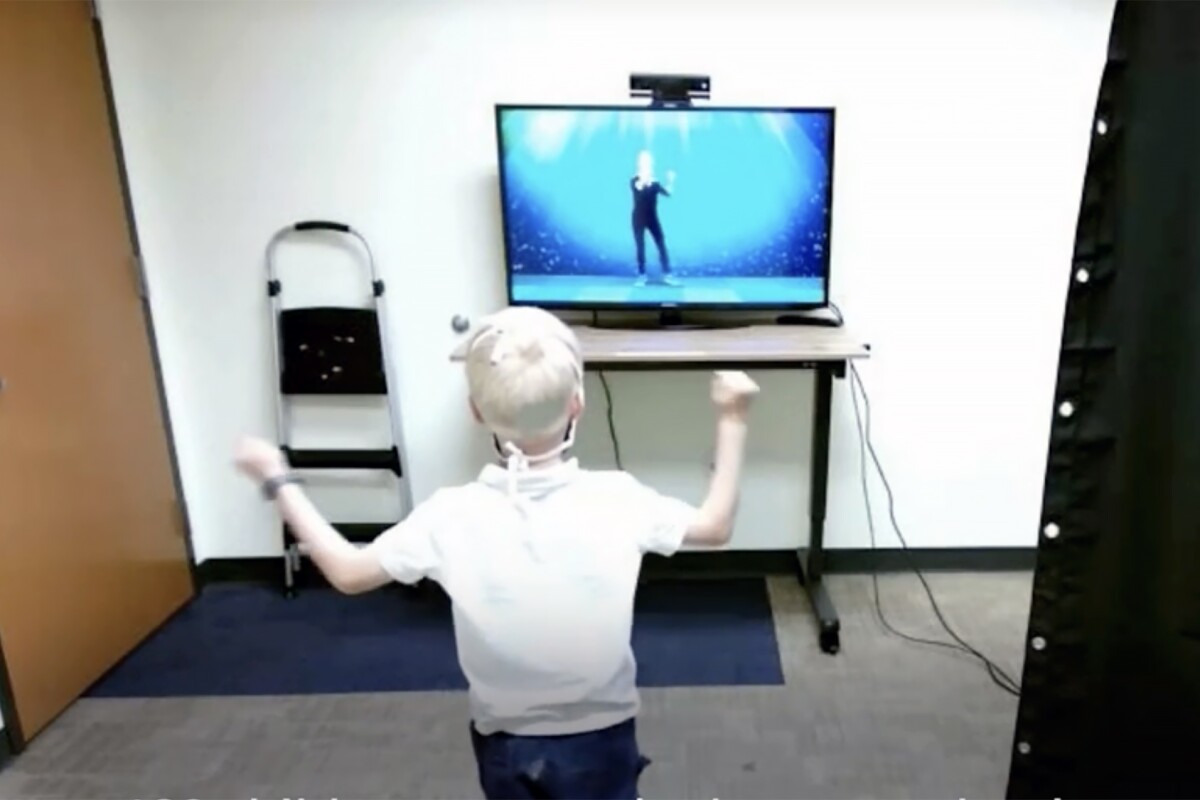
A low-cost tool accurately distinguishes neurotypical children from children with autism just by watching them copy the dance moves of an on-screen avatar for a minute.It can even tell autism from ADHD, conditions that commonly overlap.
Early diagnosis of autism spectrum disorder (ASD) is key to ensuring that effective interventions are put in place that, ultimately, improve a person’s quality of life. However, because ASD commonly co-exists with attention-deficit hyperactivity disorder (ADHD), its diagnosis can be tricky and may be missed or delayed. In addition, testing a child for ASD is time-consuming and expensive.
In a new study, researchers from the Kennedy Krieger Institute, an American non-profit organization, and Nottingham Trent University in the UK developed and tested a novel means of reliably and accurately diagnosing autism in children, even when it exists alongside ADHD: a one-minute motion-detecting video game.
“Diagnosing autism can be challenging, especially when children have overlapping traits with other conditions like ADHD,” said Dr Stewart Mostofsky, a pediatric neurologist, director of the Center for Neurodevelopmental and Imaging Research at the Kennedy Krieger Institute, and a co-author of the study. “If the condition is misdiagnosed, it can impact support and resources for the child.”
ASD is characterized by an impairment of social and communication skills that can be mild, moderate, or severe. Compared to neurotypical children, studies have shown that children with ASD struggle particularly with tasks like ball catching and motor imitation that require efficient visual-motor integration. Previous research has also found that children use imitation to form and maintain relationships with others and learn social norms and rituals. Those who can’t appropriately learn these social cues through imitation face exclusion from peers and the broader community.
Because it’s crucial for learning both social and motor skills, it follows that imitation could be a good biomarker for ASD. So, based on this and the aforementioned studies, the researchers developed the Computerized Assessment of Motor Imitation, or CAMI, to detect ASD by focusing on differences in motor imitation.
“Traditionally, autism is viewed as a disorder of social-communicative functioning,” said Dr Bahar Tunçgenç, an expert in social development from Nottingham Trent University’s Department of Psychology and the study’s corresponding author.“However, we have growing knowledge that autistic people have sensory-motor difficulties, like motor imitation, which may have knock-on effects on how they develop social interactions and communication skills in childhood. CAMI taps into these sensory-motor difficulties, showing that they are not shared with children with ADHD.”
The researchers recruited 183 seven-to-13-year-olds and divided them into four groups: those with ADHD but without ASD, those with ASD and co-occurring ADHD, ASD without ADHD (ASD only), and neurotypical children. Over two one-minute trials, the children were asked to stand and copy the whole-body, dance-like movements of a video avatar while two Kinect Xbox cameras recorded them. For each trial, CAMI calculated an imitation score that varied between zero (no imitation at all) and one (perfect imitation, such as that performed by a well-trained researcher). https://www.youtube.com/embed/69gOg8k0TrI?enablejsapi=1
1-minute video game can diagnose autism with 80% accuracy
The two trials featured different movement sequences. CAMI scores for each trial were averaged to give a composite CAMI score for each participant between zero and one, with a higher score indicating better imitation. CAMI showed 80% accuracy in distinguishing children with ASD from neurotypical children and 70% accuracy in distinguishing children with ASD from those with ADHD. The researchers said CAMI has significant potential in clinical settings as a diagnostic tool.
“What really makes CAMI exciting is its simplicity,” Tunçgenç said. “Video games are already so popular. It’s fun for kids and delivers fast results that are easy to interpret for clinicians. My hope is for CAMI to eventually be used in clinical practices everywhere.”
The researchers said that with further development, it could be adapted for use with younger children and those with more severe developmental challenges, which would further broaden its utility.
“This tool could transform autism diagnoses worldwide,” said Mostofsky. “By identifying autism as precisely as possible, we can connect children to interventions that improve their quality of life and long-term outcomes. We want to see CAMI used widely in clinics to support diagnosis as an alternative that is quick, low-cost, and requires minimal setup.”
Workers are under more pressure to adapt to new technologies and demands. Emotional intelligence is going to become even more critical to success, argues this expert.
Today’s fast-paced workplace requires us to change and adapt at increasing speeds, while managing complex interpersonal demands. Despite these challenges, we can utilize emotional intelligence to meet these continually increasing demands and excel in our new reality.
The basis of emotional intelligence is the ability to recognize, understand, and manage our emotions—as well as know how they impact others. Beyond that, emotional intelligence gives us greater ability to understand the emotions of others, allowing for greater empathy. This in turn increases our ability to work effectively with others of different backgrounds and perspectives.
Glenn Llopis, author ofMake Reinvention Your Superpower, argues that a lack of emotional intelligence traps people in what he calls “career quicksand.”He explains that this occurs when individuals lose sight of their unique capabilities because they are rewarded for following the corporate playbook instead of their own. As a result, they are not encouraged to explore new ideas, having been trained to believe that success relies on executing old ones.
How to encourage emotional intelligence
Organizations are increasingly becoming aware that being successful today requires more collaboration, creativity, and adaptability. Research at Lawrence Technological University found that emotional intelligence“improves one’s ability to be socially effective, and can lead to improved collaborative outcomes.”
Subscribe to the Compass newsletter.Fast Company’s trending stories delivered to you daily
Successful organizations in today’s climate will be comprised of emotionally intelligent people who can pivot quickly. The good news is that emotional intelligence is not some innate quality; it’s something you can build. Employees at all levels of the organization will need to boost their collaboration, problem-solving, and teamwork skills.
One way to encourage these traits is for leaders to ask every employee to share examples of collaboration, good teamwork, and problem-solving during staff meetings. They can set up an easy-to-use process whereby staff can recognize each other when they demonstrate using emotional intelligence in their daily work. Having an emotional intelligence employee-of-the-month recognition program can also help keep the focus on continuous improvement. Finally, managers can also ensure that employees are aware that empathy and resilience are attributes that will make workers more likely to get a promotion.
Building collaboration and conflict-resolution skills
Organizations of the future will need to collaborate more both internally and externally.
Having employees who are able to work with various people of different cultural backgrounds will increase team and organizational cohesiveness.
Llopis emphasizes the importance of using emotional intelligence to approach workplace diversity with curiosity. This mindset helps uncover valuable insights and opportunities for growth. “When we look around with intentionality and expect to discover something new, we open ourselves to seeing possibilities we might have overlooked,” he says.
Conflict and problems inevitably arise at work. But because organizations must move so quickly, teams must be able to solve these issues quickly and effectively. Unresolved frustrations, unexpected changes, anxiety, and disappointment in organizations can lead to a negative and toxic workplace quite quickly if workers don’t have the tools they need. Emotional-intelligence training teaches people to work through these common workplace issues without losing track of what they are trying to accomplish. These workers are better able to navigate difficult conversations that lead to better acceptance and understanding with their peers and leaders.
The ability to work through difficult interpersonal relationship challenges leads to increased optimism and stronger growth mindsets for those who go through them. Llopis says that self-trust is central to emotional intelligence and reinvention, enhancing one’s ability to manage workplace conflict. “By cultivating a deep understanding of oneself and confidence in one’s abilities, self-assurance empowers employees to navigate their own challenges and support others, fostering deeper connections and adaptability in high-stress work environments,” he says.
The value of an emotionally intelligent culture
Companies that invest in supporting emotional intelligence find that their culture shows improvement. The results of an environment of collaboration are greater freedom to be creative and experiment with new solutions and innovations. Open communication and dialogue become part of how everyone in the organization is expected to conduct themselves. This results in an atmosphere of psychological safety, which allows everyone the freedom to experiment, take some risks, and push their own boundaries so they can reach their full potential.
Organizations that put a high emphasis on emotional intelligence in their recruitment, onboarding, and training process will find they are molding their organizations in a manner that allows all of their people to have more fulfilling careers. Nurturing empathy and resilience means everyone has a supportive environment where everyone can reinvent themselves while keeping the organization moving forward.
ABOUT THE AUTHOR
Harvey Deutschendorf is an emotional intelligence expert, author and speaker. To take the EI Quiz go to theotherkindofsmart.com More
Media caption,The latest footage of the crash site area has been released by French officials
The co-pilot suspected of deliberately crashing the Germanwings jet in the French Alps had researched suicide methods and the security of cockpit doors, German prosecutors said.
Internet searches from the week before the crash were found on the tablet computer used by Andreas Lubitz,
Meanwhile, the second “black box” flight recorder from the plane has been recovered.
There were no survivors among the 150 people on board the A320 on 24 March.
Internet research
The German prosecutors said internet searches made on the tablet found in Lubitz’s Duesseldorf flat included “ways to commit suicide” and “cockpit doors and their security provisions”.
Spokesman Ralf Herrenbrueck said: “He concerned himself on one hand with medical treatment methods, on the other hand with types and ways of going about a suicide.
Media caption,Authorities in France say the second flight recorder has been found
“In addition, on at least one day he concerned himself with search terms about cockpit doors and their security precautions.”
Prosecutors did not disclose the individual search terms in the browser history but said personal correspondence supported the conclusion Lubitz used the device in the period from 16 to 23 March.
Lubitz, 27, had been deemed fit to fly by his employers at Germanwings, a subsidiary of Lufthansa.
The first “black box”, the voice recorder, was recovered almost immediately at the crash site.
Image caption,Investigators found Andreas Lubitz had used a tablet computer to research cockpit security
Based on that evidence, investigators said they believed Lubitz intentionally crashed Flight 9525, which was travelling from Barcelona to Duesseldorf, taking control of the aircraft while the pilot was locked out of the cockpit.
The second “black box” recovered is the flight data recorder (FDR) which should hold technical information on the time of radio transmissions and the plane’s acceleration, airspeed, altitude and direction, plus the use of auto-pilot.
Image caption,French Gendarmerie General David Galtier holds up a picture of the blackened flight recorder found earlier
At a press conference, Marseille prosecutor Brice Robin said there was “reasonable hope” the recorder which was being sent to Paris for examination, would provide useful information.
The “completely blackened” equipment was found near a ravine and was not discovered immediately because it was the same colour as the rocks, he said.
He said: “The second black box is an indispensable addition to understand what happened especially in the final moment of the flight.”
He told the media 150 separate DNA profiles had been isolated from the crash site but he stressed that did not mean all the victims had been identified.
As each DNA set is matched to a victim, families will be notified immediately, he said,
He added 40 mobile phones had been recovered. He said they would be analysed in a laboratory but were “heavily damaged”.
‘Severe depression’
Also on Thursday, Germanwings said it was unaware that Lubitz had experienced depression while he was training to be a pilot.
Lufthansa confirmed on Tuesday that it knew six years ago that the co-pilot had suffered from an episode of “severe depression” before he finished his flight training.
“We didn’t know this,” said Vanessa Torres, a spokeswoman for Lufthansa subsidiary Germanwings, which hired Lubitz in September 2013.
She could not explain why Germanwings had not been informed.
The final minutes
Lubitz began the jet’s descent at 10:31 (09:31 GMT) on 24 March, shortly after the A320 had made its final contact with air traffic control.
Little more than eight minutes later, it had crashed into a mountain near Seyne-les-Alpes.
At a time when many Americans are experiencing increased stress, anxiety, and personal loss, we must also ensure that our country can meet the mental health needs of those struggling in this crisis.
President Donald J. Trump
IMPROVING MENTAL HEALTH: President Donald J. Trump is taking action to improve Americans’ mental health which has been harmed by prolonged lockdowns.
President Trump signed an Executive Order to address the negative impact of prolonged shutdowns on mental and behavioral health and increase suicide prevention efforts.
The President is establishing a cabinet-level working group to assess the mental health needs of the most vulnerable, including the elderly, minorities, children, veterans, and people with disabilities.
The order also focuses on providing grant funding to support mental health treatment services including telehealth, peer-to-peer, and safe in-person therapeutic services.
The Trump Administration is also working to award contracts and grants to community organizations which provide mental health and suicide prevention support.
PROTECTING AMERICANS: The President’s order comes at a time when many Americans are facing increased mental health problems and other challenges stemming from the pandemic.
Research shows that Americans’ mental health has suffered during the COVID-19 shutdowns and vulnerable Americans have been disproportionately affected.
According to a CDC study, symptoms of anxiety and depression increased significantly since the prolonged stay-at-home orders, with disproportionately worse mental health outcomes among vulnerable groups.
40.9% of Americans reported at least one adverse mental health condition and 10.7% reported seriously considering suicide.
In July, a Kaiser Family Foundation poll found that 53% of American adults reported that their mental health was negatively affected due to worries over COVID-19.
One in five of those who sheltered in place reported experiencing a major negative mental health consequence.
The overall negative impact of social distancing practices and economic shutdowns on mental wellbeing has led to reports of increased substance use and overdoses, decreased access to addiction treatment services, and increased calls to suicide prevention centers.
PROMOTING MENTAL AND PHYSICAL HEALTH: President Trump has worked tirelessly to improve Americans’ mental and physical health during his tenure in office.
President Trump has fought the opioid crisis in our Nation’s communities, issuing a nationwide call to action and working to expand access to medication-assisted treatment for opioid use disorder, including making it easier to find treatment services.
To protect our Nation’s veterans, President Trump signed an Executive Order, directing the creation of a roadmap to empower veterans and end the national tragedy of suicide.
Early in the pandemic, the President participated in a call with mental health and substance use disorder leaders and professionals to discuss the effects of COVID-19 on mental health.
The President signed legislation which allocated approximately $425 million in emergency funds to address mental and substance use disorders.
DEI must DIE, only Skills and competence should matter! “I believe we need to return to a focus on merit. It shouldn’t matter whether you’re a man or a woman, your race, or your beliefs. What should matter is how skilled you are and how well you do your job.” -Elon Musk
The court found that Mohammed Zina had benefited by £1.1mn from his conduct, which included insider trading and taking out loans fraudulently from Tesco Bank.https://on.ft.com/3WFfHjg
(EurActiv) — Swedish Prime Minister Ulf Kristersson admitted that his government has lost control over a burgeoning wave of violence sweeping the country, amid escalating public concern.
The acknowledgment came during an emergency meeting where Kristersson announced the acceleration of new legislation targeting juvenile involvement in criminal activities.
The beginning of 2025 has seen bombings carried out at an average of one per day, leading to 27 bombings by January 27 – including several in residential communities, the Nordic Timesreported.
“Sweden is in the midst of a new wave of violence; it’s primarily the bombings that are increasing, with almost one occurring every day,” Kristersson told reporters on Thursday.
“It’s abundantly clear that we do not have control over this wave of violence; otherwise, we wouldn’t be here,” he added.
In 2024, there were 317 total blasts reported by police, which has coincided with a troubling escalation in gang-related conflicts.
According to the Swedish prime minister, gang violence is now affecting entire communities, showing “total indifference” to the consequences in residential areas. The Swedish Police Authority estimated in 2024 that 1,700 under-18s were active members of criminal networks.
In response, the Swedish government will bring forward planned legislation that will grant police more powers to detain children under the age of 15 in some circumstances.Originally due in the summer of 2026, the law is now slated to come into effect as early as 1 October this year.
Nevertheless, Kristersson described these criminal issues as “inherited” over a long period, suggesting that resolving them would be a project that extends through the entire decade.
Political pressure continues to mount on the prime minster, who has made the fight against armed crime one of his talking points in the 2022 election campaign.
Given that a hard line on organised crime in Sweden is one of the hallmarks of the Sweden Democrats – the far-right party that supports Kristersson’s government – the prime minister faces a dual imperative to take decisive action: to please his ally, and prevent the party out-flanking him on the issue at the 2026 election.
Further recent measures taken to tackle Swedish gang violence a proposal to amend the country’s constitution to strip dual nationals of their citizenship if convincted of involvement in gang crime.
A government-commissioned investigation also proposed on Wednesday that people convicted of crimes in Sweden should in future be able to serve their sentences in foreign prisons, as there are no ‘absolute obstacles’ under Swedish law.













 China is building the world’s largest military command center that is 10 times bigger than the US Pentagon.


