
Post
See new posts
Conversation

With Trump announcing a 25% tariff on imports from Canada, worth noting that the American trade deficit with Ireland is 47% higher.

See new posts
With Trump announcing a 25% tariff on imports from Canada, worth noting that the American trade deficit with Ireland is 47% higher.
Fighting Israel’s Media War
Help JNS get the facts out
news

Israeli Education Minister Yoav Kisch introducing the new artificial intelligence technology initiative on Feb. 3, 2025. Credit: Israel Ministry of Education.
(Feb. 3, 2025 / JNS)
The Israeli Education Ministry announced on Monday that it is implementing a nationwide program to integrate artificial intelligence into the nation’s school system.
The initiative includes training 70,000 teachers to use AI in classrooms
and bringing in 3,000 training mentors from over 400 tech companies to support schools in incorporating new technologies and adapting AI tools to educational needs.
Additionally, five new AI tools, including chatbots, lesson-planning platforms and a learning interface based on the popular Minecraft video game will be introduced starting on Monday.
By signing up, you agree to receive emails from JNS.
The program is designed for all students from 4th to 12th grade.
Participating companies include Google, Microsoft, Apple and Nvidia.
Related Articles

French resolution calls to designate IRGC as a terrorist groupFeb. 3, 2025

Top Thai officials visit Western Wall after citizens freed from GazaFeb. 3, 2025

This is Hamas’s ‘Shadow Unit’Feb. 3, 2025
“Together with the world’s most advanced technology industry and thousands of engineers, we are placing Israel at the forefront of AI-era education,” Kisch continued. “This is one of our most critical missions—providing the next generation with the tools and skills to succeed in the world of tomorrow.”
The initiative kicks off with special events and webinars in February, engaging over 70,000 educators to ensure successful implementation.

A former senior advisor to the Federal Reserve, John Harold Rogers, has been arrested for allegedly conspiring to steal trade secrets for the benefit of the People’s Republic of China. While in China, he secretly shared the stolen information during secret meetings in hotel rooms, all while pretending to teach classes at a local university. He is facing up to 15 years in jail.


Subscribe
DEI must DIE, only Skills and competence should matter! “I believe we need to return to a focus on merit. It shouldn’t matter whether you’re a man or a woman, your race, or your beliefs. What should matter is how skilled you are and how well you do your job.” -Elon Musk

Subscribe
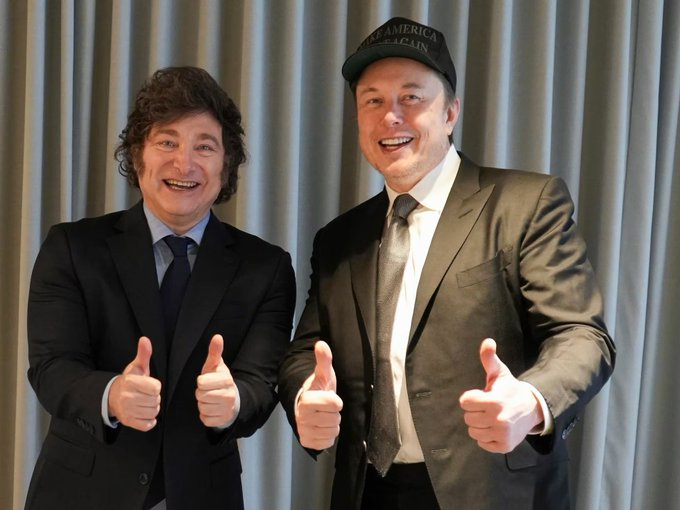
MILEI’S ‘CHAINSAW’ REFORMS SLASH GOVERNMENT—ARGENTINA LOVES IT AND ELON AGREES
One year in, Milei’s radical cuts are working—and his popularity is soaring. He axed 9 ministries, shut down 200 state offices, and slashed spending by 30%. Inflation plummeted from 25% per month to 2.7%. Argentina even posted a budget surplus. Deregulation is fueling a boom: Apartment supply tripled, rent prices halved, and new airline competition is driving fares down. Milei warns the “deep chainsaw” is next—and Elon says he’s making all the right moves. Source: Cato Institute,
@JMilei ,

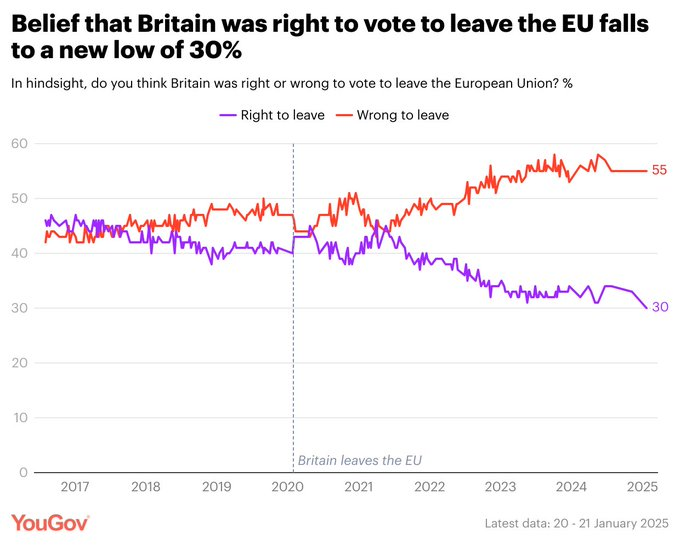
It’s now painfully obvious Brexit hasn’t worked, and is actively harming us economically. (It didn’t even control our bloody borders!) Given the British people would clearly vote overwhelmingly to go back into the EU, we should have another referendum.
Quote

YouGov
@YouGov
Jan 29 2025
The number of Britons saying the UK was right to vote to leave the EU has hit its lowest level since the referendum, ahead of the fifth anniversary of Brexit on Friday Right to vote to leave: 30% (-3 from Nov) Wrong to vote to leave: 55% (=)
Show more
01-30-2025 RAPID RESPONSE
The LinkedIn founder talks about his new book, ‘Superagency,’ and argues that people can use AI to reshape their daily work lives.

[Photo: RR]
BY Robert Safian 7 minute read Share
Reid Hoffman returns to Rapid Response to explore today’s AI landscape, and the future promised by a concept he calls “superagency.” Hoffman shares his vision for what an AI-infused workday will soon look like, how we should address society’s greatest fears about technology, and more. As we enter a daunting new era—politically, socially, and technologically—Hoffman urges listeners to choose curiosity over fear.
This is an abridged transcript of an interview from Rapid Response, hosted by Robert Safian, former editor-in-chief of Fast Company. From the team behind the Masters of Scale podcast, Rapid Response features candid conversations with today’s top business leaders navigating real-time challenges. Subscribe to Rapid Response wherever you get your podcasts to ensure you never miss an episode. https://art19.com/shows/674dce4f-cbe7-432b-b9b7-319222baf119/episodes/47fb02e8-5287-4909-9e72-1b8759618ff7/embed
So you have a new book out today called Superagency with coauthor Greg Beato. Some people have called the book a surprisingly positive take on AI and on humanity. I think the surprise is less about you being optimistic than about the topic, that there’s so much skepticism right now about the future of both AI and humanity.
Can you start first by defining the word agency, and then what superagency is beyond that?
AI, like other kinds of general-purpose technologies that have come before, gives us superpowers. Superpowers are like a car gives you superpower for mobility, the phone gives you superpowers for connectivity and information. AI gives you superpowers for the entire world of information, navigation, decision-making, etc.
And what superagency is, is not just when you as an individual get the superpower, but when you and many of the people around you, when millions of people throughout society also get that superpower. Just as a car doesn’t just transform your mobility, your ability to go somewhere, when other people’s mobility is similarly transformed, like a doctor can come for a house call, a friend can come to visit. So the society that you experience with this kind of superagency is when many people get the same superpowers, and we’re all benefiting from our own and from others’.
I mean, the fears around AI, I guess, are that AI will eventually limit human control. And when you’re talking about superagency, you’re sort of positing the opposite, that we’re going to have more control.
Well, it’s actually different, but more in some important ways. These technological transformations of agency are never only additive. They’re mostly additive. Like the car is broadly additive. But of course, if your agency was previously that you were a driver of a horse carriage, that agency changes.
Like when you have a phone, you can reach out to other people, but other people can also reach out to you. So you’re available. Agency kind of transforms in these cases. You can already see it if you start playing with these agents. You can now do things and accomplish things that you couldn’t accomplish before, which unlocks your ability to learn things, your ability to communicate things, your ability to do things faster and in more interesting ways.
That’s part of the reason why it’s really important that we actually play with these technologies. We engage with them. We do serious things with them. We do what I call in the book “iterative deployment,” and that’s what’s so important for us all engaging on this path heading towards superagency.
You’ve been preaching about the potential of AI for some time. You wrote a book with ChatGPT to demonstrate the potential. You’ve made digital twins of yourself to try demystifying it.
Not everyone is convinced. What do you feel like you have to fight most in getting people over this, and what prompted you to do the book now as a way to try to make that change?
My biggest hope and persuasion is that people who are AI fearful or skeptical may begin to add some AI curiosity and kind of say, “Hey, look, I should try to play with this.”
Part of what superagency is about is to say, look, it doesn’t just matter for yourself, but it’s other people getting exposure to this that will also be good for your life. For example, if you think about the fact that I have a smartphone, I have a medical assistant that is as good or better than the average doctor.
Would you rather have a radiologist read your X-ray scan, or would you rather have a radiologist with an AI?
advertisement
And the answer is with an AI every day of the week, eight days a week, because that then gives me a much better health outcome.
So it’s not just me and my superpowers, but other people gaining superpowers also helps me.
Even if I’m not engaging quite the way you would like me to most, I’m still going to get some of the benefits of this. It’s going to be part of cultural changes.
Ultimately how people get to adopting and adapting their lifestyle to these new technologies is because they begin to see, “Oh, actually, in fact, this is a new, very good thing.” As opposed to when cars were first introduced, they were considered so dangerous that they had to have a person walking in front of them, waving an orange flag.
Now, we got rid of that regulation very quickly. And it’s like, okay, well, they’re dangerous, but can we contain and shape the danger in ways that are small relative to this massive benefit of superagency and mobility?
AI acting on its own seems to be what scares people the most about it. But I’ve thought that the likelihood that I’m going to lose my job to an AI alone may happen at some point, but I’m more likely now to lose my job to someone who uses AI better than I do, right? Although if I’m losing my job, maybe it doesn’t matter that much either way, which one I’m losing it to.
Part of the thing that I love about thinking about technology is whenever you think there’s a problem, including a problem created by technology, you think, Can technology be a solution? So, yes, I do think that a lot of jobs will then start requiring the use of AI and AI agents as part of being professional. It’s a little bit like if you said, “Hey, I’m a professional today, and I don’t use a computer,” or “I don’t use a smartphone.” It’s like, no, not really good.
So there are technological requirements, which increase with new tool sets for doing jobs, and AI is definitely going to be one of those. That being said, part of the solution, you go, “Oh, my God, am I going to be out of a job?” Well, actually . . . this gets back to the book being for technologists and thinking about human agency: How do we help people have their agency to learn the new skills and say, “Hey, yes, my job is going to be taken over by a human using an AI.”
Well, how about that human being me? Or, okay, so this particular one doesn’t work, but how can the AI help me find a different job? In many ways, I think we will naturally get there, but I think, you know, just because we’ll naturally get there doesn’t mean we can’t get there better by being intentional in having design.
It’s one of the reasons I identify myself as a bloomer in the book versus a zoomer, because I don’t think that everything will just be great with technology.
I think we have to steer it intentionally, because when human beings encounter new general-purpose technologies as early as the printing press, all the rest of them, we mess up in various ways. We handle the transition of new technologies badly. And part of the reason why I’m doing this book, this podcast, things like this, is to try to say, “Let’s do this transition much better.” It doesn’t mean we won’t have suffering in the transition.
But if you embrace it with some agency, we can possibly make that both less painful and have more opportunities. We are entering into the cognitive industrial revolution, and all you have to do is look at any simple books about the industrial revolution to recognize transitions can be painful.
Let’s do this one better.

Subscribe
GERMANY: AfD leader Alice Weidel has taken a bold, Trumpian stance, vowing that within 100 days of taking office, she will seal Germany’s borders, slash asylum seeker subsidies, and initiate an unprecedented mass remigration effort.


