


-
Archives
- October 2026
- September 2026
- August 2026
- July 2026
- June 2026
- May 2026
- April 2026
- March 2026
- February 2026
- January 2026
- December 2025
- November 2025
- October 2025
- September 2025
- August 2025
- July 2025
- June 2025
- May 2025
- April 2025
- March 2025
- February 2025
- January 2025
- December 2024
- November 2024
- October 2024
- September 2024
- August 2024
- July 2024
- June 2024
- May 2024
- April 2024
- March 2024
- February 2024
- January 2024
- December 2023
- November 2023
- October 2023
- September 2023
- August 2023
- July 2023
- June 2023
- May 2023
- April 2023
- March 2023
- February 2023
- January 2023
- December 2022
- November 2022
- October 2022
- September 2022
- August 2022
- July 2022
- June 2022
- May 2022
- April 2022
- March 2022
- February 2022
- January 2022
- September 2021
- August 2021
- July 2021
- June 2021
- May 2021
- April 2021
- February 2021
- January 2021
- December 2020
- November 2020
- October 2020
- September 2020
- August 2020
- July 2020
- June 2020
- May 2020
- April 2020
- March 2020
- February 2020
- January 2020
- December 2019
- November 2019
- October 2019
- September 2019
- August 2019
- July 2019
- June 2019
- May 2019
- April 2019
- March 2019
- February 2019
- January 2019
- December 2018
- November 2018
- October 2018
- September 2018
- July 2018
- June 2018
- May 2018
- April 2018
- March 2018
- February 2018
- January 2018
- December 2017
- November 2017
- October 2017
- September 2017
- August 2017
- July 2017
- June 2017
- May 2017
- April 2017
- March 2017
- February 2017
- January 2017
- December 2016
- November 2016
- October 2016
- September 2016
- August 2016
- July 2016
- June 2016
- May 2016
- April 2016
- March 2016
- February 2016
- January 2016
- December 2015
- November 2015
- October 2015
- September 2015
- August 2015
- July 2015
- June 2015
- March 2015
- January 2015
-
Meta
Europe must step up nuclear defence to resist Russia | Former British ambo to NATO. Source: Times Radio
Posted in Uncategorized
Leave a comment
One of the Greatest ever anti-war (Iraq) speeches by the Late Tony Benn
Posted in Uncategorized
Leave a comment
Source: Mother Jones. Trumpian Chaos Has Infected the Planet’s Most Remote Research Outpost: Antarctica
Trumpian Chaos Has Infected the Planet’s Most Remote Research Outpost: Antarctica
“There’s a sense of unease on the station like people have never felt before.”

Coast Guard Cutter Polar Star visited Palmer Station, a USA research station on the Antarctic peninsula on March 3, 2023.U.S. Coast Guard / ZUMA
Fight disinformation: Sign up for the free Mother Jones Daily newsletter and follow the news that matters.
5th Msrch 2025
This story was originally published by WIRED and is reproduced here as part of the Climate Desk collaboration.
Few agencies have been spared as Elon Musk’s so-called Department of Government Efficiency (DOGE) has ripped through the United States federal government. Even in Antarctica, scientists and workers are feeling the impacts—and are terrified for what’s to come.
The United States Antarctic Program (USAP) operates three permanent stations in Antarctica. These remote stations are difficult to get to and difficult to maintain; scattered across the continent, they are built on volcanic hills, polar plateaus, and icy peninsulas.
But to the US, the science has been worth it. At these stations, more than 1,000 people each year come to the continent to live and work. Scientists operate a number of major research projects, studying everything from climate change and rising sea levels to the cosmological makeup and origins of the universe itself. With funding cuts and layoffs looming, Antarctic scientists and experts don’t know if their research will be able to continue, how US stations will be sustained, or what all this might mean for the continent’s delicate geopolitics
“Even brief interruptions will result in people walking away and not coming back,” says Nathan Whitehorn, an associate professor and Antarctic scientist at Michigan State University. “It could easily take decades to rebuild.”
MOTHER JONES TOP STORIES

00:15
03:12
Read More
One form for staffers “asked if you had a preference with which gender you housed with,” a source says. “That’s all been removed.”
The USAP is managed by the National Science Foundation. Last week, a number of NSF program managers staffed on Antarctic projects were fired as part of a wider purge at the agency. The program managers are critical for maintaining communication with the infrastructure and logistics arm of the NSF, and the contractors for the USAP, as well as planning deployment for scientists to the continent, keeping track of the budgets, and funding the maintenance and operations work. “I have no idea what we do without them,” says another Antarctic scientist who has spent time on the continent, who along with several others WIRED granted anonymity due to fears of retaliation.
“Without them, everything stops,” says a scientist whose NSF project manager was fired last week. “I have no idea who I am supposed to report to now or what happens to submitted proposals.”
Scientific research happens at all of the stations. At the Amundsen-Scott South Pole Station, scientists work on the South Pole Telescope and BICEP telescope, both of which study the cosmic background radiation and the evolution of the universe; IceCube, a cubic-kilometer detector designed to study neutrino physics and high energy emission from astrophysical sources; and the Atmospheric Research Observatory that studies climate science and is run by the National Oceanic and Atmospheric Administration. (Mass firings have also taken place at the NOAA.)
“The climate science [at the South Pole Station] is super unique,” an Antarctic scientist says. “The site has so little pollution that we call it ‘the cleanest air on Earth,’ and they have been monitoring the ozone layer and CO2 content in the atmosphere for many decades.”
Other directives from the Donald Trump administration have directly affected daily life on those stations. “Gender-inclusive terms on housing documents” have been removed from Antarctic staffer forms, a source familiar with the situation at McMurdo Station tells WIRED. “It asked if you had a preference with which gender you housed with,” the source says. “That’s all been removed.”
“The damage caused by gutting the [Antarctic] science budget like this is going to last generations.”
Staffers have already pushed back. “People have been painting waste bins saying “Antarctica is for ALL” in rainbow, people’s email signatures [have] pride additions, [others] keep adding preferred pronouns to emails,” the source says.
“There’s a sense of unease on the station like people have never felt before,” they add. “The job still has to get done, even though people feel like the next shoe can drop at any moment.”
That unease extends to their own job security. “There are some people currently at the South Pole that are worried about losing their jobs any day now,” a source with familiarity of the situation tells WIRED. Workers present at the station aren’t able to physically leave until October, and a midseason firing, or loss of funding, would present a unique set of challenges.
Sources are also bracing for at least a 50 percent reduction in the NSF’s budget due to DOGE cuts. These cuts are sending Antarctic scientists with assistants and graduate students scrambling. “We didn’t know if we could pay graduate students,” says one scientist. While research is conducted on the continent, scientists bring their findings back to the US to process and analyze. A lot of the funding also operates the science itself: For one project that requires electricity to run detectors, the scientist “was paranoid we would not be able to literally pay bills for an experiment starved for data.” That hasn’t come to fruition yet, but as funding cycles restart in the coming weeks and months, scientists are on tenterhooks.
Sources tell WIRED that Germany, Canada, Spain, and China have already started taking advantage of that uncertainty by recruiting US scientists focused on Antarctica.
“If the South Pole [station] is shut down, it’s basically nearly impossible to bring it back up. Everything will freeze.”
“Foreign countries are actively recruiting my colleagues, and some have already left,” says one Antarctic scientist. “My students are looking at jobs overseas now…people have been coming [to the US] to do science my whole life. Now people are going the other way.”
“Now is a great time to see if anyone wants to jump ship,” another Antarctic scientist says. “I do worry about a brain drain of tenured academics, or students who are shunted out.”
“The damage caused by gutting the [Antarctic] science budget like this is going to last generations,” says another.
Throughout DOGE’s cuts to the federal government, representatives have said that if something needs to be brought back, it could be. In some cases, reversals have already happened: The US Department of Agriculture said it accidentally fired staffers working on preventing the spread of bird flu and is trying to rehire them.
But in Antarctica, a reversal won’t necessarily work. “One of the really scary things about this is that if the Antarctic program budget is cut, then they’ll very quickly get to the point where they can’t even keep the station open, much less science projects going,” an Antarctic scientist tells WIRED. “If the South Pole [station] is shut down, it’s basically nearly impossible to bring it back up. Everything will freeze and get buried in snow. And some other country will likely immediately take over.
Others share this fear of a station takeover. “Even if science funding is cut back, there is an urgent need for the US to invest in icebreakers and polar airlift capability otherwise at some point the US-managed South Pole station might not be serviceable,” says Klaus Dodds, an Antarctic expert and professor of geopolitics at Royal Holloway University of London.
Experts are concerned that countries like Russia and China—who have already been eagle-eyed on continental influence—will quickly jostle to fill the power vacuum. “Presumably it would be humiliating for anyone who wishes to promote ‘America First’ to witness China offer to take over the occupation and management of the base at the heart of Antarctica. China is a very determined polar power,” says Dodds.
The political outcome of the US pulling back from its Antarctic research and presence could be dire, sources tell WIRED.
Antarctica isn’t owned by any one country. Instead it’s governed by the Antarctic Treaty System, which protects Antarctica and the scientific research taking place on the continent, and forbids mining and nuclear activity. Some countries, including China and Russia, have indicated that they would be interested in rule changes to the Treaty system, particularly around resource extraction and fishing restrictions. The US, traditionally, has played a key role in championing the treaty: “Many of the leading polar scientists and social scientists are either US citizens and/or have been enriched by contact with US-led programs,” says Dodds.
That leadership role could change quickly. The US also participates in a number of international collaborations involving major Antarctic scientific projects. A US pullback, Whitehorn says, “makes it very hard to regard the US as a reliable partner, so I think there will be a lot less interest in accepting US leadership in such things…The uncertainty will drive people away and sacrifice the leadership the US already has.”
“If the NSF can’t function, or we don’t fund it, projects with long lead times can just die,” another scientist says. “I’m sure international partners would be happy to partner elsewhere. This is what it means to lose US competitiveness.”
BEFORE YOU CLICK AWAY!
Mother Jones was founded to do journalism differently. We stand for justice and democracy. We reject false equivalence. We go after stories others don’t. We’re a nonprofit newsroom, because the kind of truth-telling investigations we do doesn’t happen under corporate ownership.
And the essential ingredient that makes all this possible? Readers like you.
It’s reader support that enables Mother Jones to devote the time and resources to report the facts that are too difficult, expensive, or inconvenient for other news outlets to uncover. Please help with a donation today if you can—even a few bucks will make a real difference. A monthly gift would be incredible.Donate Now
Posted in Uncategorized
Tagged antarctic, antarctica, science, science-fiction, travel
Leave a comment
VP Vance: Response to Tariffs: Bring companies back to the U.S. is the message.
Posted in Uncategorized
Leave a comment
Ian Bremmer on Why We’re Fucked
The Lincoln Project1.35M subscribers
Premiered Mar 4, 2025 The Lincoln Project Podcast
Political scientist, author, and entrepreneur Ian Bremmer — who’s also the founder and president of Eurasia Group and the founder of GZERO Media — stops by to chat with Rick about how we’re fucked, and why we’re fucked. There is nothing like sitting down with a good ole expert friend at the beginning of a potential World War to discuss the American economy, AI, global politics, and the growing dangers inside and outside the U.S. democratic government. ・・・・・・・・・・・・・・
Follow Ian Bremmer at @ianbremmer on X & @ianbremmer.com on Bluesky Check out more of Ian’s work at @eurasiagroup.net and @gzeromedia.com Follow Rick Wilson at @TheRickWilson on X & @therickwilson.bsky.social on Bluesky. Subscribe to Rick’s weekly writings on his Substack at therickwilson.substack.com. J#oin the fight with Lincoln Project at http://www.lincolnproject.us & follow us @ProjectLincoln on X & @lincolnproject.us on Bluesky. If you’d like to help us continue this critical work, visit https://action.lincolnproject.us/helplp to make a difference.
People mentioned
3 people
Donald Trump
President of the United States (2017–2021, 2025–present)
Joe Biden
President of the United States from 2021 to 2025
Posted in Uncategorized
Leave a comment
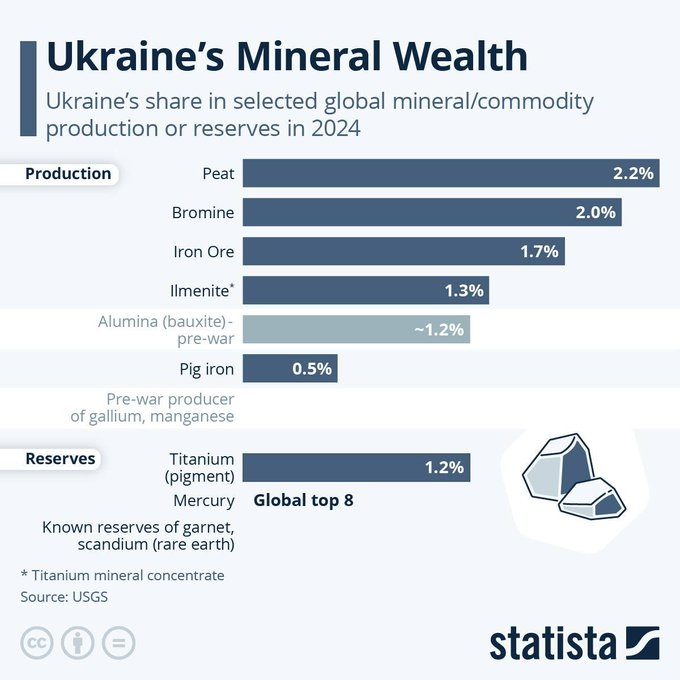
Ukraine Mineral Wealth

UKRAINE’S UNTAPPED MINERAL WEALTH
—WHY IT MATTERS
Ukraine isn’t just a battleground; it’s a resource powerhouse.
With key global shares in peat (2.2%), bromine (2.0%), and iron ore (1.7%), its natural wealth is undeniable.
It also holds 1.2% of the world’s titanium pigment reserves—critical for aerospace and defense—while ranking among the top 8 globally in mercury reserves.
Before the war, Ukraine was a major producer of gallium and manganese—key materials in high-tech industries. Source: Statista
Posted in Uncategorized
Leave a comment
Tariffs Hit: Here Comes the Trumpcession w/ Prof. Richard Wolff
Mar 5, 2025 The Socialist Program
Recession is looming in the U.S. again. Europe is becoming increasingly irrelevant in the global economy. Prof. Richard Wolff argues that Trump’s tariffs and push to increase military spending in NATO countries are acts of desperation in the face of a capitalist system starting to shake. Prof. Richard Wolff is an author & co-founder of the organization Democracy at Work. You can find his work at rdwolff.com. Listen to The Socialist Program’s full interview with Prof. Wolff on any podcast platform: ‘Trumpcession Is Coming’ Become a Patron of this show, including weekly interviews with Prof. Richard Wolff, at / thesocialistprogram
Posted in Uncategorized
Leave a comment
John Mearsheimer, Who Predicted Russia Ukraine War, Says Pro-Zelensky Europe ‘Coalition’ Won’t Last. Source:
CNBC Awaaz. 5.47M subscribers
Premiered 16 hours ago #keirstarmer#russiaukrainewar#zelenskyJohn Mearsheimer the prominent political scientist known for his controversial prediction of the Russia-Ukraine conflict, says Volodymyr Zelensky failed at the one job he had – to protect Ukraine, and therefore, he must step down. Mearsheimer also says UK’s announcement of a European ‘coalition of the willing’ to guarantee Ukraine’s security, will not come through.
Posted in Uncategorized
Leave a comment

