The fentanyl issue is a flimsy excuse to raise U.S. tariffs on Chinese imports. Our countermeasures to defend our rights and interests are fully legitimate and necessary. The U.S., not anyone else, is responsible for the #FentanylCrisis inside the U.S. In the spirit of humanity and goodwill towards the American people, we have taken robust steps to assist the U.S. in dealing with the issue. Instead of recognizing our efforts, the U.S. has sought to smear and shift blame to China, and is seeking to pressure and blackmail China with tariff hikes.They’ve been PUNISHING us for helping them. This is not going to solve the U.S.’s problem and will undermine our counternarcotics dialogue and cooperation. Intimidation does not scare us. Bullying does not work on us. Pressuring, coercion or threats are not the right way of dealing with China. Anyone using maximum pressure on China is picking the wrong guy and miscalculating. If the U.S. truly wants to solve the fentanyl issue, then the right thing to do is to consult with China by treating each other as equals. If war is what the U.S. wants, be it a tariff war, a trade war or any other type of war, we’re ready to fight till the end.
Meta (formerly Facebook) plans to build the world’s longest undersea cable that will be longer than the Earth is round. The high-capacity, fiber-optic cable that will link five continents will span a fantastic 31,000 miles (50,000 km) – for reference, the circumference of the Earth is 24,901 miles (40,075 km).
Undersea cables are one of those technologies that most of us are probably unaware of or assume to be some old-fashioned marginal holdover from the Victorian era. In fact, our global digital culture is utterly dependent on a vast network of cables running across every sea that are far from being marginal, carrying over 95% of all the telecommunication data between continents.
When the first successful transatlantic cable opened for business on August 16, 1858, it was something of a nine-day wonder. Though it could only carry about one byte of Morse code every two minutes, it heralded a new age.Oceans that once took weeks or months to span, were jumped over in seconds by messages tapped out on a telegraph key.
In less than 20 years, this single cable became an increasingly large and increasingly important network, with Britain linking its empire from London to India and beyond with cables under its sole control for security reasons.
Today, there are over 600 undersea cables linking the world together and maps of them look like some global underground railway network.Compared to them, the satellite links are almost an afterthought when it comes to sheer traffic flow.
This is one reason why events of recent years have gained the attention of the world’s government as Baltic Sea cables have been repeatedly cut under suspicious circumstances – especially around Finland and Sweden.
The early undersea cables were made of copper, though most of the thickness was made of a wrapping of steel cable for armor protection as well as layers of waterproof materials. Today, the cables use glass fibers that carry laser impulses instead of electricity.
According to Meta, the new multi-billion dollar cable will link the USA, India, Brazil, South Africa, and Australia and form a new backbone for the world’s data system.Aside from its length, the new cable will have a much larger capacity, with 24 fiber pairs, making it the largest of its kind ever built. It will be laid on the seabed to a depth of up to 4.3 miles (7 km), with some lengths in shallow waters being buried to protect against accidental or intentional interference.
Trump on Truth Social: “We should spend less time worrying about Putin, and more time worrying about migrant rape gangs (…) So that we don’t end up like Europe”
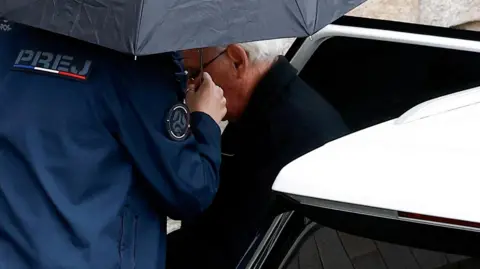
His name was in a child abuse diary – now his family listen to ‘vile’ testimony
Laura Gozzi
BBC News
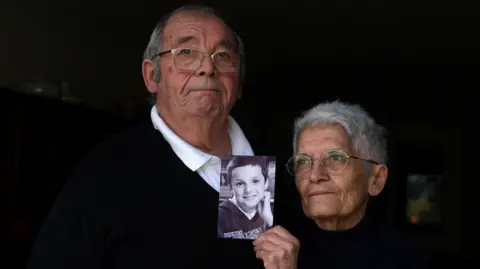
Mauricette Vinet and her husband Roland, holding a photograph of their grandson Mathis
This story contains distressing details from the start
When Mauricette Vinet speaks of her grandson, her voice grows warm with affection.
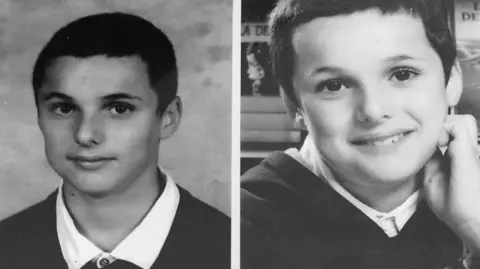
“He was a lovely little boy. He had a strong personality, for sure! But he always thought of others, always asked if he could help,” says the French retiree, in her 80s.
“He loved to be out in the garden with his grandfather, picking green beans. He was a charming boy, Mathis,” she adds.
“But, as you know, there was a ‘before’ – and there was an ‘after’.”
Mauricette and her husband Roland are among the 267 plaintiffs who have pressed charges against Joël Le Scouarnec, the French former surgeon who is accused of abusing almost 300 people – mostly children, and almost all his patients – over the course of several decades. The trial started in Vannes, Brittany, on Monday.
Le Scouarnec and Mathis only crossed paths once, when Mathis, aged 10, was hospitalised overnight at the clinic in the small French north-western town of Quimperlé. Le Scouarnec – a mild-mannered, respected gastrointestinal surgeon – told Mathis’ parents the boy had to be kept overnight for checks.
It turned out Mathis only had a stomach ache, and he was sent home the next day. But Mauricette is convinced the brief hospital stay changed Mathis forever.
Mathis as a young boy, in photos shared by his grandmother Mauricette
“The unease set in, little by little. It happened gradually in the first year; then he stopped being happy and became aggressive with everyone,” she tells the BBC.
There is no way to establish conclusively whether Mathis’ troubles were linked to the surgeon. What is certain is that in his teenage years Mathis distanced himself from his family and started using increasingly hard drugs; later, he spent time in detox and rehab centres.
Then, in 2018, police knocked on his door.
They told him a man named Joël Le Scouarnec had been arrested the year before for raping his six-year-old neighbour. During a search of the surgeon’s home, police uncovered stacks of diaries and hard disks in which Le Scouarnec appeared to list hundreds more victims. Mathis’ name was among them.
Mauricette said Mathis told her police then read out an excerpt of the diary to him, which seemed to detail abuse Le Scouarnec’s inflicted on him during his hospital stay.
“Then they left. Mathis shut the door and was left on his own, with no help. And that was the beginning of a descent into hell,” Mauricette says.
The police visit helped Mathis make sense of flashbacks that had long plagued him, Mauricette says: “His malaise finally made sense; he traced it to the source.”
Mathis pressed charges against Le Scouarnec, but the revelations sent him down a spiral which came to an abrupt end on 14 April 2021, when Mathis overdosed and died. He was 24.
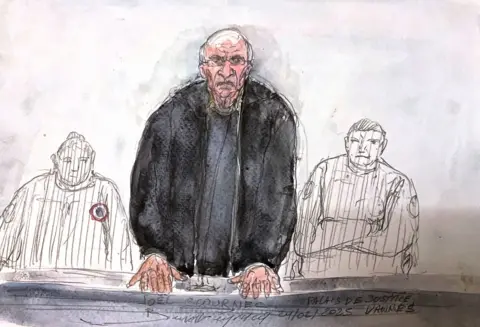
Court sketch created on February 24, 2025 shows retired surgeon Joel Le Scouarnec speaking during a hearing on the opening day of his trial
Mauricette and her husband pressed charges the very next day, and they are now listed as “indirect victims” of Le Scouarnec.They have attended court in Vannes, north-western France, every day since the trial opened on Monday.
It has not been an easy listen.
The testimony of witnesses – mostly close relatives of Le Scouarnec, now 74 – painted a picture of an apparently ordinary middle-class family which, behind the scenes, has been ravaged by child abuse, incest and sexual violence.
Annie, Le Scouarnec’s sister, said she had been “taught to keep quiet”.
This week, it was all brought out in the open.
All three sons of Le Scouarnec struck an almost apologetic tone as they told the court about their happy childhoods with a cultured, intellectual father who may not have been particularly present but who was kind, patient and supportive.
“We had holidays, nice houses – everything that constitutes a normal family,” said one.
The youngest son – who said he stopped contact with Le Scouarnec in 2017 “to preserve the image of him I have from my childhood” – said he now “looked upon everyone with distrust” and never left his own toddler alone with anybody.
“I am always worried that if my father could do this then my neighbour could, my partner, anyone,” the 37-year-old said.
Later the middle son – a tall man in his early 40s who admitted he was a “not totally abstinent alcoholic” – shared his memories of being abused at the hands of his paternal grandfather, Le Scouarnec’s father. ****
He was shocked as he was told for the first time in court that among his father’s alleged victims were some of his childhood friends.
Le Scouarnec admits the majority of the charges against him, his lawyer has said
And, on Friday, a stunned silence descended upon the courtroom as Le Scouarnec admitted he had abused his granddaughter – his eldest son’s daughter when she was under five years old. Moments after the revelation, the 44-year-old and his partner left the room to be assisted by a psychologist.
Other witnesses sparked consternation in the plaintiffs. Due to their sheer number, they sit in a separate room – a former university lecture hall – and follow proceedings via video link.
Christian D., a friend of Le Scouarnec now aged 80, often answered questions from the court sarcastically and repeatedly minimised the events at the centre of the trial, declaring that he could not “afford to cry over everything that happened in the world”.
Later, he insisted that he “never saw anything, therefore had nothing to say” about the devastating allegations against his friend. When he stated that he would take in Le Scouarnec if he was ever to leave jail, many alleged victims in the lecture hall got up and left their seats.
But most difficult for Mauricette and Roland was the much-awaited testimony of Marie-France L., Le Scouarnec’s ex-wife.
It has been alleged that she was at the centre of the omerta that reigned in the Le Scouarnec family, as she was repeatedly made aware of her husband’s obsession with children but did nothing to stop it.
Many lawyers and plaintiffs now believe she could have spared hundreds of children from being abused. Le Scouarnec’s brother – who was also heard this week – openly wondered whether she had been too enamoured by the lifestyle provided by her husband’s salary to speak out.
Marie-France has always denied this and, at the stand, was frequently defiant in the face of the accusations levelled at her.
“Catastrophe has struck: she knows I am a paedophile,”Le Scouarnec wrote as early as the mid-1990s in his diary. “Perhaps he was talking about his conscience,” Marie-France told the court.
She also suggested her five-year-old niece – who Le Scouarnec has been convicted of raping – had most likely “manipulated” her husband.
“She’s devious, that one. She loves the attention,” she said. Later, she complained that she was being “blamed” for everything. Only when she was shown an indecent photo montage Le Scouarnec made of their son as a child did she look visibly shocked.
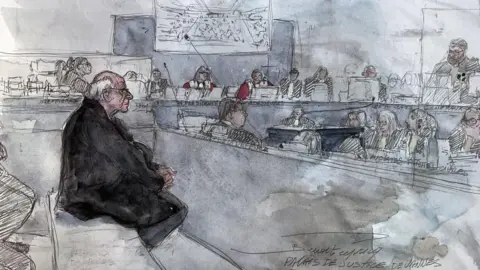
Joël Le Scouarnec’s trial is due to last until June
“That was absolute theatre,” Mauricette told the BBC, adding that Christian D.’s testimony had been “vile” and that she thought Marie-France was living in “pure denial”.
As the gut-wrenching events played out, Le Scouarnec sat in his box – mostly reactionless, but at times noticeably agitated, his voice cracking as he asked his sons for forgiveness. He flinched when excerpts of his diary were read out, and averted his eyes as indecent photographs he took of his nieces were shown.
His lawyers have said he admits to the “majority” of the charges against him, and that he will explain himself over the course of the trial, which is due to last until June.
The alleged victims will take the stand from next week; Mauricette and Roland will do so in April. “I will look at Le Scouarnec and tell him what is deep in my heart – he killed my grandson,” Mauricette says.
“Not with a gun, but he killed him,” she adds. “He’s going to get 20 years, but his victims… will have to live with this their whole lives.
“Their sentences will be longer than his.”
Throughout the week, over in the victims’ hall, people came and went, but the majority stayed for hours on end each day.
As descriptions of trauma and abuse poured in, one middle-aged woman covered her face with her hand and kept it there a long time.
Next to her, a young man rubbed his eyes repeatedly, then stood up and left.
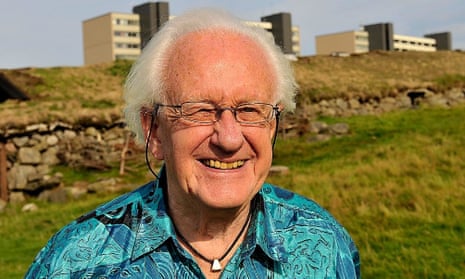
The Norwegian sociologist Johan Galtung, who has died aged 93, was a leading contributor to peace and conflict research. His ideas about positive peace and structural violence have had a global resonance.Now taught in more than 500 universities, the field he helped to establish has become a worldwide endeavour to develop systematic knowledge about the causes of violence, the conditions of peace and the means of effective peacebuilding.
When he was called up to the Norwegian army in 1951, Galtung had a crisis of conscience. Should he follow his father’s example and go into the army, or should he refuse to serve? He decided to refuse.
But it was not enough just to say no. Feeling a “palpable disgust” for war, Galtung wanted to find an alternative. He asked a librarian for books on the study of peace. She said no such books existed. This was the moment his mission in life became clear. He would set about developing peace studies himself.
Galtung used his six months in prison as a conscientious objector to read the writings of Gandhi. With his mentor, the philosopher Arne Naess, he extracted a set of 81 norms for nonviolent conflict behaviour. The book and articles they wrote served as a foundation for Galtung’s later thinking.
He studied at the University of Oslo, gaining a postgraduate degree in mathematics in 1956, the year of his marriage to Ingrid Eide, a sociologist and later minister in Norway’s Labour party government. Active in student politics, he learned to speak eight languages and read widely in history, psychology, economics and international relations.
In 1957 he was awarded a doctoral degree in sociology and took up an assistant professorship in sociology at Columbia University, New York.
There he absorbed behavioural social science and statistical methods. Rather than accept tenure, he returned to Oslo and set up a department for conflict and peace research in the Norwegian Institute for Social Research, together with Eide.
In 1966 this department became the Peace Research Institute Oslo (Prio), with Galtung as its first director. It was also the home of the Journal of Peace Research, which Galtung founded in 1964. Both still perform leading roles in the field.
In a series of powerful articles for the journal, Galtung laid out a conceptual basis for peace studies. It should cover both direct violence (the application of physical force to hurt or kill) and structural violence (the deprivation of life chances as a result of social structures). To these he paired negative peace (the absence of direct violence) and positive peace (the absence of structural violence). The task of peace studies should be to pursue both negative and positive peace. To some, this risked peace studies becoming a “black hole”, with no limits on its scope.
He saw conflict as an opportunity for positive change, and advocated finding creative ways to reconcile differences
But Galtung insisted on the need for a comprehensive approach. Development was a condition of peace. In 1977 he left his chair in peace studies at the University of Oslo to take up a project on the goals, processes and indicators of development at the United Nations University in Tokyo. A central challenge was to find ways to alleviate the consequences of conflict.
Galtung made significant contributions towards a theory of conflict and conflict transformation. He saw conflict as an opportunity for positive change, and advocated transcending difference by finding creative ways to reconcile differences.
He argued that if the Versailles treaty had been rescinded in 1924, and Germany helped through its economic difficulties, the second world war and the Holocaust could have been avoided. He went on to propose solutions for many of the world’s conflicts.
With Eide he had two sons, Harald and Andreas. They divorced in 1968. The following year he married Fumi (Fumiko) Nishimura, and they had a daughter, Irene, and son, Fredrik.
In 1993 he and Nishimura founded Transcend International, a global network for peace, development and environment dedicated to bringing about a more equitable and less violent world through conflict transformation and mediation.
One success for Transcendcame in 1995, when Ecuador’s chief negotiator took up Galtung’s proposal for a binational nature park to settle the disputed border with Peru. It was incorporated in the treaty of Brasilia, which ended the conflict in 1998. Galtung also proposed the idea of peace journalism, based on balanced reporting of peace and conflict, rather than news values based on violence.
Born in Oslo, Johan was the son of Helga (nee Holmboe) and August Galtung, an ear nose and throat surgeon. He was nine when Hitler invaded Norway. In April 1940, the German heavy cruiser Blücher, leading the assault on Oslo, was sunk by Norwegian torpedoes. Galtung’s father was called upon to treat the wounded. Johan remembered asking him whether he was tempted to let his scalpel slip a little.
“Absolutely not!” his father replied. “The most essential duty of a physician is to save lives, anyone’s life, without distinction.” Galtung later took this as a norm for peace research. It should be a field for humanity, not any particular country. Diagnosis, prognosis and therapy should be the peace researchers’ concerns.
In 1944 Galtung’s father was rounded up with other prominent Norwegians and sent to a Nazi concentration camp. Every day his family feared they would hear of his execution. But he was released unharmed a month before the war ended. Galtung later spoke of his influence, notably of the need to be conscious of what you are doing, rather than just go along with what you are supposed to do.
As an inspirational, charismatic and eclectic speaker, Galtung connected with grassroots peacebuilders who thought outside the box. In 2011 he founded the Galtung Institute to ensure that his work in “peace theory and peace practice” continued. His contribution was recognised through his many honorary degrees, visiting professorships and, in 1987, the Right Livelihood award.
He is survived by Nishimura and his children.
Johan Vincent Galtung, peace studies pioneer, born 24 October 1930; died 17 February 2024
The Japan Times (@japantimes) posted at 1:05 am on Sun, Mar 02, 2025:
An artificial intelligence-driven humanoid robot called AIREC is a prototype future “caregiver” for Japan’s rapidly aging population and chronic shortage of aged-care workers.
Don’t believe Team Biden’s “unprovoked invasion” narrative. In three words (10-minute video), Professor Jeffrey Sachs, Columbia University, compellingly explains the origin of the war in #Ukraine: Reckless NATO expansion! https://x.com/ivan_8848/status/1852163971501166661/video/1
to start lecturing the US President They should be aware that this administration knows exactly whats happened in Ukraine and what’s happening there now. The US is “Under new Managment”
Bishop Athanasius Schneider speaks very clearly: “They are not refugees, they are invaders who want to Islamize Europe! They want to destroy historical culture in Europe!”
Bishop Athanasius Schneider speaks very clearly: "They are not refugees, they are invaders who want to Islamize Europe! They want to destroy historical culture in Europe!" pic.twitter.com/tKBSWCnOny