Professor of American studies at the Clinton Institute Scott Lucas tells Times Radio’s Maddie Hale that Donald Trump just gave Elon Musk his first “slap on the wrist” when the US President told cabinet secretaries that only they can make decisions about cutting staff from government departments, not Elon Musk or his Department of Government Efficiency. Join this channel to get access to perks –
A weekly collection of thought-provoking articles on tech, innovation, and long-term investing from Nightview Capital’s Eric Markowitz.
Fields marked with an * are required
This is an installment of The Nightcrawler, a weekly collection of thought-provoking articles on tech, innovation, and long-term investing by Eric Markowitz of Nightview Capital. You can get articles like this one straight to your inbox every Friday evening by subscribing above. Follow him on X: @EricMarkowitz.
I’m in London this week for research and meetings, and a recurring theme keeps surfacing in my conversations: how is the nature of research evolving in a post-AI world?
What’s clear is that Deep Research functions on OpenAI and Grok 3 are now surpassing human capabilities in many ways. Even David Perell, known for his widely popular writing courses, recently announced he’s winding down his business — calling it an “existential crisis” — largely because AI is reshaping what it means to be a writer.
My view is evolving, but ultimately rather simple: the real value in research will accrue to those who prioritize in-person conversations, first-hand insights, and developing conviction — while leveraging AI for the heavy lifting of background work. As David writes: “The world of non-fiction writing has fundamentally changed, and many of the skills I’ve developed and built my career on are becoming increasingly irrelevant.”
Key quote:“The amount of expertise required to out-do an LLM is rising fast. For example, the quality of a well-prompted, ChatGPT Deep Research report is already higher than what I can produce in a day’s worth of work on almost any subject. The question is: What kinds of non-fiction writing will continue to last? Here’s a heuristic: The more a piece of writing comes from personal experience, the less it’s likely to be overtaken by AI. Personal writing, like biographies and memoirs, aren’t going away anytime soon. That’s because people have data about their lives that LLMs don’t have.”
Inside the “Ludic Fallacy”: The psychology of probabilities
Long-term investing isn’t about being right all the time. It’s about maximizing wins — and minimizing losses. Simple in theory; hard in practice.
Counterpoint Global’s latest report — authored by Michael Mauboussin and Dan Callahan — explores this idea through concepts like the Babe Ruth effect (embracing strikeouts for big wins), the hedgehog vs. fox mindset (updating views vs. clinging to one big idea), and behavioral psychology’s role in decision-making, including loss aversion and overconfidence. It also examines the ludic fallacy — the mistake of applying neat probabilities to a messy, uncertain world — highlighting how investors often misprice risk by treating markets like predictable games.
The key takeaway? Successful investing isn’t about perfect predictions. It’s about understanding expected value in an increasingly complex, unpredictable world.
Key quote: “Price is the relatively easy part. Buying or selling securities incurs transaction costs, and the magnitude of those costs depends on factors such as the liquidity of the security. But price is transparent and investors can estimate market impact. Value is the hard part. This is because value is really ‘expected value,’ which represents a range of potential payoffs with associated probabilities. Investing is an inherently probabilistic activity. The concept of expected value raises lots of issues that we will explore.”
Key quote: “AI is progressing so fast that its researchers are freaking out. It is now routinely more intelligent than humans, and its speed of development is accelerating. New developments from the last few weeks have accelerated it even more. Now, it looks like AIs can be more intelligent than humans in 1-5 years, and intelligent like gods soon after. We’re at the precipice, and we’re about to jump off the cliff of AI superintelligence, whether we want to or not. When are we jumping? What’s at the bottom? Do we have a parachute?”
Key quote: “When you meet pen and paper with undivided attention, curiosity, and courage, you find a gate to your underworld. Like Dante, you must journey through the world of shadows and face all aspects of your being. When you emerge and see the light again, you get a chance to re-write our story. You also get a shot at transcendence.”
Key quote: “Satya Nadella on: Why he doesn’t believe in AGI but does believe in 10% economic growth, Microsoft’s new topological qubit breakthrough and gaming world models, and whether Office commoditizes LLMs or the other way around.”
This prescient article told us the truth of the war in Ukraine, ten years ago. “Having masterminded the coup in February against the democratically elected government in Kiev, Washington’s planned seizure of Russia’s historic, legitimate warm-water naval base in Crimea failed. The Russians defended themselves, as they have done against every threat and invasion from the west for almost a century. “But Nato’s military encirclement has accelerated, along with US-orchestrated attacks on ethnic Russians in Ukraine. If Putin can be provoked into coming to their aid, his pre-ordained “pariah” role will justify a Nato-run guerrilla war that is likely to spill into Russia itself.” #JohnPilger
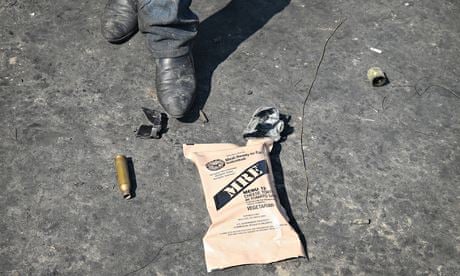
A pro-Russian activist with a shell casing and a US-made meal pack that fell from a Ukrainian army APC in an attack on a roadblock on 3 May in Andreevka, Ukraine. Photograph: Scott Olson/Getty
Why do we tolerate the threat of another world war in our name? Why do we allow lies that justify this risk? The scale of our indoctrination, wrote Harold Pinter, is a “brilliant, even witty, highly successful act of hypnosis”, as if the truth “never happened even while it was happening”.
Every year the American historian William Blum publishes his “updated summary of the record of US foreign policy” which shows that, since 1945, the US has tried to overthrow more than 50 governments, many of them democratically elected; grossly interfered in elections in 30 countries; bombed the civilian populations of 30 countries; used chemical and biological weapons; and attempted to assassinate foreign leaders.
In many cases Britain has been a collaborator. The degree of human suffering, let alone criminality, is little acknowledged in the west, despite the presence of the world’s most advanced communications and nominally most free journalism. That the most numerous victims of terrorism – “our” terrorism – are Muslims, is unsayable.That extreme jihadism, which led to 9/11, was nurtured as a weapon of Anglo-American policy (Operation Cyclone in Afghanistan) is suppressed.In April the US state department noted that, following Nato’s campaign in 2011, “Libya has become a terrorist safe haven“.
The name of “our” enemy has changed over the years, from communism to Islamism, but generally it is any society independent of western power and occupying strategically useful or resource-rich territory, or merely offering an alternative to US domination. The leaders of these obstructive nations are usually violently shoved aside, such as the democrats Muhammad Mossedeq in Iran, Arbenz in Guatemala and Salvador Allende in Chile, or they are murdered like Patrice Lumumba in the Democratic Republic of Congo. All are subjected to a western media campaign of vilification – think Fidel Castro, Hugo Chávez, now Vladimir Putin.
Washington’s role in Ukraine is different only in its implications for the rest of us. For the first time since the Reagan years, the US is threatening to take the world to war. With eastern Europe and the Balkans now military outposts of Nato, the last “buffer state” bordering Russia – Ukraine – is being torn apart by fascist forces unleashed by the US and the EU. We in the west are now backing neo-Nazis in a country where Ukrainian Nazis backed Hitler.
Having masterminded the coup in February against the democratically elected government in Kiev, Washington’s planned seizure of Russia’s historic, legitimate warm-water naval base in Crimea failed. The Russians defended themselves, as they have done against every threat and invasion from the west for almost a century.
But Nato’s military encirclement has accelerated, along with US-orchestrated attacks on ethnic Russians in Ukraine.If Putin can be provoked into coming to their aid, his pre-ordained “pariah” role will justify a Nato-run guerrilla war that is likely to spill into Russia itself.
Instead, Putin has confounded the war party by seeking an accommodation with Washington and the EU, by withdrawing Russian troops from the Ukrainian border and urging ethnic Russians in eastern Ukraine to abandon the weekend’s provocative referendum. These Russian-speaking and bilingual people – a third of Ukraine’s population – have long sought a democratic federation that reflects the country’s ethnic diversity and is both autonomous of Kiev and independent of Moscow. Most are neither “separatists” nor “rebels”, as the western media calls them, but citizens who want to live securely in their homeland.
Like the ruins of Iraq and Afghanistan, Ukraine has been turned into a CIA theme park – run personally by CIA director John Brennan in Kiev, with dozens of “special units” from the CIA and FBI setting up a “security structure” that oversees savage attacks on those who opposed the February coup. Watch the videos, read the eye-witness reports from the massacre in Odessa this month. Bussed fascist thugs burned the trade union headquarters, killing 41 people trapped inside. Watch the police standing by.
A doctor described trying to rescue people, “but I was stopped by pro-Ukrainian Nazi radicals. One of them pushed me away rudely, promising that soon me and other Jews of Odessa are going to meet the same fate. What occurred yesterday didn’t even take place during the fascist occupation in my town in world war two. I wonder, why the whole world is keeping silent.” [see footnote]
Russian-speaking Ukrainians are fighting for survival. When Putin announced the withdrawal of Russian troops from the border, the Kiev junta’s defence secretary, Andriy Parubiy – a founding member of the fascist Svoboda party – boasted that attacks on “insurgents” would continue.In Orwellian style, propaganda in the west has inverted this to Moscow “trying to orchestrate conflict and provocation“, according to William Hague. His cynicism is matched by Obama’s grotesque congratulations to the coup junta on its “remarkable restraint” after the Odessa massacre. The junta, says Obama, is “duly elected”. As Henry Kissinger once said: “It is not a matter of what is true that counts, but what is perceived to be true.”
In the US media the Odessa atrocity has been played down as “murky” and a “tragedy” in which “nationalists” (neo-Nazis) attacked “separatists” (people collecting signatures for a referendum on a federal Ukraine). Rupert Murdoch’s Wall Street Journal damned the victims – “Deadly Ukraine Fire Likely Sparked by Rebels, Government Says“. Propaganda in Germany has been pure cold war, with the Frankfurter Allgemeine Zeitung warning its readers of Russia’s “undeclared war”. For the Germans, it is a poignant irony that Putin is the only leader to condemn the rise of fascism in 21st-century Europe.
A popular truism is that “the world changed” following 9/11. But what has changed? According to the great whistleblower Daniel Ellsberg, a silent coup has taken place in Washington and rampant militarism now rules.The Pentagon currently runs “special operations” – secret wars – in 124 countries. At home, rising poverty and a loss of liberty are the historic corollary of a perpetual war state. Add the risk of nuclear war, and the question is: why do we tolerate this?
The following footnote was appended on 16 May 2014: The quotation from a doctor who says he was “stopped by pro-Ukrainian Nazi radicals” was from an account on a Facebook page that has subsequently been removed.
Coast Guard Cutter Polar Star visited Palmer Station, a USA research station on the Antarctic peninsula on March 3, 2023.U.S. Coast Guard / ZUMA
Fight disinformation: Sign up for the free Mother Jones Daily newsletter and follow the news that matters.
5th Msrch 2025
This story was originally published by WIRED and is reproduced here as part of the Climate Deskcollaboration.
Few agencies have been spared as Elon Musk’s so-called Department of Government Efficiency (DOGE) has ripped through the United States federal government. Even in Antarctica, scientists and workers are feeling the impacts—and are terrified for what’s to come.
The United States Antarctic Program (USAP) operates three permanent stations in Antarctica. These remote stations are difficult to get to and difficult to maintain; scattered across the continent, they are built on volcanic hills, polar plateaus, and icy peninsulas.
But to the US, the science has been worth it. At these stations, more than 1,000 people each year come to the continent to live and work. Scientists operate a number of major research projects, studying everything from climate change and rising sea levels to the cosmological makeup and origins of the universe itself. With funding cuts and layoffs looming, Antarctic scientists and experts don’t know if their research will be able to continue, how US stations will be sustained, or what all this might mean for the continent’s delicate geopolitics
“Even brief interruptions will result in people walking away and not coming back,” says Nathan Whitehorn, an associate professor and Antarctic scientist at Michigan State University. “It could easily take decades to rebuild.”
One form for staffers “asked if you had a preference with which gender you housed with,” a source says. “That’s all been removed.”
The USAP is managed by the National Science Foundation. Last week, a number of NSF program managers staffed on Antarctic projects were fired as part of a wider purge at the agency. The program managers are critical for maintaining communication with the infrastructure and logistics arm of the NSF, and the contractors for the USAP, as well as planning deployment for scientists to the continent, keeping track of the budgets, and funding the maintenance and operations work. “I have no idea what we do without them,” says another Antarctic scientist who has spent time on the continent, who along with several others WIRED granted anonymity due to fears of retaliation.
“Without them, everything stops,” says a scientist whose NSF project manager was fired last week. “I have no idea who I am supposed to report to now or what happens to submitted proposals.”
Scientific research happens at all of the stations. At the Amundsen-Scott South Pole Station, scientists work on the South Pole Telescope and BICEP telescope, both of which study the cosmic background radiation and the evolution of the universe; IceCube, a cubic-kilometer detector designed to study neutrino physics and high energy emission from astrophysical sources; and the Atmospheric Research Observatory that studies climate science and is run by the National Oceanic and Atmospheric Administration. (Mass firings have also taken place at the NOAA.)
“The climate science [at the South Pole Station] is super unique,” an Antarctic scientist says. “The site has so little pollution that we call it ‘the cleanest air on Earth,’ and they have been monitoring the ozone layer and CO2 content in the atmosphere for many decades.”
Other directives from the Donald Trump administration have directly affected daily life on those stations. “Gender-inclusive terms on housing documents” have been removed from Antarctic staffer forms, a source familiar with the situation at McMurdo Station tells WIRED. “It asked if you had a preference with which gender you housed with,” the source says. “That’s all been removed.”
“The damage caused by gutting the [Antarctic] science budget like this is going to last generations.”
Staffers have already pushed back. “People have been painting waste bins saying “Antarctica is for ALL” in rainbow, people’s email signatures [have] pride additions, [others] keep adding preferred pronouns to emails,” the source says.
“There’s a sense of unease on the station like people have never felt before,” they add. “The job still has to get done, even though people feel like the next shoe can drop at any moment.”
That unease extends to their own job security. “There are some people currently at the South Pole that are worried about losing their jobs any day now,” a source with familiarity of the situation tells WIRED. Workers present at the station aren’t able to physically leave until October, and a midseason firing, or loss of funding, would present a unique set of challenges.
Sources are also bracing for at least a 50 percent reduction in the NSF’s budget due to DOGE cuts. These cuts are sending Antarctic scientists with assistants and graduate students scrambling. “We didn’t know if we could pay graduate students,” says one scientist. While research is conducted on the continent, scientists bring their findings back to the US to process and analyze. A lot of the funding also operates the science itself: For one project that requires electricity to run detectors, the scientist “was paranoid we would not be able to literally pay bills for an experiment starved for data.” That hasn’t come to fruition yet, but as funding cycles restart in the coming weeks and months, scientists are on tenterhooks.
Sources tell WIRED that Germany, Canada, Spain, and China have already started taking advantage of that uncertainty by recruiting US scientists focused on Antarctica.
“If the South Pole [station] is shut down, it’s basically nearly impossible to bring it back up. Everything will freeze.”
“Foreign countries are actively recruiting my colleagues, and some have already left,” says one Antarctic scientist. “My students are looking at jobs overseas now…people have been coming [to the US] to do science my whole life. Now people are going the other way.”
“Now is a great time to see if anyone wants to jump ship,” another Antarctic scientist says. “I do worry about a brain drain of tenured academics, or students who are shunted out.”
“The damage caused by gutting the [Antarctic] science budget like this is going to last generations,” says another.
Throughout DOGE’s cuts to the federal government, representatives have said that if something needs to be brought back, it could be. In some cases, reversals have already happened: The US Department of Agriculture said it accidentally fired staffers working on preventing the spread of bird flu and is trying to rehire them.
But in Antarctica, a reversal won’t necessarily work. “One of the really scary things about this is that if the Antarctic program budget is cut, then they’ll very quickly get to the point where they can’t even keep the station open, much less science projects going,” an Antarctic scientist tells WIRED. “If the South Pole [station] is shut down, it’s basically nearly impossible to bring it back up. Everything will freeze and get buried in snow. And some other country will likely immediately take over.
Others share this fear of a station takeover. “Even if science funding is cut back, there is an urgent need for the US to invest in icebreakers and polar airlift capability otherwise at some point the US-managed South Pole station might not be serviceable,” says Klaus Dodds, an Antarctic expert and professor of geopolitics at Royal Holloway University of London.
Experts are concerned that countries like Russia and China—who have already been eagle-eyed on continental influence—will quickly jostle to fill the power vacuum. “Presumably it would be humiliating for anyone who wishes to promote ‘America First’ to witness China offer to take over the occupation and management of the base at the heart of Antarctica. China is a very determined polar power,” says Dodds.
The political outcome of the US pulling back from its Antarctic research and presence could be dire, sources tell WIRED.
Antarctica isn’t owned by any one country. Instead it’s governed by the Antarctic Treaty System, which protects Antarctica and the scientific research taking place on the continent, and forbids mining and nuclear activity. Some countries, including China and Russia, have indicated that they would be interested in rule changes to the Treaty system, particularly around resource extraction and fishing restrictions. The US, traditionally, has played a key role in championing the treaty: “Many of the leading polar scientists and social scientists are either US citizens and/or have been enriched by contact with US-led programs,” says Dodds.
That leadership role could change quickly. The US also participates in a number of international collaborations involving major Antarctic scientific projects. A US pullback, Whitehorn says, “makes it very hard to regard the US as a reliable partner, so I think there will be a lot less interest in accepting US leadership in such things…The uncertainty will drive people away and sacrifice the leadership the US already has.”
“If the NSF can’t function, or we don’t fund it, projects with long lead times can just die,” another scientist says. “I’m sure international partners would be happy to partner elsewhere. This is what it means to lose US competitiveness.”
BEFORE YOU CLICK AWAY!
Mother Jones was founded to do journalism differently. We stand for justice and democracy. We reject false equivalence. We go after stories others don’t. We’re a nonprofit newsroom, because the kind of truth-telling investigations we do doesn’t happen under corporate ownership.
And the essential ingredient that makes all this possible? Readers like you.
It’s reader support that enables Mother Jones to devote the time and resources to report the facts that are too difficult, expensive, or inconvenient for other news outlets to uncover. Please help with a donation today if you can—even a few bucks will make a real difference. A monthly gift would be incredible.Donate Now