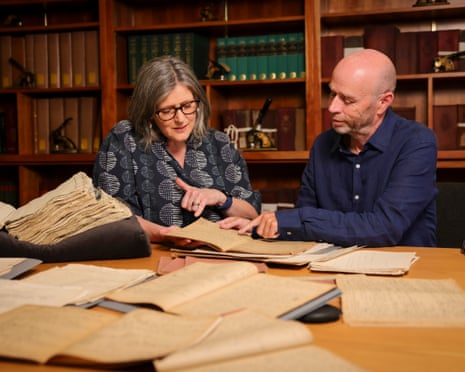
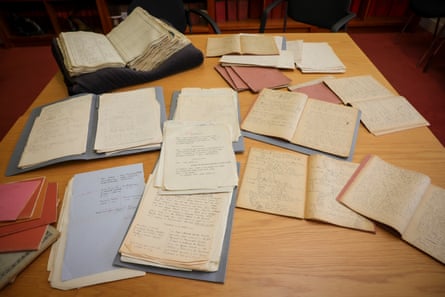
Zoë Reid, keeper of manuscripts at the National Archives of Ireland, examines records with the census specialist Brian Gurrin. Photograph: Chris Bellew/Fennell Photography
Seven centuries of lost historical records covering espionage, political corruption and the lives of ordinary people in Ireland have been recovered and released.
A pioneering project to fill gaps in Irish history is making 175,000 more records and millions more words of searchable content freely available to researchers and members of the public.
The Virtual Record Treasury of Ireland, a global academic collaboration led by Trinity College Dublin, deployed historians, computer scientists and other specialists to digitally recreate parts of a vast archive destroyed in Ireland’s civil war.
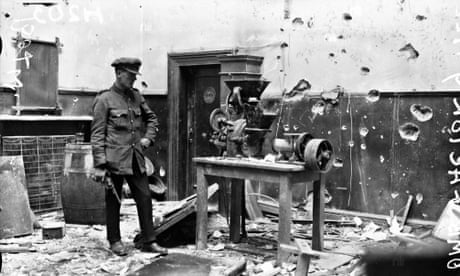
The project launched in 2022 on the centenary of the burning of the Public Record Office in Dublin in a five-day battle that began on 28 June 1922. It is now marking the 103rd anniversary of the calamity by adding freshly recovered material that takes in the Anglo-Norman conquest and the 1798 rebellion and a genealogical trove from 19th-century censuses.
Notebooks containing transcriptions made by genealogists and historians of the 19th-century census before it was destroyed by fire in 1922. Photograph: Chris Bellew/Fennell Photography
“It’s a very significant scale of data,” said Peter Crooks, a Trinity historian and academic director of the project. “It’s an enormous stretch of time from the 13th century up to the 19th century. The scale of what can be brought in, in terms of reconstruction, continues to amaze me.”
Once the envy of scholars around the world, the six-storey Public Record Office at the Four Courts by the River Liffey contained priceless troves dating from medieval times. It was obliterated as troops of the fledgling Irish state battled former comrades hunkered in the building.
It was long assumed that all was lost but the project enlisted 75 archives and libraries in Ireland, the UK and around the world to source transcripts and duplicates of documents, many of which had lain, forgotten, in storage. The latest troves to be catalogued and digitised bring the total to 350,000 records and 250m words of searchable Irish history.
Patrick O’Donovan, the culture minister, said international collaboration underpinned the “riches” that had been rediscovered. “It offers an invaluable historical resource for people of all ages and traditions across the island of Ireland and abroad, and democratises access so that our shared history is more accessible and engaging for everyone.”
The project has fused old-fashioned academic investigation, artificial intelligence and support and expertise from institutions that contain Irish records, notably the National Archives of Ireland, the Public Record Office of Northern Ireland, the UK National Archives at Kew and the Irish Manuscripts Commission. “The circle of collaborators has widened and deepened,” said Crooks.
The latest material includes 60,000 names from the lost censuses, creating a data hoard for genealogists and Irish diaspora descendants, among others, to trace family lineage, says Ciarán Wallace, a Trinity historian and co-director of the project. “This is only a fragment of what’s missing but 60,000 is a huge improvement on a blank slate.”
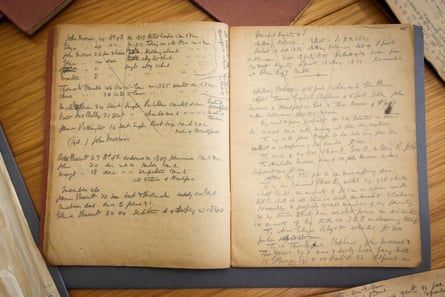
A notebook preserved in the National Archives of Ireland containing names of two households, transcribed from the 1841 census for Headford, County Galway. Photograph: Chris Bellew/Fennell Photography
The project’s “age of conquest” portal contains parchments in Latin and 5m words of Anglo-Norman Irish history, spanning 1170 to 1500, that have been translated into English.
Uploaded state papers, spanning 1660 to 1720, comprise 10m words, including extensive intelligence reports from the Tudor era when English monarchs tightened their grip on England’s first colony.
A diary that ended up at the US Library of Congress is now accessible and sheds light on dodgy deals that led to the abolition of the Irish parliament in 1800 and Ireland’s incorporation into the UK. “You find out about some of those underhanded dealings,” said Joel Herman, a research fellow who works on the project. “One member of parliament said he can’t vote for it because of the corrupt methods that have been used to win votes.”
Along with the new material, a search tool called the Knowledge Graph Explorer is being introduced that can identify people, places and the links between them.
AI startup factory aims to launch 100K companies a yearSource: TK
Most people who want to start a business never do. They lack the necessary technical skills, connections, or capital to get started.Henrik Werdelin thinksAI can change that equation entirely.
What happened: Werdelin’s new startup studio, Audos, is helping non-technical founders build profitable companies using AI-powered tools. Since launching in beta, the platform has already helped create hundreds of new businesses and raised $11.5 million to scale that effort.
The pitch is simple: you don’t need to code or raise venture capital. Simply share your business idea, and Audos will help you launch it using generative AI, ad platforms and pre-built automation.
Instead of taking equity, Audos takes a 15% revenue share on an indefinite basis. Founders can get up to $25,000 to get started and keep full ownership of their companies. AI agents guide new users through ideation and launch, while distribution gets handled through targeted social media advertising. Current founders include mechanics, coaches and creators.
Why this matters: With Goldman Sachs estimating that AI could displace over 300 million jobs, Audos believes many people will need to become entrepreneurs by necessity, not choice.Rather than chasing unicorns, the platform focuses on “donkeycorns” — small, sustainable businesses that “grind like a mule” and are run by one to three people.
Think a postpartum fitness trainer building an AI-powered coaching business, or a sommelier creating a personalized wine recommendation service. Werdelin’s vision is helping a million entrepreneurs build million-dollar businesses. The model makes startup building feel less like a Silicon Valley race and more like opening a modern mom-and-pop shop — but one powered by AI.
The Irish Independent article from March 1932 discusses the Irish Free State’s Executive Council’s deliberations on two key issues: the Oath of Allegiance and the Land Annuities, with a focus on Michael Comyn K.C.’s involvement. Below is a summary and analysis based on the provided text:Summary:
Oath of Allegiance:
The Executive Council, after a two-and-a-half-hour discussion, firmly insisted on abolishing the Oath of Allegiance, a requirement under the 1921 Anglo-Irish Treaty for members of the Oireachtas (Irish Parliament).
The Council argued that the Oath is not mandatory under the Treaty and its removal is a domestic matter, as the Irish Constitution, which includes the Oath, is an internal framework subject to amendment.
The need to reconcile different political factions and ensure their representation in the Oireachtas was highlighted as a key justification for removing the Oath.
Land Annuities:
The article addresses a dispute over the payment of Land Annuities—funds owed to Britain under agreements related to land purchases in Ireland.
The Council rejected the British claim (represented by Mr. Thomas) that these payments were part of an international agreement, arguing that the arrangement was merely between two ministers (one from the Free State and one from Britain) and lacked formal ratification by either parliament.
The opinion of Mr. Costello, the former Attorney General under the previous government, was cited to argue that the 1926 financial settlement was unrelated to the Annuities.
Political Context:
The response to Britain was being finalized and was expected to be sent to London soon after the article’s publication.
William Cosgrave, leader of the opposition, remained silent on the issues but was expected to clarify his and his party’s stance when the Dáil (Irish lower house) convened.
Analysis:
Oath of Allegiance: The insistence on removing the Oath reflects the anti-Treaty sentiment of the newly elected Fianna Fáil government under Éamon de Valera, which took office in 1932. The Oath was a contentious symbol of British influence, and its removal was seen as a step toward greater Irish sovereignty. The argument that it was not mandatory under the Treaty and was a domestic issue underscores the government’s strategy to frame constitutional changes as within Ireland’s sovereign rights.
Land Annuities: The dispute over the Annuities was part of a broader economic and political conflict with Britain, which escalated into the Anglo-Irish Trade War (1932–1938). The Free State’s position—that the agreement lacked parliamentary ratification—challenged the legal basis of Britain’s claims, reflecting a push to renegotiate or reject financial obligations tied to the Treaty.
Michael Comyn K.C.’s Role: As a prominent legal figure, Comyn likely provided counsel to the Executive Council, shaping the legal arguments against the Oath and Annuities. His involvement highlights the government’s reliance on legal expertise to justify its positions.
Cosgrave’s Silence: Cosgrave’s reserved stance suggests political caution, as his Cumann na nGaedheal party had previously supported the Treaty and its obligations. His eventual statement in the Dáil would likely clarify whether he would oppose or align with de Valera’s policies.
Historical Context:This article captures a pivotal moment in Irish history, as the Fianna Fáil government sought to dismantle aspects of the 1921 Anglo-Irish Treaty. The removal of the Oath and the withholding of Land Annuities were central to de Valera’s agenda of asserting Irish independence, leading to tensions with Britain that culminated in economic and diplomatic conflicts.If you need further details, such as specific outcomes of these deliberations or additional historical context, let me know! I can also search for related posts or articles on X or the web for more contemporary perspectives, if desired.
DeepSearch
35s
15 sources
Exploring historical context
Analyzing outcomes
Evaluating legal arguments
Assessing political impact
Completed
Exploring historical context
The request is about a 1932 Irish Independent article on the Oath of Allegiance and Land Annuities. It seems you’re looking for info or analysis on this historical event.
Searching for “Irish Independent article March 1932 Oath of Allegiance and the Annuities Michael Comyn K.C.”
Papers concerning Irish Oath of Allegiance and Land Annuities 1932 – Wikisource, the free online library
en.wikisource.org
Full article: The Commonwealth and the Oath of Allegiance Crisis: A Study in Inter-War Commonwealth Relations
Web search found several relevant sources, like Wikisource’s full text of 1932 papers. This could be what the article references, presented to the British Parliament in April.
There’s also an academic piece from Taylor & Francis on the 1932 Oath crisis. It offers context on Anglo-Irish legal disagreements, which might help.
I’m considering how these sources can verify the user’s question. Let’s check the Wikisource document for details on March 1932.
Browsing en.wikisource.org for “Oath of Allegiance and Land Annuities in March 1932”
The browse result matches the time period, summarizing correspondence from March and April 1932. It covers the Oath and Land Annuities debate between Ireland and the UK.
On March 22, Ireland said the Oath isn’t mandatory in the Treaty and modifying the Constitution is domestic. The UK countered on March 23, calling the Oath integral to 1921 and demanding land annuity payments.
This correspondence aligns with the article’s mention of Ireland’s unyielding stance on removing the Oath. It also notes the Land Annuities weren’t part of an international agreement ratified by parliaments.
Searching for “Irish Independent article March 1932 Oath of Allegiance and the Annuities Michael Comyn K.C.”
Papers concerning Irish Oath of Allegiance and Land Annuities 1932 – Wikisource, the free online library
en.wikisource.org
Full article: The Commonwealth and the Oath of Allegiance Crisis: A Study in Inter-War Commonwealth Relations
I’m thinking the Irish Independent article likely reported on these events. The official documents confirm Ireland’s determination to abolish the Oath, seeing it as a domestic issue.
Michael Comyn K.C. was involved, probably offering legal advice. William Cosgrave’s role suggests leadership in finalizing responses to Britain.
Searching for “outcome of Oath of Allegiance and Land Annuities disputes in 1932 Ireland”
Papers concerning Irish Oath of Allegiance and Land Annuities 1932 – Wikisource, the free online library
en.wikisource.org
Oath of Allegiance – Documents on Irish Foreign Policy – Volume 4 – 05/04/1932
In 1932, the UK insisted the Oath was integral to the Treaty and demanded Land Annuity payments. Ireland, led by de Valera, argued it wasn’t mandatory and questioned formal undertakings Wikisource.
The disputes caused tensions, with the UK viewing the Oath as essential to 1921 agreements. Ireland saw it as a domestic issue, leading to the 1933 Oath removal.
De Valera removed the Oath in 1933, sparking an economic war over Land Annuities. This conflict lasted until 1938, resolved by an agreement easing tariffs.
The withholding of Land Annuities led to economic hardship for Ireland. Britain imposed a 20% tariff, and Ireland retaliated, but Britain was less affected.
Analyzing outcomes
Fianna Fáil’s 1933 Oath abolition marked a shift in Irish sovereignty. It highlighted tensions with Britain, setting the stage for economic conflicts.
The Land Annuities dispute led to the Anglo-Irish Trade War, lasting from 1932 to 1938. This economic conflict strained Ireland’s economy more than Britain’s.
Evaluating legal arguments
Ireland argued the Oath was a domestic issue, not mandatory under the Treaty. They also claimed Land Annuities lacked formal parliamentary ratification.
Mr. Costello, the former Attorney General, said the 1926 financial settlement was unrelated to Annuities. This legal stance supported Ireland’s position.
Assessing political impact
William Cosgrave’s silence was notable, given his party’s Treaty support. His stance could influence opposition to de Valera’s policies when the Dáil convened.
The article suggests the Executive Council’s response was nearly ready, indicating imminent action on both issues with Britain.
Completed
Key Points
Research suggests the Irish Free State aimed to abolish the Oath of Allegiance, viewing it as non-mandatory and a domestic issue, leading to its removal in 1933.
It seems likely the Land Annuities dispute with Britain escalated into an economic war, resolved in 1938 with a settlement.
The evidence leans toward Michael Comyn K.C. providing legal counsel, though his specific role is less documented.
Controversy existed, with Britain insisting the Oath and Annuities were Treaty obligations, while Ireland sought greater sovereignty.
BackgroundThe Irish Independent article from March 1932 reflects the Irish Free State’s efforts to assert independence from Britain, focusing on the Oath of Allegiance and Land Annuities. These issues were central to tensions following the 1921 Anglo-Irish Treaty.Oath of AllegianceThe Executive Council, led by Éamon de Valera, was firm in abolishing the Oath, arguing it wasn’t mandatory and was a domestic matter. This led to its removal in 1933, a significant step toward sovereignty.Land AnnuitiesThe dispute over Land Annuities, payments owed to Britain, saw Ireland contesting their binding nature, leading to the Anglo-Irish Economic War (1932–1938). This was resolved in 1938 with a lump-sum payment agreement.Michael Comyn K.C.’s RoleMichael Comyn K.C. likely provided legal advice, helping frame the Oath’s removal and Annuities dispute as domestic issues, though specific details are less clear.
Survey Note: Detailed Analysis of the Irish Independent Article (March 1932)The provided excerpt from the Irish Independent, dated March 1932, offers a snapshot of the Irish Free State’s political landscape during a pivotal moment in its history, focusing on the Oath of Allegiance and the Land Annuities. This analysis delves into the historical context, key actors, and outcomes, drawing on verified sources to provide a comprehensive understanding.Historical Context and BackgroundThe article is set against the backdrop of the newly elected Fianna Fáil government under Éamon de Valera, which came to power in February 1932. This government, rooted in anti-Treaty sentiment, sought to dismantle aspects of the 1921 Anglo-Irish Treaty that it viewed as infringing on Irish sovereignty. The Treaty, signed on 6 December 1921, established the Irish Free State as a dominion within the British Commonwealth, requiring members of the Oireachtas (Irish Parliament) to take an Oath of Allegiance to the Irish Free State and fidelity to the British Crown. Additionally, it obligated the Free State to collect and remit Land Annuities—payments from Irish farmers for land purchases facilitated by the British government before independence.The article’s mention of a two-and-a-half-hour discussion by the Executive Council indicates the gravity of these issues, with a response being finalized for Britain, expected to be sent by late March 1932. This aligns with historical records, such as the correspondence documented in Papers concerning Irish Oath of Allegiance and Land Annuities 1932
, which shows communications between the Irish Free State and the UK in March and April 1932.The Oath of Allegiance: A Symbol of ContentionThe article highlights the Executive Council’s “unyielding” stance on abolishing the Oath of Allegiance, arguing it was not mandatory under the Treaty and its removal was a “purely domestic matter.” This position is supported by the Irish Free State’s communication on 22 March 1932, as noted in the Documents on Irish Foreign Policy
, where they stated the Constitution was the “people’s Constitution,” and modifications were within their internal sovereignty.The need for “reconciliation of sections and their representations in the Oireachtas” was a key argument, reflecting the political divisions from the Irish Civil War (1922–1923), where the Oath was a flashpoint between pro-Treaty and anti-Treaty factions. Historical sources, such as Oath of Allegiance (Ireland)
, confirm that the Oath, included in Article 17 of the 1922 Constitution, required members to swear allegiance to the Constitution and fidelity to King George V, a provision that de Valera and Fianna Fáil found intolerable.The outcome, as seen in Anglo-Irish trade war
, was the passage of the Constitution (Removal of Oath) Act in 1933, effectively abolishing the Oath. This move was a significant assertion of Irish sovereignty, though it drew strong objections from Britain, as evidenced by J.H. Thomas’s statements in Hansard on 23 March 1932 , where he insisted the Oath was “an integral part of the Treaty.”The Land Annuities: Economic and Legal DisputesThe article also addresses the Land Annuities, with the Executive Council rejecting Britain’s claim (represented by Mr. Thomas) that these payments were part of an international agreement. They argued that the arrangement, made between two ministers, lacked parliamentary ratification and was thus not binding. This is echoed in de Valera’s response on 5 April 1932, as seen in Documents on Irish Foreign Policy
, where he questioned the “formal and explicit undertaking” regarding the Annuities.The article mentions citing Mr. Costello, the former Attorney General, to argue that the 1926 financial settlement was unrelated to the Annuities. This legal strategy aimed to undermine Britain’s position, which, as per the UK’s response on 9 April 1932 in Papers concerning Irish Oath of Allegiance and Land Annuities 1932
, referenced agreements from 1923 and 1926 as binding.The dispute over Land Annuities led to the Anglo-Irish Economic War, detailed in History of Ireland 1932 – 1945: The Economic War and the Second World War and Land annuities, economic war and the Anglo Irish Trade Agreement 26 July 2023 Free
. Ireland withheld payments, prompting Britain to impose a 20% tariff on Irish goods in 1932, while Ireland retaliated with tariffs on British coal. This economic conflict, lasting until 1938, severely impacted Ireland’s economy, given its dependence on British markets. The war ended with the 1938 Anglo-Irish Agreement, where Ireland made a lump-sum payment to settle the Annuities dispute, and Britain relinquished control of the Treaty Ports.Michael Comyn K.C.: Legal Counsel and InfluenceThe article’s mention of Michael Comyn K.C. suggests his involvement in providing legal counsel to the Executive Council. While specific details are less documented, his role as a prominent Irish lawyer likely involved shaping the legal arguments against the Oath and Annuities. Historical sources, such as Michael Collins (Irish leader) – Wikipedia
, provide context on the legal and political landscape, but direct references to Comyn’s specific contributions in 1932 are sparse. His expertise would have been crucial in framing the Oath’s removal as a domestic matter and challenging the binding nature of the Annuities agreement, aligning with the article’s content.Political Dynamics and William Cosgrave’s SilenceThe article notes William Cosgrave, leader of the opposition (Cumann na nGaedheal), expressing no opinion on the matters but likely to declare his stance when the Dáil met. Cosgrave’s party had supported the Treaty, making his position significant. Historical accounts, such as Irish Civil War – Wikipedia
, indicate that Fianna Fáil’s entry into the Dáil in 1927, taking the Oath, marked a shift, but by 1932, de Valera’s government was pushing for its abolition. Cosgrave’s eventual stance would have been crucial in gauging opposition, though the article suggests he remained cautious, possibly reflecting the political sensitivity of the issues.Table: Key Events and Outcomes (1932–1938)
Date
Event
Outcome
March 1932
Irish Free State communicates intent to abolish Oath
Led to diplomatic exchanges, British objections.
March 1932
Dispute over Land Annuities begins
Escalated into Anglo-Irish Economic War (1932–1938).
1933
Constitution (Removal of Oath) Act passed
Oath of Allegiance abolished, asserting Irish sovereignty.
1938
Anglo-Irish Agreement signed
Settled Annuities dispute with lump-sum payment, Britain relinquished Treaty Ports.
Broader Implications and LegacyThe events of 1932 were transformative for Irish-British relations. The abolition of the Oath of Allegiance in 1933 and the resolution of the Land Annuities dispute in 1938 were steps toward greater Irish independence, culminating in the 1937 Constitution, which replaced the 1922 Constitution and removed all references to the British Crown. The Economic War, while economically challenging, underscored Ireland’s determination to assert economic sovereignty, as detailed in The Commonwealth and the Oath of Allegiance Crisis: A Study in Inter-War Commonwealth Relations
.This analysis confirms the article’s content aligns with historical records, providing a detailed picture of Ireland’s push for sovereignty in 1932, with lasting impacts on its constitutional and economic landscape.
(by Private Notice) asked the Secretary of State for Dominion Affairs if he has had a communication from the Irish Free State Government regarding that Government’s attitude towards Land Purchase Annuities due to this country and other Treaty obligations, and, if so, what was the nature of his reply?
The SECRETARY of STATE for DOMINION AFFAIRS (Mr. J. H. Thomas)
I was officially informed yesterday by the High Commissioner for the Irish Free State that, in the opinion of his Government, the Oath of Allegiance is not mandatory in the Treaty, and that the Irish Free State have an absolute right to modify their Constitution as tile people desire. It is manifest that the Oath is an integral part of the Treaty made 10 years ago between the two countries and hitherto honourably observed on both sides. We are addressing to His Majesty’s Government in the Irish Free State a communication which will snake our standpoint clear beyond a possibility of doubt.
With regard to the Land Annuities, we have received no official communication from the Irish Free State Government, but from a, statement reported to have been made yesterday by Mr. de Valera in the Free State Senate we understand that the Free State Government propose to retain the Irish Land Annuities. These Annuities are payments which the tenants of purchased estates make in order to repay the sums lent to them to buy their land. The Irish Free State Government are bound by the most formal and explicit undertaking to continue to pay the Land Annuities to the National Debt Commissioners, and the failure to do so would be a manifest violation of an engagement which is binding in law and in honour on the Irish Free State, whatever Administration may be in power, in exactly the same way as the Treaty itself is binding on both countries.
The Rundown: Meta has reportedly successfully recruited four OpenAI researchers for its new superintelligence unit, including three from OAI’s Zurich office and one key contributor to the AI leader’s o1 reasoning model.
The details:
Zuckerberg personally recruited Lucas Beyer, Alexander Kolesnikov, and Xiaohua Zhai, the trio that established OpenAI’s Zurich operations last year.Meta also landed Trapit Bansal, a foundational contributor to OpenAI’s o1 reasoning model who worked alongside co-founder Ilya Sutskever.Sam Altman said last week that Meta had offered $100M bonuses in poaching attempts, but “none of OpenAI’s best people” had taken the offer.Beyer confirmed on X that the Zurich trio was joining Meta, but denied the reports of $100M signing bonuses, calling them “fake news”.Meta’s hiring spree comes after its $15B investment in Scale AI and poaching of its CEO Alexandr Wang to lead the new division.
Why it matters: Meta’s new superintelligence team is taking shape — and despite Altman’s commentary last week, at least four of his researchers are willing to make the move. With an influx of new talent from top labs and a clear willingness to spend at all costs, Meta’s first release from the new unit will be a fascinating one to watch.
If the Department of Government Efficiency (DOGE) can stop our Social Security system from sending checks to dead people, that would be a plus. Yet a far more important task is to stop the system from overpaying people who are very much alive.
Last year the Social Security Administration admitted it had identified 2 million beneficiaries who have been overpaid and sent them “clawback” letters, demanding the government’s money back. Some of these claims go back several decades, and they can amount to hundreds of thousands of dollars.
As revealed in a recent episode of 60 Minutes, in one case the agency sent a clawback letter to a 32-year-old man, living on Social Security and disabled by cerebral palsy. The agency claimed that 21 years earlier, when he was 11 years old, his mother was overpaid $4,902 on his behalf—and the government wants its money back! In another case the agency demanded more than $300,000 from a disabled woman living on her Social Security benefits. In a third case, the agency demanded to be reimbursed for an overpayment that was 45 years old.
In all these cases, the agency admits that these mistakes were made by the government, not by the beneficiaries. Further, if its demands are not met, Social Security threatens to stop sending the beneficiaries as much as half of their monthly benefit checks.
Why Should Taxpayers Care?
Aside from the human tragedies clawback letters create for the people who receive them, there are three practical reasons why taxpayers should care.
First, our government has wasted millions of dollars by sending out checks for the wrong amounts—money that in most cases will never be recovered. Second, when the government demands its money back it is often going after people who had no idea they were overpaid and who are living on a fixed income. Forcing a retiree to sell his house or cash out his IRA to pay a surprise bill from the government seems especially cruel in many cases. That’s inconsistent with Social Security’s role as a safety net.
Third, virtually no one on Social Security knows whether their check is the “right” amount. That means every beneficiary is at risk of receiving a clawback letter, and that creates a level of insecurity that is the opposite of the purpose of the Social Security system.
Although the dimensions are much smaller, Social Security acknowledges it also has a history of sending checks to people who are dead. We don’t have to rely on Donald Trump or Elon Musk for verification. The agency’s Inspector General recently discovered as many as 217 dead Oregonians were receiving checks. In one case, a dead beneficiary received checks for 15 years.
While the agency overpays some people, it underpays others. According to the Office of Inspector General, more than 13,000 widows and widowers collectively have lost $130 million in Social Security benefits because of mistakes in claiming spousal benefits. Married couples also lose thousands of dollars because they make mistakes in claiming spousal benefits. More often than not, these mistakes are made because of bad advice from Social Security personnel.
Note: If people make a mistake in claiming benefits, they are generally not allowed to correct it—even if the mistake was not their fault. Yet, as noted, if Social Security makes the mistake, it demands its money back.
Why is Social Security Making So Many Mistakes?
Why is Social Security making so many mistakes? For two reasons. First, the system is enormously complex. It has 2728 rules and hundreds of thousands of pages explaining the rules, governing just 13 basic benefits. Second, it relies on human resources rather than computer programs to make decisions.
The most important revelation from DOGE so far is not the finding of large amounts of fraud, waste and abuse. It is the finding that so many agencies (including the IRS and the FAA) are using computer programming language that the private sector abandoned decades ago. The main language used to run Social Security’s core systems, for example, is a 60-year-old program called COBOL (Common Business-Oriented Language). There aren’t that many people alive who are still able to program in COBOL.
That Social Security does not have a computer program that can tell its own employees as well as beneficiaries the right amount of their monthly benefit is truly amazing. What is even more surprising is that the private sector not only has a very accurate Social Security benefit calculator, it also tells viewers how to claim benefits in a way that maximizes their lifetime income.
The private calculator, developed by Boston University economist Laurence Kotlikoff, is available to everyone for $49. Yet think of how much misery could be avoided if the government created something similar—or simply leased the private program—and made it available to everyone for free.
It was Prof. Kotliioff who first discovered the problem of clawback letters. He created an online portal where people could submit their personal horror stories, many of which appear in a book he co-authored with financial advice columnist Terry Savage.
Changes Can Be Made
Going forward, there are three changes that merit urgent attention. First, we need to bring Social Security’s computer systems into the 21st century. There is no reason why the country’s most important retirement system isn’t using the same software available to private financial firms.
Second, there should be a reliable online calculator that allows Social Security personnel to avoid mistakes and prospective beneficiaries to make informed judgments about claiming benefits.
Third, there should be a one-year statute of limitations on Social Security clawback claims while we are waiting to get an accurate computer system in place.
DOGE can help with the first two of these reforms. Congress is probably needed for the third.
American president Donald Trump and Chinese president Xi Jinping have finally resolved a months-long trade dispute revolving around the rare earth metals vital to developing artificial intelligence. It’s a resolution that makes it all the more bizarre that the US President is opening the floodgates for an AI arms race with China.
Following Trump’s baffling “Liberation Day” tariffs back in April, Chinese lawmakers moved to cut the flow of rare earth metals into the US. China has a near-global monopoly on rare earth minerals — which are critical for building high-tech products like wind turbines and computer chips — giving Beijing a huge asset at the bargaining table.
That all changed on Thursday, when Commerce Secretary Howard Lutnick announced“they’re going to deliver rare earths to us,” adding that “we’ll take down our countermeasures” in kind. The deal, which was signed on Tuesday, is one of 10 that the Trump administration made with global trade partners following the much-maligned tariffs.
With all the trade progress, one might expect the White House to ease down on its aggressive stance with China — at least until the minerals start flowing again.
Instead, that’s the exact opposite of what happened. Just a day after Lutnick announced a deal had been signed, news broke that Trump is on the cusp of signing executive actions which would dramatically escalate the so-called “AI arms race” with China. Per CNBC, the moves encompass four major plans.
The first is a deregulatory measure which would make it easier for AI companies to suck power from civilian power grids.Companies like Elon Musk’s xAI have turned to noxious outdoor generators to fuel their power hungry data-centers, as regulators and energy officials assess short- and long-term impacts on surrounding communities. This would seemingly fast-track that process, giving tech companies federal approval to latch onto grids immediately, consequences be damned.
The executive order would also approve the sale of federal land to tech companies — building off of a broader strategy that involves privatizing federally protected wild land — helping them set up their noisy and hazardous data centers without having to worry about pesky local governments.
Other measures include rolling out an “AI action plan” to inform the public, as well as a propaganda drive to push the narrative that the US is locked in a life-or-death arms race with China, according to CNBC‘s anonymous sources.
This is all done under the pretext that we are, in fact, locked in a new cold war — a fiction that has more to do with preventing free-market competition with China than with any sort of genuine international threat.
With US leaders set on rehashing the nuclear arms race, AI industry reporter Garrison Lovely sums it up well: “Only one superpower has a government commission publicly calling for a militarized race to build superintelligent AI, and it’s not China.”
Summary: Researchers have uncovered how losing the autism-linked gene PTEN in a specific set of inhibitory neurons reshapes brain circuits tied to fear and anxiety. Using advanced circuit-mapping techniques, they found that deleting PTEN in somatostatin-expressing neurons of the amygdala disrupted local inhibition by 50% while strengthening excitatory input from nearby brain regions.
This imbalance led to heightened anxiety and fear learning in animal models, without affecting social or repetitive behaviors often seen in autism. The study offers one of the most precise maps yet of how microcircuit changes may underlie distinct ASD-related traits, opening new doors for targeted treatments.
Key Facts:
Circuit-Specific Change: PTEN loss in somatostatin neurons weakens local inhibition and amplifies excitatory signals in the central amygdala.
Behavioral Outcome:The altered circuitry was linked to increased fear and anxiety but not to social or repetitive behavior changes.
Precision Mapping: Researchers used a high-resolution optogenetic approach to chart microcircuit alterations tied to genetic mutations.
Source: Max Planck Florida
Researchers at the Max Planck Florida Institute for Neuroscience have discovered how loss of a gene strongly associated with autism and macrocephaly (large head size) rewires circuits and alters behavior.
Their findings, published in Frontiers in Cellular Neuroscience, reveal specific circuit changes in the amygdala resulting from PTEN loss in inhibitory neurons, providing new insights into the underlying circuit alterations that contribute to heightened fear and anxiety.
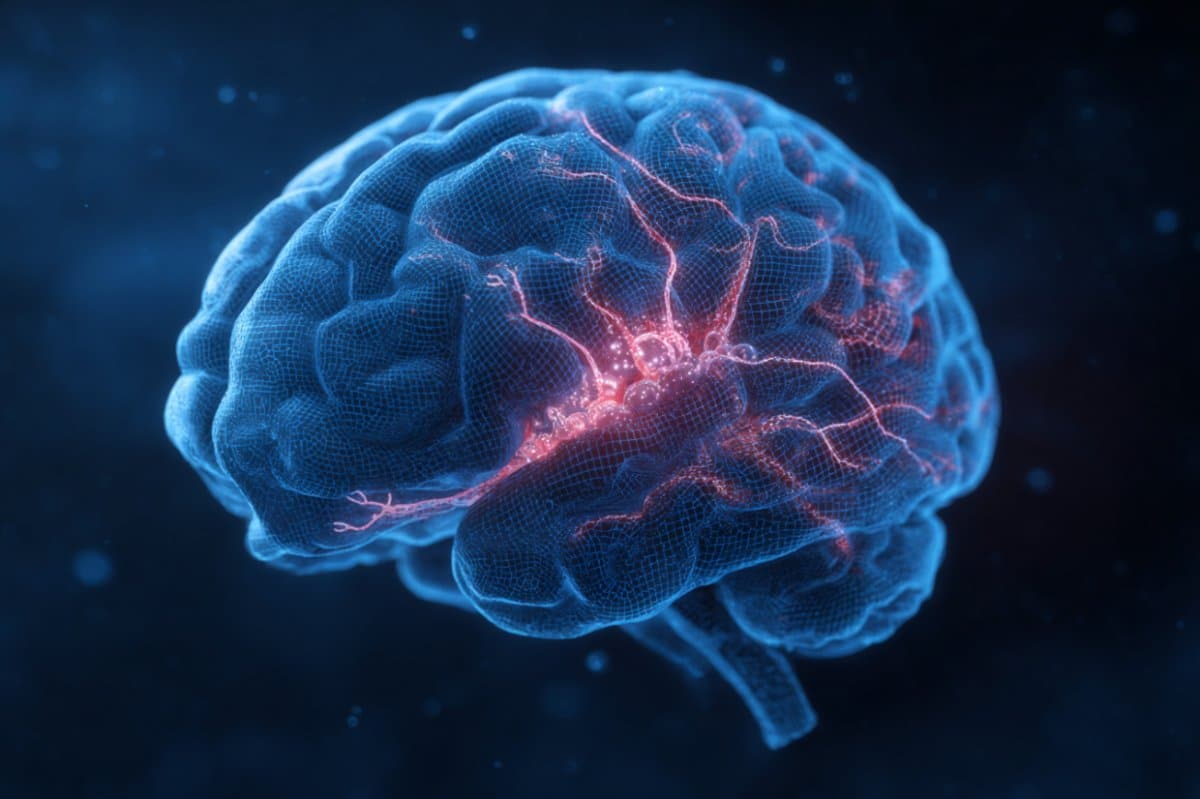
The scientists focused on the circuits in the central amygdala (CeL) – a brain region known to serve as an inhibitory gate on the downstream expression of fear responses – and found striking results. Credit: Neuroscience News
PTEN has emerged as one of the most significant autism risk genes. Variations in this gene are found in a significant proportion of people with autism who also exhibit brain overgrowth, making it a key player in understanding differences in brain function.
To investigate the impact of PTEN misregulation, researchers have turned to animal models, where global reduction of PTEN results in altered sociability, repetitive behaviors, and increased anxiety that are often associated with ASD in humans.
But understanding how PTEN dysfunction results in specific circuit and behavioral changes has been difficult in animal models that disrupt PTEN throughout the nervous system.
Therefore, MPFI research group leader Dr. McLean Bolton and her team have focused on the changes in the central lateral amygdala driven by loss of PTEN in a critical neuronal population—somatostatin-expressing inhibitory neurons.
Alterations in the function of inhibitory neurons in the development of ASD have been seen through both human tissue studies and genetic mouse models. Moreover, the PTEN gene is known to regulate the development of inhibitory neurons.
Therefore, a cell-type-specific disruption of PTEN in inhibitory neurons was a valuable target for understanding specific circuit changes associated with ASD.
“Although a cell-type specific disruption does not replicate the genome-wide changes seen in humans, it is essential to examine how genetic risk factors operate within distinct neural circuits,” explained Dr. Bolton.
“Understanding these mechanisms is a crucial step toward targeted interventions for specific traits such as severe anxiety.”
The team, led by Dr. Tim Holford, combined a genetic model that disrupted PTEN only in somatostatin-containing inhibitory neurons with a unique circuit mapping approach previously developed in the lab.
This approach measured the electrical responses of individual neurons to the sequential optogenetic activation of hundreds of nearby neurons, allowing rapid mapping of connectivity and strength with the precision of electrical recordings and the scale of imaging approaches.
“This is a powerful method that we can use to determine changes in local neuron connectivity and strength resulting from genetic variations.
“We were interested in uncovering how the disruption of PTEN signaling in a single cell type would change the way the brain processes information and contribute to the broad ASD phenotype,” described Dr. Holford.
The scientists focused on the circuits in the central amygdala (CeL) – a brain region known to serve as an inhibitory gate on the downstream expression of fear responses – and found striking results.
Deleting PTEN specifically in somatostatin-containing interneurons disrupted local inhibitory connectivity in the CeL by roughly 50% and reduced the strength of the inhibitory connections that remained.
This diminished connectivity between inhibitory connections within the CeL was contrasted by an increase in the strength of excitatory inputs received from the basolateral amygdala (BLA), a nearby brain region that relays emotionally-relevant sensory information to the CeL.
Behavioral analysis of the genetic model demonstrated that this imbalance in neural signaling was linked to heightened anxiety and increased fear learning, but not alterations in social behavior or repetitive behavior traits commonly observed in ASD.
The results not only confirm that PTEN loss in this specific cell type is sufficient to induce specific ASD-like behaviors, but also provide one of the most detailed maps to date of how local inhibitory networks in the amygdala are affected by genetic variations associated with neurological disorders.
Importantly, the altered circuitry did not affect all ASD-relevant behaviors—social interactions remained largely intact, suggesting that PTEN-related anxiety and fear behaviors may stem from specific microcircuit changes.
As Dr. Holford explains, “By teasing out the local circuitry underlying specific traits, we hope to differentiate the roles of specific microcircuits within the umbrella of neurological disorders, which may one day help in developing targeted therapeutics for specific cognitive and behavioral characteristics.
“In future studies, we hope to evaluate these circuits in different genetic models to determine if these microcircuit alterations are convergent changes that underlie heightened fear and anxiety expression across diverse genetic profiles.”
About this genetics, autism, and anxiety research news
Author: Lesley Colgan Source: Max Planck Florida Contact: Lesley Colgan – Max Planck Florida Image: The image is credited to Neuroscience News
PTEN in somatostatin neurons regulates fear and anxiety and is required for inhibitory synaptic connectivity within central amygdala
Introduction: The phosphatase and tensin homolog deleted on chromosome 10 (PTEN) is a negative regulator of the mTOR pathway and is strongly associated with autism spectrum disorder (ASD), with up to 25% of ASD patients with macrocephaly harboring PTEN mutations.
Mice with germline PTEN haploinsufficiency show behavioral characteristics resembling ASD, as do various mouse models with conditional knockouts of PTEN. Human tissue studies and those from multiple genetic mouse models suggest that dysfunction of GABAergic interneurons may play a role in the development of ASD, but the precise mechanisms remain elusive.
PTEN provides a target for investigation because it regulates the development of inhibitory neurons arising from the medial ganglionic eminence, promoting the survival and maturation of parvalbumin (PV+) neurons at the expense of somatostatin (SOM+) neurons.
Methods: Here, we investigate how PTEN regulates SOM+ neurons at the cellular and circuit level in the central lateral amygdala (CeL), an area that governs the key ASD behavioral symptoms of social anxiety and altered emotional motivation for social engagement using behavioral analysis, electrophysiology, and two-photon local circuit mapping.
Results: We found that knocking out PTEN in SOM+ neurons results in elevated levels of fear and anxiety and decreases CeL local circuit connectivity. Specifically, this manipulation decreased the strength of connections between individual neurons and altered the distribution of local connections in a cell-type specific manner. In contrast to the deficit in local inhibitory connections within CeL, the excitatory drive from the major CeL input, the basolateral amygdala (BLA) was enhanced.
Discussion: This combined imbalance of enhanced excitation and diminished local inhibition likely underlies the heightened fear learning and anxiety we observed in the PTEN-SOM-KO mice.
Join our Newsletter
I agree to have my personal information transferred to AWeber for Neuroscience Newsletter ( more information )
Sign up to receive our recent neuroscience headlines and summaries sent to your email once a day, totally free.
We hate spam and only use your email to contact you about newsletters. You can cancel your subscription any time.

 Source: TK


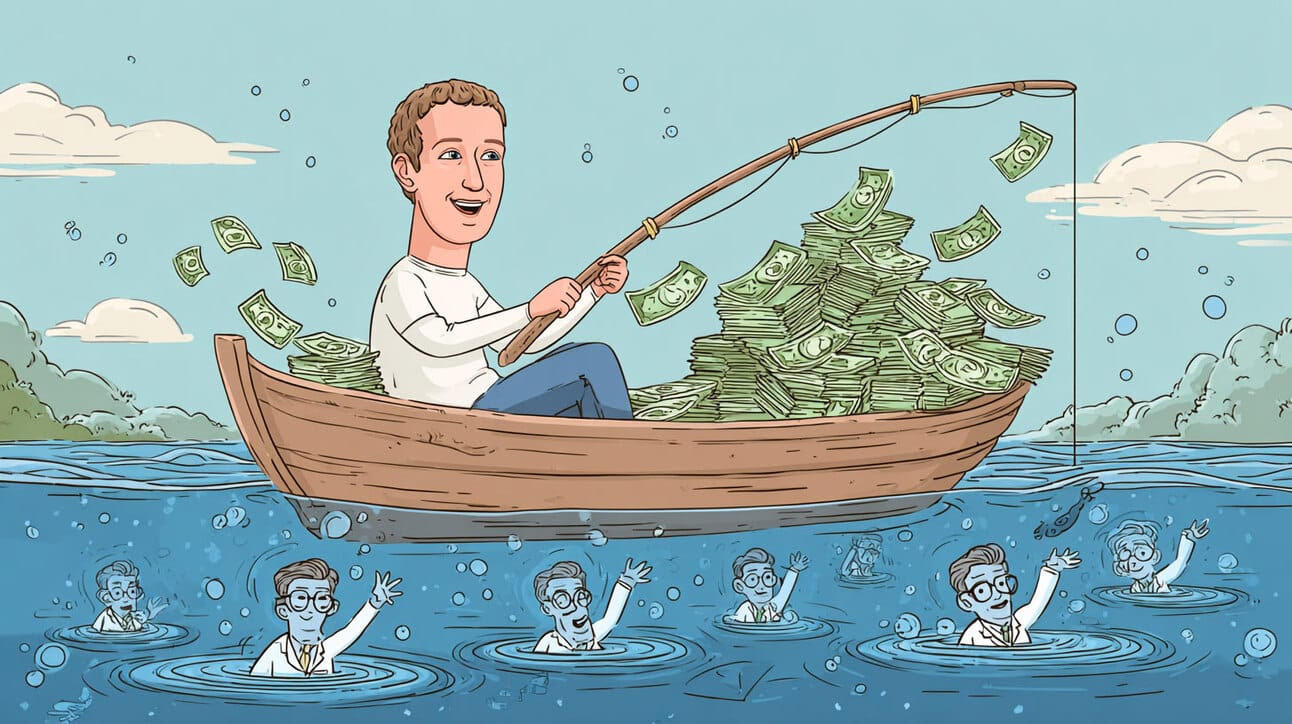 Image source: Midjourney / The Rundown