American president Donald Trump and Chinese president Xi Jinping have finally resolved a months-long trade dispute revolving around the rare earth metals vital to developing artificial intelligence. It’s a resolution that makes it all the more bizarre that the US President is opening the floodgates for an AI arms race with China.
Following Trump’s baffling “Liberation Day” tariffs back in April, Chinese lawmakers moved to cut the flow of rare earth metals into the US. China has a near-global monopoly on rare earth minerals — which are critical for building high-tech products like wind turbines and computer chips — giving Beijing a huge asset at the bargaining table.
That all changed on Thursday, when Commerce Secretary Howard Lutnick announced“they’re going to deliver rare earths to us,” adding that “we’ll take down our countermeasures” in kind. The deal, which was signed on Tuesday, is one of 10 that the Trump administration made with global trade partners following the much-maligned tariffs.
With all the trade progress, one might expect the White House to ease down on its aggressive stance with China — at least until the minerals start flowing again.
Instead, that’s the exact opposite of what happened. Just a day after Lutnick announced a deal had been signed, news broke that Trump is on the cusp of signing executive actions which would dramatically escalate the so-called “AI arms race” with China. Per CNBC, the moves encompass four major plans.
The first is a deregulatory measure which would make it easier for AI companies to suck power from civilian power grids.Companies like Elon Musk’s xAI have turned to noxious outdoor generators to fuel their power hungry data-centers, as regulators and energy officials assess short- and long-term impacts on surrounding communities. This would seemingly fast-track that process, giving tech companies federal approval to latch onto grids immediately, consequences be damned.
The executive order would also approve the sale of federal land to tech companies — building off of a broader strategy that involves privatizing federally protected wild land — helping them set up their noisy and hazardous data centers without having to worry about pesky local governments.
Other measures include rolling out an “AI action plan” to inform the public, as well as a propaganda drive to push the narrative that the US is locked in a life-or-death arms race with China, according to CNBC‘s anonymous sources.
This is all done under the pretext that we are, in fact, locked in a new cold war — a fiction that has more to do with preventing free-market competition with China than with any sort of genuine international threat.
With US leaders set on rehashing the nuclear arms race, AI industry reporter Garrison Lovely sums it up well: “Only one superpower has a government commission publicly calling for a militarized race to build superintelligent AI, and it’s not China.”
Summary: Researchers have uncovered how losing the autism-linked gene PTEN in a specific set of inhibitory neurons reshapes brain circuits tied to fear and anxiety. Using advanced circuit-mapping techniques, they found that deleting PTEN in somatostatin-expressing neurons of the amygdala disrupted local inhibition by 50% while strengthening excitatory input from nearby brain regions.
This imbalance led to heightened anxiety and fear learning in animal models, without affecting social or repetitive behaviors often seen in autism. The study offers one of the most precise maps yet of how microcircuit changes may underlie distinct ASD-related traits, opening new doors for targeted treatments.
Key Facts:
Circuit-Specific Change: PTEN loss in somatostatin neurons weakens local inhibition and amplifies excitatory signals in the central amygdala.
Behavioral Outcome:The altered circuitry was linked to increased fear and anxiety but not to social or repetitive behavior changes.
Precision Mapping: Researchers used a high-resolution optogenetic approach to chart microcircuit alterations tied to genetic mutations.
Source: Max Planck Florida
Researchers at the Max Planck Florida Institute for Neuroscience have discovered how loss of a gene strongly associated with autism and macrocephaly (large head size) rewires circuits and alters behavior.
Their findings, published in Frontiers in Cellular Neuroscience, reveal specific circuit changes in the amygdala resulting from PTEN loss in inhibitory neurons, providing new insights into the underlying circuit alterations that contribute to heightened fear and anxiety.
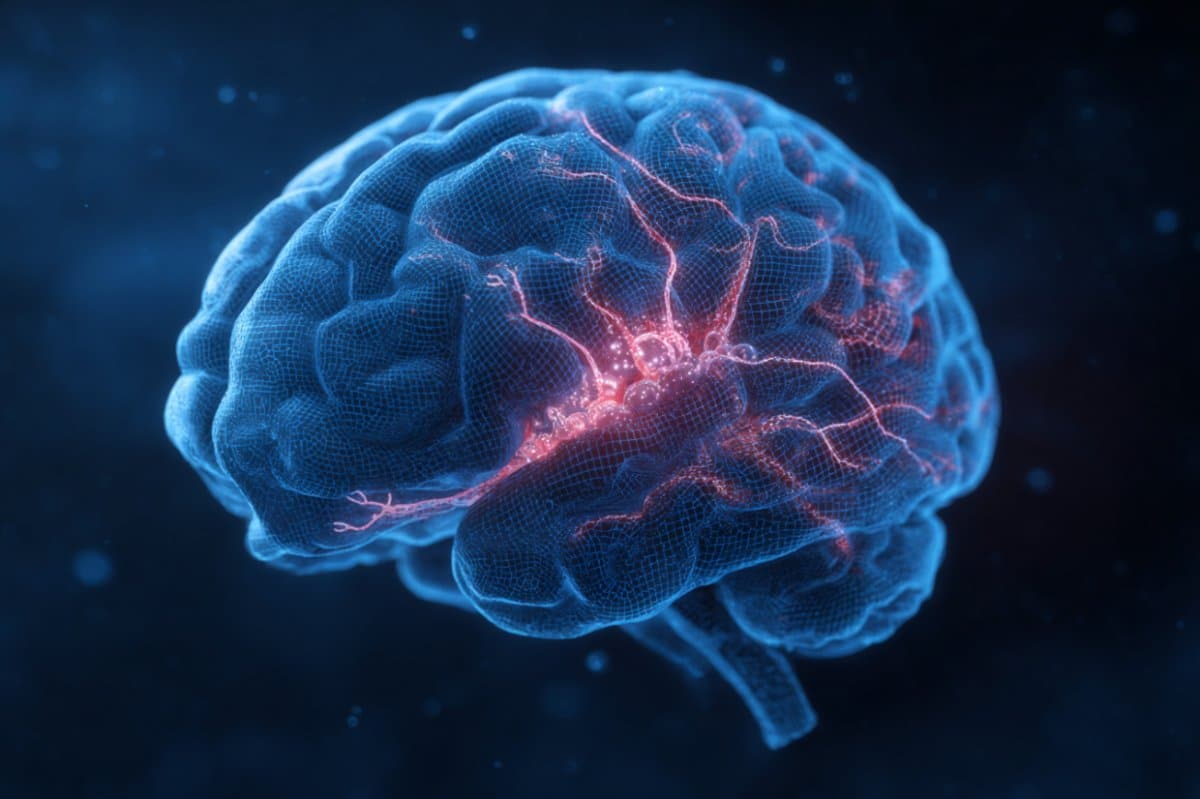
The scientists focused on the circuits in the central amygdala (CeL) – a brain region known to serve as an inhibitory gate on the downstream expression of fear responses – and found striking results. Credit: Neuroscience News
PTEN has emerged as one of the most significant autism risk genes. Variations in this gene are found in a significant proportion of people with autism who also exhibit brain overgrowth, making it a key player in understanding differences in brain function.
To investigate the impact of PTEN misregulation, researchers have turned to animal models, where global reduction of PTEN results in altered sociability, repetitive behaviors, and increased anxiety that are often associated with ASD in humans.
But understanding how PTEN dysfunction results in specific circuit and behavioral changes has been difficult in animal models that disrupt PTEN throughout the nervous system.
Therefore, MPFI research group leader Dr. McLean Bolton and her team have focused on the changes in the central lateral amygdala driven by loss of PTEN in a critical neuronal population—somatostatin-expressing inhibitory neurons.
Alterations in the function of inhibitory neurons in the development of ASD have been seen through both human tissue studies and genetic mouse models. Moreover, the PTEN gene is known to regulate the development of inhibitory neurons.
Therefore, a cell-type-specific disruption of PTEN in inhibitory neurons was a valuable target for understanding specific circuit changes associated with ASD.
“Although a cell-type specific disruption does not replicate the genome-wide changes seen in humans, it is essential to examine how genetic risk factors operate within distinct neural circuits,” explained Dr. Bolton.
“Understanding these mechanisms is a crucial step toward targeted interventions for specific traits such as severe anxiety.”
The team, led by Dr. Tim Holford, combined a genetic model that disrupted PTEN only in somatostatin-containing inhibitory neurons with a unique circuit mapping approach previously developed in the lab.
This approach measured the electrical responses of individual neurons to the sequential optogenetic activation of hundreds of nearby neurons, allowing rapid mapping of connectivity and strength with the precision of electrical recordings and the scale of imaging approaches.
“This is a powerful method that we can use to determine changes in local neuron connectivity and strength resulting from genetic variations.
“We were interested in uncovering how the disruption of PTEN signaling in a single cell type would change the way the brain processes information and contribute to the broad ASD phenotype,” described Dr. Holford.
The scientists focused on the circuits in the central amygdala (CeL) – a brain region known to serve as an inhibitory gate on the downstream expression of fear responses – and found striking results.
Deleting PTEN specifically in somatostatin-containing interneurons disrupted local inhibitory connectivity in the CeL by roughly 50% and reduced the strength of the inhibitory connections that remained.
This diminished connectivity between inhibitory connections within the CeL was contrasted by an increase in the strength of excitatory inputs received from the basolateral amygdala (BLA), a nearby brain region that relays emotionally-relevant sensory information to the CeL.
Behavioral analysis of the genetic model demonstrated that this imbalance in neural signaling was linked to heightened anxiety and increased fear learning, but not alterations in social behavior or repetitive behavior traits commonly observed in ASD.
The results not only confirm that PTEN loss in this specific cell type is sufficient to induce specific ASD-like behaviors, but also provide one of the most detailed maps to date of how local inhibitory networks in the amygdala are affected by genetic variations associated with neurological disorders.
Importantly, the altered circuitry did not affect all ASD-relevant behaviors—social interactions remained largely intact, suggesting that PTEN-related anxiety and fear behaviors may stem from specific microcircuit changes.
As Dr. Holford explains, “By teasing out the local circuitry underlying specific traits, we hope to differentiate the roles of specific microcircuits within the umbrella of neurological disorders, which may one day help in developing targeted therapeutics for specific cognitive and behavioral characteristics.
“In future studies, we hope to evaluate these circuits in different genetic models to determine if these microcircuit alterations are convergent changes that underlie heightened fear and anxiety expression across diverse genetic profiles.”
About this genetics, autism, and anxiety research news
Author: Lesley Colgan Source: Max Planck Florida Contact: Lesley Colgan – Max Planck Florida Image: The image is credited to Neuroscience News
PTEN in somatostatin neurons regulates fear and anxiety and is required for inhibitory synaptic connectivity within central amygdala
Introduction: The phosphatase and tensin homolog deleted on chromosome 10 (PTEN) is a negative regulator of the mTOR pathway and is strongly associated with autism spectrum disorder (ASD), with up to 25% of ASD patients with macrocephaly harboring PTEN mutations.
Mice with germline PTEN haploinsufficiency show behavioral characteristics resembling ASD, as do various mouse models with conditional knockouts of PTEN. Human tissue studies and those from multiple genetic mouse models suggest that dysfunction of GABAergic interneurons may play a role in the development of ASD, but the precise mechanisms remain elusive.
PTEN provides a target for investigation because it regulates the development of inhibitory neurons arising from the medial ganglionic eminence, promoting the survival and maturation of parvalbumin (PV+) neurons at the expense of somatostatin (SOM+) neurons.
Methods: Here, we investigate how PTEN regulates SOM+ neurons at the cellular and circuit level in the central lateral amygdala (CeL), an area that governs the key ASD behavioral symptoms of social anxiety and altered emotional motivation for social engagement using behavioral analysis, electrophysiology, and two-photon local circuit mapping.
Results: We found that knocking out PTEN in SOM+ neurons results in elevated levels of fear and anxiety and decreases CeL local circuit connectivity. Specifically, this manipulation decreased the strength of connections between individual neurons and altered the distribution of local connections in a cell-type specific manner. In contrast to the deficit in local inhibitory connections within CeL, the excitatory drive from the major CeL input, the basolateral amygdala (BLA) was enhanced.
Discussion: This combined imbalance of enhanced excitation and diminished local inhibition likely underlies the heightened fear learning and anxiety we observed in the PTEN-SOM-KO mice.
Join our Newsletter
I agree to have my personal information transferred to AWeber for Neuroscience Newsletter ( more information )
Sign up to receive our recent neuroscience headlines and summaries sent to your email once a day, totally free.
We hate spam and only use your email to contact you about newsletters. You can cancel your subscription any time.
Colonel Douglas Macgregor joins the show to discuss the ceasefire between Israel and Iran. Will it last? Colonel Macgregor has his doubts as Israel continues to exert force on the region with its own nuclear weapons. Lets break it down
War Intel (@warintel4u) posted at 6:59 pm on Sat, Jun 28, 2025: ️A Catastrophe is Striking the Gulf States and Iran
Over the past two decades, India has dominated the software industry. As a result, Gulf nations and Iran have heavily relied on Indian software and programmers.
John Mearsheimer is an international relations scholar at University of Chicago. He is one of the most influential and controversial thinkers in the world on the topics of war and power.
Elon Musk: Neuralink will help us understand a lot more about consciousness. “I’ve thought a lot about what is consciousness. Where does consciousness arise? If you start at the beginning of the universe, assuming the standard model of physics is true, then you have this Big Bang, the matter condensing into stars, those stars exploding. A lot of the atoms that are in your body right now were once at the center of stars. Those stars exploded, recondensed. Fast forward 13.8 billion years, and here we are. And somewhere along that very long journey to us, consciousness arose. Or the molecules started talking to each other. And it begs the question of what is consciousness? Is everything conscious? Maybe. It’s hard to say where along that line, there’s no sort of discrete point where consciousness didn’t exist and then suddenly does exist. It seems to be, maybe you have a condensation of matter that has a density of consciousness, we don’t know. The real answer is, we don’t know what consciousness is. But with Neuralink and the progress that the company’s making, we’ll begin to understand a lot more about consciousness.” Neuralink Update, June 27, 2025
===============
🚨 BREAKING: Neuralink’s Blindsight will let humans see in radar, infrared, and ultraviolet—just like Geordi La Forge from Star Trek.
It’s a major step toward giving people superhuman vision with cybernetic upgrades. pic.twitter.com/EzZTNqQwLO





 ️A Catastrophe is Striking the Gulf States and Iran


