X FORMER USAID ADMINISTRATOR CLAIMS TRUMP CUTS COULD COST 12 MILLION LIVES

Posted in Uncategorized | Leave a comment

“It’s Happening Sooner Than I Expected…” | Richard Wolff

Chasing Sharpe

1 Jul 2025

Richard D. Wolff is an American economist and professor emeritus at the University of Massachusetts Amherst. He is known for his critiques of economic inequality and his advocacy for worker cooperatives as a way to empower individuals and address systemic issues within the economy. Through his books, interviews, lectures, and public appearances, Wolff explores topics such as economic democracy and alternative economic models.

Posted in Uncategorized | Leave a comment

Grok3 AI: Belfast Newsletter August 4th, 1932. Senator Counihan and Senator Comyn K.C.

The article you’ve referenced from the Belfast Newsletter dated August 4, 1932, provides a snapshot of a critical moment in Irish political and economic history, specifically relating to the Irish Free State’s disputes with Britain over land annuities and the broader context of Anglo-Irish relations. Below, I’ll provide an analysis of the content, contextualize the issues discussed, and address the key points raised by Éamon de Valera, Senator Counihan, and Senator Michael Comyn, while filling in some gaps where the text is incomplete.


Context: The Irish Free State and the Land Annuities Dispute. The Irish Free State, established in 1922 following the Anglo-Irish Treaty, was navigating a tense relationship with Britain in the early 1930s. One of the central issues was the land annuities, payments owed by Irish farmers to the British government as part of land purchase schemes initiated under various Land Acts (notably from the late 19th and early 20th centuries). These acts allowed tenant farmers to buy their land through loans, with repayments (annuities) collected over decades. After the Treaty, the Free State government collected these annuities and, under agreements with Britain, passed them on to the British Treasury to service the loans. By 1932, Éamon de Valera, leader of the newly elected Fianna Fáil government, sought to retain these annuities in Ireland, arguing they were an unfair burden on the Free State and that Britain had no legal claim to them. This sparked the Anglo-Irish Economic War (1932–1938), where Britain imposed tariffs on Irish goods, and Ireland retaliated with its own tariffs, severely impacting trade. The dispute was not just economic but deeply political, tied to Irish sovereignty and the legacy of the Treaty.


Analysis of the Article 1. De Valera’s Emergency Fund. The article begins with de Valera’s introduction of a £2,000,000 emergency fund to the Dáil (referred to here as the “Chamber of Deputies”). This fund aimed to:

  • Promote trade and industry.
  • Support the establishment of new industries.
  • Address expenses arising from the “present emergency.”

The “emergency” likely refers to the economic fallout from the annuities dispute and the escalating trade war with Britain. De Valera’s government was preparing for economic retaliation from Britain, which soon materialized in the form of tariffs on Irish agricultural exports (especially cattle). The fund was a proactive measure to cushion the Irish economy and assert self-sufficiency, reflecting Fianna Fáil’s policy of economic nationalism and reducing dependence on Britain. The fact that amendments delayed de Valera’s policy statement suggests political friction, possibly from opposition parties like Cumann na nGaedheal, which favored maintaining closer ties with Britain and honoring the Treaty’s financial obligations.

2. Senator Counihan’s Position

Senator Counihan’s remarks reflect a hardline stance in support of de Valera’s refusal to compromise further with Britain:

  • He argues that no “self-respecting Irishman” would push for more negotiations, emphasizing national dignity and sovereignty.
  • He frames the annuities dispute as the most significant issue since the Black and Tan War (1919–1921) and the Anglo-Irish Treaty (1921), underscoring its gravity.
  • His reference to “Right” being on Ireland’s side suggests a moral and possibly legal argument, aligning with de Valera’s position that the annuities should remain in Ireland.
  • The mention of British Prime Minister Ramsay MacDonald and war debts to America connects the Irish dispute to broader international politics. Counihan implies that Britain’s refusal to compromise on the annuities could jeopardize its negotiations with the United States over World War I debt repayments, as Ireland’s stance might embolden other nations to challenge British financial claims.

Counihan’s rhetoric is nationalistic, framing further concessions as a slippery slope that could undermine Irish autonomy. His position reflects the growing sentiment in the Free State that Ireland should assert its independence, even at the cost of economic hardship.

3. Senator Michael Comyn’s Legal Argument.

Senator Michael Comyn, a King’s Counsel (K.C.), provides a legal perspective on the annuities dispute:

  • He asserts that the Free State has a strong legal case for retaining the annuities, contrary to claims (likely from British authorities or pro-British elements in Ireland) that Ireland’s position lacks legal grounding.
  • Comyn argues that the annuities were part of the public debt of Great Britain at the time of the 1921 Treaty. Under the Government of Ireland Act 1920, which established frameworks for Irish governance (though largely superseded by the Treaty in the South), these payments should have been directed to the treasury of “Southern Ireland” rather than Britain.
  • He suggests Britain avoids arbitration because it fears losing on legal merits, implying confidence in Ireland’s position.

Comyn’s argument hinges on the interpretation of the 1921 Treaty and earlier agreements, particularly the financial settlements that accompanied Irish independence. The Free State’s claim was that the annuities, as debts tied to Irish land, should benefit the Irish state, not Britain. Britain, however, viewed them as part of its public debt, repayable to its Treasury. The incomplete text (“Britain will never allow that point to become a question submission to arbitration because they …”) likely indicates Britain’s reluctance to submit the issue to an impartial tribunal, fearing a ruling in Ireland’s favor. This aligns with historical accounts: Britain consistently resisted international arbitration, preferring bilateral negotiations where it held more leverage.


Broader Implications:

The article captures a pivotal moment in the Anglo-Irish Economic War, which had profound consequences:

  • Economic Impact: Britain’s tariffs on Irish goods (up to 20–40% on cattle and dairy) devastated Ireland’s export-driven economy, while Ireland’s retaliatory tariffs hurt British coal and industrial exports. The emergency fund proposed by de Valera was an attempt to mitigate this damage by fostering domestic industry.
  • Political Ramifications: The dispute deepened the divide between Fianna Fáil’s nationalist vision and Cumann na nGaedheal’s pro-Commonwealth stance. It also strained Ireland’s relationship with Britain, leading to further steps toward dismantling the Treaty’s provisions (e.g., the abolition of the Oath of Allegiance in 1933).
  • International Context: Counihan’s reference to war debts reflects the global economic instability of the 1930s, with the Great Depression and negotiations over war reparations shaping international relations. Ireland’s defiance was a bold move, signaling its intent to act as a sovereign nation on the world stage.

Critical Perspective:

While the senators’ arguments reflect Irish nationalist sentiment, the issue was not as clear-cut as presented:

  • Legal Ambiguity: The annuities’ status was contentious. The 1921 Treaty and subsequent financial agreements (e.g., the 1923 and 1926 agreements) obligated the Free State to collect and remit the annuities to Britain. De Valera’s unilateral decision to retain them in 1932 was seen by Britain as a breach of these agreements, though Ireland argued they were imposed under duress.
  • Economic Risks: De Valera’s policies, while popular among nationalists, risked long-term economic harm. The trade war reduced Irish farmers’ incomes, increased unemployment, and strained rural communities. The £2,000,000 fund, while significant, was a short-term measure unlikely to fully offset these losses.
  • British Perspective: Britain viewed the annuities as a legitimate debt tied to loans it had underwritten. Refusal to pay was seen as a challenge to its authority within the Commonwealth, prompting a harsh response to deter other dominions from similar actions.

The senators’ confidence in Ireland’s legal and moral position was partly rhetorical, aimed at rallying domestic support. However, the refusal to compromise prolonged the economic war until a partial resolution in the 1938 Anglo-Irish Agreement, which saw Britain waive most of the annuities in exchange for a lump-sum payment and the return of the Treaty Ports.


Conclusion:

The Belfast Newsletter article highlights the intensity of the land annuities dispute and its role in shaping Irish sovereignty and economic policy in 1932. De Valera’s emergency fund was a pragmatic response to the looming trade war, while Senators Counihan and Comyn articulated the nationalist and legal arguments fueling Ireland’s defiance. The dispute underscored the Free State’s precarious position as a newly independent nation, balancing economic survival with the assertion of sovereignty. While Ireland’s stance was bold, it came at a significant cost, reflecting the complex interplay of law, politics, and economics in the post-Treaty era.

Grok3: If you’d like, I can generate an image to visualize this historical moment (e.g., a depiction of the Dáil or a symbolic representation of the Economic War) or search for additional sources to expand on specific details. Let me know!


Posted in Uncategorized | Tagged , , , , | Leave a comment

Anthropic Shredded Millions of Physical Books to Train its AI

Futurism Logo

Book It

Jun 29, 1:30 PM EDTbyFrank Landymore

Anthropic Shredded Millions of Physical Books to Train its AI

Such waste.

/ Artificial Intelligence/ Ai Copyright/ Anthropic/ Generative Ai

Getty / Futurism

Image by Getty / Futurism

Today in schnozz-smashing on-the-nose metaphors for the AI industry’s rapacious destruction of the arts: exactly how Anthropic gathered the data it needed to train its Claude AI model. 

As Ars Technica reports, the Google-backed startup didn’t just crib from millions of copyrighted books, a practice that’s ethically and legally fraught on its own. No —  it cut the book pages out from their bindings, scanned them to make digital files, then threw away all those millions of pages of the original texts. To say that the AI “devoured” these books wouldn’t merely be colorful language.

This practice was revealed in a copyright ruling on Monday, which turned out to be a major win for Anthropic and the data-voracious tech industry at large. The judge presiding over the case, US district judge William Alsup, found that Anthropic can train its large language models on books that it bought legally, even without authors’ explicit permission.

It’s a decision that owes, in part, to Anthropic’s method of destructive book scanning — which it’s far from the first company to use, according to Ars, but is notable for its massive scale. In sum, it takes advantage of a legal concept known as the first-sale doctrine, which allows a buyer to do what they want with their purchase without the copyright holder intervening. This rule is what allows the secondhand market to exist — otherwise a book’s publisher, for example, might demand a cut or prevent their books from being resold.

Leave it to AI companies, though, to use this in bad faith. According to the court filing, Anthropic hired former head of partnerships for Google’s book-scanning project Tom Turvey in February 2024 to obtain “all the books in the world” without running into “legal/practice/business slog,” as Anthropic CEO Dario Amodei described it, per the filing. Turvey came up with a workaround. By buying physical books, Anthropic would be protected by the first sale doctrine and would no longer have to obtain a license. Stripping the pages out allowed for cheaper and easier scanning.  Since Anthropic only used the scanned books internally and tossed out the copies afterwards, the judge found this process to be akin to “conserv[ing] space,” Ars noted, meaning it was transformative. Ergo, it’s legally OK.

It’s a specious workaround and flagrantly hypocritical, of course. When Anthropic first got up and running, the startup went the even more unscrupulous route of downloading millions of pirated books to feed its AI. Meta did this with millions of pirated books, too, for which it is currently getting sued by a group of authors.

It’s also lazy and careless. As Ars notes, plenty of archivists have pioneered various approaches for scanning books en masse without having to destroy or alter the originals, including the Internet Archive and Google’s own Google Books (which not too long ago was also the subject of its own major copyright battle.)

But anything to save a few bucks — and to get that all too precious training data. Indeed, the AI industry is running out of high quality sources of food to feeds its AI — not least of all because it’s short-sightedly spent this whole time crapping where it eats — so screwing over some authors and sending some books to the shredder is, for Big Tech, a small price to pay.

More on AI: Microsoft Is Having an Incredibly Embarrassing Problem With Its AI

Advertisement

Posted in Uncategorized | Tagged , , , , | Leave a comment

The Rundown AI… “Medical superintelligence and Microsoft”

Microsoft’s ‘step towards medical superintelligence’
Image source: Microsoft
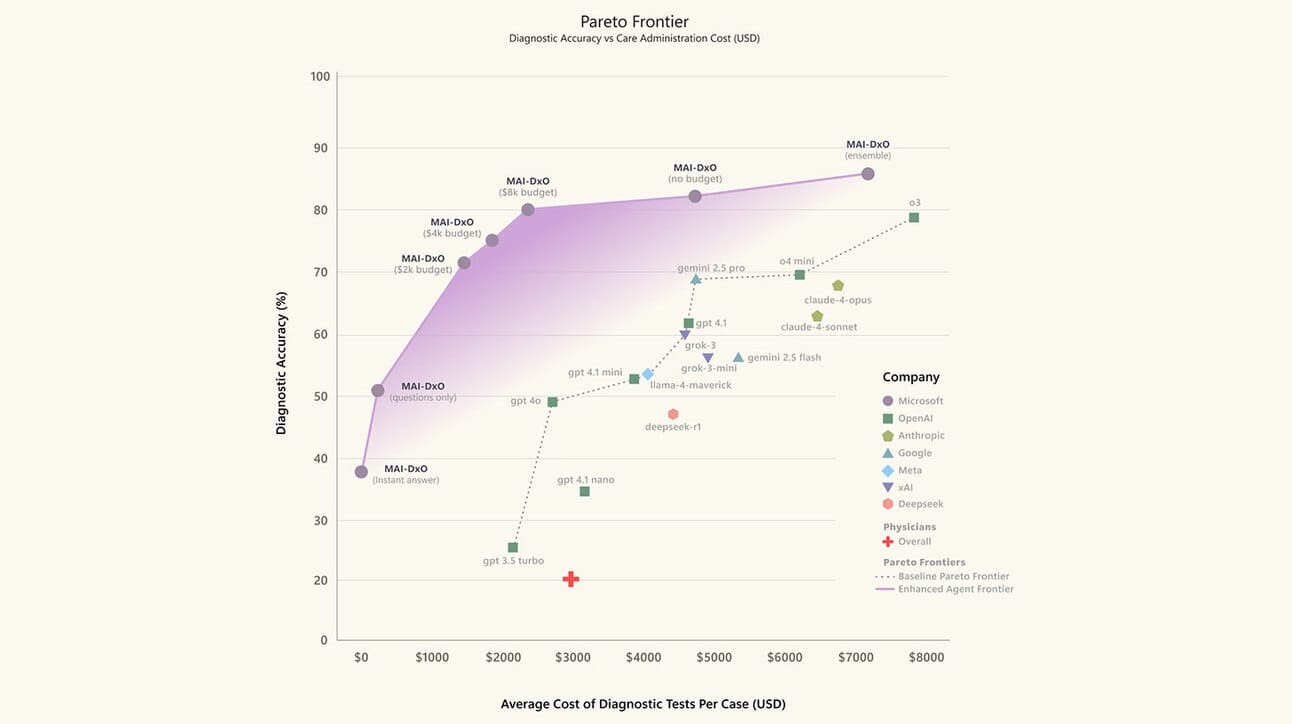
The Rundown: Microsoft just introduced the MAI Diagnostic Orchestrator, an AI system that achieves 4x higher diagnosis results than experienced doctors on some of medicine’s most challenging cases, marking a “step towards medical superintelligence.”
The details:
MAI-DxO simulates a virtual medical team, with specialized AI agents handling hypothesis generation, test selection, and cost monitoring. Researchers created SDBench, a benchmark with 304 complex cases — with MAI-DxO, paired with OpenAI’s o3, achieving the highest accuracy in testing.The MAI/o3 pairing solved 85.5% of cases correctly, with a group of physicians with 5-20 years of experience averaging just 20%.The AI system also resulted in cost savings over human doctors, spending $2,397 per case compared to an average of $2,963 for physicians.
Why it matters: A step towards “medical superintelligence” is a powerful statement, but MAI’s numbers compared to physicians are truly jaw-dropping. Plus, ordering fewer unnecessary tests and nailing tough diagnoses directly addresses healthcare’s current paradox: the over-treatment of simple cases and under-diagnosis of complex ones.
Posted in Uncategorized | Leave a comment

The Deep View: AI for Good …. Startups and solving real problems

AI for Good: $348M fund backs startups solving real problems
Source: Midjourney v7
Sweden’s Norrsken Foundation is investing $348 million in European startups using AI to address major global issues, including climate change, health, food, education and social impact. The new fund is one of the largest in Europe dedicated to AI-for-good ventures, aiming to redirect innovation toward solving what matters most.
Founded in 2016 by Klarna co-founder Niklas Adalberth, Norrsken now manages over $1 billion in assets across multiple impact-focused investment vehicles. The foundation’s venture arm believes most AI companies are still optimizing ads and inboxes instead of addressing human challenges.
As Agate Freimane, General Partner at Norrsken VC, puts it: “AI is not just another productivity boost, it’s a real chance to fix what truly matters.”
Where the money’s going
Startups using AI to improve climate, health, food, education and society$348 million earmarked specifically for AI-for-good projects. Part of a larger $1 billion impact fund network under Norrsken’s umbrellaBuilt to help early-stage ventures scale meaningful solutions Aimed at shifting AI away from ad clicks and toward real-world progress
Why this matters: While AI funding is booming, with over $80 billion in VC deals last quarter alone, most startups still focus on ad tech and SaaS efficiencies. Norrsken’s move is a shift toward purpose-built AI, aiming to unlock real-world benefits for underserved communities and overlooked global issues.
Freimane is blunt about the stakes: “Artificial intelligence is the most powerful tool humanity has ever created. Yet, so far we are mainly using it to optimise clicks and automate emails.”
This fund wants to change that.

Posted in Uncategorized | Leave a comment

AI especially for older people researching their family history and leaving a link of data into posterity. Why can we not move the National Archives Ireland to GPO; why can’t we exhibit the paintings of former President of the Royal Hibernian Arts … his paintings of the Rising are to be revelled in ie if they are not in the hands of the private sector? We too can access our newspapers. See family history on this site by searching Grok3 AI … NAI gave me several links to newspapers and I learned so much from same.

A Breakthrough in France Genealogy: MyHeritage Publishes a New Collection of 731 Million Records Extracted From French Newspapers

  • By Esther

June 3, 2025

A Breakthrough in France Genealogy: MyHeritage Publishes a New Collection of 731 Million Records Extracted From French Newspapers

We’re happy to announce the release of a new historical record collection on MyHeritage: France, Names & Stories in Newspapers. This collection includes 731 million structured records extracted from French newspapers. These records were created using advanced AI technology developed in-house by MyHeritage.

This is the first Names & Stories collection on MyHeritage in a language other than English — following the 11.6 billion English-language records published previously in 15 other collections.

Search France, Names & Stories in Newspapers

Historical newspapers offer rich details for family history that official records often lack. They add color and context — stories of everyday life, personal achievements, public recognition, photos, and much more. With the Names & Stories collections, these stories are searchable and also matched to your family tree. You can uncover surprising new details — even about relatives you didn’t think to search for.

Records in this collection typically include full names and identified relationships, relevant locations, occupations, and associated institutions, as well as the newspaper title, publication date, and place. They provide a snippet of text from the newspaper, a short article summary generated by AI, and the full scanned text (OCR) of the article. In addition, each record includes a link to view the original full scan of the newspaper page on the Gallica.fr website.

Examples

Here are a few examples from the France, Names & Stories in Newspapers collection.

Example 1

An article from L’Époque, published in 1938, describes the wedding celebration of Jacques Delacour and Marie-Louise Rambaud — a richly detailed item packed with family connections. The marriage took place at the Saint-Paterne church in Orléans, and the article is notable for the number of named individuals and family relationships it includes.

Record entry for Jacques Delacour in the France, Names & Stories in Newspapers collection on MyHeritage.com (Click to zoom)

Posted in Uncategorized | Tagged , , , , | Leave a comment

This is Why Jews Are Hated Wherever They Go | Sowell Speaks

Sowell Speaks

24 Jun 2025 #ThomasSowell#Slavery#HooverInstitution

This is Why Jews Are Hated Wherever They Go | Sowell Speaks. Thomas Sowell, a renowned economist and social critic, has held teaching positions at Cornell and UCLA and has served as a Senior Fellow at Stanford’s Hoover Institution since 1980. This channel is dedicated to sharing his economic and philosophical insights.

Posted in Uncategorized | Leave a comment

Over 60’s. Being aware is important. Japan’s oldest doctor: These Morning Habits Triple Your Stroke … As a person with TBI the coordination suggestion is familiar to me. Highly recommend this.

Posted in Uncategorized | Leave a comment

Urgent Attention: We have a capacity to store gas, we need more. Maybe it is time for our Government to engage with Viktor Orban’s approach to start using Russian Oil/Gas … Listen to Professor Mearsheimer, Col. Douglas Macgregor. Ukraine war is at an end. Russia has basically won. Let’s take the scales from our eyes. We need to consider trade, our needs especially in winter, on oil and gas.

Dan O’Brien

@danobrien20

Other European countries have scrambled to acquire floating storage and regasification units since 2022. LNG imports into the EU have doubled. It’s a matter of national security that an FSRU is acquired and we don’t go into another winter with the unnecessary risk of extended blackouts. https://independent.ie/irish-news/planners-seek-clarity-on-coalitions-gas-reserve-policy-before-deciding-fate-of-shannon-lng-plan/a1701387552.html…

Quote

Dan O’Brien

@danobrien20

·

2h

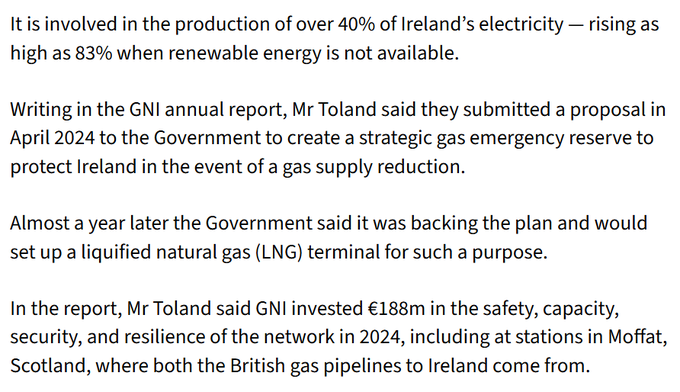
At times as much as 83% of Ireland’s electricity is generated from gas. Government has plans to ration electricity for weeks and months if anything happens to the single pipeline bringing gas from Britain. With so many risks that cannot be mitigated, it is staggering that

Show more

Posted in Uncategorized | Leave a comment