Jul 3, 2025 #israel#iran#trumpNew York Times columnist Thomas L. Friedman unpacks the geopolitical fallout from Iran’s stunning defeat in a 12-day war against Israel and the US—and what it means for Israel, Gaza, the US, and the Middle East’s future. Subscribe to GZERO’s YouTube channel and turn on notifications (🔔): / @gzeromedia
Spanish mathematician Javier Gómez Serrano and Google DeepMind team up to solve the Navier-Stokes million-dollar problem
A team of researchers and engineers has been secretly working for three years on one of humanity’s most devilish enigmas, the solution of which is considered imminent thanks to artificial intelligence
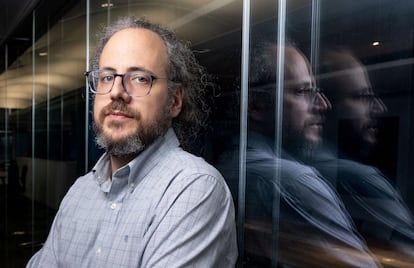
Mathematician Javier Gómez Serrano at the EL PAÍS newsroom in Madrid on May 27.Alex Onciu
The mathematician Javier Gómez Serrano, born in Madrid 39 years ago, has partnered with the artificial intelligence giant Google DeepMind to try to “soon” solve one of the most devilish enigmas known to humans, the Navier-Stokes equations, as he himself has told EL PAÍS. This is one of the seven Millennium Prize Problems, for whose solution the U.S.-based Clay Mathematics Institute is offering $1 million (and “immortal fame,” as the Spanish researcher emphasizes). The so-called Navier-Stokes Operation, underway for three years with a team of 20 people, has so far been carried out with complete discretion, although the chief of Google DeepMind, Demis Hassabis, let slip in a January interview that they are “close to solving a Millennium Prize Problem” without mentioning which one. “We’ll see that in the next year or year and a half.”
Gómez Serrano, who teaches at Brown University, is speaking publicly about the quest for the first time. “There is a general consensus in the community right now that the problem will be solved soon, but no one knows who will do it or how,” he explains. The challenge dates back to the 19th century, when two mathematicians, the Frenchman Henri Navier and the Irishman George Gabriel Stokes, independently published, in 1822 and 1845, the equations that describe the motion of fluids such as water and air.Based on the temperature, viscosity and initial velocity of the fluid, the equations calculate its velocity at a later time. Two centuries after their enunciation, it is still unknown whether the solutions always maintain a regularity or whether an explosion could occur, a sudden change in behavior, as if a tsunami were triggered in a calm sea. These equations are essential for predicting phenomena as relevant as the weather, catastrophic floods, the movement of an airplane, or blood flow in a human being.
The enigma seems poised to be solved imminently. Gómez Serrano co-leads a team of five academics who met while working at Princeton University and are now scattered across various U.S. institutions. They are two geophysicists — Taiwanese Ching-Yao Lai and Chinese Yongji Wang, authors of complex models for calculating melting ice in Antarctica — and three mathematicians: Australian-British Tristan Buckmaster (the other group co-leader), Spaniard Gonzalo Cao Labora, and Gómez Serrano himself, who was raised in the working-class Madrid neighborhood of Puente de Vallecas.
Great mathematical minds have stumbled trying to solve this challenge, devoting the best years of their academic lives to it, only to find themselves stuck in a dead end. In 2014, Thomas Hou’s team at the California Institute of Technology did achieve a major breakthrough, thanks to a prior simplification of the problem. Hou’s group did not use the Navier-Stokes equations, but an earlier version proposed in 1752 by the Swiss mathematician Leonhard Euler to describe the motion of ideal, viscosity-free fluids. The researchers produced a simulation of a fluid inside a cylinder, which, under certain initial conditions, appeared to give rise to a “singularity”: the sought-after tsunami in a calm sea. Gómez Serrano’s team used artificial intelligence techniques — machine learning neural networks — to refine the solution and understand where and how the singularity forms. Their results, published three years ago, were interpreted as a sign that a solution to the million-dollar problem was imminent.
The Spanish mathematician believes that only three other groups in the world are seriously competing to solve the enigma: the aforementioned Thomas Hou in California; the tandem formed by Egyptian Tarek Elgindi and Italian Federico Pasqualotto, also in the United States; and the team led by Diego Córdoba, a 53-year-old Madrid native who, more than a decade ago, supervised Gómez Serrano’s PhD dissertation at the Institute of Mathematical Sciences in Madrid, on how waves break in the sea.
“The Navier-Stokes problem is tremendously difficult,” he acknowledges. “People haven’t been successful using traditional mathematics. What sets our strategy apart from everyone else’s so far is the use of artificial intelligence. That’s the advantage we have, and we think it can work. I’m optimistic; progress is very, very rapid,” he notes. In his view, the solution will arrive sometime in the next five years.
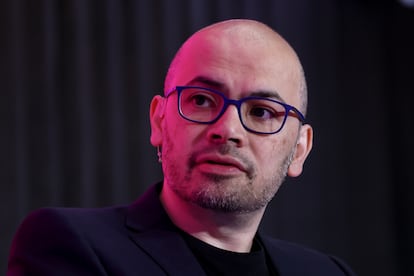
British neuroscientist Demis Hassabis, head of Google DeepMind, at a conference in London on June 2.Jack Taylor (Getty Images for SXSW London)
Gómez Serrano has just participated in another historic breakthrough with Google DeepMind: AlphaEvolve, a new artificial intelligence system that solves complex mathematical problems with unprecedented efficiency. The Spanish professor and his American colleague Terence Tao — considered the greatest living mathematician — trained the program for four months with 50 puzzles. “In 75% of cases, it matches the best human result. In another 20%, it improves on it. A 95% success rate is, frankly, impressive,” says Gómez Serrano.
“I think a trained human, reading the related literature, programming extensively, and preparing for several months, could perhaps achieve this. But AlphaEvolve did it in a day. That’s really the advantage. It can become a tool that greatly accelerates research. It will change the way we do mathematics,” he argues.
The head of Google DeepMind, the British neuroscientist Demis Hassabis, and his American colleague John Jumper won the Nobel Prize in Chemistry last year for creating AlphaFold2, an artificial intelligence system capable of predicting the intricate structures of all 200 million known proteins. The program accomplishes in minutes what previously required months of work. The revolution of the new AlphaEvolve system is that, unlike AlphaFold2 and the program designed for the Navier-Stokes puzzle, it is not created with machine learning to solve a very specific problem, but rather is an extensive language model, like ChatGPT, that solves problems in a wide variety of branches of mathematics without requiring specialized knowledge.
Demis Hassabis has predicted that so-called artificial general intelligence, software with human-like intelligence and self-learning capabilities, will arrive around 2030. Gómez Serrano is more cautious. “There are people, more daring than me, who predict that, within five or 10 years, artificial intelligence will be at the level of the best mathematicians in history. I don’t know, but I know it’s progressing extremely rapidly,” he reflects. “There are two currents: the optimists and the pessimists, who think of Terminator [the 1984 film in which an artificial intelligence rebels against humans]. I believe we will ask more complicated questions, that we will be able to better understand nature and design better materials and better medicines. I believe it will change the world, and I want to believe it will change it for the better.”
Sign up for our weekly newsletter to get more English-language news coverage from EL PAÍS USA Edition
Peacemaker (@peacemaket71) posted at 5:22 am on Sat, Jul 05, 2025: Professor Jeffrey Sachs:
“The source of all the conflict in the world is Great Britain. That goes for the Gaza Strip, China, Pakistan, India, and the entire Middle East. It was Great Britain that created this whole mess. For 200 years, it was the most powerful empire in the
The Rundown: MIT researchers unveiled a breakthrough wireless sensor, dubbed mmNorm, that could give warehouse robots a kind of “X-ray vision,” letting them spot hidden damage before a box is ever opened, ensuring ultimate quality control.
The details:
The system uses millimeter wave signals, like those in Wi-Fi, that can penetrate common shipping materials to create detailed 3D images of objects out of view. This means a robot can “see” through a cardboard box, detecting if an item buried under packing is damaged without opening the package, even a bit. The tech could be mounted on mobile robots in fulfillment centers, automating quality control and reducing the need for manual package checks. It is designed to work with cluttered or even densely packed boxes, distinguishing between multiple overlapping objects.
Why it matters: The breakthrough tech spots hidden flaws — like a broken mug handle or a cracked circuit — that would normally go unnoticed until a box is opened. If adopted, it could streamline warehouse checks, slash returns from damaged goods, and raise the bar for automated quality control in logistics.
Are you dating a stupid man? Or worse — are you becoming one? In this video, we break down the 6 hidden signs of a stupid man — inspired by the deep psychological insights of Carl Jung, stoic philosophy, and raw real-life behavior. These are the men who pretend to be confident, but are emotionally stunted. Men who look strong on the outside, but are fragile inside. From men who react instead of reflect, to those who confuse lust for love, this video will reveal the unconscious patterns keeping so many men stuck — and how to break free from them before it’s too late. This is not just about relationships or masculinity. It’s about emotional maturity, mental strength, and the ability to evolve — or self-destruct. 👉 If you’ve ever felt stuck in your own ego… 👉 Or dated someone who looked like a man, but acted like a boy… You need to watch this. 🎯 What You’ll Learn:
The 6 signs of a psychologically stupid man Why emotional immaturity often hides behind fake confidence Carl Jung’s perspective on ego, projection, and the shadow self How to evolve into a wiser, grounded man — or avoid dating the wrong one 🔔 Subscribe for more deep-dive content on: Psychology & Carl Jung
Iraqi forces foil smuggling of over one ton of drugs via Syria, Al Iraqiya News, March 16, 2025
On March 21, 2025, Syrian anti-narcotics forces uncovered a staggering cache of approximately 3 million Captagon pills in a warehouse in Aleppo, arresting one suspect in a major operation. The seizure, conducted in collaboration with Aleppo’s security directorate, has reignited scrutiny on the Iranian regime’s long-standing involvement in the region’s illicit drug trade. While the Syrian Interior Ministry has referred the suspect to judicial authorities, emerging reports point to a deeper connection with Tehran-backed networks that have historically fueled instability in Syria.
Under the former regime of Bashar al-Assad, which collapsed in December 2024, Syria transformed into a hub for Captagon production and trafficking, with allegations consistently linking these operations to Iranian militias and Hezbollah, both heavily supported by Tehran.
Sources indicate that the Iranian regime utilized drug revenues to fund its proxy forces across the Middle East, exploiting Syria’s chaos to expand its influence. The recent Aleppo bust follows a pattern of heightened Syrian efforts to dismantle these networks, including military operations targeting Hezbollah along the Lebanon border and crackdowns on weapons smuggling tied to the Iranian regime’s Islamic Revolutionary Guard Corps (IRGC).
The regime’s role in Syria’s drug trade is part of a broader strategy to sustain its regional ambitions despite growing pushback. Since Assad’s fall, Tehran has reportedly sought to ignite insurgencies in Syria’s coastal regions, using its proxies to maintain a foothold. The Captagon trade, long a financial lifeline for these groups, has flooded Middle Eastern markets, with the amphetamine-based drug becoming a staple of organized crime in the region. Iraqi authorities recently seized over a ton of Captagon originating from Syria, underscoring the scale of the problem.
This latest seizure in Aleppo highlights the enduring challenge of confronting Iran’s destabilizing activities in post-Assad Syria. As Syrian forces intensify their efforts to curb Tehran’s influence, the international community watches closely, wary of the broader implications for regional security.
Rejection, especially from your own child, can be painful—but Stoic philosophy teaches us that every hardship holds a lesson. In this video, Stoic Training explores why being rejected by your child in old age can be a hidden blessing and how to transform this experience into wisdom, strength, and inner peace. Drawing from the teachings of Marcus Aurelius, Seneca, and Epictetus, we’ll uncover the Stoic approach to loss, detachment, and acceptance, helping you regain control over your emotions and find meaning even in painful moments. Watch now to embrace resilience, self-mastery, and the true power of Stoicism. Don’t forget to subscribe for more Stoic insights and leave a comment to share your thoughts! 👉 / @stoictraining Check out other videos from the channel, about Stoicism from Marcus Aurelius, Epictetus, Seneca and others:
What if every conversation you have is part of an invisible marketplace, and you’re giving away your most valuable assets for free? Former CIA officer Andrew Bustamante introduces the concept of the economy of secrets, where every withheld thought and every shared opinion carries leverage.
In this hidden system, those who understand the rules gain power, and those who don’t become easy targets.


 Professor Jeffrey Sachs:
 Image source: Ideogram/The Rundown