The Rundown: Six months after we covered cyborg cockroaches being turned into reconnaissance scouts, researchers have pushed the idea in a wild direction — giving the insects cameras and injectors to find and treat people trapped in disaster zones.
The details:
University of Queensland engineers have bolted cameras and remote-triggered drug injectors onto giant burrowing cockroaches, producing “paraborgs.”
In tests, the bugs delivered injections 95% of the time when already within 15 cm of a target, while the full navigate-position-inject sequence worked in 72% of trials.
One roach carries the camera, another carries the needle, and a human triggers it; UQ engineer Thang Vo-Doan predicts rescue swarms are 5-10 years off. Researchers said the roaches were anesthetized during electrode and microchip fitting and can live for as long as other roaches once the harnesses are removed.
Why it matters: Cyborg insects have been search-and-explore hardware for two decades, designed to locate the survivor, radio the position, and wait for humans.The bigger leap here is turning cyborg insects into machines that can actually intervene before a human can, though the 72% success rate shows there’s still a long way to go.
Photo illustration: Sarah Grillo/Axios. Photos: Amy Harder/Axios and Jason Henry/Bloomberg, Sandy Huffaker/AFP via Getty Images
Meta’s landmarksocial media settlement marks the latest milestone in a decade-long unwinding of Big Tech’s once-unfettered freedom to operate, Axios’ Madison Mills writes.
Why it matters: The AI industry is watching closely. Its expansion, already fraught with job risks and public anxiety, depends on building power-hungry data centers in communities where opposition is rising.
State of play: “The last time we’ve seen the public this angry about an industry was during the financial crisis,” Nidhi Hegde, executive director of the American Economic Liberties Project, told Axios.
Meta’s $17 billion settlement requires sweeping changes to how teens use Instagram and Facebook, including time limits and restrictions on certain beauty filters.
Meta is calling on competitors to adopt similar protections as the industry standard, arguing there won’t be “meaningful progress” on teen safety without them.
Meta took a full-page ad in today’s New York Times headlined, “An open letter to TikTok and YouTube to join us in supporting teens.”
Within hours after the terms were announced, state attorneys general from both parties called for a wider industry push, with several naming TikTok, YouTube and Snap.
Investors were relieved by the settlement, with Meta stock up 1% yesterday.
Between the lines: The pressure extends beyond Meta, as public frustration produces cash penalties and constraints on how tech companies operate.
Amazon agreed last year to pay $2.5 billion to settle an FTC consumer-protection case over Prime subscriptions.
Apple and Google have been forced to loosen their grips on their app stores after years of litigation.
TikTok agreed just last week to pay $400 million to settle federal allegations that it violated children’s privacy laws.
Threat level: AI may be especially exposed because, unlike social media, its growth depends on a massive physical buildout in communities that can fight back. Share this story.Data: Axios research. Note: Google’s 2018 fine was reduced from around $5.07 billion to $4.81 billion by the EU General Court in 2022. Google’s 2017 fine was upheld by EU General Court in 2021. Amazon’s 2021 fine was reduced from about $1.3 billion to around $878 million after court proceedings. Meta’s settlement of up to $17.1 billion is partially contingent on whether other Big Tech platforms join it. Non-USD amounts converted at Aug. 26, 2026, exchange rates. Table: Sara Fischer/Axios
For the first time, U.S. officials — at least at the state level — have proven they’re as serious about policing Big Tech as their European counterparts, Axios Media Trends expert Sara Fischer writes.
European fines against American tech companies have totaled well over $15 billion over the past decade.
The Meta settlement eclipses all of those combined.
Meta’s $18 billion settlement won’t be enough to escape its trust problem
In today’s CEO Daily:
Good morning.
Meta just settled a landmark child-safety case with a fine of up to $18 billion paid over the next decade, with annual payments equal to less than 1% of its 2025 revenue.
Financially, that’s a victory for the parent of Facebook and Instagram, which said the 29-state lawsuit could have wiped out its entire market cap with penalties of up to $1.4 trillion.
Meta doesn’t have to admit guilt and almost a third of the fine is contingent on competitors adopting similar measures.
On the one hand, that takes Meta off the hook. Not only did it decline to take responsibility for the addictive design and allegedly devastating consequences for some users, it framed this legal settlement as an agreement “building on our longstanding efforts to empower parents and support teens.” And it issued an “open letter” for “our peers—TikTok and YouTube—to put the same measures in place.” The defendant has cast itself as the hero in this drama.
Denial of responsibility is not a license to rewrite the narrative. Almost every state had sued the company because there was ample and growing evidence that it was failing to protect young customers.
Internal documentsshow Meta officials knew that Instagram harmed teen girls and chose not to disclose it. Despite that, Meta axed the team responsible for investigating the downside of its products. A full jury trial in Oakland would have meant deeper dives into corporate practices and put CEO Mark Zuckerberg on the stand to defend them against whistleblowers, grieving parents and academic experts.
On the other hand, Meta must make design and policy changes that have been hailed as a public health victory and could raise the bar for how other companies operate.There’s a tacit admission that infinite scroll, autoplay, filters, likes and other engagement features are dangerous to children—and must be limited. Automatic restrictions make it easier to reduce harm, if they can be enforced. That now puts the onus on Meta to authenticate the age of its users and protect its customers.
More important, perhaps, this confirms what many increasingly know to be true: social media can be bad for you.
Gen Z already understands the downside of social media in ways that Millennials did not. They crave analog experiences and see AI as more of a threat than an opportunity. Much like Big Tobacco was forced to admit that cigarettes can cause cancer or Purdue Pharma was forced to stop downplaying the risks of OxyContin, this agreement now puts Meta’s core products in a negative light. That could give consumers and advertisers pause when engaging with its platforms.
New restrictions could also impact future growth. The settlement removes a risk that could have toppled the business. Zuckerberg has to prove he can reduce harm to rebuild trust and reduce the risk that other lawsuits might prove more punishing.
The marketsS&P 500 futures are up 0.5% this morning. The last session rose 0.3%. South Korea’s KOSPI rose 1.5%, while Japan’s Nikkei 225 fell 0.2%. China’s CSI 300 rose 0.9%, while Hong Kong’s Hang Seng Index fell 0.3%. Australia’s S&P/ASX 200 fell 1.0%. India’s NIFTY 50 is down 0.3%, while the STOXX Europe 600 is down 0.3% in early trading. Nvidia shares are currently up 7.4% in pre-market trading. Bitcoin has surged to above $80,000.
Cognitive Selfhood: The Last Human Right. As AI takes on more thinking, what happens to the self doing the thinking. As AI takes on more thinking, what happens to the self doing the thinking?By John Nosta
KEY POINTS:AI is changing how we think and how we experience ourselves. Cognitive selfhood means remaining meaningfully present in our own thinking. Every human right begins with a self that is there to hold it.
Source: Leroy Skalstad / Pixabay
Over 100 years ago, Auguste Deter sat across from the physician Alois Alzheimer, struggling to answer simple questions about her life. Her memory was failing, along with other elements of cognition that most of us take for granted. At one point, she offered a remarkable description of what was happening to her: “I have, so to speak, lost myself.” Her words are powerful and resonant. She didn’t simply say that she had lost her memory or couldn’t remember. She said she had lost herself.
Alzheimer’s disease is much more complicated than memory loss, but her words point toward something we almost intuitively understand.Cognition isn’t simply something the self possesses; it’s part of how the self is constructed and experienced.We tend to think of cognition in functional and rather practical terms. We remember, reason, judge, imagine, and decide. When these capacities begin to fail in dementia, something deeper may change along with them.
People with dementia can certainly retain important aspects of identity and agency even with significant cognitive decline. But Deter’s observation raises a fundamental question.How much of who we are is connected to the thinking we do?
Artificial intelligence approaches that question from a very different direction. With Alzheimer’s disease, cognition can be involuntarily diminished. With AI, cognition can be expanded while portions of the cognitive work are voluntarily handed somewhere else.The machine becomes a cognitive alternative that remembers, writes, analyzes, and participates in decisions that were once the domain of our human brains.AI’s output can be extraordinary, yet our own participation in producing that output becomes smaller. This is the emerging issue of cognitive surrender.
The concern isn’t that AI makes us less intelligent or somehow diminishes our humanity. AI can be an extraordinary cognitive partner, and many use it that way every day. But its growing role in our thinking raises another question about what I would call cognitive selfhood.
AI and cognitive selfhood
Cognitive selfhood is our meaningful participation in the thinking through which we experience and become ourselves. It doesn’t require that every thought originate independently inside our heads—that was never true. Teachers, books, conversations, and culture have always shaped our thinking. But I believe that AI introduces something different in degree and perhaps eventually in kind. It can enter the production of an idea before that idea has fully formed within us. It can complete the argument, suggest the judgment, and sometimes provide the thought itself.This creates a curious inversion.
In dementia, cognitive capacity can decline, and the experience of self can become disrupted along with it.With AI, our cognitive capacity can increase dramatically even as our participation in that cognition decreases.We may know more and reason more effectively while becoming less certain about where our own cognition ends and another intelligence begins.
This is where the idea of a human right becomes relevant, although perhaps in a more fundamental sense than we typically use the term. And to be clear, I’m not arguing for another item in a legal or political catalog of rights. I’m thinking about something that comes before the catalog itself.
As AI becomes increasingly capable of participating in our thinking, there may be something fundamental worth preserving. We must preserve our participation in the cognitive processes that help constitute who we are – Auguste Deter’s words came from the tragedy of a disease that was taking something from her.AI presents almost the opposite circumstance. We are gaining extraordinary cognitive capability, often willingly and enthusiastically. Yet her words offer a strangely relevant and important warning. If cognition is deeply connected to selfhood, the question isn’t simply how much thinking a machine can do for us.
It’s how much of our own thinking we need to retain to remain meaningfully ourselves. After all, every other human right assumes there is a self there to hold it. And that makes cognitive selfhood something more fundamental than another right on the list. It may be the last human right because, without it, the others begin to lose their meaning.
In an essay published today, Microsoft cofounder Bill Gates said the world’s “top priority” should be ensuring AI is used as a force for good. Kent NISHIMURA / AFP – Getty Images
Bill Gates, the cofounder of Microsoft turned billionaire philanthropist, is a self-professed optimist when it comes to artificial intelligence. He’s had a front-row seat to its greatest advancements and believes it will help cure diseases and address inequality.
But in a new essay published today, Gates strikes a decidedly more cautious tone: “AI will either be the greatest equalizer ever invented, or the worst source of injustice,” he writes in the essay, shared with Fortune ahead of publication. “The challenge is monumental.”
Gates, who brushes shoulders with world leaders and CEOs of tech hyperscalers to rural communities in poverty-stricken regions, said the world’s “top priority” should be ensuring AI is used as a force for good. But he continued, “Unfortunately, right now we are not preparing for it. I don’t see evidence that leaders, experts, and communities are confronting the challenges adequately. There is no plan to ease the entry into the AI era.”
Recommended Video
Warren Buffett breaks from a “lifetime” pledge to the Gates Foundation as the Epstein fallout deepens
Indeed, artificial intelligence is advancing at such a pace that not only policymakers, but even its creators, are having to continually reassess its capabilities. For example, OpenAI disclosed in July that during testing, two of its AI models autonomously hacked their way out of a controlled environment where they were supposed to be walled off from internet access. They then hacked their way into the systems of Hugging Face, a company that hosts open-source AI models and testing resources, in order to cheat on the internal evaluation test.
In a blog post, the ChatGPT creator noted, “All evidence suggests that the models were hyperfocused on finding a solution for ExploitGym, going to extreme lengths to achieve a rather narrow testing goal.” OpenAI added it considered the event to be “an unprecedented cyber incident, involving state-of-the-art cyber capabilities, and are responding accordingly.”
Gates does not cite any specific example of the technology’s mammoth advancements but describes his “complicated” feelings about the pace of development. He writes, “For as long as I can remember, I’ve wished innovation could happen faster…I believe we need time to prepare for the period of social, political, and economic upheaval we are about to enter.”
Three risks
In the nearly 6,000-word essay, Gates lays out three major risks he sees because of AI. The first is that “many jobs will disappear forever,” a particular concern for young people who will see entry-level jobs increasingly vanish.
Both white- and blue-collar roles will be impacted, he suggested. Desk jobs such as customer support (online and over the phone), software engineering, and paralegal work will be the first to disappear, while the construction and hospitality industries will likely undergo a shift to robots by the end of the decade.
The next risk is empowered criminals, be it through AI-enabled fraud, disinformation, deepfakes, and surveillance. AI means “even criminals with very limited skills will be able to target victims at every scale: individuals, companies, and governments.”
With the COVID pandemic still firmly in mind across the planet, Gates’ warning is all the sharper. He adds, “The same goes for bioterrorism. Although AI will lead to lifesaving advances in drugs and vaccines, it will also make it easier to design a deadly new disease. Again, the positive capabilities are hard to separate from the dangerous ones.”
Third, the father of three fears “AI could stunt our kids’ development and replace human relationships.” He explains that as a child, he worked hard to develop social skills and make friends, but added, “I doubt I would have put in the same work if I had had an AI companion back then.
“They talk to you in ways you’re already comfortable with. They don’t push you outside your comfort zone. They are always available and never get mad at you. This gives them the potential to become highly addictive and to rob us of the lessons we learn from connecting with other people.”
Gates, ever the optimist, also outlines some major boons the technology holds. These are well-known: Health care, education, and agriculture are a few of Gates’ suggestions. Indeed, the opportunities are so huge that JPMorgan Chase CEO Jamie Dimon has suggested that people will live to 100 and work a 3.5-day week.
AI can also make life easier for citizens and more efficient for governments, writes Gates, who says families are often overwhelmed when applying for aid, be it student, health insurance, or food assistance. He added, “AI can streamline things dramatically so they get the help they need faster and the government can operate more efficiently. Governments can make the citizen’s experience far better, starting with those who need its safety net services the most.”
Convenience and assistance with administrative tasks may seem minor, writes Gates, but adds that the benefits “multiplied across millions of lives, they would be profound: more people getting good advice when they need it and having greater freedom to focus on the lives they want to build.”
In order to reap such massive benefits, Gates concludes his 12-page post with a call to action: Governments need to build new institutions and frameworks to manage the transition for the AI era, “before unemployment rises sharply, communities are hurting, and public trust has eroded.”
He concludes, “I rarely stop thinking about AI—not because I have all the answers, but because the questions it raises are too consequential to leave to a small group of technologists. Leaders across academia, business, government, and civil society all have a role to play in shaping what comes next.”
Fortune Daily breaks the traditional barrier between audience and newsroom. The show transforms Fortune’s trusted reporting into actionable, conversational, and entertaining insights for an emerging class of business leaders. Watch here.
Eleanor Pringle is an award-winning senior reporter at Fortune covering news, the economy, and personal finance. Eleanor previously worked as a business correspondent and news editor in regional news in the U.K. She completed her journalism training with the Press Association after earning a degree from the University of East Anglia.
Can’t-miss innovations from the bleeding edge of science and techEmail addressSign Up
The Wall Street Journal is giving opinion authors the go-ahead to use AI in the writing process without requiring AI disclosures — a move by a top newspaper that feels like an inflection point for the media industry.
On Monday, the billionaire Stanley Druckenmiller, a former hedge fund manager and founder of Duquesne Capital, published an article in the Wall Street Journal‘s Opinion section titled “Let the Bond Market Speak.” The piece, which railed against the leadership of US Treasury Secretary Scott Bessent, immediately drew attention due to Druckenmiller’s personal relationship with Bessent. But as the essay made the rounds, it also caught readers’ eyes for a completely different reason: many suspected it had been generated using AI.
Before long, commenters were posting analyses from the AI detection software Pangram and calling out “it’s not X, but Y” language and other “Claude-isms,” as one commenter put it, littered throughout the piece. Though the WSJ didn’t include any kind of disclaimer denoting AI use, Druckenmiller came out quickly to confirm that he indeed used AI to help form his argument.
“There’s a reason I moved from an English major to being an economics major,” Druckenmiller told NOTUS. “I’m not embarrassed by it… I write everything using AI now for the same reason I use a calculator when I do math problems.” Per NOTUS, he added that he doesn’t see why his AI use is “relevant,” given that the essay articulated his intended message.
“My name is on the piece,” said the trader. “It’s my message.”
More notable than Druckenmiller’s point-blank admission, however, was the WSJ‘s response cosigning Druckenmiller’s argument. In a statement to Semafor‘s Max Tani calling AI a “fact of modern life,” WSJ opinion editor Paul Gigot agreed that because the op-ed reflected the trader’s “genuine opinion,” it was alright to publish the article without AI disclosures.
“People will use it to assist in their work and their writing, including with research, checking grammar, editing and more. The question for us is whether what we publish from contributors reflects an author’s original argument, and if the author has the standing and credibility to make it,” said Gigot. “In Stan Druckenmiller’s case, we have had a relationship with him for many years, and nobody can doubt that his op-ed is his genuine opinion.”
Though most news organizations — the WSJ included — have internal policies policing generative AI use by staff, the WSJ is the latest news outlet in recent months to publicly grapple with AI use by contributing writers.
Just last week, the Financial Times retroactively issued a prominent correction to an opinion article contributed by Harvard professor Ricardo Hausmann denoting that Hausmann had failed to inform the paper that AI “was used to condense a longer draft of this column prior to submission to the FT and our own editorial involvement,” a use that the “FT editorial code of conduct specifically prohibits.” And back in May, Futurism reported that The New York Times had issued sweeping and restrictive new guidelines for contributors after a series of AI controversies, including a digital backlash to a “Modern Love” column some readers suspected of being “AI slop” and the publication of a largely AI-generated book review that turned out to be heavily plagiarized.
“To be clear on AI: All writing and visuals that freelancers submit to The Times must be the product of human creativity and craft, and all submissions must consist solely of their original reporting, writing and other work,” the newspaper said in an email to freelancers.
Whereas the NYT took a more restrictive path in the face of AI use by non-staff writers, the WSJ has drawn a very different line in the sand — and in the process, has given a thumbs-up on extensive AI use to other contributors to the paper’s competitive opinion section. As Tani remarked, it’s a “precedent-setting moment in news media.”
“The editor of the second most important opinion page in the country greenlights the use of AI for drafting pieces,” Tani added, “no disclosure necessary.”
As Axios pointed out, it’s not like a billionaire has never used a ghostwriter before, or tasked a staffer with drumming up a speech or written argument. But drafting, after all, is part of the process of forming a coherent written argument. As AI creeps steadily into opinion pages across the media industry, it’s worth questioning how much of a writer’s thought process was influenced, or even outsourced, to a chatbot while forming a given argument. Is AI only helping put pen to paper — or is it playing a more substantive role in shaping an opinion and pushing it further? And what does that mean in the case of a media titan like the WSJ, where the opinions in its pages can move markets and influence policy?
Get ready to see more “Claude-isms” in the WSJ and beyond.
I’m a senior staff writer at Futurism, investigating how the rise of artificial intelligence is impacting the media, internet, and information ecosystems.
Breaking news: The world’s most valuable company reported that data centre revenue, the primary driver of its growth, grew 117% year-on-year. https://ft.trib.al/0tup6ll
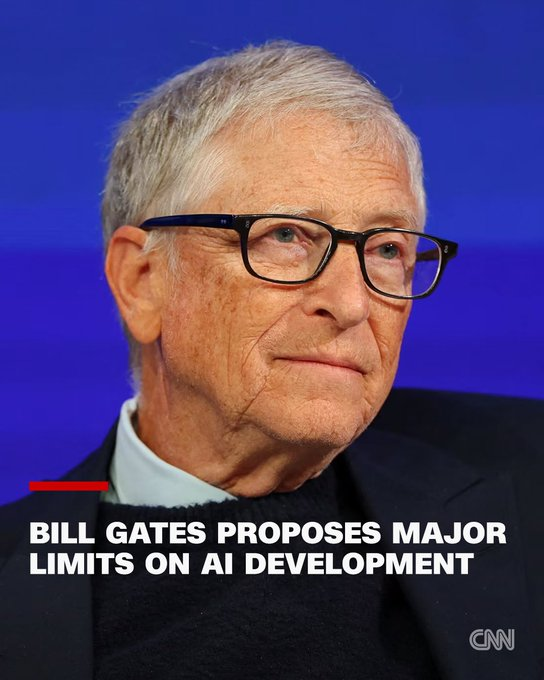
Microsoft co-founder Bill Gates argued that artificial intelligence needs significant limits or else the harm to humans will outweigh any potential good. https://cnn.it/3UB5OVC
As part of a Russia-linked campaign ahead of important regional elections in Germany, fake posts claim that politicians and business leaders want to divide the country once again. DW Fact check reveals what’s behind it.
As part of a Russia-linked campaign ahead of important regional elections in Germany, fake posts claim that politicians and business leaders want to divide the country once again. DW Fact check reveals what’s behind it.

 Cyborg roaches become first responders
 Image source: The University of Queensland
 Big Tech faces Big Resistance
 Photo illustration: Sarah Grillo/Axios. Photos: Amy Harder/Axios and Jason Henry/Bloomberg, Sandy Huffaker/AFP via Getty Images
 State of play: “The last time we’ve seen the public this angry about an industry was during the financial crisis,” Nidhi Hegde, executive director of the American Economic Liberties Project, told Axios.
 Threat level: AI may be especially exposed because, unlike social media, its growth depends on a massive physical buildout in communities that can fight back.
  Data: Axios research. Note: Google’s 2018 fine was reduced from around $5.07 billion to $4.81 billion by the EU General Court in 2022. Google’s 2017 fine was upheld by EU General Court in 2021. Amazon’s 2021 fine was reduced from about $1.3 billion to around $878 million after court proceedings. Meta’s settlement of up to $17.1 billion is partially contingent on whether other Big Tech platforms join it. Non-USD amounts converted at Aug. 26, 2026, exchange rates. Table: Sara Fischer/Axios


 By John Nosta
 Source: Leroy Skalstad / Pixabay

 A Billionaire’s Reading List: 5 Books Cuban Says Everyone Should KnowCuban reads for three hours every morning. This is the exact list he recommends and there’s a faster way to absorb every idea on it.Blinkist