🇺🇸 Navy SEALs spent four months clearing Iran’s mines from Hormuz, diving at night to strap charges onto them BY HAND.
The covert operation ran mostly after dark. SEAL divers worked alongside the Navy’s Common Uncrewed Surface Vessel, a drone boat that tows sonar-equipped submersibles like the MK 18 Mod 2 Kingfish to scan the seabed and find the mines.
Once a mine was located and the area cleared, a diver went into the water, approached it, fixed a charge to it and destroyed it, or a robot drone did the same where it was safer but slower.
They cleared roughly 80 mines the IMO had counted in June, across four months, with no American casualties, which for work this dangerous is its own achievement.
Credit the sailors who pulled this off.
The dark truth is how fast Iran adapts around them. Last week it fired rockets rigged to drop sea mines from shore, a delivery method that seeds the water in an afternoon without exposing a single boat to the Navy, and its military claimed two tanker hits in the same stretch. The SEALs cleared the lane the hard way. Iran keeps inventing cheaper faster ways to fill it back in. Source: Financial Times / Writer: Daniel
The September 11 2001 terrorist attacks were unlike anything the world had seen before.
For America, and the watching world, September 11 (or 9/11) seemed most like a Pearl Harbour moment – a devastating surprise attack by a distant enemy that demanded a response.
But here the distant enemy was not a nation state in the middle of war, it was a ragtag collection of rebels living in mountain hideouts, long underestimated and widely misunderstood.
It took Hollywood movies to convey the horror of Pearl Harbour. But hundreds of millions around the world watched, via live satellite TV feeds, in disbelieving horror as a fully laden commercial aircraft slammed into the first World Trade Centre tower in New York. Hundreds of millions more saw the second tower hit, then witnessed both massive skyscrapers collapsing faster and more completely than seemed possible.
At the time, this felt like a moment that changed everything – a hinge point in history on which so much would turn. Twenty-five years later, that devastating intuition has been confirmed through a cascading series of grim events and tragic mistakes.
Could the September 11 attacks have been prevented?
In September 2026 we live in a world of uncertainty and change. Geopolitics, technology and the physical world are experiencing rapid transformation that fascinates and terrifies in equal measure.
Much of this would have occurred without September 11, but there is a sense in which that day changed all these things.
The collapse of 80 years of global order cannot be said to have simply resulted from the world’s biggest terror attack, but it certainly played a role in triggering a series of responses that has changed all the nations involved.
Could the September 11 attacks have been foreseen and prevented? Absolutely.
Counterterrorism intelligence has evolved massively over the past 25 years. But international terrorism was not new in 2001, nor was al-Qaeda – the terrorist group responsible – completely unknown and operating without scrutiny.
Well before the 9/11 Commission report was published, it was clear there were multiple “if only” moments that may have prevented the attack. If only those sounding the alarm had been listened to. If only the FBI and the CIA had put aside their rivalries to trust each other, fully share what they knew, and act on it. If only the threat posed by al-Qaeda was taken more seriously. At all of these points, the attacks could have been stopped.
The September 11 attacks were audaciously ambitious, involving global orchestration of planning, training and execution on a scale never seen before. In the decades that followed, there have been dozens of mass-casualty terrorist attacks, first by al-Qaeda and then by its spinoff, Islamic State.
The biggest and most effective have been in conflict zones where explosive material is readily available and the tempo of violence makes stopping every attack impossible. But in stable states there have been multiple massive attacks that have killed hundreds at a time. One year after 9/11, in 2002, the October 12 bomb attacks in Bali took 202 lives, 88 of them from Australia.
Lessons have been learned
One area of lasting success in the past 25 years is the development of police lead intelligence. Police forces are now cooperating effectively across international agencies, which have developed remarkable capacity to intercept communications and disrupt planned terror attacks involving cells and networks.
Thankfully, the ratio between attempted large-scale attacks that were detected and disrupted and those that have succeeded is large. Increasingly, the vast majority of terror plots are being thwarted at the planning stage.
The flip side of this is that lone actor attacks, with one or two gunmen acting alone without a cell or a network, remain a constant threat that is not easily countered. Australians were reminded of the horror of such attacks in the Bondi Beach shootings of December 2025.
Were it not for this welcome international cooperation and fast-evolving capacity, the past 25 years would have seen many thousands more lives lost.
However, this does not mean the threat posed by terrorist organisations seeking to inflict a mass casualty attack has been eliminated. Thankfully, it’s highly unlikely an attack of the scale and nature of September 11 could be repeated. But it is not impossible. The best intelligence systems in the world are only as good as the political frameworks in which they exist, and the leaders they serve.
A terrible recent reminder of this occurred on October 7 2023, when the al-Qaeda aligned Hamas terror group, based in the Gaza Strip and supported by Iran, succeeded in a mass attack on Israel.
Even more than was the case with the 2001 attacks, there were multiple intelligence reports and warnings given ahead of October 7. The attacks succeeded not so much because of an intelligence failure as a failure by Israeli leadership to listen to the intelligence.
Almost three years on, there has yet to be a proper reckoning of how Hamas managed to succeed beyond what anyone had dared think possible. Hubris and misplaced confidence in modern technology, a structural unwillingness to listen to junior intelligence officers, particularly women, and a complex web of political interests and cynical manipulation came together to defeat some of the world’s best counterterrorist intelligence.
The years since the October 7 attack by Hamas have shown the true potential of terrorism to provoke an angry, vengeful response that involves striking out without any plan, with catastrophic consequences.
The devastating impact of the response to the Hamas attacks, not just on the two million plus people living in the Gaza Strip but more broadly on Israel, the West Bank, Lebanon and the wider Middle East, is the topic for another discussion.
But it is that vengeful, angry response of understandable outrage that is causing the greatest lasting damage.
How the response to terrorism creates more terror
One clear way the September 11 attacks changed the world was as a catalyst for a decades-long global “War on Terror”. This war never had a clear strategic plan or an agreed endpoint. Instead, it saw first Afghanistan, then Iraq, drawn into destructive conflict that amplified threats and gave new opportunities to terrorist groups. Al-Qaeda had never been as effective as when the occupation of Iraq gave rise to Islamic State.
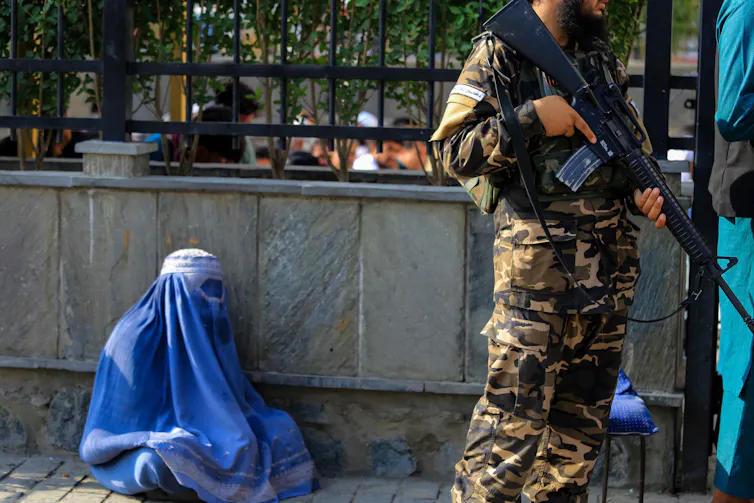
Incredibly, 20 years after a relentless military campaign by a global coalition fighting the Taliban in Afghanistan, the al-Qaeda aligned terror group is now running a cruel authoritarian state repressing tens of millions, particularly women and children. It presents a growing threat not just to its immediate neighbours but also to the wider world.
The return of the Taliban has been disastrous for many, particularly women and children. Stringer/EPA
The great mistake made was not the failure to stop the September 11 attacks in the first place, although that should have been achieved. It was the failure to understand how terrorism can amplify its impact through our response to outrage.
To properly understand the way in which September 11 functions as a hinge point in history, we need to look back 50 years before 2001 to see the coalescing of the forces that gave rise to al-Qaeda.
Al-Qaeda’s origin story stems from the imprisoning and persecution of Muslim Brotherhood leaders in Egypt in the 1950s. The 1966 prison execution of visionary brotherhood leader Sayyid Qutb saw his brother and remaining Brotherhood leaders flee to Saudi Arabia, where their revolutionary political vision was fused with state-sponsored Wahhabi fundamentalism and the support of Osama bin-Laden. It fuelled the global resistance movement in Afghanistan and gave rise to groups such as Jemaah Islamiyah, the Southeast Asian terror network behind the Bali bombings.
Twenty-five years after September 11, the Salafi jihadi terrorist ideas first sketched out by Sayyid Qutb, then realised by al-Qaeda, remain an enduring threat.
Their impact in Afghanistan and central Asia continues to be underestimated. But it is in Africa where both al-Qaeda and Islamic State continue to expand and evolve, inflicting devastating violence across a dozen conflict zones.
Given the September 11 attacks were 50 years in the making, there’s every reason to believe the threat unleashed through the rise of al-Qaeda presents an enduring problem.
Sadly, the mistakes of the past 25 years seem set to produce more generations of angry young men drawn to the siren song of revolutionary jihad.
How beavers can help create fire breaks as part of a drought preparation plan
Published: September 7, 2026 1.48pm BST
Share article
Print article
Most of the countryside around the Holnicote estate in Somerset has been dry and dusty for most of the summer. But one corner remains conspicuously green.
Here in south-west England, an animal that was made extinct in Britain in the 16th century, mostly because of hunting, is making a comeback. Reintroduced just six years ago, beavers have helped turn a small watercourse on the estate into a wet meadow – a true oasis amid the parched landscape.
It is an Instagram-worthy example of why reintroducing beavers to more of Britain could help us prepare for the next drought. It shows how they reshape rivers and the surrounding land to hold water in the landscape for longer, rather than allowing it to drain away rapidly.
Beavers are often called ecosystem engineers. They fell small trees, build dams and dig channels. Water backs up behind their dams, spills across the valley bottom and soaks into the surrounding soil. Sediment and woody debris accumulate, while wetland plants establish themselves.
The result can be a mosaic of ponds, channels, marshes and wet woodland. During dry weather, this stored water can keep soil and vegetation wetter for longer.
This effect was highlighted in a 2008 Canadian study that examined aerial photographs of Elk Island National Park in Alberta over 54 years. Beavers had disappeared from that landscape in the 19th century, but returned in 1954.
The number of active beaver lodges, where beavers live and raise their young, was found to explain more than 80% of the variation in the area of open water. During 2002, the driest year studied, wetlands with beavers on them contained nine times more open water than those without them.
This does not mean releasing beavers in Britain will reproduce the Canadian numbers. It is a different beaver species in a different landscape, and the effects of any beaver colony depend on the shape, soils and land use of its catchment. But British research points in the same direction.
Researchers studying a beaver enclosure on an intensively managed grassland in Devon in 2011 found that 13 dams stored around 1 million litres of additional water. The dam structures built by the beavers held back the stream to create a series of ponds. Because such dams are leaky, this water was released gradually, slowing storm flows while maintaining water downstream during dry periods.
Holding more water in a landscape has another increasingly important benefit: it helps vegetation stay green. Healthy, damp vegetation is harder to burn, so beaver wetlands may provide refuges for wildlife and help interrupt a fire’s progress.
A 2020 study of five wildfires in the western USfound that streamside vegetation in beaver-dammed areas was three times less affected than comparable areas without beavers.
Again, this does not prove that beavers will always stop British wildfires. Our landscapes, vegetation and fires differ from those of the western US. A wet strip beside a stream is no substitute for proper wildfire prevention and response. But creating wetter, greener corridors through a drying landscape is a useful extra layer of protection.
Beavers are not suitable for every watercourse. Their engineering can flood farmland, block culverts and damage trees. So, reintroductions need proper assessment, long-term management and support for affected landowners. England now requires a licence and a management plan for any beaver releases into the wild.
A ‘welly belt’ of wetlands?
We also shouldn’t expect beavers to repair the whole landscape. There’s other work to do, including restoring peatlands, ponds and marshes, reconnecting rivers with their floodplains, and re-establishing vegetated buffer strips along watercourses.
The UK could establish a “welly belt”: a connected network of wetland areas where needing waterproof boots is recognised as a useful feature, rather than an engineering fault to be drained away. Beaver-made wetlands could form an important part of that network, if managed correctly.
The need for careful management has recently been highlighted in Norfolk, where two wild beavers that mysteriously appeared on the River Wensum have produced the county’s first kits for more than 500 years.
Some suspect an illegal release, sometimes called “beaver bombing”. But tempting as it may sound to revive the US’s wonderfully eccentric 1948 experiment, which used surplus wartime parachutes to relocate troublesome beavers into remote parts of Idaho, Britain needs planned releases – not airborne rodents.
We do need far more beavers, though, in the right places. They will not end drought or wildfires. But they can help put water back into a landscape we have spent centuries draining – and keep it there until we need it.
Osama bin Laden’s early life was shaped far more by privilege, travel, and exposure to the West than by the extremism he later embraced.
Born in 1957 into one of Saudi Arabia’s wealthiest families, he grew up surrounded by the trappings of success: elite schools, access to global culture, and a family business deeply connected to modernization projects across the Middle East.
As a teenager, he was quiet, studious, and athletic, known more for his love of soccer and horses than for any political fervor.In the early 1970s, his family sent him abroad for summer programs, including a short English-language course in Oxford. He was around fourteen, still years away from the ideological rigidity that would define his adult life. Accounts from that period describe him as polite, reserved, and curious, moving through a world of Western students, teachers, and cultural norms without any hint of the militant worldview he would later adopt.
It was a moment in his life when his path could have gone in countless directions. Throughout his late teens and early twenties, bin Laden remained primarily focused on religion, business, and family.He married young, managed construction projects, and lived as a conservative but conventional Saudi businessman.
The geopolitical upheavals that would radicalize him, the Soviet invasion of Afghanistan, the rise of transnational jihadist networks, and the ideological influence of extremist clerics, had not yet taken hold.His early life was not the story of a budding terrorist but of a privileged young man whose future was still unwritten, shaped more by opportunity than by violence.
Osama as a child within his enormous, high‑status family. His father had more than 50 children, and Osama, the son of a mother who was not part of the core household, grew up on the margins of that empire. Teachers described him as unusually quiet, almost withdrawn, and intensely eager to please authority figures. He wasn’t rebellious or political; he was the kid who sat in the back, memorized long passages of poetry, and tried to blend in.
That early mix of isolation, discipline, and a craving for belonging shaped him long before ideology entered his life.#archaeohistories
Trump declared no more selling Bombardier in the United States, saying the Canadian planemaker’s products aren’t good enough and that over half its revenue comes from American buyers, airports and service.
The grievance underneath is reciprocity: he accuses Canada of shutting out U.S. banks and companies, and specifically of blocking Gulfstream from doing business there. Gulfstream is Bombardier’s main rival in business jets.
If they want the American market, he wrote, they must build here.
He closed with a list: buy American, fly American airliners, drink American liquor, sail on Lake America.
Bombardier’s U.S. business is roughly half the company.
Israeli aircraft struck an airbase in Syria that Turkish forces were preparing to use. Satellite imagery showed fresh craters across the runway. No Turkish personnel were reported killed — but according to US envoy Tom Barrack, speaking to i24 News, Turkish forces were never warned the aircraft were coming, and could have scrambled fighters believing Turkey itself was under attack. Barrack called the events “serious and worrying,” and confirmed Washington is now quietly discussing a permanent deconfliction mechanism, potentially with a 24-hour coordination center. In this conversation, retired Colonel Douglas Macgregor argues that this was not a misunderstanding — and that a collision between Israel and Turkey has been structurally inevitable since the day the two sides reached their understanding over Syria. He compares that arrangement to a temporary pause between rivals that was never going to hold, and explains why he believes the strike was deliberately timed after Turkish officers had left the site. The discussion widens from there into the strategic picture almost no one is mapping together: Why Ankara privately regards Syria — and much of northern Iraq — as historically Turkish, and why the Turkish foreign minister’s first stop in Damascus was a signal the region understood immediately. Why Macgregor argues the emerging Saudi–Pakistani–Turkish alignment is not an anti-Iranian bloc, contrary to most Western coverage. What Turkey’s NATO membership actually obliges anyone to do. The B61 gravity bombs stationed on Turkish soil, and the memorandum Macgregor says he sent to the White House from the Pentagon urging their removal. Then the hardest part of the conversation: the return of tactical nuclear weapons to serious policy discussion. Macgregor recounts the war-gaming logic Colin Powell demolished in the 1990s, explains why the 1945 precedent does not transfer to a state that is resupplied by two major powers, and argues the entire premise rests on a misreading of what nuclear use would actually produce. He closes on the connection between military overreach and financial fragility — long-bond yields, the sovereign debt position, and why he believes the two problems will arrive together rather than separately.
For free and unbiased Medicare help, dial 507-478-7579 to speak with my trusted partner, Chapter, or go to https://askchapter.org/smerconish Paid Partnership
Are we more aware of mental health than ever — or have we started treating ordinary emotions like illnesses? Michael Smerconish sits down with Dr. Tami Benton, Psychiatrist-in-Chief at Children’s Hospital of Philadelphia, to examine a provocative argument: Could America’s increased focus on mental health actually be contributing to more psychological distress?Benton pushes back on the idea that we’ve gone too far, while explaining the important difference between normal sadness or anxiety and a disorder that interferes with everyday life.
The conversation also turns to kids, social media, resilience, parenting and whether growing up today really is harder than it used to be. Vote on today’s poll and subscribe to the daily newsletter at http://www.smerconish.com Chapter and its affiliates are not connected with or endorsed by any government entity or the federal Medicare program. Chapter Advisory, LLC represents Medicare Advantage HMO, PPO, and PFFS organizations and stand alone prescription drug plans that have a Medicare contract. Enrollment depends on the plan’s contract renewal. While we have a database of every Medicare plan nationwide and can help you to search among all plans, we have contracts with many but not all plans. As a result, we do not offer every plan available in your area. Currently we represent 50 organizations which offer 18,160 products nationwide. We search and recommend all plans, even those we don’t directly offer. You can contact a licensed Chapter agent to find out the number of products available in your specific area. Please contact Medicare.gov, 1-800-Medicare, or your local State Health Insurance Program (SHIP) to get information on all of your options.
Responding immediately with sarcasm likely signals a healthy, high-functioning brain because it demands rapid, sophisticated cognitive processing.
Sarcasm requires instantly grasping context, detecting irony, and crafting a cleverly inverted response that conveys the opposite of literal meaning while preserving humor or critique.
This involves lightning-fast integration of language centers, emotional intelligence, and theory of mind—understanding how others will interpret the remark.
Such quick wit reflects strong executive function in the prefrontal cortex, excellent working memory to hold multiple layers of meaning, and cognitive flexibility to pivot from straightforward thought to playful subversion.
It also indicates robust social awareness and emotional regulation, as effective sarcasm lands without unintended harm.
Slower or absent sarcastic ability can stem from fatigue, stress, neurological conditions like certain brain injuries, depression, or cognitive decline that blunt processing speed and creativity.
An immediate sarcastic reply shows the brain is alert, pattern-recognizing, and confidently playful—hallmarks of neural health and resilience. It demonstrates the mind isn’t laboring under heavy cognitive load but instead cruising efficiently, turning potential tension into levity.
In evolutionary terms, this verbal agility may have signaled intelligence and adaptability, traits still valued today. Thus, effortless sarcasm serves as a subtle biomarker of mental sharpness and overall brain vitality.


 Navy SEALs spent four months clearing Iran’s mines from Hormuz, diving at night to strap charges onto them BY HAND.