
-
Archives
- September 2026
- August 2026
- July 2026
- June 2026
- May 2026
- April 2026
- March 2026
- February 2026
- January 2026
- December 2025
- November 2025
- October 2025
- September 2025
- August 2025
- July 2025
- June 2025
- May 2025
- April 2025
- March 2025
- February 2025
- January 2025
- December 2024
- November 2024
- October 2024
- September 2024
- August 2024
- July 2024
- June 2024
- May 2024
- April 2024
- March 2024
- February 2024
- January 2024
- December 2023
- November 2023
- October 2023
- September 2023
- August 2023
- July 2023
- June 2023
- May 2023
- April 2023
- March 2023
- February 2023
- January 2023
- December 2022
- November 2022
- October 2022
- September 2022
- August 2022
- July 2022
- June 2022
- May 2022
- April 2022
- March 2022
- February 2022
- January 2022
- September 2021
- August 2021
- July 2021
- June 2021
- May 2021
- April 2021
- February 2021
- January 2021
- December 2020
- November 2020
- October 2020
- September 2020
- August 2020
- July 2020
- June 2020
- May 2020
- April 2020
- March 2020
- February 2020
- January 2020
- December 2019
- November 2019
- October 2019
- September 2019
- August 2019
- July 2019
- June 2019
- May 2019
- April 2019
- March 2019
- February 2019
- January 2019
- December 2018
- November 2018
- October 2018
- September 2018
- July 2018
- June 2018
- May 2018
- April 2018
- March 2018
- February 2018
- January 2018
- December 2017
- November 2017
- October 2017
- September 2017
- August 2017
- July 2017
- June 2017
- May 2017
- April 2017
- March 2017
- February 2017
- January 2017
- December 2016
- November 2016
- October 2016
- September 2016
- August 2016
- July 2016
- June 2016
- May 2016
- April 2016
- March 2016
- February 2016
- January 2016
- December 2015
- November 2015
- October 2015
- September 2015
- August 2015
- July 2015
- June 2015
- March 2015
- January 2015
-
Meta
Voice of Nigeria VON: Why Do Muslims Throw Stones at the Jamarat? The Deeper Meaning… Struggle between good and evil. Can we learn anything from this in a world of wars especially focused between Christians and Islam
Posted in Uncategorized
Leave a comment
Neutrality Studies: Iran … Western War narrative challenged
Iran DESTROYS Western War Narrative… With Lego Movies | Explosive Media
May 19, 2026 Interviews
The Iran-War is fought not only on the battle field, but also on the media-front. And Iran won it BIG-TIME with the incredibly popular Lego movies, explaining the Iranian position and exposing the US system of war and destruction. At the same time, the makers of the Lego movies also build bridges to the US population. Together with Benjamin Schoendorff from the Resistance is Fertile Podcast I interview one of the Iranian’s behind the videos from the group that calls itself “Explosive Media”—the Lego Resistance Front. Links: Explosive Media:https://lnk.bio/ExplosiveMediaa Resistance is Fertile Podcast: https://resistanceisfertilepodcast.su… Neutrality Studies substack: https://pascallottaz.substack.com (Opt in for Academic Section from your profile settings: https://pascallottaz.substack.com/s/a…) Merch: https://neutralitystudies-shop.fourth… Donation: https://neutralitystudies.com/donate
Posted in Uncategorized
Leave a comment
The Irish government’s agreement to supply Russia with vast quantities of alumina is even more concerning than it first appears : Australia banned the export of alumina to Russia, citing its critical role in the Kremlin’s war machine. Meanwhile, Ireland’s exports of alumina to Russia have skyrocketed since the 2022 invasion of Ukraine, now providing 99% of all alumina from the EU.
The Irish government’s agreement to supply Russia with vast quantities of alumina is even more concerning than it first appears : Australia banned the export of alumina to Russia, citing its critical role in the Kremlin’s war machine. Meanwhile, Ireland’s exports of alumina to Russia have skyrocketed since the 2022 invasion of Ukraine, now providing 99% of all alumina from the EU. Ireland also approves approx 95% of all Russian visa applications – an extremely high percentage. Ireland’s Russian embassy in Dublin is widely viewed by security sources as a hub for Russian intelligence (GRU/SVR) and influence operations in Western Europe. It has an unusually large staff relative to bilateral ties, and Ireland’s neutrality, location (back door to the UK), and open society make it attractive for hybrid activities
Posted in Uncategorized
Leave a comment
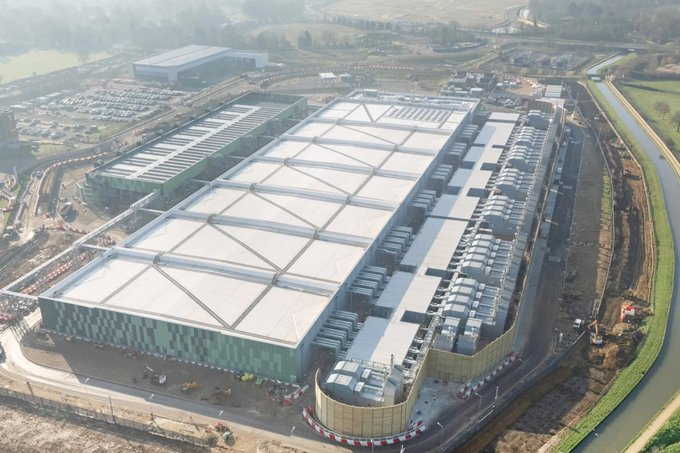
The UK now hosts more than 500 active data centres (the third largest in the world). They have been rammed through despite huge local community concerns about the impact on their local landscapes and energy and water consumption. These enormous data centres are giant industrial facilities consuming vast quantities of electricity, water and land while placing increasing pressure on the UK’s energy infrastructure.
·
The UK now hosts more than 500 active data centres (the third largest in the world). They have been rammed through despite huge local community concerns about the impact on their local landscapes and energy and water consumption. These enormous data centres are giant industrial facilities consuming vast quantities of electricity, water and land while placing increasing pressure on the UK’s energy infrastructure.
Water consumption by data centres is expected to reach 9.3 trillion litres, while CO2 emissions will rise to 399 million tons.
Annual power consumption from data centres is projected to double to 945 TWh by 2030, around the same as the whole of Japan’s energy consumption, with AI accounting for 40% of the total.
The rise of AI is accelerating this trend. The UK Government’s Compute Roadmap notes that AI data centres can devote up to 40% of their energy consumption to cooling systems.
It is estimated that data-centre power and water consumption could double by 2030 due to AI growth.
Emerging research suggests large AI facilities can create localised warming effects around their sites, sometimes described as a “data heat island” effect.
Numerous campaigns against these data centres are being organised by local communities. No one voted for this. If you are involved in any of these local campaigns, please DM me and I’ll try and help you amplify your campaigns.
Posted in Uncategorized
Leave a comment
AL Jazeera English: US forces have carried out strikes on Iran, hitting an oil tanker in the Strait of Hormuz and targeting Qeshm Island, a vital military stronghold and it’s not the first time they have attacked ….
Posted in Uncategorized
Leave a comment
Steve Hanke X: “You’re F***king Crazy … says one to another
Steve Hanke
@steve_hanke
Professor of Applied Economics
| Distinguished Senior Scholar
|
| FX & Commodity Trader | Reagan White House | Views are my own

Posted in Uncategorized
Leave a comment
CFI (Center for Inquiry) Sam Harris and Richard Dawkins in Conversation
Premiered 17 hours ago #RichardDawkins#SamHarris#SecularismThe Center for Inquiry proudly presented the 2026 Richard Dawkins Award to neuroscientist, philosopher, bestselling author, and host of the Making Sense podcast, Sam Harris. Presented annually by CFI, the Richard Dawkins Award honors distinguished individuals whose work advances science, reason, secularism, and free inquiry. Past recipients include Neil deGrasse Tyson, Brian Cox, Bill Nye, Steven Pinker, Daniel Dennett, Christopher Hitchens, Ricky Gervais, Tim Minchin, and many others who have helped shape public conversations around evidence, skepticism, and humanist values. In this special online ceremony, recorded live on April 18, 2026, Dawkins and Harris engaged in a wide-ranging conversation touching on artificial intelligence, consciousness, morality, politics, mindfulness, and the rapidly changing relationship between technology and human creativity. The event concluded with an audience Q&A exploring the broader intellectual journey that has defined Harris’ career. Watch the full conversation and ceremony here. Learn more about the Richard Dawkins Award and the Center for Inquiry: CFI: https://centerforinquiry.org Richard Dawkins Award: https://centerforinquiry.org/richard-…#SamHarris#RichardDawkins#CenterForInquiry#Skepticism#Secularism#FreeInquiry
Transcript
Follow along using the transcript.
Show transcript
Posted in Uncategorized
Leave a comment
How machines become minds : Geoffrey Hinton and Joel Hellermark The Godfather of AI
Jun 1, 2026
Geoffrey Hinton, Nobel Prize–winning pioneer of deep learning, joins Sana’s founder and CEO, Joel Hellermark, for a candid conversation about the future of AI, what it means to create “beings” rather than tools, and how we navigate the next great intellectual revolution. From fast‑learning neural architectures to the ethics of training data, Hinton offers a rare, unfiltered look at where this all might be heading.
What’s in this video: —How evolution, development, learning, and now AI form ever‑faster “loops” of intelligence —Why Hinton thinks AI may soon outstrip human mathematicians and reach much higher levels of intelligence —The coming “third revolution” after Copernicus and Darwin: humans no longer being the only beings around —How language‑model “self‑play” and internal inconsistencies could let AI improve with little new data —The risks of a purely profit‑driven race for smarter AI and why we must design “beings that care about us” —Hinton’s architectural bet on fast‑changing weights and brain‑like synapses beyond current transformer hardware
Hinton argues that the real stakes of AI are not only economic or technical, but civilizational. As we move from being the only intelligent beings to coexisting with artificial ones, we face a choice: build systems that are merely powerful, or build beings that genuinely care about human flourishing.
Recorded live at Sana AI Summit 2026, New York, May 21st, 2026. Subscribe for more insights on AI and the future of technology.Geoffrey Hinton and Joel Hellermark explore the evolution of artificial intelligence and its potential to surpass human cognition. They discuss the future of model architectures, the importance of training data, and the societal implications of developing autonomous systems that possess capabilities beyond traditional computing.Summary
How this was made
Posted in Uncategorized
Leave a comment
Atlas: World’s first undersea data center powered by offshore wind is online. Comment: Ireland surrounded by sea but a rather visionless government
World’s first undersea data center powered by offshore wind is online
June 01, 2026

Wind turbines off the coast of Shanghai, China
View 1 Images
Just over seven months from completing phase one of this mega-project, Chinese engineers have finished the build and switched on the world’s first underwater data center (UDC) powered by offshore wind turbines. What’s more, it doesn’t need freshwater and cuts land use by more than 90% compared with above-ground centers.
We reported on the big build in October 2025, when the first stage had been constructed. At the time, there was no projected timeline for it to become operational. The underwater infrastructure, off the coast of Shanghai in the Lin-hang Special Area, was officially switched on in late May, and it’s far more impressive than it may sound on paper.
Data centers don’t need freshwater to function – but it remains the simplest cooling option, as it puts fewer demands on surrounding infrastructure, thanks to its lower levels of salts, minerals and biological impurities that can corrode pipes or reduce cooling efficiency over time. Unlike many inland facilities that still rely on freshwater, UDCs instead use the surrounding ocean as a heat sink, transferring this heat through sealed cooling systems.
This center, built by a subsidiary of China Communications Construction, uses a circulating copper-pipe heat exchange system that reportedly reduces electricity consumption by 22.8%. Offshore wind farms are also estimated to generate 95% of the electricity needed to run its 192 server racks across four levels, significantly reducing reliance on existing power infrastructure.
“For an undersea data center of the same scale, the electricity used for cooling would only account for about one-tenth of total power consumption,” Tsinghua University Professor Li Zhen told China Daily. “If data centers of the same scale were placed underwater, even allowing extra margins, cooling consumption could fall to around 30-billion kW. That would save about 50 billion kWh of electricity each year.”
According to state media, the center is currently operating at 2.3 MW – but has a planned capacity of 24 MW (enough to power 20,000 households). This “room to move” is essentially future-proofing the UDC’s usefulness, as companies turn their attention from initial builds to longevity when it comes to hardware upgrades and compute capacity.
Nonetheless, while UDCs may reduce freshwater demands and land use, underwater computing is still a largely unknown at commercial scale. Questions remain around how these facilities will endure – and what the ecological effects of continuously releasing heat into local marine environments might be.
But considering tech companies are racing to put data centers in space to meet rising demand, real-world projects like China’s UDC could serve as valuable test cases in the AI age, revealing whether moving computing infrastructure into new environments can offset existing land-based issues – or reveal entirely new ones.
Source: China Daily
We recommend
- Pinxian Wang: no place for a ‘gold rush’ in the exploration of the deep sea National Science Review
- Shuangqing Forum on carbon neutrality in construction and architecture National Science Review, 2023
- China’s goal of achieving carbon neutrality before 2060: experts explain how National Science Review
- Research on the impact and mechanism of China’s digital infrastructure construction on air pollution Shaojie Zhou, Chenyao Qu, Journal of Digital Economy, 2025
- Scientific experiments on Tiangong-2, the predecessor of the China Space Station He Zhu, National Science Review, 2022
- Chinese scientists called for comprehensive lake management to achieve regional sustainable development by Science China Press, National Science Review, 2022
Tags
EnergyChinaArtificial IntelligenceData CenterData StorageMarine InnovationsWind turbineWind-poweredUnderwaterGreen+Techno
Posted in Uncategorized
Tagged ai, climate-change, energy, sustainability, technology
Leave a comment
Fortune: Remore work … Gen Z hiring nightmare
Mounting evidence suggests remote work is behind the Gen Z hiring nightmare. Even the New York Fed thinks so
By
Contributing Reporter
June 2, 2026, 2:21 PM ET
Add us on

Young people are paying the price for the remote work options employees fought for.Hristo Rusev/Getty Images)
Just a few years ago, remote work was something like a matter of life or death. In the pandemic-stricken early years of the 2020s, most white-collar workers who fled to the country or even changed their living situations counted their blessings as bosses seemed inclined to let home offices be even as lockdown orders expired. Almost half of full-time U.S. employees were working from home by fall 2021, of which some 90% said they wanted to stay remote in some shape or form.
Cognizant’s CEO is hiring over 20,000 entry-level graduates this year
They may have gotten their wish. Of jobs that could be done remotely, 78% of U.S. work locations are currently either remote or hybrid, according to Gallup data, up from 40% in 2019. Meanwhile, fully on-site roles went from 60% of placements in 2019 to 22% this year.
But for every millennial or Gen Xer happily able to take calls in sweatpants Mondays and Fridays, mounting evidence suggests that working in your sweatpants is the real reason, not AI adoption, behind the plunge in entry-level hiring halfway through the decade.
New research from the Federal Reserve Bank of New York puts numbers on the dynamic. Researchers found the unemployment rate for college graduates younger than 29 climbed from 3.1% to 3.7% over the past nine years. Over the same period, unemployment among more experienced college graduates older than 29 actually ticked down, from 1.9% to 1.8%.
The divergence traces back to “remotable” fields—software engineering, financial analysis, and other white-collar roles. In jobs that require physical presence, like nursing, the age gap spiked briefly in 2020 then normalized. In remote-eligible work, it never did. Remote work could account for as much as 64% of the overall rise in youth unemployment since the pandemic, the researchers found.
Recent graduates aged 22 to 27 are currently dealing with an unemployment rate of 5.6% as of March. It’s higher than the general unemployment rate (4.2%), and well above the share of degree-holders of all ages without a job (3.1%). Many would-be white-collar workers have designated generative AI adoption across U.S. firms as the scapegoat for a lack of entry-level work opportunities.
The same economists behind the new Fed research recently published another paper for the National Bureau of Economic Research, focusing on productivity among software engineers at a large U.S. firm. The researchers found that while remote work can boost output among experienced workers, it can be to the detriment of younger engineers.
Feedback on coding work increased 18.3% when workers were in the office, improving the quality of output, according to the paper. Younger workers disproportionately benefited from in-person mentorship and feedback sessions, while periods of flexible work at their company had “scarring effects” on young graduates’ development.
Separate researchers are increasingly aligning on this thesis—that the same privilege workers staged company walk-outs to protect only a few years ago—is at least partially responsible for the wave of youth unemployment and underemployment sweeping the U.S. Firms that operate on distributed teams have become less willing to hire young workers requiring mentorship, economists say, and are happy to keep hiring older and safer staff instead.
Remote work villain
A closer look at who is and who isn’t finding jobs points to remote work as a powerful variable. Comparing unemployment trends across “remotable” occupations, such as software engineering or financial analysis, with occupations that rely on physical presence like nursing, the Fed research found the entire increase in relative youth unemployment boils down to remotable fields. Hiring rates have mostly normalized for physical roles. Nursing, for example, has been one of the labor market’s bright spots lately.

Paid Content
Inside the organization powering California’s surplus lines market
From The Surplus Line Association of California
Other research is coming to a similar conclusion. A working paper by economists at the London School of Economics and the University of Oxford, published last month, scanned hundreds of millions of hiring records and job postings in the U.S., U.K., Canada, and Australia between 2017 and 2025. They found that while entry-level hiring has indeed plummeted—between 14% and 29%, depending on which country—senior hiring has risen 5% to 21%.
Remote work appeared to be a key culprit behind the discrepancy. Companies that publicly announced strategy shifts towards working from home or hybrid models early in the pandemic are now more likely to staff senior roles and older workers, with fewer entry-level roles available.
The authors do note that the companies most adapted to offer flexible work options are also more likely to employ for roles that are more easily automated by AI, suggesting some correlation might be at play.
But both the working paper and the new Fed research point out that the age gap in hiring predates the mass diffusion of AI tools. Over the past few months, companies that have pinned layoffs and muted hiring on automation have been accused of so-called AI-washing, blaming technology for headcount decisions that were likely to happen anyway. Economists have so far been at pains to find evidence that AI adoption is directly responsible for unprecedented shifts in the labor market, finding that its impact so far has been mostly similar to that of the Internet or computers: disruptive, but not apocalyptic.
“There is zero evidence of job losses because of AI,” Torsten Slok, chief economist at investment firm Apollo, wrote in a blog post last week. Citing employment data that has held steady in recent months, Slok said the push for AI adoption might actually be raising demand for jobs as firms hire more engineers and AI experts.
Employers might see AI as a convenient justification for their hiring decisions, though from an economics’ standpoint, the remote work factor might have more to stand on.
That AI has taken the brunt of blame is likely small reassurance to new graduates struggling to advance in their career. Young workers in general are likely aware that the popularity of remote work is mostly to their disadvantage, as a Gallup poll last year found Gen Z to be the age group least likely to prefer a fully remote workplace setup, citing in part the lack of interaction with coworkers.
The Fortune 500 Innovation Forum will convene Fortune 500 executives, U.S. policy officials, top founders, and thought leaders to help define what’s next for the American economy, Nov. 16-17 in Detroit. Apply here.
About the Author
By Tristan BoveContributing Reporter
Posted in Uncategorized
Tagged ai, artificial-intelligence, business, chatgpt, technology
Leave a comment

