
World’s first undersea data center powered by offshore wind is online
June 01, 2026
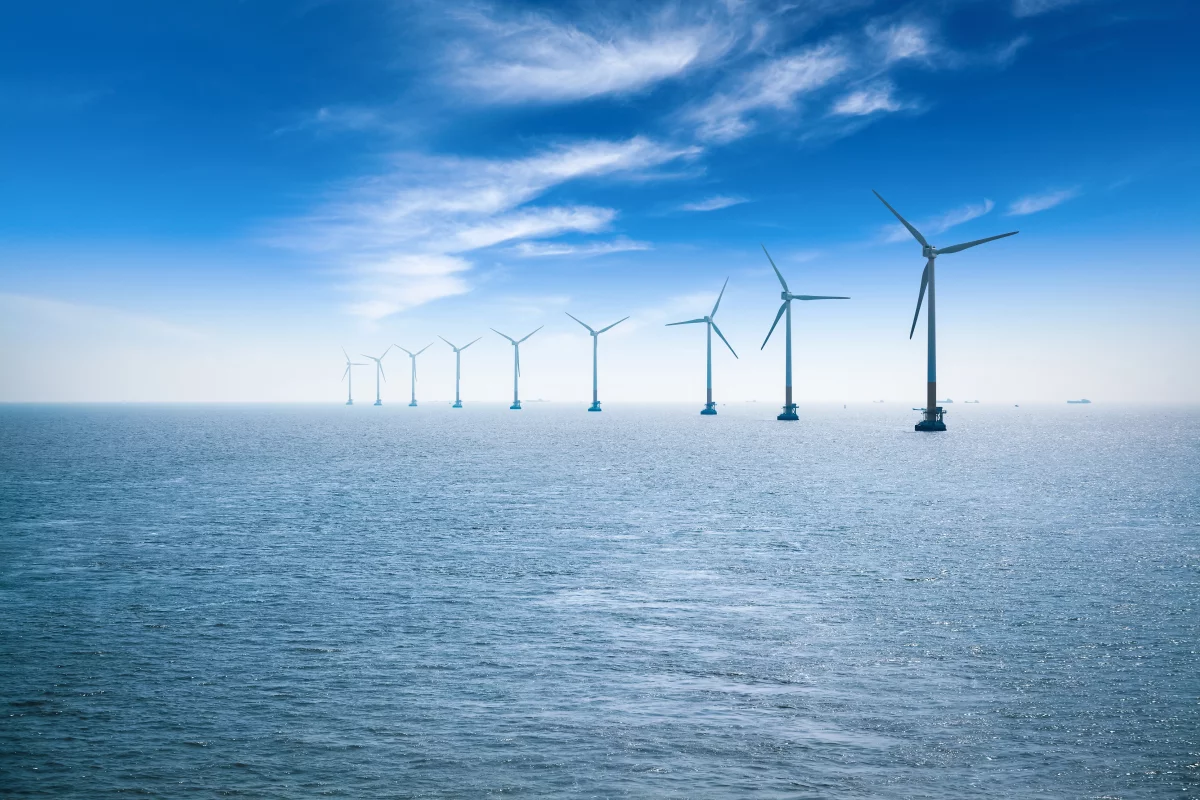
Wind turbines off the coast of Shanghai, China
View 1 Images
Just over seven months from completing phase one of this mega-project, Chinese engineers have finished the build and switched on the world’s first underwater data center (UDC) powered by offshore wind turbines. What’s more, it doesn’t need freshwater and cuts land use by more than 90% compared with above-ground centers.
We reported on the big build in October 2025, when the first stage had been constructed. At the time, there was no projected timeline for it to become operational. The underwater infrastructure, off the coast of Shanghai in the Lin-hang Special Area, was officially switched on in late May, and it’s far more impressive than it may sound on paper.
Data centers don’t need freshwater to function – but it remains the simplest cooling option, as it puts fewer demands on surrounding infrastructure, thanks to its lower levels of salts, minerals and biological impurities that can corrode pipes or reduce cooling efficiency over time. Unlike many inland facilities that still rely on freshwater, UDCs instead use the surrounding ocean as a heat sink, transferring this heat through sealed cooling systems.
This center, built by a subsidiary of China Communications Construction, uses a circulating copper-pipe heat exchange system that reportedly reduces electricity consumption by 22.8%. Offshore wind farms are also estimated to generate 95% of the electricity needed to run its 192 server racks across four levels, significantly reducing reliance on existing power infrastructure.
“For an undersea data center of the same scale, the electricity used for cooling would only account for about one-tenth of total power consumption,” Tsinghua University Professor Li Zhen told China Daily. “If data centers of the same scale were placed underwater, even allowing extra margins, cooling consumption could fall to around 30-billion kW. That would save about 50 billion kWh of electricity each year.”
According to state media, the center is currently operating at 2.3 MW – but has a planned capacity of 24 MW (enough to power 20,000 households). This “room to move” is essentially future-proofing the UDC’s usefulness, as companies turn their attention from initial builds to longevity when it comes to hardware upgrades and compute capacity.
Nonetheless, while UDCs may reduce freshwater demands and land use, underwater computing is still a largely unknown at commercial scale. Questions remain around how these facilities will endure – and what the ecological effects of continuously releasing heat into local marine environments might be.
But considering tech companies are racing to put data centers in space to meet rising demand, real-world projects like China’s UDC could serve as valuable test cases in the AI age, revealing whether moving computing infrastructure into new environments can offset existing land-based issues – or reveal entirely new ones.
Source: China Daily
We recommend
- Pinxian Wang: no place for a ‘gold rush’ in the exploration of the deep sea National Science Review
- Shuangqing Forum on carbon neutrality in construction and architecture National Science Review, 2023
- China’s goal of achieving carbon neutrality before 2060: experts explain how National Science Review
- Research on the impact and mechanism of China’s digital infrastructure construction on air pollution Shaojie Zhou, Chenyao Qu, Journal of Digital Economy, 2025
- Scientific experiments on Tiangong-2, the predecessor of the China Space Station He Zhu, National Science Review, 2022
- Chinese scientists called for comprehensive lake management to achieve regional sustainable development by Science China Press, National Science Review, 2022
Tags
EnergyChinaArtificial IntelligenceData CenterData StorageMarine InnovationsWind turbineWind-poweredUnderwaterGreen+Techno


