
Trendingnow
1
2
3
This Las Vegas casino just gave almost 10,000 workers more than $70 million in company stock to celebrate its 50th birthday

By
News Editor
Follow
September 14, 2026, 4:20 PM ET
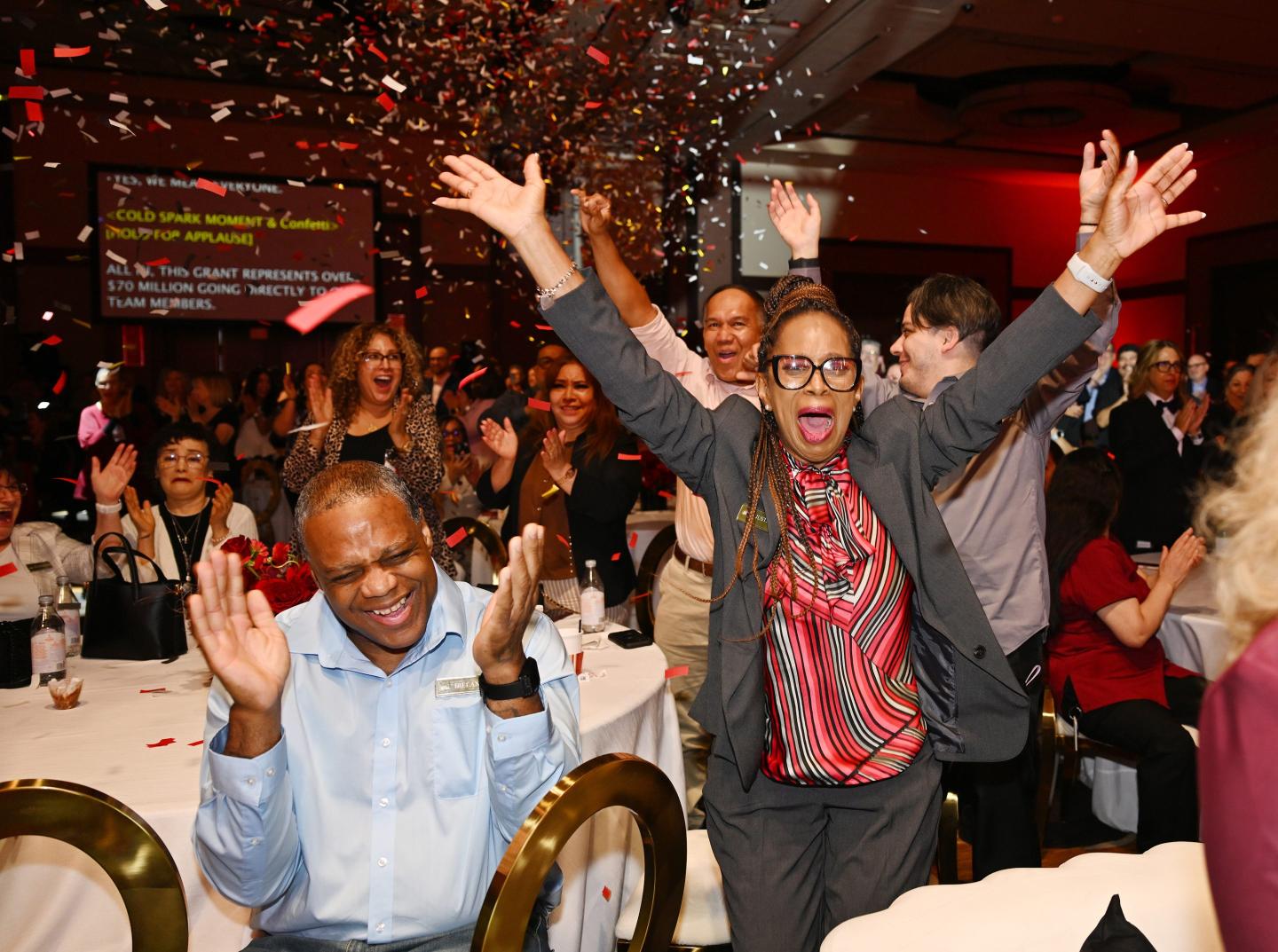
Red Rock Resorts eligible employees got $1,000 per year of service in company stock. Denise Truscello/Getty Images for Station Casinos
Add Fortune on Google for similar content.Add us on Google
It used to be that you put your time in, work hard, get a nice pension, and maybe you’ll get a gold Rolex at your retirement party. While the ideas of a pension—let alone a five-figure watch—may seem fleeting at best, not all companies are doing away with rewarding employee loyalty. Some, like Red Rock Casino Resort & Spa, are offering any eligible employee $1,000 in company stock per year of service.
Recommended Video
GM announces $5 billion stock buyback
To celebrate the Las Vegas casino operator’s 50th birthday, Station Casinos last Wednesday surprised nearly 10,000 full- and part-time employees with a stock award worth more than $70 million. Frank Fertitta III, chairman and CEO of Station Casinos parent company Red Rock Resorts , and Vice Chairman Lorenzo Fertitta told a ballroom of workers that anyone employed as of that date would receive $1,000 in Red Rock Resorts Class A stock for every year of service.
“When you walk out of here today, we want you to walk out differently than you walked in—not just as someone who works at Station Casinos, but as someone who owns a piece of it,” Lorenzo Fertitta told the employees. “Every guest you take care of, every shift you show up for—this is now your company too.”
Eligible employees can now begin claiming their shares as of Monday. Some of the company’s longest-serving workers received tens of thousands of dollars’ worth of company shares, like Ida Johnson, who joined the company in 1977 and received $49,000 in stock. Six other employees who started at Bingo Palace in the 1970s and still work for the company today each received more than $45,000 in equity.
A family business
Station Casinos traces its roots to 1959, when founder Frank Fertitta Jr. moved from Galveston, Texas, to Las Vegas. He opened his own casino in 1976, a 5,000-square-foot property called simply “The Casino,” with 100 slot machines, six table games and 90 employees, Frank Fertitta III said at the event. It became Bingo Palace a year later and was renamed Palace Station in 1984.
“From the very beginning, our dad knew it was the team members and the relationships with our guests that was the most important part of the casino business,” Fertitta III told Fortune.
The company now owns and operates 14 properties across the Las Vegas Valley, including Red Rock Casino Resort Spa, Green Valley Ranch Resort Spa Casino and Durango Casino & Resort, along with stakes in several smaller venues.
“Our father founded this company on a few simple principles: serve the local community, deliver great value, and most importantly, take care of our team members,” Fertitta III said. “This award reflects those values and recognizes the people who have brought them to life every day for the past 50 years.”
Fertitta III closed the ceremony by thanking employees. “Thank you for making the last 50 years possible, and we look forward to what we can accomplish together over the next 50 years,” he said. “Thank you for taking care of one another. Thank you for taking care of our guests and thank you for making Station Casinos the local favorite.”
Station Casinos isn’t the first employer to reward its rank and file with equity. Bank of America handed nearly its entire global workforce a $1 billion restricted-stock pool while Apple gave most of its employees a $2,500 stock bonus after the 2017 tax overhaul. Samsung began awarding shares worth up to $20,000 to staff outside the C-suite starting this fall, and the family owner of Louisiana manufacturer Fibrebond Corp. carved out a $240 million bonus pool—averaging $443,000 a worker—for employees when the company was sold last year.

Paid Content
The new blueprint for protecting Asian family wealth
From HSBC
Exclusive: In a new sit-down interview with Fortune, OpenAI CEO Sam Altman explains safety standards are “not at a place” to push AI capabilities much further and warns AI beyond human control is “absolutely” possible. Watch or listen here.
About the Author
By Catherina GioinoNews Editor
Follow
Catherina covers markets, the economy, energy, tech, and AI.

 Image source: Microsoft
 “Great Fuel Crisis” arrives
 Illustration: Aïda Amer/Axios. Stock: Getty Images


 Power moves: John Kelly on skilled trades
 BlackRock’s John Kelly speaks at the global company’s Infrastructure Summit in Washington in March. Photo: Kylie Cooper/Reuters
 Jay Carney — former White House press secretary, and alumnus of TIME, Amazon and Airbnb — has joined venture capital firm SV Angel, founded by Ron Conway, as a general partner and head of public policy and communications. Carney will lead SV Angel’s new Project Blueprint, partnering with tech founders and lawmakers to shape AI policy.


 Image source: Mecka AI
