Actor and singer Michael Crawford suffered a severe breakdown in 2005, which led to a diagnosis of Myalgic Encephalomyelitis (ME), or Chronic Fatigue Syndrome (CFS). He described the post-viral condition as a “physical meltdown,” leaving him completely exhausted, brain-fogged, and unable to climb stairs by mid-afternoon. [1, 2, 3]
While no official, public medical report was ever published, Crawford has given multiple candid interviews about his decade-long struggle and eventual path to recovery. [1, 2, 3, 4]
Key Details of His Experience:
The Trigger: Crawford collapsed in January 2005. He had spent four months performing the obese Count Fosco in The Woman in White while wearing a heavy fat suit, which caused him to lose essential minerals and fluids through extreme sweating. This severe depletion left his immune system vulnerable, allowing a subsequent viral illness (which he initially mistook for the flu) to trigger the ME/CFS. [1, 2]
Diagnosis Process: He underwent extensive physical examinations, including MRI brain and body scans, with teams of doctors trying to determine why he was experiencing total depletion. [1]
Impact on Career: The exhaustion and brain fog forced him to step away from the stage and screen for several years. [1, 2]
Recovery and Lifestyle: Crawford eventually relocated to a small seaside town near Auckland, New Zealand, which he credited with helping him recover from the debilitating condition. His recovery focused on pacing—using gentle “movement” rather than formal exercise to slowly rebuild his strength. [1, 2, 3]
For further information regarding ME/CFS symptoms and management, you can refer to resources like the ME Association.
If you are interested in ME/CFS, I can:
Provide information on common triggers and early symptoms
Outline diagnostic criteria used by medical professionals today
Share details on the difference between pacing and graded exercise
The six-day funeral for Iran’s late Supreme Leader Ayatollah Ali Khamenei is underway, with authorities shutting down streets, airspace and daily life in Tehran. Massive crowds are expected all over Iran. But one man is notably missing – Iran’s new Supreme Leader and Ali Khamenei’s son, Mojtaba Khamenei. DW’s Anthony Howard spoke to Behnam Ben Taleblu with the Foundation for the Defense of Democracies in Washington D.C. about what the funeral is saying about the state of affairs in Iran.
How far would an Andy Burnham government be willing to go to tackle inequality? In this episode of The Fourcast, economist and activist Gary Stevenson told us that the incoming prime minister will “fail” unless he is willing to properly tax wealth. [Subscribe to our Substack newsletter: https://channel4news.substack.com/sub…] A former trader who made millions in the City, Gary Stevenson has gained a huge online following as one of the left’s foremost campaigners against inequality. He spoke with Krishnan Guru-Murthy about his new Channel 4 documentary ‘How to Get Filthy Rich’ and told us whether he would be willing to work with a future Prime Minister Andy Burnham.
America’s 250th birthday arrives at a time of deep political division. Trust in government is low, public confidence is shaken, and many Americans believe the country is headed in the wrong direction. But Ian Bremmer argues that today’s challenges aren’t as unprecedented as they may seem.
Panoramic view of Envision’s wind farm in Shanxi, China. Image courtesy of Wikimedia Commons under Creative Commons Attribution-Share Alike 4.0 International license.Share
Editor’s note: This story was originally published by The Guardian. It appears here as part of the Climate Deskcollaboration.
China has emerged as the sole winner in Asia from the strait of Hormuz crisis, according to a report published on Tuesday.
The report by the geopolitical consulting firm Asia Group concluded that China had weathered the storm of the global commodities crisis resulting from the closure of the Middle Eastern waterway, and also stood to gain from the economic and geopolitical trends sparked by the wider conflict.
Iran virtually closed the strait, a vital waterway through which much of the world’s oil and gas flows, after the US and Israel launched joint strikes on February 28, targeting government and military sites and killing Iran’s supreme leader, Ali Khamenei. The ensuing crisis has sent global energy prices soaring, with Asia particularly exposed.
The report noted that before the strait’s closure, roughly 80 percent of the oil and nearly 90 percent of the liquefied natural gas transiting the waterway was destined for Asian markets, along with a significant share of other critical commodities.
The report looked at Asia’s largest economies—China, India, Japan and South Korea—as well as emerging markets across south-east Asia. The researchers mapped the economic and political repercussions of the crisis and its impacts across key sectors including manufacturing, energy and agriculture.
They concluded that China was a clear winner from the crisis caused by Donald Trump’s foray into the Middle East.
The country’s large stockpiles of oil and the hugely ambitious rollout of renewable energy mean it has been less exposed to the energy shock than other countries.
China has long maintained strategic reserves of energy, and last year took advantage of cheap prices to build up even bigger stockpiles. Its crude imports grew from 11.1 million barrels a day to 11.6 million in 2025, with over 80 percent of that increase being sent to stockpiles, according to analysis by Erica Downs, a senior research scholar at the Center on Global Energy Policy. As of January, China had enough stockpiled to cover 104 days of imports at the 2025 level.
The country has also been building massive amounts of renewable energy infrastructure in recent years. Last year it installed 315 gigawatts of new solar capacity, more than half of the world’s new solar. The year before, it added 277 gigawatts. Beijing is aiming for half of China’s energy to come from non-fossil sources by 2030, with the share from wind and solar reaching 30 percent, up from 22 percent in 2025.
Although China’s energy mix is still largely based on coal, which accounts for more than 50 percent, renewables’ share is increasing rapidly.
The Asia Group’s report said: “With 1.4 terawatts of operating renewable capacity already online and a reported 90-110 days of crude import cover in reserve, China weathered the initial shock better than any regional peer.”
China has also benefited from other countries reacting to the crisis by accelerating its clean energy buildout. Beijing dominates the global supply chain in solar and other clean technology industries and in recent years has been pushing much of this production overseas at low prices, to the chagrin of western leaders worried about their own industries.
China’s electric vehicle exports soared by more than 110 percent in May compared with the previous year, while solar shipments in April increased by 60 percent.
Beijing has called for a ceasefire in the Middle East, and when Trump visited in May and met China’s president, Xi Jinping, he claimed the two countries were united in wanting to find a settlement. But the Asia Group report noted: “The crisis allows Beijing to cast the United States as the destabilizing actor whose Middle East entanglements impose costs on the world.”
There are some risks to China from the instability. Drew Thompson, a senior fellow at the S Rajaratnam School of International Studies in Singapore, said: “It’s tempting to see any loss of credibility in the US as a benefit for China, but that’s not necessarily the case for Beijing, which does not want to supplant Washington as a Middle East hegemon or provider of security for the region.”
Wen-Ti Sung, a non-resident fellow with the Atlantic Council’s Global China Hub, based in Taiwan, said the crisis could also make Beijing think twice about a future military assault on Taiwan because it showed the difficulty of navigating ships through hostile territory.
The Asia Group’s report concluded: “Ultimately Beijing views the pain points not as existential threats, but as challenges to be managed and even opportunities to be exploited.”
Together, we make the world safer.
The Bulletin elevates expert voices above the noise. But as an independent nonprofit organization, our operations depend on the support of readers like you. Help us continue to deliver quality journalism that holds leaders accountable. Your support of our work at any level is important. In return, we promise our coverage will be understandable, influential, vigilant, solution-oriented, and fair-minded. Together we can make a difference.
Weave Robotics announced its first robot for folding laundry just five months ago, and it already has a new product on offer. Like its predecessor, the new Isaac 1 robot also folds clothes. But unlike the old model, this one can tidy up your living room and make the bed on demand. It looks cuter, too.
Indeed, the Isaac 1 gets an unassuming Baymax-like pair of eyes set into a rounded rectangular head. This sits atop a torso with soft fabric-covered shells and arms. The torso is mounted on a telescopic arm with a motorized base, so it can get around your house and extend its height from 3 ft to 5 ft 9 inches (0.9 – 1.75 m), depending on the task at hand.https://www.youtube.com/embed/m7pZr90BQw4?enablejsapi=1
Launching Isaac 1: our most capable home robot
Isaac 1’s mobility and clutter-clearing functionality are a major step up from the Isaac 0, which is meant to remain stationary in front of a table where it can fold laundry. However, both of them are limited in their ability to complete their respective tasks, and may require teleoperation, i.e. being remotely controlled by a human who looks through the robot’s cameras at what needs doing, and helps finish the job.
That’ll likely remain a deal-breaker for some. Having a stranger peering into your home – even if their field of view is limited – may not be what some potential buyers bargain for when ponying up US$8,000 for the privilege of never having to fold laundry again.
The Isaac 1 features a cutesy design, a motorized base to move around your home and tidy up, and cameras up top
For others, it might be just what they’ve been waiting for. The team at Weave says Isaac 1 is “the robot we wanted for our own homes.” It’s also shipped Isaac 0 to homes and businesses across California since its February launch, so the firm isn’t entirely alone in its optimism.
I did some quick math using the company’s claims of Isaac 0 folding customers’ clothes for 2,000+ hours since launch, with more than 1,000 lb of laundry handled each week. That doesn’t work out to a lot, so either there aren’t yet a lot of Isaac 0s at work, or they shipped only recently – or maybe my math is terrible. In any case, I’ve written to the company to learn more.
Regardless of where you stand on the notion of a household bot that occasionally needs remote human assistance, there are a couple of things worth noting here. For one, Isaac 1 promises to do a lot more than the previous model for the same price – $8,000 up front, or $449/month on a subscription plan.That says a lot about how quickly robotics tech is developing when it comes to shippable products.
In a big step up from the previous model, Isaac 1 can clear clutter, straighten cushions, and make beds
Secondly, Isaac 1 looks a lot more refined than Isaac 0, which looked like it was assembled from a generic parts bin. It’s interesting to see how a startup is able to move quickly with design choices and get this out the door in a matter of months after initially rolling out a basic proof of concept – and what its idea of a finished, ready-for-prime-time robot has evolved into in that time.
Isaac 1 can shrink down to a height of 3 ft and physically disable its cameras when not in use
Weave says it’ll continue to enhance Isaac 1’s capabilities over time with firmware updates. I’d argue the biggest improvement would be fully autonomous operation that would negate the need to ever have a human handle it remotely.
If you’re in the US and are keen to give this a go, you can make a $250 deposit to reserve an Isaac 1. The company aims to begin shipping orders this [Northern Hemisphere] fall, starting in California. Take a closer look on Weave Robotics’ site.
Abhimanyu has been a trusted voice in the science, technology, transport innovations, startup and AI spaces for more than a decade at several global outlets, including three and a half years as the managing editor at TNW. He holds a Bachelor of Arts in Economics, Psychology and Sociology. When he’s not writing about breakthroughs in science and tech, he’s usually out motorcycling around South India.
An Andreessen Horowitz-backed startup is building a trading market for AI computing power — letting companies buy, sell and hedge access to GPUs, similar to how oil traders trade barrels of crude, Axios’ Madison Mills writes.
Why it matters: Goldman Sachs estimates $7.6 trillion will be spent globally on compute, power and data centers by 2031, but the financial infrastructure to sustain that spending doesn’t yet exist.
Ornn, founded by 20-something entrepreneurs Kush Bavaria and Wayne Nelms, wants to help build that infrastructure.
So far, AI companies have tried to lock up supply and prices through long-term pre-purchasing agreements. Keep reading.
“There is no other species on Earth that does science. It is, so far, entirely a human invention, evolved by natural selection in the cerebral cortex for one simple reason: it works. It is not perfect. It can be misused. It is only a tool. But it is by far the best tool we have, self-correcting, ongoing, applicable to everything. It has two rules. First: there are no sacred truths; all assumptions must be critically examined; arguments from authority are worthless. Second: whatever is inconsistent with the facts must be discarded or revised. We must understand the Cosmos as it is and not confuse how it is with how we wish it to be. The obvious is sometimes false; the unexpected is sometimes true. Humans everywhere share the same goals when the context is large enough. And the study of the Cosmos provides the largest possible context. Present global culture is a kind of arrogant newcomer. It arrives on the planetary stage following four and a half billion years of other acts, and after looking about for a few thousand years declares itself in possession of eternal truths. But in a world that is changing as fast as ours, this is a prescription for disaster. No nation, no religion, no economic system, no body of knowledge, is likely to have all the answers for our survival. There must be many social systems that would work far better than any now in existence. In the scientific tradition, our task is to find them.” — Carl Sagan
The GMO co-founder weighs in on bubbles, AI hype, environmental issues, and where investors can find better values. Today on the podcast, we’re delighted to welcome back Jeremy Grantham to discuss his book, The Making of a Permabear: The Perils of Long-term Investing in a Short-term World, which he co-authored with Edward Chancellor. Jeremy is the long-term investment strategist at his namesake firm, Grantham, Mayo, Van Otterloo & Company, or GMO, which he co-founded in 1977. He serves on GMO’s asset-allocation committee and board of directors. Prior to GMO, Jeremy was co-founder of Batterymarch Financial Management and, before that, was an economist at Royal Dutch Shell. He earned his undergraduate degree from the University of Sheffield and his MBA from Harvard University. Jeremy is a member of the Academy of Arts and Sciences, holds a CBE from the UK, and is a recipient of the Carnegie Medal of Philanthropy. In 1997, he and his family started the Grantham Foundation for the protection of the environment, which supports research and action to address climate change. The Making of a Permabear: The Perils of Long-term Investing in a Short-term World https://www.amazon.com/Making-Permabe…
Episode Highlights 00:00:00 Writing Permabear With Edward Chancellor 00:06:44 Value Investing and Identifying Market Bubbles 00:15:07 Current Market Outlook and Valuation Risks 00:20:28 Value Discipline, SpaceX’s IPO, and Past Market Bubbles 00:27:26 Speculative Trading, Indexing, and Zero‑Sum Markets 00:34:24 Market Inefficiencies, Small-Cap Stocks, and the Greater Fool Theory 00:43:27 Artificial Intelligence Hype, Attractive Assets, and Market Pessimism 00:47:02 Climate Risks, Resource Constraints, and Shrinking Populations More From Morningstar 3 Warnings for Investors From the Ultimate Contrarian https://www.morningstar.com/personal-… Ben Carlson: Exploring Risk and Reward https://www.morningstar.com/podcasts/… What Today’s Index ETFs Get Right, and Wrong, for Investors https://www.morningstar.com/funds/wha…
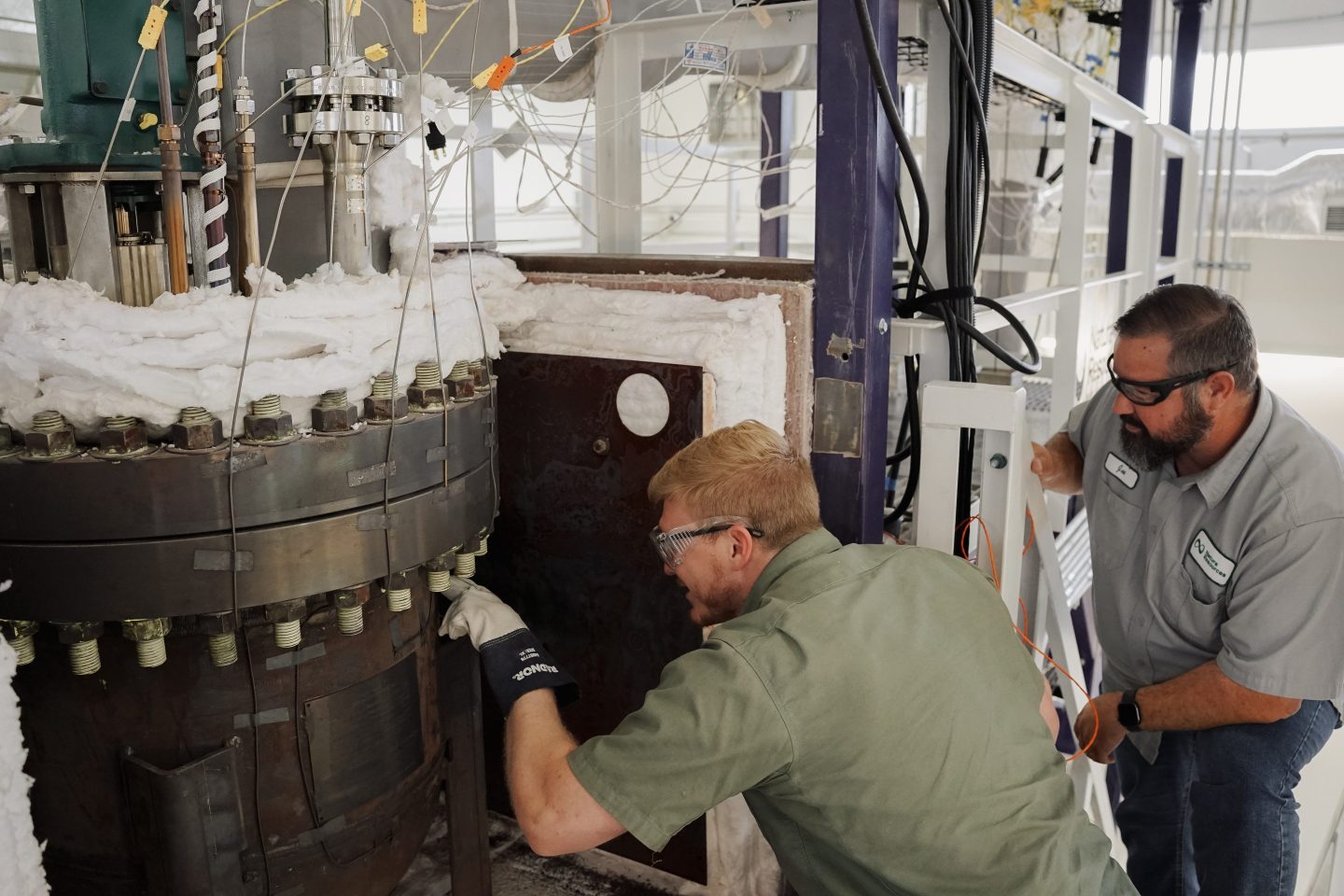
During a planned molten salt test system downtime, project manager Walter Phillips and lab manager Joe Caton inspect the thermocouple placement to verify sensor and system integrity. Natura’s system has now surpassed 2,000 hours of operation, with more than 1,750 of those hours running autonomously.Natura Resources
Nearly a decade ago, third-generation Texas oilman Doug Robison was plotting his retirement and the sale of his petroleum company when a trip to his children’s alma mater, Abilene Christian University, changed his career trajectory—at an atomic level.
Recommended Video
He heard a brief talk from Rusty Towell, the director of the school’s Nuclear Energy Experimental Testing lab (NEXT), on the potential of next-generation, molten-salt nuclear reactors for affordable power to lift much of the world out of poverty. Robison was sold. “I met him in the back of the room and said, ‘What would you do if you’re fully funded?’ I asked him three times, and he wasn’t ready for the question.” Two weeks later, Towell offered Robison a rough plan. “I said, ‘You’re funded. Let’s go.”
Robison’s $3.2 million research donation kickstarted the effort and news spread. Then-U.S. Energy Secretary Rick Perry—and former Texas governor—sent a team to Abilene to study the research. In 2019, the Department of Energy offered fuel and salt in support of the project if they agreed to build a test reactor. ACU volunteered to host it.
“I held my hand up in the room and said, ‘I’ll fund it,’” Robison said. ACU President Phil Schubert took Robison aside, asking, “Do you have any idea how we’re going to do this?” Robison replied. “Phil, I don’t have a clue.”
A few months later, Natura Resources was born as a next-generation nuclear startup, aiming to build smaller reactors using new technologies for cooling and other functions. Robison took the defunct corporate shell of an organic farming company he’d started in the 1980s—Natura—and turned it into the startup, even if it’s technically over 40 years old. “It’s a transition from organic agriculture to advanced nuclear,” Robison told Fortune with a laugh, adding that they both still involve clean energy.
Since then, Natura has grown, as has its university alliance—more than 150 researchers from ACU, the University of Texas at Austin, Texas A&M University, and the Georgia Institute of Technology.
They plan to bring the first reactor, MSR-1, online in 2028 in Abilene. The Nuclear Regulatory Commission approved the construction permit in 2024. A 100-megawatt commercial reactor is planned for West Texas’ Permian Basin or near Texas A&M in Bryan by 2032.
Natura joined the Trump administration’s ambitious Nuclear Reactor Pilot Program—involving 10 companies initially—to achieve criticality on at least three test reactors by the Fourth of July—the same date the administration ends subsidies for wind and solar projects.
Natura is not one of the three meeting that goal this weekend, but it hardly matters.
Leaders of the pack
Natura is focused on bringing its test reactor fully online by 2028—even if 2026 was an early goal—and building up a supply chain to scale up commercially in the 2030s. Late last year Natura bought the advanced nuclear development company, Shepherd Power, from energy technology and manufacturing firm NOV—partnering with NOV in the process.
“What we’re trying to prove more than anything is showing that we can actually build a reactor system,” said Natura chief operating officer Jordan Robison, who is also Doug’s nephew. “There is a difference between a criticality test and building a full reactor system.”
Achieving criticality is the milestone when a nuclear reactor sustains its first chain reaction. It’s a key milestone, but the reactor is not operating continuously and producing electricity. An operating reactor is safely generating power over a long period.
In fact, none of the perceived leaders of the next-gen nuclear race achieved criticality in Trump’s pilot program. In addition to Natura, Google-partnered Kairos Power, Bill Gates-backed TerraPower, Sam Altman-backed Oklo, or Amazon-backed X-energy are all focused on building nuclear reactors for utility-scale grid power and hyperscalers. And Natura will need to attract more outside funding to scale up as well.
The three that announced criticality successes by July 4 are all focused on smaller microreactors to power industry or military bases, and not initially utility-scale power. They are Antares Nuclear’s Mark-0 at the Idaho National Laboratory, Valar Atomics’ Ward 250 at the Utah San Rafael Energy Lab, and Deployable Energy’s Unity reactor, also at the Idaho National Lab.
All the aforementioned are developing next-gen nuclear technology for small modular reactors (SMR) or even smaller microreactors. So-called Gen IV reactors rely on non-water coolants—traditional nuclear plants use light-water reactors—such as liquid metals, molten salts, or high-pressure gases. They’re designed for inherent safety with reactors that cannot physically melt down even if all power is lost.

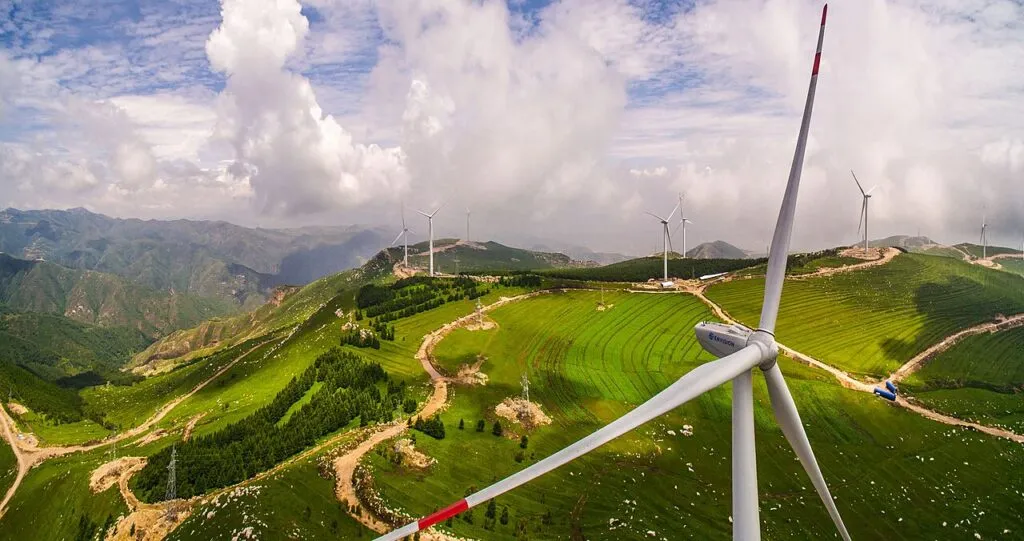 Panoramic view of Envision’s wind farm in Shanxi, China. Image courtesy of Wikimedia Commons under Creative Commons Attribution-Share Alike 4.0 International license.Share





 Trading AI compute like oil