Billionaire investor Peter Thiel planned to host a secretive retreat for his “Dialog” network at the Powerscourt Hotel and Spa in Enniskerry, County Wicklow, from August 12-16, 2026. However, the venue canceled the event on July 3, 2026, amid widespread controversy and planned protests. [1, 2, 3, 4, 5]
Key Details About the Event:
The Attendees: Over 200 participants from the tech, financial, political, and defense sectors were registered, including Elon Musk, US Treasury Secretary Scott Bessent, and NATO’s Supreme Allied Commander for Europe. [1, 2]
The Agenda: Leaked documents revealed scheduled sessions on “Navigating WWIII,” “Battlefield Technologies,” and “Bring Back Nuclear”. [1]
The Controversy: Political opposition and activist groups strongly criticized the gathering. They cited Thiel’s political donations and his company Palantir’s technological support for the Israeli Defence Forces (IDF) in Gaza. [1, 2, 3]
The Cancellation: Following public outcry and campaigns at the estate, the Powerscourt Hotel canceled the reservation. [1, 2]
For the latest updates on the fallout from this cancellation, you can follow local coverage from The Irish Times or RTE News.
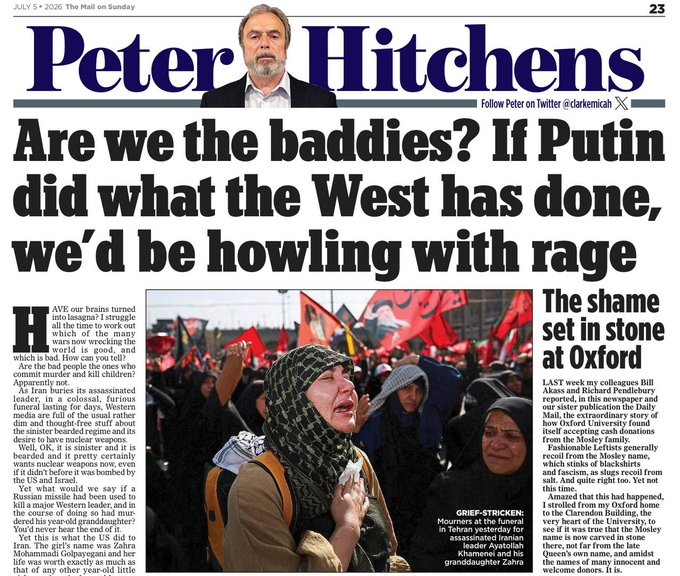
British veteran journalist Peter Hitchens is raising very uncomfortable questions today in the Mail on Sunday about the West’s double standards. The title of the article is: “Are we villains? If Putin had done what the West did, we would be outraged”.
He points out that the Western press, joyfully commenting on the assassination of Ayatollah Khamenei in Iran, did not even mention the death of his one-year-old granddaughter: “NO ONE in the US government ever directly commented on her death, let alone apologized.
It seems that it’s the Iranians’ fault that they had a little girl when the US decided to kill her grandfather in a surprise attack”. He then asks to imagine the uproar in Europe if Russia had done the same as the Americans did with the girls’ school in Minab or what the Israelis did with Gaza.
In conclusion, Hitchens concludes: Maybe it’s worth trying something else? For these suggestions, of course, I will again be called a pacifist, a traitor, etc. This mindless nonsense is drowning debates in countries that have allowed primitive propaganda to supplant thought.If we continue in this vein, we are heading for a complete national catastrophe. Yes, few dare to ask such obvious questions out loud in the mainstream Western press.
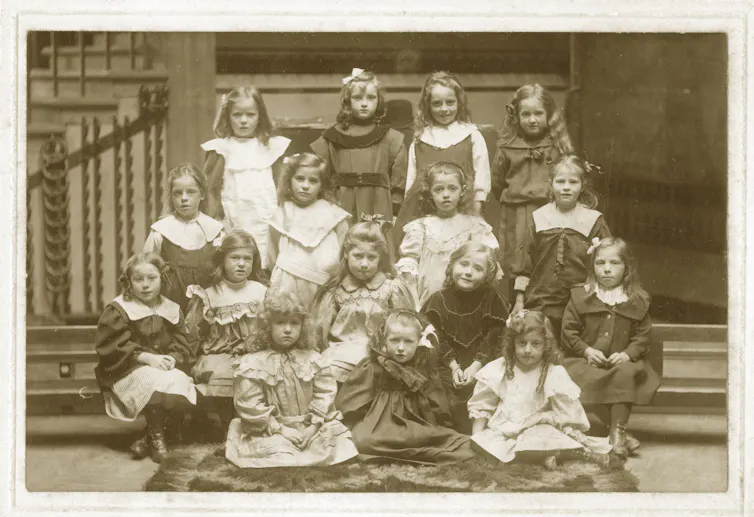
Nuns as teachers are historically associated with anything but progress. Often stereotyped as exactors of cruel discipline, nuns in the classroomv are thought of as wielding rulers – and worse – ready to rap disobedient children’s knuckles. And yet, during the 19th century, Catholic sisters were, in their own way, radicals as they engaged in work that challenged the norms of their time: the education of girls.
At that time, the education of women was still controversial. Some even argued that academic study was detrimental to women’s health, potentially causing infertility.
The standard education for a middle-class girl involved home schooling with an emphasis on social accomplishments in preparation for the marriage market, while working-class girls often started work as early as eight years old. Catholic sisters defied the low intellectual expectations of women of their time by providing education not only for well-to-do girls but also for poor ones.
While women in Catholic orders are most often thought of as living in cloistered retreat, the 19th century saw a dramatic rise in women living religious lives out in the world, engaging in education, nursing and other forms of social care.By 1880, these sisters, the term for women in active congregations, comprised 80% of Catholic women in religious orders.
The growth of girls’ education
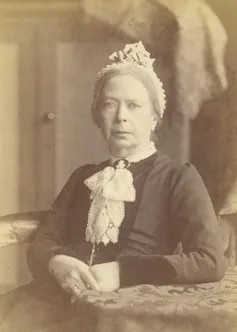
Frances Mary Buss,was a contemporary of the 19th-century Catholic sisters who also pioneered education for girls in the Victorian era. Wikipedia
Catholic sisters were not only leaders in education in Catholic countries but also made important contributions to girls’ education in Britain. Following the 1829 Catholic Relief Act, which dismantled the penal laws against Catholics, a flood of religious orders arrived.
In the 19th century, approximately 10,000 nuns and sisters lived in England and Wales as part of 105 orders, which grew to 175 by 1937. The majority of these were engaged in education.
Our mission is to share knowledge and inform decisions.
About us
Congregations such as the Faithful Companions of Jesus, the Sisters of Notre Dame de Namur, the Ursulines, and the Sisters of Mercyestablished schools for girls across Britain with particular concentrations in London and the industrialised urban areas in the northwest and west Midlands. These women were contemporaries of better-known education pioneers like Frances Mary Buss and actively participated in the growth of girls’ education.
Contrary to the popular notion of convents as finishing schools for elite young ladies, Catholic schools in Britain ran the gamut, from fee-paying boarding schools to “poor schools”, which provided free education to girls from lower socioeconomic backgrounds.
Catholic “poor schools” were larger and more rigorous than the contemporary “dame schools” in which local women provided education in their homes and the “ragged schools”, which gave free education and other resources to children in need. They provided religious education alongside reading, writing and functional skills training to serve the needs of a new influx of Irish immigrants.
While their focus on religious education might not accord with modern notions of progress, these schools were radical for their time as they countered the rigid Victorian association of women with the private domestic sphere.
By engaging in public processions and prize days, Catholic schools celebrated girls as individuals who were visible in the public sphere. The Catholic sisters who taught these girls modelled an alternative to the idea that a woman should exist solely for her family.
While the numbers of students taught by Catholic sisters is hard to gauge, we get some sense from examples like the Faithful Companions of Jesus, the first foreign order to set up schools after the Catholic Relief Act. The order ran more than 20 schools across the country in addition to working in primary schools and establishing night schools, teaching thousands of girls in poor parts of Liverpool and Manchester as well as in London.
Another order, the Sisters of Mercy, the largest convent network in the UK, taught in 41 elementary schools, 24 schools for middle and upper-class girls, nine orphanages as well as training schools for servants and five night schools. Between the first and second world wars, there were almost 1,600 Sisters of Mercy educating over 40,000 children.
Rather than remaining marginal and detached, these schools kept pace with changes in the British education system. As a series of education acts between the late 19th and mid 20th century (culminating in the Butler Education Act of 1944) made free schooling a right, Catholic sisters taught more and more children.
In order to keep providing education to a maximum number of students, these schools obtained grants from the government, which meant that they had to conform to national standards.Grant-aided schools also required certificated school teachers, so women’s congregations began to open their own teacher training colleges.
Inspection reports by the Board of Education show that Catholic girls’ schools offered rigorous educational programmes that kept up with the latest teaching developments. One 1901 inspection of a school in Birkenhead run by the Faithful Companions of Jesus reports that the geography course was “founded on some of the best modern textbooks. The lessons heard on the days of inspection were carefully prepared and thoughtfully given … The school possesses some good modern maps, and the equipment is constantly receiving additions”.
The changes in girls’ education over the course of the 19th and early 20th centuries were dramatic.Between 1851 and 1900, female literacy rose from 51% in 1840 to over 90% by 1900. In 1878, the first women were accepted for degrees at a UK university (the University of London).
Catholic sisters played a surprising role in these transformations. They opened some of the first formal schools for girls in the country, not only keeping up with developments in national education but sometimes anticipating them. Far from being an obstacle to women’s progress, nuns were significant players in the movement for equal education.
The ideas that shaped it are even older – ideas like freedom, justice, and respect for the rule of law. Others, like equality under the law, have evolved over time. To better understand the American journey from 1776 to 2026, we’re turning to historians like David McCullough and journalists like Bret Stephens. Bret Stephens has been an opinion columnist for The New York Times since 2017. Previously, he served as a foreign affairs columnist and deputy editorial page editor at The Wall Street Journal. In 2013, he received the Pulitzer Prize for Commentary. From 2002 to 2004, he was editor-in-chief of The Jerusalem Post in Israel. Stephens holds degrees from the University of Chicago and the London School of Economics. This conversation comes at a pivotal moment, as many Americans are asking fundamental questions about the state of the American idea—and America itself. We’ll explore those questions, including the presidency of Donald Trump. Then, tomorrow, on the Fourth of July, we’ll revisit an archival conversation with the late David McCullough. Today, I’m pleased to welcome New York Times columnist Bret Stephens.
On The USA’s 250th birthday, President Trump used his Independence Day speech to warn against communism, while promoting his political agenda. But what vision of of the United States was he presenting on a day meant to celebrate the nation? We break down the messaging, symbolism and politics behind Trump’s speech with US analyst Scott Luca. 00:00 How the US celebrated its big messy birthday 00:46 Trump praises American history and uses the stage to talk up his own record 01:35 Nationalist group Patriot Front marching 02:23 How do Americans feel about the state of the union? 06:10 Is Trump breaking with July Fourth tradition? 7:45 How do today’s celebrations compare with America’s bicentennial in 1976? 9:50 Extreme weather disrupts celebrations. 11:55 Trump warns of communist threats – calling it a cancer and ‘a loser’ 12:40 Cold war is long over – why these warnings about communism now? 15:30 What would a historian looking back on the 250th celebrations think?
Who is Vladimir Medinsky, the nationalist historian leading Russia’s peace talks delegation?
Profile
Europe
Russia’s delegation to the latest round of US-brokered peace talks between Kyiv and Moscow in Geneva is once again being led by ultraconservative historian and presidential aide Vladimir Medinsky – a man who rewrote Russia’s history textbooks to justify Moscow’s all-out invasion of Ukraine.
Vladimir Medinsky made his own soldiers when he was a boy. Growing up in the 1970s in the city of Smila, a railway junction in Ukraine’s Cherkasy oblast on the uplands of the Dnieper River, Medinsky would cut toy soldiers out of paper, paint on their uniforms with fastidious hands and fix them to thick cardboard backing.
“We drew a big map showing mountains, rivers, valleys, and cities and organised ‘toy battles’ on it,” Medinsky – then serving as President Vladimir Putin’s minister of culture – told Russian news agency TASS in 2016. “We fought a state against a state, an army against an army.”
Medinsky is no longer playing. After being absent from the past two rounds of negotiations in Abu Dhabi, the 55-year-old presidential aide is back at the head of Moscow’s delegation to the US-brokered talks in Geneva on ending the war in Ukraine on Tuesday and Wednesday.
It is a role he first held in the days and weeks following Russia’s full-scale invasion of Ukraine in February 2022, when delegations from Kyiv and Moscow met first in Belarus and then on the banks of the Bosporus in Istanbul to hammer out a ceasefire and eventual peace. Nearly four years of war has followed the talks’ ultimate failure.
Russia using Africans as ‘cannon fodder’ in Ukraine: INPACT/All Eyes on Wagner
Medinsky’s presence in Geneva has raised hackles in some quarters. Negotiators from the Ukrainian side have accused Medinsky in the past of using the talks to launch into long lectures unspooling his Russian nationalist reading of his country’s historic relationship with Ukraine.
After peace talks first resumed in Istanbul last May, Medinsky was quick to cast his mind back to another war of attrition waged in the far reaches of the world.
“We don’t want war, but we are ready to fight for a year, two, three – however long it takes,” he reportedly said during the talks. “We fought Sweden for 21 years. How long are you ready to fight?”
The end of the end of history
“My understanding is that whenever he is heading the delegation, it’s a sign that Russia wants to present the more political-ideological line and talk about global positioning of power, and how we can make sure that Russia is respected on the international arena and the civilisational choices and political and ideological values that Russia stands for are accepted and respected,” said Maria Falina, an assistant professor at Utrecht University’s department of history and art history specialising in modern and contemporary Eastern Europe.
“And when the delegation is headed by somebody from the military or secret services, then it is a more technical discussion about territory, land, peace guarantees, security, et cetera. So I think it really is about the what kind of message the Kremlin wants to send, and what they expect from each new round of the talks – and a lot has to do with what’s happening on the front line.”
Born to a retired colonel who served in both the Warsaw Pact’s invasion of Czechoslovakia and the doomed Soviet occupation of Afghanistan, Medinsky’s own application to a Moscow military academy was turned down due to his poor eyesight.
Turning instead towards journalism, which he studied at the prestigious Moscow State Institute of International Relations, Medinsky maintained a keen interest in Russian history – and military history in particular.
A model student and member of the Communist Party’s Komsomol youth organisation, he nonetheless joined the ranks of the demonstrators who flocked to defend Moscow’s White House in August 1991, where Russian Federation president Boris Yeltsin was sheltering from an abortive putsch launched by hardliners in the military. A few months later, the Soviet Union collapsed.
Medinsky graduated the following year. Along with a few friends from university, he launched a PR firm that soon found a strong client base in financial institutions and the tobacco lobby.
Although he launched his own political career following Putin’s rise to power in 1999, Medinsky became better-known for a three-volume series, “Myths About Russia”. These widely read books aimed to debunk what Medinsky said were negative stereotypes about Russia, its people and its history – many of which he said had been spread over the centuries by foreign powers eternally hostile to the Russian nation.
He continued his studies, earning a doctorate in medieval history based on a thesis accusing Western historians of systemic bias towards Russia. A group of academics have accused Medinsky of plagiarising his thesis.
“For Medinsky and for others promoting – we can call it Putin’s vision of politics in Russia, but it’s not just his, it’s a collective enterprise – Russia is existing in very strong opposition to the collective West,” Falina said. “And this collective West is the embodiment of post-Second World War liberal democratic values. Russia presents an alternative, and it is a civilisational and ideological alternative to this … liberal world order and liberal political values. And Medinsky is a spokesperson for this ideological package.”
Culture wars
Medinsky’s shock appointment to minister of culture in 2012 made it clear that his crusade had found high favour. Once named to Putin’s cabinet, Falina said, the new minister wasted little time in mobilising the full power of the Russian state behind his revisionist project.
“As minister for culture, Medinsky was promoting cultural productions in film, in theatre, exhibitions, anything – you name it – that supported his understanding of Russian patriotism,” she said. “Of supporting the idea of the great Russian state, be it in the Middle Ages, Early Modern period, Imperial Russia, Soviet Union – it doesn’t really matter, as long as it is a strong Russian state which is both strong and somehow culturally, nationally Russian.”
Underlying these efforts, Falina said, was a growing will in the Kremlin to rework Russia’s tangled history of revolution, reaction and war into a simpler story that would place the country at the heart of world affairs.
“They’re trying to use history to create social cohesion,” she said. “And of course, they’re not the only ones who are doing this – history has been used like this by many countries – but the key difference is that in some societies, history is being used for peace and reconciliation processes … where you foster a historical dialogue, and then you overcome a divisive past and create social coherence. But what they’re trying to do is impose a single narrative of the past, and through that, brush over any potentially divisive elements.”
Throughout his term as culture minister, Medinsky continued to serve as the head of the state-backed Russian Military Historical Society, organising summer camps for Russian teens instructing them in the glory of the country’s past military triumphs.
When the Russian State Archive released a declassified military investigation calling into question the existence of the much-mythologised “Panfilov’s Twenty-Eight Guardsmen” – a group of soldiers who in 1941 reportedly laid down their lives to bring an entire German tank division to a halt at the height of what Russia calls the “Great Patriotic War” – Medinsky campaigned for the archive head’s resignation. He soon got it. Even if the story wasn’t true, he said, the myth was “a sacred legend that no one should touch”. A feature-length blockbuster would soon follow.
Partly written by Medinsky, the book has been criticised for a deeply revisionist account of Russia’s trials, triumphs and tribulations across the 20th century, praising Joseph Stalin’s leadership and portraying the war against Ukraine as a continuation of Moscow’s fight against Nazi Germany and its collaborators.
“There were multiple attempts to create a single history textbook that all schools in all the country would use,” Falina said. “It was highly criticised. They abandoned the attempt and restarted it several times – which happens in large bureaucracies – and with every new iteration it became more and more patriotic, more and more conservative, less and less critical of any excesses of [the] Russian or Soviet or pre-Imperial past. And Medinsky there played a critical role.”
Just as you may not run as fast or jump as high as you did as a teenager, your brain’s cognitive power-that is, your ability to learn, remember, and solve problems-slows down with age. You may find it harder to summon once familiar facts or divide your attention among two or more activities or sources of information. These changes affect your ability to focus, so you may find yourself getting more easily distracted than you were when you were younger.
Get your copy of Improving Concentration and FocusThis instructive guide from Harvard Medical School offers practical, proven, commonsense strategies to recapture your concentration and maintain your brain’s alertness and fitness. Improving Concentration and Focus addresses four focus-hindering factors you can control. You’ll discover why multi-tasking can actually erode memory skills and learn ways to give your brain essential “downtime.” You’ll also learn what you can do to improve cognitive function and speed. SHOW ME MORE →
Everyday tips for better focus
Applying some simple strategies to your daily routine can help you stay focused on your goals.
Make lists. Prioritize your activities with daily or weekly lists of things you want to accomplish within that time frame. For best results, limit your lists to a few key items and refresh frequently.
Set aside organizational time. Spend a few minutes in the morning and afternoon cleaning your desk and refocusing on what you’ll be doing in the hours ahead.
Use smartphone tools. Apps on your phone can let you set up appointment reminders, mark deadlines, and highlight important days on your calendar. Be careful, though. Smartphones can also turn into a distraction. If you are among those people who can lose many hours on your phone, see “Find your phone-life balance” for strategies to take control.
Conquer clutter in your home and office. Creating space to keep your most important things easily accessible will save you time and effort down the road.
Reduce distractions. For example, this could mean moving your workstation to a quieter area in the office. If working at home, don’t try to get things done while the TV is on or other activities are taking place around you.
Jot down ideas as they come to you. Make quick notes to remind you of things you would like to do, such as a meal you’d like to cook or a movie you want to see. Rather than letting yourself get off track, you can address these ideas once your more urgent tasks are accomplished.
Don’t procrastinate. Dealing with emails, phone calls, and other demands as they come up can help prevent you from getting overwhelmed later on.
Be a clock watcher. Get a watch and get in the habit of using it. The more aware you are of time, the more likely you’ll be able to avoid taking too long on a task.
Do one thing at a time. Multitasking is overrated. Instead, try to focus on completing one task and then move on to the next.
Be realistic about your time. The better you get at refusing unnecessary projects or other commitments, the less cluttered and overwhelming your schedule will become.
Use convenient financial tools. For example, online banking, bill pay reminders, and personal finance software can help you to organize your finances. Consider working with an accountant for taxes and other matters when needed.
Repeat new information. Saying things out loud and writing down new information can help you remember it.
For more information on conquering distractions and finding focus, check out Improving Concentration and Focus, an online guide from Harvard Medical School.
Triggernometry is proudly independent. Thanks to the sponsors following for making that possible: We use Ground News to escape the echo chamber and stay fully informed. Go to https://ground.news/triggernometry to save 40% on the Ground News unlimited access Vantage plan.