Illustration: Sarah Grillo/Axios. Stock: Getty Images
President Trump today walked back his plan to collect a 20% toll from ships transiting the Strait of Hormuz, Axios’ Barak Ravid reports. Instead, Trump said, Gulf states would make major investments in the U.S.
Trump wrote on Truth Social: “Based on highly productive conversations with Middle East leadership, I have decided to replace the 20% United States Reimbursement Fee with Trade and Investment Deals that the various Gulf States will be making into the United States.
“Trump latertold reporters that he received calls from “kings and emirs” asking him not to impose tolls in the Strait of Hormuz.
The president said: “I don’t think anybody should charge a fee for the strait or any other strait in the world.”
“I don’t like the concept of a fee, but at the same time it is not fair that we are protecting this strait for the entire world … and we are not somehow compensated.”
Reality check: Saudi Arabia, Qatar, the UAE and Bahrain had already committed to investing more than $2 trillion in the U.S. over the next several years — even before the war with Iran.
Trump said in his post that the Gulf countries will make “new Investments” that “will make that Number even larger.”
️ Trump made hiscomments several hours before a U.S. naval blockade on Iran comes into effect, and amid exchanges of fire between the U.S. and Iran in the Strait of Hormuz for the fourth day in a row.
Trump wrote: “The Strait of Hormuz is open to ALL Ship traffic except for Iran — and that is because of their lying, violent, malicious leadership, which is taking them down the path of TOTAL DESTRUCTION.”
In his latest Quick Take, Ian Bremmer reacts to the sudden death of Sen. Lindsey Graham and reflects on a complicated political legacy. Ian says Graham was once one of the most respected American legislators abroad, a close ally of John McCain, and a senator foreign leaders sought out for his knowledge, insight, and access. He was bright, charming, funny, and deeply engaged on international affairs. But that respect deteriorated over the past decade, especially as Graham moved in and out of alignment with President Trump. “Lindsey Graham knew exactly who Trump was,” Ian says, and still chose to stay close enough to influence him. Graham’s record was more complicated than simple praise or condemnation. He backed Ukraine when Trump was unwilling to do so, pushed to preserve some US foreign aid, and made a real difference on issues Ian believes mattered. At the same time, his hawkishness and loyalty to Trump caused damage to US alliances and America’s reputation abroad. Ian’s takeaway: Graham believed in his country, believed he was a patriot, and believed access to power was the way to matter. Whether that access was worth the cost is the question his legacy leaves behind.
Artificial intelligence has enormous potential, but only if people can actually access it.
Speaking at the 2026 AI for Good Global Summit, UN General Assembly President Annalena Baerbock argues that AI should not be viewed as a cure-all for global development. Without reliable internet, telecommunications infrastructure, and access to basic technology, even the most advanced AI tools cannot reach the communities that need them most.
Baerbock also stresses that expanding AI must go hand in hand with protecting international humanitarian law and investing in the foundations of development. From education in crisis zones to communications infrastructure during conflict, she argues that governments and companies alike must pair technological innovation with commitments to human rights, connectivity, and international cooperation.This conversation is presented by GZERO Media in partnership with Microsoft. The Global Stage series convenes global leaders for critical conversations on the geopolitical forces reshaping our world.
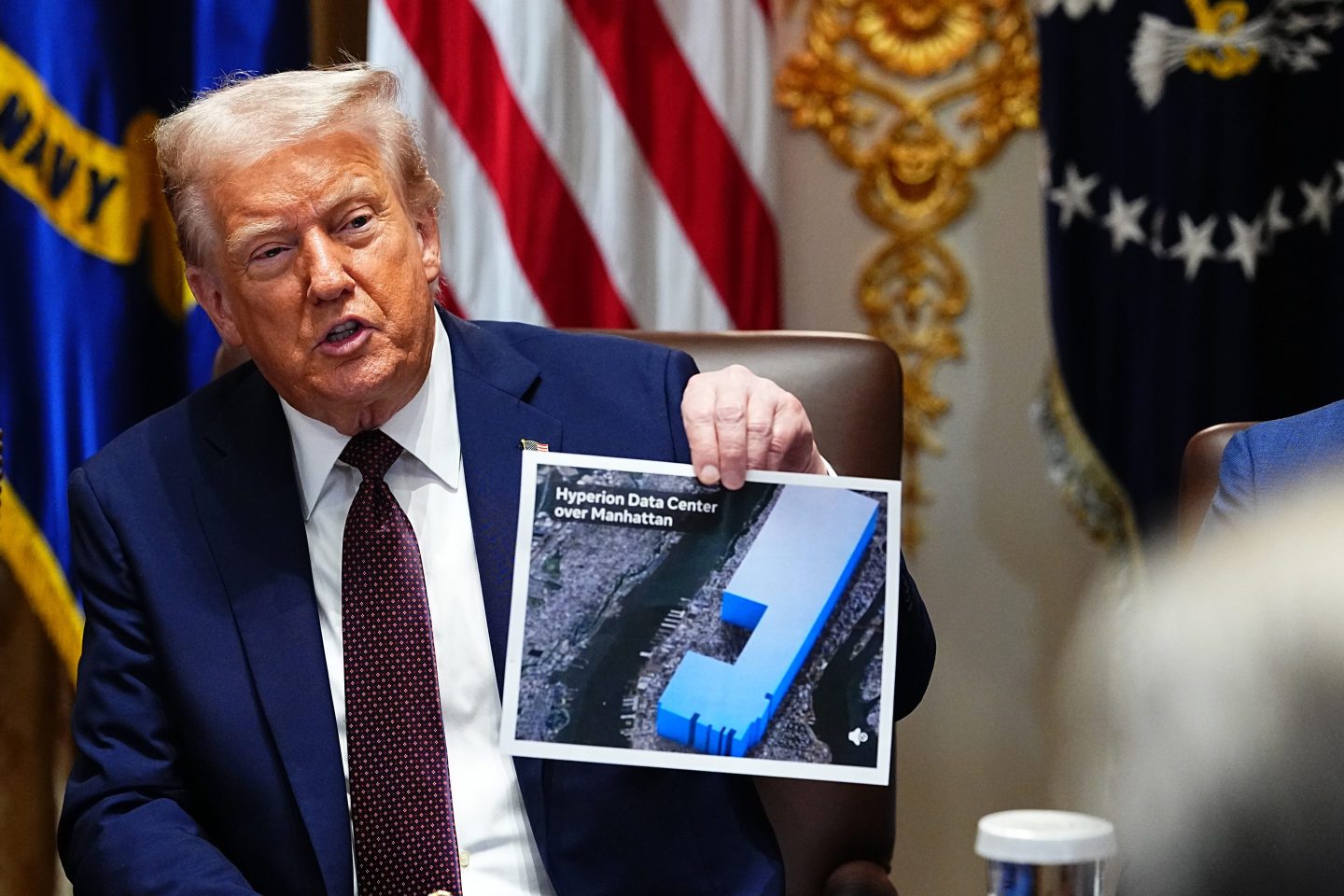
President Donald Trump holds up a graphic comparing the size of Meta’s new data center in rural Louisiana dubbed “Hyperion” to Manhattan.Getty Images— Aaron Schwartz/CNP/Bloomberg
Meta’s sprawling AI data center in rural Louisiana just got a massive cash infusion, but not everyone close to the project is celebrating.
Recommended Video
The company said Monday its Hyperion supercluster in Richland Parish will expand to a 5-gigawatt facility costing more than $50 billion, making it Meta’s largest data center and one of the biggest AI infrastructure projects in the world. The site was earlier projected to deliver more than 2 gigawatts of compute capacity, the kind of power needed to train the large language models behind tools like ChatGPT. When construction began in 2024, the price tag was $10 billion.
That means the cost of the project has quintupled in less than two years, largely thanks to deep-pocketed private capital and the state’s willingness to forgo tax revenue to land the deal. In late 2024, Louisiana Gov. Jeff Landry signed a law making data centers built before 2029 sales-tax-exempt for 20 years.
But missing out on tax revenue doesn’t appear to bother Landry. In a Monday statement, he said since the deal was signed, the state has “secured more than $150 billion in new investment by creating an environment where companies can move quickly and build at scale.”
Some business owners appear to be on the same page, claiming their workers are earning more with additional people and resources.
“We’ve been in the charter bus business for 29 years, but nothing compares to what Meta’s project has meant for us,” Scott Holmes, owner of local business Mayo Tours, said in a statement. “We went from 40 coaches to 102, and most of our drivers onsite are now earning over $80,000 a year in a region where the median income is $42,000.”
But not all locals see this behemoth of a data center project as good for the area. Hyperion sits in a parish of about 20,000 people, one of the poorest in Louisiana, and the expansion is reviving hard questions about who ultimately foots the bill for a project of this scale.
The buildout has already brought heavier traffic, rising rents, and even attempted evictions as thousands of construction workers pour into the area, former Fortune AI writer Sharon Goldman reported this spring. This has left many residents feeling that the project’s biggest decisions were locked in before they understood its scale, and that it’s now even bigger than originally expected.
“Meanwhile, there is literally a sign outside welcoming Meta workers while local families are left wondering where they’re supposed to go,” Erika James, a 34-year-old mother of two who grew up in Richland Parish and now lives in a mobile home park in Monroe about 30 minutes away from the Meta site, told Fortune’s Goldman. “We are now having to entertain the idea of leaving the area completely.
“There is nowhere to go if you can’t pay triple prices,” she continued.
Some of the state’s own dealmakers have also been more vocal about the trade-offs. Louisiana Economic Development Secretary Susan Bourgeois told the Times-Picayune that Meta made it clear when the deal was first being discussed that it wouldn’t be done without incentives.
“It was ‘If you don’t have this, we will not consider your state,’” Bourgeois said. One lawyer who helped negotiate the deals also said the point of the deal wasn’t to be “nice and welcoming.”
“We’re only giving this to get them here,” Mike Busada, a Shreveport attorney who helped negotiate the deals with Meta, told the Times-Picayune. “We don’t want to give them a dollar more than we have to.”
To be sure, Meta isn’t skipping out on taxes entirely.While it’s exempt from state and local sales tax on the equipment inside Hyperion—the servers, chillers, and electrical infrastructure that make up most of its spending—it still pays a 1% local sales tax on its purchases.
And because the construction cost is so enormous, even that 1% has made a difference for some locals. An ordinance funnels that 1% into school employee bonuses, which topped $50,000 for some local teachers, according to Meta. That’s a huge amount of money one recipient called “jaw-dropping,” considering the average teacher salary in Louisiana is $56,785, ranking them No. 49 in the nation, according to National Education Association data.
Still, local officials concede that the windfall is tied to the construction phase and will likely shrink once construction ends.
“Sales tax at that level may be somewhat temporary,” Scott Franklin, a director at the Richland Parish chamber of commerce, toldThe Wall Street Journal.
Meta also argues the project has “always been about more than building infrastructure,” according to Rachel Peterson, vice president of data centers at Meta.
“The people, workforce and partnership we’ve found in Louisiana have enabled this project to be a cornerstone of our global infrastructure,” she said in a statement. “With more than $1.6 billion already contracted with local companies and thousands of jobs being supported, we’re delivering real economic impact alongside the AI infrastructure that will power the future.”
Who pays for the power?
Another major concern about the project is the power bill it’ll produce. To supply Hyperion’s enormous electricity use, utility Entergy is building 10 new plants, along with 240 miles of new transmission lines, all paid for by Meta, which has also agreed to fund up to 2.5 gigawatts of renewable energy and signed what Entergy calls a “Ratepayer Protection Pledge.”
Even so, consumer groups fear the project’s major demand could still push up rates for everyone else on the grid. In January, the environmental law group Earthjustice—representing the Alliance for Affordable Energy and the Union of Concerned Scientists—asked Louisiana regulators to investigate Meta’s financing arrangement with Blue Owl Capital, under which Meta sold off roughly 80% of the data center to a venture debt firm.
“Louisiana ratepayers may have even less protection from the costs of this massive data center than they had just several months ago, which were already severely lacking,” Paul Arbaje, energy analyst at UCS, said in a statement. “The Commission must look further into Meta’s new financing structure to make sure that the bag Entergy’s customers are already holding hasn’t ballooned out of control.”
The Louisiana Public Service Commission declined to take up the probe in February.
“By dismissing this motion, the [Louisiana Public Service Commission] is giving the green light to more tech companies to use this kind of financial maneuvering to maximize profits while evading public accountability,” Susan Stevens Miller, senior attorney at Earthjustice, said in a statement.
Even Landry has moved to address the risk. In June, he directed his economic development agency to draft new rules meant to shield consumers from getting stuck with the cost of new power plants.
Louisiana is just a snapshot of the nation’s data center drama
The tension playing out in Richland Parish is also a national debate. As Meta races ahead with its multi-hundred-billion-dollar AI push, rivals Microsoft, Alphabet, and Amazon are also chasing the same tax breaks and energy deals from states scrambling for a piece of the AI boom. Amazon alone has committed $12 billion to data centers in northwest Louisiana.
And elsewhere, residents are equally as cautious of major data center projects. A Gallup poll conducted in March found that seven in 10 Americans oppose the construction of an AI data center in their local area, a higher share than those who oppose living near a nuclear power plant. Among opponents, many cited strain on resources such as water and energy, as well as higher utility bills.
Those concerns are already reshaping policy. In April, Maine became the first state to pass a bill barring the development of large-scale data centers, and a Wisconsin city approved a referendum giving voters more say over major tax-funded projects tied to a local data center campus.
Subscribe to Fortune Gulf Brief. Every Tuesday, this new newsletter delivers clear-eyed, authoritative intelligence on the deals, decisions, policies, and power shifts shaping one of the world’s most consequential regions, written for the people who need to act on it. Sign up here.
Hello, Tuesday! It’s Bastille Day. Smart Brevity™ count: 1,430 words … 5½ mins. Thanks to Noah Bressner for orchestrating. Edited by Andrew Pantazi and Bill Kole.The four-day 2026 Aspen Security Forum, which begins today in Colorado, will welcome speakers and participants from 56 countries (including Axios’ Marc Caputo) for nonpartisan conversations about Iran, the Western Hemisphere, U.S.–China competition and more. Full schedule … Register for livestream.
1 big thing: Google DeepMind CEO wants U.S.-led global AI watchdog
Demis Hassabis speaks at Google I/O developer conference in Mountain View, Calif., in May. Photo: Jeff Chiu/AP
Demis Hassabis, Google DeepMind co-founder and CEO, is calling on the U.S. to establish an AI watchdog with the power to screen the world’s most advanced models — and coordinate an industry-wide slowdown if dangers mount.
Hassabis, the Nobel laureate behind Gemini, lays out the plan in a personal manifesto published this morning, “A Framework for Frontier AI and the Dawning of a New Age.”
Why it matters: Hassabis tells me in an exclusive interview that the time has come for a more “systematic” approach to AI regulation — funded by the industry, staffed by world-class technical experts, and answerable to the U.S. government.
Today’s AI-driven cyber risksare “warning shots,” Hassabis tells me from his London base. Within 18 months, he says, those capabilities — plus far graver biological and nuclear threats — could live inside open-source models beyond any government’s control.
Hassabis emphasized that risks will come from the major labs’ more powerful future proprietary models, not just open-source models.
“What we collectively do now,” he writes in his manifesto, “will determine how the next phase of civilization unfolds.”
Behind the scenes: Hassabis has spent months quietly building support for the plan, briefing the Trump administration, fellow lab leaders and European officials before going public.
“The noises I’ve been hearing are very positive,” he says of his talks with the administration, which had embraced a laissez-faire approach to AI regulation before Mythos.
Hassabis, a scientist who commands rare respect across AI’s warring camps, says the other major lab leaders agree at a high level: “This is where the industry needs to go.
“His timeline is aggressive. “Months,” Hassabis says, ideally with the new body operational “before year-end.”
How it works: Hassabis is proposing an AI standards body modeled on FINRA (Financial Industry Regulatory Authority), the private, industry-funded watchdog that polices Wall Street under SEC oversight, Axios’ Zachary Basu and Madison Mills write.
Frontier labs would initially share their models with the body voluntarily, up to 30 days before release, for safety testing that probes dangerous cyber, biological and “deception” capabilities.
Once the testing regime proves “effective and robust,” Hassabis writes, formalization “could quickly follow.” That means frontier models would be required to pass before deploying in the U.S.
Hassabis envisions a majority-independent board stacked with Turing Award winners and other credentialed experts, alongside industry, government and open-source representatives.
The intrigue: The rules would apply to all frontier-class models, “no matter their country of origin or whether they are open or closed” — with the qualifying benchmarks regularly updated as capabilities evolve.
Hassabis predicts the “frontier” designation would carry cachet: Being tested means you matter. “I think that’s a pretty nice, prestige kind of asset to have,” he says.
The big picture: The Trump administration’s improvised crackdown on Anthropic’s Mythos and Fable models last month was “a bit of a wake-up call,” Hassabis says — proof Washington needs something sturdier than ad hoc directives.
Anthropic saw its most powerful models frozen overnight by an export-control order, then spent 2½ weeks negotiating their release with no established rules, protocols or playbook.
OpenAI, hoping to avoid the same fate, agreed to restrict GPT-5.6 to government-vetted partners at launch. It was released publicly last week after negotiations and testing with the Commerce Department.
The bottom line: Hassabis believes AGI — a system with all the cognitive powers of the human brain — is “probably only a few short years away,” and that we’re standing in “the foothills of the singularity.”


 Trump wrote on Truth Social: “Based on highly productive conversations with Middle East leadership, I have decided to replace the 20% United States Reimbursement Fee with Trade and Investment Deals that the various Gulf States will be making into the United States.
 Reality check: Saudi Arabia, Qatar, the UAE and Bahrain had already committed to investing more than $2 trillion in the U.S. over the next several years — even before the war with Iran.
 ️ Trump made his comments several hours before a U.S. naval blockade on Iran comes into effect, and amid exchanges of fire between the U.S. and Iran in the Strait of Hormuz for the fourth day in a row.
 / @gzeromedia

 Hello, Tuesday! It’s
  The four-day 2026 Aspen Security Forum, which begins today in Colorado, will welcome speakers and participants from 56 countries (including Axios’
  Demis Hassabis speaks at Google I/O developer conference in Mountain View, Calif., in May. Photo: Jeff Chiu/AP
 Behind the scenes: Hassabis has spent months quietly building support for the plan, briefing the Trump administration, fellow lab leaders and European officials before going public.
 The intrigue: The rules would apply to all frontier-class models, “no matter their country of origin or whether they are open or closed” — with the qualifying benchmarks regularly updated as capabilities evolve.
