Published: November 24, 2009 Last Updated: July 16, 2025
Parisian revolutionaries and mutinous troops storm and dismantle the Bastille, a royal fortress and prison that had come to symbolize the tyranny of the Bourbon monarchs, on July 14, 1789. This dramatic action signaled the beginning of the French Revolution, a decade of political turmoil and terror in which King Louis XVI was overthrown and tens of thousands of people, including the king and his wife Marie Antoinette, were executed.
By the summer of 1789, France was moving quickly toward revolution. Bernard-René Jordan de Launay, the military governor of the Bastille, feared that his fortress would be a target for the revolutionaries and so requested reinforcements. On July 12, royal authorities transferred 250 barrels of gunpowder to the Bastille, and Launay brought his men into the massive fortress and raised its two drawbridges.
Origins of the French Revolution
King Louis XVI and the French nobility face a revolution of the Third Estate.
3:38m watch
At dawn on July 14, a great crowd armed with muskets, swords, and various makeshift weapons began to gather around the Bastille. Launay’s men were able to hold the mob back, but as more and more Parisians were converging on the Bastille, Launay raised a white flag of surrender over the fortress. Launay and his men were taken into custody, the Bastille’s gunpowder and cannons were seized, and the seven prisoners were freed. Upon arriving at the Hotel de Ville, where Launay was to be arrested and tried by a revolutionary council, he was instead pulled away by a mob and murdered.
The capture of the Bastille symbolized the end of the ancien regime and provided the French revolutionary cause with an irresistible momentum. In 1792, the monarchy was abolished and Louis and his wife Marie-Antoinette were sent to the guillotine for treason in 1793.
The son of the late Wagner founder Yevgeny Prigozhin and around 500 former mercenaries have built a major criminal empire in Africa. After Prigozhin’s death in 2023, most Wagner overseas assets were absorbed by the Russian Defense Ministry’s African Corps. However, Pavel Prigozhin and about 500 loyalists refused to integrate and went independent. They control illegal gold mining at the Ndassima mines in the Central African Republic, generating an estimated $500 million annually.
The group has also established its own drug cartel, smuggling high-dose tramadol, known in Africa as “cocaine for the poor,” and distributing it to fighters, pro-Russian demonstrators, and miners.They use the profits to buy weapons and maintain independence.
They have additionally set up the production of addictive alcoholic surrogates mixed with tramadol. Local authorities in the Central African Republic are unable to dismantle this autonomous narco-empire in remote regions.
Children in the slums of Cumberland Street. Dublin, Ireland, 1940. My father was born in a similar “Tenement” house that very year on Mercer Street near St. Stephens Green. 8 rooms housing 13 families with a single toilet outside.
These once great Georgian houses were abandoned to unscrupulous land Lords by the British elites when they returned to London due to Irish “independence” but sadly the promise of a great new Republic quickly faded as the careerist cabal of self serving politicians slithered into the vacuum. In reality, nothing changed for the poor when Dublin Castles bureaucrats painted the post boxes green covering the red. The dysfunction and poverty continued and, in many cases, accelerated.
Today, Ireland is suffering a chronic shortage of housing. Thousands of Irish children are living in poverty. They are homeless and hopeless due to the serial failure of Irelands political elite. They are focused not on the welfare of our people but on complying with every whim of an unelected EU elite, which they one day aim to become part of.
Ireland is also suffering an epidemic of drug use, cocaine and cannabis are everyday fixtures for our young, home ownership is a fantasy for most, even renting a home impossible die to the misery farming of large investment landlords precludes young Irish from buying a starter home. Massive rents prevent saving for a home, and the cycle continues.
Irelands political elite have morphed into a uni party cabal, obsessed with woke agendas, demonising anyone brave enough to call out the incessant March towards the evisceration of our society and every trace of our uniqueness. We are losing our young to places that can offer them hope of a home and a future, all the while the Eilites import their “professional” replacements, Indians and Bangladeshis now staff out hospitals, Filipinos our care homes and Brazilians our bars and cafes.
Irelands once booming tourism trade is collapsing, a 15 billion euros trade is dying, our hotels sold out to house immigrants and Ukrainians, our towns and cities bereft of life, boarded up businesses, chicken shops and mobile phone stores where once communities thrived and children played.
Irelands’ health system is in a state of permacrisis, petty corruption, and a two-tier system that prioritises those that can pay have led to a massive 20% of the population waiting for care in the public system. Deaths from malpractice are now routine, billions paid annually for a grossly dysfunctional and dangerous ecosystem of failure.
All the while, our stony faced “liberal” politicians queue up to idolise the Ukrainain Dictatorship, “unconditionally” supporting the Brussles fourth reich for fear of dirtying their bibs ahead of a cosy appointment to the Brussels political retirement home.
Trump’s America is now the new enemy ,only matched by “Putins Russia” on the scale of indignation and outrage regularly peddled in the utterly gutless client media.
Ireland is decaying before our eyes. A beautiful country, home to generations of our ancestors who struggled in unimaginable adversity to deliver us to this? No Irishman or woman can or should remain silent on the reality of what’s happening to our homeland. You will be called “far right”. You will be called a racist and you will be attacked most aggressively by those who preach tolerance to all, except their kin who call out the criminal neglect of our country. Our home, our Ireland.
Trump’s war with Iran is back on, but in reality it never ended.
Renewed attacks by both sides this weekend continued today with new Iranian assaults on U.S. military bases and assets in Bahrain, Jordan, Kuwait and Oman.
This prompted Trump to declare that the U.S. will take over the Strait of Hormuz, reintroduce its naval blockade of Iranian ports, and, for the first time, charge a 20 percent fee on maritime cargo, mirroring Iran’s tolls on traffic in the Strait of Hormuz.
(Didn’t Marco Rubio say less than three weeks ago that charging tolls on international waterways violates international law?)
Oil prices have already risen about 5 percent. Although they’re still below this spring’s highs, American consumers will surely be hit by steadily higher prices for gas and for food (because food production depends on fertilizer and many components of fertilizer also depend on ships moving through the strait).
The new fighting was inevitable because the so-called “memorandum of understanding” signed by the U.S. and Iran on June 17 reopened the Strait of Hormuz on the condition that Iran was in control of it.
The memo said Iran would “make arrangements using its best efforts for the safe passage of commercial vessels” through the strait. Conspicuously missing from the agreement was any guarantee that ships could safely sail any portion of the strait.
It prohibited the charging of tolls or fees for only 60 days while negotiations toward another agreement continued.
The final line of the memorandum formally ceded to Iran a central role in managing the strait: “The Islamic Republic of Iran will conduct dialogue with the Sultanate of Oman to define the future administration and maritime services in the Strait of Hormuz, in discussion with other Persian Gulf littoral states, in line with the applicable international law and the sovereign rights of coastal states of the Strait of Hormuz.”
This is what we get with a president who’s desperate to get gas prices down before the midterm elections, a vice president who knows nothing about negotiating treaties and insists “we have all the cards” when the deck is loaded for the other side, a secretary of defense only capable of ordering more bombs be dropped, and a State Department that isn’t even at the table.
So what now? Iran is suffering economic pain but it’s a fierce dictatorship, so it’s willing to endure pain to hold on to its trump card — control over the strait.
But America is still a democracy and we’re not willing to endure a lot of pain simply to restore the status quo we had before the brainless egomaniac in the Oval Office decided to attack Iran.
We’ll start voting in three months, and most of us can be expected to vote out the bums in Congress who have supported him. Then Congress can pass a resolution revoking Trump’s power to pursue this costly and unnecessary war, which is the only way to end it.
Unless, of course, he converts us into a dictatorship before then.
This giant data center is under construction in Richland Parish, La. Photo: Meta
Meta announced an expansion of a data center now under construction in Richland Parish, La. — which already was Meta’s biggest — to 5GW of compute capacity. That’ll make it one of the largest data centers in history.Tax revenue from the data center funded teacher bonuses up to $50,000 this year in rural Richland Parish, Meta said, as part of a PR campaign amid national backlash against data centers.
Richland Parish is a four-hour drive north of New Orleans, near the Arkansas state line. The first part of the data center is expected to open in 2028.
Meta says it’s investing more than $50 billion in the region, with $1.6 billion in local contracts and 1,000+ jobs. Sheldon Jones, superintendent of the Richland Parish School System, called the checks “life-altering for our teachers and their families, and it’s transforming our schools.”
Reality check: Data centers have become one of the most contentious local issues in America. Communities elsewhere are fighting over power bills, water supplies and noise complaints.
P.S. At a New Orleans reception last night, teachers, business owners and community leaders from Richland Parish celebrated Louisiana’s future with the state’s civic, business, and political leaders, and Dina Powell, Meta’s president and vice chairman. Musical performers included Delfeayo Marsalis, a New Orleans jazz trombonist and Wynton Marsalis’ brother.
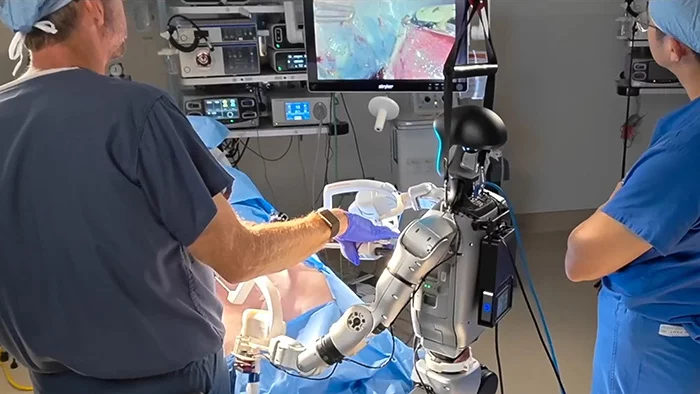
Surgeons at UC San Diego just handed the scalpel to two humanoid robots, who went on to complete live surgical procedures for the first time in history. This milestone moves beyond the fixed robotic arms found in operating rooms today and hints at an operating room of the future where humans and humanoids work side by side.
Humanoid robots are already showing up in factories, warehouses, and even on battlefields, precisely because their human-like shape lets them operate in spaces built for people without any redesign. A Morgan Stanley report from late June projects that China, the current leader in the field, will produce 446,000 humanoid units annually by 2030, with full-size humanoids growing from 30% market share in 2026 to 70% by 2028.
UC San Diego’s team wants to bring that same flexibility into the operating room. In one procedure, a humanoid robot and a human surgeon acting as an assistant completed a cholecystectomy (gallbladder removal). In a second, two humanoid robots worked together and finished the operation solo.
In one surgery, a humanoid robot and a human surgeon acting as an assistant successfully performed a gallbladder removal
The trials, described in a paper published in Nature, were carried out on large non-primate mammals, but the achievement matters because it moves the technology from concept to something that has demonstrably handled real surgical tasks.
The researchers say their real target is the growing shortage of surgeons and the surgical backlogs it creates, especially in rural areas or regions far from major hospitals. Traditional surgical robots address none of that: they’re bulky, expensive, and typically require rebuilding the operating room around them.
A conventional robotic system weighs around 800 kg (1,764 lb) and needs significant space. The humanoid system used here, nicknamed Surgie, looks to have started life as a Unitree G1, and stands just 1.5 m (about 5 ft) tall and weighs only 27 kg (60 lb) – compact enough to wheel into a small clinic or a field hospital.
“It’s a fraction of the cost, and it takes a fraction of the space in an operating room,” says Dr. Shanglei Liu, assistant professor of surgery at UC San Diego School of Medicine and one of the study’s lead authors, who personally operated one of the robots during the trials. “So it’s easy to deploy, anywhere from rural areas to the battlefield and even to space.”
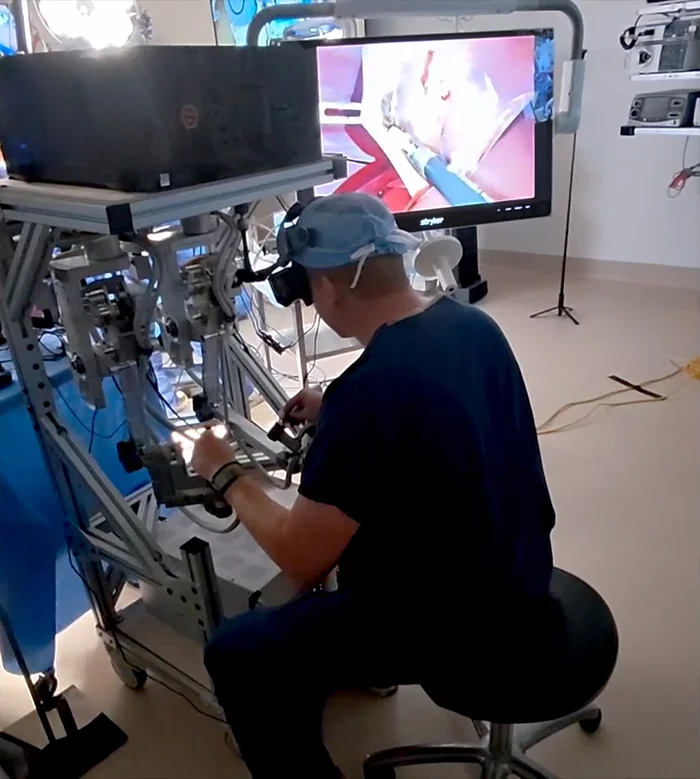
Dr. Ryan Broderick controls a robot during a gallbladder removal procedure
The surgeons control the robots remotely, using standard surgical tools fitted with adapters so the robotic hands can grip and maneuver them properly. Testing moved through stages: lab simulations, animal trials, and finally live surgery. The results are promising but not flawless – the robots needed recalibration mid-procedure, operations took longer than usual, and latency (the lag between a surgeon’s hand movement and the robot’s response) remains a challenge for any remote-controlled surgery.
That said, today’s routine surgical robots also started out slow and clumsy. “This achievement reflects the power of bringing engineers and surgeon innovators together to solve meaningful clinical problems at our world-class training and research lab,” says Dr. Ryan Broderick, interim director of UC San Diego’s Center for the Future of Surgery.
The team envisions humanoids eventually doing more than assisting in surgery: fetching instruments, tidying the room, or working alongside human staff as full team members.
“Many communities struggle with adequate staffing on the surgical team, which means patients are not being treated,” says Dr. Michael Yip, a UC San Diego engineering professor and co-author. “Our goal is an operating theater of the future, where humanoid robots and humans work side by side as an integrated team to deliver procedures to those in need, both in traditional hospital settings as well as in non-traditional, field medicine scenarios.”
A short video of the project has been posted to the YouTube channel of UC San Diego’s Advanced Robotics and Controls Lab, which we’ll link to rather than embed as it contains graphic imagery of surgery.




 Reality check: Data centers have become one of the
  P.S. At a New Orleans reception last night, teachers, business owners and community leaders from Richland Parish celebrated Louisiana’s future with the state’s civic, business, and political leaders, and