Ann Widdecombe just 4 hours before she was murdered. Her belief in an “Establishment” in existence

https://twitter.com/wideawake_media/status/2077720011100062016/video/1

Posted in Uncategorized | Leave a comment

The Deep View: New US open model takes on China’s top AI

New US open model takes on China’s top AI

China and Europe have typically led the charge on open models. Now, another US company is joining the fray with a significant entrant into the race.

On Wednesday, Thinking Labs, the AI startup founded by ex-OpenAI CTO Mira Murati, launched its first model: Inkling. The model sets itself apart from leading AI labs in the US in a very important way: it is open-weight, allowing customers to customize it directly to their needs through fine-tuning and training. To suit that purpose, the model was built to perform across a wide range of areas. Or, as Thinking Machines describes it, it’s a “generalist model” that can reason about text, images, and audio rather than being proficient in just one domain. This can be observed in benchmark performance, which isn’t best-in-class but is consistent across specialties, as seen in the image below. Tweet screenshotOther model features include:

Parameters: Mixture-of-Experts transformer model with 975 billion total parameters, 41 billion active.

Context window: Up to one million tokens 

Pretrained: On 45 trillion tokens of text, images, audio and video, allowing it to be proficient across all three. 

Lightweight counterpart: Inkling-Small, a lighter-weight model with 12 billion active parameters.

Fine-tuning: To make customization accessible, the company says it is making Inkling available on Tinker, the company’s training API platform. 

Cost-efficiency: Inkling’s “controllable thinking effort” allows users to customize the cost/performance curve.Until now, most open-source models have been developed in other countries, with China leading the way. These models are good for the ecosystem because they allow people and organizations to more deeply specialize the models, adjust their behavior, run them locally, and even save money. Though, as Thomas Randall, Research Director at Info-Tech Research Group, told The Deep View, they may not be for everyone. “If organizations have use cases where cost control, sovereignty, fine-tuning, deployment flexibility, or domain-specific performance matter, then open-source models are relevant,” said Randall. “For the highest-risk or most complex work (e.g., legal, medical, cyber, or regulated decisions), closed frontier model providers are preferable because of safety tooling, support models, auditability, and more mature deployment ecosystems.” Still, for the US to compete in the open-weights model space, it has a lot left to do, despite recent entrants from not only Thinking Machines but Nvidia, Google and OpenAI. A closer look at benchmark performance shows that many of China’s leading labs, which have also taken a generalist approach with their open-weight models, have outperformed Inkling on benchmarks. That includes GLM 5.2, DeepSeek V4 Pro, and Kimi K2.6. Kimi K3 also just released on Thursday, and it’s Kimi’s most capable model to date, with 2.8 trillion parameters.Competition is the lifeblood of any industry. This is especially true for the state of AI we are in now, where enterprises and AI builders are prioritizing cost, and open-weight models provide a tangible solution while applying pressure on the leading labs to be more cost-conscious. Just this month, OpenAI and Meta have both released new models, each highlighting their cost efficiency. Still, it is important to keep in mind the broader backdrop, including the rising costs of finite resources such as data centers and energy. Open-weight models still need the same compute power, even if they cost less than proprietary models. 
 LINKS

Posted in Uncategorized | Leave a comment

China: Creativity, engineering, Ireland can’t even get the railway back in operation which went from Navan, Co. Meath to Dublin, as far back as the 1950’s. We need some of the calibre of the Chinese for action.

https://twitter.com/Eng_china5/status/2078025417349570750/video/1

https://twitter.com/Eng_china5/status/2078025417349570750/video/1

Posted in Uncategorized | Leave a comment

IIEA Robert Watt – 16th July 2026 Hosted by Dan O’Brien. Promising insights for Ireland

Posted in Uncategorized | Leave a comment

Department of State: Marco Rubio a powerful speech worth engaging with

Declan Ganley

@declanganley

·

Brilliant speech by

@SecRubio

one I expect will have historic significance. Well worth your time and it has ramifications for (at minimum) all the democracies. Via

@mirandadevine

https://twitter.com/StateDept/status/2077769288266461660/video/1

Posted in Uncategorized | Leave a comment

President Trumps’ views on the mentally ill … it is not promising; it is a step backward into asylums as he calls them. Where is the hope for people diagnosed with mental illness; President Trump is right, many of them are found on the streets homeless but then there are others taking the medications and working their way through life in a positive way.

https://twitter.com/TRUMP_ARMY_/status/1971935595468575119/video/1

========================

An AI Synopsis:

AI Overview

+2

Donald Trump’s mental health policy centers on expanding civil commitment laws and aggressively institutionalizing unhoused individuals and those with severe mental illness. These actions have rolled back decades of disability rights, though his administration also faced significant bipartisan pushback and legal challenges regarding planned funding cuts to frontline health services. [1, 2, 3, 4]

Executive Action on Homelessness and Mental Illness

A core component of Trump’s mental health platform is addressing homelessness by framing it as a public safety and public health crisis. His administration signed an executive order directing federal agencies, including the Attorney General and the Department of Health and Human Services (HHS), to encourage the forced institutionalization of individuals living on the streets who pose a risk to themselves or are unable to care for themselves. The order calls for the reversal of legal precedents and termination of consent decrees that historically impede civil commitments. [1, 3]

Funding Battles and Service Cuts

The administration’s approach to mental healthcare has led to intense conflict with states, advocacy groups, and local healthcare providers. Initial plans to cut roughly $2 billion in federal funding for mental health and addiction programs were met with widespread bipartisan outrage. While the administration walked back some of these cuts following pressure from lawmakers and health departments, advocates continue to criticize policies that prioritize forced commitments over funding voluntary, community-based care and housing-first programs. [1, 2, 3]

For a closer look at the logistical challenges and controversy surrounding the administration’s push for forced psychiatric care amidst resource shortages, see this news report:

Related video thumbnail

23s

Trump pushes forced mental health care

CBS19

YouTube · 1 Oct 2025

Civil Rights and Disability Oversight

The pivot toward institutionalization has faced heavy scrutiny from disability rights organizations, such as the American Bar Association (ABA), which argue the expanded criteria for involuntary commitment undermine decades of hard-won civil rights protections. The administration has also explored shifting the oversight of special education from the Department of Education to HHS, a move critics warn could “remedicalize” education for students with disabilities and reduce their integration into mainstream community settings. [1]

To understand more about the legal and institutional shifts under the administration, including the concerns voiced by disability and elderly care advocates, watch the following video:

Posted in Uncategorized | Leave a comment

Steve Hanke: NB AI but so clever.

@steve_hanke

·

Reuters reports that Iran told Yemen’s Houthis to be ready to close the Bab el-Mandeb Strait if the US strikes Iranian power infrastructure. Annually, ~10-12% of global trade flows through the Bab el-Mandeb Strait. US & ISRAEL + IRAN = CLIMBING A DANGEROUS ESCALATION LADDER.

Posted in Uncategorized | Leave a comment

DW: A decade after Brexit, youth in Britain want the EU back

07/15/2026July 15, 2026

Ten years after the Brexit referendum, only one-third of people in Britain believe that leaving the EU was the right decision. Among young people in particular, support for rejoining the European Union is strong.

https://p.dw.com/p/5GXo2

Ten years after the Brexit referendum, a growing number of people in Britain are questioning the UK‘s  departure from the EU. The activist Ceira Casey Sergeant is marching from London to Brussels to campaign for rejoining the European Union. Critics of Brexit cite weaker economic growth and pressure on the National Health Service. Some people who supported Brexit now say key promises made by “Leave” campaigners were never made good on. As public opinion shifts, over 80% of people younger than under-25s are said to support a return to the European Union,  fueling a renewed debate about Britain’s future relationship with the EU.

Posted in Uncategorized | Leave a comment

Axios: Looking for a deal? Try Tokyo. Comment: Ireland rents are so expensive too

Looking for a deal? Try Tokyo
 
A bar chart that compares average three-bedroom rents across 11 cities. New York is highest at $8,873, followed by Zurich at $6,285 and San Francisco at $6,071. Tokyo is lowest at $2,361. Most cities cluster between about $4,850 and $5,900.Data: Numbeo.com via Deutsche Bank Research Institute. (For an apartment in the “city center.”) Chart: Emily Peck/Axios

The cost of living in Japan has gotten exceptionally cheap in dollar terms compared with other developed countries, Axios’ Emily Peck writes from a new report.

Major U.S. cities have grown ever more pricey.

🤑 Inflation, a stronger dollar and a weaker yen, and larger economic shifts have scrambled the global cost-of-living map.

The authors of the Deutsche Bank Research Institute paper write: “The old assumptions about which places are expensive, which are cheap and where wages compensate for living costs no longer always hold.”

🌎 The bank looked at 69 cities across six continents, comparing the costs of housing and dining out — plus things like the price of a “cheap date” and an iPhone.

Tokyo ranks near the middle or bottom of the bank’s tables for many expenses. It’s 57th most expensive for a meal for two, and 40th for renting a three-bedroom apartment

.🏙️ Stunning stat: The average monthly rent for a three-bedroom apartment in New York is now $8,900. In Tokyo, it’s just $2,400.

Yes, but: Averages can skew the numbers, as super pricey rentals get thrown into the mix.

Reality check: Jim Reid, head of the Deutsche Bank Research Institute, tells Axios that “being expensive isn’t necessarily an outright negative.”

“It can be just because the economy runs well and attracts a lot of inflows.”Explore the data … Share this story.
Posted in Uncategorized | Leave a comment

Fortune: He sold his last company to Palantir. Now he’s betting $32 million that robots can fix construction’s labor crisis. Quote: “Salar al Khafaji sold his last company, Silk, to Palantir in 2016. A week after he left, he knew he was going to build again. Al Khafaji landed on construction—an industry many in tech saw as a graveyard. “Most people told me it’s a really, really bad idea,” he told Fortune.

Innovation Robotics

He sold his last company to Palantir. Now he’s betting $32 million that robots can fix construction’s labor crisis

Lily Mae Lazarus

By 

Lily Mae Lazarus

Reporter, News

July 15, 2026, 8:00 AM ET

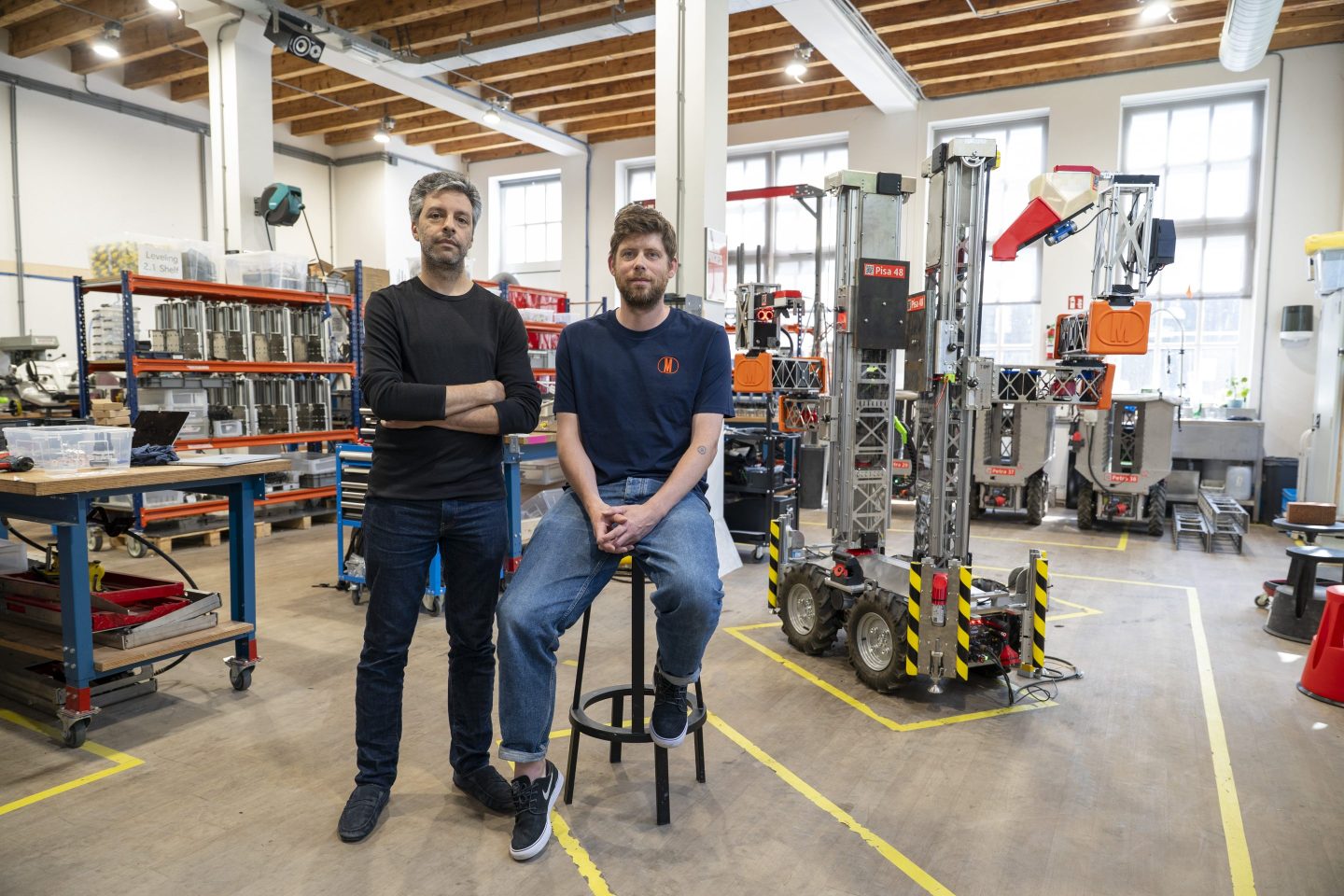
Salar al Khafaji stands while Sebastiaan Visser sits on a stool in front of a robotics warehouse

Monumental builds fleets of compact, electric, self-driving bricklaying robots that show up on construction sites and lay walls.Courtesy of Monumental

Salar al Khafaji sold his last company, Silk, to Palantir in 2016. A week after he left, he knew he was going to build again. Al Khafaji landed on construction—an industry many in tech saw as a graveyard. “Most people told me it’s a really, really bad idea,” he told Fortune.

Recommended Video


His Amsterdam-based construction robotics company, Monumental raised a $32 million Series B led by Khosla Ventures, Fortune learned exclusively. The round follows a $25 million round in February 2024 co-led by Plural and Hummingbird. The new capital will fund a U.S. launch this year, scale its European robot fleet, and expand the range of tasks its machines can handle.

Al Khafaji’s nay-sayers weren’t wrong to be skeptical about the construction space. Construction technology has burned through substantial venture capital in the past seven years and investment activity in the space has ultimately declined 33% year-on-year. Katerra—a SoftBank-backed startup that tried to overhaul the entire construction supply chain under one roof—raised over $1 billion and went bankrupt in 2021. Australia’s FBR built a truck-mounted bricklaying robot arm that can lay up to 360 blocks per hour, but at nearly $6 million per machine it requires contractors to make a massive upfront bet on unproven technology. The pattern repeats: bold technology, wrong business model, contractor walks away.

Monumental builds fleets of compact, electric, self-driving bricklaying robots that show up on construction sites and lay walls. The company works like a specialist subcontractor—the kind a general contractor hires to handle one specific job, like plumbing or electrical—except the crew is robots. Contractors get a quote in familiar terms (per brick, per square meter), and Monumental handles everything else. “We’re selling them a wall,” al Khafaji explained. 

The company uses whatever bricks and mortar a contractor already specifies, meaning regulators see nothing new to approve. Al Khafaji explained this as a deliberate workaround to the building-code fragmentation that killed many of its predecessors. The company currently has more than 150 robots on live European job sites.

Monumental’s latest round coincides with a greater shortage of construction labor. Global construction accounts for 13% of world GDP but has seen virtually no productivity gains in 50 years. In the U.S., the industry needs 349,000 net new workers in 2026 alone, and the housing shortfall sits at 3 to 4 million units. Al Khafaji is blunt about the scale: “You could have 10,000 robots a day and we would literally have just touched a few percentage points of the shortage.” That framing—filling a hole, not displacing workers—is also Monumental’s political cover entering a union-heavy market where tightening immigration enforcement is already shrinking the informal labor pool that much of American construction quietly depends on.

The company isn’t the only bet on the sector. Last November, Zurich-based Gravis Robotics raised $23 million to outfit existing heavy machinery—excavators, loaders—with cameras and AI so they can operate autonomously or be guided remotely via tablet. 

And equipment giants like Caterpillar, Komatsu, and Volvo are all circling the autonomous construction equipment market, valued at $10 billion in 2025 and growing at 7.9% annually. Where Gravis retrofits machines already on site, Monumental deploys its own fleet from scratch. 

Monumental’s entry is targeted at Texas, Florida, Virginia, and Arizona, where building activity and labor shortages are most acute. Al Khafaji’s 18-month benchmark is a permanently deployed fleet in the high double to low triple digits across at least two states. The longer roadmap stretches from bricklaying to full facades. Someday, he mused “you’ll drive around and find them on an average construction site.”

The Fortune 500 Innovation Forum will convene Fortune 500 executives, U.S. policy officials, top founders, and thought leaders to help define what’s next for the American economy, Nov. 16-17 in Detroit. Apply here.

About the Author

Lily Mae Lazarus

By Lily Mae LazarusReporter, News

Lily Mae Lazarus is a news reporter at Fortune.

Posted in Uncategorized | Leave a comment