

Academic rigour, journalistic flair
Arts + CultureBusiness + EconomyEducationEnvironmentHealthPolitics + SocietyScience + TechWorldPodcastsInsights
Share article
Print article
Irish whiskey is one of Ireland’s great export success stories. Exports were worth over €930 million in 2025, with the country’s much-loved spirit being sold all over the world.
Even amid difficult international trading conditions, with concerns around tariffs for export to the US, exports to the EU have grown by more than 21% in four years.
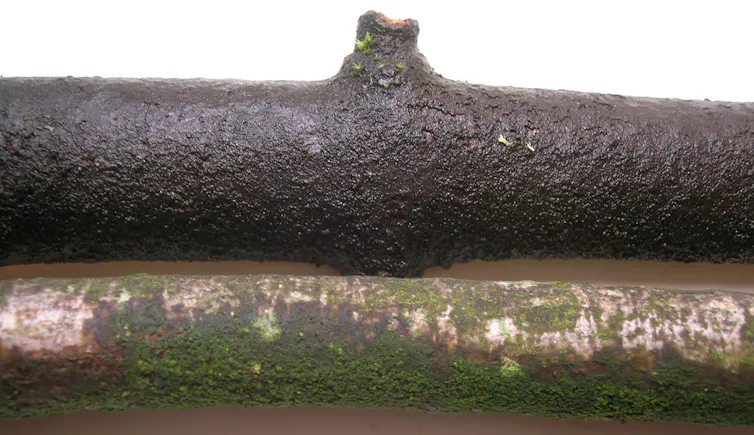
However, while thousands of barrels quietly mature in warehouses around Ireland, something else is happening outside some of them. On walls, roofs, road signs, trees and other surfaces close to some whiskey maturation facilities, a distinctive black patina appears.
It may look like soot or air pollution, but in some cases the culprit is a fungus: Baudoinia, commonly known as “whiskey fungus” or “whiskey black”, and fuelled by the presence of ethanol alcohol in the air.
Despite the fact it has been known about for years, there has been surprisingly little research on its effects, such as whether the fungus can spread from distilleries to nearby properties, including residential homes.
Ethanol alcohol emissions from the industry are also thought to contribute to ground level ozone, a harmful air pollutant. But we don’t know whether the fungus has any adverse consequences for people’s health. It may not be dangerous at all, but this is something we are investigating through a project at Dublin City University.
We want to ensure the knowledge of scientists reaches millions. Join us.
Get newsletter
The angels’ share
During maturation, ethanol and other volatile compounds evaporate and pass through the porous cask. They then enter the surrounding atmosphere around the distillery. This portion of the whiskey is often known as the “angels’ share”.
A review commissioned by the Scottish government estimated that more than 90% of non-methane volatile organic compound (NMVOC) emissions associated with whiskey production occur during maturation.
NMVOCs are chemicals that participate in atmospheric reactions and contribute to the formation of pollutants like ground-level ozone. Ethanol alcohol overwhelmingly dominates these emissions from whiskey production.
As they condense into the air moisture, these ethanol vapours also create an unusual ecological niche. Baudoinia can occur naturally at very low abundance, but exposure to this airborne alcohol can favour its growth.
Around maturation warehouses, this can result in conspicuous dark fungal growth on exposed surfaces. The association has been recognised for more than a century, initially around cognac maturation facilities in France, and has subsequently been documented around spirit maturation warehouses in Scotland, Canada and the US.

Black discolouration
So can whiskey fungus spread from distilleries to nearby properties, causing unsightly dark growth in people’s homes? In 2022, following a complaint about black discolouration on houses close to the Midleton distillery in county Cork, the Irish Environmental Protection Agency (EPA) investigated whether Baudoinia was present.
While the fungus was identified on a whiskey warehouse, it was not detected on any of the three nearby residential properties sampled.
There are still major gaps in what we know about whiskey fungus in Ireland, such as how far it travels, what controls its growth, and what, if anything, its presence tells us about ethanol concentrations in the surrounding environment.
A recent review led by researchers at University College Cork suggests that ethanol may play several roles for the fungus. It may act as a germination signal and as a source of carbon to support the growth of the fungus.
Research around whiskey maturation warehouses also suggests that the extent of visible colonisation depends on factors including distance from the ethanol source, prevailing wind, moisture and the type and texture of the surface available for colonisation.
Ireland has commitments to reduce NMVOC emissions under the EU National Emission Reduction Commitments Directive. As mentioned, these NMVOC emissions can help produce ozone, a harmful air pollutant that damages vegetation and crops, reduces lung function and aggravates respiratory conditions such as asthma. It is also a greenhouse gas that contributes to climate change.
The difficulty is knowing precisely how much ethanol is being released. National inventories generally rely on production data and emissions factors. These are useful for estimating emissions across an industry, but they do not necessarily tell us what is happening around an individual maturation facility – how emissions change with the number and age of barrels, how ethanol disperses beyond a warehouse boundary, or how weather conditions affect local concentrations.
Is whiskey fungus dangerous?
However, it’s important not to jump from the presence of a striking black fungus to conclusions about health. The Scottish government review of the available literature found no evidence demonstrating health effects from short- or long-term exposure to Baudoinia. However, it also identified important evidence gaps and recommended further investigation and environmental monitoring.
So, there are two assumptions we should avoid. One is that because something looks alarming, it must be dangerous. The other is that because harm has not yet been demonstrated, there is nothing worth investigating. What we need is evidence.
That is the purpose of the new research project we are undertaking at Dublin City University, in collaboration with the University of Toronto. The EPA-funded EREG project is tasked with investigating the ethanol emissions from maturation facilities and the environmental distribution and biology of Baudoinia in Ireland.
We will combine emissions estimation, environmental monitoring and microbiology and examine how whiskey maturation emissions are currently regulated. We will also engage with the industry, regulators and communities. In fact, if you live near a whiskey maturation facility in Ireland and have noticed this black staining, we want to hear from you.
Ireland does not need to choose between a successful whiskey industry and environmental protection. The objective is to develop the evidence needed to allow the industry to grow sustainably while ensuring that communities and the environment are appropriately protected. The angels’ share is an unavoidable – and much celebrated – part of making whiskey.
But from an environmental science perspective, there is another question worth asking: once the angels have taken their share, where does it go next?


