

AUG20
AUG20
Choose another dateOK
August
| 28 | 29 | 30 | 31 | 1 | 2 | 3 |
| 4 | 5 | 6 | 7 | 8 | 9 | 10 |
| 11 | 12 | 13 | 14 | 15 | 16 | 17 |
| 18 | 19 | 20 | 21 | 22 | 23 | 24 |
| 25 | 26 | 27 | 28 | 29 | 30 | 31 |
1619
First enslaved Africans arrive in Jamestown, setting the stage for slavery in North America

Hulton Archive/Getty Images
Published: August 13, 2019Last Updated: February 18, 2025
On or about August 20, 1619, “20 and odd” Angolans, kidnapped by the Portuguese, arrive in the British colony of Virginia and are then bought by English colonists. The exact date is not definitively known (a letter from the time identified the ship’s arrival coming in “the latter part of August”), but this date has been chosen by many to mark the arrival of the enslaved Africans in the New World—beginning two and a half centuries of slavery in North America.
Founded at Jamestown in 1607, the Virginia Colony was home to about 700 people by 1619. The first enslaved Africans to arrive in Virginia disembarked at Point Comfort, in what is today known as Fort Monroe. Most of their names, as well as the exact number who remained at Point Comfort, have been lost to history, but much is known about their journey.
Life Aboard a Slave Ship
Life aboard the ship was agonizing and dangerous; nearly 2 million enslaved Africans would perish on their journey across the Atlantic.
They were originally kidnapped by Portuguese colonial forces, who sent captured members of the native Kongo and Ndongo kingdoms on a forced march to the port of Luanda, the capital of modern-day Angola. From there, they were ordered on the ship San Juan Bautista, which set sail for Veracruz in the colony of New Spain. As was quite common, about 150 of the 350 captives aboard the ship died during the crossing. Then, as it approached its destination, the ship was attacked by two privateer ships, the White Lion and the Treasurer. Crews from the two ships kidnapped up to 60 of the Bautista’s enslaved people. It was the White Lion which docked at Virginia Colony’s Point Comfort and traded some of the prisoners for food on August 20, 1619.
Scholars note that the arrivals were technically sold as indentured servants. Indentured servants agreed, or in many cases were forced, to work with no pay for a set amount of time, often to pay off a debt and could legally expect to become free at the end of the contract. Many Europeans who arrived in the Americas came as indentured servants. Despite this classification—and records which indicate that some of them did eventually obtain their freedom—it is clear that the Africans arriving at Point Comfort in 1619 were forced into servitude and that they fit the Universal Declaration of Human Rights’ definition of enslaved peoples.
The arrival at Point Comfort marked a new chapter in the history of the trans-Atlantic slave trade, which began in the early 1500s and continued into the mid-1800s. The trade uprooted roughly 12 million Africans, depositing roughly 5 million in Brazil and over 3 million in the Caribbean. Though the number of Africans brought to mainland North America was relatively small—roughly 400,000—their labor and that of their descendants was crucial to the economies of the British colonies and, later, the United States.
Two of the Africans who arrived aboard the White Lion, Antonio and Isabella, became “servants” of Captain William Tucker, commander of Point Comfort. Their son William is the first known African child to have been born in America, and under the law of the time he was born a freeman. In the coming decades, however, slavery became codified.
Slavery in America
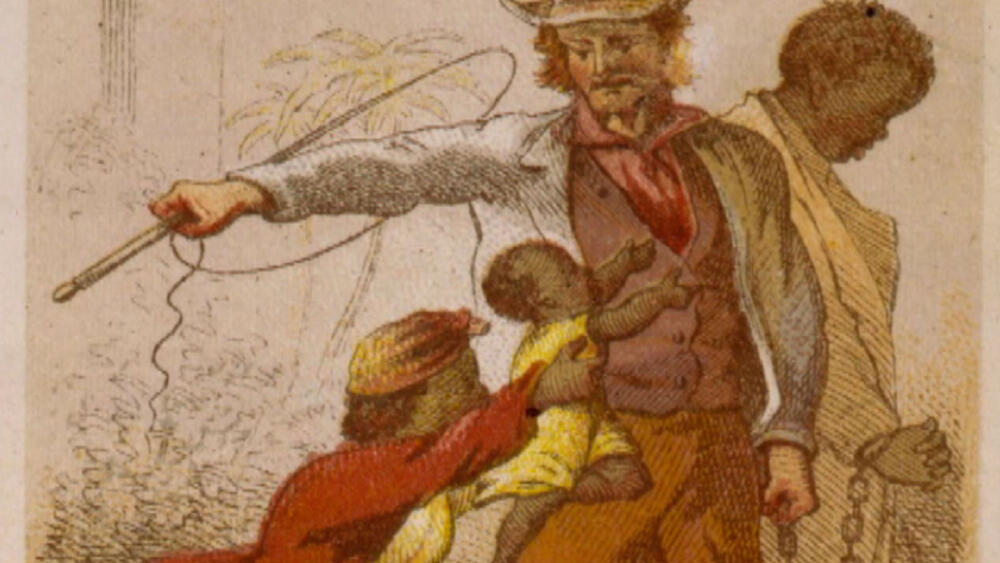
In 1619, the Dutch introduced the first captured Africans to America, planting the seeds of a slavery system that evolved into a nightmare of abuse and cruelty that would ultimately divide the nation.
Servants of African origin were oftentimes forced to continue working after the end of their contract, and in 1640 a Virginia court sentenced rebellious servant John Punch to a lifetime of slavery. With fewer white indentured servants arriving from England, a racial caste system developed and African servants were increasingly held for life. In 1662, a Virginia court ruled that children born to enslaved mothers were the property of the mother’s owner.
As cash crops like tobacco, cotton and sugar became pillars of the colonial economy, slavery became its engine. Though the slave trade was outlawed in 1807, chattel slavery and the plantation economy it made possible flourished in the South. The 1860 census found that there were 3,953,760 enslaved people in the United States, making up roughly 13 percent of the total population.
The conflict between abolitionists and those who wanted to preserve and spread slavery was a major catalyst in the outbreak of the Civil War. President Abraham Lincoln formally freed enslaved people in the South with the Emancipation Proclamation in 1863, although it was not until the passage of the Thirteenth Amendment in 1865 that slavery was formally abolished in the United States.
In the end, 246 brutal years of slavery had an incalculable effect on American society. It would take another century after the Civil War for racial segregation to be declared unconstitutional, but the end of state-sanctioned racism was by no means the end of racism and discrimination in America. Because it became a crucial part of the culture and economy of early America after its introduction in Jamestown, slavery is often referred to as the nation’s “original sin.”
Timeline
Also on This Day in History
Discover more of the major events, famous births, notable deaths and everything else history-making that happened on August 20th


