
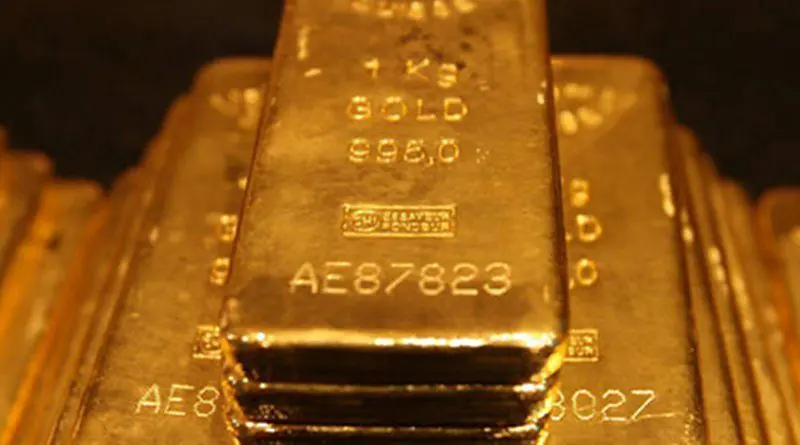
Gold Bars. Photo by Agnico-Eagle Mines Limited, Wikipedia Commons.
Alliance Of Sahel States’ Multibillion-Dollar ‘Gold Pipeline’ – Analysis
By Arab News
FacebookTwitterEmailFlipboardMastodonLinkedInShare
Video Muted
By Hafed Al-Ghwell
Key Takeaways:
- Mali, Burkina Faso and Niger are building an economic system centered on gold (≈230 tonnes/year, ~$32 billion market value) after exiting ECOWAS, using greater state control of mines, refining and trade to reduce external dependence.
- Massive discrepancies between official exports and actual gold flows (hundreds of tonnes of undeclared metal) reveal extensive smuggling, while new state refineries aim to capture more of the value chain.
- Control of the “gold pipeline” (mine → refinery → buyer), including links to Russian networks, is turning the commodity into an instrument of political and financial autonomy for the AES juntas.
The collapse of West Africa’s political order last year assumed an oddly bureaucratic tone. The Economic Community of West African States formally confirmed the departure of Mali, Burkina Faso and Niger, even as the bloc preserved a six-month transition for visas, trade and passport recognition. Diplomatic language made the rupture sound manageable, yet the underlying economic break was considerably more consequential.
The three states had already built the machinery of separation. The Alliance of Sahel States, created in September 2023 as a mutual defense pact, acquired a confederal structure a year later, complete with a planned import levy and a proposed regional development bank. By the time the ECOWAS exit became official, the juntas had moved beyond rejecting Western political conditions. They were beginning to assemble an economic system designed to function with less reliance on them.
And gold sits at the center of this transformation.
The three Alliance of Sahel States economies collectively produce about 230 tonnes of gold a year. At a spot price of just over $4,380 per troy ounce, that volume carries a gross market value of about $32.4 billion. A staggering figure representing a little more than half the combined gross domestic product of the three economies, corresponding to the value of gold extracted, not government revenue, export earnings or money available to the juntas.
It is a distinction central to understanding the Sahel’s new political economy.
Gold does not need to make Mali, Burkina Faso or Niger rich to make their governments harder to isolate. A commodity with enormous value relative to its physical weight can finance imports, secure hard currency, attract foreign partners and compensate for weaknesses in conventional financial channels. Every additional point in the chain that governments control can increase the share of that value they retain.
As a result, the overall strategy has already moved in this direction. Mali’s 2023 mining code raised the potential state stake in mining projects from 20 percent to 35 percent. Burkina Faso has created a state mining participation company while increasing royalties on higher-value production. Niger has gone further, nationalizing the Somair uranium operation previously controlled by France’s Orano and revoking licenses held by several Western companies.
Moreover, a parallel monetary system is also being discussed. Alliance of Sahel States officials have floated a common central bank and currency to replace the CFA franc, whose reserve arrangements have long been politically contentious. A functioning gold-backed currency remains difficult to imagine given the bloc’s limited reserve-management and monetary institutions. However, it does signal that gold, bilateral settlement and physical commodities are likely to become alternatives to conventional currency channels.
What’s more, Western and ECOWAS assumptions have another problem. Regional growth can remain respectable while regional integration deteriorates. ECOWAS projected 5 percent growth for 2026 and 7.1 percent for 2027, yet those aggregates say little about who controls the mineral rents being generated inside the bloc’s former Sahelian core. The three departing states remove about 70 million consumers from the customs union while taking major mineral assets outside its institutional framework.
A useful way to read the break, therefore, is vertically rather than horizontally. ECOWAS measures economic integration through trade, markets and formal institutions. The Alliance of Sahel States is increasingly pursuing sovereignty through control of a “gold pipeline” running from mine to tax office to refinery to foreign buyer.
Put simply, the political exit was the announcement — the pipeline is the project.
However, the most revealing part of the Sahel’s commodity story begins where the official export figures stop making sense.
Take Mali, for instance. In 2019, it was reported to have sold nearly 81 tonnes of Malian gold to a single country, but Bamako declared only about half a tonne of this. SWISSAID has estimated that between 30 tonnes and 57 tonnes of Malian gold may be smuggled out each year, representing $1.98 billion to $3.77 billion in undeclared trade. Between 2012 and 2022, the cumulative quantity of undeclared Malian gold was estimated at about 300 tonnes, worth some $13.5 billion.
Elsewhere, Niger’s official gold exports in 2022 amounted to only 235 kg, worth less than €10 million ($11.5 million), but again just one country recorded €457 million in gold imports from Niger. Burkina Faso is estimated to lose about $490 million a year through smuggling and under-declaration. Togo, meanwhile, reported billions of dollars-worth of gold exports in 2024 despite producing little gold itself. The figures do not prove every tonne originated in the Alliance of Sahel States but they expose how poorly national production statistics map onto the bullion actually reaching international markets.
Physical gold makes the problem unusually difficult to police. Couriers reportedly move between 10 kg and 40 kg per trip. A $500 airfare is irrelevant when the passenger is carrying bullion easily worth hundreds of thousands to millions of dollars. The transaction also bears little resemblance to conventional commodity trade: the gold can move through intermediaries, change hands for cash and enter a refining system where its provenance becomes progressively harder to reconstruct.
Domestic refining could change things even further. Burkina Faso launched a national refinery in late 2024 with an annual capacity of 150 tonnes a year. Mali broke ground in June 2025 on a refinery designed to process 200 tonnes, with 62 percent state ownership and the remainder held by Russia’s Yadran Group and a Swiss investor. The Malian facility is designed for 99.5 percent purity and has been explicitly presented as a regional processor capable of handling gold from neighboring Burkina Faso.
This lurch to refining matters because it captures a stage of the value chain that producers have historically outsourced. More importantly, high-purity bullion is highly fungible. Once ore has become standardized bars, the questions shift from where the metal was mined to who is willing to buy it.
Russia enters the system at this point, with Kremlin-associated networks linked to more than $2.5 billion in African gold flows since 2022, while Wagner Group-linked forces reportedly gained access to Mali’s Intahaka artisanal mine and received payment for security services.
A mine, a security contractor, a refinery and an offshore buyer can therefore become parts of one circuit in which gold finances security; security protects access to gold; refining increases the commodity’s portability; and offshore markets convert bullion into currencies, imports or further strategic relationships.
Ultimately, the Alliance of Sahel States juntas’ vertical sovereignty is complete: control over mine, refinery, transport and buyer transforms gold from commodity into instrument of state power. The laundering machine will eventually transcend gold itself — turning into a conversion mechanism in which commodities, illicit flows, nationalization decrees, external security guarantees and political rhetoric are endlessly transmuted into one another, making Western isolation of a sufficiently autonomous political system tolerable.
- Hafed Al-Ghwell is senior fellow and program director at the Stimson Center in Washington and senior fellow at the Center for Conflict and Humanitarian Studies. X: @HafedAlGhwell

About Arab News
Arab News is Saudi Arabia’s first English-language newspaper. It was founded in 1975 by Hisham and Mohammed Ali Hafiz. Today, it is one of 29 publications produced by Saudi Research & Publishing Company (SRPC), a subsidiary of Saudi Research & Marketing Group (SRMG).
Get the Eurasia Review newsletter
Selected analysis, news, and opinion delivered by email.First name or full nameEmail By continuing, you accept the privacy policy


