
Intensive – 16–17 June 2026 – Secure your place now alert
Chatham House – International Affairs Think Tank Show navigation
Breadcrumb
Trump–Xi summit will be about managing US–China rivalry, not resolving it
The summit’s short agenda reveals a preference for continuing stability, which buys time. The question is how each side will use it.
Expert comment
Published 13 May 2026 —4 minute READ
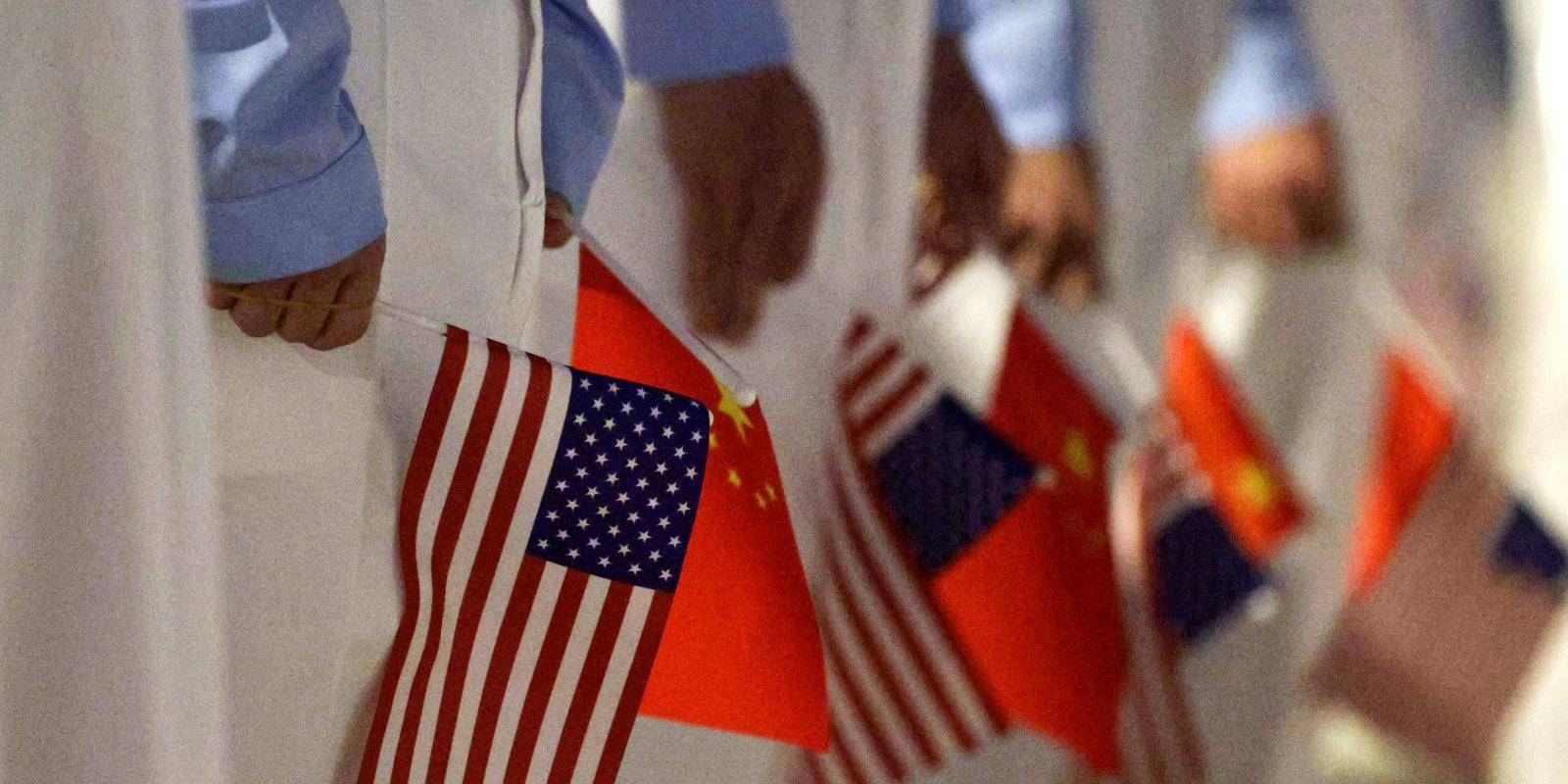
Image — Chinese youth hold American and Chinese flags as they join officials to welcome US President Donald Trump at Beijing Capital International Airport on 13 May 2026 in Beijing, China. Photo by Alex Wong/Getty Images.

Max Yoeli
Senior Research Fellow, US and North America Programme
When US President Trump and China’s President Xi meet in Beijing this week, the US list of concrete deliverables is short: keep rare earths flowing, create a board of trade mechanism for non-sensitive sectors, and secure Chinese purchase commitments. The gap between this short agenda and the long list of issues between two nations engaged in grinding, multidimensional competition reveals a shared preference for managing their rivalry rather than resolving it. But while Xi pursues this relationship management as strategy, Trump takes a more transactional and improvisational approach. With three more Trump-Xi meetings expected this year – at APEC in Shenzhen, the G20 in Miami and a Xi state visit – the question now is how each side will use this continued stalemate.
Trump brings a commercial focus to Beijing and will be accompanied by a CEO delegation, reflecting a turn away from focusing on more structural issues. Among his aims are Chinese purchases of American products like soybeans, LNG and Boeing aircraft. While such purchases, even if fulfilled, are unlikely to compensate for the damage to US businesses from the 2025 trade war, the optics are helpful for a politically vulnerable administration.
Xi also brings economic concerns – especially with further US tariffs pending – and will push on technology access. He has also signalled that Taiwan tops his agenda. China has long criticized US military support for Taiwan, which Beijing considers Chinese territory. The Trump administration approved an $11 billion arms package for Taiwan in December but has not yet followed through with delivery – even after Taiwan’s Legislative Yuan approved a special defence budget last week. On Monday, Trump indicated he would discuss the package with Xi, casting doubt on longstanding US policy regarding Taiwan.
The brief agenda spans only a fraction of the US–China relationship. On AI, officials seek to establish a communication channel rather than address underlying competition. On China’s nuclear build-up, Beijing has shown little appetite to engage. Although communication beats silence, such underwhelming efforts sidestep structural dynamics. Other issues like the South China Sea, industrial overcapacity and currency issues are marginal or absent. While the closure of the Strait of Hormuz has pushed Iran up the agenda, the focus will be on immediate resolution levers rather than underlying Chinese support for Iran, Russia and North Korea.
Washington’s narrow focus is itself revealing. It partly reflects the Trump administration’s transactional, short-term approach. More significantly, the 2025 trade war and Chinese rare earth export controls reoriented leverage and exposed vulnerabilities – even more acute given depleted US munitions stocks amid the Iran war.
Going into the summit, both leaders face domestic constraints. Trump is navigating affordability politics, inflation, an unpopular war and setbacks to his trade agenda, with his approval rating at second-term lows. Agricultural communities, core to his support, have lost export markets and face rising fertilizer prices. For Trump, the pressure is on ahead of November’s midterm elections when his Republican party must defend Congressional majorities. He is also on the clock to resolve the Iran war.
Xi, meanwhile, faces debt, deflation, demographic headwinds and softening global demand. China’s latest economic growth target is its lowest since 1991, even as pre-war stockpiles and diversified imports help buffer Iran shocks. But Beijing operates on a longer timeline; Xi answers to party elites and the focus is on stability.
An asymmetric stalemate
The US and China have taken very different approaches to managing their economic rivalry. As the two leaders seek continuing stability to buy time, how they use it is telling.
China has spent the past decade – especially since Trump’s first term – building its economic statecraft architecture, including export controls, the unreliable entity list, the Anti-Foreign Sanctions Law, and rare earth export licensing. China’s October 2025 rare earth export controls showed a willingness to use its dominance over rare earth supply chains as leverage. Although these measures were largely suspended by the so-called ‘Busan truce’, earlier April 2025 controls on permanent magnets and heavy rare earths remain in place. Beijing’s recent order directing companies not to comply with US sanctions against five refineries, accused of importing Iranian oil, also points to China’s growing assertiveness. Related workTrump’s treatment of US allies has weakened his negotiating position with Xi
Cohesive strategy and patient investment have strengthened China’s hand in other critical domains too. China installed more solar capacity in 2024 than the rest of the world combined and dominates battery and EV supply chains. It is also accelerating frontier technology progress and increasingly pushing towards indigenization – even after Washington opened a door by giving the green light for Nvidia H200 chip sales.
But there are gaps, notably advanced lithography, the machinery required to produce cutting-edge semiconductors. And China’s foundations are not unshakeable: fixed-asset investment struggled in 2025, the property sector continues to drag, and industrial policy draws mounting external backlash.
The US picture is more mixed. Trump administration policy is an uneven companion to private sector innovation – and often a hindrance. In areas with bipartisan support, consistent policy and strategic coherence can deliver progress. Continued export control coordination with the Netherlands and Japan on lithography is one example; efforts to develop alternatives to China’s critical minerals dominance are another, though they will take years to fully realize.
In other areas, progress is hampered by policy improvisation: the back-and-forth on tariffs, curtailed deployment of renewables, damaged research and state capacity, narrowing talent pathways, and a pattern of White House policy reversals. The US economy has nonetheless proven resilient, drawing on deep inherited advantages, such as AI infrastructure investment, energy abundance, deep capital markets, and innovation ecosystems. But tailwinds alone are insufficient. Without more coherent policy, including an industrial policy doctrine, gaps will emerge and grow.
Evaluating summit outcomes
For trade partners looking ahead, little will change. Hedging and trade diversification remain prudent policy. More broadly, evaluating the summit’s outcomes demands looking past immediate headlines and statements to the data and execution that follow. What commitments are made on the economic side – and whether they are fulfilled – are particularly important and will set the stage for future meetings.
Topics
Regions
Departments
Subscribe to our weekly newsletter
Our flagship email provides a round-up of content, plus the latest on events and how to connect with the institute.Enter emailSubscribe
content
While the expectation is for no drastic changes, three unlikely scenarios are worth considering. The first is dramatic change in the Middle East, whether a ceasefire, Hormuz reopening or resumed bombing. The second is a bilateral blowup, although an impulsive response by the Trump administration that strains the Busan truce would face domestic backlash. Third is a small but real risk that Trump offers an unexpected accommodation – including on Taiwan language or technology controls – in exchange for economic and commercial benefits.
A summit where pomp and ceremony meets policy continuation is more likely and will allow for a collective exhale. Stability buys both nations more time. The more pointed question is what each does with it. Forget the hackneyed notion that China thinks in centuries. Against a US system that operates in news cycles and swings between elections, even modest long-term discipline is advantageous. And Beijing is using this time to build. If Washington fails to match this effort with greater policy coherence and execution it will enter the next three Trump–Xi meetings in a weaker position.


